Blackwell issued a 2nd edition of The Great Arch in 1991, six years after the original publication, for which Philip Corrigan and I wrote a postscript discussing new work on English state formation published since 1985, and responding to various reviews of the book.  Both entailed some clarification and extension of its arguments. The 2nd edition had a very small print-run and soon went out of print, so this text is little known.

The excellent cover illustration is from Lyubov Popova’s set for The Earth in Turmoil (1923).  I have posted a downloadable scan of the postscript here for anyone interested.

GA 2d ed cover


There was also a Spanish translation of the Introduction and Afterthoughts sections of The Great Arch, in Antropología del Estado: Dominación y prácticas contestatarias en América Latina, ed. María L. Lagos and Pamela Calla, Cuaderno de Futuro Nº 23, La Paz (Bolivia): Hernando Calla, 2007, pp. 39-116.  A pdf can be downloaded free here.

Benjamin Tallis and Derek Sayer

Czech PM-designate Andrej Babis (left) with Austrian People’s Party leader Sebastian Kurz. Wikimedia commons. 


The Iron Curtain may have been drawn back in 1989-1991, but you wouldn’t know it to read much of the commentary on the Czech parliamentary elections – and much recent commentary on ‘Eastern Europe’ more generally.

Much attention has been lavished on comparing Czech politician Andrej Babiš to Viktor Orban, Jaroslaw Kaczynski, Donald Trump and, more plausibly, to Silvio Berlusconi, but this has obscured deeper problems in western analyses of the region. Many of the sins laid at the door of central and eastern Europeans are no less prevalent in western countries, but this is too often lost amidst enduring Cold War stereotypes.

In a recent Op-Ed typical of this trend, Jochen Bittner charged that across the Visegrad Group (Poland, Hungary, the Czech Republic, and Slovakia), “leading politicians agitate against the European Union, portraying it as an imposing, undemocratic force.”

This is true. But populist politicians across western Europe portray the EU in exactly the same way. Marine Le Pen in France and Geert Wilders in the Netherlands both promised their electorate referendums on EU membership in hopes of emulating Brexit, whose champion was the anti-establishment politician and Donald Trump ally Nigel Farage …


Read full article in Open Democracy.


Brexit is a portmanteau
word borrowed without asking
from the Greek for clusterfuck
like the Elgin Marbles

Brexit is my half-cut father
propping up the public bar
nothing against our colored cousins
so long as they stay where they are

Brexit is not hearing foreign languages on the High Street
Brexit is not hearing foreign languages on the bus
Brexit is not hearing foreign languages

again for ever and ever amen

Brexit is Morrissey
kissing Nigel Farage’s magnificent ass
Brexit is Johnny Rotten remembering he is
white working class

Brexit is the future fucked over
by a red white and blue

but mostly white

dream of the past

Keep Calm and
Carry On Up The Khyber
Pass


This is an Op-Ed piece I wrote for CEE New Perspectives, the companion blog of the academic journal New Perspectives which is published by the Institute of International Relations (IIR) in Prague.  I reproduce it here with permission.

http://ceenewperspectives.iir.cz/2016/01/08/prejudice-hysteria-and-a-failure-of-political-leadership-of-refugees-and-november-17-in-prague/

The Saskatchewan Star-Phoenix reports that the University of Saskatchewan has hastily reversed parts of its decision to fire Director of the School of Public Health Dr Robert Buckingham for publicly criticizing the administration and given him his tenure (though not his Deanship) back.  This is welcome news.

Serious questions remain.

University of Saskatchewan president Irene Busch-Vishniac has issued a statement complaining that the U of S received “inaccurate and undeserved” criticism from across Canada after Buckingham’s firing.

“The debate that is raging,” she says, “confuses Dr. Buckingham’s former role as executive director of the School of Public Health with the academic freedom associated with of a tenured faculty member. In his role as an administrator at a level that removes him from the faculty association, Dr. Buckingham is not only permitted but encouraged to have opinions that might disagree with those developed by top administrators.  However, once a decision is made at the institutional level, all senior leaders must publicly conform to that decision or resign their leadership role.”

No, Dr Busch-Vishniac, it was you and your cronies who “confused” Professor Buckingham’s roles by depriving him of tenure as a punishment for stepping out of line as an administrator.  And the whole world knows it.  Thanks to social media.

Perhaps you and others in universities tempted to use disciplinary procedures to close down free and open debate over issues of public concern might think twice next time.


Update, May 15.  The whistleblowing document “Silence of the Deans” that got Dr Buckingham fired can be found here.  Fuller background, including CAUT reaction, can be found here.

This is a deplorable, almost unbelievable instance of hubris on the part of university management that deserves worldwide publicity and worldwide condemnation. I am reblogging here an article by colleagues at the University of Alberta, where I am a Professor Emeritus.  I am also concerned as a Fellow of the Royal Society of Canada, whose duty as the country’s national academy is to do the utmost to protect academic freedom–including the freedom of deans, heads of department, and others occupying administrative positions to speak their minds on matters of legitimate public concern even when (and perhaps especially when) doing so may bring them into conflict with their own university management.  Academic leadership requires academic integrity and the exercise of judgment, not blind obedience to authority on the model of Leninist party discipline.  What is of concern here is not simply Professor Buckingham’s firing, but the attempted “gag” orders on deans discussing the university’s plans with colleagues, students or the public–that is to say, the main “stakeholders” involved–that he courageously defied.  I would urge other FRSCs to condemn the University of Saskatchewan’s action in the strongest possible terms.  Unfortunately I do not believe such administrative high-handedness or threats to academic freedom are confined to Canada or the University of Saskatchewan. Please publicize as widely as possible.

Arts Squared's avatarArts Squared

When I first saw the letter below circulating on Twitter as of mid-day, seemingly issued on the letterhead of the office of the Provost and VP Academic at the University of Saskatchewan and signed by the current occupant of those positions, Brett Fairbairn, I paused for a moment to question whether it was real. Could any Provost or VP Academic in Canada truly believe that s/he can charge a colleague with “egregious conduct and insubordination” for his or her expression of concern about decisions being taken by administrators at his or her institution, and issue the kind of summary judgment to which this letter speaks?

USask Provost Letter to Dr. Buckingham 14May14The presumption of this letter and the decision taken by the University of Saskatchewan’s Provost and VP Academic is that members of the administration of a public university in Canada are not members of a collegium responsible to the public, but rather members of a secretive corporate elite that is free to require…

View original post 435 more words

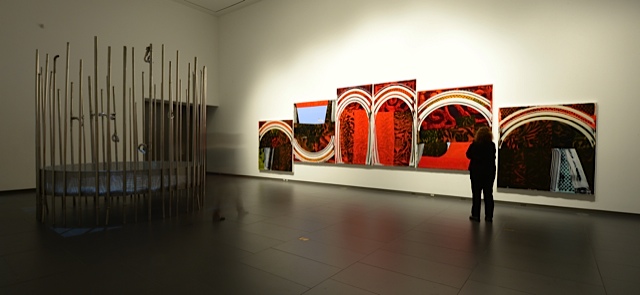
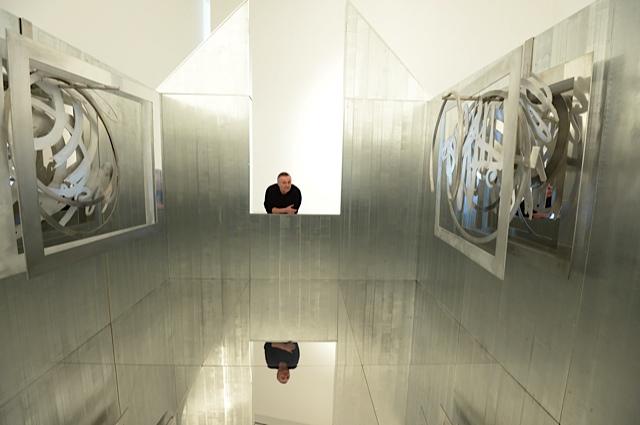
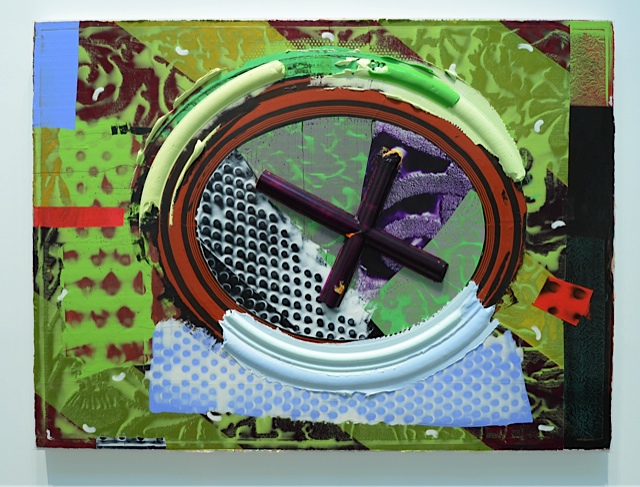
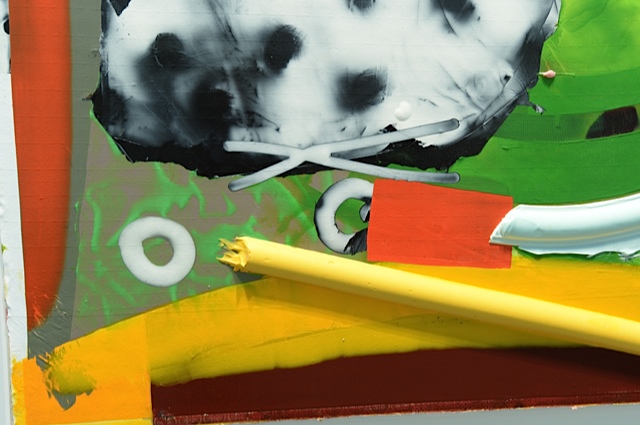
I have known Clay Ellis for years.  Clay and his wife Michelle are what I miss most about living in Alberta.  Their hospitality, their generosity, their grace.  His work, somewhere in a zone of his own between painting, sculpture, and video, abstract and concrete, conceptual and figurative art, conjures up a sense of time and a spirit of place like little else I know.  We have had many drunken conversations about Picasso, country music and the meaning of it all over the years, and I look forward to many more.  He is one of Canada’s greatest living artists.  These are some shots from his most recent exhibition at the stunning new Art Gallery of Grande Prairie.  

The text is from the gallery website.  The photographs were taken by Rob Ganzeveld.

DSC_0107

Clay Ellis: Weaners, Culls and Divvies

January 17, 2014 – April 6, 2014

Art Gallery of Grande Prairie (Alberta, Canada)

DSC_0174

Born and raised on a ranch in Southern Alberta, Clay Ellis explores his connection with the landscape, referring to images, the temperament and gestures of his past.

“I think that the focus behind this exhibition is equal parts of reflecting on the experiences of growing up on the ranch, considering the reality of no longer being a part of it, and pondering what the land means to the individuals that currently live on the property.”

DSC_0117

The transformation of the ranch itself, from homestead to ranching company, marked by the restructuring of out-buildings, the parceling of land, and the move towards automation, has happened in only a few generations.

For most operations, it is no longer necessary or practical to house a workforce, a shift that replaced hired hands and displaced extraneous family members. Usable tack turned to relic, and family members became guests to a property that had once been their home.

DSC_0054

It is from the perspective of guest that Ellis makes his observations. While the works are informed by the changing perspectives of land use and ranching practices from one generation to the next, it has been his yearly visits over a 45 year period that have allowed him to see changes to the landscape that may escape those embedded in the rigors of the day to day.

Ellis neither condones nor prescribes ideology but rather suggests that to assess change we must first see it.

DSC_0069

DSC_0171DSC_0128DSC_0166

DSC_0072

“Art has much more important things to do than change the world”–Clay Ellis, in one of those aforementioned conversations.

Though some UK universities are playing by the rules in preparing their submissions for REF 2014 and treating their academic staff with respect and decency, Lancaster seems not to be alone in employing procedures to select staff for its REF submission that satisfy neither HEFCE’s own Guidelines for the REF nor the established norms of academic peer review.

This morning I received an email from Warwick University UCU, informing me of a recent survey of Warwick staff who were being excluded from the REF, and requesting that I publicize their document on my blog.  I am happy to do so.


Warwick survey shows REF rules being bypassed and selection guidelines ignored

Much good research excluded; Interdisciplinary research sidelined; Academics left in limbo

Warwick UCU has conducted a survey of all its members to ask if they had received a letter from the Deputy Vice-Chancellor informing them that they were to be excluded from the REF. Forty-four members replied, the largest response we have received to any of our surveys. (We also received responses from some members who had recently been moved to teaching-only contracts who are no longer eligible.)

We wanted to know the grounds on which they were excluded, the process by which the decision had been made and what the implications would be for them and for research within the university going forward. Above all we wanted to see if the guidelines and principles of the national Research Excellence Framework and Warwick’s own Code of Practice are in fact being upheld.

Main findings in brief:

• The majority of respondents are excluded on ‘quality’ grounds, meaning they have enough submissible research but the university judged it to be below some threshold (e.g. for some individuals/departments an ‘average’ of 3*, and for others 3.5*)

• Selection criteria are not transparent, are applied inconsistently and with little regard to inclusivity – in contravention of the stated REF principles.

• A small number of members have been granted a right of appeal on substantive, academic grounds (despite the university having said that it would only hear appeals within the context of Equality Legislation) and been reinstated.

• Research is often excluded on the subjective judgement of heads of department without having been independently appraised by experts external to the university, and in some cases, externals were asked to ‘confirm’ HoDs’ assessments, not to read and assess the work independently.

• Some research is excluded purely on ‘strategic grounds’.

• Interdisciplinary research is being excluded without proper appraisal: it seems to be routinely described as ‘below the standard required in terms of quality’.

• Some academics complain that the university would rather exclude them than ask for their research outputs to be cross-referred to a different REF panel.

• Many members are unclear as to the consequences of exclusion for their careers. They are unsure if they are in good standing or not.

THE FULL WARWICK UCU DOCUMENT CAN BE FOUND HERE.

I today received an email from Trevor McMillan, Pro Vice-Chancellor (Research) at Lancaster University, asking that I “address two very serious issues” connected with my previous posts about Lancaster’s selection of History staff for the 2014 REF on this blog.  The letter was not marked confidential.

Professor McMillan is concerned, first, that the identity of History’s Critical Friend “has been easily deducible from the information I have posted online.” He asks that I “modify the text online to remove this possibility and also write to Professor ________ to apologise for what has been posted.”

As Professor McMillan very well knows, the “removal of the relevant text from my blog” for which he asks will seriously weaken the presentation of the procedural issues at stake in my appeal, to the undoubted advantage of the University in what has become an increasingly public debate.

Two key arguments in my case are (1) that the professional experience that led the History Department to invite Professor ________ to become its Critical Friend did not qualify him for the role he came subsequently to occupy in Lancaster History’s REF process; specifically, (2) that Professor ________ ‘s particular field of academic expertise did not qualify him to make judgments of the “originality, rigor and significance” of many colleagues’ outputs within the Department, including my own.  Since these judgments played a key part in the University’s selection of staff for submission in the REF, Lancaster’s procedures did not meet HEFCE’s requirements.

Professor McMillan demands I now remove from my blog (1) my description of Professor ________ ‘s area of expertise together with (2) any reference to the professional experience that led us to invite him to become our Critical Friend in the first place, in the interests of maintaining his anonymity.  My case will thereby lose much of its evidential support.  I am permitted to make generic arguments, but not to publish the facts on which they rest.

This is an excellent example of how what Paolo Palladino, in his original Open Letter, referred to as the “culture of secrecy” surrounding the REF at Lancaster works to suppress free discussion and dissent.

I shall remove “the relevant text” from my blog, but only because I shall lay myself to disciplinary action for disregarding the direct instructions of a superior if I do not.  I am also happy to write to Professor ________ explaining my actions, but not to apologize for them.  To apologize would constitute an admission of a liability that I do not accept.

The second issue that concerns Professor McMillan is this:

Your implied comparison online of compliance with the REF process and attitudes to the Holocaust has caused some great distress among a number of your colleagues at Lancaster.  While we clearly support academic freedom for our staff I hope that you will see that this cannot go so far as real upset caused to colleagues and therefore this warrants the removal of the relevant text from your blog.

For those interested, the full text of the post concerned can be found here.

I did not “compare the REF to the Holocaust.”  The specific problem I raised was explaining how individuals involved in administering the REF are prepared to engage in actions that may damage the reputations and careers of colleagues, even though they know that the processes of evaluation involved are far less rigorous than those normally used in academia.  This might be seen as an instance of a more general problem of how ordinary decent folks sometimes do extraordinary and indecent things when required or empowered to do so by the bureaucratic organizations for whom they work.

I cited a number of classic studies (Weber, Foucault, Havel) in the sociological literature that variously address this problem.  I could have mentioned others: the Milgram experiments, for instance, in which randomly-selected subjects showed themselves willing to administer powerful doses of electric shock to fellow human beings when reassured by people in white coats that it was OK to do so, or Adorno and Horkheimer’s Authoritarian Personality.  Bauman’s Modernity and the Holocaust is a pivotal work in this tradition, and is seen as a seminal contribution to the field precisely because of the way it brings out the connections between the extreme evil of the Holocaust and the everyday routines and expectations of modern bureaucracies—like, in this case, universities.

Since I doubt Professor McMillan—or, possibly, some of those who claim to have been caused “great distress” by my reference to Modernity and the Holocaust—will find the time, as the REF cull at Lancaster nears its conclusion, to read one of the great classics of contemporary sociology, let me give you Wikipedia’s summary of Bauman’s argument:

Drawing upon Hannah Arendt and Theodor Adorno’s books on totalitarianism and the Enlightenment, Bauman developed the argument that the Holocaust should not simply be considered to be an event in Jewish history, nor a regression to pre-modern barbarism. Rather, he argued, the Holocaust should be seen as deeply connected to modernity and its order-making efforts.  Procedural rationality, the division of labour into smaller and smaller tasks, the taxonomic categorisation of different species, and the tendency to view rule-following as morally good all played their role in the Holocaust coming to pass.  And he argued that for this reason modern societies have not fully taken on board the lessons of the Holocaust; it is generally viewed—to use Bauman’s metaphor—like a picture hanging on a wall, offering few lessons.

I am not going to be intimidated out of applying the analysis of bureaucracy and conformity developed in the discipline in which I was trained, sociology, to my own workplace, or to the REF more generally.  I do not regard the fact that people claim to have been “upset” by my reference to Bauman as sufficient reason to remove the reference from the blog, as Professor McMillan demands.  It is a wholly unwarranted intrusion into the academic freedom to which all Lancaster University employees should be entitled.  I will therefore not remove or amend this post.

Let me finally say that several of my colleagues at Lancaster have also been caused “great distress” by their exclusion from University’s submission to the 2014 REF.  They have ample reason for feeling “real upset.”  As I put it in an earlier post on this blog,

I find it poignant that so cavalier an attitude toward evaluating the research of colleagues should be adopted in a university that requires external examiners for PhDs to be “an experienced member of another university qualified … to assess the thesis within its own field” and—unlike in North America—also requires all undergraduate work to be both second-marked internally and open to inspection by an external examiner before it can count toward a degree.   Why are those whose very livelihood depends on their research—and its reputation for quality—not given at least equivalent consideration as the students they teach?

I understand why the University might prefer discussion to focus on my alleged breaches of confidentiality and upsetting of colleagues rather than its own lamentably inadequate REF procedures.  But does Professor McMillan really want to go on record as saying that “academic freedom for our staff … cannot go so far as real upset caused to colleagues,” while at the same time maintaining that the freedom of administrators to evaluate people’s research in the way Lancaster has in History–with all its demonstrably distressing effects for individuals who are excluded from the REF as a consequence–should be above public debate or criticism?