I stumbled across this text—notes for a talk at a graduate summer school organized by Yoke-Sum Wong at Lancaster University in June 2010—while trawling through old files on my computer looking for something else. As was common during my talks at that time and since, I worked from a Powerpoint slide presentation containing images and quotations (NOT bullet points) around which I ad libbed (and broke often for discussion), working with only skeletal notes, of which these are typical. The Powerpoint has long since disappeared, leaving me with this torso. I thought it nevertheless worth reproducing, as the ghost of a provocative article that never got written. I have provided as many hyperlinks to the images that likely would have been on the slides as I can manage—I have no permissions to reproduce the images themselves—as well as restoring some of the quotes I would have used on the slides.


Slide 1   Title

This talk is not an exposition of Foucault so much as a riff on themes emerging from his History of Sexuality, Part 1, centred also around the other two texts I asked you to read: the opening section of Jean-Jacques Rousseau’s Confessions, and the first two pages of Georges Bataille’s Story of the Eye.  

The image on the slide is from Toyen (Marie Čermínová), illustration for Sade, Justine (Prague 1933, 69 Editions, limited edition “for subscribers only”).

Slide 2   Warning

This is a warning—obligatory these days in academic contexts.  The show contains images many would deem offensive or obscene. You are not obliged to stay/watch.  The wording is that which precedes showing of True Blood on UK TV.  Some might think it an advertisement: we are promised fun, fun, fun “From the outset …”  Here goes … 


PART 1 PURITY AND DANGER

Slide 3   Sally Mann Immediate Familyintro

First section of the talk is built around the controversial images in Sally Mann’s Immediate Family (1992).  I’ve called it “purity and danger” (Mary Douglas) because it highlights the uneasiness of borderlines, in this case of sexuality and innocence.  Oxymoron of the sexualized child.

Mann is one of America’s most respected and renowned contemporary photographers, but these images caused great controversy at time of publication and even more since.  Why?  She sees them as natural, normal, family photos: a mother’s view of her kids as they grow <quote on slide, note sarcasm>

Slide 4   Immediate Family, examples

(Open for discussion).  Note:  1. Nudity (photos).  2.  Signifiers of adult sexiness (pearl necklace<candy> cigarettelaced-up boots/roller skates: think Julia Roberts in Pretty Woman).  3.  Body poses (come hither/look at me).  Or is it just “dressing up”: childhood mimicry of adult behaviour?  Close to the bone …

Slide 5   “Venus after School

(Open for discussion)  Note:  1. Pose of body on couch, gaze, positioning of hand on crotch.  2.  Background figure.   3.  Title (again the titillating oxymoron).

Does this remind you of anything?

Slide 6   Manet “Olympia

Why was Olympia so inflammatory?  Because Manet took a classical nude pose (after Titian) and used a famous contemporary courtesan (i.e. a prostitute) as his model.  Note directness of her gaze.  Also the black ribbon around the neck—not functional clothing, emphasizes nudity.

Key issue here resonances between Mann’s Venus and Manet’s Olympia, transferring the attributes of the hooker onto the pre-pubescent girl, sexualizing the adolescent body by association  (Derrida: the trace.  Issue here is not representation but signification—what do the visual elements of the image conjure up, signify, connote).

Slide 7  Kate Moss “Obsession”

A notorious—but not censored or withdrawn—Calvin Klein ad featuring an 18-year-old naked Kate Moss, shot by her then boyfriend Mario Sorrenti.  Plays on same oxymoronic borderlines.  Note the androgeny of the body (breasts hidden)—she could almost be a boy—the same direct gaze.  But also, in this case, the association of word and image: (1) the product being advertised, a perfume, is called Obsession (2) it is a perfume for men.  Is the implication that this is what men clandestinely obsess about?

We can debate the morality of such ads later, but the main point I want to establish now is that sexuality is irreducibly caught up in (and arguably constituted by) the field of language, verbal and visual—the play of signification—and language, conversely, is shot through with sexuality.  Which is why it is difficult to talk, appropriately, about today’s topic.  What language do we use that is not either complicit in the phenomenon we are studying (therefore obscene + pornographic) or does violence to the subject-matter by abstracting from precisely what makes the erotic what it is?


PART 2 UPENDING THE REPRESSION HYPOTHESIS

Slide 8   Diverted traffic

Photo shot (by me) in London 2002.  That pearl necklace again. I liked the juxtaposition of the nude, the phallic traffic light, and the sign “Diverted Traffic.”  But the notion of diverted traffic is central to the classical “repression hypothesis” that Foucault is attacking.  Central to his argument is a reversal: far from society’s taboos and prohibitions repressing/diverting primeval sexual drives that are always already there, it is they that constitute and differentiate human sexualities in the first place. 

Slide 9   Dangers of Pollution

Surrealists were major critics of what they saw as the “bourgeois” organization of sexuality, drawing on Freud as potential liberating force.  Max Ernst’s 1931 article “Danger de pollution” is attacking the detailed, almost bureaucratic, moral classification of the relative sinfulness of various sexual activities, orifices, etc. in medieval Catholic texts. 

“Thanks to the prescience of the Church doctors, the female body is now divided by horribly precise borders into decent and indecent areas.  Irresistible passion may sometimes cause these borders to disappear, but they continually return with nauseating sharpness―until the glorious day when a happy massacre will rid the earth of clerical pests forever.”

A Foucauldian response would be to say that it is precisely the zoning of the body and division of sexual activities into decent and indecent that eroticizes them in the first place, creating the pleasures and gradations of perversion.

Slides 10  + 11   Hooker postcards 

Which is well exemplified by the sex trade.  Hooker postcards in London telephone boxes (but also small ads, internet sites, etc.).  <Gloss photos>: fine-grained national/racial divisions (busty black lady, new Italian goddess, Asian spanking delights, French kissing); lexicon of activities—O and A levels, water sports, bubble bath, tie n’tease, 2-way spanking; details of “toys”­—strap and slipper, uniforms, sexy lingerie; and a galaxy of masquerades­—school girl, naughty nurse, French maid.

The lexicon of perverted pleasures is as detailed as in the notorious DSM—which in many ways it parodies.  I am reminded of Foucault’s Chinese encyclopedia in The Order of Things

To repeat my earlier point about language, this cornucopia of illicit delights depends in its very constitution upon an elaborate, if not always readily intelligible, system of classification.


PART 3 THE PLEASURES OF DISCIPLINE

Slide 12   The duplicity of the subject

Title is an allusion to the doubled nature­—the duplicity—of the Foucauldian subject (subject/agent, but also subjected).  Disciplines do not only repress, they constitute agents and agency: as PhD students should know!  They have their pleasures.  Extreme, almost parodic exemplification of this thesis in the field of human sexuality is masochism.

Slide 13    Man is born free …

Celebrated example of such a masochistic sexuality is Jean-Jacques Rousseau, author of Social ContractEmile, or Education, and Discourse on the Origins of Inequality.  Rousseau is the very embodiment of the Enlightenment.  Keystones of his philosophy include (a) innate goodness of Man and (b) his infinite perfectibility through the application of Reason to social organization.  Stands at the head of progressive political philosophies, influencing Marx among others.  A key icon of modernity (opposite of Catholic doctrines of the Fall and original sin).  But he had a dark and dirty secret, which saw the light of day at the beginning of his Confessions.  He harbored a lifelong longing to be put over a woman’s knee and spanked.

Slide 14   Dominatrix

Rousseau attributed his “bizarre taste” to a spanking he received at the hands of his adoptive mother, Mlle Rambercier, at the age of eight.

“Just as Mlle Lambercier had the affections of a mother for us,” he relates, “she also had the authority of one, and sometimes carried it to the point of inflicting children’s punishments on us, when we deserved it.” 

For a rather long time she confined herself to the threat, and this threat of a punishment that was completely new to me seemed very frightening; but after its execution, I found the experience of it less terrible than the expectation had been, and what is most bizarre in this is that this punishment increased my affection even more for the one who had inflicted it on me.

“It even required all the truth of that affection,” he goes on, “to keep me from seeking the repetition of the same treatment by deserving it: for I had found in the suffering, even in the shame, an admixture of sensuality which had left me with more desire than fear to experience it a second time from the same hand.”  

Elaborate on passage: what is so erotic?  Not just the physical sensation of pain.  The admixture of suffering, shame, and sensuality.

Comment on the dominatrix image on slide.  She doesn’t have to be dressed like that to administer a spanking.  Proximity of cane and buttocks­—intimation of what the sub is about to receive, transposed onto the female body.

Slide 15   Hello Kitty

Such masochism is not an exclusively male preserve. An episode recounted in Kenneth Tynan’s diaries:

The most unexpected thing I ever heard said: after a dinner party in the mid-fifties. The host desultorily asked the guests to name the three things they loved the most in the world. The answers ranged from the predictably serious (‘Schubert’s Quartets’) to the predictably skittish (‘onyx cufflinks’) until Kitty Freud shook her dark hair and said with trembling candour:

‘Travel, good food, and being spanked on my bottom with a hairbrush.’

Could/would a man have said this—or got away with it?  The (socially-constructed) feminine is—or was in Bohemian London in the 1950s—arguably a space in which masochism can be “play” in a way in which it is not for men, because it fundamentally subverts what defines masculinity (being on top).  For good or ill …

Slide 16   Secretary

Not just the 1950s. Would the film have been such a success—or the poster be so sexy—if the roles had been reversed? 

Possibly the erotic attraction of being spanked, especially for a man, lies precisely in the reversal itself.  Is submission (to irrational desire) the ultimate transgression of an order based upon the fantasy of (male, rational) domination?


PART 4 SEX AND THE SIGNIFIER

Slide 17   Language games

I want to return, at this point, to the question of the interface between language and the body, addressed at the beginning in connection with Sally Mann.  Dramatized by Hans Bellmer in his 1930s dolls (elaborate). 

“I tried to rearrange the sexual elements of a girl’s body like a sort of plastic anagram,” Bellmer told an interviewer in 1972. “I remember describing it thus: the body is like a sentence that invites us to rearrange it, so that its real nature becomes clear through a series of anagrams.” 

Frequently banned as obscene, Bellmer’s dolls are anathema to many feminists because of how they are seen to represent the female body.  But playing on the signification of dolls is not confined to surrealist sickos …

Slide 18   Pussycat dolls

The transvestite Thai Band Venus FlyTrap (Venus again: but in this case also a carnivorous plant) play (transgressively) on the visual signifiers of feminine sexiness illustrated by the Pussycat Dolls.  But the Pussycat Dolls themselves are no less inscribed in the field of language, playing on not only the whole repertoire of dollishness (Hello Dolly, Guys and Dolls, dollybirds, etc. etc.) which Bellmer perverts but also the connotations of pussy …  Which brings me to Georges Bataille.

Slide 19   The pleasures of the text

At the beginning of Bataille’s The Story of the Eye 15-year-old Simone asks: 

“milk is for the pussy, isn’t it? Do you dare me to sit in the saucer?” Then I lay down at her feet without her stirring and for the first time, I saw her ‘pink and dark flesh,’ cooling in the white milk.”

Why is Bataille’s text sexy?  Indeed powerfully erotic?  There is nothing intrinsically sexual, after all, about a saucer of milk for the cat.

English translation works because of pun on pussy.  The French chat has same double meaning (and the chapter title is “L’oeil du chat”—which is also where the book ends/climaxes).  The French works through a different pun (“Les assiettes, c’est fait pour s’asseoir, n’est-ce pas, me dit Simone.  Paries-tu?  Je m’assois dans l’assiette”).  Roland Barthes’ analysis: the eroticism lies in the play of signifiers.  

Bellmer’s photographic illustration of this scene, I suggest, would have been less powerful, less erotic, here, because it is too literal: a crude representation rather than a playful and productive signification.

Slide 20   Exchanging glances with a cat

So I will leave you with an image which—in the context of this talk, and juxtaposed with another image from Picasso—might lead us to a different reading of Levi-Strauss’s famous closing words to Tristes Tropiques

Farewell to savages, then, farewell to journeying! And instead, during the brief intervals in which humanity can bear to interrupt its hive-like labours, let us grasp the essence of what our species has been and still is, beyond thought and beneath society: an essence that may be vouchsafed to us in a mineral more beautiful than any work of Man; in the scent, more subtly evolved than our books, that lingers in the heart of a lily; or in the wink of an eye, heavy with patience, serenity, and mutual forgiveness, that sometimes, through an involuntary understanding, one can exchange with a cat.


I am afraid I have no memory whatsoever of what image I might have chosen to end the presentation with, though Gustave Courbet’s L’Origine du monde is a distinct possibility. In which case the Picasso would likely have been his Two Figures and a Cat (1903).
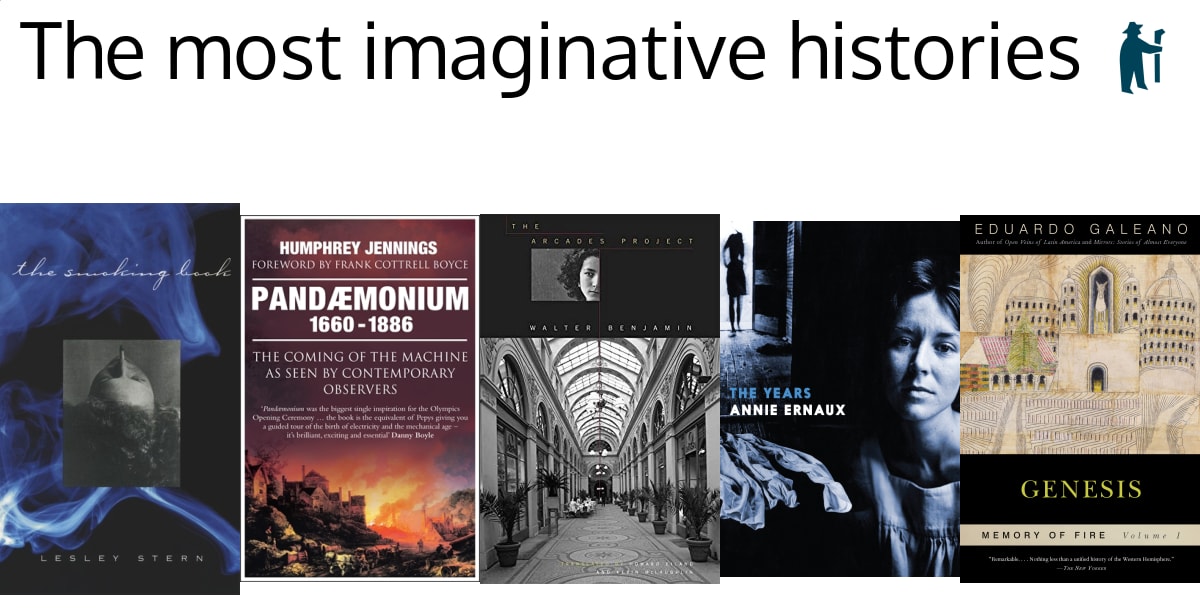

I was invited by the Shepherd website to provide a list of five favorite books in any category. I chose “imaginative histories,” a concept coined by the documentary filmmaker, founder of the pioneering social research outfit Mass–Observation, and leading member of the British surrealist group Humphrey Jennings. My five recommendations may be found here.


Adolf Hoffmeister on terrace of Les deux magots café, Paris, 1969. Photo by Václav Chochola, CC BY-SA 4.0 https://creativecommons.org/licenses/by-sa/4.0, via Wikimedia Commons

I have recently published a short essay on the eventful life of the “Czech writer, publicist, dramatist, painter, illustrator, scenographer, caricaturist, translator, diplomat, lawyer, professor, and traveler” (as he is described in the Czech Wikipedia; French Wikipedia adds “and radio commentator”) Adolf Hoffmeister (1902–1973), known to his friends as Ada.

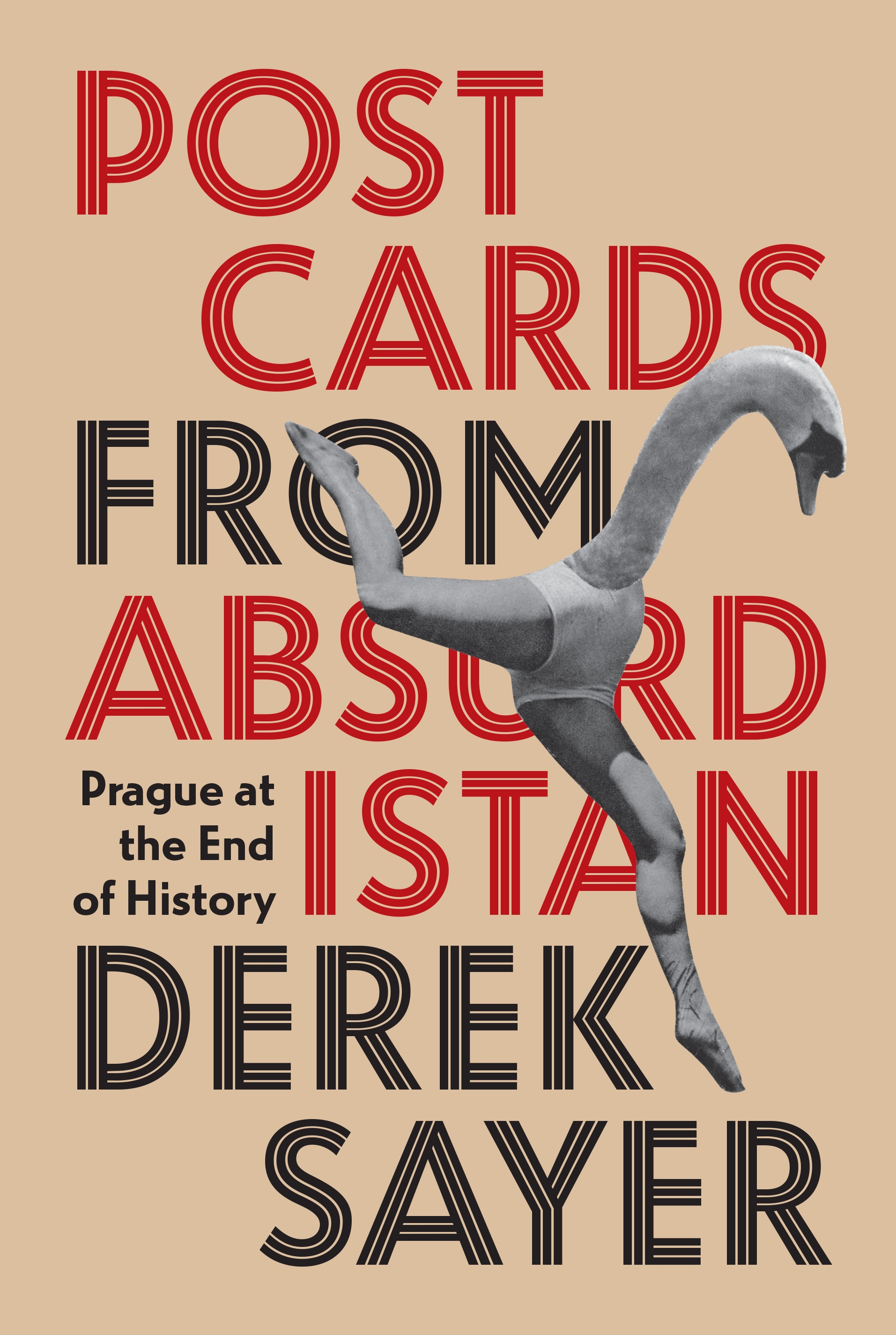
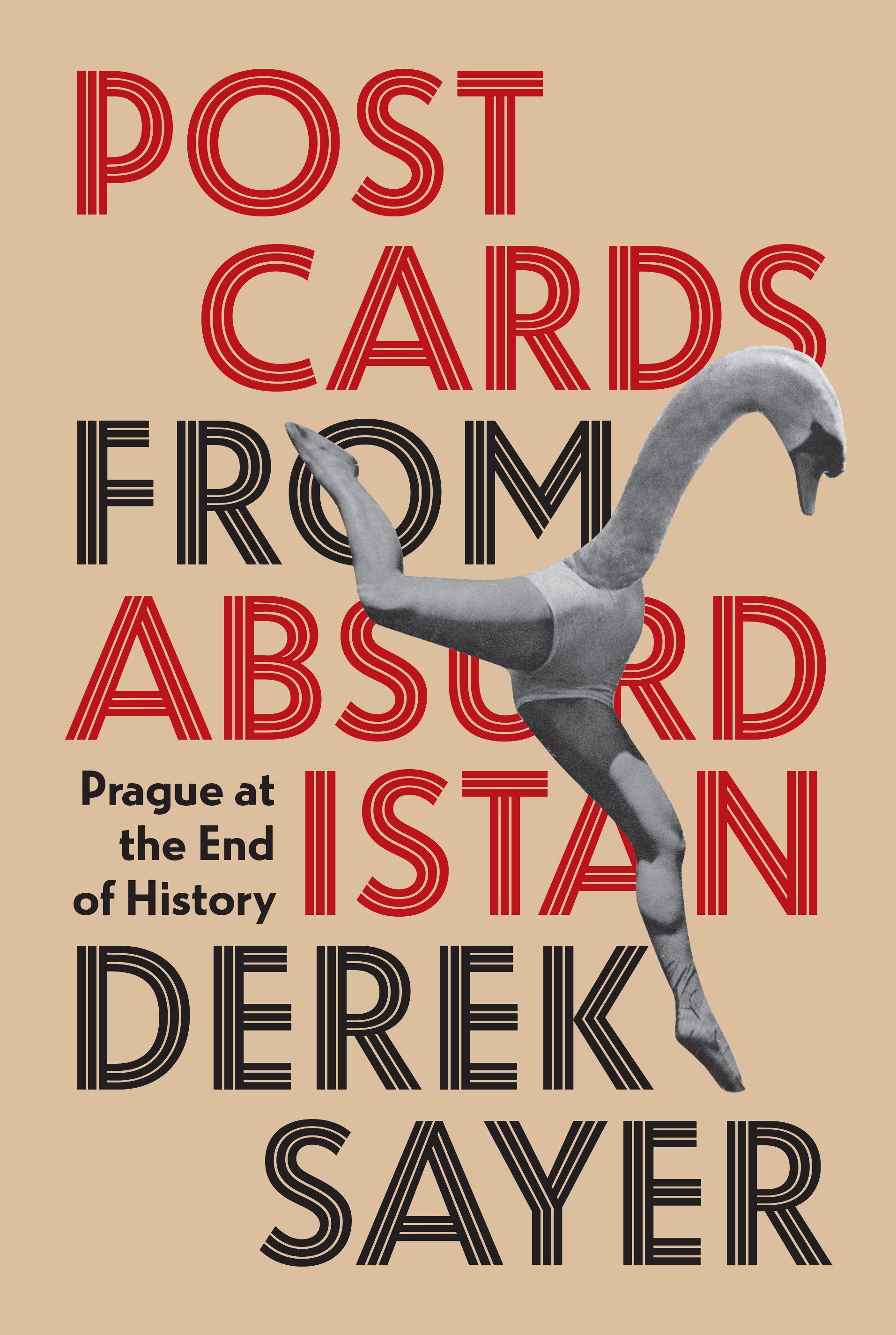
A central character in my book Postcards from Absurdistan: Prague at the End of History, Hoffmeister wrote the libretto for Hans Krása’s children’s opera Brundibár, which was staged 55 times in the notorious Terezín (Theresienstadt) ghetto during 1943-4 before the composer, the set designer František Zelenka, and most of the children in the cast were deported to Auschwitz and murdered.

I end the essay:

Hoffmeister died of a heart attack on July 24, 1973. His life was extraordinary, and yet it was thoroughly representative of Czechoslovakia’s twentieth century. Like countless other men and women—writers and politicians, architects and athletes, journalists and filmmakers, artists, musicians, and comedians—his story shows why Czech dissidents sardonically baptized their country Absurdistan. Biographies like Ada’s are why Prague provides a more revealing vantage point on the modern condition than the western capitals from which we are accustomed to look out, naively equating history with progress. Things look different when viewed from Central Europe. Prague’s modernity undermines easy distinctions between east and west, good and evil, right and wrong. Here, all choices come with costs, and the lines dividing collaboration and resistance, consent and dissent, dissolve into a blur of moral uncertainties. This is a landscape painted in infinite shades of gray. When authoritarianism is in the ascendant and democracy under global assault, we cannot afford to dismiss twentieth-century Czechoslovakia as a faraway country. Prague’s modern history should sound a warning to us all.

The third and final volume in my Prague trilogy, Postcards from Absurdistan: Prague at the End of History, is out today in North America in hardback and Kindle editions. More details here (Princeton) and here (amazon.com).

Early reviews are positive:

“Necessary. It should be in every academic library” (Library Journal, starred review)

“Derek Sayer’s Postcards from Absurdistan is an encompassing review of cultural and sociopolitical Prague from tumultuous 1938 onward, detailed with compassion for the Czech people … Fascinating and capacious, Postcards from Absurdistan surveys Prague’s anguished recent past, raising concerns for its future amid new global conflicts and challenges.” (Foreword Reviews)

“Covering literature, the graphic arts, music, philosophy, architecture, and photography, Sayer profiles a staggering cast of artists and intellectuals … The book is littered with memorable vignettes, including [Egon Erwin] Kisch learning in Mexico City that his brothers back in Prague have been killed … (Publishers Weekly)

Postcards from Absurdistan will be published in the UK and Europe on January 3, 2023.

Frontispiece. Jan Reegen, Rita, 1950, tempera, on a protectorate newspaper and a Union of Czech Youth poster, 62.5 by 43.5 cm, Galerie Ztichlá klika v Praze. From Marie Klimešová, Roky ve dnech: české umění 1945–1957, Prague, 2010.

My new book, Postcards from Absurdistan: Prague at the End of History, will be published by Princeton University Press on November 22. This is the third and final volume of my Prague Trilogy. The earlier volumes, both of which were also published by Princeton, were The Coasts of Bohemia: A Czech History (1998) and Prague, Capital of the Twentieth Century: A Surrealist History (2013).

PUP have now posted a preview of Postcards from Absurdistan on the web containing the Contents, Chapter 1, and Index.

Advance praise:

“Like Walter Benjamin’s Arcades Project on nineteenth-century Paris, Derek Sayer’s book on twentieth-century Prague brilliantly mixes an infinity of small worlds that reflect the greater world of an enigmatic and fascinating city.”—Jan Baetens, author of Rebuilding Story Worlds: “The Obscure Cities” by Schuiten and Peeters

Postcards from Absurdistan is a compelling account of the official and the everyday dramas of twentieth-century Prague. Derek Sayer evokes the farce, satire, tragedy, and absurdity of the fragments that create history, masterfully balancing reality and the myths constructed by visual artists, writers, dramatists, and composers.”—Marta Filipová, author of Modernity, History, and Politics in Czech Art

“An extraordinary entrance ticket to modern Czech culture—erudite, independent, fascinating!”—Jindřich Toman, author of Czech Cubism and the Book

“Brilliant and addictively readable, Postcards from Absurdistan is at once an intimate history of Prague and a lively retelling of the story of the twentieth century.”—Paulina Bren, author of The Greengrocer and His TV: The Culture of Communism after the 1968 Prague Spring.

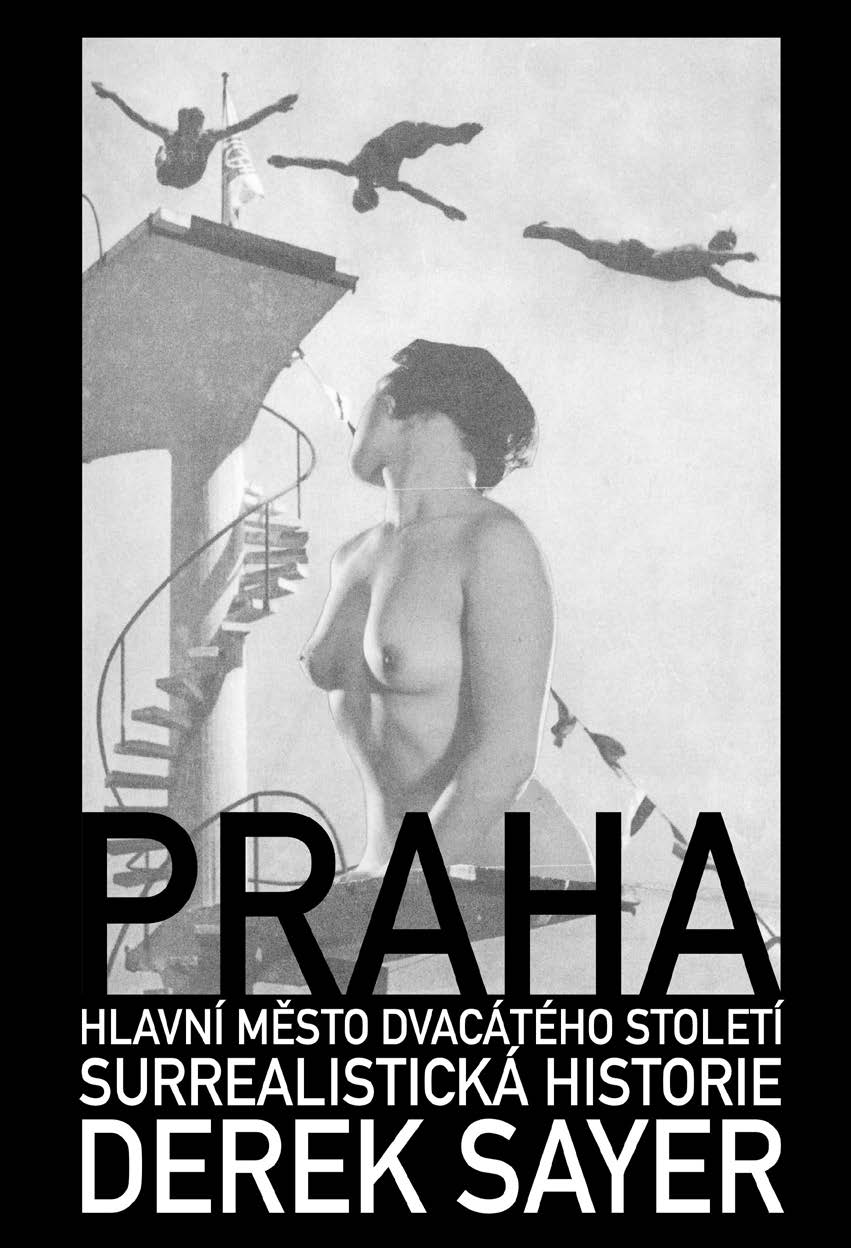
Very pleased to see that I am getting some excellent reviews in the Czech press for the Czech edition of Prague, Capital of the Twentieth Century, which was published earlier this year in Prague by Volvox Globator. Extracts below.


Czech readers are at last getting a translation of the best known book by the internationally acclaimed and award-winning Bohemist, which is an adventurous tour through twentieth-century Prague in all its surreal corners, that lurk at literally every step.

Prague – “a city located at a crossroads of imagined futures that seemed boundless and imagined pasts that eternally threatened to return.” Just because of this it became an inspirational metropolis for a movement so sensitively reactive to the social changes of its time. Now, surrealist Prague is presented in a spectacular monograph, which in more than 500 pages shows the important role of this uncanny city in its interwoven connections, without which surrealism would not have achieved its celebrated forms. And what is still more remarkable – it is not a Czech but a Canadian-British Bohemist who narrates this adventure …

In his spellbinding account of the turbulent art of Prague and the lives of its creators, Sayer does not forget the finest details … (Elizaveta Getta, “Město surrealistických snů,” iLiterature.cz, 1 August 2021)


I dare not estimate the total number of pragensia, i.e. books dedicated to Prague, that have so far been published. Two of them, however, are absolutely fundamental works and rightly recognised throughout the world. These are Magic Prague by the Italian bohemist Angelo Ripellino and Prague in Black and Gold by the now ninety-eight-year-old Prague native and Yale University professor emeritus Peter Demetz. These two admirers of Prague were joined eight years ago by a generation and a half younger Canadian-British bohemist Derek Sayer, with his extraordinary cultural-historical monograph Prague, Capital of the Twentieth Century, subtitled A Surrealist History

I consider Derek Sayer’s book Prague, Capital of the Twentieth Century, with the significant subtitle A Surrealist History, to be an excellent guide to the history that we assume we know. This Canadian has managed to make it special precisely by looking from elsewhere and putting into context what, seen from up close, appears like some impressionist paintings—illegible spots of colour. (Zdenko Pavelka, Meziřádky Zdenko Pavelky, Magazín OKO, 25 May 2021.)


According to the author, the modern history of Prague is “an illustrative lesson in black humor.” Where else can one get a better sense of irony and absurdity, a lasting mistrust of the sense of grand theories and of totalitarian ideologies, and a Rabelaisian delight in how all social and intellectual claims to rationality are indiscriminately subverted by the erotic? But above all, Sayer repeatedly emphasizes that we should understand “modernism” as Vítězslav Nezval prefigured it in his collection Woman in the Plural, namely as something diverse and plural. According to Sayer, it is time to acknowledge that abstract art and the gas chamber are equally authentic expressions of the modern spirit …

The author’s picture of Prague and those times … is dominated by left avantgarde artists … about whose occasional inclination toward the Stalinist Soviet Union the author writes overly generously … Despite this slight bias and minor errors, we can agree with Lenka Bydžovská, who wrote enthusiastically about the original book that Sayer amazes the reader with his “encyclopedic knowledge, his reliable orientation in specialist literature, memoirs and correspondence, in literature and art, but above all with his inventiveness, his ability to illuminate seemingly familiar events, stories and works from a different angle.” (Jan Lukavec, “Surrealistická setkávání v modernistické metropoli” [Surrealist encounters in a modernist metropolis], Deník N, 3 June 2021.)  


A substantial book on art has been published—and yet it doesn’t weigh 5 kg! It is, however, weighty in its genuine passion, content and reach. The main theme is the interwar cultural scene in Prague, with an emphasis on the local surrealist circle, which has gained an international reputation. The book is about this phenomenon, but it is is also full of enjambments, digressions and wider contexts. It is a great read—and yet it is based on a truthful, factual and clearly accurate text. Here we have writing that is extremely learned, informed as well as naturally flowing. It is strange that no one has written a book like this before. Only now has a foreigner taken it up. And that is very good …

Sayer’s book is a great achievement. It is a source of information, education and entertainment. A volume that brings Czech history to life, a text that penetrates its numerous hidden corners, a collection of (un)known stories of which we can generally be proud, for they prove the valuable place of our cultural activities and art in the first half of the 20th century. We belonged to the avant-garde, and Derek Sayer knows how to write about it. (Radan Wagner, “Vynikající kniha nejen o Praze a českém surrealismu” [An exceptional book not only on Prague and Czech Surrealism], ArtReview, 12 June 2001.)


A slightly incorrect and provocative guide to the cultural history of Prague, not only of the last century. It reminds Western readers how significant a role Prague played in the world’s modern culture. For those here, it can help them to perceive in a new, unhackneyed and lively way many of Prague’s realities that we too often take to be self-evident. For Prague flaneurs. (PLAV, iLiteratura.cz, 19 June 2021, where it is among six non-fiction books listed in the site’s traditional annual recommendations for summer reading.)


Eight years after the original, a Czech translation of a monumental guide to Czech modern culture has come out, whose author is Derek Sayer … The author’s aim is not only to rehabilitate Czech surrealism before the global public, but to present Prague as the city of “another” modernity: “This is not ‘modern society’ as generations of western social theorists have habituated us to think of it, but a Kafkan world in which the exhibition may turn into a show trial, the interior mutate into a prison cell, the arcade become a shooting gallery, and the idling flaneur reveal himself to be a secret policeman …”

For him Prague is also the capital city of the twentieth century because “this is a place in which modernist dreams have again and again unraveled; a location in which the masks have sooner or later always come off to reveal the grand narratives of progress for the childish fairy tales they are.” And also a place where “the past is not easy to escape … even when, and perhaps especially when, you are making new worlds.” (Petr Zídek,”Kniha o českém surrealismu aneb monografie světové Prahy” [A book on Czech surrealism or a monograph of global Prague], Právo, 1 July 2021.)


It is beyond debate that Sayer’s work is a monumental achievement in terms of the scope and variety of facts and events covered, and one cannot but bow before it (Veronika Košnarová, “‘Hadrář’ Prahy dvacátého století? Kulturní dějiny jako postmoderní freska” [A “ragpicker” of 20th-century Prague: Cultural History as a Postmodern Fresco],” Soudobé dějiny / CJCH 2023 / 1, pp. 223-33.  Review essay.


None of these reviewers are without their criticisms, and I am grateful where they have pointed out occasional factual mistakes in the text. There are of course errors, mostly minor, in the book (and as Petr Zídek and Veronika Košnarová noted in their reviews, some more were added in the Czech edition that were not picked up by the Volvox Globator editors). Zdenko Pavelka also (justly) alerts readers that:

“Sayer’s knowledge of realities and his ability to connect them in time and space are exceptional. I have to warn, however, that sometimes maybe also with a certain exaggeration or, let us say, poetic license. Perhaps you know that the Kinský Palace on the Old Town Square was the seat of the State German Gymnasium at the end of the 19th century, which Franz Kafka attended as a student. Sayer mentions that just outside the windows of his classroom is the balcony from which Gottwald spoke on 21 February 1948. I’m not sure whether in this case Sayer is not slightly embellishing reality in the Hrabalian manner, because the rooms at the disposal of the gymnasium were supposed to be in the rear of the palace. But even if Kafka did not sit in that balcony room, the well-known story of how in a later retouched photograph of the balcony scene, only the cap of Gottwald’s faithful comrade Vladimir Clementis remains, of course on Gottwald’s head, is certainly close to Kafka, but also to the surrealists.”

Precisely. In this case the error was inadvertent, but call it hasard objectif. The Kinský Palace remains an excellent example of Prague’s surrealities. As to the comparison with Bohumil Hrabal, I take it as a compliment.

This set of texts and images was part of an exhibition titled EX SITU: (Un)making Space out of Place that led to a photobook of the same title.  The exhibition was convened and the photobook edited by Craig Campbell and Yoke-Sum Wong.  

EX SITU was part of a series of international workshops/events held over the last five years in the US, UK, Germany, and Greece involving art and media practitioners, academics, and research students from different disciplinary backgrounds. These meetings have led to an anthology of essays, Feelings of Structure: Explorations in Affect (McGill-Queens University Press) co-edited by Karen Engle and Yoke-Sum Wong.

All participants in the EX SITU exhibition/photobook were asked to couple up to six images with the same number of texts, each of no more than 100 words, on any topic of their choice.  I shot the photographs in Athens, Greece in 2016.  The original photobook layout with text and image side by side can be downloaded here.

I found the form an interesting one to work with.  My intention was to set up layers of open-ended resonance and signification within a limited group of texts and images, rather than have the images simply illustrate the texts or the texts caption the images.  I wanted to convey something of what Milan Kundera calls “the density of unexpected encounters.”

I am posting this work now in eager anticipation of the latest in this series of events, the  STRUCTURES OF ANTICIPATION research creation symposium at the University of Windsor, Ontario.


1  athens_bank

athens1 bank

Greece’s government has said the country is “turning a page” after Eurozone member states reached an agreement on the final elements of a plan to make its massive debt pile more manageable.

The government spokesman, Dimitris Tzanakopoulos, hailed “a historic decision” that meant “the Greek people can smile again.”

The government in Athens will have to stick to austerity measures and reforms, including high budget surpluses, for more than 40 years. Adherence will be monitored quarterly.

Guardian, June 22, 2018


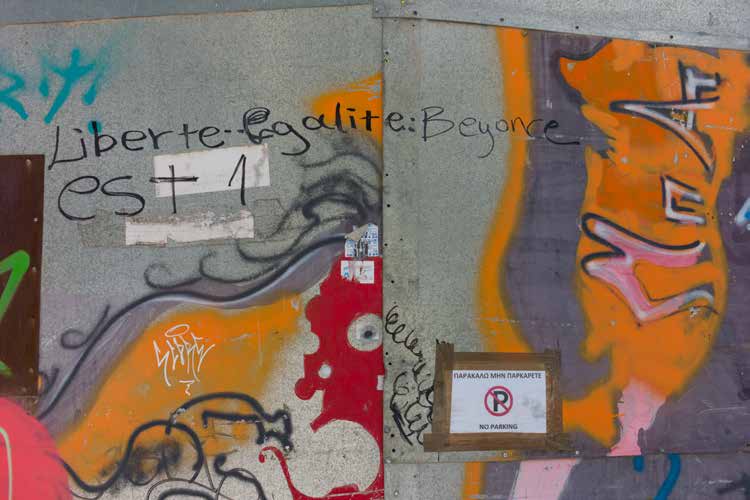
2  athens_bey

athens2 beyonce

The latest video by the Carters, a.k.a. Beyoncé and Jay-Z, is a treat. Filmed in the Louvre, “Apesh-t” begins with close-ups of various old master paintings. A bell tolls atmospherically.

And then, out of nowhere, comes a moment of pure swagger.

Beyoncé and Jay-Z, sumptuously dressed, stare out diffidently, like a royal couple posing for a baroque marriage portrait. Behind them, out of focus, is the Mona Lisa. The gallery (which was once, of course, a royal palace) is otherwise empty.

Washington Post, June 19, 2018


3  athens_aesthetics

athens3 aesthetics

Note: the word in Greek letters in the top left of the photo reads: “AESTHETICS.”

Origin Late 18th century (in the sense ‘relating to perception by the senses’): from Greek aisthētikos, from aisthēta ‘perceptible things’, from aisthesthai ‘perceive.’ The sense ‘concerned with beauty’ was coined in German in the mid-18th century and adopted into English in the early 19th century, but its use was controversial until much later in the century.

Oxford Dictionaries


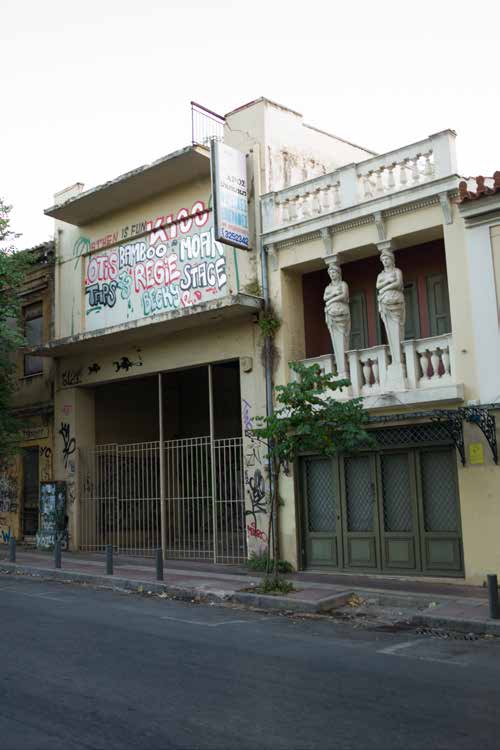
4  athens_caryatids

athens4 caryatids

45, Asomaton Str.

The residence with the caryatids in Kerameikos has been cherished like no other not only by the Athenians, but also by the city’s visitors … When the French photojournalist Henri Cartier-Bresson visited Athens in the 50s, he “captured” two spry old ladies dressed in black, walking under the shadow of the lissome and proud silhouettes of the caryatids. The contrast of the black and white figures, of motion and stillness, of decay and eternal beauty, created a powerful picture, one of Bresson’s most representative.

Tina Kontogiannopoulo, Streets of Athens blog


5  athens_magritte

athens5 magritte

The first version, that of 1926 I believe: a carefully drawn pipe, and underneath it (handwritten in a steady, painstaking, artificial script, a script from the convent, like that found heading the notebooks of schoolboys, or on a blackboard after an object lesson!), this note: “This is not a pipe.”

The other version—the last, I assume—can be found in Aube à l’Antipodes. The same pipe, same statement, same handwriting. But instead of being juxtaposed in a neutral, limitless, unspecified space, the text and the figure are set within a frame.

Michel Foucault, This Is Not a Pipe


6  athens_museum

athens6 museum

The definition of a museum has evolved, in line with developments in society. Since its creation in 1946, ICOM updates this definition in accordance with the realities of the global museum community.

According to the ICOM Statutes, adopted by the 22nd General Assembly in Vienna, Austria on August 24th, 2007:

“A museum is a non-profit, permanent institution in the service of society and its development, open to the public, which acquires, conserves, researches, communicates and exhibits the tangible and intangible heritage of humanity and its environment for the purposes of education, study and enjoyment.”

ICOM website


yomiuri shimbun

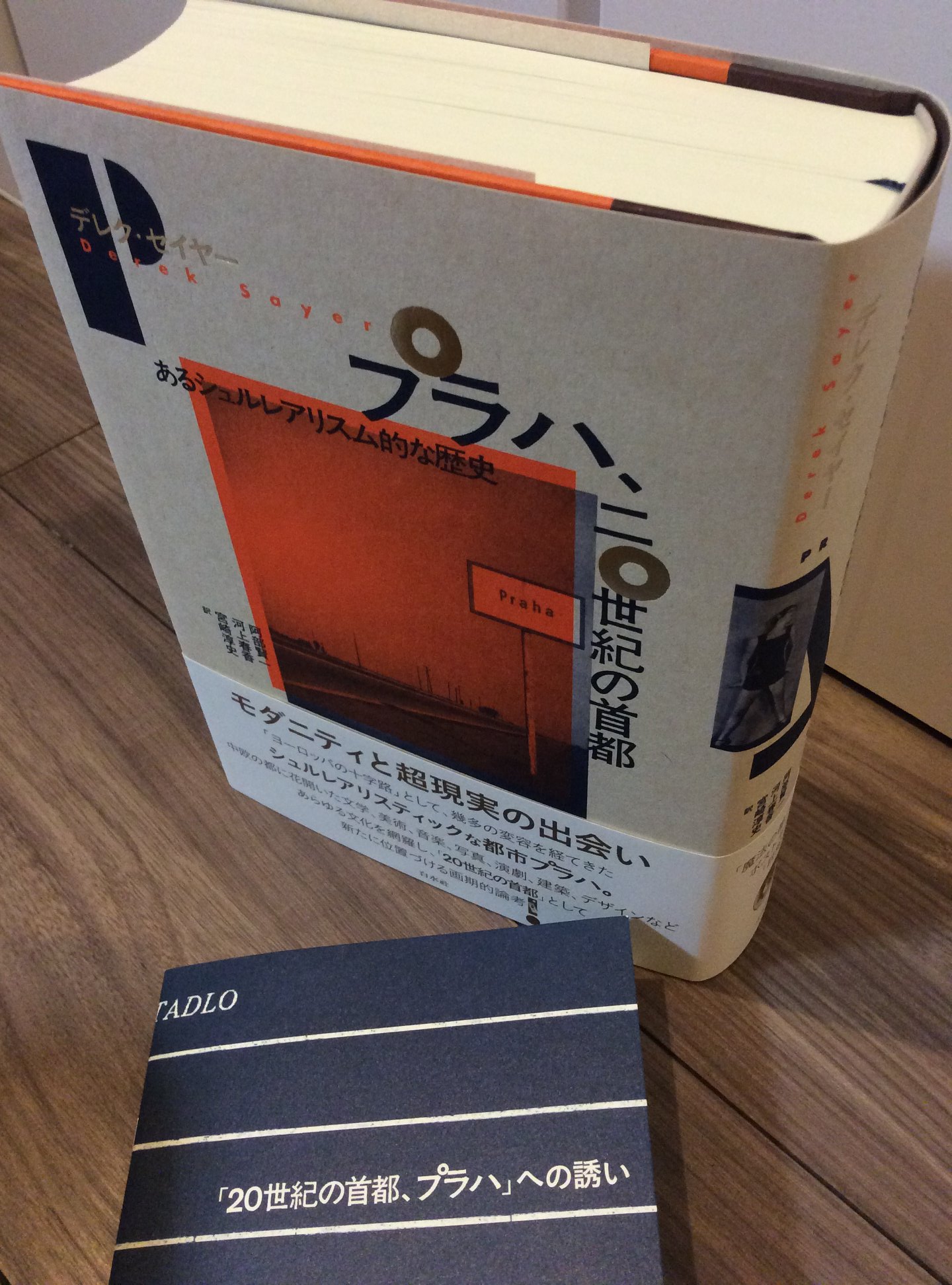
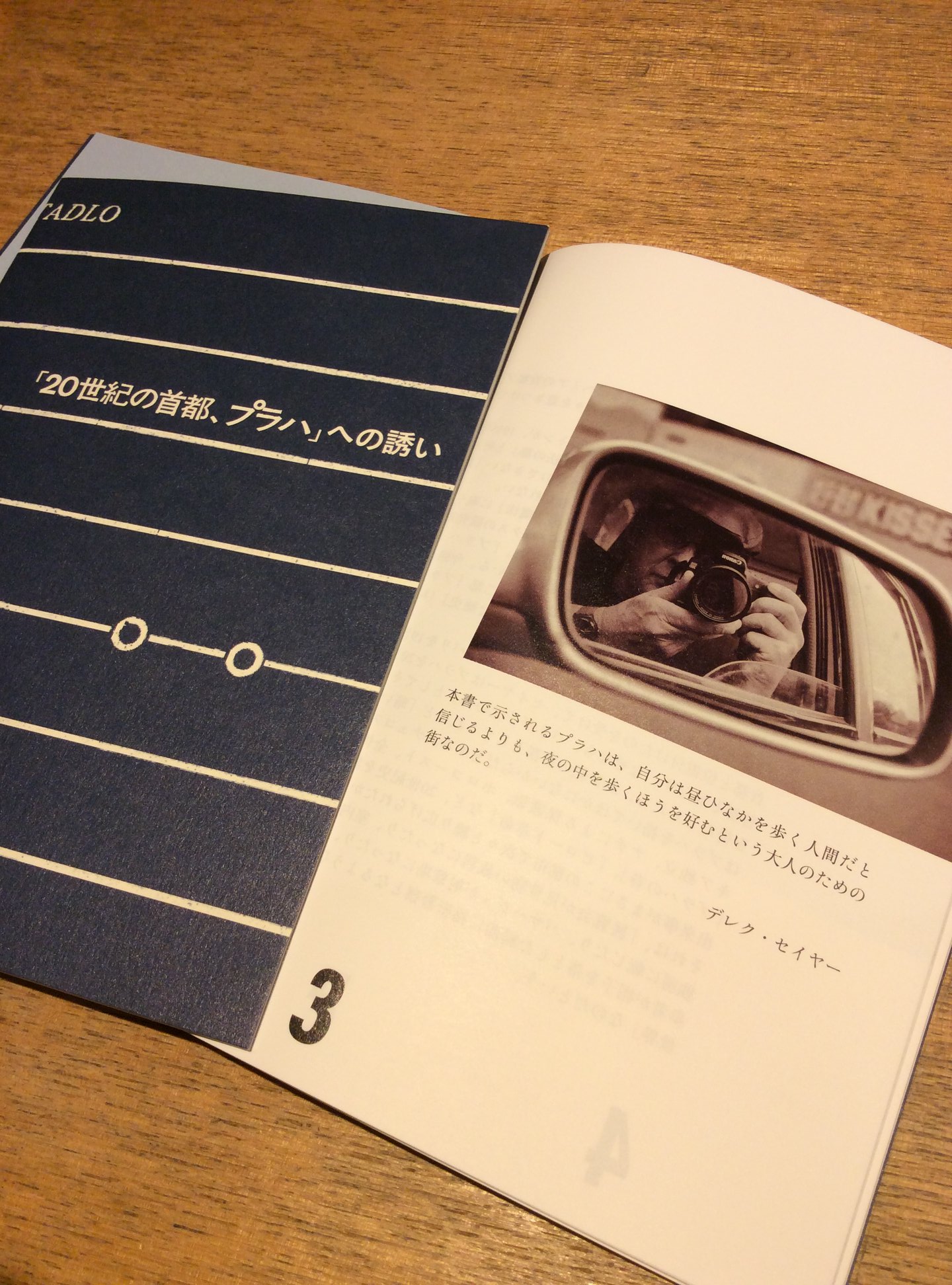
I am really pleased that my book Prague, Capital of the Twentieth Century: A Surrealist History was published in Japanese translation in September 2018 by the Tokyo publisher Hakusuisha.

The book has received what I am told are excellent reviews in several leading Japanese newspapers and magazines, including Yomiuri Shimbun (28 December 2018), Asahi-Shimbun  (“The City of Kafka and Čapek,” 6 November 2018 book page: “a great book”), Mainichi Shimbun (by Shigeru Kashima, 27 January 2019, reproduced in All-Reviews, 6 March 2019: “It is a must-read document for understanding the Czech avant-garde”), and Repre (no. 35, 2019, by Haraka Hawakame: “With a focus on Prague, the Czech capital, this book crosses literature, art, music, cinema, theatre, architecture and all cultural areas starting from the surrealism movement and draws nearly 600 pages of European cultural history in the first half of the 20th century.  It is a great book”).

I have also been told that Tosho Shimbun (the reviewer’s weekly) “recommended the book as one of the most impressive books for 2018.”

I am extremely fortunate, not to say honored, to have a leading Japanese expert on the Czech avant-garde, Kenichi Abe, as my translator, assisted by Kawakami Haruka and Atsushi Miyazaki.  An Associate Professor at the Graduate School of Humanities and Sociology at the University of Tokyo, Dr Abe has translated (among many other Czech works) Bohumil Hrabal’s I Served the King of England into Japanese. Translating Hrabal must be the pinnacle of the translator’s art!  Kenichi Abe’s most recent translation, appearing this month, is of Bianca Bellová’s Jezero (The Lake). His own book Karel Teige: Poezii no tankyusha (Karel Teige: the surrealist who pursued the poiesis, 2018) is a first attempt to map the Prague interwar avant-garde in Japanese.

The publishers have done a superb job of producing this Japanese edition, with outstanding book design, many illustrations (some not in the original English edition) and a stunning cover by Junpei Niki that montages some of the book’s key motifs.

Many thanks to all!


japanese ed cover

japanese brochureabe teige.jpg