“STOP immigrants and Drahoš. This land is ours! Vote Zeman.” Election posters all over the Czech Republic, January 2018.

“This is the order of the moment for every one of us, it is the historical task of our generation … Our new republic cannot be built as anything other than a purely national state, a state of only Czechs and Slovaks and of nobody other than Czechs and Slovaks! Although our land is beautiful, fertile, rich, it is small and there is no room in it for anybody other than us … Every one of us must help in the cleansing of the homeland.” Prokop Drtina, Minister of Justice in postwar Czechoslovak National Front Government, 17 May 1945.

The Bohemian Germans of whom Drtina wanted the homeland “cleansed” had lived in the Czech Lands of Bohemia and Moravia since they were invited in by Czech kings in the 13th century.  The chronicle of František Pražský, written in the 1340s, records that as early as 1315 Czech lords complained of “these foreigners who are in the kingdom,” requesting instead that the king favor “us, who were born in the kingdom …”

Six hundred years later Communist Party leader Klement Gottwald echoed the lords’ complaint in Brno on 23 June 1945, denouncing “the mistakes of our Czech kings, the Přemyslids, who invited the German colonists here” and demanding that Czechs expel “once and for ever beyond the borders of our land … an element hostile to us.”

Between 1945 and 1946 over three million Bohemian Germans (and thousands of Hungarians) were forcibly expelled from Czechoslovakia.  At least 15,000 people, and probably many more, perished in one of the worst examples of ethnic cleansing in 20th-century Europe.  Czechs made up 70% of the population of the Czech Lands of Bohemia and Moravia—the present-day Czech Republic—in 1939.  In 1950 they made up 94%.

The Sudetenland was resettled by Czechs and Slovaks, who showed their gratitude by voting in huge numbers for the Communist Party of Czechoslovakia in the elections of 1946.  To this day, the region remains one of the most desolate and depressed parts of the country.  Needless to say the former Sudetenland voted heavily for Zeman in the election of 2013 (in which, astonishingly, the events of 1945-6 became a major issue between Zeman and his liberal opponent Karel Schwarzenberg) and again in 2018.

As I said in my previous post, history is never past.


PS.  Before the war Prokop Drtina was a prominent member of the National Socialist Party who became Edvard Beneš’s personal secretary and confidant.   He was a member of the London-based Czechoslovak government-in-exile, familiar to Czechs from his BBC radio wartime broadcasts as Pavel Svatý.  He went on to become one of the “bourgeois ministers” in Klement Gottwald’s communist-led coalition government, whose collective resignation in February 1948 precipitated the coup d’état that led to 42 years of communism in Czechoslovakia.  Drtina unsuccessfully attempted suicide three days later and was imprisoned until 1960.  Later he became a signatory of the dissidents’ Charter 77.  He died in 1980, with no end of communist rule in sight.  His autobiography, published by the émigré publishing house 68 Publishers in Toronto in 1982 and in Czechoslovakia for the first time in 1991, is called Czechoslovakia My Fate.

“Years ago we saw No-Man’s-Land, in a film, and because the film took place in 1918, we thought, fools that we were, that it was past history.  We went home from the cinema with a feeling of pride in the free radiant future toward which the people of today walk hand in hand.  At that time we had not yet experienced the strange twists and turns, the detours, dead ends, blind alleys, that history creates” (Milena Jesenská, “In No-Man’s-Land,” Přítomnost [The Present], 29 December 1938; translated by A. G. Brain, in Jana Černá, Kafka’s Milena, Northwestern University Press, 1993, p. 201).

Three months later Czechoslovakia was dismembered and Bohemia and Moravia invaded by Hitler’s Wehrmacht and turned into a Protectorate of the Third Reich.  Milena Jesenská was arrested in November 1939.  She died in Ravensbrück concentration camp in May 1943.

Today, almost 100 years after Czechoslovakia declared independence from Austria-Hungary and 28 years after the Velvet Revolution, Czech history veers off down another inimitably Czech country lane.

Miloš Zeman, who has warned that if the Czech Republic accepts more refugees from Syria (currently it has admitted a grand total of 12) “unfaithful women will be stoned, thieves will have their hands cut off and we will be deprived of the beauty of women, since they will be veiled” was re-elected as President of the Czech Republic.  At least the margin of victory was narrow (51.36% to Jiří Drahoš’s 48.63%) and the major cities of Prague, Brno and Plzen turned out in force for Drahoš.

Moral: history is never past.  Good thing Václav Havel appreciated the absurd.

0418 NEDENAVRUPA.indd

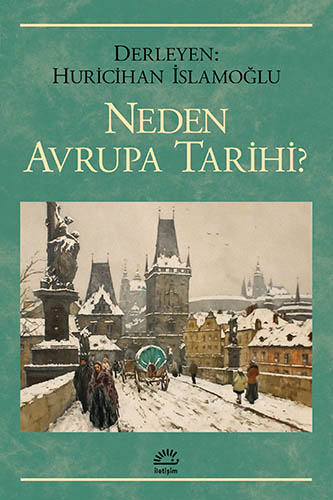
One of my earliest attempts to formulate the argument of my Prague Trilogy was in a keynote lecture I wrote for the conference New Directions in Writing European History at the Middle Eastern Technical University, Ankara, Turkey, on October 25-6, 1994.  I was one of three keynote speakers, along with Paul Langford and John Hall.  My lecture was titled “Prague as a Vantage Point on Modern European History. ”

The conference proceedings, including the three keynote lectures, responses by Turkish scholars, and a transcript of audience questions and panel discussions, were published in English in METU Studies in Development, vol. 22, no. 3, 1995.

I am pleased to belatedly discover that my lecture, along with those of John Hall and Paul Langford, has appeared in Turkish translation in Huri Islamoglu (ed.), Neden Avrupa Tarihi (Istanbul: Iletisim Yayincilik, 2nd ed, 2014).  I like the cover too.

The title means “Why European history?”—a good question.   I began my contribution to the discussion of John Hall’s paper (which was titled “The Rise of the West”) as follows:

I found the presentation very compelling and I was suspicious precisely because of that.  It was the clarity, the simplicity, the elegance of it that came across so strongly, but I wonder can you do that when you are talking about 2000 years of European history and contrasting it with the rest of the world?  Can you compass that complexity within so simple an argumentative framework, within a single theory?  I want to try to pin you down by asking three simple questions …

The simple questions are: first, what is Europe?  Second, where is the West?  And third, when was modernity? 


toplum20170617121649


My 1986 book with David Frisby, Society, has coincidentally also just appeared in Turkish under the title Toplum.  The same publisher previously did a Turkish edition of The Violence of Abstraction.

Given the appalling repression going on in Turkish universities since the failed coup in 2016, it is heartening that such texts are still being published.

Earlier this year New Perspectives published an updated version of a paper I had been working on—on and off—for more than a decade, in which I tried to re-examine some of the arguments about English state formation presentein my 1985 book with Philip Corrigan, The Great Arch, in light of my later work on Czech history in my Prague Trilogy.

Abstract

Considering the differences between the superficial orderliness of the English/British table of royal succession and the apparent anarchy of its Bohemian counterpart, this essay questions aspects of the analysis of English state formation offered in Philip Corrigan and Derek Sayer’s 1985 study The Great Arch: English State Formation as Cultural Revolution. Rather than providing a contrast to England’s institutional political continuities over centuries, Bohemia’s manifestly fractured history furnishes a vantage point from which the ideological character of such claimed historical continuities becomes clear.  E. P. Thompson’s image of a “great arch” of state formation attributes far too much shape, solidity, and coherence to a process that was always, whether in England or Bohemia, a matter of flux and fluidity – a landscape in constant erosion, upon which coherence is only ever imposed in momentary retrospect.

New Perspectives has just made the text freely downloadable here.  I would welcome any comments.

Benjamin Tallis and Derek Sayer

Czech PM-designate Andrej Babis (left) with Austrian People’s Party leader Sebastian Kurz. Wikimedia commons. 


The Iron Curtain may have been drawn back in 1989-1991, but you wouldn’t know it to read much of the commentary on the Czech parliamentary elections – and much recent commentary on ‘Eastern Europe’ more generally.

Much attention has been lavished on comparing Czech politician Andrej Babiš to Viktor Orban, Jaroslaw Kaczynski, Donald Trump and, more plausibly, to Silvio Berlusconi, but this has obscured deeper problems in western analyses of the region. Many of the sins laid at the door of central and eastern Europeans are no less prevalent in western countries, but this is too often lost amidst enduring Cold War stereotypes.

In a recent Op-Ed typical of this trend, Jochen Bittner charged that across the Visegrad Group (Poland, Hungary, the Czech Republic, and Slovakia), “leading politicians agitate against the European Union, portraying it as an imposing, undemocratic force.”

This is true. But populist politicians across western Europe portray the EU in exactly the same way. Marine Le Pen in France and Geert Wilders in the Netherlands both promised their electorate referendums on EU membership in hopes of emulating Brexit, whose champion was the anti-establishment politician and Donald Trump ally Nigel Farage …


Read full article in Open Democracy.

This is an Op-Ed piece I wrote for CEE New Perspectives, the companion blog of the academic journal New Perspectives which is published by the Institute of International Relations (IIR) in Prague.  I reproduce it here with permission.

http://ceenewperspectives.iir.cz/2016/01/08/prejudice-hysteria-and-a-failure-of-political-leadership-of-refugees-and-november-17-in-prague/

Excellent piece by Louis Armand on Prague, mutability, and modernity.

Equus Press's avatarequus press

THE PERENNIAL CITY

The truth about a city can’t be gauged from the lines on a street map. And yet how can the idea of Prague exist, except as a kind of diagram of itself, the fractured geometry of an alchemist’s necronomicon, the figura mentis,figura intellectus, figura amoris

May 1945. Edvard Beneš, the man who would come to enjoy the “doubtful distinction of having signed away his country twice,”[1] stood at his window up in Prague Castle surveying the city below. Prague had just been “liberated” by the Red Army after six years as a de facto SS statelet. During that time 345,000 Czechs (263,000 of them Jews) had been killed by the Nazis, Lidice had been razed and its inhabitants murdered, and the Czech armaments industry had fed Hitler’s leviathan. The state-of-the-art Barandov film studios had meanwhile made Prague the jewel in Goebbels’ propaganda crown, safely…

View original post 7,157 more words

For immediate Release: October 22, 2014

Lancaster University Professor Wins the American Historical Association’s 2014 George L. Mosse Prize

Washington, DC— Derek Sayer, professor of cultural history at Lancaster University, has been selected as the winner of the 2014 George L. Mosse prize for his book Prague, Capital of the Twentieth Century: A Surrealist History (Princeton University Press, 2013). The George L. Mosse Prize is awarded annually for an outstanding major work of extraordinary scholarly distinction, creativity, and originality in the intellectual and cultural history of Europe since 1500. The prize will be awarded during a ceremony at the Association’s 129th Annual Meeting in New York, NY, January 2-5, 2015.

Sayer’s book was selected by a review committee of AHA members including Brad S. Gregory, Chair (Univ. of Notre Dame), Celia Applegate (Vanderbilt Univ.), and Michael T. Saler (Univ. of California, Davis). “Set against the city’s recurrent and often brutal political dislocations, with vast erudition that incorporates the literature, music, arts, and architecture of Prague’s cultural avant-garde from before World War I through the Velvet Revolution,” commented 2014 Mosse Prize committee chair Brad S. Gregory, “this study is as conceptually bold as it is impressively learned.”

The George L. Mosse Prize was established in honor of George Lachmann Mosse, American cultural historian, with funds donated by former students, colleagues and friends of the late Dr. Mosse.

The American Historical Association is a nonprofit membership organization founded in 1884 and incorporated by Congress in 1889 for the promotion of historical studies. The AHA provides leadership for the discipline, protects academic freedom, develops professional standards, aids in the pursuit and publication of scholarship, and supplies various services to sustain and enhance the work of its members. As the largest organization of historians in the United States, the AHA is comprised of over 13,000 members and serves historians representing every historical period and geographical area. For further information, visit http://www.historians.org or call 202-544-2422. ###