Nowhere was the suppression of Palestinian voices and erasure of the Gaza genocide more evident than in Harris’s campaign

First published in Canadian Dimension, November 21, 2024

Kamala Harris speaking with attendees at the 2019 Iowa Democratic Wing Ding at Surf Ballroom in Clear Lake, Iowa. Photo by Gage Skidmore/Flickr.

Red lines? What red lines?

If anyone has any remaining doubts about the outgoing Biden-Harris administration’s support for Israel’s genocide in Gaza—even after Kamala Harris lost the election to Donald Trump—they can safely put them to rest. As Joe Biden reminded his longtime “personal friend” and “friend to our nation” Israeli President Isaac Herzog in the Oval Office on November 12, “the United States’ commitment to Israel is ironclad.”

That same day Biden made good on his promise, as he has repeatedly done—at whatever cost to Palestinians and to the Democrats’ electoral prospects—throughout the last year. Joe may be a lame duck president, but nothing is going to stop him from going the extra mile for his Zionist buddies while he still can.

A month prior, US Secretary of State Antony Blinken and Secretary of Defense Lloyd Austin had warned Israel that unless within 30 days it demonstrated “a sustained commitment to implementing and maintaining” concrete measures “to reverse” what they euphemistically termed “the downward humanitarian trajectory” in Gaza, there might be “implications for US policy under NSM-20 and relevant US law (weapons supply).”

This was widely reported as a threat to cut off, or at least to limit, the flow of American arms unless Israel dramatically improved its treatment of Palestinian civilians, especially in north Gaza, which the IDF had been brutally besieging since early October.

Key demands in the letter included expediting (rather than blocking) the flow of aid into Gaza; facilitating “humanitarian pauses” in the fighting to allow aid to be distributed; allowing the Red Cross to visit Palestinian detainees in Israeli prisons “in light of reports of abuse”; and ending “the isolation of northern Gaza Strip” and “officially announc[ing]” that Israel “has no policy of forced evacuation of Palestinians from northern Gaza Strip to the southern Gaza Strip.”

These were indeed—for the first time—concrete, measurable benchmarks by which to assess Israeli progress in meeting the US’s alleged concerns.

The timing of this “leak” of what the White House claimed was “a private diplomatic communication” raised widespread suspicions at the time that this might be no more than an electoral ploy designed to stem the hemorrhage of Muslim, Arab, and youth support for Harris shown by the “uncommitted” movement in key swing states.

Now that the election has come and gone, the doubters have been proved right. As the 30-day deadline expired on November 12, the State Department announced it “has concluded that Israel is not currently impeding assistance to Gaza and therefore is not violating US law.” The flow of American weapons to Israel continues as before.

A post-apocalyptic environment

Israel’s own figures show that less aid entered Gaza in the last month than at any time since December 2023. While the Blinken-Austin letter demanded that Israel allow 350 aid trucks to enter Gaza per day, ”with five days remaining in the 30-day review period, just over 1,000 total trucks had crossed into Gaza, an average of just 42 trucks a day.”

I quote here from a “Gaza Scorecard” drawn up by independent experts on behalf of eight humanitarian groups, including Save the Children, MercyCorps, and Oxfam. The report shows that of 19 US benchmarks set out in the letter, Israel failed to comply with 15 and only partially complied with four.

Meanwhile, “Israel … concurrently took actions that dramatically worsened the situation on the ground, particularly in Northern Gaza. That situation is in an even more dire state today than a month ago.”

Speaking to CNN’s Christiane Amanpour on November 14, UNRWA chief Philippe Lazzarini described Gaza today as “a post-apocalyptic environment,” with “people just waiting to be killed, either by airstrike, by disease, or even by hunger.”

Ignoring another demand in Blinken and Austin’s letter, on October 28 the Israeli parliament overwhelmingly passed two laws criminalizing UNRWA—the only body with the resources, experience, and staff capable of coordinating any competent relief effort in Gaza—as a “terrorist organization” and banning it from operating in Israel, including within the occupied territories of East Jerusalem, the West Bank, and Gaza. The Israeli government has since confirmed that these laws will take effect within 90 days.

Lazzarini warned that “dismantling UNRWA will collapse the United Nations humanitarian response [in Gaza], which relies heavily on the Agency’s infrastructure.” EU High Representative for Foreign Affairs Josep Borrell Fontelles was another who urged “Israeli authorities to reconsider, in order to prevent disruptions to UNRWA’s life-saving services and ensure continued and unhindered humanitarian access for UNRWA to the Palestine refugees that it was set up to serve,“ adding for good measure: “This legislation stands in stark contradiction to international law.” These appeals fell on deaf ears.

On November 5, IDF Brigadier General Itzik Cohen let slip what was really going on. “There is no intention of allowing the residents of the northern Gaza Strip to return to their homes,” he told Israeli reporters. “Humanitarian aid would be allowed to ‘regularly’ enter the south of the territory but not the north, since there are ‘no more civilians left.’”

The Israeli daily Haaretz had no hesitation in calling a spade a spade. Its lead editorial on November 10 proclaimed:

The Israeli military is conducting an ethnic cleansing operation in the northern Gaza Strip. The few Palestinians remaining in the area are being forcibly evacuated, homes and infrastructure have been destroyed, and wide roads in the area are being built and completing the separation of the communities in the northern Strip from the center of Gaza City.


Two important independent studies published on November 14 concur. In a damning report starkly titled “Hopeless, Starving, and Besieged”: Israel’s Forced Displacement of Palestinians in Gaza, Human Rights Watch concluded that “the Israeli government’s acts of forced displacement … amount to a crime against humanity. Israel’s actions appear to also meet the definition of ethnic cleansing.”

The latest report of the UN Special Committee to Investigate Israeli Practices Affecting the Human Rights of the Palestinian People went still further, concluding that “Israel is intentionally causing death, starvation and serious injury, using starvation as a method of war and inflicting collective punishment on the Palestinian population,” all of which are methods of warfare “consistent with the characteristics of genocide.”

I won’t speculate here on how far Israel’s recent actions are an attempt to implement the so-called General’s Plan (to depopulate North Gaza prior to turning it into a free-fire zone) or form a prelude to resettling the area with Jewish settlements, West Bank–style, as has been advocated by the more extreme members of the Israeli government.

Suffice it to say that the US State Department’s claim that Israel is “making progress” in meeting the demands set out in the Blinken-Austin letter is a sick joke.

So too are the repeated assurances that Joe Biden and Kamala Harris are “working tirelessly” “around the clock” for a ceasefire in Gaza and a solution to the Palestinian–Israeli conflict. On November 20—for the fourth time—the US used its veto to block a UN Security Council resolution mandating an immediate and unconditional ceasefire in Gaza. The other 14 members of the council all voted in favour of the resolution.

It is not reality on the ground that matters here. As Guardian columnist Owen Jones succinctly puts it, “no matter what the people of Gaza endure, the narrative prevails.”

The most moral army in the world

Honed in the hasbara factories of Tel Aviv, parroted by Western politicians across the spectrum, and amplified by Western media ad nauseam, the narrative to which Jones refers has more than a whiff of Orwellian doublethink (“the power of holding two contradictory beliefs in one’s mind simultaneously, and accepting both of them”) about it.

While this narrative affirms the sanctity of supposed Western values of national self-determination, democracy, human rights, and the international rule of law, it defends gross violations of these same principles with equal passion in the case of Israel. The IDF, we are assured after every massacre, is “the most moral army in the world.”

This doublethink requires us to believe that this is a war of “children of light” against “children of darkness,” of civilization against barbarism, of the enlightened West against the benighted rest. It requires us, in short, to buy into the most racist tropes of the Western colonialist heritage in order to defend a present-day colonialist genocide.

“War is peace, freedom is slavery, ignorance is strength,” ran the party’s slogan in George Orwell’s Nineteen Eighty-Four. “The Party told you to reject the evidence of your eyes and ears. It was their final, most essential command.”

Winston Smith goes on to say “Freedom is the freedom to say that two plus two make four. If that is granted, all else follows.”

In many Western countries today, the freedom to say that two plus two make four is no longer always granted—at least, not in relation to speech concerning Israel and Palestine. The prevailing narrative prevails not because it is true but because other voices, other stories, have been drowned out.

If—with the imprimatur, let us remember, of the UN, the International Court of Justice (ICJ), leading international NGOs (Oxfam, Save the Children, Human Rights Watch, Amnesty International, etc.), and a growing number of Western nations (Ireland, Spain, Norway, Belgium, among others)—you dare to reject the doublethink and insist that irrespective of the undoubted war crimes Hamas committed on October 7, Israel is guilty of war crimes, crimes against humanity, and (by now more than “plausible”) genocide in Gaza on an infinitely greater scale, you are likely to pay dearly.

It may cost you your job, your opportunity to publish, exhibit, or perform, and even put you behind bars.

Last month in Britain, pro-Palestinian journalists were woken by dawn police raids and had their phones and computers confiscated under “terrorism” legislation. Canadian authorities soon emulated their UK colleagues by sending a SWAT team to the Vancouver home of the international coordinator of the Samidoun Palestinian Prisoner Solidarity Network, which they recently (and controversially) declared a “terrorist entity.” In both cases the intent seems to be to intimidate: no charges have yet resulted from either raid.

Across North America, university authorities have called in baton-wielding police to break up protest encampments and disciplined hundreds of students and faculty for doing no more than exercising their right to say two plus two make four. Some now have criminal records, while others merely lost their housing, health insurance, and degrees.

This week’s Joe Biden prize for doublethink must surely go to Harvard Divinity School, which has just suspended students from using its library for two weeks after 55 graduate students, many of whom are Jewish, held a “pray-in” there. “In and of itself, advocacy for the cause of people under duress—whether in Israel, Gaza, or other parts of the world—is noble,” explained the Dean. So what exactly was the problem?

In Canada, MP Anthony Housefather, “senior advisor to prime minister Trudeau on antisemitism,” announced in July that he was working with Deborah Lyons, former Canadian ambassador to Israel and “Canada’s special envoy on preserving holocaust remembrance and combatting antisemitism,” to put pressure on Windsor University to cancel an agreement it had made with its own students to consider their demands for divestment from Israel in exchange for their peacefully ending their encampment.

The German parliament is currently considering a government resolution that would enforce the IHRA definition of antisemitism (which has been widely condemned for conflating criticism of Israel or of Zionism with antisemitism) and remove state funding for artistic and scientific endeavours from any individuals or organizations supporting boycotts of Israel. The same IHRA definition forms the basis of a new “handbook” for combatting antisemitism issued in October under the auspices of Heritage Canada.

Though the handbook, prepared by Lyons’ office, assures us that it is “non-legally binding” and “does not constitute a legal opinion or a legislative interpretation of antisemitism”—best cover your ass against future Charter of Rights challenges, eh?—its recommendations add up to a chillingly totalitarian apparatus of moral regulation.

Among its suggestions are “Incorporating the definition into school policies and campus codes of conduct—helping administrators and institutions draw the line as to what is and what is not antisemitism.”

Since October 7 state power has been mobilized across the “free world” to suppress dissent and ensure that the prevailing narrative continues to prevail. There is little doubt about who can speak and whose voices are not to be heard.

I’m speaking!

Nowhere was this suppression of Palestinian voices and erasure of the Gaza genocide more evident than in Kamala Harris’s campaign for the US presidency.

Ahmad Ibsais, who describes himself as a “first generation Palestinian American and law student,” summarized the experience of Palestinian, Arab, and Muslim Americans during the 2024 election. These American communities certainly didn’t feel the “joy” that was—obscenely, some might think, given the circumstances—touted as Harris’s hallmark.

Just look at how the Democrats campaigned in the state I live in, Michigan. A crucial swing state where elections can hinge on mere thousands of votes, Michigan is home to some 200,000 Muslim Americans. Over the past year, these voters made it clear, in every way they could, that their vote was conditioned on the party pledging to end its financial, political and military support of massacres of Palestinians, Lebanese and Yemenis. The “uncommitted” campaign—looking to end the Democratic Party’s support for Israel’s genocide—secured more than 100,000 votes in the state’s Democratic primary.

The Democratic Party did not listen. Harris not only refused to abandon Biden’s staunchly pro-Israel policies on Palestine but also personally supported continued bloodshed in Gaza by publicly insulting anti-genocide campaigners in the state. When pro-Palestinian protesters interrupted a Harris rally in Detroit by simply stating that they “won’t vote for genocide”, she shut them up with her catchphrase, “I’m speaking”. She then sent former President Bill Clinton to the state to deliver a speech that tried to justify the mass killing of Palestinians. Liz Cheney, the Republican daughter of Iraq war architect and war criminal Dick Cheney, also made an appearance in the state to campaign for Harris. Congressman Ritchie Torres, who spent the past year accusing anyone demanding an end to the bloodshed in Gaza of being an anti-Semitic terrorist, was another surrogate Harris sent to Michigan.

As a result, understandably, Muslims in Michigan did not vote for Harris.


Palestinian voices were kept off the stage at the Democratic National Convention in August in Chicago, despite the uncommitted movement offering to endorse Harris’s candidacy as well as having their representative’s speech vetted in advance.

“I’ve had some pretty crushing days, but to be honest today took the cake,” Ruwa Romman, a Georgia State representative who was one of the speaker candidates uncommitted submitted to the Harris campaign, posted on X. “I do not understand how there’s room for an anti-choice Republican [presumably Liz Cheney] but not me in our party. I need someone to explain to me what to do now.”

Jamaal Bowman, the pro-Palestinian New York congressman whom the American Israel Public Affairs Committee (AIPAC) and other superpacs spent a reported $23 million to unseat in a special election in June, says he offered to campaign for Harris in Michigan (where he is popular) but his offer was declined in favor of Cheney, Clinton, and Torres.

Steve Salaita, who was hounded out of the tenured position he had been offered and accepted as a Professor of American Indian Studies at the University of Illinois after a series of tweets criticizing Israel’s 2014 bombardment of Gaza—this “war” did not begin on October 7—gets to the heart of things:

Liberals can tolerate you only when you behave: vote (as per their demands), show up for diversity photoshoots, ease up on the religion, and don’t make too much noise about Palestine. They see you as children to be marshalled into civic duty every few years according to their own convenience. The moment you reject their delusions of lesser evilism, even when the supposedly lesser evil is incinerating your kin and leading the world to the brink of catastrophe, they no longer feel obliged to maintain decorum. It’s now obvious that liberals were itching for an excuse to unleash a lot of deep-seated animosity. All it took was your principled rejection of genocide.

Harris’s electoral collapse

Although some votes still remain to be counted, as of November 19 Kamala Harris had won 73,966,464 votes (48.3 percent) in the November 5 election as against Donald Trump’s 76,581,025 (50 percent). This gave Trump a majority of 312 to 226 in the Electoral College, beating Biden’s 306 to 232 score in 2020. Trump also won the popular vote, the only Republican candidate to do so since 1988, apart from George W. Bush in 2004.

Nevertheless, 2024 is less an election Trump won than an election that Harris lost—spectacularly. Despite it being widely billed as a “historic” election that Americans considered “the most important in their lifetime,” overall turnout was down by nearly three million over 2020, from 65.8 to 63.5 percent. A lot of folks chose to stay home, and the numbers suggest that many of them were Biden voters in 2020.

In Cook County, Illinois, which includes Chicago, turnout was down by a whopping 20 percent. Trump matched his 2020 vote, but Harris’s total was more than 417,000 votes adrift of Biden’s.

Though Trump’s share of the national vote rose from 46.9 percent in 2020 to 50 percent in 2024, he increased the actual number of his votes by only a modest 2.3 million (from 74,224,319 to 76,581,025)—in an election in which an additional four million eligible voters were added to the rolls since 2020. Harris’s vote, by contrast, fell precipitously. It was down by more than seven million on Biden’s 81,284,666 total in 2020.

These patterns hold both nationally and in the seven battleground states that decide the outcome of most American presidential elections, and in particular in the three “blue wall” states that Trump took from the Democrats in 2016 and Biden recovered in 2020—Pennsylvania, Wisconsin, and Michigan.

These were must-win states for the Democrats, and Kamala Harris spent a lot of time campaigningthere.

This year Trump won all seven battleground states by narrow but clear majorities, and posted margins of 1.8 percent in Pennsylvania, 0.9 percent in Wisconsin, and 1.4 percent in Michigan. This compares with Biden’s margins of 1.2 percent in Pennsylvania, 0.6 percent in Wisconsin, and 2.8 percent in Michigan. These were all tight races and small swings, but Michigan—where Abdul Ibsais and 200,000 other Muslim Americans live—registered the biggest shift.

Where Biden racked up 2,804,040 votes in Michigan in 2020, Harris managed 2,724,029—a net loss of some 80,000 votes. A significant part in this loss was clearly due to Arab American and Muslim voters either abstaining, voting for third-party anti-war candidate Jill Stein, or shifting their vote to Trump.

In the Detroit suburb of Dearborn, where 55 percent of the residents are of Middle Eastern descent and Biden got 69 percent of the vote in 2020, Trump won 42.48 percent of the vote, Harris 36.26 percent, and Stein 18.37 percent. In Dearborn Heights, where 39 percent of the residents are of Middle Eastern descent, Trump defeated Harris by 44 to 38.3 percent, with Stein at 15.1 percent. In Hamtramck, the first majority-Muslim city in the US, Harris got 46.2 percent—as compared with Biden’s 85 percent in 2020—while Trump got 42.7 percent and Stein 8.96 percent. Lost Muslim votes are also likely to have impacted Democrat performance in Pennsylvania and Wisconsin.

Had Harris won the three blue-wall states and the rest of the results stayed the same, she, not Donald Trump, would now be US president-elect.

It is significant, then, that Trump’s combined margin of victory over Harris in Michigan, Pennsylvania, and Wisconsin—and therefore, the difference between the Democrats’ holding or losing the White House—was a razor-thin 232,000 votes. Additionally, Jill Stein got 91,475 votes, many of which might otherwise have gone to the Democrats had they moderated their stance on Gaza.

These numbers by no means prove that Gaza was the only factor in Harris’s collapse, but they certainly show that it cannot be ignored.

We might reasonably ask whether, if Harris had been less adamant in her insistence that “I’m speaking!” and more willing to move on Israel, she might have persuaded enough of Biden’s 2020 voters—not only Muslim Americans, but college kids, other young people, and progressives who campaigned hard for the Democrats in 2020 but were nauseated by Biden’s policies on Gaza—to support her. Instead, they flipped or stayed home.

Gaza’s revenge?

I suppose it is heartening to see Bernie Sanders and Elizabeth Warren, who endorsed and campaigned for Kamala Harris whatever their reservations on Gaza, co-sponsoring a Senate motion of disapproval on the Biden administration’s continuing to supply arms to Israel despite the latter’s failure to meet the conditions set out in the Blinken-Austin letter.

Sanders now thunders: “There is no longer any doubt that Netanyahu’s extremist government is in clear violation of US and international law as it wages a barbaric war against the Palestinian people in Gaza.” Warren now warns: “The failure by the Biden administration to follow US law and to suspend arms shipments is a grave mistake that undermines American credibility worldwide.”

Really, senators? What took you so long? Even some of your less performatively progressive colleagues like Tim Kaine and Chris Van Hollen (who told Zeteo: “President Biden’s inaction, given the suffering in Gaza, is shameful. I mean, there’s no other word for it”) have long demanded conditioning on the supply of offensive weapons to Israel.

Unsurprisingly, the motion failed. But at least 18 Senate Democrats seem to be belatedly developing a conscience, now that it is too late to influence policy.

US support for Israel’s genocide was important not only because it cost Harris substantial support in battleground states—we’ll never know how much, because exit polls by definition don’t capture the reasons millions of voters stayed home—but also as the most conspicuous symptom of a deeper sickness in the Democratic Party.

And the country.

Exploring how and why the election result has left him “disappointed, fearful, numb,” prize-winning author Viet Thanh Nguyen puts it well. The source of his disappointment and fear is not just the prospect of a second (and likely much worse) Trump term:

Donald Trump does not represent something new in the United States. Instead, he is part of a fundamental contradiction that the United States was born from, a contradiction that has never gone away. On the one hand, the beauty of democracy, opportunity, freedom, and equality (for some). On the other hand, the brutality that made that beauty possible: colonization, genocide, enslavement, occupation, and war. Some willingly embrace the brutality, others are willing to look away from it. That is why the Democratic Party’s loss of its moral compass on Gaza and calling what Israel is doing a genocide was not simply a “single issue,” but a symptom of the rot within a party that hoped that the beauty of multiculturalism and diversity would somehow be enough to overcome the brutality. 


There are limits to doublethink. If you campaign on “ironclad support” for Israel’s genocide and ethnic cleansing in Palestine, you are saying there are no moral limits on the means you use so long as the ends are worthy. Don’t be surprised if people then conclude it’s fine to vote for mass deportations, internment camps, jailing of political opponents, and using the military to quash dissent at home in support of their (decent, Christian, patriotic) doublethink agendas. Sow the wind, reap the whirlwind.

In its contempt for the rule of law in international affairs, not to mention its acquiescence in domestic suppression of free speech on Palestine, the Biden-Harris administration has helped prepare the ground for the coming Trump tyranny at home.

Trump’s triumph will not stop Israel’s assault on Gaza. Palestinians know that very well, and they do not need Pennsylvania’s Democrat junior senator John Fetterman to lecture them (“Congratulations, you’re going to love the next Muslim ban,” he sneered) on the dire consequences of their refusing to vote as Bill Clinton told them to.

The election result could be seen as Gaza’s revenge for the Democrats’ hypocritical indifference to Palestinian suffering while campaigning on abortion rights, the price of eggs and gas, and “saving American democracy.” Now liberal America will suffer too.

So, unfortunately, will many others.

The Blinken-Austin letter could be a game-changer, or just another electoral gimmick

First published in Canadian Dimension, October 15, 2024

Aftermath of an Israeli bombing raid on the Jabalia refugee camp in the Gaza Strip. Photo courtesy the Palestinian News & Information Agency-WAFA/Wikimedia Commons.

In my most recent article for Canadian Dimension, I wrote about the stark discrepancies between US policy on supplying arms to Ukraine and Israel.

Though both states are nominally US allies, the Biden-Harris administration’s “unwavering support” for Ukraine has not stopped it from limiting or conditioning supplies of “offensive” as distinct from “defensive” weapons—long-distance ballistic missiles that are capable of reaching deep into Russia, for instance—in the interests of preventing escalation of the conflict and keeping European allies onside.

The US’s “ironclad commitment” to Israel, by contrast, has meant that the supply of offensive weaponry—like 500-pound and 2,000-pound “bunker buster” bombs capable of demolishing whole apartment blocks and incinerating their occupants—has continued to flow unimpeded, notwithstanding widespread international condemnation (including by several European states) of Israel’s war crimes, crimes against humanity, and possible genocide in Gaza, or the Netanyahu government’s frequent breaches of what the US has itself described as “red lines.”

Until now. But a recent report by Axios suggests things may—may—be about to change.

Axios claims to have seen a letter sent on October 14 by US Secretary of State Antony Blinken and Secretary of Defence Lloyd Austin to Israeli Minister for Strategic Affairs Ron Dermer and Minister of Defence Yoav Galant, which was first reported on Israel’s Channel 12.

If the Axios report is accurate, for the first time the US administration is explicitly threatening to suspend military aid to Israel unless some very specific conditions are met.

These conditions, says Axios, amount to “the most wide-ranging and comprehensive list of US demands from Israel since the beginning of the war.”

Noting that IDF evacuation orders have forced 1.7 million Palestinians into Mawasi, a narrow strip of land on the Gaza coast where they are prey to dangerous diseases, at the same time as recent Israeli policies have made it harder to supply international aid into Gaza and limited its movement within the Strip, Blinken and Austin wrote that:

The amount of assistance entering Gaza in September was the lowest of any month during the past year … to reverse the downward humanitarian trajectory as consistent with its assurances to us, Israel must, starting now and within 30 days act on the following concrete measures …

Failure to demonstrate a sustained commitment to implementing and maintaining these measures may have implications for US policy under NSM-20 and relevant US law (weapons supply).


These “concrete measures” included demands that Israel must:

  • allow “the permanent transfer of 350 aid trucks daily to the Gaza Strip through all four current border crossings as well as the opening of a fifth border crossing”;
  • enable “humanitarian pauses [in the fighting] throughout Gaza to allow the distribution of aid for at least the next four months”;
  • permit “the Palestinians who are concentrated along the coast in Mawasi to move east inland and away from the coastal area before winter”;
  • “end the isolation of northern Gaza Strip and officially announce it has no policy of forced evacuation of Palestinians from northern Gaza Strip to the southern Gaza Strip”; and
  • “allow the Red Cross to visit Palestinian detainees in detention facilities in Israel as soon as possible, in light of reports of abuse of detainees.”

In addition, Blinken and Austin expressed the US administration’s “concern” about a bill currently before the Israeli parliament, the Knesset, that would “sever ties between the Israeli government and UNRWA and to change the status-quo towards the organization in Jerusalem.”

Noting that this law, if passed, “would be devastating for the humanitarian effort in the Gaza Strip at a critical time and would prevent education and welfare services for tens of thousands of Palestinians in Jerusalem” and could also “constitute a violation of US laws,” Blinken and Austin demanded that “Prime Minister Benjamin Netanyahu exercise his powers and influence over Knesset members so the bill doesn’t pass.”

Finally, Blinken and Austin wrote, “the US wants to establish a new mechanism with Israel to discuss incidents of mass Palestinian civilian casualties during IDF operations.”

On reading this report my response was mixed. This could be a game-changer, not only for Gaza but for the rapidly escalating conflict that threatens to engulf the entire Middle East (if not eventually the world). Without US arms and diplomatic support at the United Nations for its defiance not only of UN Security Council resolutions but also the International Court of Justice and the International Criminal Court, Israel becomes far more vulnerable not only militarily but to international pressure.

A change in US policy on arms at this point would also make domestic political sense. The presidential election is less than a month away, and the race is too close to call in the critical swing states.

While Kamala Harris has doubled down on Biden’s “ironclad commitment” to Israel’s defence, a threat to condition the supply of offensive weapons of the sort that has been the administration’s policy in Ukraine could win back some of the Palestinian American, Arab American, Muslim American, and young American votes the Democrats have lost over Gaza—because these groups have much to lose otherwise from a Trump victory.

If, that is, it is not too late. Remember Hubert Humphrey’s loss, in uncannily similar circumstances—cleaving too close to an unpopular president despite US involvement in a divisive war (Vietnam)—to Richard Nixon in 1968?

On the other hand, Biden has ignored his own red lines before, and Blinken has recently been exposed as flagrantly disregarding State Department advice back in April that Israel’s actions in Gaza were not in conformity with the very same legal requirements he is now invoking. The Blinken-Austin letter sets a 30-day deadline for Israel to act on its demands, which takes us to November 12—a week after the US election.

Should Harris, buoyed by the apparent prospect of a U-turn on Biden’s policy on arms to Israel, win on November 5, what is there to prevent her administration, having done its due diligence, from certifying that Israel’s assurances that it is acting in accord with relevant US laws are “credible and reliable,” as Blinken did—outrageously—before?

So long as the IDF continue to blockade aid, turn Jabalia refugee camp into a free-fire kill zone, fire on UN peacekeepers in Lebanon, and burn hospital patients alive with US-supplied bombs, this is not a time to ease up on the pressure on Israel and the US to obey international law.

It is a time, on the contrary, for heightened vigilance.


Update

The full text of the Blinken-Austin letter has now been posted on X by the Israeli journalist Barak Ravid and its authenticity confirmed by the White House, whose spokesman Matthew Miller describes it as “a private diplomatic communication” whose “timing was not influenced by next month’s presidential election.” Sure.

The contents of the letter are as described by Axios, though there are some additional demands made of Israel that are not mentioned in the Axios report.

The student protests and the Gaza genocide

First published in Canadian Dimension May 1, 2024

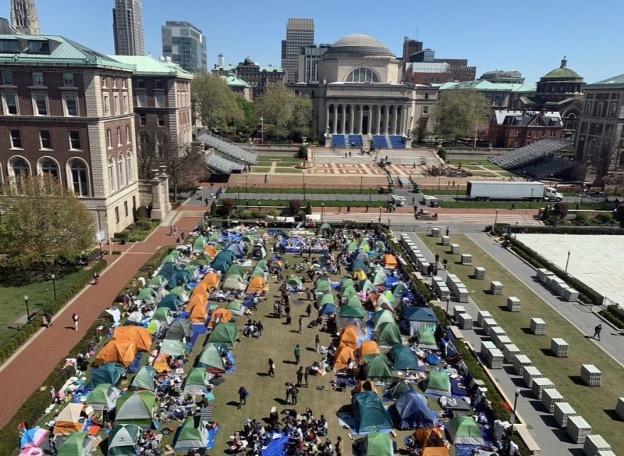
Student encampment at Columbia University. Photo courtesy Columbia Students for Justice for Palestine/X.

There are snipers on the roof of the school where I got my MA.

There are police beating students at the school where I got my PhD.

At each school, I studied authoritarian regimes and how they brainwash people into believing that state brutality is not only normal, but deserved.

—Sarah Kenzior, post on X, April 28, 2024

LBJ, LBJ, how many kids have you killed today?

To some of us of a certain age, 2024 is beginning to have a very 1968 feel about it. I turned 18 in 1968. When the Rolling Stones released “Street Fighting Man” that summer, many in my generation saw it as a call to arms.

The annus mirabilisannus horribilis began with North Vietnam’s Tet Offensive, which turned the tide of the Vietnam War and galvanized a worldwide anti-war movement. On March 17, mounted police charged down protesters outside the US embassy in Grosvenor Square in London, England. On April 4, civil rights leader Martin Luther King was murdered in Memphis, setting off riots in Washington, Baltimore, Chicago, and scores of other American cities. In May, student protests paralyzed Paris and triggered a general strike that brought General De Gaulle’s Fifth Republic to its knees. On June 4, Democratic presidential candidate Robert F. Kennedy was assassinated in Los Angeles. On the night of August 20-21, Soviet-led Warsaw Pact forces invaded Czechoslovakia, peremptorily ending Alexander Dubček’s Prague Spring.

A week later it was the police’s turn to riot at the Democratic national convention in Chicago, where they savagely beat anti-war protestors on Michigan Avenue. On October 2, armed forces opened fire on 10,000 demonstrators in the Plaza de las Tres Culturas in Mexico City, killing hundreds of university and high school students. When the Mexico Olympic Games opened ten days later, Tommie Smith and John Carlos raised their fists in Black Power salutes on the 200-metre medal podium and Czech gymnastics multi-gold medalist Věra Čáslavská turned her head and averted her eyes as the Soviet anthem began to play and the Soviet flag was raised. On October 21, International Anti-War Day, thousands of students occupied Shinjuku Station in Tokyo.

Two weeks later, Richard Nixon, the red-baiting veteran of the House Un-American Activities Committee (HUAC) , was elected US president.

Today’s circumstances are not the same, but the déja vu is inescapable. Then as now, the trigger for disorder has been an unpopular foreign war. Then as now, domestic opposition to involvement in that war has been met with widespread repression. Then as now, the repression has exposed power structures that would sooner hide behind bland facades of neoliberal normality. And then as now, young students have been in the vanguard of the protests.

Gaza is the moment of moral conscience for this generation, as Vietnam was for mine. I’m cheering for the kids.

Do you feel safe sending your child to a school which gives up its students to the police?

On April 17, Columbia University President Baroness Nemat “Minouche” Shafik, formerly vice president at the World Bank, deputy managing director of the IMF, deputy governor of the Bank of England, and president and vice chancellor of the London School of Economics, testified before the US House Education and Workforce Committee on “campus antisemitism.”

The committee, whose resident attack dog is New York’s 22nd congressional district representative and aspiring MAGA vice-presidential running mate Elise Stefanik, had previously claimed the scalps of University of Pennsylvania President Liz Magill and Harvard University President Claudine Gay.

Magill and Gay’s resignations were quickly hijacked for the Republicans’ wider “war on woke,” and in particular its war on Diversity, Equity and Inclusion (DEI) initiatives. GOP presidential candidate Vivek Ramaswamy couldn’t stop himself from saying the quiet bit out loud. “Better late than never,” he crowed. “It was a thinly veiled exercise in race & gender when they selected Claudine Gay”—the first Black president of Harvard and only the second Black woman to head an Ivy League university. Here as elsewhere, charges of antisemitism were a convenient vehicle for advancing—and concealing—other political agendas that have little to do with protecting Jews.

The House antisemitism investigations have been compared, not unreasonably, to HUAC’s witchhunting of “subversives” during the early years of the Cold War. No doubt mindful of Magill and Gay’s fate, Shafik turned out to be a more than friendly witness. She assured the committee that “Antisemitism has no place on our campus, and I am personally committed to doing everything I can to confront it directly.”

Conceding that “the events of October 7 brought to the forefront an undercurrent of antisemitism that is a major challenge for universities across the country”—a representation of the situation that has been fiercely contested by participants, who among other things point to the large numbers of Jewish students and faculty taking part in the pro-Palestine protests—Shafik detailed the steps Columbia had taken to combat antisemitism since October 7. The “central challenge,” she said, was “trying to reconcile the free speech rights of those who want to protest and the rights of Jewish students to be in an environment free of harassment or discrimination.”

Her opening statement detailed a raft of actions taken with the aim of monitoring, policing, and disciplining protesters, but offered little but platitudes in regard to free speech.

“We restricted access to our campus to those with valid Columbia identification, increased the public safety presence across all of our campuses, brought in external security firms,” Shafik explained. “We updated our policies and procedures … to make it easier to report allegations of hate speech, harassment, and other forms of disruptive behavior, including antisemitic behavior” via “enhanced reporting channels, and supplementing internal resources through a team of outside investigators.”

On October 12, “we brought law enforcement onto our Morningside Heights campus to ensure the safety of our community at a protest for the first time in more than 50 years”—that is to say, since Columbia was occupied back in 1968 (when the police raid on April 30 resulted in 712 arrests and 148 reports of injuries). Thereafter the university authorities have maintained “regular communication with the New York City Police Department, ensuring they were either present or on standby for all major events, including vigils and demonstrations.”

Shafik was “personally frustrated,” she told the committee, to discover that Columbia’s existing “policies and structures were sometimes unable to meet the moment.” The school’s event policy was hastily rewritten to restrict the places and times that protests would be permitted on campus, require two working day’s notice of intended demonstrations, and set out “a clear procedure for adjudication of alleged violations and consequences for students and student groups who break the rules.”

Following these revisions two student societies, Students for Justice in Palestine (SJP) and Jewish Voice for Peace (JVP), were suspended after leading an unauthorized student walkout on November 9, and several students were suspended on March 24 after “an event took place at a campus residential facility that the University had previously barred—twice—from occurring.”

Columbia concurrently established a Task Force on Antisemitism “led by three prominent Jewish members of our faculty,” whose brief was “first, to assess the events and other causes contributing to the pain in Columbia’s Jewish community; second, to review the relevant policies, rules, and practices that affect our campus; and third, to propose other methods to help the entire community understand the effects of antisemitism at Columbia.”

What is claimed to be an internal administration document leaked to SJP suggested that Dean of General Studies (GS) Lisa Rosen-Metsch, one of three members of the Task Force, had not only overseen “a serious and intentional misuse of GS institutional aid, where TAU [Tel Aviv University] Dual BA Program students receive disproportionately higher funds than others, without the required basis of demonstrated financial need,” but also “convened meetings with GS veterans who served in the Israel Defense Forces (IDF), directing them to counter pro-Palestinian student activities and to actively disrupt pro-Palestinian activity on campus.” If the document is genuine these are serious allegations, which undermine any confidence in the impartiality of the Task Force—or of Columbia University.

Notwithstanding Shafik’s acknowledgment—the only one in her entire statement—that “Our Palestinian students and faculty have also been affected as their families and friends suffer through a humanitarian crisis,” no such dedicated task force was set up to address their pain: a pain, it might be conjectured, that went deeper than merely being made to feel uncomfortable in the presence of students protesting the ongoing Israeli actions that were taking the lives and obliterating the homes of their friends and relatives in Gaza. Anti-Palestinian, -Arab, or -Muslim speech and actions were evidently not seen as deserving of comparable attention by the university either then or later.

This is despite the fact that three Palestinian students had been shot in Burlington, Vermont, on November 25, leaving one paralyzed from the chest down after a bullet lodged in his spine—and in full knowledge that several of Columbia’s own students had been sprayed with a noxious chemical substance, possibly Skunk, at a pro-Palestine rally on January 19, sending ten of them to hospital. Former IDF soldiers studying at Columbia were alleged to be involved in this attack.

Despite the deafening chorus from the pro-Israel lobby bemoaning Jewish students across the US being made to feel “unsafe” by protesters demanding Palestinian freedom (as distinct from Israeli sovereignty, as in Likud’s program) from the river to the sea, none—thankfully—have yet been subjected to remotely comparable violence.

Predictably, the Task Force on Antisemitism’s first report “endorsed Columbia’s new Interim University Policy for Safe Demonstrations” and “also called for stronger enforcement of our policies, a goal toward which we are diligently working.”

Disclose! Divest! We will not stop, we will not rest!

In the early morning hours of April 17, the same day Shafik testified before the House Education and Workforce Committee, students established a Gaza Solidarity Encampment of around 50 tents on the South Lawn of Columbia’s Morningside Heights campus in support of “divestment and an end to Columbia’s complicity in genocide.”

The protest was organized by Columbia University Apartheid Divest (CUAD), a coalition of over 120 groups, including the SJP and JVP, founded in 2016 to “call on the University to divest its stocks, funds, and endowment from companies that profit from the State of Israel’s violations of international law and Palestinian human rights through its ongoing system of settler colonialism, military occupation, and apartheid.”

Dressed in full riot gear, the NYPD cleared the encampment the next day and arrested over 100 people, 108 of whom were charged with trespass. NYPD Chief of Patrol John Chell later told the Columbia Spectator that “To put this in perspective, the students that were arrested were peaceful, offered no resistance whatsoever, and were saying what they wanted to say in a peaceful manner.”

It wasn’t the cops that initiated the sweep. Shafik had requested NYPD in writing to remove the students, claiming that “the encampment and related disruptions pose a clear and present dangerto the substantial functioning of the University.” The formulation I have italicized was likely included to justify Shafik’s acting without the imprimatur of the university’s senate executive committee, which she was statutorily bound to consult in such serious cases.

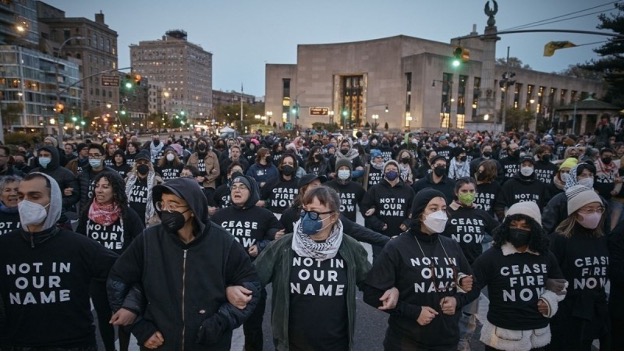
Protesters block traffic during a pro-Palestinian demonstration demanding a permanent ceasefire in Gaza, near the home of Senator Chuck Schumer in Brooklyn, April 23, 2024. Photo by Andres Kudacki/AP.

Columbia and its partner institution Barnard College then summarily suspended three students. Among them was Isra Hirsi, the daughter of congresswoman Ilhan Omar (D–MN05), who is one of a small but growing number of Democratic representatives to have opposed the Biden administration’s continuation of unconditional financial and military support for Israel despite the spiraling humanitarian crisis in Gaza. It is doubtless pure coincidence that Omar had given Shafik a stiff grilling at the House Education and Workforce Committee hearing.

On April 20 Columbia told all the arrested students that they had been suspended, meaning that many would be forced to vacate their student housing. At Barnard, students were given 15 minutes to pack their belongings.

Undeterred, protesters set up camp again on April 22. The following days saw an uneasy standoff, with negotiations between the students and the university authorities taking place against the threat of bringing the cops in again. On April 29, Columbia gave the students an ultimatum. The bold type is the university’s:

Please promptly gather your belongings and leave the encampment. If you voluntarily leave by 2 p.m., identify yourself to a University official, and sign the provided form where you commit to abide by all University policies through June 30, 2025, or the date of the conferral of your degree, whichever is earlier, you will be eligible to complete the remainder of the semester in good standing (and will not be placed on suspension) as long as you adhere to that commitment … If you do not leave by 2 p.m., you will be suspended pending further investigation.


Shafik issued a statement the same day in which the University offered “to develop an expedited timeline for review of new proposals from the students by the Advisory Committee for Socially Responsible Investing, the body that considers divestment matters”; “to publish a process for students to access a list of Columbia’s direct investment holdings”; “to convene a faculty committee to address academic freedom and to begin a discussion on access and financial barriers to academic programs and global centers”; and “to make investments in health and education in Gaza, including supporting early childhood development and support for displaced scholars.”

These concessions fell far short of the students’ demands, but to wring them at all from an administration whose first response had been to call in the NYPD says much for the power of protest. Shafik remained adamant, however, that “the University will not divest from Israel.”

The 2:00 p.m. deadline passed without the students leaving. On the evening of April 29, Columbia began issuing mass suspensions. Elise Stefanik meantime issued a statement that read:

Columbia has surrendered to the radical pro-Hamas antisemitic mob instead of securing campus and protecting Columbia’s Jewish students. There can be no more extensions or delays. There can be no negotiations with self-proclaimed Hamas terrorists and their sympathizers. 


Overnight, the students occupied Hamilton Hall, a building that had been a centre of the 1968 protests too. They hung a banner out of an upper floor window renaming it Hind’s Hall, in memory of six-year-old Hind Rajab, the little girl who was killed, likely by Israeli tank fire, in Gaza along with the Palestinian Red Crescent Society ambulance crew sent to rescue her after she had endured hours, trapped in a car with her dead relatives, as the sole survivor of an IDF strike.

Though the front pages of the American press have been filled for the last two weeks with breathless accounts of the campus protests, it is easy to lose sight of their objective.

As Maryam, a Barnard College student arrested in the NYPD sweep on April 18 and subsequently suspended (and made homeless) for her part in the encampment, urged on April 22,

I wish people would listen to Columbia student organizers and center Gaza. Our escalation is long overdue and we are escalating for Palestine & nothing else. Please have all eyes on Palestine and do not cease coverage of Gaza whatsoever. 

Israel bombs, NYU pays, how many kids have you killed today?

I have dwelt on Columbia not only because the current campus unrest first came to a head there, but also because both the students’ actions and the administration’s response foreshadowed events across North America and beyond.

The faceoff at Columbia unleashed a tsunami of encampments, occupations, and other forms of protest at dozens—likely by now hundreds—of US universities, ranging from Ivy League schools like YaleHarvardPrinceton, and Brown, top private universities like NYUEmoryStanford, and the University of Chicago, and large public universities like UCLAUC BerkeleyUSC, and the University of Texas (UT) at Austin, to small colleges and working-class campuses like Cal Poly Humbolt.

Per the New York Times the latter school, which is situated in redwood forests 275 miles north of San Francisco, has become “the site of the nation’s most entrenched campus protest. It has gone well beyond the encampments seen on many college quads elsewhere; at Cal Poly Humboldt, protesters took over the power centre of the campus and have rejected increasingly desperate entreaties from officials for them to vacate the premises.”

The movement has since spread to universities in Canada (McGillConcordia, the University of Ottawa, and UBC), France (Sciences-Po and the Sorbonne), Australia (Universities of Melbourneand Sydney), Italy (Sapienza University in Rome), and the UK (WarwickUCL). I am proud to say that the first international Gaza solidarity encampment was erected by students and faculty at the University of Alberta, where I taught for 20 years and remain a professor emeritus, on April 22.

Putting a whole new complexion on the hollow and tokenistic land acknowledgments with which McGill, like every other university in Canada, nowadays begins all its official functions, the Traditional Council of the Five Nations Longhouse Confederacy of the Kahnawake Kanienkehaka (Mohawk) Nation, upon whose territory McGill University sits, drew unwelcome attention to the enduring connections between settler colonies past and present across the globe.

Noting “the behavior of the european [sic] for the last five hundred years … in their systematic colonial genocide wars upon our Mother Earth and all Original Peoples and our territories here in Turtle Island and abroad, including Palestine,” and tartly observing that “any and all military actions are intrinsic with the more primitive and lower levels of human thought,” the Council stated:

in accordance with the Two Row Wampam Peace Treaty, we grant the full right to those who are occupying McGill and other campuses throughout Turtle Island to be upon the said lands, with the express intent of engaging their administrations to divest from the colonial genocide of israel [sic] upon the Palestinian People and from the war machine in general. 


Many encampments in the US have been violently broken up by police—at the university’s behest. On April 29 the New York Times published an incomplete list of campuses where protestors had been arrested, including Columbia (108 arrests), Yale (60), NYU (“dozens”), USC Los Angeles (93), UT Austin (57), Emerson College in Boston (118), Ohio State University in Columbus (36), Emory (28), Aurora campus in Denver (40), Arizona State University in Tempe (69), Northeastern University in Boston (98), Washington University in St. Louis (100 arrests, including Green Party presidential candidate Jill Stein), and Virginia Tech (91).

Police have since made further arrests at UT AustinCal Poly Humbolt, the University of UtahVirginia Commonwealth UniversityUNC Chapel Hill, and elsewhere. Raising the spectre of the killing of four students and wounding on nine others by the National Guard at Kent State University on May 4, 1970, police snipers were photographed on roofs overlooking demonstrations at Ohio State and Indiana University.

Though nobody has yet been killed, video offers plentiful evidence of vicious policing. There is likely an element of class resentment here, since the protesters have been widely portrayed in the media as spoiled rich brats. Clips from Emory showing philosophy department chair Noëlle McAfee being led away in handcuffs in her own words “like a criminal” and economics professor Caroline Fohlin being thrown to the ground and restrained by burly cops (even as she shouted “I’m a professor!”) went viral on social media. Neither of these academics were involved in the encampment, but they made the mistake of questioning police manhandling of their students.

As with Israel’s targeted killing of seven World Central Kitchen aid workers in Gaza on April 1, which momentarily grabbed the attention of Western politicians and media only because six of the victims hailed from Western countries (the IDF had previously killed at least 224 Palestinian humanitarian personnel in Gaza without arousing international indignation), the spectacle of middle-aged, upper-middle-class, professional white women being on the receiving end of police brutality brought home power dynamics that are routinely experienced by Black, brown, and Indigenous minorities on a daily basis but otherwise hidden from sight.

Since we are in Atlanta, Georgia, we might recall the name of another protester, 26-year-old Stop Cop City activist Manuel Terán, into whose head, torso, hands, and legs police pumped at least 57 bullets during a multi-agency “counter-insurgency” raid in January 2023.

This is not the only respect in which events in the US uncannily mirror events in Gaza, opening up power relations to the clarifying light of day.

Say it clear, say it loud, Palestine will make us proud

“It is kind of weird that the biggest story in the US about Israel-Palestine is about college campuses when there are multiple mass graves being uncovered and constant bombardment in Gaza right now,” Benjamin H. Bradlow, Assistant Professor of Sociology at Princeton University posted on Xon April 21.

The American Association of University Professors drew attention to the same jarring contrast in a post juxtaposing the phoney hysteria surrounding US campus protests with the very real scholasticide—the magnitude and systematicity of the horror cry out for the neologism—the IDF has let loose on the Palestinian education system in Gaza:

It’s worth reminding those critical of the student protests raging across the US: Gaza no longer has universities. Every single university in Gaza has been bombed into oblivion. Hundreds of academics, scholars, professors, & students have been killed since Oct. 7.


But if the material fabric of American universities remains intact, give or take the odd broken window or piece of “offensive” graffiti, the same can no longer be said of the cozy, liberal blanket of myth within which they have long nestled.

Columbia may have chairs, lectures, and reading rooms dedicated to the memory of Edward Said, the Palestinian scholar whose Orientalism (1978) was “perhaps the most influential scholarly book of the late twentieth century,” enshrine Frantz Fanon’s Wretched of the Earth in its core curriculum, and afford postcolonial theorists like Gayatri Spivak the space in which to speak, but when the chips are down the gloves come off.

The administration “deanlets” whose takeover Benjamin Ginsberg warned of a decade ago in his grimly prescient The Fall of the Faculty are now running the university show, and it is clear that their commitment to the humane values of free speech, academic freedom, open intellectual inquiry, and faculty governance that supposedly form the bedrock upon which the modern university is built count for little compared with the next check from a wealthy donor or threat from a rabble-rousing politician.

When New England Patriots owner Robert Kraft pulled support from Columbia because of “the virulent hate that continues to grow on campus and throughout our country” and MAGA Republican Speaker Mike Johnson warned President Biden “Antisemitism is a virus, and because the administration and woke university presidents aren’t stepping in, we’re seeing it spread … We have to act” after paying a photo-op visit to Morningside Heights, Columbia students and faculty might have expected some pushback on the part of their president against such slurs.

But no. Minouche went with the flow and abjectly accommodated to the entitlements of power.

In a lengthy open letter published on April 29 in the Boston Review, Robin D.G. Kelley, who is now Gary B. Nash Professor of American History at UCLA but who taught at Columbia from 2003-2006, castigates Shafik’s “draconian, unethical, illegal, and dishonest actions toward your own students and faculty.”

“In my nearly forty years as a faculty member,” he says,

I have never seen such brazen cruelty toward students and faculty, such cowardice before what amounts to a right-wing witch hunt, and such blatant dishonesty … In your desperate effort to deflect attacks from the likes of Elise Stefanik, you have abandoned the principles of academic freedom—including our obligation to engage in truthful, accurate, and nuanced discourse—and sacrificed the safety of our colleagues.


“I suspect that your previous executive and managerial posts in the World Bank, the International Monetary Fund, and the Bank of England did not prepare you to lead a university,” he acidly goes on. But that is surely why Shafik was hired. “You are keeping no one safe,” Kelley rages, “except for your donors, trustees, and Columbia’s endowment.”

In today’s upside-down Orwellian world, in which politicians gaslight the public into believing that a genocide carried out in plain sight is legitimate self-defense and anybody who suggests otherwise—including Jews—is “antisemitic,” are these not the only people—corporations, in the US, being people too—that really matter? The ones who are used to calling the shots?

The genocide in Gaza and the repression on American university campuses are intimately connected. It is time we lifted our heads from our everyday evasions and diversions, our compromises and complicities, and started to listen to the kids.

Is it ‘antisemitic’ to accuse Israel of genocide in Gaza?

First published in Canadian Dimension August 28, 2024

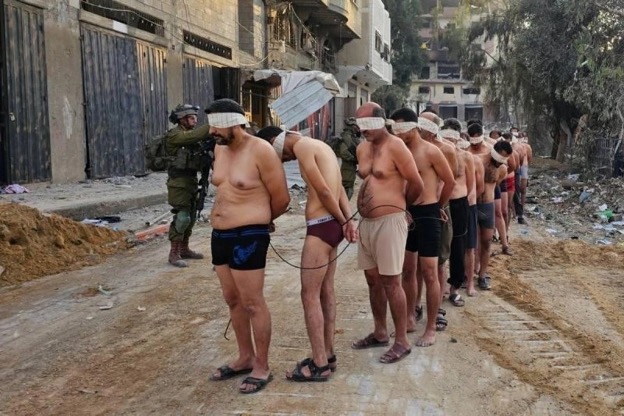
Stripped, blindfolded, and bound Palestinian civilians are taken prisoner and ordered into a line by Israeli occupation forces in Gaza in December 2023. Photo from a social media post by an Israeli soldier.

Bad men need nothing more to compass their ends, than that good men should look on and do nothing.
—John Stuart Mill


Supporters of Israel’s current “war” against Gaza often ask why critics don’t show equal concern for the victims of no less horrific conflicts elsewhere.

The implication, which is spelled out in the Holocaust Remembrance Alliance (IHRA) “working definition” of antisemitism, is that while “criticism of Israel similar to that leveled against any other country cannot be regarded as antisemitic,” we are guilty of antisemitism if we single out Israel for criticism while remaining silent on comparable atrocities in Sudan, or Myanmar, or Yemen.

While the IHRA definition has been accepted by many Western governments (including Canada), it has been challenged as “unclear in key respects and widely open to different interpretations” by 350 leading international scholars in the fields of Holocaust history, Jewish studies, and Middle East studies who came together to sign the alternative Jerusalem Declaration on Antisemitism (JDA) in 2020.

Pointing out that “The IHRA Definition includes 11 ‘examples’ of antisemitism, 7 of which focus on the State of Israel,” the JDA offers an alternative set of guidelines and examples.

The authors caution:

In general, when applying the guidelines each should be read in the light of the others and always with a view to context. Context can include the intention behind an utterance, or a pattern of speech over time, or even the identity of the speaker, especially when the subject is Israel or Zionism. So, for example, hostility to Israel could be an expression of an antisemitic animus, or it could be a reaction to a human rights violation, or it could be the emotion that a Palestinian person feels on account of their experience at the hands of the State. In short, judgement and sensitivity are needed in applying these guidelines to concrete situations.


Since October 7 I have published more on the Gaza genocide—I choose the word advisedly, for reasons that have recently been eloquently spelled out by former Israeli Defense Forces (IDF) soldier and world-renowned historian of genocide Omer Bartov—than I have ever published on any contemporary conflict in my 73 years on this planet, which have seen genocides in Bangladesh, East Timor, Cambodia, Somalia, Bosnia, Rwanda, Congo, and elsewhere, in many cases resulting in more deaths. This is an exception to my usual writing. As a rule, I seldom comment on current affairs.

Does this make me an antisemite?

Or is there something truly exceptional in the Gaza situation itself that calls for exceptional attention—and action?

Self-defence?

What has been going on in Gaza for almost a year now is not a conventional war between states. Indeed, to describe it as a war at all is misleading.

According to the International Court of Justice (ICJ) Advisory Opinion of July 19 on “Legal Consequences Arising from the Policies and Practices of Israel in the Occupied Palestinian Territory,” Gaza remains an occupied Palestinian territory because Israel:

continue[s] to exercise, certain key elements of authority … including control of the land, sea and air borders, restrictions on movement of people and goods, collection of import and export taxes, and military control over the buffer zone, despite the withdrawal of its military presence in 2005.


“This is even more so,” the judgment pointedly adds, “since October 7, 2023.”

What triggered Israel’s latest assault on Gaza was thus not an attack by a foreign state, like Russia’s assault on Ukraine or Israel’s 1973 Yom Kippur war, but an uprising by an occupied populace exercising a right of armed resistance that is recognized in international law.

This does not mean that Hamas committed no war crimes on October 7, but that Israel’s retaliation cannot be construed as self-defence.

A state cannot defend itself against a population whose land, per the ICJ, it has been illegally occupying for the last 67 years. This is not a war but a policing operation, albeit one of exceptional savagery.

October 7 may have seen “the worst horrors perpetrated on Jews since the Holocaust,” as Benjamin Netanyahu admonished Justin Trudeau when the latter questioned Israel’s “killing of women, of children, of babies” in the Gaza Strip. But contrary to its leaders’ frequent comparisons with the Holocaust, Israel is not facing an existential threat.

Hamas’s founding covenant promised “to raise the banner of Allah over every inch of Palestine” by Holy War—a statement that may be, but need not be interpreted as threatening a genocide of the Jewish population rather than elimination of an Israeli state in which “the right to exercise national self-determination … is unique to the Jewish people.” But Hamas is no more in a position to achieve this aim than it was in 1988.

It has no nukes, nor fighter planes, nor warships, nor tanks, nor high-tech drones and bombs. October 7 was launched on the back of hang-gliders, motorbikes, bulldozers, and the kind of assault rifles Americans can buy at Walmart.

In any case, Hamas revised its covenant in 2017 to accept a two-state solution, which has supposedly been the cornerstone of Western foreign policy since the 1993-5 Oslo Accords.

Managing terrorism

The total death toll on October 7—including those killed by IDF friendly fire—was 1,139 people, and one-third of the Israeli victims were not civilians, but members of the security forces. Horrific as the Hamas massacres were, this is paltry compared with the slaughter and destruction Israel has wreaked upon Gaza since.

The figure for known deaths in Gaza from Israeli military action now exceeds 40,000, while a recent article in the Lancet conservatively estimates the likely cumulative death toll from all war-related causes, including famine and disease, at upward of 186,000.

There was never any military necessity for Israel to cause so many civilian casualties. Hamas’s future threat could have been handled as Spanish governments did the Basque separatist terrorists of ETA or British governments did the IRA, by a combination of military containment and political engagement.

Instead, Israel consciously and deliberately chose the genocidal Amalek option. Sending his soldiers off to war, Benjamin Netanyahu recalled an episode from the Bible:

“This is what the Lord Almighty says,” the prophet Samuel tells Saul. “‘I will punish the Amalekites for what they did to Israel when they waylaid them as they came up from Egypt. Now go, attack the Amalekites and totally destroy all that belongs to them. Do not spare them; put to death men and women, children and infants, cattle and sheep, camels and donkeys.’”


According to official Israeli figures, 4,688 people were killed in “Palestinian terrorist attacks” since 1948, including the October 7 victims. For comparison, around 3,500 people died in the Irish Troubles between 1969 and 1998—meaning that the number of deaths from terrorism per annum in the Troubles was almost double that of Israel.

Despite this, neither Margaret Thatcher—who narrowly escaped death when the IRA bombed the Grand Hotel in Brighton in 1984 during the Conservative Party annual conference, killing five people and injuring 34 others—nor any other British prime minister responded by bombing West Belfast and Derry back into the Stone Age, even if the IRA was as embedded in the Catholic civilian population as Hamas is in Gaza.

Nor did Northern Ireland’s British occupiers cut off electricity, water, food, and fuel to Republican areas, as Israeli Defence Minister Yoav Gallant promised he would do to Gaza’s Palestinian “human animals” on October 9 (a promise Israel largely fulfilled).

The IRA’s indiscriminate pub bombings (and “kneecapping” of suspected informants and collaborators) were appalling too. But I suggest that had the British or Spanish authorities acted like Netanyahu or Gallant toward Gaza, the reaction among other Western governments—not least, the US government—would have been very different.

As a response to a terrorist attack from an occupied territory, Israel’s Gaza campaign is wholly exceptional, at least among Western democracies that claim to be governed by international law—the club to which Israel repeatedly and proudly claims to belong, and on whose behalf, Netanyahu frequently says, it is fighting.

Israel exists in a state of exception, to use the German jurist Carl Schmitt’s concept, in which the rule of law is suspended and the normal rules don’t apply.

Tooling genocide

Although a handful of countries have broken ranks as the conflict has ground on, the majority of Western states, led by the US, the UK, and Germany, have unconditionally supported Israel irrespective of the ever-rising death toll and destruction in Gaza.

Such unanimity is exceptional. Under President Eisenhower, the US condemned the British, French, and Israeli 1956 invasion of Suez, while Canada, like France and Germany, refused to participate in the US-led “coalition of the willing” that invaded Iraq in 2003.

As remarkably, this consensus extends across the mainstream democratic political spectrum, with so-called centre-left governments—Joe Biden and Kamala Harris’s Democrats in the US, Keir Starmer’s Labour Party in the UK, Olaf Scholz’s Social Democrats in Germany, Anthony Albanese’s Labour Party in Australia, Justin Trudeau’s Liberals in Canada—being as “ironclad” in their support for Israel (and as McCarthyite in their tarring of Israel’s critics as “antisemitic”) as their right-wing counterparts.

This support includes massive provision of arms, without which Israel could not continue its genocide. The US is Israel’s largest supplier of armaments (69 percent in 2019-23), followed by Germany (30 percent in 2019-23).

On August 13 the Biden administration approved a further $20 billion in weapons sales to Israel, including 50 F-15 fighter jets, 30 medium range air-to-air missiles, tactical vehicles, 32,739 tank cartridges of 120-mm rounds and 50,400 120-mm high-explosive cartridges for mortars.

The US’s one and only brief suspension of a munitions shipment (of 1,800 2,000-pound and 1,700 500-pound bombs) was lifted after Biden quietly forgot his threat to withhold further supplies of offensive weapons if Israel invaded Rafah.

Genocide Joe has now thankfully bowed out, but his anointed successor Kamala Harris has let it be known that her administration will not countenance an arms embargo on Israel either.

To be sure that the world got the message, no Palestinian American was permitted to speak on the main stage at the recent Democratic National Convention in Chicago—despite the risks of alienating Arab American voters in swing states like Michigan, which the Democrats need to win in November to hold the White House.

Canada has supposedly officially halted its arms sales to Israel, though it has now emerged that $60 million of made in Québec military hardware is still destined for murdering Palestinian children as part of the US$20 billion package.

Despite pro forma calls for a ceasefire by their foreign ministers, Germany and the UK are still providing Tel Aviv with arms. Having repeatedly called upon the previous Tory government to make public the legal advice it had received on doing so, the new British Foreign Secretary David Lammy has so far resisted calls to publish the advice himself.

At best, Western governmental representatives have criticized this or that individual IDF action or Israeli politician’s inflammatory statement or expressed “heartbreak” at the Palestinian people’s “suffering”—as if it were the result of an earthquake or tsunami rather than a war in which Western governments themselves are deeply implicated.

These mild admonishments are invariably prefaced (and thereby framed) by affirmations of Israel’s “right to defend itself” and ritual invocation of the horrors of October 7, as if these could somehow mitigate the evils perpetrated by Israel since.

US Defense Secretary Lloyd Austin meeting with Israeli Prime Minister Benjamin Netanyahu and Israeli Defense Minister Yoav Gallant in Tel Aviv, October 13, 2023. Photo by US Department of Defense/Wikimedia Commons.

Diplomatic cover

Recent calls for a ceasefire from the USUK, and the settler-colony troika of Canada, Australia and New Zealand are long on pieties and short on proposals that might actually achieve the purported objective—like UN Security Council mandated sanctions on Israel or an embargo on the supply of arms.

David Lammy, for example, issued a statement on July 14 that began: “The death and destruction in Gaza is intolerable. This war must end now, with an immediate ceasefire, complied with by both sides.” He continued:

I am meeting with Israeli and Palestinian leaders to stress the UK’s ambition and commitment to play its full diplomatic role in securing a ceasefire deal and creating the space for a credible and irreversible pathway towards a two-state solution. The world needs a safe and secure Israel alongside a viable and sovereign Palestinian state.


Nothing came of Lammy’s Middle East trip. Netanyahu refused to meet with the British foreign secretary, following the incoming Labour government’s decision to withdraw its predecessor’s objection to the International Criminal Court (ICC) chief prosecutor’s pursuit of an arrest warrant for Netanyahu and the Israeli defence minister.

Since October 7 the US and its allies have consistently blocked any effective diplomatic initiatives to end the war through the international body that is best placed to do so, the United Nations. This sharply contrasts with America’s unsuccessful attempts to use the UN as a cloak for its unprovoked invasion of Iraq in 2003.

Having vetoed two earlier UNSC attempts to mandate a ceasefire, the US finally abstained on resolution 2728 demanding “an immediate ceasefire for the month of Ramadan, the immediate and unconditional release of hostages and the urgent need to expand the flow of aid into Gaza,” allowing it to pass on March 25 on a vote of 14-0.

In a press conference immediately afterwards, US State Department spokesman Max Miller sought to undermine the resolution by repeatedly denying that it was binding.

Israel predictably ignored this resolution, as it has since ignored resolution 2735, which was presented by the US and passed unanimously on June 10 with one abstention (Russia). This endorses the three-stage US “roadmap to an enduring ceasefire and the release of all hostages” that Joe Biden unveiled in a televised address to the nation on May 31 as “a comprehensive new proposal” which, he said, “Israel has now offered.”

The ball was now firmly in Hamas’s court, US representative Linda Thomas-Greenfield assured the Security Council:

“The only way to bring about a durable end to this war” is a ceasefire deal between Israel and Hamas, she stressed, adding that Israel has agreed to a comprehensive deal on the table, which is nearly identical to Hamas’ own proposal. “Now we are all waiting for Hamas to agree to the ceasefire deal it claims to want, but we cannot allow to wait and wait,” she stated, noting that “with every passing day, needless suffering continues.”


Either Biden and Thomas-Greenfield were lying or the Israeli government was stringing them along.

The day after Biden’s TV address, senior Hamas official Sami Abu Zuhri told Reuters that “Hamas accepts a UN Security Council ceasefire resolution and is ready to negotiate over the details,” adding that “it was up to Washington to ensure that Israel abides by it.”

Benjamin Netanyahu meantime declared, contrary to Biden, that Israel’s “conditions for ending the war have not changed”:

The destruction of Hamas’ military and governing capabilities, the freeing of all hostages and ensuring that Gaza no longer poses a threat to Israel … The notion that Israel will agree to a permanent ceasefire before these conditions are fulfilled is a non-starter.


Negotiations have continued in Doha and Cairo, but every time a breakthrough seems in sight Israel moves the goal posts and comes up with new conditions it knows are likely to be unacceptable to Hamas. The latest have included continuing IDF military occupation of the Philadelphi Corridor on the Gaza-Egypt border and the newly-bulldozed Netzarim corridor that now divides the north and south of the Gaza Strip.

Crucially for Hamas, Netanyahu has repeatedly refused to commit to what Biden, in his May 31 address, assured the American people would be the outcome of the process—namely, that in phase two of the proposal,

Israeli forces would withdraw from Gaza; and as long as Hamas lives up to its commitments, a temporary ceasefire would become, in the words of … the Israeli proposal, “the cessation of hostilities permanently.”

Notwithstanding these repeated attempts to derail the talks—not to mention Israel’s assassination of Hamas’s political leader Ismail Haniyeh, the chief negotiator in the Cairo ceasefire talks, in Tehran on July 31—the US continues to blame the failure to reach an agreement on Hamas.

These are not good faith negotiations. They are political theatre.

Legal aid

On January 26, in response to South Africa’s request that the ICJ impose provisional measures “preserving … the right of the Palestinians in Gaza to be protected from acts of genocide and related prohibited acts,” the court ruled that there was a “plausible” risk of genocide in Gaza. It required Israel, inter alia, to:

take all measures within its power to prevent … (a) killing members of the group [Palestinians]; (b) causing serious bodily or mental harm to members of the group; (c) deliberately inflicting on the group conditions of life calculated to bring about its physical destruction in whole or in part; and (d) imposing measures intended to prevent births within the group.


A US state department spokesperson dismissed the ICJ findings (and the extensive and compelling evidence on which they were based), with the blithe assertion: “We continue to believe that allegations of genocide are unfounded.”

This is typical of US attempts to undermine the authority and discredit the judgments of the world’s two highest courts.

While paying lip-service to the ICJ’s “work in upholding the international rules-based order,” Canada made clear that “Our support for the ICJ does not mean that we accept the premise of the case brought by South Africa.” As ever, Mélanie Joly’s statement, which conspicuously ignored the question of genocide, went on to affirm “Israel’s right to exist and defend itself” and condemn “Hamas’s brutal attacks of October 7.”

On May 20, Chief Prosecutor Karim Khan asked the ICC to issue arrest warrants for Israeli Prime Minister Benjamin Netanyahu and Defence Minister Yoav Gallant for war crimes and crimes against humanity that included “starvation of civilians as a method of warfare,” “wilfully causing great suffering, or serious injury to body or health,” “wilful killing … or murder as a war crime,” “intentionally directing attacks against a civilian population,” “extermination,” “persecution,” and “other inhumane acts.”

Khan concurrently requested warrants for three Hamas leaders for crimes including “murder,” “taking hostages,” “rape and other acts of sexual violence,” “torture,” “cruel treatment,” and “outrages upon personal dignity.” Dispensing its own brand of summary justice, Israel has since assassinated two of them, Mohammed Deif and Ismail Haniyeh.

Predictably and ludicrously, Israeli politicians branded the ICC, as they previously had the ICJ, as “antisemitic.”

“We haven’t seen such a show of hypocrisy and hatred of Jews like that of the Hague Tribunal since Nazi propaganda,” proclaimed far-right Finance Minister Bezalel Smotrich. This is a man who recently complained to a conference in support of Jewish settlements that:

It’s not possible in today’s global reality to manage a war—no one will allow us to starve two million people, even though that might be just and moral until they return the hostages.


By ignoring the rulings of its own highest international courts, the West, led by the US, is allowing Israel to do exactly that.

Ignoring the substance of Khan’s charges, many Western governments—this time France and Germany were more circumspect—responded to his request for arrest warrants for Israeli leaders with outrage. Urged on by the US, Rishi Sunak’s UK government launched proceedings at the ICC challenging its jurisdiction in Gaza.

Joe Biden issued a White House statement that read, in full:

The ICC prosecutor’s application for arrest warrants against Israeli leaders is outrageous. And let me be clear: whatever this prosecutor might imply, there is no equivalence—none—between Israel and Hamas. We will always stand with Israel against threats to its security. 


Secretary of State Antony Blinken wrote that:

We reject the Prosecutor’s equivalence of Israel with Hamas. It is shameful. Hamas is a brutal terrorist organization that carried out the worst massacre of Jews since the Holocaust and is still holding dozens of innocent people hostage, including Americans.


On June 4, the US House of Representatives passed a bill “To impose sanctions with respect to the International Criminal Court engaged in any effort to investigate, arrest, detain, or prosecute any protected person of the United States and its allies.”

This time Mélanie Joly refrained from any official Canadian comment beyond noting that “All parties must make sure that they abide by international law.” But Justin Trudeau, too, found “the sense of an equivalency between the democratically elected leaders of Israel and the bloodthirsty terrorists that lead up Hamas” “troubling.”

For these Western leaders, what was outrageous or troubling was Kamil Khan’s even-handed focus on the crimes committed, irrespective of the status of their perpetrators.

What is more troubling is the unspoken assumption that elected representatives of “democracies” deserve different treatment to those whom the West has branded as terrorists—even if their crimes are the same (or worse). Do I need to remind today’s politicians that Adolf Hitler was democratically elected as German Chancellor too?

In a press release summarizing its advisory opinion of July 19 on “Legal Consequences Arising from the Policies and Practices of Israel in the Occupied Palestinian Territory,” the ICJ unambiguously spelled out the obligations of states regarding Israel’s behaviour in the occupied Palestinian territories, including Gaza:

all States are under an obligation not to recognize as legal the situation arising from the unlawful presence of the State of Israel in the Occupied Palestinian Territory and not to render aid or assistance in maintaining the situation created by the continued presence of the State of Israel in the Occupied Palestinian Territory.


The West’s continuing military and diplomatic support of Israeli action in Gaza and the other occupied Palestinian territories, in short, has been and continues to be in flagrant violation of international law.

Israel again inhabits that state of exception, beyond and outside the law, rather like the absolute immunity the US Supreme Court has recently granted Donald Trump.

States of exception

If Israel inhabits one state of exception, Palestinians inhabit another—and the two are mutually complementary.

The Palestinian state of exception is one of perpetual homelessness, hunger, disease, and violence. It is policed by IDF snipers who shoot Palestinian children in the head, the torturers and rapists of Sde Teiman and other Israeli detention camps and prisons, and the depraved young soldiers of “the most moral army in the world” who post videos of themselves prancing around in underwear stolen from displaced—or dead—Palestinian women on social media.

It is Israel’s state of exception, guaranteed by the West, that enables this reduction of Palestinian existence to bare life.

So to return to the question with which I began: is it antisemitic to single out Israel for criticism over Gaza while remaining silent on comparable atrocities elsewhere?

I do not think I—or the thousands of others across the West who are appalled by the genocide in Gaza—have suddenly morphed into antisemites. We refuse, rather, to make Palestinians an exception to human rights or Israelis an exception to human obligations.

My short answer to the question “Why Gaza?” and not Sudan, Myanmar, or Yemen—or East Timor, Bosnia, or Rwanda—is that inadequate as their responses to other atrocities may often have been, Western governments (and other institutions, like corporations, the mainstream media, or universities) were rarely actively complicit in perpetrating these horrors. Gaza is different. We are up to our necks in it.

I refuse to turn away and pretend the genocide in Gaza is a quarrel in a faraway country between people of whom we know nothing.

As a citizen of two Western democracies, Canada and the UK, I want to say, loud and clear: not in my name.

‘Unwavering support’ versus ‘ironclad commitment’—a tale of two strategies

First published in Canadian Dimension October 1, 2024 / 14 min read

The Great Mosque of Gaza in the late nineteenth century. Photo by Maison Bonfils/Library of Congress.

The discrepancy between Western framing of the conflicts in Ukraine and Gaza has often been noted. In the words of one critic, Kari McKern, writing in July 2024:

In Gaza, Palestinian suffering is often sanitised or contextualised to diminish its horror. When an Israeli airstrike hit a UN school sheltering civilians in July 2024, killing dozens, many Western outlets led with the Israeli military’s claims of militant activity in the area rather than centring the civilian deaths. Meanwhile, Ukrainian civilian casualties are presented as unambiguous tragedies, with individual stories examined and highlighted to evoke empathy. This asymmetry extends to the language used to describe combatants and their actions. Hamas fighters are invariably “terrorists,” while Ukrainian forces are “defenders” or “freedom fighters.” Israel “responds” or “retaliates,” while Russia “invades” or “attacks” …

The human toll in both conflicts is staggering, yet the West’s reaction has been wildly inconsistent. [When] Ukrainian apartment buildings are destroyed Western leaders were quick to decry war crimes. But similar accusations against Israel for its actions in Gaza are absent, muted or included so as to be dismissed entirely. As one Palestinian journalist put it, “Our dead don’t seem to count the same way.”


There is one instance of the West’s double standards, however, that has received little if any comment. Arguably, it is the most important—and revealing—inconsistency of all. It concerns Western, and especially American, policies regarding arms supplies to “allies.”

When US President Joe Biden and UK Prime Minister Keir Starmer met in Washington, DC, two weeks ago for “an in-depth discussion on a range of foreign policy issues of mutual interest,” the conflicts in Ukraine and Gaza dominated their conversation.

According to the official White House readout of their September 13 meeting, “The two leaders reaffirmed their unwavering support for Ukraine as it continues to defend against Russia’s aggression.” In that connection, they “expressed deep concern about Iran and North Korea’s provision of lethal weapons to Russia and the People’s Republic of China’s support to Russia’s defense industrial base.”

While paying lip-service to “the urgent need for a ceasefire deal that will free the hostages and enable increased relief in Gaza, and the need for Israel to do more to protect civilians and address the dire humanitarian situation in Gaza,” the self-appointed leaders of the free world “reiterated … their ironclad commitment to Israel’s security.”

No doubt diplomats can explain the subtle differences between “unwavering support” and “ironclad commitment.” On previous form, they would seem to be considerable.

Unwavering support, or the “slow yes” Ukraine strategy

Kari McKern’s point was nicely illustrated in Keir Starmer’s address to the UN Security Council on September 25.

Directly addressing the Russian representative, he said he deplored the 35,000 Ukrainian civilians killed or injured, the six million forced to flee and the 20,000 Ukrainian children kidnapped since Russia invaded Ukraine on 24 February 2022—not to mention “Six hundred thousand Russian soldiers … killed or wounded in this war.”

And for what? The UN charter, which they [Russian representatives] sit here to uphold, speaks of human dignity. Not treating your own citizens as bits of meat to fling into the grinder.


“I think of Yaroslav Bazylevych, whose wife and three daughters were killed earlier this month by a Russian strike on civilians in Lviv,” the British PM went on. “And I wonder how Russia can show its face in this building.”

We must ensure accountability for those violating the UN charter and this council must recommit to the values that it sets out. This should go without saying. Yet, the greatest violation of the charter in a generation has been committed by one of this council’s permanent members.


We have yet to hear Starmer shedding any tears over Israel’s killings of five-year-old Hind Rajab and seven-year-old Sidra Hassouna, or the assassination of Palestinian poet Refaat Alareer, who was murdered along with his brother, his brother’s son, his sister, and four of her children in a targeted Israeli airstrike on his Gaza apartment on December 7—or any criticism of Israel’s condemnation of scores of its own citizens to fiery deaths at IDF hands on October 7 as a result of applying the Hannibal Directive.

The British PM also had little to say about “flagrant violations of the charter” when Israel disregarded four UN Security Council ceasefire resolutions this year, ignored two rulings by the International Court of Justice (ICJ) on the plausible risk of genocide in Gaza and the illegality of its continuing occupation of the Palestinian territories seized during the 1967 Six Day War, and refused to cooperate with the International Criminal Court (ICC) investigation into possible war crimes in the Occupied Territories. But let that pass.

The crucial point, in the present context, is that despite what Starmer (rightly) represents as a blatant act of aggression by Russia—and notwithstanding the ICC issuing an arrest warrant for Russian President Vladimir Putin for “the war crime of unlawful deportation of population (children)”—the West has consistently not provided Ukraine with all the armaments it has requested, nor permitted their unconditional use against Russia.

Ukrainian President Volodymyr Zelensky’s repeated pleas that these restrictions harm Ukraine’s ability to defend itself have so far fallen on deaf ears—not least in the US.

Though the line is not always an easy one to draw, the Biden administration has mostly limited its “unwavering support” to provision of defensive weapons for use in fighting within Ukraine or immediately adjacent border areas, and conditioned supplies of arms on their not being used to strike the Russian heartland.

Hardware requested in the course of the war by Ukraine and denied or delayed by Western states includes Patriot air-defence missiles (not supplied by the US until 300 days into the war), US Abrams and German Leopard and Marder tanks, long-range high precision HIMARS artillery, and F-16 fighter jets (which the US embargoed until 29 months after the Russian invasion).

Provision of ATACAMS (Army Tactical Missile Systems), which have a range of around 190 miles and could hit many Russian cities, has so far remained a particular no-no.

While the UK now wishes to give Zelensky permission to deploy British-made Storm Shadow long-range ballistic missiles to strike targets deep within Russia, the US, which makes some components for the missiles, has so far refused to entertain this. Despite the urgings of Starmer and UK Foreign Secretary David Lammy on their recent visits to Washington, at the time of writing the US is continuing to veto Britain’s suggestion.

Criticizing what he calls the Biden administration’s “slow yes” strategy in Time magazine in December 2023, Elliot Ackerman wrote that:

This has led to a kind of phony war, in which the US and NATO cheer Ukraine’s victories and gradually provide Ukraine with high-end weapons, but dole them out slowly and in numbers small enough to allow Ukraine to fight but not to win.


The key considerations behind this strategy, at least as publicly stated by Biden and other American officials, appear to be avoidance of provoking a potentially nuclear escalation, as Putin has threatened, and fear of exacerbating disagreements among NATO European members, whose support for the Ukrainian cause differs widely.

These are eminently reasonable concerns. We might therefore equally reasonably ask: why has similar caution not prevailed when it comes to arming Israel?

Ironclad commitment, or the “we never say no” strategy

While the united Western support for Israeli action that followed Hamas’s attacks of October 7 has slowly fractured as the carnage in Gaza has grown, with Ireland, Spain, Norway, Belgium, Portugal, and even France among others becoming more critical of Israel and supportive of the Palestinian cause—though not of Hamas—Israel’s major Western arms suppliers have stood fast in their commitment to the Jewish state.

The UK and Germany have recently introduced (very) limited restrictions on licenses for arms sales to Israel following the ICJ advisory opinion of July 19 on the illegality of Israel’s occupation of the Palestinian territories—presumably in the hope that this will protect them against any future charges of complicity in Israeli war crimes in Gaza.

A German government spokesman was nonetheless adamant that “There is no ban on arms exports to Israel, and there will be no ban,” while David Lammy assured the UK Parliament that it was “with regret” that “we are announcing the suspension of around 30 export licences to Israel,” affirming once again that “The UK continues to support Israel’s right to self-defence in accordance with international law.” Those 30 licenses represented a mere eight percent of the UK’s total arms sales to Israel.

According to Foreign Minister Mélanie Joly, Canada officially ceased approving new arms supplies to Israel in March. The details, however, including continuing use of Canadian-made components in US-supplied weapons, remain distinctly murky.

Michael Bueckert, vice president of Canadians for Peace and Justice in the Middle East, is one of many who argues that because of lack of clarity and loopholes in the law:

this government is misleading Canadians into thinking that we aren’t exporting weapons to Israel at all. As Canadians increasingly demand that their government impose an arms embargo on Israel, politicians are trying to pretend that the arms trade doesn’t exist.


Most consequentially, the US (which supplies around 70 percent of Israel’s arms imports) has remained determinedly immune to any pressure to restrict or condition these supplies, whether from international bodies like the UN, the ICJ, the ICC, and a raft of human rights and charitable NGOs, or from domestic critics.

I am not just referring here to the usual left-wing suspects like Jill SteinBernie Sanders, or “Squad” members Ilhan Omar and Alexandra Ocasio-Cortez.

Even the self-described “highest-ranking Jewish elected official in our government, and a staunch defender of Israel,” Senate Majority Leader Chuck Schumer, warned back on March 14:

If Prime Minister Netanyahu’s current coalition … continues to pursue dangerous and inflammatory policies that test existing US standards for assistance, then the United States will have no choice but to play a more active role in shaping Israeli policy by using our leverage to change the present course.

The United States’ bond with Israel is unbreakable, but if extremists continue to unduly influence Israeli policy, then the Administration should use the tools at its disposal to make sure our support for Israel is aligned with our broader goal of achieving long-term peace and stability in the region.


While Schumer did not explicitly call for conditioning future US arms supplies on Israel “changing course,” the inference is difficult to avoid.

Despite widespread speculation at the time that “There is a very real chance that the United States will halt the sale of offensive weaponry to Israel by month’s end should it fail to dramatically improve the amount of aid entering Gaza, or if it launches a military operation in Rafah without a credible plan for the million-plus Palestinians sheltering there,” the Biden administration instead doubled down on arming the genocide.

On May 8 Biden told CNN that “I made it clear that if they go into Rafah … I’m not supplying the weapons that have been used historically to deal with Rafah, to deal with the cities—that deal with that problem.” The subsequent US suspension of a shipment of 1,700 500-pound bombs and 1,800 2,000-pound bombs—its only restriction of arms supplies to date—proved to be short-lived. Israel ignored Biden’s “red line” and launched its bloody assault on Rafah. The US lifted its halt on 500-pound bombs on July 10.

Meanwhile, Secretary of State Antony Blinken reportedly twice played fast and loose with US law in cases that would have required the US to cease supplying arms to Israel.

In late April, Blinken allegedly ignored misgivings in the State Department over whether Israel’s use of US-supplied arms in Gaza was “consistent with all applicable international and domestic law and policy, including international humanitarian law and international human rights law,” and certified Israel’s own assurances as “credible and reliable.” This was required under the Biden administration’s National Security Memorandum (NSM) 20, a measure adopted on February 8 with the declared aim of ensuring accountability.

Around the same time, per a recent scoop in Politico, Blinken was aware of both a US Agency for International Development (USAID) 17-page memo to the State Department claiming that Israel was “subjecting US humanitarian aid destined for Gaza to ‘arbitrary denial, restriction and impediments,’” and emails from the head of the State Department Bureau of Population, Refugees and Migration which asserted that “Israel was blocking humanitarian aid and that the Foreign Assistance Act should be triggered to freeze almost $830 million in taxpayer dollars earmarked for weapons and bombs to Israel.”

Blinken chose to ignore both sets of recommendations, testifying to Congress on May 10 that “We do not currently assess that the Israeli government is prohibiting or otherwise restricting the transport or delivery of US humanitarian assistance.”

On July 2, 12 former Biden administration officials who had resigned over US policy toward Gaza issued a joint statement in which they argued that:

America’s diplomatic cover for, and continuous flow of arms to Israel has ensured our undeniable complicity in the killings and forced starvation of a besieged Palestinian population in Gaza.


Ongoing weapons transfers to Israel despite its actions in Gaza, they added, have “put a target on America’s back.”

Notwithstanding the Rafah offensive and other subsequent Israeli atrocities including airstrikes on schools and hospitals, on August 13 the Biden administration approved a further $20 billion in weapons sales to Israel, including 50 F-15 fighter jets, 30 medium range air-to-air missiles, tactical vehicles, 32,739 tank cartridges of 120-mm rounds and 50,400 120-mm high-explosive cartridges for mortars.

America’s “ironclad commitment” to Israel seems unlikely to change whoever wins the November US presidential election. Interviewed on CNN on August 30, the only person standing in the way of a second Donald Trump presidency offered little “joy”—am I the only one who finds this campaign motif obscene in the circumstances?—to Palestinians:

Let me be very clear: I am unequivocal and unwavering in my commitment to Israel’s defense and its ability to defend itself. And that’s not going to change …


Asked whether this means there would be “no change in policy in terms of arms and so forth?” Kamala Harris responded: “No, I—we have to get a deal done.”

This refusal to countenance any deviation from Biden’s policy is all the more remarkable given that opinion polls suggest the election is likely to be extremely close.

According to a recent YouGov poll in the crucial swing states of Arizona, Pennylvania, and Georgia, “80% or more of Democrats and Independents support a permanent cease-fire and 60% or more disapprove of more weapons to Israel.” Polls cannot be treated as reliable predictors, but the successes of the “uncommitted” campaign in the Democratic primaries earlier this year suggest that in refusing to reconsider the party position on arms to Israel Harris is risking losing substantial Arab American, Muslim American, and youth support and votes in the swing states where she needs them most.

There could be no more eloquent—or sadder—testimony to the US “ironclad commitment” than the Democrats’ apparent willingness to throw the election to Donald Trump rather than even consider conditioning arms supplies to Israel on its behaving in accordance with international law.

Beyond realpolitik?

The contrast between Western, and especially US, policies on arms supply to Ukraine and Israel, is glaring. It is also difficult to rationally comprehend, let alone morally justify.

While the figures for Ukrainian casualties cited by Keir Starmer in his September 25 address to the UN are undoubtedly horrific, they look positively benign when compared with the casualties in Gaza. In eleven months of war (compared with two years and eight months of war in Ukraine), at least 41,534 Palestinians have been killed and more than 96,092 injured. More than 10,000 are missing, presumed buried under the rubble.

Though Gaza’s Health Ministry casualty figures do not differentiate between civilians and combatants, even Joe Biden conceded back in March that “more than 30,000 Palestinians have been killed—most of whom are not Hamas” (my emphasis).

Israel has slaughtered nearly 16,500 children in Gaza—surely a more heinous war crime than Russia’s kidnappings of Ukrainian kids. Around 1.9 million people—nearly nine in ten Gazans—have been “displaced,” i.e., forced to flee from their homes, at least once.

In making these comparisons, we need to remember that while the pre-war population of Ukraine was 37.9 million, that of Gaza was a mere 2.3 million.

If ever there was a case for embargoing or at least conditioning arms supplies on purely humanitarian grounds, Gaza provides it. The IDF makes Putin’s butchers of Chechnya, Georgia, and Syria—not to mention Mariupol—look like the most moral army in the world.

Ukraine is facing a genuine existential crisis provoked by an invasion by a great power that possesses the largest nuclear armory on the planet. Should Russia win this war, the implications for European—and Western—security are potentially profound.

By contrast, however appalling (or criminal) the events of October 7 may have been, Israel is confronting what some have likened to a prison breakout by a people whose territories it has been illegally occupying for 67 years, in an area around twice the size of Washington, DC, whose borders it has blockaded since 2007.

Hamas might wish to destroy Israel but it does not remotely have the capacity to do so. October 7 is not evidence of an existential threat to the Israeli state, but of unforgiveable lapses in security while its leaders’ minds were on other things.

The costs to the West of its “ironclad commitment” to Israel far outweigh any benefits. Whatever potential geopolitical, economic, or domestic political advantages may once have been conferred by support for Israel are forever buried in the rubble of Gaza. We are beyond realpolitik, and the world is slowly realizing it.

On September 18 the United Nations General Assembly overwhelmingly adopted “a historic text demanding that Israel brings to an end its unlawful presence in the Occupied Palestinian Territory, no later than 12 months from the adoption of the resolution,” in accord with the ICJ advisory opinion of July 19.

With a recorded vote of 124 nations in favour, 14 against, and 43 abstentions, the resolution calls for Israel to comply with international law and withdraw its military forces, immediately cease all new settlement activity, evacuate all settlers from occupied land, and dismantle parts of the separation wall it constructed inside the occupied West Bank.

The General Assembly further demanded that Israel return land and other “immovable property”, as well as all assets seized since the occupation began in 1967, and all cultural property and assets taken from Palestinians and Palestinian institutions.

The resolution also demands Israel allow all Palestinians displaced during the occupation to return to their place of origin and make reparation for the damage caused by its occupation.


Apart from Israel and the US, the opponents of the resolution were Argentina, Czechia, Hungary, Malawi, Papua New Guinea, Paraguay, and the Pacific states of Fiji, Micronesia, Nauru, Palau, Tonga, and Tuvalu—a tiny minority of the international community.

Several European nations, including the UK, Germany, and Italy, abstained, as did Australia, Canada, India—and Ukraine, whose supply of US arms, as we have seen, has always been conditional on doing what Uncle Sam says.

It is noteworthy—and shows how far opinion has shifted over the last eleven months—that supporters of the resolution included Belgium, Estonia, Finland, France, Greece, Iceland, Ireland, Japan, Latvia, Luxembourg, New Zealand, Norway, Portugal, and Spain. Most of the BRICS countries, including Russia, China, South Africa, and Brazil, voted in favor of the resolution.

Israel and the United States are increasingly isolated in the court of world opinion.

Yet still the carnage continues and still the arms flow. On September 27, in what may prove to be a cataclysmic escalation of the war to Lebanon, Israel dropped US-supplied 2,000-pound bunker-buster bombs on the Dahiya residential area of Beirut, flattening six apartment blocks and killing Hezbollah leader Hassan Nasrallah. Benjamin Netanyahu authorized the strike by telephone from his hotel room in New York, where he was addressing the UN General Assembly and scores of delegates walked out.

The cost of Nasrallah’s scalp was likely several hundred Lebanese civilian lives. The Palestinian journalist got it right. Their dead don’t seem to count the same way.