Facts, fictions, and fabrications regarding Israel’s ‘Black Sabbath’
First published Canadian Dimension April 2, 2024
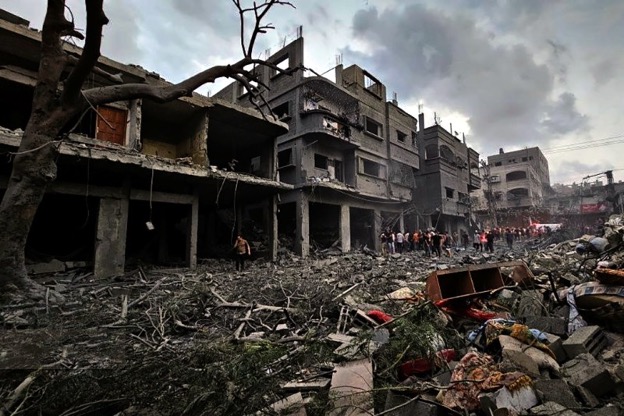
Destruction in Gaza following an Israeli bombing raid. Photo courtesy Fars News Agency/Wikimedia Commons.
Red lines
In his State of the Union address, delivered on March 7, US President Joe Biden signaled an apparent shift in American policy toward the Gaza War—though so far, it has to be said, this has proved largely cosmetic.
Asked afterward by an MSNBC interviewer whether Israel’s threatened invasion of Rafah, where 1.5 million desperate Palestinians have taken refuge, would constitute a “red line,” Biden answered:
It is a red line, but I’m never going to leave Israel. The defense of Israel is still critical, so there’s no red line where I’m going to cut off all weapons so they don’t have the Iron Dome to protect them.
He then added:
But there’s redlines that if he [Benjamin Netanyahu] crosses them … They cannot have 30,000 more Palestinians dead as a consequence of going after … there’s other ways to deal with the trauma caused by Hamas.
At the time, some interpreted this as a hint that Biden might condition the future supply of specifically offensive weapons on Israel’s reining in its assault.
Netanyahu’s response was defiant. “We’ll go there [Rafah],” he assured a Politico interviewer (and has repeated many times since):
We’re not going to leave them [Hamas]. You know, I have a red line. You know what the red line is? That October 7 doesn’t happen again. Never happens again.
A week later, stung among other things by Canada’s decision to suspend future arms sales to Israel, Netanyahu challenged “our friends in the international community”:
Is your memory so short? So quickly you forgot about October 7, the worst massacre committed against Jews since the Holocaust? So quickly you are ready to deny Israel the right to defend itself against the monsters of Hamas?
And so we return, as we always return, to October 7.
Hamas is ISIS
The events of October 7 are the alpha and omega of Israel’s representation of its assault on Gaza as “self-defense” against Hamas’s supposed “existential threat,” which Israel compares to ISIS and the Nazi Holocaust.
Israel’s position can be summarized by saying that nothing Israel did to Palestinians before October 7 can possibly justify Hamas’s attack, whereas the horrors of that attack justify anything and everything Israel has done to Gaza since—or will do to Gaza in the future.
I have no wish to minimize the horrors Hamas perpetrated on October 7. But given what those horrors have been used to justify since—as of April 1, at least 32,845 Palestinians have been killed and 75,392 injured in pursuit Israel’s “absolute victory“—it is important to try to distinguish fact from fiction concerning “Black Sabbath.”
Netanyahu set out his stall on October 9:
We didn’t want this war.
It was forced upon us in the most brutal and savage way …
The savage attacks that Hamas perpetrated against innocent Israelis are mindboggling: slaughtering families in their homes, massacring hundreds of young people at an outdoor festival, kidnapping scores of women, children and elderly, even Holocaust survivors.
Hamas terrorists bound, burned and executed children.
They are savages.
Hamas is ISIS.
And just as the forces of civilization united to defeat ISIS, the forces of civilization must support Israel in defeating Hamas …
“We saw the wild animals,” he told his shaken compatriots in a televised address two days later:
We saw the barbarians we are facing. We saw a cruel enemy. An enemy worse than ISIS. We saw boys and girls, bound, shot in the head. Men and women burned alive. Young women raped and slaughtered. Fighters decapitated … In one place, they set fire to tires around them, and burned them alive.
Speaking on October 18 in Tel Aviv, which he was the first US president to visit in a time of war, Joe Biden echoed his host’s narrative:
More than 1,300 innocent Israelis killed, including at least 31 American citizens, by the terrorist group Hamas.
Hundreds—hundreds of young people at a music festival of—the festival was for peace—for peace—gunned down as they ran for their lives.
Scores of innocents—from infants to elderly grandparents, Israelis and Americans—taken hostage.
Children slaughtered. Babies slaughtered. Entire families massacred.
Rape, beheadings, bodies burned alive.
Hamas committed atrocities that recall the worst ravages of ISIS, unleashing pure unadulterated evil upon the world.
There is no rationalizing it, no excusing it. Period.
These are very serious accusations. The question is: how far are they warranted?
Imagined atrocities
On October 10 Israel announced that “more than 1,400 people” had been “killed by Hamas terrorists” in the October 7 attack. On November 10 the Israeli foreign ministry “updated” its estimate to “around 1,200 people.” The reason for the revision, said spokesman Lior Haiat, was that “there were a lot of corpses that were not identified and now we think those belong to terrorists … not Israeli casualties.”
That so many bodies were so badly burnt that it was difficult to establish who they were, let alone how they died, should have rung alarm bells, but it did not stop Haiat from baldly asserting (and Western media from mindlessly repeating) that “Hamas terrorists … brutally murdered about 1,200 people in cold blood.”
To this day, Western media reiterate again and again that “Some 1,200 people, mostly civilians, were killed in southern Israel during the Hamas-led incursion on Oct. 7.” It is not infrequently stated that “at least” or “more than” 1,200 were killed.
Yet a more authoritative and accurate count, compiled by Israel’s state social security agency Bituah Leumi and reported by Agence France-Presse (AFP) on December 15, has long been available to Western media. This gave a total of 1,139 deaths resulting from Hamas’s attack, of whom 695 were Israeli civilians, 373 were security forces, and 71 were foreigners.
AFP reported a revised total based on new Israeli figures of 1163 on February 1, which included 20 hostages known to have died since in Gaza.
These figures conclusively debunk the tales of beheaded babies, babies baked in ovens, babies hung on clothes lines, babies ripped from their mothers’ wombs and stabbed, that were widely reported as fact in the Western press and propagated by politicians like Biden and US Secretary of State Anthony Blinken. Such stories did much to gain Israel support in the early weeks of its retaliatory assault on Gaza.
Golan Vach, head of the army’s search and rescue unit, related how he “personally” transported “a decapitated baby” found in its dead mother’s arms in Be’eri kibbutz. But only one baby appears in Bituah Leumi’s list of those killed in Be’eri, 10-month-old Mila Cohen, and she was shot (and not decapitated). The Israeli government claimed on October 10 that “forty babies” were murdered at Kfar Aza kibbutz, but Bituah Leumi lists 46 civilians killed at Kfar Aza in all, of whom the youngest was 14.
Full exposés of these and other fabrications can be found on The Grayzone, Haaretz, Mondoweiss, and Electronic Intifada websites, so I need not say any more here.
In fact, per Bituah Leumi’s figures, a total of 36 children were killed in Israel on October 7, twenty of whom were under 15 years old and ten of whom died in rocket attacks. Only two of them were babies. Three children aged between two and six were killed in their home at Nir Oz kibbutz, and two brothers aged five and eight perished in their car with their parents when they drove into IDF–Hamas crossfire.
While all these deaths are to be mourned—as are those of 12,400 Palestinian children Israel killed between October 8 and February 20 in Gaza—they would seem to fall into the category of what Joe Biden, excusing the deaths of innocents in Gaza, called “a price of waging war” rather than recalling “the worst ravages of ISIS.”
Some might see Israel’s callously abandoning premature babies to die after the IDF assaulted Al-Nasr Children’s Hospital and forced medical staff to leave, on the other hand, as an unambiguous crime against humanity. We might also spare a thought for 12-year-old Sidra Hassouna, who was left hanging dead from a wall, ribbons of flesh all that was left of her legs after an earlier Israeli strike on Rafah.

Kibbutz Be’eri a few days after the Hamas attack of October 7. Photo by Micah Brickman/Wikimedia Commons.
Hasbara
One of the most creative purveyors of atrocity stories was Yossi Landau, southern commander of ZAKA, an Israeli religious voluntary organization that collects bodies and body parts from the sites of attacks and disasters.
ZAKA volunteers are often wrongly described in the Western media as “first responders,” but this is misleading. ZAKA’s concern is with proper burial of the dead according to Judaic ritual, and—crucially in this context—its volunteers have no forensics training. Indeed, they are actively hostile to the use of autopsies or other forensic procedures they regard as defiling the dead, even though these are often required to reliably establish the cause of a death (or physical evidence of a rape).
Landau is the sole source for a horrific story that went around the world, which Anthony Blinken repeated to the Senate Appropriations Committee on October 31:
A young boy and girl, six and eight years old, and their parents, around the breakfast table. The father, his eye gouged out in front of his kids. The mother’s breast cut off. The girl’s foot, amputated. The boy’s fingers cut off, before they were executed. And then their executioners sat down and had a meal. That’s what this society is dealing with, and no nation could tolerate that.
There is not a shred of corroborating evidence for this gruesome tale. And the Bituah Leumi list contains no siblings aged 6 to 8 recorded as killed in Be’eri.
An investigation published on January 31 in Haaretz details how “As part of the effort to get media exposure, Zaka spread accounts of atrocities that never happened, released sensitive and graphic photos, and acted unprofessionally on the ground.”
Since October 7 ZAKA has worked closely with the National Hasbara Headquarters in the Israeli prime minister’s office. Hasbara is a Hebrew term meaning “explanation,” or “public diplomacy,” but is more aptly translated here as government propaganda.
Meeting with ZAKA volunteers on November 23, Netanyahu told them:
These are powerful stories and we are in a major fight. This fight is not about to end at the moment … we need to buy time, which we also buy by turning to world leaders and to public opinion. You have an important role in influencing public opinion, which also influences leaders.
Demographics of the dead
The rhetoric of politicians and Western mainstream media has relentlessly sought to create the impression that the principal targets of Hamas’s attack were innocent, civilian victims—especially babies, children, women, and elderly people. Working from an earlier list of victims published by Haaretz on October 19, a report for Action on Armed Violence by Tamsin Westlake paints a significantly different picture.
“Of the total of 1,004 victims whose gender is identified, 735 (73.4 percent) … were male, and 278 (26.6 percent) female.” The gender imbalance was even more marked among victims belonging to the military (298 or 77.6 percent males, to 38 or 11.8 percent females) and police (86.44 percent males, 4.72 percent females).
The dead included 29 children under 18 and 57 people over the age of 61, who together formed less than seven percent of the total. By far the largest category of October 7 casualties fell into the 18–25 age group (447 people), followed by 26 to 40-year-olds (226 people).
This age and gender profile of victims is the exact opposite of what we would expect to find from listening to Netanyahu and Biden, reading the Daily Express or the New York Times, or watching ABC, BBC, CBC, or CNN.
The high number of 18- to 25-year-old victims includes many killed at the Nova music festival (332, a figure that was later revised upward to 364). But as Westlake points out, “One of the reasons the number of victims between 18-25 is large compared to the other categories is that most of the individuals in that age range were serving in the military—258 out of 447.”
While more civilians than military died on October 7, it is grossly misleading to say that the victims were “mostly civilians.” Per Bituah Leumi’s figures, one-third (32.75 percent) of the casualties were members of the IDF, police, or security guards. These were not “innocent civilians.” They were combatants.
Friendly fire
There can be no doubt that Hamas did murder large numbers of civilians in cold blood on October 7. Many were shot, often at close quarters. Some burned to death when Hamas fighters set fire to their homes to smoke them out of safe rooms. Others died when Hamas threw hand grenades into the bomb shelters in which they were hiding.
But there is also much to suggest that many civilian deaths, including at the Nova music festival and in Be’eri kibbutz—the sites of the worst casualty counts—resulted from IDF “friendly fire.” This has been well covered in Mondoweiss, Electronic Intifada and Middle East Eye, so I shall give just a few examples here.
In Be’eri kibbutz, reported photographer Quique Kierszenbaum, “Building after building has been destroyed … walls reduced to concrete rubble from where Israeli tanks blasted the Hamas militants where they were hiding.” Tuval Escapa, a member of the Be’eri security team, told Haaretz that “the commanders in the field made difficult decisions—including shelling houses on their occupants in order to eliminate the terrorists along with the hostages.”
On being shown footage of the destruction at Be’eri and Kfar Aza for Al Jazeera’s excellent documentary October 7—the fullest and best-researched investigation to date—British military expert Chris Cobb-Smith concluded that “such catastrophic structural damage was clearly not caused by a structural collapse from a fire” and would have been “caused by some sort of heavy weapons system during combat.”
Hamas fighters only carried light weaponry—mainly assault rifles and rocket-propelled grenades (RPGs). This kind and scale of damage, as other analyses confirm, could only have been caused by fire from tanks, drones, or Apache helicopters, which only the IDF possessed.
The same applies to the large number of cars burnt out at the Nova music festival, which provided some of the most haunting images of the day’s horrors. As Jonathan Cook puts it, “The burnt cars piled up as a visual signifier of Hamas’ sadism are, in fact, evidence of, at best, Israel’s incompetence and, at worst, its savagery.”
Yasmin Porat’s testimony
Forty-four-year-old mother of three Yasmin Porat escaped the Nova festival with her partner to Be’eri kibbutz, only to be captured and held together with 11 other hostages in a house occupied by 40 Hamas fighters. “They treated us very humanely,” she says, “Because their objective was to kidnap us to Gaza. Not to murder us.”
After two hours Israeli security forces arrived. There was a fierce gun battle, during which one of the Hamas militants surrendered, taking Porat out of the house with him as a human shield.
Yasmin Porat: I see on the lawn, in the garden of the people from the kibbutz. There are five or six hostages lying on the ground outside, just like sheep to the slaughter, between the shooting of our [fighters] and the terrorists.
Aryeh Golan [interviewer]: The terrorists shot them?
Yasmin Porat: No, they were killed by the crossfire. Understand there was very, very heavy crossfire.
Aryeh Golan: So our forces may have shot them?
Yasmin Porat: Undoubtedly.
The fighting went on until 8:30, when:
They [i.e., the IDF] eliminated everyone, including the hostages. After insane crossfire, two tank shells were shot into the house … And at that moment everyone was killed. There was quiet, except for one survivor that came out of the garden, Hadas.
Porat’s account is corroborated by the other survivor, Hadas Dagan, as well as by Brig. Gen. Barak Hiram, who led the IDF forces. Hiram wanted the standoff resolved by nightfall. After the Hamas fighters fired an RPG, he ordered the tank commander: “The negotiations are over. Break in, even at the cost of civilian casualties.”
Liel Hetzroni
Among the victims were 12-year-old twins Liel and Yanai Hetzroni, whose screams for help, Dagan says, she will never forget.
A pretty little girl, Liel Hetzroni became a poster child for hasbara. On November 14, former Prime Minister Naftali Bennett tweeted:
12 year old Liel Hetzroni of Kibbutz Beeri was murdered in her home by Hamas monsters on Oct 7th. Her body has now been identified. Her brother and grandfather were also murdered. Look at her sweet smile. Liel harmed nobody. She was murdered just because she’s Jewish.
Bennett’s claim was repeated by the Jewish Chronicle and Lucy Manning of the BBC. Israeli news site Ynet reported that Hamas fighters “murdered them all. Afterwards, they set the house alight.”
The trigger-happy Brig. Gen. Barak Hiram, who gave the order that killed Liel and torched the house, was subsequently reprimanded for ordering the demolition of a building at Israa University in Gaza City without proper authorization. He is currently being considered for the post of Benjamin Netanyahu’s military secretary.
The fog of war
A detailed account of the events of October 7 by Israeli military correspondents Ronen Bergman and Yoav Zitun was published in the newspaper Yedioth Ahronoth’s weekend supplement 7 Days on 12 January 2024 and translated by Electronic Intifada on January 20. It makes uncomfortable reading:
On this Black Sabbath … some of the hardest, most embarrassing and infuriating chapters in the history of the army were also written. This includes a command chain that failed almost entirely and was entirely blindsided; orders to open fire on terrorist vehicles speeding towards Gaza even as there was a concern that they contained captives—some sort of renewed version of the Hannibal Directive; fighters who—due to lack of communications—had to direct aerial support using their cell phones … warplanes roaming the air in the critical moments of the attack without guidance … and even unmanned aircraft operators who had to join the kibbutz WhatsApp groups in order to let besieged civilians help them to build a list of targets. And everything was so crazy, chaotic, improvised, and haphazard that you have to read it to believe that this is what actually happened.
At 8:10, with much of Israel’s observation and communications systems knocked out by Hamas, Zik UAV (drone) operators were told, “You have authority to fire at will.”
When at 8:30 the only two Apache helicopters then in the air in the Gaza envelope spotted “a tremendous river of human beings, flowing through the gaps [in the fence] toward the settlements of the south,” squadron commander Lt. Col. A ordered more helicopters to take off with the instruction “Shoot anyone who intrudes in our space, without [waiting for] authorization.”
“Twenty-eight fighter helicopters shot over the course of the day all of the ammunition in their bellies, in renewed runs to rearm,” wrote Zitun in an earlier article.
We are talking about hundreds of 30 millimeter cannon mortars (each mortar is like a hand grenade) and Hellfire missiles. The frequency of fire at the thousands of terrorists was enormous at the start, and only at a certain point did the pilots begin to slow their attacks and carefully choose the targets
It was difficult, if not impossible for drone operators or Apache pilots to distinguish between infiltrators from Gaza and civilians. One pilot confessed, “I find myself in a dilemma as to what to shoot at, because there are so many of them.”
A mass Hannibal
“At midday,” Bergman and Zitun claim, “the IDF instructed all its fighting units to perform the Hannibal Directive in practice, although it did so without stating that name explicitly.” First adopted in 1986, the Hannibal Directive says it is better that Israeli soldiers be killed than captured.
The instruction was to stop ‘at any cost’ any attempt by Hamas terrorists to return to Gaza … the primary goal was to stop the retreat of the Nukhba [Hamas] operatives. And if they took captives with them as hostages, then to do so even if this means the endangerment or harming of the lives of civilians in the region, including the captives themselves.
Reserve Israeli air force Lt. Col. Nof Erez described this in a Haaretz interview as a “mass Hannibal.”
In the area between the settlements and the fence, around 1000 bodies were later recovered along with 70 vehicles destroyed by fire from helicopters, tanks, or UAVs, in many cases incinerating all the occupants—whether intruders from Gaza or Israeli hostages being taken there.
It seems beyond reasonable doubt that a significant number of victims of Hamas’s October 7 attack were not “murdered in cold blood,” but killed by IDF friendly fire.
What is of particular importance here is not just their numbers—which we will never know for certain—but how they died.
Most of those who were burned to death—and especially those whose remains, like Liel Hetzroni’s, were so badly burnt as to be unrecognizable—are at least as likely to have been killed not by Hamas at all, but by fire from IDF tanks, helicopters, or drones.
It was exactly these that Israel utilized for the allegations of Hamas “burning people alive” that became such a central element of its narrative of Palestinian bestiality.
Sexual violence
If there is one issue that has swung support behind Israel as much as accusations of burning people alive, it is the claim that Hamas used rape as a weapon of war.
Establishing the truth, in this case, is far from easy. There is little or no visual or forensic evidence of systematic rape having occurred on October 7, and no rape survivors have come forward to tell their tales. This is perhaps not surprising, given that—in addition to the usual comprehensible reluctance of rape victims everywhere to come forward—victims in this case may not have survived but been murdered.
To date, there is only one first-person account from an Israeli woman who personally experienced sexual violence at the hands of Hamas. A released hostage, lawyer Amit Soussana, told the New York Times on March 26 that she had been compelled by her guard to perform an unspecified sex act on him while she was held captive in a Gaza apartment. Her account is certainly more than credible, but it does not speak to what happened in Israel under the very different circumstances of October 7.
The fullest (and most influential) coverage of the sexual violence allegations was in the New York Times feature “Screams without Words: How Hamas weaponized sexual violence on Oct. 7,” published on December 28 and credited to Jeffrey Gettleman, Anat Schwartz and Adam Sella. This extremely graphic account of horrific sexual violations and mutilations caused shockwaves, but it was soon widely challenged.
Among other problems, key testimonies upon which the more lurid sexual violence stories relied, including from Yossi Landau, have been debunked. The family of a supposed victim who was central to the Times story, Gal Abdush, denied that she was raped. The Israeli police have stated that they cannot locate any eyewitnesses of rape on October 7 or connect the Times testimonies with any independent evidence.
Most damningly, the main investigative reporter for “Screams without Words,” Anat Schwartz, an Israeli filmmaker and former air force intelligence official, had no prior reporting experience. She had also (inadvertently, she says) previously “liked” social media posts calling on Israel to “turn the strip into a slaughterhouse … Those in front of us are human animals who do not hesitate to violate minimal rules.”
Schwartz began her research, she says, by calling Israeli hospitals, rape crisis centers, trauma recovery facilities, and sex assault hotlines, but “She was told there had been no complaints made of sexual assaults” at any of them. “Did anyone call you? Did you hear anything?” she demanded of the manager of the South Israel sexual assault hotline, “How could it be that you didn’t?” She then called people at Be’eri and other kibbutzim targeted on October 7, with the same result. “Nothing. There was nothing. No one saw or heard anything.” It was only after hitting this brick wall that she turned to other sources, who like Landau were only too willing to talk.
Absence of reliable evidence of sexual violence on October 7, however, does not necessarily mean it did not occur. The most recent study, Pramila Patten’s report for the UN, concludes that:
there are reasonable grounds to believe that conflict-related sexual violence occurred during the 7 October attacks in multiple locations across Gaza periphery, including rape and gang rape, in at least three locations.
Though the methodological shortcomings and evidentiary deficiencies of the report (which Patten is aware of and acknowledges in the text) have been roundly critiqued, I believe this conclusion is not implausible—especially when we take into account the fact that thousands of armed and unarmed civilians flooded through the fence after it had been breached by Hamas’s elite Nukhba units. Rape is common in war, and Patten’s report provides sufficient reason to think that October 7 was no exception.
Patten goes on to say that her team were unable to establish “The overall magnitude, scope, and specific attribution of these violations”—i.e., whether to Hamas or others—which “would require a comprehensive investigation by competent bodies.” The case for systematic, mass rape by Hamas as a weapon of war remains unproven.
There are also many charges of sexual violence toward Palestinian detainees—many of whom are held without charge—in Israeli prisons, but these have received much less attention in the Western media. Both these and the accusations against Hamas urgently need independent investigation before any firm conclusions can be drawn.
Pure, unadulterated evil?
However many people died, Hamas’s October 7 attack on Israel was not in itself a war crime. The UN considers Gaza to have been occupied by Israel since 1967, and under international law occupied populations have the right to self-defense, including armed resistance. It is not against international law for resistance fighters to attack military targets, and some civilian deaths might be expected as collateral damage.
This is not to say that no war crimes were committed in the course of Hamas’s attack. The right to resist is “subject to the rules of international humanitarian law, including the respect of the principle of distinction between civilians and combatants.”
There is abundant evidence, not least from their own headcam and dashcam videos, that Hamas fighters deliberately massacred unarmed civilians. Members of other Palestinian militias and Gazan civilians who followed Hamas through the fence may also have perpetrated atrocities, including sexual violence. Hostage-taking is against international law (though Palestians would retort that Israel is holding thousands of their people hostage in its jails under “administrative law,” without charge or trial).
These were undoubted war crimes, whoever committed them, and need to be condemned as such. If terrorism against civilians turns out to have been a deliberate strategy authorized by Hamas’s commanders, as distinct from acts of indiscipline by fighters or others on the ground, the ultimate responsibility lies with them.
Nevertheless, the narrative that Israel mobilized to cement global support for its retaliation in Gaza rested less on the war crimes that actually were committed on October 7 than the ones that weren’t. What we have seen is a triumph of hasbara.
Odious comparisons
After we discount the fabrications and correct for hasbara spin, what is left of the Israeli narrative of October 7?
Black Sabbath remains, in Joe Biden’s words, “the worst atrocity committed against the Jewish people in a single day since the Holocaust.” Whether it can reasonably be compared with the Holocaust—or in Netanyahu’s other favorite analogy, ISIS—in its brutality, its scale, or the actual threat it offers to Israel’s survival is another matter.
The Holocaust was an industrialized genocide, carried out over several years by a vast military and bureaucratic state apparatus, which killed six million Jewish civilians (and several million others). Hamas is a non-state actor, operating out of a besieged and blockaded territory, with limited resources and weaponry, facing a nuclear-armed state. To see these as in any way comparable as threats is palpably absurd. Hamas might wish to drive all Jews into the sea (though it is on record since 2017 as being open to a two-state solution on 1967 borders), but it lacks any capacity to do so.
Hamas committed undoubted war crimes on October 7. But nothing its fighters are so far proven to have done comes close to ISIS’s litany of “crimes of unspeakable cruelty … such as mass executions, sexual slavery, rape and other forms of sexual and gender-based violence, torture, mutilation, enlistment and forced recruitment of children and the persecution of ethnic and religious minorities, not to mention the wanton destruction of cultural property,” as listed by the International Criminal Court.
More to the point, perhaps, even if Hamas did commit every one of the ISIS-like atrocities of which it has been accused, this would not justify Israel’s collective punishment of Palestinian civilians in Gaza, either morally or in international law.
The comparison that needs to be made by the international community is rather with the infinitely greater horrors Israel has inflicted on Gaza since October 7, which its Black Sabbath narrative—a farrago of cherry-picked facts, half-truths, fabrications, and lies—has played an inordinate part in legitimating and enabling.
And the US?
In her report to the UN Human Rights Council titled “Anatomy of a Genocide,” issued on March 25, UN Special Rapporteur Francesca Albanese summarized these horrors:
After five months of military operations, Israel has destroyed Gaza. Over 30,000 Palestinians have been killed, including more than 13,000 children. Over 12,000 are presumed dead and 71,000 injured, many with life-changing mutilations. Seventy percent of residential areas have been destroyed. Eighty percent of the whole population has been forcibly displaced. Thousands of families have lost loved ones or have been wiped out. Many could not bury and mourn their relatives, forced instead to leave their bodies decomposing in homes, in the street or under the rubble. Thousands have been detained and systematically subjected to inhuman and degrading treatment. The incalculable collective trauma will be experienced for generations to come.
Albanese was, of course, immediately slandered by Matthew Miller, a spokesman for the US Department of State, as “antisemitic.”
Meantime, the Biden Administration quietly authorized a new $2.5 billion arms package to Israel including 1,800 MK84 2,000-pound bombs—one of which can demolish an entire city block, and which therefore “are almost never used anymore by Western militaries in densely populated locations due to the risk of civilian casualties.”
Some red line.







 coasts of bohemia