Canadian Dimension, Oct 2, 2025

United States envoy Morgan Ortagus casts the lone veto against a UN Security Council draft resolution calling for a Gaza ceasefire, aid access, and hostage release. The measure, supported by 14 members, failed due to the US veto. Photo by Laura Jarriel/United Nations.

It will soon be two years since Hamas launched its “Al-Aqsa Flood” attack on southern Israel. Israel’s retaliatory “war” has since reduced Gaza to an uninhabitable wasteland and caused—at a very conservative minimum—more than 66,000 Palestinian deaths, with some 83 percent of them, according to Israeli Defense Forces (IDF) data, being civilians. Since Israel broke its January ceasefire agreement and resumed its offensive in March, 15 of every 16 out of the 16,000 Palestinians the IDF has killed have been civilians.

In the aftermath of October 7 there was enormous support for Israel, especially in the West. But as the “war” ground on, with no apparent end in sight and ever-mounting civilian casualties, the tide of Western public opinion turned. Recent pressure led several Western governments to reluctantly berate Israel for its “intolerable and unacceptable” and “utterly reckless and appalling” actions—while doing precious little to stop them.

Despite the chorus of condemnation, we have seen nothing approaching the battery of sanctions that played such a large part in bringing down the apartheid regime in South Africa, not to mention the swingeing economic, political, and cultural sanctions imposed on Vladimir Putin’s Russia immediately following its February 2022 invasion of Ukraine.

This paralysis on the part of the “international community” is remarkable, given that what is at issue is increasingly being recognized as a genocide—the worst of all crimes under international humanitarian law. But it is not, perhaps, surprising. Given their previous support for Israel, not to mention their vulnerability to economic bullying by Trump’s US, Western leaders found themselves tossed on the horns of an impossible dilemma.

The genocide dilemma

As far back as January 2024, the International Court of Justice (ICJ) ruled that there was a “plausible risk” of genocide in Gaza and ordered Israel to take several measures to avert this outcome. At that point the official death toll stood at 27,500—less than half of what it is now. Israel ignored these and further ICJ orders of March and May 2024.

It will likely be years before the ICJ reaches a final verdict on whether or not Israel is guilty of genocide. The world’s highest court on war crimes, the International Criminal Court (ICC), has however already issued arrest warrants in November 2024 for Israeli Prime Minister Benjamin Netanyahu and former Defence Minister Yoav Gallant for using “starvation as a method of warfare” and other war crimes and crimes against humanity.

On September 16, 2025, an authoritative new report by a UN Independent Commission of Inquiry, based on two years of investigation, concluded that:

Israeli authorities and Israeli security forces committed four of the five genocidal acts defined by the 1948 Convention on the Prevention and Punishment of the Crime of Genocide, namely killing, causing serious bodily or mental harm, deliberately inflicting conditions of life calculated to bring about the destruction of the Palestinians in whole or in part, and imposing measures intended to prevent births.


Amnesty InternationalHuman Rights Watch, the International Federation for Human Rights, the University Network for Human RightsMédecins Sans Frontières, the Israeli groups B’Tselem and Physicians for Human Rights, the International Association of Genocide Scholars, and the Lemkin Institute for Genocide Prevention and Human Security, as well as some of the world’s leading genocide and Holocaust historians like Israeli scholars Raz Segal and Omer Bartov, have all come to the same conclusion.

It takes some chutzpah to contend that all of these are part of some global antisemitic conspiracy to discredit Israel. Denying the genocide—the US position—is becoming less and less credible, while refusing to take a stance until the final ICJ verdict is in, which the British and Canadian governments are doing, simply looks evasive.

The problem for Western politicians is that the 1948 Genocide Convention—to which all members of the G7 apart from Japan are parties, as is Israel—requires them not only to refrain from committing genocide themselves, but “to prevent and to punish” genocide “whether [its perpetrators] are constitutionally responsible rulers, public officials or private individuals.”

The argument made by Joe Biden, Justin Trudeau, and others against the ICC warrants that “there is no equivalence—none—between Israel and Hamas“ has no standing in international law. A war crime is a war crime and a genocide is a genocide, no matter who is committing it, guerrilla “terrorists” or the elected leaders of a democratic nation state.

Complicating things further, “complicity in genocide” is also a punishable offense. If Israel is committing genocide, then it is a genocide in which Western governments have been complicit throughout the last two years, by supplying arms, providing diplomatic cover, ignoring their own intelligence assessments that Israel has been obstructing aid, and suppressing protest. No wonder some politicians are beginning to get cold feet.

A rift in the West?

On September 18 all members of the UN Security Council except the United States voted to adopt a resolution calling for an immediate and permanent ceasefire in Gaza, the release of all hostages, and for Israel to immediately and unconditionally lift all restrictions on the entry of humanitarian aid. The US vetoed the measure. This is the sixth time in the last two years that the US has (ab)used its veto power to block a ceasefire in Gaza.

Though France and the UK voted for the resolution, no Western government has yet been prepared to defy America and trigger the nuclear option, which would be to put a United for Peace resolution to the General Assembly. If passed by a two-thirds majority, this would override any Security Council veto and could pave the way for armed UN intervention in Gaza. This procedure was invoked 13 times between 1951 and 2022.

There were nevertheless straws in the wind suggesting that some Western governments were more prepared to risk Israeli and (more importantly) US wrath and take baby steps toward pressuring Israel to end its genocide than at any time during the present “war”—if only to retrospectively cover their collective asses and avoid indictments from the ICC.

The EU Commission has finally proposed to strip Israeli goods of privileged access to European markets, with new tariffs imposed on billions of euros of exports, as well as sanctioning extremist individual Israeli ministers—though such a measure may still not pass, given continuing support for Israel by Germany and some other EU states.

Recognition of Palestine—an empty gesture?

Canada, the UK, Australia, France, and several other Western countries announced with great fanfare at the 80th UN General Assembly session in September in New York—or the day before it, “out of respect for the Jewish new year”—that they were recognizing the State of Palestine. They were very late to the party. One hundred and forty seven states had recognized Palestine prior to their move, including Spain, Ireland, Norway, and Slovenia in 2024.

While it would be wrong to dismiss the legal significance of recognition out of hand, in the absence of other measures it will likely have limited practical impact on the ground. That does not mean it is insignificant. It underlines the tensions between the US and some of its most important Western allies (as well as splits within Europe itself).

Canadian Prime Minister Mark Carney was refreshingly candid about why his government was changing tack:

The current Israeli government is working methodically to prevent the prospect of a Palestinian state from ever being established. It has pursued an unrelenting policy of settlement expansion in the West Bank, which is illegal under international law. Its sustained assault in Gaza has killed tens of thousands of civilians, displaced well over one million people, and caused a devastating and preventable famine in violation of international law. It is now the avowed policy of the current Israeli government that ‘there will be no Palestinian state’.


Netanyahu responded with predictable fury—and in the process confirmed that Carney’s charges were amply justified:

I have a clear message to those leaders who are recognizing a Palestinian state after the horrendous October 7 massacre: You are rewarding terror with an enormous prize.

And I have another message for you: It’s not going to happen. There will be no Palestinian state to the west of the Jordan River.

For years I have prevented the creation of that terror state, against tremendous pressure, both domestic and from abroad.

We have done this with determination, and with astute statesmanship. Moreover, we have doubled the Jewish settlement in Judea and Samaria [i.e., the West Bank], and we will continue on this path.


In the face of such clarity on the part of Israel, we have to ask why Western leaders are still peddling the fantasy of a “two-state solution” at all. The suspicion must be that it is yet another evasion, designed to cover up their unwillingness to tackle the role played by ethnic cleansing and genocide in Israel’s Zionist project head on.

Trumpery at the UN

The US, by contrast, has made its opposition to recognizing Palestine at this point in time crystal clear. Interviewed recently by Tony Dokoupil of CBS Mornings, US Secretary of State Marco Rubio insultingly dismissed recognition as “almost a vanity project for a couple of these world leaders who want to be relevant, but it really makes no difference.”

In between gratuitously insulting America’s Western allies (“I look at London where you have a terrible mayor, a terrible, terrible mayor and it’s been so changed, so changed. Now they want to go to Sharia law”) and trumpeting his own imaginary achievements (“I have ended seven unendable wars… Everyone says that I should get the Nobel Peace Prize for each one of these achievements”), Trump found time to briefly mention Gaza in his address to the UN General Assembly on September 23.

His concern was not the ongoing genocide:

Now, as if to encourage continued conflict, some of this body [the UN] is seeking to unilaterally recognize a Palestinian state. The rewards would be too great for Hamas terrorists for their atrocities. This would be a reward for these horrible atrocities, including October 7th…


Three days later, in his own address to the UN General Assembly, Netanyahu accused Carney and company of capitulating “under pressure of a biased media, radical Islamist constituencies, and antisemitic mobs.”

The Israeli prime minister said little that did not repeat what he had told the same body in 2023 and 2024. What was different this time was that Netanyahu’s plane was forced to take a circuitous route to New York in order to avoid the airspace of countries that were legally bound to enforce the ICC arrest warrant. And he spoke to a largely empty hall.

On his entry, over 100 delegates from over 50 countries walked out in protest. Of those that remained, the UK and even the US filled their seats with junior staff instead of senior diplomats. The majority of those who left were from the Global South.

Sadly, Canada’s Ambassador Bob Rae remained seated. It was, he explained to CTV News, his job.

Trump’s “peace plan”

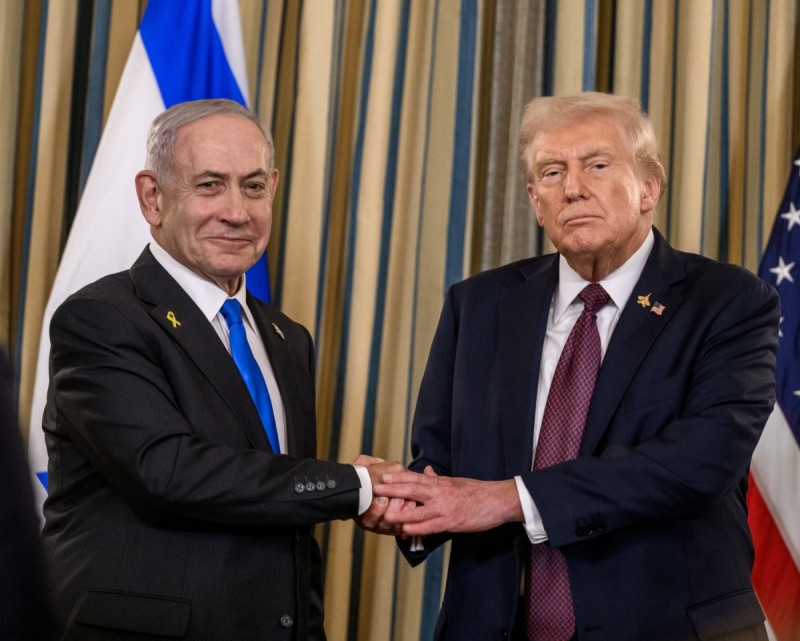
This is the background against which, on September 29, Trump and Netanyahu jointly unveiled the latest US “peace plan” at a White House press conference. Netanyahu had reportedly made several last-minute changes to the draft drawn up by Trump’s team, all to Israel’s advantage.

The 20-point plan calls for immediate suspension of all military operations, followed by the release of all Israeli captives within a 72-hour period. Israel will then release “250 life sentence prisoners plus 1,700 Gazans who were detained after Oct. 7, 2023, including all women and children detained in that context.”

This is only a fraction of more than 10,000 Palestinians languishing in Israeli jails, 3,600 of whom are held without charge or trial in “administrative detention”—many more hostages, as they are, than the 251 Israelis captured by Hamas in the October 7 attack.

It is grim testimony to the disproportionality of this “war” that “For every Israeli hostage whose remains are released, Israel will release the remains of 15 deceased Gazans.”

After the hostages are released, an amnesty will be extended to Hamas members who “commit to peaceful coexistence and to decommission their weapons,” while any who wish to leave Gaza “will be provided safe passage to receiving countries.” Hamas will disarm and “all military, terror, and offensive infrastructure, including tunnels and weapon production facilities, will be destroyed and not rebuilt.” Hamas and other factions “agree to not have any role in the governance of Gaza, directly, indirectly, or in any form.”

Once the agreement has been accepted, full aid “will proceed without interference from the two parties through the United Nations and its agencies, and the Red Crescent,” as well as unspecified third parties (likely a reference to the US-based private so-called Gaza Humanitarian Foundation, which has been responsible for the deaths of hundreds of Palestinians queuing for food).

Though this provision is likely to play badly in Israel, which has banned the UN’s Palestinian refugee agency UNRWA from operating within its boundaries, this is is the only role envisaged for the UN in the entire document.

The plan stipulates that “Israel will not occupy or annex Gaza” and promises that “No one will be forced to leave Gaza,” while “those who wish to leave will be free to do so and free to return.” As “a temporary International Stabilization Force” put together by “The United States… with Arab and international partners” trains “vetted Palestinian police forces in Gaza,” the IDF will gradually withdraw from the Strip to a perimeter “security zone.”

Gaza will meantime be governed by “a technocratic, apolitical Palestinian committee… of qualified Palestinians and international experts, with oversight and supervision by a new international transitional body… headed and chaired by President Donald J. Trump, with other members and heads of State… including Former Prime Minister Tony Blair.”

This “Board of Peace” will “set the framework and handle the funding for the redevelopment of Gaza until such time as the Palestinian Authority has completed its reform program… and can securely and effectively take back control of Gaza.”

As Patrick Wintour has perceptively noted in the Guardian, though it is not explicitly stated in the document, this “reform program” requires that the Palestinian Authority ends its participation in legal proceedings against Israel at the ICJ and ICC. (The text refers to the reform programme “as outlined in various proposals, including president Trump’s peace plan in 2020,” and the latter demands this.)

The Board of Peace will oversee a “Trump economic development plan to rebuild and energize Gaza”—is Trump’s dream of a “Riviera of the Middle East” about to come true?—and “A special economic zone will be established with preferred tariff and access rates to be negotiated with participating countries.”

Surrender or annihilation

It is significant that Hamas—whose negotiators Israel had attempted to assassinate in a September 9 air strike on Qatar—was not involved in drafting the plan or even provided with an advance copy. Palestinians are being presented with an ultimatum reminiscent of the one the Germans gave Rotterdam in 1940: surrender or your city will be destroyed.

And indeed, even while Hamas is considering the plan—for which Trump has demanded their answer “within three or four days”—Israel’s Defence Minister Israel Katz has issued a “final warning” on October 1 that “This is the last opportunity for Gaza residents who wish to do so to move south and leave Hamas operatives isolated in Gaza City,” making clear that “Those who remain… will be considered terrorists and terrorist supporters.”

If the Palestinians reject the plan, then in Donald Trump’s words at the White House press conference:

Israel would have my full backing to finish the job of destroying the threat of Hamas.

But I hope that we’re going to have a deal for peace, and if Hamas rejects the deal… Bibi, you’d have our full backing to do what you would have to do.


Netanyahu added: “If Hamas rejects your plan, Mr President, or if they supposedly accept it and then do everything to counter it, then Israel will finish the job by itself. This can be done the easy way or it can be done the hard way, but it will be done.”

The only positives in the Trump plan for the Palestinians are that it offers a possible road to ending the genocide—as is desperately needed—without Israel annexing Gaza or expelling its people, as the extreme rightwing ministers in Netanyahu’s government have demanded. In his earlier musings on a “Riviera of the Middle East” Trump too had envisaged “cleaning out” all of the Palestinians.

But even these modest consolations for the loss of Palestinian lives, homes, and hopes over the last two years are very far from guaranteed.

The plan requires Hamas to hand over all of the Israeli hostages before any Palestinian prisoners are released and to disarm on the basis of promises of amnesty while the IDF remains in Gaza. The timetable for withdrawal, by contrast, is vague and dependent on transfer of power to new security forces whose composition remains undetermined.

Once Hamas has given up its hostages and its weapons, there is nothing to stop Israel from reneging on the agreement—as it previously did with the January 2025 ceasefire—and “finishing the job” of genocide and ethnic cleansing against a defenceless Gazan population.

It is scarcely reassuring that after his return from Washington, Netanyahu put out a video reassuring Israelis that “the IDF stays in the majority of the Strip.”

Asked in the same video whether he had agreed to a Palestinian state, the Israeli prime minister replied: “Not at all, and it is not written in the agreement. One thing was made clear: We will strongly oppose a Palestinian state.”

This gives the lie to Emmanuel Macron’s claim—echoed by among others Antony Albanese and Mark Carney—that the Trump plan provides a foundation “to build a lasting peace in the region, based on the two-state solution.”

If Bibi has anything to do with it, there will be no such thing. Ever.

The plan does in fact mention Palestinian statehood, only to locate it firmly in the realms of the never-never:

While Gaza redevelopment advances and when the P.A. [Palestinian Authority] reform program is faithfully carried out, the conditions may finally be in place for a credible pathway to Palestinian self-determination and statehood, which we recognize as the aspiration of the Palestinian people. (My emphasis)

A week is a long time in politics

Little more than a week ago, Canada, Australia, Britain, France, and other Western allies broke ranks with Israel and the US and recognized a Palestinian state. Mark Carney and others made it clear that they were taking this step, in part, to forestall Israel’s attempts—about which Benjamin Netanyahu has been quite open—to sabotage any possibility of a two-state solution to the Israeli/Palestinian conflict.

Today, those same states are falling over backwards to lean on Hamas to accept a deal that disarms the Palestinian resistance, requires it to forgo any legal recourse for Israeli war crimes and/or genocide through the ICJ and ICC, hands Gaza over to an unelected foreign junta headed by Donald Trump and Tony Blair—onetime cheerleader of the Iraq War that left over a million Iraqis dead—to “redevelop,” and indefinitely postpones any prospect of Palestinian statehood. The word for this is betrayal.

French President Emmanuel Macron, German Chancellor Friedrich Merz, UK Prime Minister Keir Starmer, Australian Prime Minister Anthony Albanese, President of the EU Commission Ursula von der Leyen, and EU Foreign Minister Kaja Kallas, have all hastened to issue statements lauding “President Trump’s leadership” (Starmer) and hailing the plan as “the best immediate chance to end the war” (Kallas). “Elbows up” Mark Carney was the most sycophantic of them all, welcoming the deal as “historic.”

All agree that “Hamas has no choice but to immediately release all hostages and follow this plan,” with only Macron adding “I expect Israel to engage resolutely on this basis.”

One can almost hear the huge collective sigh of relief that went up in Western capitals as soon as the Trump plan was announced. The cracks are papered over, the delinquent allies are back in the US fold, and our craven leaders are off the genocide hook.

If Hamas fails to “seize this opportunity” (von der Leyen), we must infer, it has only itself to blame for the consequences.

The rewards of terror

Hamas senior leader Mahmoud Mardawi is bang on when he characterizes the Trump plan as offering “an end to this criminal war in exchange for ending the Palestinian people’s right to their state and their rights to their land, homeland, and holy sites.”

Mardawi is adamant that “no Palestinian will accept that,” but genocide is a powerful persuader.

Whether, out of desperation, Palestinians will buy this sordid “deal” remains to be seen. If they do, Israel gets its hostages back and it’s game over for the Palestinian resistance.

If they don’t, Israel will “finish the job” with full US backing and blame Hamas for forcing it to kill yet more Palestinian babies in order to ensure its security. Either way this is a win–win situation for Israel.

If, as Netanyahu says, a purely symbolic recognition of a non-existent Palestinian state is “an enormous prize” for the terror of Hamas’s October 7 attack, then how much greater are the rewards for the IDF’s two years of live-streamed genocide in Gaza?

It’s elbows down as Mark Carney and Anita Anand throw Canadian ICC judge Kimberly Prost under the American bus

Canadian Dimension / August 31, 2025 

The flag of the International Criminal Court at The Hague. Photo by Tony Webster/Wikimedia Commons.

A long time ago

“It was an extraordinary moment,” remembered Stephen Lewis, Canada’s ambassador to the United Nations from 1984 to 1988. “I was at the UN for four glorious years. I had never seen anything like it before, and I never saw anything like it afterwards…”

On October 23, 1985, Canadian Prime Minister Brian Mulroney gave an “electrifying” speech to the UN General Assembly, in which he not only denounced the evil of South African apartheid but promised Canada would to do everything in its power to end it:

Canada is ready, if there are no fundamental changes in South Africa, to invoke total sanctions against that country and its repressive regime. More than that, if there is no progress in the dismantling of apartheid, relations with South Africa may have to be severed absolutely.


At the next year’s Commonwealth Conference in Vancouver, Mulroney famously faced down British Prime Minister Margaret Thatcher over her opposition to sanctions, pointedly asking her whether she would respond in the same way “if she was dealing with a country with a population of 25 million whites that was ruled by four million blacks.”

Less than four years after Mulroney threw down the gauntlet at the UN, South African President F.W. de Klerk, under heavy international pressure from sanctions, began to dismantle the odious edifice of apartheid, legalizing the African National Congress and releasing its leader Nelson Mandela after 27 years imprisonment on February 11, 1990.

Mandela and de Klerk jointly won the Nobel Peace Prize in 1993, and Mandela went on to become South Africa’s first democratically elected president in 1994. That did not stop the US listing him as a “terrorist” until a few days before his 90th birthday in 2013, weeks before his death.

“On the 10th anniversary of our democracy,” Mandela wrote in a personal letter to Brian Mulroney in 2004:

one recalls the momentous time of our transition and remembers the people involved both within and outside South Africa. As prime minister of Canada and within the Commonwealth, you provided strong and principled leadership in the battle against apartheid. This was not a popular position in all quarters, but South Africans today acknowledge the importance of your contribution to our eventual liberation and success.

In a galaxy far, far away

A few months after his release, Mandela addressed the Canadian Parliament. Introducing his guest, Mulroney recalled “with pride, the stand taken by Canada’s prime minister, John Diefenbaker, at the Commonwealth Conference of 1961, which resulted in South Africa’s withdrawal from that body”:

Prime Minister Diefenbaker brought the Commonwealth to declare unequivocally that racial discrimination was totally contrary to its fundamental principles and that, if South Africa did not change, Mr. Diefenbaker said then South Africa must leave. He did so against some considerable opposition, but with the strong conviction and the certain knowledge that it was right. Mr. Diefenbaker’s action marked the beginning of international pressure on the apartheid regime.


The opposition came principally from the UK, together with Australia and New Zealand—countries that were once collectively referred to, alongside South Africa, Canada, and Newfoundland, as the British Empire’s “White Dominions.” The US was also not happy with Canada rocking the apartheid boat, since it saw South Africa as an important ally in the global fight against communism and the ANC as dangerously pro-communist. Not for the first or the last time in American history, geopolitics trumped any moral concerns.

Both Diefenbaker and Mulroney were Conservative politicians, and Mulroney had campaigned on a platform of improving relations with the US after the tensions of the Lester Pearson and Pierre Trudeau years—a promise that was to give us NAFTA. But this did not stop either of them from defying the United States when they believed it was necessary. They did not regard Canada’s membership of NATO (or the “Free World”) as requiring automatic deference to Washington’s priorities, or overlooking palpable evils like apartheid in the interests of maintaining a united Western front in the Cold War.

Canada’s Liberal governments, too, agreed on the need for an independent Canadian foreign policy, and were not afraid to break with the “elephant to the south” (as Pierre Trudeau characterized the US) when called for either. This might even be seen as a hallmark of Canadian identity—an essential one, if we must sleep next to the beast.

Diefenbaker refused to station US nuclear warheads on Canadian soil and gave only lukewarm backing to John F. Kennedy during the Cuban missile crisis. Lester Pearson criticized America’s Vietnam War (allegedly leading Lyndon B. Johnson to grab him by the lapels and yell “Don’t you come into my house and piss on my rug!”) and Pierre Trudeau provided sanctuary to American draft dodgers. Jean Chrétien declined to follow the US-led “Coalition of the Willing” into the Iraq War without approval by the UN.

This is not to say that Canada’s conduct on the world stage was above criticism. As Yves Engler and others have pointed out, Canada is a settler colony whose treatment of its Indigenous population—now as well as then—leaves much to be desired. Canada’s pivot to opposing apartheid in South Africa came late in the day, and its enforcement of sanctions was half-hearted. Thousands of Canadians were allowed to enlist in the US military and fought in Vietnam, while Canadian governments of both parties provided the US with multiple forms of covert support even while not officially joining the war effort.

All the same, there is a yawning moral gulf between Canadian policies then and now.

Canada and the ICC—then

The guiding principle of Canadian foreign policy during the latter part of the twentieth century was multilateralism. Governments of both parties portrayed Canada’s role in the world as advancing universal human rights rather than defending narrowly conceived national interests. Their preferred self-image was of Canada as a global peacemaker.

At times—as in the case of apartheid—the human rights agenda called for intervention, and the proper vehicle for this was international organizations like the UN, because they alone could alone provide legitimacy for such actions. The corollary was solid Canadian support for the institutional and legal framework established after the Second World War, above all the UN and its agencies, the Geneva Conventions, and international humanitarian law.

An important addition to this legal framework was the International Criminal Court (ICC), which was established by the Rome Statute in 1998, in part in response to the genocides in Rwanda and Bosnia. The ICC was intended to be “an independent, permanent court of last resort with jurisdiction to investigate and prosecute the most serious crimes of international concern, namely genocide, crimes against humanity, war crimes and aggression.”

Canada played a “pivotal role”—I quote the Canadian government official website here—in the ICC’s foundation.

Canada chaired the “Like-Minded Group,” a coalition of states “that helped to motivate the wider international community to adopt the Rome Statute.” A senior Canadian diplomat, Philippe Kirsch, was chosen to chair the conference in Rome that negotiated and drafted the statute “under Canada’s leadership.” Kirsch was subsequently elected as an ICC judge in February 2003 and served as the ICC’s first president until 2009.

Canada became “the first country in the world to adopt comprehensive legislation implementing the Rome Statute” in the form of the Crimes Against Humanity and War Crimes Act passed by the Canadian parliament in June 2002. This law for the first time “officially criminalizes genocide, crimes against humanity and war crimes based on customary and conventional international law, including the Rome Statute.”

In December 2017 a second Canadian, Kimberly Prost, was elected an ICC judge for a nine-year term. Prost’s previous experience had included 18 years at Canada’s justice department and positions with the Commonwealth Secretariat and the UN Office on Drugs and Crime. In 2006, she was appointed as a judge of the International Criminal Tribunal for the former Yugoslavia in a major trial related to the Srebrenica genocide.

Opposition to the ICC

Not all states welcomed the establishment of the ICC. At the end of the 1998 Rome conference, 120 countries (including almost all of the United States’ allies) voted in favor of the treaty. Seven countries opposed it—the US, China, Libya, Iraq, Qatar, Yemen, and Israel. Twenty-one countries abstained.

One hundred and twenty-five countries have signed and ratified the Rome Statute and as such are legally bound to co-operate with the court, including in arresting and transferring indicted persons or providing evidence and witnesses for ICC prosecutions.

All member states of the EU are ICC members (though Hungary has now signalled its intention to withdraw from the court), as are Australia, New Zealand, and all G7 members—apart from the United States. The US signed but did not ratify the Rome Statute under Bill Clinton, and John Bolton informed the UN in May 2003 on behalf of the George W. Bush administration that “the United States does not intend to become a party to the treaty,” and “has no legal obligations arising from its signature on December 31, 2000.”

Other states that have never signed up to and/or ratified the Rome Statute include Russia, China, and India—existing or aspiring regional superpowers who, like the US, are unwilling to let a multilateral court intrude on their sovereignty—and Israel. Among the reasons Israel gives for opting out is the ICC’s definition of “the transfer of parts of the civilian population of an occupying power into occupied territory” as a war crime.

Bush, Obama and Trump

US relations with the ICC remained fractious during the Bush administration. The American Service-Members’ Protection Act (ASPA) passed in January 2002 prohibited US cooperation with the ICC, blocked US funding of the ICC, and required the US “to enter into agreements with all ICC signatory states to shield American citizens abroad from ICC jurisdiction” under pain of sanctions if they did not comply.

That same year, the US threatened to veto renewal of all UN peacekeeping missions unless its troops were granted immunity from ICC prosecution. It withdrew this demand in 2004, after pictures emerged of US troops abusing Iraqi prisoners in Abu Ghraib.

The Obama administration cooperated with the ICC in various ways, including supporting the UN Security Council’s referral of Libya to the court in 2011 and sharing intelligence on ICC-indicted fugitives. But it never ratified the treaty—or repealed ASPA.

The first Trump administration reverted to hostility. When the ICC prosecutor’s office requested in March 2019 to open a probe into possible war crimes in Afghanistan, the US responded by threatening to revoke visas for any ICC staff seeking to investigate not only Americans, but also Israelis and other US allies.

The ICC wished to “look into methods that the US military and CIA used to interrogate detainees” in Afghanistan, because:

There is reasonable basis to believe that, since May 2003, members of the US armed forces and the CIA have committed the war crimes of torture and cruel treatment, outrages upon personal dignity, and rape and other forms of sexual violence pursuant to a policy approved by US authorities.


The US responded by taking the unprecedented step of individually sanctioning two top ICC officials, prosecutor Fatou Bensouda and head of jurisdiction Phakiso Monochoko.

Biden and the ICJ

On April 2, 2021, US President Joe Biden wrote to Congress announcing that he was ending Trump’s visa restrictions and sanctions on ICC officials. When the ICC issued an arrest warrant against Vladimir Putin in March 2023 for war crimes in Ukraine, Biden commented “Well, I think it’s justified… I think it makes a very strong point.”

Despite these signs of détente, the Biden administration’s “ironclad” defense of Israeli actions in Gaza increasingly brought the US into open conflict again with both the ICC and the International Court of Justice (ICJ)—the principal judicial organ of the United Nations, which is regarded as world’s highest court in matters of international law.

On December 29, 2023 South Africa brought an application to the ICJ charging the State of Israel with committing genocide in Gaza, and requested the court to order provisional measures to “protect against further, severe and irreparable harm to the rights of the Palestinian people under the Genocide Convention.”

On January 26, 2024 the court ruled that the risk of genocide in Gaza was “plausible,” and ordered Israel to take immediate steps to prevent the situation deteriorating further. These and further measures ordered by the ICJ on March 28 and May 24 were flouted by Israel and essentially ignored in Washington and other Western capitals. The US meantime used its UN Security Council veto to forestall any binding ceasefire motion.

Responding to the January 26 judgment, the US State Department emphasized that “Israel has the right to take action to ensure the terrorist attacks of October 7 cannot be repeated” and reasserted its belief that “allegations of genocide are unfounded.”

Canadian Foreign Affairs Minister Mélanie Joly issued a statement that paid lip service to “the ICJ’s critical role in the peaceful settlement of disputes and its work in upholding the international rules-based order,” while emphasizing that “Our support for the ICJ does not mean that we accept the premise of the case brought by South Africa.” Like the US, Joly spent more time discussing “Israel’s right to exist and defend itself” and Hamas’s brutalities on October 7 than addressing the ICJ orders, on which she had little to say.

The ICC arrest warrants

Relations between the international courts and the US reached their nadir on November 21, when the ICC issued arrest warrants for Benjamin Netanyahu and Israeli Defense Minister Yoav Gallant for “the war crime of starvation as a method of warfare” and “the crimes against humanity of murder, persecution, and other inhumane acts.”

Western politicians erupted. “The ICC issuance of arrest warrants against Israeli leaders is outrageous,” thundered Biden. “Let me be clear once again: whatever the ICC might imply, there is no equivalence—none—between Israel and Hamas. We will always stand with Israel against threats to its security.”1  

Though he undertook to abide by the ICC ruling, Justin Trudeau found “the sense of an equivalency between the democratically elected leaders of Israel and the bloodthirsty terrorists that lead up Hamas” “troubling.”

The point both seem to have missed was that the equivalency lay in the war crimes both sides were alleged to have committed, which were equally contrary to international law.

0n February 6, 2025, just two weeks after he began his second term as US president, Donald Trump signed an executive order titled “Imposing Sanctions on the International Criminal Court.”   

The first person to be individually sanctioned was ICC chief prosecutor Karim Khan, the man who was responsible for preparing the arrest warrants for Netanyahu and Gallant. Four more judges were sanctioned on June 5. Two more judges and two ICC assistant prosecutors were sanctioned on August 20. One of them was Canadian Kimberly Prost.

Canada and the ICC—now

The ICC denounced this latest US move as “a flagrant attack against the independence of an impartial judicial institution which operates under the mandate from 125 States Parties from all regions.” Belgium, Denmark, France, Finland, Estonia, the Netherlands, Norway, Senegal, Slovenia, Spain, and Sweden all condemned the US sanctions, as did Amnesty International, Human Rights Watch, the International Bar Association, and the European Parliament Subcommittee on Human Rights.   

But from Canada—crickets. Well, to be precise, on August 20 Canada’s UN ambassador Bob Rae, responding to a CTV News report on the sanctions, angrily posted on X:

This US attack on the International Criminal Court and its judges is disgraceful. Judge Kim Prost are [sic] carrying out their public duties. Attacks on them by Russia, Israel and the US are intended to weaken and intimidate the international legal system. They must not succeed.

But for whatever reason—some have suggested that he was pressurized into doing so by the Canadian government—Rae quickly deleted the post. And that was that.  

Ten days have passed since the US sanctioned Canada’s senior international judge, and there has been no official response from the Government of Canada.

Mark Carney supposedly had “a productive and wide-ranging conversation” with Trump on August 21 in which “We focused on trade challenges, opportunities, building a new economic and security relationship between Canada and the US, and supporting long-term peace and security for Ukraine and Europe.” Neither his post on X nor the official readout from the call contains any reference to Kimberly Prost. Carney has since made public pronouncements on the economy, Canada–US trade, Ukraine, and a new Canada–Poland Strategic Partnership, but he has remained silent on the issue of the ICC.  

Foreign minister Anita Anand, whose brief this surely is, was reported to have expressed disquiet about Prost’s sanctioning in her meeting with Marco Rubio on August 21, but her own account of the meeting makes no mention of it. Her brief X post reads, “Today, I had a productive meeting with Secretary @SecRubio in Washington. We discussed collaboration on shared priorities, including: supporting Ukraine, advancing Arctic security, addressing the security crisis in Haiti and continuing to provide humanitarian aid in Gaza.”

So far as I am aware, no other statement regarding American strongarming of the ICC—the court Canada worked so hard to establish back in the day—or the sanctioning of Kimberly Prost has been issued by any Canadian government agency or senior officials.

Elbows down

On Friday August 22, two days after Marco Rubio sanctioned Kimberly Prost, the Integrated Food Security Phase Classification (IPC), the world’s hunger watchdog, declared a state of famine in and around Gaza City. Its report emphasized that “This famine is entirely man-made, it can be halted and reversed.”

This seems highly unlikely since Israel is now in the early stages of a new offensive to recapture Gaza City, and is in the process of clearing out an estimated 1m inhabitants.

If not yet a truth universally acknowledged, it is certainly a truth that is increasingly recognized that since 1967, Israel has enforced a cruel apartheid regime within the Occupied Palestinian Territories, and that since October 8, 2023, the IDF has been engaged in war crimes, crimes against humanity, and probable genocide in Gaza.

Many Palestinians would argue that the genocide is merely the culmination of a Zionist program of ethnic cleansing that began with the establishment of the state of Israel and the attendant Nakba in wars of 1947-8.

It would be nice, even at this very late stage in the day, if some Western leader were to electrify the UN with a speech calling for total sanctions against Israel and its repressive regime and threatening absolute severance of relations with Israel—or even a UN-led peacekeeping military intervention—if there is no progress in dismantling the apartheid regime or halting the ethnic cleansing and genocide.

Of one thing we can be sure. That leader will not be Mark Carney. We can be equally confident that Anita Anand will not emulate Dutch foreign minister Caspar Veldkamp and several of his cabinet colleagues in quitting the government in protest at its refusal to implement stronger sanctions against Israel.

I hold no particular brief for Brian Mulroney—or John Diefenbaker, or Lester Pearson, or Pierre Elliott Trudeau, or Jean Chrétien. They all had their faults. But they were Titans compared with the moral Lilliputians who govern Canada today. I can’t imagine any of them would have thrown Kim Prost under the bus to get “the best trade deal with the United States… better than that of any country.” Even the language echoes Trump.

Nor, I suspect, would they have stood by for two years while Israel obliterated Gaza and bombed, shelled, and finally starved hundreds of thousands of Palestinian men, women and children to death—whatever the reason. Never again means never again.

Derek Sayer / Canadian Dimension / July 29, 2025 

Girl in Gaza on her way to get food. Photo by Jaber Jehad Badwan/Wikimedia Commons.

After reneging on its January ceasefire agreement with Hamas, Israel imposed a total blockade on aid into Gaza on March 2 and cut off remaining electricity supplies a week later. It resumed its military assault on March 18. Since then, Gaza’s health authorities have recorded a further 8,196 fatalities and 30,094 injuries. The death toll from IDF actions since the present “war” began on October 7, 2023 has now passed 60,000.

United Nations data show that throughout July the IDF has been killing one person every 12 minutes. “An average of 119 Palestinians are being killed daily so far in July—the highest rate since January 2024. More than 401 Palestinians a day are being wounded, the highest figure since December 2023.”

To put this in perspective, this means that in the last month Israel has killed, on average, more people in Gaza every week than the 736 Israeli civilians who died during Hamas’s October 7 attack on southern Israel (many of them casualties of Israeli “friendly fire”)—the event that triggered, and has repeatedly been used to justify, Israel’s present “war.”

For Pity’s Sake, Stop This Now!

Aid agencies have been warning of imminent famine for months, threatening the lives of Gaza’s 2.1 million inhabitants—or whatever portion of them have survived nearly two years of IDF bombardment—who have no means of escape from the besieged enclave. Deaths from hunger are now rising exponentially, beginning with the most vulnerable.

As Nesrine Malik explains:

The children die first. In conditions of starvation, their growing bodies’ nutritional needs are higher than those of adults, and so their reserves are depleted faster. Their immune systems, not yet fully developed, become weaker, more susceptible to disease and infection. A bout of diarrhoea is lethal. Their wounds don’t heal. The babies cannot be breastfed as their mothers have not eaten. They die at double the rate of adults.


On July 29, the Integrated Food Security Phase Classification, or IPC—the world’s official famine watchdog—for the first time issued a famine alert, as distinct from a warning, for Gaza, stating that:

The worst-case scenario of Famine is currently playing out in the Gaza Strip. Conflict and displacement have intensified, and access to food and other essential items and services has plummeted to unprecedented levels.

Mounting evidence shows that widespread starvation, malnutrition, and disease are driving a rise in hunger-related deaths. Latest data indicates that Famine thresholds have been reached for food consumption in most of the Gaza Strip and for acute malnutrition in Gaza City.

Immediate action must be taken to end the hostilities and allow for unimpeded, large-scale, life-saving humanitarian response. This is the only path to stopping further deaths and catastrophic human suffering.


Recent days have seen a tsunami of horrific headlines, illustrated by graphic photos of starving children. In the UK, the Guardian’s July 23 lead story blared: “‘We faced hunger before, but never like this’: skeletal children fill hospital wards as starvation grips Gaza.” The article was illustrated with a mother-and-dying-child image that seems destined to become as iconic as Nick Ut’s famous Vietnam War photo “Napalm Girl.”

The front page of the Daily Express—a right-wing populist tabloid—carried the same photo, captioning the image “For Pity’s Sake, Stop This Now.” The accompanying article was headlined “The suffering of little Muhammad clinging on to life in Gaza hell shames us all.” The paper’s head of news Callum Hoare posted on X:

The brutal suffering in Gaza must end. The shocking image shows Muhammad Zakariya Ayyoub al-Matouq, one, who weighs the same as [a] three-month old baby due to the humanitarian crisis following the continued blocking of basic aid to civilians by Israel.


Spain’s El País showed a child’s outstretched hand holding a crust of bread under the headline, “Hunger in Gaza sparks global outcry to stop the war.” India’s Economic Times paired a front-page editorial calling Israel’s actions “genocidal” with a photo of empty cooking pots outside a damaged building. The Washington Post led with “Mass Starvation Stalks Gaza” and a photo of a another Palestinian woman holding another emaciated infant.

Is “balance” finally giving way to truth?

Western newsrooms are no longer taken in by IDF propaganda videos purportedly showing “senior Hamas terrorists boasting about their meals in underground terror tunnels” while gorging on fresh fruit—a tall order, since Israel has been blockading the Strip since March 2. Nor are they uncritically accepting Israeli official statements as statements of fact, as most of them have shamefully done for the last two years.

BBC News—which has repeatedly, and justifiably, been accused of systematically downplayingPalestinian sufferings and whitewashing Israeli war crimes—issued a joint statement on July 24 with AFP, AP, and Reuters, which backhandedly conceded that the IDF indeed is using starvation as a weapon of war in Gaza. It began:

We are desperately concerned for our journalists in Gaza, who are increasingly unable to feed themselves and their families. For many months, these independent journalists have been the world’s eyes and ears on the ground in Gaza. They are now facing the same dire circumstances as those they are covering.

Journalists endure many deprivations and hardships in warzones. We are deeply alarmed that the threat of starvation is now one of them.


The statement neglected to mention that in the interests of keeping the genocidal truth under wraps, Israel has banned international media from Gaza and so far killed 232 local journalists in the course of its current “war”—more than the number of journalists killed in the US Civil War, the First and Second World Wars, the Korean War, the Vietnam War, the wars in Yugoslavia, and the post-9/11 war in Afghanistan combined.

Even the New York Times, which has been steadfast in its support for Israel throughout its “war” on Gaza, carried a long and damning essay by the renowned Israeli Holocaust scholar Omer Bartov headlined “I’m a Genocide Scholar. I Know It when I See It.” To be fair, the paper carried an op-ed by Bret Stephens a few days later arguing “No, Israel Is Not Committing Genocide in Gaza,” in the interests not of truth but of “balance.”

Despite Israel’s increasingly implausible attempts to deny that there is famine in Gaza—or to shift the blame to Hamas (which a recent USAID investigation found is not “stealing aid,” a conclusion that was repeated later by IDF senior officers interviewed by the New York Times) or the UN (ignoring Israel’s own ban on UNRWA in Israel and the occupied Palestinian territories and refusal of visas to UN agency personnel)—the dam has broken.

When “aid distribution centres” become killing fields

In late May, under international pressure, Israel permitted the US-backed so-called Gaza Humanitarian Foundation (GHF) to distribute meagre and inappropriate aid packages through four centres set up to replace the 400-plus distribution points previously run by UNRWA and other international aid agencies. The GHF is a private body, staffed largely by US contractors, with no prior experience of supplying humanitarian aid in war zones.

Benjamin Netanyahu admitted that allowing this “minimal” aid was only done to keep US politicians onside. Israel’s National Security Minister Itamar Ben Gvir denounced the change in policy as “a grave mistake,” while Heritage Minister Amichay Eliyahu argued that “letting humanitarian aid in now directly harms the war effort to achieve victory.”

On July 8, following the death of five Israeli soldiers in a Hamas ambush—a drop in the ocean compared with the daily Palestinian civilian casualties—Ben Gvir demanded “a total siege, a military crushing, encouraging immigration and settlements” and Finance Minister Bezalel Smotrich called on Netanyahu to “immediately halt” aid for Gaza. They could hardly have made it clearer that Israeli combatants’ deaths will be paid for many times over by Palestinian civilian lives, whatever the Geneva Conventions might say.

Outside of the so-called “humanitarian zones,” to which over 90 percent of Gaza’s inhabitants have been compulsorily evacuated and now live in squalid tents—which the IDF still regularly hits, claiming to target “Hamas militants” but killing and maiming many more civilians with every strike—82.6 percent of the Gaza Strip is now within the Israeli-militarized zone or under displacement orders. Three of the GHF centres are located in the ruins of Rafah in the south, the other in Deir al-Balah in central Gaza.

Hundreds of Palestinians have been massacred when lining up for food at GHF centres or trying to reach them. As of July 15, per the Office of the United Nations High Commissioner for Human Rights (OHCHR), 875 people had been killed trying to access food for their families, 674 of them in the vicinity of GHF sites. That number has now passed 1,000.

Interviewed for the BBC World Service on July 25, retired US special forces officer Lt. Col. Anthony Aguilar, a former Green Beret, explained why he had quit his job with GHF:

I witnessed the Israeli Defense Forces shooting at the crowds of Palestinians… Without question I witnessed war crimes by the [IDF], using artillery rounds, mortar rounds, and tank rounds against unarmed civilians… I have never witnessed such a level of brutality and use of indiscriminate and unnecessary force against a civilian population—an unarmed, starving population.

Lies, damned lies, and hasbara

Charging that “Today, Palestinians in Gaza face an impossible choice: starve or risk being shot while trying desperately to reach food to feed their families,” on June 30 more than 240 international charities and NGOs, including Oxfam, Save the Children, and Amnesty International, issued a joint statement calling for “immediate action to end the deadly Israeli distribution scheme (including the so-called Gaza Humanitarian Foundation) in Gaza, revert to the existing UN-led coordination mechanisms, and lift the Israeli government’s blockade on aid and commercial supplies.”

Donald Trump’s Ambassador to Israel Mike Huckabee, former Republican governor of Arkansas, knows better. On July 24 he posted on X two photographs, which we are to assume were shot in Gaza though no date or location is given, with the comment:

Here are photos of UN trucks & enough food to feed all of Gaza but it sits rotting! UN is a tool of Hamas! US based GHF is actually delivering food FOR FREE and SAFELY. UN food is either looted by Hamas or rots in the sun! Photos from yesterday.

Huckabee, whose “evangelical Christian beliefs,” per the official US embassy website, “include support for Israeli control over their ancient and indigenous homeland,” clearly believes his responsibilities including shilling for hasbara (Israeli public diplomacy aimed at explaining and promoting Israel’s policies and image internationally). It would be nice to see him apply the same argument about ancestral homelands to the Indigenous inhabitants of the United States, but let that pass. Israel’s rights are judged by different standards.

Huckabee also believes that “There is no such thing as a Palestinian” and “no such thing as a West Bank. It’s Judea and Samaria. There’s no such thing as a settlement. They’re communities, they’re neighborhoods, they’re cities. There’s no such thing as an occupation.” This is of course music to Ben Gvir, Smotrich, and Netanyahu’s ears.

UN spokesperson Farhan Haq has cited “a number of interdependent factors” that have stopped UN aid being delivered even when it has reached Gaza, including “bureaucratic, logistical, administrative, and other operational obstacles imposed by Israeli authorities”—something former British Foreign Secretary and one-time Prime Minister David Cameron complained about back in March 2024—and “shooting incidents that have killed and injured people gathering to offload aid supplies along convoy routes.”

One recent shooting incident is related by Cindy McCain, the widow of US Senator John McCain and head of the World Food Program:

Shortly after passing the final checkpoint beyond the Zikim crossing point into Gaza, the convoy encountered large crowds of civilians anxiously waiting to access desperately needed food supplies… As the convoy approached, the surrounding crowd came under fire from Israeli tanks, snipers and other gunfire. We are deeply concerned and saddened by this tragic incident resulting in the loss of countless lives.

Today’s violent incident comes despite assurances from Israeli authorities that humanitarian operational conditions would improve; including that armed forces will not be present nor engage at any stage along humanitarian convoy routes. There should never, ever, be armed groups near or on our aid convoys, as reiterated on many occasions to all parties to the conflict.

Without these fundamental conditions in place, we cannot continue providing life-saving support across the Gaza strip.

The politicians react

If key sections of the Western media are now changing their tune on Gaza, disgust with Israel’s treatment of Palestinians is even more pronounced among the wider public.

survey carried out by Pew Research Center published on June 3 found that in 20 of 24 countries surveyed, half of adults or more have a negative view of Israel. Among Western or Western-aligned nations, Israel was viewed “very” or “somewhat unfavourably” by 79 percent of respondents in Japan, 78 percent in the Netherlands, 75 percent in Spain and Sweden, 74 percent in Australia, 72 percent in Greece, 66 percent in Italy, 64 percent in Germany, 63 percent in France, 62 percent in Poland, 61 percent in the UK, 60 percent in Canada and South Korea, and even—remarkably, in view of bipartisan support for Israel among both Republican and Democrat party leaderships—53 percent in the US.

This was before the recent blanket press coverage of the growing famine and almost daily massacres of Palestinians seeking food at the GHF distribution centres.

Wrong-footed by events, and under immense pressure from their respective publics, Western politicians have been falling over themselves to take back the narrative.

On July 21, Canada joined 24 other Western nations and the EU Commissioner for Equality, Preparedness and Crisis Management in a statement that firmly rapped Israel over the knuckles for its most recent transgressions in Gaza:

The suffering of civilians in Gaza has reached new depths. The Israeli government’s aid delivery model is dangerous, fuels instability and deprives Gazans of human dignity. We condemn the drip feeding of aid and the inhumane killing of civilians, including children, seeking to meet their most basic needs of water and food. It is horrifying that over 800 Palestinians have been killed while seeking aid. The Israeli Government’s denial of essential humanitarian assistance to the civilian population is unacceptable. Israel must comply with its obligations under international humanitarian law.


On July 25 the leaders of Britain, France, and Germany issued another statement reminding Israel that “withholding essential humanitarian assistance” is “unacceptable” and describing the situation in Gaza as a “humanitarian catastrophe.” They added that they “stand ready to take further action to support an immediate ceasefire and a political process that leads to lasting security and peace for Israelis, Palestinians and the entire region,” without saying what that action might comprise.

No doubt Keir Starmer and Emmanuel Macron would rather we forgot that they had signed a joint statement with Canada’s Mark Carney calling on the Israeli government “to stop its military operations in Gaza and immediately allow humanitarian aid to enter Gaza,” and threatening “If Israel does not cease the renewed military offensive and lift its restrictions on humanitarian aid, we will take further concrete actions in response,” two months ago, on May 19. Needless to say no actions of any consequence were taken.

The time for covering asses is at hand

Aware, perhaps, of their potential liability under the Geneva Conventions for not doing everything within their power to prevent genocide—or at least war crimes and crimes against humanity—in Gaza, individual Western politicians have meantime been lining up to put their immense sympathy for the Palestinian people on record.

Keir Starmer proclaims “The suffering and starvation unfolding in Gaza is unspeakable and indefensible. While the situation has been grave for some time, it has reached new depths and continues to worsen. We are witnessing a humanitarian catastrophe.”

Starmer’s Foreign Secretary David Lammy says he is he is “appalled, sickened” by the “grotesque” targeting of starving Palestinians. “These are not words that are usually used by a foreign secretary who is attempting to be diplomatic,” he adds, “but when you see innocent children holding out their hand for food, and you see them shot and killed in the way that we have seen in the last few days, of course Britain must call it out.”

Australia’s PM Antony Albanese laments that “The situation in Gaza has gone beyond the world’s worst fears… Gaza is in the grip of a humanitarian catastrophe. Israel’s denial of aid and the killing of civilians, including children, seeking access to water and food cannot be defended or ignored.”

EU foreign policy supremo Kaja Kallas (who stated on July 15 that “the EU will not move forward with sanctions against Israel”) protests that “The killing of civilians seeking aid in Gaza is indefensible.” “The images from Gaza are unbearable,” posts Ursula von der Leyen, President of the European Commission, “Israel must deliver on its pledges.”

Canadian government representatives have been more reticent in their condemnations—a good deal more reticent than when they denounce instances of alleged “antisemitism.”

But noting on July 24 that “denial of humanitarian aid is a violation of international law,” Mark Carney stated that “Canada condemns the Israeli government’s failure to prevent the rapidly deteriorating humanitarian disaster in Gaza.”

Foreign Affairs Minister Anita Anand echoed her boss, posting on X the same day:

The humanitarian crisis in Gaza worsens by the day. Women and children are starving, without adequate access to food and water, the most basic of needs. It is inexcusable and must end… the Israeli government must allow the uninhibited flow of humanitarian aid to reach Palestinians civilians, who are in urgent need.


New Democrat Party MP (and candidate for NDP leader) Heather McPherson asks, not altogether unreasonably:

For nearly 21 months @NDP has urged action from Canada: recognize Palestinian statehood, impose sanctions, suspend CIFTA, implement arms embargo. In a caucus of 169 MPs only a handful of Liberals have spoken out for Palestine. Why the Liberal silence? Cowardice? Racism?

It’s only words

Several things need to be said about this belated outpouring of sympathy for innocent Palestinians on the part of politicians who have been arming, diplomatically supporting, and repressing domestic criticism of Israel’s genocide for the last two years.

First, however tough their language, they never use the word genocide—or the terms war crimes and crimes against humanity. The reason is pretty clear. To do so would not only acknowledge these governments’ past complicity in the worst crimes known to the law, but legally require them to act immediately to end that complicity in the future.

The preferred term is always “humanitarian catastrophe,” which naturalizes the event—equating it with other things that cause famine, like crop failures, floods or drought—and shifts the focus away from the human actors and actions that have caused it.

Second, there is a systematic attempt to suggest that it is only now that the situation has become catastrophic. The implication is that it was legitimate to support Israel’s assault on Gaza previously. As one puzzled comment on X put it:

I have been wondering why the Zionists’ stepped up use of hunger as a mass murder weapon has suddenly triggered a Western outcry, but two years of pre-announced, and equally vile, mass murder via bombs and bullets did not generate the same outcry.


Third—and most importantly—none of these statements, however strongly worded, have been followed by any action that would put real pressure on Israel to change its behaviour. And knowing this, Israel continues to largely ignore Western protests.

Even Emmanuel Macron’s historic promise to recognize a Palestinian state—a largely symbolic gesture, albeit a significant one—has been attacked by Donald Trump, and Britain and Canada, who at one time looked prepared to join him, are now reportedly getting cold feet for fear of angering the US.

It is not as if the international community doesn’t have plenty of weapons at its disposal to force compliance on rogue states.

Apartheid South Africa was kicked out of the UN and subjected to stringent economic, sporting, and cultural sanctions and boycotts that eventually brought the system to its knees. The first Gulf War against Iraq was fought under UN auspices, and the second by a US-led “coalition of the willing.”

The most obvious contemporary example of such international action—which contrasts sharply with the West’s pusillanimous avoidance of any meaningful action to stop Israel’s carnage in Gaza—was the coordinated response to Russia’s invasion of Ukraine, which has been met with wave after wave of sanctions.

For whatever reasons—be they geopolitical, economic, or racist—not to take comparable action against Israel is a choice. Our choice.

Our genocide

Faced with widespread Western condemnation, Netanyahu has now agreed to allow air drops of aid into Gaza and daily 10-hour “humanitarian pauses” in three areas of the Strip to enable UN convoys and other aid organizations to safely distribute food and medicine. As in his earlier pivot in May, he explained that given the international reaction, Israel “needs to continue to allow the entry of a minimum amount of humanitarian aid.”

I see this as a purely tactical retreat, like Netanyahu’s earlier acceptance under US pressure of two ceasefire deals which he subsequently broke. He went on to reassure Israelis that “We will continue to fight, we will continue to act until we achieve all of our war goals—until complete victory.” His fundamental objectives have not changed.

On July 28, the day after Netanyahu’s announcement, Israel’s leading human rights organization B’Tselem announced the publication of a report titled Our Genocide on social media. They did not pull their punches or mince their words:

Israel is committing genocide in Gaza.

It sounds inconceivable. But it’s the truth.

Israel is taking deliberate, coordinated action to destroy the Palestinians in the Gaza Strip. Explicit statements by Israeli officials, combined with a consistent policy of destructive attacks and other practices of annihilation, prove beyond a doubt that Israel’s target is the entire population of Gaza.

Entire cities razed to the ground; medical, educational, religious and cultural infrastructure systematically destroyed; 2 million Palestinians forcibly displaced with the aim of expelling them from Gaza; and, of course, mass starvation and killing—all this amounts to an explicit attempt to destroy the population of Gaza and impose living conditions so catastrophic that Palestinian society cannot continue to exist there.

That is the exact definition of genocide.


They continued:

The international community has not only failed in its duty to stop the atrocities, but the leaders of the Western world, particularly the United States and Europe, also share responsibility by providing support that enables Israel’s acts of destruction. It is the duty of the international community to stop the genocide Israel is carrying out in Gaza…

This is our genocide, and we need to stop it.


Israel’s genocide. And the West’s.

Western leaders seem finally to be waking up to the monstrosity of the horrors Israel has unleashed upon Gaza

First published in Canadian Dimension February 21, 2024

Damage in Gaza caused by Israeli airstrikes, October 2023. Photo courtesy Islamic Relief Canada.

After four months of war, some Western leaders seem finally to be waking up to the monstrosity of the horrors Israel has unleashed upon Gaza, in which our governments and civil societies—our corporations, our news organizations, our social media, our educational and cultural institutions—are unarguably complicit.

The West has supplied the bombs, tanks, drones, and Hellfire missiles with which the Israel Defense Forces (IDF) has killed at least 28,473 Palestinians, injured another 68,146, displaced 90 percent of the population, and rendered much of the Gaza Strip uninhabitable. Over 12,300 of the dead are children or young teenagers. These are the known casualties, as of February 13; thousands more people are missing, presumed buried under the rubble. According to Israel’s social security agency Bituah Leumi, by comparison, Hamas’s October 7 attack killed “695 Israeli civilians, including 36 children, as well as 373 security forces and 71 foreigners, giving a total of 1,139 deaths”—not 1,400, as was stated as recently as February 15 by National Security Minister Itamar Ben Gvir—an unknown but likely substantial number of whom died from IDF friendly fire.

Comparisons may be odious, but I am not the only one making them. Benjamin NetanyahuJoe Biden, and other defenders of Israel’s actions in Gaza have constantly reiterated that October 7 was “the deadliest day for Jews since the Holocaust,” coopting the memory of the most horrific crime of the twentieth century to justify what threatens to be the worst genocide so far of the twenty-first.

But however horrific Hamas’s crimes were on October 7, they are dwarfed by Israel’s retribution, which matches them in its callous brutality but is infinitely greater in its scale. It seems the IDF has taken Netanyahu’s injunction to “remember what Amalek has done to you, says our Holy Bible” literally: “Now go, attack the Amalekites and totally destroy all that belongs to them. Do not spare them; put to death men and women, children and infants, cattle and sheep, camels and donkeys,” says the relevant passage from the first book of Samuel.

For every Israeli killed on October 7, the IDF have now killed 27 Gazans. For every Israeli civiliankilled on October 7, the IDF have now killed 40 Gazans. For every Israeli child killed on October 7, the IDF has now killed 342 Gazan children.

You might have seen one of them, 12-year-old Sidra Hassouna, hanging dead from a wall in Gaza, ribbons of flesh all that was left of her legs after Israel struck Rafah in a “complex overnight operation” to free two hostages, while a worldwide audience of 123.7 million people were glued to the 2024 US Super Bowl, making it “the highest number of people watching the same broadcast in the history of television.”

Western representatives at the UN have repeatedly prevented the Security Council from ordering a ceasefire that might have halted this carnage. Western media have boosted the Israeli narrative through brazenly one-sided reporting (e.g. at CBCBBCCNN), while our universities, museums, film studios, art galleries, professional associations, and a host of private employers have compliantly suppressed all pro-Palestinian speech on grounds of “antisemitism.”

The ICJ ruling that there is a “plausible” case that Israel is committing genocide in Gaza vindicated Israel’s critics, but has so far done little to alter the situation on the ground. Canada’s evasiveresponse, in which Foreign Affairs Minister Mélanie Joly reiterated Israel’s “right to defend itself” in the face of “Hamas’s brutal attacks of October 7,” was typical of official Western reaction. Immediately after the court delivered its verdict, the US, UK, Canada, and 13 other “Western democracies” diverted attention from the ruling by suspending funding to UNRWA, the principal relief agency in Gaza upon which hundreds of thousands of Palestinian lives depend, on the basis of Israel’s unevidenced allegation that a dozen UNRWA staff (out of 13,000) had participated in Hamas’s October 7 attack.

Such is the power of the spectre of October 7, which up till now has been a black hole into which everything—reason, morality, proportionality, context, or any other perspectives on the conflict—get sucked and disappear.

Palestinians inspect the ruins of Aklouk Tower destroyed in Israeli airstrikes in Gaza City on October 8, 2023. Photo courtesy the Palestinian News & Information Agency-WAFA/Wikimedia Commons.

Is the tide turning?

When the Spanish and Belgian prime ministers denounced “innocent killings of civilians” back in November, Netanyahu rebuked them because they “did not place total responsibility on Hamas for the crimes against humanity it perpetrated: massacring Israeli citizens and using Palestinians as human shields.” As Israel seems poised for a final solution (“absolute victory”) by assaulting Rafah, where an estimated 1.4 million Palestinians the IDF has driven from their homes are holed up in conditions of unimaginable squalor, famine, and disease, that argument seems finally to be losing its stranglehold over rational or moral debate.

Maintaining that “The expanded Israeli military operation in the Rafah area poses a grave and imminent threat that the international community must urgently confront,” Irish Prime Minister Leo Varadkar and Spanish Prime Minister Pedro Sánchez wrote Ursula van der Leyden on February 13 demanding that “the European Commission urgently review whether Israel is complying with its obligations to respect human rights in Gaza.” Along with Belgium, Luxembourg, Norway, and Portugal, Ireland and Spain have been among a handful of European countries who have refused to join the boycott of UNRWA and publicly criticized Israel for its military response to October 7.

More recent converts to the chorus of belated concern include the EU’s top diplomat Josep Borrell, UK Foreign Secretary David Cameron, French Foreign Minister Stéphane Séjourné, German Foreign Minister Annalena Baerbock, Australian Foreign Minister Penny Wong, and Mélanie Joly, who is rapidly developing into Canada’s very own Susan Collins. These all speak for states who have up till now backed “Operation Swords of Iron,” as Israel’s Gaza offensive is officially codenamed, to the hilt.

On February 14, Australian Prime Minister Anthony Albanese, Canadian Prime Minister Justin Trudeau, and New Zealand Prime Minister Christopher Luxon went further, issuing a joint statement calling for a ceasefire. As the Times of Israel noted, the statement “did not mention removing the terror group [Hamas] from power, as a trilateral statement in December had, but rather focused on civilians in Rafah.”

Though the leaders reiterated that they “unequivocally condemn Hamas for its terror attacks on Israel on October 7” and demanded that “Hamas must lay down its arms and release all hostages immediately,” the statement’s main focus was no longer on Hamas but Israel. The settler colony troika adopted a markedly different tone toward the ICJ’s measures than Mélanie Joly’s earlier statement of January 26:

There is growing international consensus. Israel must listen to its friends and it must listen to the international community. The protection of civilians is paramount and a requirement under international humanitarian law. Palestinian civilians cannot be made to pay the price of defeating Hamas.

An immediate humanitarian ceasefire is urgently needed. Hostages must be released. The need for humanitarian assistance in Gaza has never been greater. Rapid, safe and unimpeded humanitarian relief must be provided to civilians. The International Court of Justice has been clear: Israel must ensure the delivery of basic services and essential humanitarian assistance and must protect civilians. The Court’s decisions on provisional measures are binding.


Perhaps more significantly—time alone will tell—a visibly exasperated Joe Biden, whose public backing for Israel has up till now been (in his words) “unwavering,” told White House Reporters on February 8: “I’m of the view, as you know, that the conduct of the [Israeli] response in the Gaza Strip has been over the top.” The White House meantime leaked that in private, Joe calls “that guy” Netanyahu an “asshole.”

Speaking in Tel Aviv a day earlier, US Secretary of State Antony Blinken had warned: “the daily toll that [Israel’s] military operations continue to take on innocent civilians remains too high …”

Israelis were dehumanized in the most horrific way on October 7. The hostages have been dehumanized every day since. But that cannot be a license to dehumanize others. The overwhelming majority of people in Gaza had nothing to do with the attacks of October 7, and the families in Gaza whose survival depends on deliveries of aid from Israel are just like our families. They’re mothers and fathers, sons and daughters—want to earn a decent living, send their kids to school, have a normal life. That’s who they are; that’s what they want. And we cannot, we must not lose sight of that. We cannot, we must not lose sight of our common humanity.

An Israeli artillery unit in action near the Gaza Strip. Photo courtesy IDF Spokesperson’s Unit/Wikimedia Commons.

Colonialist legacies

It’s nice to see Western politicians admit that Palestinians are people rather than (as Israel’s Defense Minister Yoav Gallant called them) “human animals.” It would be nicer still if the words were matched by deeds—the suspension of arms shipments to Israel, the immediate restoration of UNRWA funding, and Western support for a binding UN Security Council resolution on a ceasefire and implementation of resolution 242 (1967) mandating Israel’s withdrawal to its 1967 borders would be a start. Despite Biden’s and Blinken’s words, the US used its veto to block a Security Council ceasefire resolution for a third time on February 20.

But one has to ask: what took you all so long? Where have you been these last four months (these 57 years of illegal Israeli occupation)? Whether or not the ICJ in the end classifies them as genocidal, what has blinded you to the palpable war crimes playing out live from Gaza on our screens in real time, that have horrified the rest of the world and brought hundreds of thousands of protestors out on Western streets week after week, only to be maligned by you as antisemites?

These questions might especially be asked of otherwise (relatively) progressive Western politicians, who are on the center-left of their countries’ political spectrum yet have stood foursquare behind the most right-wing government in Israel’s history while it methodically obliterated Gaza and canceled its people: Joe Biden and other Democrat leaders (Nancy Pelosi, Hillary Clinton, Chuck Schumer) in the US, Labour Party leader Keir Starmer in the UK, Justin Trudeau in Canada.

Could an embarrassing part of the answer be that “the West,” or what is more accurately conceived as the Global North, is made up largely of imperialist states that not so long ago possessed colonies spread across the Global South, and their former settler colonies (Australia, Canada, New Zealand, and above all the United States)? That Israelis are in some obscure way felt to be, in a phrase once beloved of British supporters of Ian Smith’s rogue UDI regime in what was then Rhodesia, “our kith and kin,” in a way that Palestinians (Arabs, Muslims) are not? Why else would we be prepared to believe the most ludicrous of Israeli atrocity stories while for so long ignoring the mountain of evidence of war crimes committed against Palestinians now and previously by the IDF?

We need seriously to consider the disturbing proposition that it is not contemporary economic interests or geopolitical alliances, nor even the undoubted power of pro-Zionist lobby groups like the American Israel Public Affairs Committee (AIPIC) or Canada’s Centre for Israel and Jewish Affairs (CIJA), that are the decisive factors in Western support for Israel, but the deeper, affectual bonds of a shared legacy of colonialism. That what most closely and insidiously binds the West to Israel, at the end of the day, is a deeply embedded culture of white supremacy in which “the natives” are indeed regarded (in Benjamin Netanyahu’s words) as children of darkness, capable of any vileness, while we are the progressive children of light, pure as the driven snow.

Israel’s human targeting software and the banality of evil

First published in Canadian Dimension April 18, 2024

Lavender fields near Hitchin, England. Photo by DeFacto/Wikimedia Commons.

Here’s the smell of the blood still. All the perfumes of Arabia will not sweeten this little hand.

—William Shakespeare, Macbeth, Act 5, Scene 1

Lavender

For some unknown, but no doubt morbidly humorous reason—the same sick humour, perhaps, that leads the Israel Defense Forces (IDF) to refer to their periodic punitive strikes on Gaza as “mowing the grass“—the IDF have decided that “Lavender” is an appropriate name for the artificial intelligence (AI) software they use to identify “human targets” in Gaza.

Since October 7, IDF strikes have killed at least 33,545 Palestinians including 8,400 women and over 13,000 children, injured another 76,049, and left 8,000 more missing, presumed buried under the rubble. The blitzkrieg has destroyed over 60 percent of Gaza’s housing stock, made two million people homeless, and left most of the strip uninhabitable.

Israel’s supporters deny that this bombing has been “indiscriminate” (as Joe Biden himself recently called it). They are right. It is worse. Seldom in the history of human conflict have so many bombs been so deliberately aimed at targeted individuals.

The great science fiction fear has always been of AI escaping human control and the machines taking over, as in The Matrix films. The story of Lavender suggests, on the contrary, that the real danger arises when the awesome data-crunching capacities of AI are put in the hands of human beings.

The Lavender software

On April 3 the Israeli–Palestinian magazine +972 published an explosive article by journalist and filmmaker Yuval Abraham on the IDF’s use of the Lavender software, based on interviews with six Israeli intelligence officers, all of whom have served in Gaza during the current campaign. The story was shared with the Guardian, who ran it as an exclusive the same day, and was picked up by the Washington Post (April 5) and subsequently discussed in an opinion column in the New York Times (April 10).

Though CBC Radio’s daily podcast Front Burner carried a 30-minute interview with Yuval Abraham on April 8, the Lavender revelations have gained little traction in the mainstream media. They have been crowded out in the din of swiftly moving events—the continuing political fallout from the IDF’s killing of seven World Central Kitchen aid workers on April 1 that brought the number of humanitarian personnel killed in Gaza to at least 224, an attack that became newsworthy only because six of the victims were Westerners; and more recently, Iran’s missile and drone attack on military bases in Israel on April 13 in retaliation for Israel’s bombing of its embassy in Damascus. This is unfortunate, because Lavender in many ways encapsulates all that is most chilling about Israel’s genocidal treatment of Palestinian civilians in Gaza.

“The Lavender software,” says Yuval Abraham, “analyzes information collected on most of the 2.3 million residents of the Gaza Strip through a system of mass surveillance, then assesses and ranks the likelihood that each particular person is active in the military wing of Hamas or PIJ [Palestinian Islamic Jihad]” on a scale of 1–100.

Mining data culled from a multiplicity of sources, it reaches its conclusions in much the same way as Amazon’s algorithm decides that given my demographic and my fondness for Bob Dylan’s Blonde on Blonde and the Rolling Stones’ Exile on Main Street, I must be a fan of the Beatles and the Beach Boys. How could Amazon’s algorithm possibly know that my idea of hell is being forced to listen to Pet Sounds and Sergeant Pepper’s Lonely Hearts Club Band for all eternity?

“Characteristics of known Hamas and PIJ operatives” are fed into the machine as training data, against which the general population is then compared. Features that can increase an individual’s rating include “being in a WhatsApp group with a known militant, changing cell phone every few months, and changing addresses frequently.”

“An individual found to have several different incriminating features will reach a high rating,” Abraham explains, “and thus automatically becomes a potential target for assassination.”

“The system … is known to occasionally mark individuals who have merely a loose connection to militant groups, or no connection at all,” but is reckoned to be accurate nine times out of ten on the basis of a sample manual check on several hundred Lavender-generated targets carried out at the beginning of the war.

A common error occurred, however, “if the [Hamas] target gave [his phone] to his son, his older brother, or just a random man. That person will be bombed in his house with his family. This happened often,” admitted one source.

From database to kill list

Prior to October 7, IDF policy restricted the category of “human target” to “a senior military operative who, according to the rules of the military’s International Law Department, can be killed in their private home even if there are civilians around.” This was to ensure adherence to the principle of proportionality under international law, which measures the acceptability of civilian casualties (so-called collateral damage) relative to the military advantage to be gained from the strike.

Killing human targets while they are at home often inevitably takes out other family members, including children. For that reason, the IDF’s human targets were very carefully—and always manually—vetted by intelligence officers, and they never numbered more than “a few dozen.”

But after October 7, “the army decided to designate all operatives of Hamas’ military wing as human targets, regardless of their rank or military importance. And that,” says Abraham, “changed everything.” What started as a database morphed into a kill list.

Under constant pressure from above to generate “more targets for assassination,” says officer B., the senior source interviewed by Abraham, “We attacked at a lower threshold”:

the numbers changed all the time, because it depends on where you set the bar of what a Hamas operative is. There were times when a Hamas operative was defined more broadly, and then the machine started bringing us all kinds of civil defense personnel, police officers, on whom it would be a shame to waste bombs. They help the Hamas government, but they don’t really endanger soldiers.


“Training the system based on [the latter’s] communication profiles made Lavender more likely to select civilians by mistake when its algorithms were applied to the general population,” says another of Abraham’s intelligence officers, resulting in its “including many people with a civilian communication profile as potential targets.”

On this basis the Lavender database “marked some 37,000 Palestinians as suspected ‘Hamas militants,’ most of them junior, for assassination”:

if Lavender decided an individual was a militant in Hamas, they were essentially asked to treat that as an order, with no requirement to independently check why the machine made that choice or to examine the raw intelligence data on which it is based.

Twenty-second verifications

While the IDF claims that “analysts must conduct independent examinations, in which they verify that the identified targets meet the relevant definitions in accordance with international law and additional restrictions stipulated in the IDF directives,” officer B. tells another story:

At 5 a.m., [the air force] would come and bomb all the houses that we had marked. We took out thousands of people. We didn’t go through them one by one—we put everything into automated systems, and as soon as one of [the marked individuals] was at home, he immediately became a target. We bombed him and his house.”


“At first,” B. said, “we did checks to ensure that the machine didn’t get confused. But at some point we relied on the automatic system, and we only checked that [the target] was a man—that was enough … I would invest 20 seconds for each target at this stage, and do dozens of them every day.” Ensuring the exclusion of women was not out of chivalry, but because women do not serve in Hamas’s military.

Another source, defending the use of Lavender, argued that “when it comes to a junior militant, you don’t want to invest manpower and time in it … So you’re willing to take the margin of error of using artificial intelligence, risking collateral damage and civilians dying, and risking attacking by mistake, and to live with it.”

“Everything was statistical, everything was neat—it was very dry,” said B. The Israeli military “essentially treated the outputs of the AI machine ‘as if it were a human decision,’” substituting the one for the other.

Palestinians inspect the ruins of Watan Tower destroyed in Israeli airstrikes in Gaza City, on October 8, 2023. Photo by Naaman Omar/Wikimedia Commons.

Where’s Daddy?

The extraordinarily high casualty rate from bombing, both in absolute terms and in relation to other recent conflicts like the Ukraine War, especially during the early stages of Israel’s bombardment, was a direct result of the application of Lavender.

When combined with two other AI programs, “Gospel” (which located buildings associated with Hamas operations) and the cutely-named “Where’s Daddy?” (which tracked individuals’ movements in real time), the whereabouts of those on the Lavender-generated kill list could be determined with a lethal degree of accuracy.

While the IDF claims that “analysts must conduct independent examinations, in which they verify that the identified targets meet the relevant definitions in accordance with international law and additional restrictions stipulated in the IDF directives,” officer B. tells another story:

“We were not interested in killing [Hamas] operatives only when they were in a military building or engaged in a military activity,” said A., an intelligence officer. “On the contrary, the IDF bombed them in homes without hesitation, as a first option. It’s much easier to bomb a family’s home. The system is built to look for them in these situations.”

By adding a name from the Lavender-generated lists to the Where’s Daddy? home tracking system, A. explained, the marked person would be placed under ongoing surveillance, and could be attacked as soon as they set foot in their home, collapsing the house on everyone inside …


Eventually everyone on Lavender’s list was entered into the Where’s Daddy? tracking program.

“You put hundreds [of targets] into the system and wait to see who you can kill,” explained another source. “It’s called broad hunting: you copy-paste from the lists that the target system produces.” “Even if an attack is averted,” adds officer C., “you don’t care—you immediately move on to the next target. Because of the system, the targets never end. You have another 36,000 waiting.”

In the first 45 days of bombing, at least 6,120 of the 11,078 reported Palestinian deaths in Gaza came from just 825 families. Many entire families were wiped out in single strikes. Among several cases documented by Amnesty International early on in the war:

On 10 October, an Israeli air strike on a family home killed 12 members of the Hijazi family and four of their neighbours, in Gaza City’s al-Sahaba Street. Three children were among those killed. The Israeli military stated that they struck Hamas targets in the area but gave no further information and did not provide any evidence of the presence of military targets. Amnesty International’s research has found no evidence of military targets in the area at the time of the attack.

Amnesty International spoke to Kamal Hijazi, who lost his sister, his two brothers and their wives, five nieces and nephews, and two cousins in the attack. He said: “Our family home, a three-storey house, was bombed at 5:15 pm. It was sudden, without any warning; that is why everyone was at home.”

Collateral damage degrees and dumb bombs

The likelihood of Lavender-directed strikes producing inordinately high civilian casualties was compounded by two further factors.

First, the thresholds for acceptable collateral damage were raised early in the war. From a situation in which at most a few dozen senior Hamas operatives were marked as human targets and the probability of attendant civilian casualties was manually assessed and decisions made on a case-by-case basis, the army decided that “for every junior Hamas operative that Lavender marked it was permissible to kill up to 15 or 20 civilians.”

Strikes were authorized on the basis of a “predetermined and fixed collateral damage degree” (as the ratio of civilians killed relative to targets was called). In the case of a battalion or brigade commander, “the army on several occasions authorized the killing of more than 100 civilians.” Abraham’s article documents several such mass killings.

Second—in sharp contrast to the high precision weaponry Israel used to take out senior figures in of the Islamic Revolutionary Guard Corps (IRGC) in its April 1 attack on the Iranian embassy in Damascus—the IDF’s preferred munitions for assassinating low-level Hamas targets identified by Lavender have been so-called “dumb bombs,” which collapse entire buildings on their occupants. The reasoning is impeccable:

“You don’t want to waste expensive bombs on unimportant people—it’s very expensive for the country and there’s a shortage [of those bombs],” said C., one of the intelligence officers. Another source said that they had personally authorized the bombing of “hundreds” of private homes of alleged junior operatives marked by Lavender, with many of these attacks killing civilians and entire families as “collateral damage.”


“In practice,” said source officer A., “the principle of proportionality did not exist.”

Without regard for persons

A century ago, the great German sociologist Max Weber argued that in contrast to systems of authority in pre-modern societies, modern state bureaucracies—of which the army is an extreme example—operate “without regard for persons.” “Modern loyalty,” he says, “does not establish loyalty to a person, like the vassal’s or disciple’s faith in feudal or in patrimonial relations of authority. Modern loyalty is devoted to impersonal and functional purposes.”

“The more the bureaucracy is ‘dehumanized,’” he explains, “the more completely it succeeds in eliminating from official business love, hatred, and all purely personal, irrational and emotional elements which escape calculation,” the more efficient its operations will be. If this sounds soulless, it is.

But paradoxically, the functioning of this thoroughly amoral machine rests, rather paradoxically, on a specific moralization of the individual’s relation to it. In Weber’s words:

the honor of the civil servant is vested in his ability to execute conscientiously the order of the superior authorities, exactly as if the order agreed with his own convictions. This holds even if the order appears wrong to him and if, despite the civil servants’ remonstrances, the authority insists on the order … without this moral discipline and self-denial, in the highest sense, the whole apparatus would fall to pieces.


It was precisely the moral imperative of following orders in the name of duty, with the concomitant abnegation of individual responsibility, that was repeatedly appealed to by defendants (and rejected by the court) at the Nuremberg trials. Hannah Arendt, discussing the trial of Adolf Eichmann, famously described this as “the fearsome, word-and-thought-defying banality of evil.”

Zygmunt Bauman extends this line of analysis in his classic Modernity and the Holocaust—a work not much liked in Israel—in which he argues that “The light shed by the Holocaust on our knowledge of bureaucratic rationality is at its most dazzling once we realize the extent to which the very idea of the Endlosung [Final Solution] was an outcome of the bureaucratic culture.”

Lavender takes this abnegation of personal responsibility—in this case, for thousands of innocent deaths—demanded by bureaucratic organization a quantum leap further, outsourcing moral judgment to a literal machine. Automation of the selection of “human targets” relieves the burden of responsibility—and guilt.

For me, the most chilling admission in Abraham’s article came from his most senior source, officer B.

There’s something about the statistical approach that sets you to a certain norm and standard … And I have much more trust in a statistical mechanism than a soldier who lost a friend two days ago. Everyone there, including me, lost people on October 7. The machine did it coldly. And that made it easier.


There has been much comment on the left, rightly, on how integral dehumanization of Palestinians—“human animals,” according to Israeli Defense Minister Yoav Gallant—is to the ongoing genocide in Gaza. The moral of the Lavender story is that genocide dehumanizes not only its victims but its perpetrators, enablers, and defenders as well.

Observations on the deadliest attack on the Palestinian people since the Nakba

First published in Canadian Dimension August 5, 2024

Gazan children. Photo by gloucester2gaza/Wikimedia Commons

“It’s been 300 days since October 7—the deadliest attack on the Jewish people since the Holocaust,” posted UK Foreign Secretary David Lammy on X on August 1. “Many who were brutally abducted and taken hostage remain in captivity,” he added. “Today we renew our call for an immediate ceasefire and for Hamas to release all hostages now.”

That’s it? That’s the tweet? I thought, floored—though not surprised—by Lammy’s sidelining of everything else that had happened during that 300 days in Gaza.

Less than 24 hours earlier, Israel had assassinated Hamas’s political leader Ismail Haniyeh in Tehran—the chief negotiator in the ongoing Cairo ceasefire talks, and a (relative) moderate who is on record as being open to Hamas laying down its arms in exchange for a two-state solution on Israel’s 1967 borders. This was hardly a move calculated to bring about an immediate ceasefire or the release of Hamas’s hostages.

Nor was the passage on July 19 of a resolution in the Knesset, Israel’s parliament, by a majority of 68 to nine rejecting any two-state solution to the Israeli-Palestinian conflict—the declared policy of the British government of which Lammy is a part—on grounds that “The establishment of a Palestinian state in the heart of the Land of Israel will pose an existential danger to the State of Israel and its citizens, perpetuate the Israeli-Palestinian conflict and destabilize the region.”

The unbearable lightness of Palestinian being

What incensed me more in Lammy’s post was his total erasure of the horrors Israel has inflicted on Palestinians since October 7. That day is seemingly frozen in aspic, a measure of “pure, unadulterated evil” that can only be compared to the Holocaust.

Israel’s no less evil and infinitely more destructive retaliation, in the deadliest attack on the Palestinian people since the Nakba of 1948, does not even merit a mention.

Has Lammy forgotten—to take a few atrocities at random—the murder of five-year-old Hind Rajab, together with the paramedics sent to rescue her, by Israeli tank fire as she waited, terrified, trapped in a car with the corpses of the rest of her family?

Israel’s targeted drone strike on a World Central Kitchen convoy that killed seven aid workers after it had been given the go-ahead to travel by the IDF?

The Flour Massacre, in which Israeli troops fired on Palestinians waiting to collect food aid in Gaza City, killing at least 112 people and injuring 760?

The mass graves uncovered after the IDF withdrew from the Nasser and al-Shifa hospitals, containing almost 400 bodies, some showing evidence of being buried alive?

The blockade of roads and crossings and the destruction of food aid packages destined for Gaza by Israeli settlers, while the army looked on?

The IDF soldiers prancing around with looted Palestinian women’s underwear and children’s toys, images they themselves proudly posted on social media?

The torture and rape of Palestinian prisoners at Israel’s notorious Sde Teiman detention centre—and the riots and protests in the Knesset that erupted when some of those responsible were arrested and charged with abuse?

The abuses at Sde Teiman are no anomaly. According to a lengthy story published on August 5 in the Guardian following a recent report by the Israeli human rights group B’tselem,

Violence, extreme hunger, humiliation and other abuse of Palestinian prisoners has been normalised across Israel’s jail system, according to Guardian interviews with released prisoners, with mistreatment now so systemic that rights group B’Tselem says it must be considered a policy of “institutionalised abuse.”

Former detainees described abuse ranging from severe beatings and sexual violence to starvation rations, refusal of medical care, and deprivation of basic needs including water, daylight, electricity and sanitation, including soap and sanitary pads for women.

The quantum of killing

What is the measure of our evil? The evil that Lammy overlooks because he refuses to see beyond the (undoubted) evils committed by Hamas on October 7?

Is it the 39,324 Palestinians, including 15,000 children, who have been confirmed killed by Israeli actions in Gaza since October 7—an undoubted understatement of the true death toll, because Israel has destroyed the administrative machinery for counting Palestinian deaths along with its annihilation of Gaza’s health service?

Is it the 592 people, including more than 143 children, who have died in the same period at the hands of Israeli security forces or settlers in the occupied West Bank?

Is it the 10,000-plus Palestinians who are missing, presumed dead, in the rubble of Gaza, of whom 40 percent are believed to be children?

Is it the 186,000 Palestinian deaths that a recent article in The Lancet predicted will be the likely eventual outcome of Israel’s protracted assault?

Even if the conflict ends immediately, there will continue to be many indirect deaths in the coming months and years from causes such as reproductive, communicable, and non-communicable diseases. The total death toll is expected to be large given the intensity of this conflict; destroyed health-care infrastructure; severe shortages of food, water, and shelter; the population’s inability to flee to safe places; and the loss of funding to UNRWA, one of the very few humanitarian organizations still active in the Gaza Strip.


Or is a more telling measure of evil the monstrous disproportionality between the death toll in Israel from October 7, and the death toll in Gaza since?

According to official Israeli figures, 1,139 people were killed in Israel in Hamas’s attack, of whom one-third (32.75 percent) were members of the Israel Defense Forces (IDF), police, or kibbutz security guards.

Just 36 of these victims were children. Only two of them were babies, neither of whom were beheaded, burned alive, baked in ovens, or hung on clothes lines. An unknown, but likely substantial, number of people perished from IDF “friendly fire” or implementation of its notorious Hannibal Directive.

For every victim of October 7 in Israel, 35 Palestinians—a majority of whom were women and children—have now paid with their lives in Gaza. For every Israeli child killed on October 7, Israel has now slaughtered 416 Palestinian children.

Other comparisons underline the magnitude of Israel’s killing spree. As of January 15, three months into the war, the average number of deaths per day in Gaza—250—was “higher than any recent major armed conflict including Syria (96.5 deaths per day), Sudan (51.6), Iraq (50.8), Ukraine (43.9), Afghanistan (23.8) and Yemen (15.8).”

As of March 14, “at least 12,300 youngsters [had] died in the enclave … compared with 12,193 globally between 2019 and 2022.”

By April 24, “Israel [had] dropped more than 70,000 tons of bombs on the Gaza Strip … far surpassing the [tonnage] of Dresden, Hamburg, and London combined during World War II.”

Mutilés de la guerre

Should the measure of our evil include the 17,000 Gazan children left unaccompanied or separated from their parents (as of February 2—there have been many more since)—each “a child who is coming to terms with this horrible new reality” of loss and grief?

The anguish of the thousands of Palestinian parents who have watched their children die, often in agony, or salvaged their body parts from the rubble in plastic bags?

The indelible memory of seven-year-old Sidra Hassouna, who was left hanging dead from a wall, ribbons of flesh all that was left of her legs after an Israeli air strike on Rafah?

The appalling number of wounded—more than 90,830 people so far, out of a pre-war population of 2.3 million?

After just a month of war, in November 2023, UNICEF estimated that approximately 1,000 Palestinian children had one or both legs amputated, adding recently that “it is exceedingly likely that this number has been far surpassed in the past four months.”

Surgeons working in Gaza have testified to the horror of these operations, which often have had to be done without anaesthetic. Dr. Seema Jilani, who served as a senior emergency health adviser for the International Rescue Committee, described “a hellscape full of nightmarish scenes” for the New York Times:

There was the 6-year-old boy, covered in burns, whose foot had been severed. A girl missing both feet. A toddler whose right arm and right leg had been torn off and who appeared to be hemorrhaging. He needed a chest tube, but none were available. Nor were any stretchers—and he hadn’t been given anything for his pain.


Is it a measure of our evil that the weapons Israel employs in Gaza—many of them manufactured by Western companies—are designed to produce such mutilations? Or that IDF decisions about targeting of individuals are routinely outsourced to AI?

These weapons include white phosphorus, which burns down to the bone, causing wounds that are slow to heal and prone to infection; MK-84 2,000-pound bombs, which when dropped onto densely-populated areas (as they were at Jabalia refugee camp) cause hundreds of casualties; and Israeli-made “missiles and shells … packed with additional metal designed to fragment into tiny pieces of shrapnel … that leave barely discernible entry wounds but create extensive destruction inside the body.”

Described by Amnesty International as “a more sophisticated version of the ball-bearings or nails and bolts which armed groups often pack into crude rockets and suicide bombs”—a nice irony given the standard Israeli description of Palestinian resistance groups as “terrorists”—Israel’s fragmentation weapons are specifically “designed to create large numbers of casualties.” The cruelty is the point.

A state of exception

For those who have so far escaped death or injury, Israel has left little in Gaza but what Italian philosopher Giorgio Agamben calls bare life—a “state of exception,” as in Guantanamo Bay or the Nazis’ concentration camps in which life is reduced to mere biological survival outside of the protection of law (sorry IHRA, I make no apology for “drawing comparisons of contemporary Israeli policy to that of the Nazis”).

Drawing on the testimony of soldiers and defence officials, the Israeli newspaper Haaretz describes how the IDF has created literal “kill zones” in Gaza, where anyone who ventures into them will be shot. Al Jazeera captured graphic video of one such incident, in which four Palestinian civilians were killed by drone fire.

American doctors who have worked in Gaza hospitals testify to the IDF’s targeting of Palestinian children. On one occasion, relates reconstructive surgeon Dr Irfan Alaria,

a handful of children, all about ages 5 to 8, were carried to the emergency room by their parents. All had single sniper shots to the head. These families were returning to their homes in Khan Yunis, about 2.5 miles away from the hospital, after Israeli tanks had withdrawn. But the snipers apparently stayed behind. None of these children survived.


On July 26, 45 American physicians and nurses who had worked in Gaza wrote to US President Joe Biden and Vice President Kamala Harris, describing how “every one of us on a daily basis treated pre-teen children who were shot in the head and chest.”

We wish you could see the nightmares that plague so many of us since we have returned: dreams of children maimed and mutilated by our weapons, and their inconsolable mothers begging us to save them. We wish you could hear the cries and screams our consciences will not let us forget.

Displacement and disease

Should our measure of evil include what is euphemistically called “displacement”—the eviction of people from their homes as they are ordered to move from one “safe zone” to another, which often turn out not to be safe at all? Is this not itself a form of terror?

The UN estimates that 1.9 million people—90 percent of Gaza’s population—have now been internally displaced, in some cases fleeing up to ten times. Some 110,000 made it out into Egypt before Israel stormed and closed the Rafah crossing. The rest are living in tents or bombed-out buildings or sheltering in UNRWA and other international aid agency premises.

As has been repeatedly demonstrated in the course of the last ten months, none of these temporary refuges are safe from Israeli shells, missiles, and bombs.

Nor, increasingly, do they provide protection against those other two horsemen of the Apocalypse, famine and pestilence.

Back in December the world’s famine watchdog, the Integrated Food Security Phase Classification (IPC) Famine Review Committee, warned that “Famine may occur by the end of May 2024 if an immediate cessation of hostilities and sustained access for the provision of essential supplies and services to the population did not take place.”

On July 9, the UN Human Rights Office reported that “famine has spread across the entire Gaza strip.”

The International Rescue Committee warned in April of an impending “public health catastrophe,” in which:

With Gaza’s health system decimated by Israel, diseases once easily controlled are now spreading, and children, especially malnourished children, are the most susceptible. Projections suggest that the spread of cholera, measles, polio, and meningococcal meningitis pose a mortal threat.


On July 29 Gaza’s Health Ministry declared a polio epidemic across the Gaza Strip, which, it said, “poses a health threat to the residents of Gaza and neighbouring countries” and represents a “setback” to the global polio eradication program.

Israel responded with a crash program of polio vaccinations for IDF soldiers serving in Gaza or due to be sent to Gaza, while offering no such protection to Palestinians. This is as graphic an illustration of apartheid as we could ask for.

Meantime, following orders from their brigade commanders, soldiers of the 401st Brigade of the IDF Armored Corps blew up the main water reservoir serving the city of Rafah. They filmed themselves and posted the video on social media with the caption “Destruction of the Tel Sultan water reservoir in honour of Shabbat.”

If I must die

Should our measure of evil include the material destruction and cultural devastation Israel has visited upon the Gaza Strip?

On April 2, a joint report by the World Bank, the UN, and the EU estimated the cost of damage to Gaza’s physical infrastructure at the end of January at $18.5 billion. An estimated 37 million tons of debris would need to be cleared before reconstruction could even begin. “On the most optimistic scenario,” rebuilding Gaza’s homes would take until 2040.

Israel has damaged or destroyed 88 percent of Gaza’s schools, 80 percent of its commercial facilities, 65 percent of its roads, 62 percent of its homes, and 267 places of worship.

Gaza’s water, sanitation, electricity, and telecommunications infrastructure has largely collapsed as a result of Israeli action. Some 84 percent of Gaza’s health facilities are destroyed or damaged, and only 16 out of 35 hospitals are even partially functioning.

Around 63 percent of Gaza’s heritage sites have sustained damage, out of which 31 percent have been completely demolished. Among the scores of archives and libraries destroyed are the Central Archives of Gaza City and the Rafah Museum.

All 12 universities in Gaza were bombed and damaged or destroyed during the first hundred days of the war. Israeli soldiers filmed themselves gleefully setting fire to the library in al-Aqsa university in Gaza City and posted the video online.

The IDF blew up Gaza’s last surviving university, Israa University, on January 17, more than two months after it occupied the school and converted it into a military barracks—in other words, long after it had ceased to pose any conceivable military threat.

This scholasticide extends beyond buildings, books, and artifacts. As of April 2024, according to a UN Human Rights report, “more than 5,479 students, 261 teachers and 95 university professors [had] been killed in Gaza, and over 7,819 students and 756 teachers [had] been injured—with numbers growing each day.”

Palestinian doctors have been detained en masse, beaten, humiliated, and tortured. As of August 2, the Committee to Protect Journalists’ “preliminary investigations showed at least 113 journalists and media workers were killed since the war began, making it the deadliest period for journalistssince CPJ began gathering data in 1992.”

Even artists and poets are not safe. In the best-known case—there have been many others—scholar and poet Refaat Alareer, a professor of literature and creative writing at the Islamic University of Gaza, was killed along with his brother, his brother’s son, his sister, and four of her children, in a targeted Israeli airstrike on December 7.

His last poem, “If I Must Die,” has echoed around the world.

The ICJ

Not everyone has been as indifferent to Palestinian suffering or oblivious to Israeli culpability as David Lammy. It is not only the protestors on university campuses and demonstrators in Western capitals who refuse to look away from the carnage, but the International Court of Justice (ICJ) and the International Criminal Court (ICC).

On July 19, the ICJ—the world’s highest authority on the interpretation of international law—delivered a long-awaited advisory opinion on “Legal Consequences arising from the Policies and Practices of Israel in the Occupied Palestinian Territory, including East Jerusalem.” Unambiguous and uncompromising, the ruling was a bombshell.

press release issued by the court bullet-pointed the judges’ main conclusions. The key takeaways included:

  • the State of Israel’s continued presence in the Occupied Palestinian Territory is unlawful;
  • the State of Israel is under an obligation to bring to an end its unlawful presence in the Occupied Palestinian Territory as rapidly as possible;
  • the State of Israel is under an obligation to cease immediately all new settlement activities, and to evacuate all settlers from the Occupied Palestinian Territory; [and]
  • the State of Israel has the obligation to make reparation for the damage caused to all the natural or legal persons concerned in the Occupied Palestinian Territory.

Of particular relevance to the US, the UK, Canada, and other Western states that have supported Israel, the ICJ also ruled that:

all States are under an obligation not to recognize as legal the situation arising from the unlawful presence of the State of Israel in the Occupied Palestinian Territory and not to render aid or assistance in maintaining the situation created by the continued presence of the State of Israel in the Occupied Palestinian Territory.


The court was clear that it regards Gaza as part of the Occupied Palestinian Territory because Israel “continue[s] to exercise, certain key elements of authority … including control of the land, sea and air borders, restrictions on movement of people and goods, collection of import and export taxes, and military control over the buffer zone, despite the withdrawal of its military presence in 2005.”

For the avoidance of any doubt, it adds “This is even more so since October 7, 2023.”

The ICC

Neither this, nor ICJ Justice Charlesworth’s separate declaration, in which he emphasized that “the population in the occupied territory does not owe allegiance to the occupying Power, and … is not precluded from using force in accordance with international law to resist the occupation,” exonerates Hamas from criminal responsibility for actions carried out on October 7 that were contrary to international law.

And per the ICC, Hamas—or others who followed them through the breaches in the fence—indeed did commit some grievous crimes.

On May 20, ICC prosecutor Karim Khan asked the court to issue arrest warrants for the Hamas leaders Yahya Sinwar, Mohammed Deif, and Ismail Haniyeh, whom he charged with committing “war crimes and crimes against humanity” on October 7.

These crimes included “murder,” “taking hostages,” “rape and other acts of sexual violence, “torture,” “cruel treatment,” and “outrages upon personal dignity.”

Khan also sought arrest warrants for Israeli prime minister Benjamin Netanyahu and defense minister Yoav Gallant. He itemized their crimes as:

  • Starvation of civilians as a method of warfare as a war crime contrary to article 8(2)(b)(xxv) of the [Rome] Statute;
  • Wilfully causing great suffering, or serious injury to body or health contrary to article 8(2)(a)(iii), or cruel treatment as a war crime contrary to article 8(2)(c)(i);
  • Wilful killing contrary to article 8(2)(a)(i), or Murder as a war crime contrary to article 8(2)(c)(i);
  • Intentionally directing attacks against a civilian population as a war crime contrary to articles 8(2)(b)(i), or 8(2)(e)(i);
  • Extermination and/or murder contrary to articles 7(1)(b) and 7(1)(a), including in the context of deaths caused by starvation, as a crime against humanity;
  • Persecution as a crime against humanity contrary to article 7(1)(h);
  • Other inhumane acts as crimes against humanity contrary to article 7(1)(k).

However heinous the crimes Hamas committed on October 7, they do not justify—or excuse—the crimes committed by Israel since. That is why Khan wants to see Sinwar and Netanyahu side by side in the dock at the Hague.

Dief, like Haniyeh, is now dead, another victim of Israel’s patented brand of summary justice. Haniyeh was taken out by a precision strike—the full details have not yet been made public—on the house where he was a diplomatic guest in Tehran. Dief, on the other hand, was “eliminated” in an Israeli air raid on Khan Younis on July 13.

It should not by now surprise us to learn that at least 90 Palestinians were killed and around 300 wounded in the strike.

Bringing it all back home

There are many ways of measuring the evil that Israel has done to Palestinians, both during the decades of occupation before October 7, and in the ten months since.

But the true measure of our evil lies in the West’s complicity in maintaining Israel’s illegal occupation of Palestinian land, and in particular, in the support it has offered Israel in its genocidal assault on Gaza in response to October 7.

That support runs from supplying Israel with weapons, economic aid, and diplomatic cover, through mass media recycling Israeli propaganda and suppressing Palestinian voices, to university presidents firing faculty and unleashing police on students who are peacefully protesting Israel’s genocidal war. Seldom has the postwar West seen such a concerted crackdown on freedom of expression and political dissent.

The world’s highest courts have now made it clear that to continue this support is to act as an accessory to war crimes, crimes against humanity, and (possibly) the worst crime of all—genocide. Israel is not fighting a “war of civilization against barbarism” (Netanyahu) and nor are we.

The West has long since lost any right to pontificate about human rights or the rule of law. Its vaunted “rules-based order” died on the killing fields of Gaza.

In memory of Hind Rajab and Sidra Hassouna


On April 3 the Israeli magazine +972 published an explosive article by Yuval Abraham based on interviews with six Israeli intelligence officers, all of whom have served in the army during the current war on Gaza. Its subject was the use of AI software named “Lavender” to generate targets for bombing. Abraham suggests that much of the death toll from the Israeli assault (which has now passed 33,000) is a result of the IDF treating the outputs of the AI machine “as if it were a human decision.”

Personally, I wouldn’t blame the killing on the software. The great fear about AI has always been of its escaping human control and taking over, as in the Matrix films. This is wrong. What the obliteration of Gaza has shown is that the greater danger comes when the awesome capabilities of AI are put at the disposal of human beings.


The Lavender software analyzes information collected on most of the 2.3 million residents of the Gaza Strip through a system of mass surveillance, then assesses and ranks the likelihood that each particular person is active in the military wing of Hamas or PIJ …

Lavender learns to identify characteristics of known Hamas and PIJ operatives, whose information was fed to the machine as training data, and then to locate these same characteristics … among the general population … An individual found to have several different incriminating features will reach a high rating, and thus automatically becomes a potential target for assassination. 


The Lavender system is designed to mark all suspected operatives in the military wings of Hamas and Palestinian Islamic Jihad (PIJ), including low-ranking ones, as potential bombing targets … during the first weeks of the war, the army almost completely relied on Lavender, which clocked as many as 37,000 Palestinians as suspected militants—and their homes—for possible air strikes.

One source stated that human personnel often served only as a “rubber stamp” for the machine’s decisions, adding that, normally, they would personally devote only about “20 seconds” to each target before authorizing a bombing—just to make sure the Lavender-marked target is male.


The Israeli army systematically attacked the targeted individuals while they were in their homes—usually at night while their whole families were present—rather than during the course of military activity. According to the sources, this was because, from what they regarded as an intelligence standpoint, it was easier to locate the individuals in their private houses. 

Additional automated systems, including one called “Where’s Daddy?” … were used specifically to track the targeted individuals and carry out bombings when they had entered their family’s residences.


When it came to targeting alleged junior militants marked by Lavender, the army preferred to only use unguided missiles, commonly known as “dumb” bombs (in contrast to “smart” precision bombs), which can destroy entire buildings on top of their occupants and cause significant casualties. 

“You don’t want to waste expensive bombs on unimportant people—it’s very expensive for the country and there’s a shortage [of those bombs],” said C., one of the intelligence officers. 

Another source said that they had personally authorized the bombing of “hundreds” of private homes of alleged junior operatives marked by Lavender, with many of these attacks killing civilians and entire families as “collateral damage.”


The following was posted on X (formerly Twitter) by Husam Zomlot, Palestinian ambassador to the UK, on February 14, accompanying several photos of Sidra Hassouna and her family:

This is 7 year old Sidra, the cousin of my wife. The impact of the Israeli missile was so powerful it flung her out, leaving her mutilated body dangling from the ruins of the destroyed building in Rafah 48 hours ago. My wife’s aunt Suzan, her husband Fouzy Hassouna, two of their sons, Muhammad and Karam, Karam’s wife Amouna and her three children (7-year-old twins Sidra and Suzan, and 15-month-old Malik) were all killed. The family had been displaced from the north of Gaza and took shelter in Rafah. We will be relentless until those responsible brought to justice.


All texts, except the last, are quotations from Yuval Abraham’s article “‘Lavender’: The AI machine directing Israel’s bombing spree in Gaza.” You can read more about Hind Rajab and Sidra Hassouna here and here

I took the photographs at Notre Dame de Sénanque abbey in Provence in July 2002.