The first three months of Donald Trump’s “Comprehensive Gaza Peace Plan”

Canadian Dimension/ January 8, 2026 

Trucks carrying humanitarian aid wait to cross into Gaza from Egypt through Rafah. Photo by Eskinder Debebe/UN.

On September 29, 2025, standing beside Israeli Prime Minister Benjamin Netanyahu in the White House, Donald Trump announced his 20-point Comprehensive Gaza Peace Plan to the world. Over the next few days the US president put heavy pressure on Hamas to sign up to his deal, threatening that Israel “would have my full backing to finish the job” of destroying the group if they didn’t.

Though neither Hamas nor any other Palestinian organization had been involved in drawing up Trump’s 20 points, Hamas signed an agreement with Israel at noon on October 9 to implement the first phase of the plan, which came into effect the next day.

This agreement—which, let us be absolutely clear, is all that Israel and Hamas have signed up to so far—committed both sides to a ceasefire in Gaza, following which Israel would withdraw its forces to an agreed-upon “yellow line” and “not return to areas it has withdrawn from, as long as Hamas fully implements the agreement.”

In the 72 hours following the IDF withdrawal, all Israeli hostages in Gaza (or their remains) were to be exchanged for “250 life sentence prisoners [in Israeli jails] plus 1,700 Gazans who were detained after October 7, 2023, including all women and children detained in that context.”

“Full aid” would also “be immediately sent into the Gaza Strip… at a minimum in consistence with the January 19, 2025 agreement regarding humanitarian aid.” The latter stipulated the entry of at least 600 trucks, including 50 fuel trucks, per day.

Though this aspect of the October 9 agreement received less media attention than the release of the Israeli hostages, it was critical for the Palestinians. The world’s top authority on food supply, the Integrated Food Security Phase Classification (IPC), had declared the “irrefutable” existence of famine in Gaza more than a month earlier.

The Sharm el-Sheikh Peace Summit

The ceasefire officially began on October 10. Hamas released its last 20 living hostages, and Israel began to release Palestinian prisoners on October 13.

At the Sharm el-Sheikh “Peace Summit” in Egypt that same day, Donald Trump declared that “the war in Gaza is over.” His audience included over 30 world leaders, among them Mark Carney, Keir Starmer, Emmanuel Macron, Friedrich Merz, and Giorgia Meloni, as well as leaders from Turkey, Egypt, Saudi Arabia, Qatar, and other Middle Eastern and Muslim states and UN Secretary-General António Guterres.

The “president of peace” (as US Secretary of State Marco Rubio baptized his boss) was praised on all sides. Elbows up as ever, Canadian Prime Minister Mark Carney offered “congratulations to President Trump for his essential leadership” in delivering this “historic peace plan… opening a new chapter for Israelis, Palestinians, and the world.”

Their enthusiasm is comprehensible—though totally unfounded. For months, Western leaders outside the US had been facing mounting public opposition over their support for Israel’s campaign in Gaza, as well as growing concerns over their own potential liability for complicity in what was increasingly widely being recognized as a genocide. Tensions between the US and its allies peaked when (to Israel’s fury) Britain, France, Canada, Australia, and several other Western countries recognized a Palestinian state at the 80th UN General Assembly session in September in New York.

Trump’s Gaza plan provided them with an off-ramp. As I wrote at the time, “One can almost hear the huge collective sigh of relief that went up in Western capitals as soon as the Trump plan was announced. The cracks are papered over, the delinquent allies are back in the US fold, and our craven leaders are off the genocide hook.”

The end of the war?

The reality, however, is less rosy—as everybody present in Sharm el-Sheikh must have known.

To begin with, the October 9 agreement did not commit either Israel or Hamas to accepting the rest of Trump’s 20-point plan. Hamas had always been ready to engage in prisoner exchanges—that was, after all, the reason they took hostages on October 7—Israel rather less so. Other issues have proved more intractable.

Several members of the Israeli government stridently opposed the ceasefire, and Netanyahu himself likely only entered into it under pressure from Donald Trump (who was openly campaigning for a Nobel Peace Prize). Challenged by the opposition to endorse Trump’s plan, Netanyahu’s coalition boycotted a Knesset vote on the issue.

In the ensuing days and weeks, Israeli leaders made it clear that they remained opposed to the creation of a Palestinian state now or ever and had no intention of pulling the IDF out of Gaza anytime soon. Fifty-three percent of the strip, including almost all of its arable land, lies in the area the IDF now controls behind the yellow line.

For its part, on October 24 Hamas communicated that while it was willing to “hand over the administration of the Gaza Strip to a temporary Palestinian committee composed of independent ‘technocrats’” as the Trump plan envisaged, it was not prepared to disarm without serious negotiations on establishing a Palestinian state.

Like much of what comes out of the US president’s mouth, Trump’s statement in a December 29 interview with PBS Newshour that “Hamas pledged, they swore that they were going to disarm” is quite simply false.

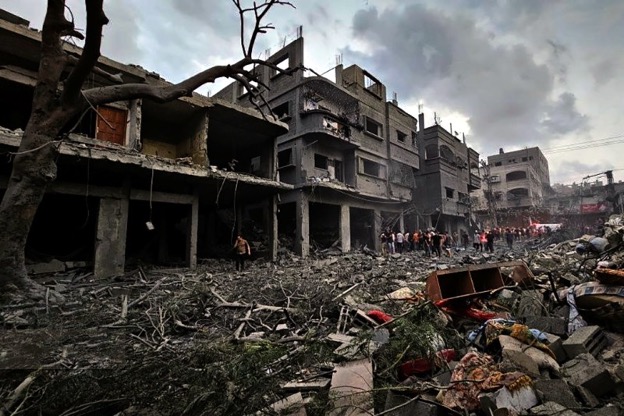
Very far from the Gaza “war” being over, the thorniest issues—Israel’s continuing occupation of Palestinian territories, disarmament of the Palestinian resistance, and the realization of a viable, sovereign Palestinian state—have yet to be resolved. So does the fate of Gaza’s surviving civilian population of over a million people, trapped in appalling conditions between the yellow line and the sea.

Two earlier ceasefires had enabled exchanges of hostages, in November 2023 and January 2025. Israel multiply breached and finally unilaterally ended both. There was—and is—no good reason to think the outcome will be any different this time around.

UN Security Council Resolution 2803

Notwithstanding these serious obstacles to a real peace, in a landmark resolution of November 17, which passed by a vote of 13-0 (with Russia and China abstaining), the UN Security Council welcomed Trump’s plan and endorsed its key provisions.

Resolution 2803 “authorized” a “Board of Peace”—whose composition is not specified in the resolution, but which will be chaired by Donald Trump himself—to:

  • Set up “a transitional governance administration, including … a Palestinian technocratic, apolitical committee of competent Palestinians from the Strip”
  • Establish “a temporary International Stabilization Force (ISF)… with forces contributed by participating States”
  • Create a “newly trained and vetted Palestinian police force,” which will work with the ISF to ensure “the process of demilitarizing the Gaza Strip, including… the permanent decommissioning of weapons from non-state armed groups.”

“As the ISF establishes control and stability, the Israel Defense Forces (IDF) will withdraw from the Gaza Strip… save for a security perimeter presence that will remain until Gaza is properly secure from any resurgent terror threat,” the text goes on. The “standards, milestones, and timeframes” will be “agreed between the IDF, ISF, the guarantors [the US, Turkey, Egypt and Qatar], and the United States.”

Astonishingly, there is no provision for any Palestinian input into this most important of issues—for both sides. If the Palestinians give up their arms with no internationally backed guarantee of eventual statehood, they are defenceless in the face of an army that has repeatedly proved its ruthlessness. But so long as Hamas is not disarmed, Israelis fear a repetition of the dreadful events of October 7, 2023, which triggered the present so-called “war” and have been invoked to justifyevery Israeli action since.

The deal of the century?

These transitional arrangements, says the resolution, will remain in place “until such time as the Palestinian Authority (PA) has satisfactorily completed its reform program, as outlined in various proposals, including President Trump’s peace plan in 2020… and can securely and effectively take back control of Gaza.”

Both the PA and Hamas denounced Trump’s 2020 plan (which he modestly called “the deal of the century”) at the time, with Hamas describing it as an attempt “to liquidate the Palestinian national project.” Among other things, the plan would have allowed Israel to annex much of the West Bank, including the Jordan Valley, leaving behind a demilitarized Palestinian “state” made up of a series of Bantustans.

Only “after the PA reform program is faithfully carried out and Gaza redevelopment has advanced,” Resolution 2803 continues, “the conditions may”— note it says “may,” not “will”—be in place for a credible pathway to Palestinian self-determination and statehood. The United States will establish a dialogue between Israel and the Palestinians to agree on a political horizon for peaceful and prosperous coexistence.”

The postponement of establishing even a “pathway” to Palestinian statehood to the indefinite future—while effectively giving Israel and the US a veto over the process—is particularly ironic, coming so soon after Canada, the UK, and all the rest purportedly “recognized” the state of Palestine.

Unsurprisingly, Hamas and the other factions in Gaza rejected Resolution 2803. In their view, Trump’s plan is no more than a “form of deep international partnership in the war of extermination waged by the [Israeli] occupation against our people.”
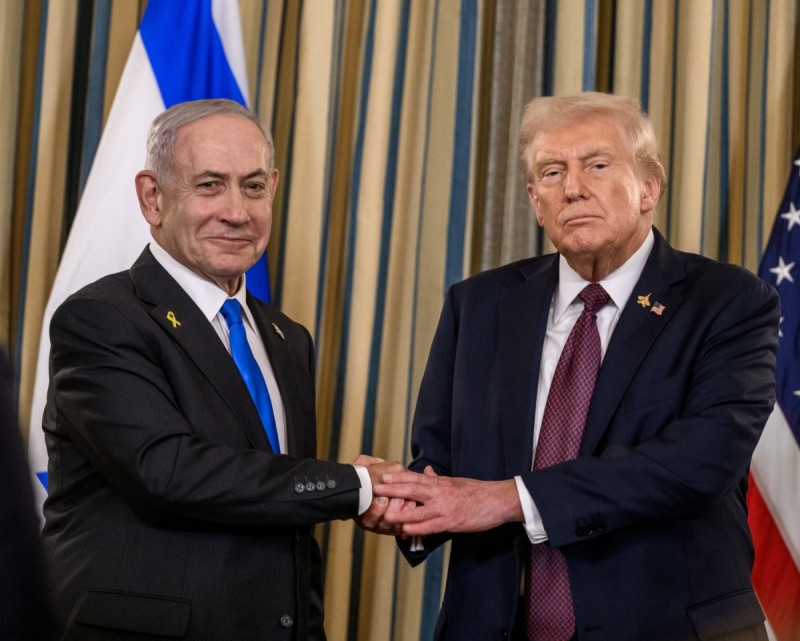
Israeli Prime Minister Benjamin Netanyahu and US President Donald Trump during the introduction of the Gaza ceasefire proposal, September 29, 2025. Photo courtesy the White House/Wikimedia Commons.

The legal background

It is difficult to overstate just how major a departure Resolution 2803 is from the UN’s previous policies on the Palestinian question—and from the body of law established by the world’s two highest international courts.

After the 1967 Six Day War, when Israel occupied the West Bank, East Jerusalem, and Gaza, Security Council Resolution 242 called for:

Withdrawal of Israel armed forces from territories occupied in the recent conflict [and]… Termination of all claims or states of belligerency and respect for and acknowledgement of the sovereignty, territorial integrity and political independence of every State in the area…


Israel ignored Resolution 242, as it has ignored literally hundreds of UN resolutions since—usually with the support of the United States, which has frequently employed its veto to shield Israel from sanctions or other UN action. The US has vetoed no less than six United Nations Security Council ceasefire resolutions in the course of the current “war” alone.

Responding to a request from the UN General Assembly, on July 19, 2024, the International Court of Justice (ICJ) ruled that “Israel’s continued presence in the Occupied Palestinian Territory is unlawful,” and it must “end its unlawful presence… as rapidly as possible,” “cease immediately all new settlement activities,” and “evacuate all settlers from the Occupied Palestinian Territory.”

The justices went on to stress that “all states,” as well as international organizations (including the UN), were “under an obligation not to recognize as legal the situation arising from the unlawful presence of the State of Israel in the Occupied Palestinian Territory and not to render aid or assistance” in maintaining the occupation.

Recalling the ICJ ruling as well as earlier resolutions, on December 3, 2024 the UN General Assembly adopted a resolution requiring Israel to “comply with international law, including ceasing all settlement activities and evacuating settlers from the Occupied Palestinian Territory.” The vote was 157 in favour, eight against, and seven abstentions. Though both the US and Israel opposed the motion, the overwhelming majority of Western democracies, including Canada and the UK, backed it.

On November 21, 2024 the International Criminal Court (ICC), which was established by the Rome Statute in 1998 as “an independent, permanent court of last resort… to investigate and prosecute the most serious crimes of international concern, namely genocide, crimes against humanity, war crimes and aggression,” issued arrest warrants for Benjamin Netanyahu and former Israeli Defence Minister Yoav Gallant for “the war crime of starvation as a method of warfare; and the crimes against humanity of murder, persecution, and other inhumane acts.”

Though not recognized by the US or Israel, this is the same court that convicted Ratko Mladić and Radovan Karadzic for their part in the 1995 Srebrenica genocide and—with US approvalindicted Vladimir Putin in 2023 for war crimes in Ukraine.

The Trump administration’s response to the ICC indictments of Netanyahu and Gallant has been to impose sanctions on both the court and several of its individual officials and judges.

The UN betrays Palestine—and itself

The Security Council’s acceptance of the Trump “peace plan” is a watershed moment for the postwar international order. It marks the definitive abandonment of attempts to resolve the Israel-Palestine dispute within this framework of international law, and their replacement by obeisance to the imperatives of great power realpolitik.

Though Russia and China both criticized the Trump plan, they conspicuously did not veto Resolution 2803. Russia has no more interest in upholding international law than Israel or the US, given its invasion of Ukraine, while China would welcome a free hand in Taiwan, which it has always insisted is an integral part of its national territory (and therefore not governed by international law regarding relations between states).

In a blistering response to Security Council Resolution 2803 Francesca Albanese, the United Nations Human Rights Council Special Rapporteur on the Situation of Human Rights in the Occupied Palestinian Territories, got to the heart of the matter.

“Despite the horrors of the last two years and the ICJ’s clear jurisprudence,” she wrote:

the Council has chosen not to ground its response in the very body of law it is obliged to uphold: international human rights law, including the right of self-determination, the law governing the use of force, international humanitarian law, and the UN Charter.


Instead, “the resolution risks entrenching external control over Gaza’s governance, borders, security, and reconstruction” and “betrays the people it claims to protect.”

Specifically:

A military force answering to a so-called ‘Board of Peace’ chaired by the President of the United States, an active party to this conflict that has continually provided military, economic and diplomatic support to the illegal occupying Power, is not legal. It is a brazen attempt to impose, by threat of continued force against a virtually defenceless population, US and Israeli interests, plain and simple.

Essentially, it will leave Palestine in the hands of a puppet administration, assigning the United States, which shares complicity in the genocide, as the new manager of the open-air prison that Israel has already established.


In abnegating its legal responsibilities and outsourcing Gaza’s future to Trump’s “Board of Peace,” she charges, the UN has betrayed not only the Palestinian people but its own founding principles as embodied in Articles 1 and 2 of the UN Charter.

You cease, I fire

Nearly three months have passed since the Gaza “ceasefire” came into effect. Israel has repeatedly stalled progress on moving to phase two of Trump’s “peace plan” until all the bodies of deceased Israeli hostages have been returned—no small task, given the difficulty of recovering them in Gaza’s devastation. By December 4 the remains of all but one hostage, police officer Ran Gvili, had been recovered. Israel is still stalling.

Though both sides have accused the other of multiple violations of the ceasefire, the monstrous asymmetry of casualties suggests the fault lies overwhelmingly with Israel.

Since October 10, at least 416 Palestinians have been killed and more than 1,110 wounded in Israeli attacks. Over the same period, just three Israeli soldiers lost their lives in Gaza. According to Palestinian sources, two of them died when their vehicle ran over unexploded ordinance, and not, as Israel claimed, in a Hamas ambush.

While there hasn’t been a single reported incident of Hamas firing rockets into Israel, the Gazan authorities claim that between October 10 and December 28 “Israel shot at civilians 298 times, raided residential areas beyond the ‘yellow line’ 54 times, bombed and shelled Gaza 455 times, [and] demolished people’s properties on 162 occasions.”

In total, Israel violated the ceasefire agreement at least 969 times from October 10 to December 28. To describe Trump’s ceasefire as “fragile,” “precarious,” or “tested,” as mainstream Western media habitually do, is to stretch the meaning of words beyond all credibility. On the Israeli side, at least, this has been a ceasefire in name only.

Restriction of aid

Let me finally turn to the only other provision in Trump’s Gaza Plan aside from the exchange of prisoners that was actually agreed in the ceasefire deal between Israel and Hamas on October 9, the resumption of “full aid” into Gaza.

Israel has failed to open the Rafah crossing into Egypt, as is explicitly mandated in the Trump plan, and has severely restricted and on occasion completely stopped traffic at other crossing points throughout the ceasefire. While the number of humanitarian aid trucks that have been allowed into Gaza since the ceasefire is disputed, it is clearly far fewer than the agreed minimum of 600 per day.

Per the Israeli human rights organization B’tselem, “Due to Israeli restrictions, as of December 16, only 57 percent of the 556 aid missions planned by the UN and its partners were carried out, including the delivery of vital aid and equipment, medical evacuations, and infrastructure repairs.”

According to Oxfam, posting on December 22:

Since the current ceasefire began on October 10th, Israeli authorities continue to arbitrarily reject scores of shipments of life-saving assistance into Gaza. Almost $50 million worth of food, water, tents, and medical supplies is still being held up at border crossings and warehouses. Oxfam alone has $2.5 million worth of aid sitting in Jordan, including 4,000 food parcels.


Expressing “serious concerns about the renewed deterioration of the humanitarian situation in Gaza, which remains catastrophic,” on December 30 the foreign ministers of Canada, Denmark, Finland, France, Iceland, Japan, Norway, Sweden, Switzerland and the United Kingdom issued a joint statement calling upon Israel to fully open all the crossings and “lift unreasonable restrictions on imports considered to have a dual use… includ[ing] urgently needed medical and shelter equipment.”

Hobbling of INGOs

The statement further demanded that international NGOs “are able to operate in Gaza in a sustained and predictable way,” and that “the UN and its partners can continue their vital work.” It emphasized that “this includes United Nations Relief and Works Agency for Palestine Refugees in the Near East [UNRWA], which provides essential services, such as health care and education, to millions of Palestinian refugees.”

This last point matters because Israel banned UNWRA—the single most important agency for coordinating aid efforts in Gaza—from operating in Israel from January 2025, on the basis of accusations (for which it provided no evidence) that some of its employees participated in the Hamas October 7 attack. That ban remains in place.

Tightening the screw further, on December 29 the Knesset passed a law cutting off electricity and water supplies to facilities owned by or operating on behalf of UNRWA in the occupied Palestinian territories, and banned provision of telecommunications, banking, and other financial services to the agency.

Under rules introduced in March 2025, Israel required aid organizations operating in Gaza and the West Bank to submit lists of their Palestinian staff by December 31 for vetting by intelligence services. Fearful that this would put their employees in danger of targeting by the IDF, many refused. Their fears are well founded. In 2024 alone, 125 UNRWA aid workers were killed in Gaza, the highest death toll in UN history.

Despite the ceasefire in Gaza, Israel has insisted on implementing this so-called “security” measure. As a result, 37 INGOs have now lost their accreditation and will have to cease operating by March 1. These include Médecins Sans Frontières, Oxfam, Vision International, ActionAid, International Rescue Committee, CARE, Medico International, Medical Aid for Palestinians, and the Norwegian Refugee Council.

These restrictions on aid entering Gaza are too numerous and systematic to be an accident. The guns may have temporarily quieted, but Israel is continuing its ethnic cleansing and genocide by other means.

As winter bites, the old, the infirm, and above all the children will continue to die. In these circumstances the survivors may be that much more willing to abandon their homeland for “voluntary” exile. In another press conference with Netanyahu on December 29, Donald Trump suggested that more than half the population would like to take advantage of such an offer (“To me it’s common sense”).

Coincidentally or otherwise, on January 2 Israel became the first country in the world to recognizethe breakaway state of Somaliland, an enclave strategically situated on the coast of the Gulf of Aden. The government of Somaliland has denied agreeing to host Israeli bases or accept displaced Gazans, but suspicions remain.

What comes next?

Three months on, the prospects for Donald Trump’s “comprehensive peace plan” are looking decidedly shaky. Having got all its hostages back, and secure in its military occupation of 53 percent of the Gaza Strip, Israel may decline to move on to phase two and find some excuse to resume the conflict as in the previous ceasefires.

Hamas is unlikely to agree to disarm in the absence of guarantees of eventual statehood that Israel will never give—what more, after all, do Palestinians have to lose by keeping their weapons? Meantime the states that were mooted as contributors of troops to Trump’s proposed international stabilization force, including Egypt, Turkey, and Indonesia, are reportedly getting cold feet about being dragged into the quagmire.

But in a sense none of this matters. The Trump plan has done its job. Gaza is out of the headlines, the allies are back on board, and the US is calling the shots—with the imprimatur of the United Nations Security Council, which has accepted the inevitable.

The “rules-based order” established at the end of World War II is over. The world is entering “a new era of great power competition; a generational struggle to maintain peace through strength”—to quote US Secretary of War Pete Hegseth, speaking after the US invasion of Venezuela—an era in which right gives way to might.

Resolution 8302 is the embodiment of that capitulation. Gaza is the future. And not just for Palestinians.


Canadian Dimension, Oct 2, 2025

United States envoy Morgan Ortagus casts the lone veto against a UN Security Council draft resolution calling for a Gaza ceasefire, aid access, and hostage release. The measure, supported by 14 members, failed due to the US veto. Photo by Laura Jarriel/United Nations.

It will soon be two years since Hamas launched its “Al-Aqsa Flood” attack on southern Israel. Israel’s retaliatory “war” has since reduced Gaza to an uninhabitable wasteland and caused—at a very conservative minimum—more than 66,000 Palestinian deaths, with some 83 percent of them, according to Israeli Defense Forces (IDF) data, being civilians. Since Israel broke its January ceasefire agreement and resumed its offensive in March, 15 of every 16 out of the 16,000 Palestinians the IDF has killed have been civilians.

In the aftermath of October 7 there was enormous support for Israel, especially in the West. But as the “war” ground on, with no apparent end in sight and ever-mounting civilian casualties, the tide of Western public opinion turned. Recent pressure led several Western governments to reluctantly berate Israel for its “intolerable and unacceptable” and “utterly reckless and appalling” actions—while doing precious little to stop them.

Despite the chorus of condemnation, we have seen nothing approaching the battery of sanctions that played such a large part in bringing down the apartheid regime in South Africa, not to mention the swingeing economic, political, and cultural sanctions imposed on Vladimir Putin’s Russia immediately following its February 2022 invasion of Ukraine.

This paralysis on the part of the “international community” is remarkable, given that what is at issue is increasingly being recognized as a genocide—the worst of all crimes under international humanitarian law. But it is not, perhaps, surprising. Given their previous support for Israel, not to mention their vulnerability to economic bullying by Trump’s US, Western leaders found themselves tossed on the horns of an impossible dilemma.

The genocide dilemma

As far back as January 2024, the International Court of Justice (ICJ) ruled that there was a “plausible risk” of genocide in Gaza and ordered Israel to take several measures to avert this outcome. At that point the official death toll stood at 27,500—less than half of what it is now. Israel ignored these and further ICJ orders of March and May 2024.

It will likely be years before the ICJ reaches a final verdict on whether or not Israel is guilty of genocide. The world’s highest court on war crimes, the International Criminal Court (ICC), has however already issued arrest warrants in November 2024 for Israeli Prime Minister Benjamin Netanyahu and former Defence Minister Yoav Gallant for using “starvation as a method of warfare” and other war crimes and crimes against humanity.

On September 16, 2025, an authoritative new report by a UN Independent Commission of Inquiry, based on two years of investigation, concluded that:

Israeli authorities and Israeli security forces committed four of the five genocidal acts defined by the 1948 Convention on the Prevention and Punishment of the Crime of Genocide, namely killing, causing serious bodily or mental harm, deliberately inflicting conditions of life calculated to bring about the destruction of the Palestinians in whole or in part, and imposing measures intended to prevent births.


Amnesty InternationalHuman Rights Watch, the International Federation for Human Rights, the University Network for Human RightsMédecins Sans Frontières, the Israeli groups B’Tselem and Physicians for Human Rights, the International Association of Genocide Scholars, and the Lemkin Institute for Genocide Prevention and Human Security, as well as some of the world’s leading genocide and Holocaust historians like Israeli scholars Raz Segal and Omer Bartov, have all come to the same conclusion.

It takes some chutzpah to contend that all of these are part of some global antisemitic conspiracy to discredit Israel. Denying the genocide—the US position—is becoming less and less credible, while refusing to take a stance until the final ICJ verdict is in, which the British and Canadian governments are doing, simply looks evasive.

The problem for Western politicians is that the 1948 Genocide Convention—to which all members of the G7 apart from Japan are parties, as is Israel—requires them not only to refrain from committing genocide themselves, but “to prevent and to punish” genocide “whether [its perpetrators] are constitutionally responsible rulers, public officials or private individuals.”

The argument made by Joe Biden, Justin Trudeau, and others against the ICC warrants that “there is no equivalence—none—between Israel and Hamas“ has no standing in international law. A war crime is a war crime and a genocide is a genocide, no matter who is committing it, guerrilla “terrorists” or the elected leaders of a democratic nation state.

Complicating things further, “complicity in genocide” is also a punishable offense. If Israel is committing genocide, then it is a genocide in which Western governments have been complicit throughout the last two years, by supplying arms, providing diplomatic cover, ignoring their own intelligence assessments that Israel has been obstructing aid, and suppressing protest. No wonder some politicians are beginning to get cold feet.

A rift in the West?

On September 18 all members of the UN Security Council except the United States voted to adopt a resolution calling for an immediate and permanent ceasefire in Gaza, the release of all hostages, and for Israel to immediately and unconditionally lift all restrictions on the entry of humanitarian aid. The US vetoed the measure. This is the sixth time in the last two years that the US has (ab)used its veto power to block a ceasefire in Gaza.

Though France and the UK voted for the resolution, no Western government has yet been prepared to defy America and trigger the nuclear option, which would be to put a United for Peace resolution to the General Assembly. If passed by a two-thirds majority, this would override any Security Council veto and could pave the way for armed UN intervention in Gaza. This procedure was invoked 13 times between 1951 and 2022.

There were nevertheless straws in the wind suggesting that some Western governments were more prepared to risk Israeli and (more importantly) US wrath and take baby steps toward pressuring Israel to end its genocide than at any time during the present “war”—if only to retrospectively cover their collective asses and avoid indictments from the ICC.

The EU Commission has finally proposed to strip Israeli goods of privileged access to European markets, with new tariffs imposed on billions of euros of exports, as well as sanctioning extremist individual Israeli ministers—though such a measure may still not pass, given continuing support for Israel by Germany and some other EU states.

Recognition of Palestine—an empty gesture?

Canada, the UK, Australia, France, and several other Western countries announced with great fanfare at the 80th UN General Assembly session in September in New York—or the day before it, “out of respect for the Jewish new year”—that they were recognizing the State of Palestine. They were very late to the party. One hundred and forty seven states had recognized Palestine prior to their move, including Spain, Ireland, Norway, and Slovenia in 2024.

While it would be wrong to dismiss the legal significance of recognition out of hand, in the absence of other measures it will likely have limited practical impact on the ground. That does not mean it is insignificant. It underlines the tensions between the US and some of its most important Western allies (as well as splits within Europe itself).

Canadian Prime Minister Mark Carney was refreshingly candid about why his government was changing tack:

The current Israeli government is working methodically to prevent the prospect of a Palestinian state from ever being established. It has pursued an unrelenting policy of settlement expansion in the West Bank, which is illegal under international law. Its sustained assault in Gaza has killed tens of thousands of civilians, displaced well over one million people, and caused a devastating and preventable famine in violation of international law. It is now the avowed policy of the current Israeli government that ‘there will be no Palestinian state’.


Netanyahu responded with predictable fury—and in the process confirmed that Carney’s charges were amply justified:

I have a clear message to those leaders who are recognizing a Palestinian state after the horrendous October 7 massacre: You are rewarding terror with an enormous prize.

And I have another message for you: It’s not going to happen. There will be no Palestinian state to the west of the Jordan River.

For years I have prevented the creation of that terror state, against tremendous pressure, both domestic and from abroad.

We have done this with determination, and with astute statesmanship. Moreover, we have doubled the Jewish settlement in Judea and Samaria [i.e., the West Bank], and we will continue on this path.


In the face of such clarity on the part of Israel, we have to ask why Western leaders are still peddling the fantasy of a “two-state solution” at all. The suspicion must be that it is yet another evasion, designed to cover up their unwillingness to tackle the role played by ethnic cleansing and genocide in Israel’s Zionist project head on.

Trumpery at the UN

The US, by contrast, has made its opposition to recognizing Palestine at this point in time crystal clear. Interviewed recently by Tony Dokoupil of CBS Mornings, US Secretary of State Marco Rubio insultingly dismissed recognition as “almost a vanity project for a couple of these world leaders who want to be relevant, but it really makes no difference.”

In between gratuitously insulting America’s Western allies (“I look at London where you have a terrible mayor, a terrible, terrible mayor and it’s been so changed, so changed. Now they want to go to Sharia law”) and trumpeting his own imaginary achievements (“I have ended seven unendable wars… Everyone says that I should get the Nobel Peace Prize for each one of these achievements”), Trump found time to briefly mention Gaza in his address to the UN General Assembly on September 23.

His concern was not the ongoing genocide:

Now, as if to encourage continued conflict, some of this body [the UN] is seeking to unilaterally recognize a Palestinian state. The rewards would be too great for Hamas terrorists for their atrocities. This would be a reward for these horrible atrocities, including October 7th…


Three days later, in his own address to the UN General Assembly, Netanyahu accused Carney and company of capitulating “under pressure of a biased media, radical Islamist constituencies, and antisemitic mobs.”

The Israeli prime minister said little that did not repeat what he had told the same body in 2023 and 2024. What was different this time was that Netanyahu’s plane was forced to take a circuitous route to New York in order to avoid the airspace of countries that were legally bound to enforce the ICC arrest warrant. And he spoke to a largely empty hall.

On his entry, over 100 delegates from over 50 countries walked out in protest. Of those that remained, the UK and even the US filled their seats with junior staff instead of senior diplomats. The majority of those who left were from the Global South.

Sadly, Canada’s Ambassador Bob Rae remained seated. It was, he explained to CTV News, his job.

Trump’s “peace plan”

This is the background against which, on September 29, Trump and Netanyahu jointly unveiled the latest US “peace plan” at a White House press conference. Netanyahu had reportedly made several last-minute changes to the draft drawn up by Trump’s team, all to Israel’s advantage.

The 20-point plan calls for immediate suspension of all military operations, followed by the release of all Israeli captives within a 72-hour period. Israel will then release “250 life sentence prisoners plus 1,700 Gazans who were detained after Oct. 7, 2023, including all women and children detained in that context.”

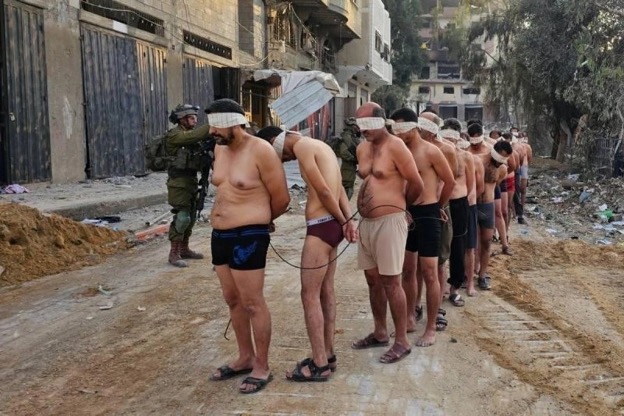
This is only a fraction of more than 10,000 Palestinians languishing in Israeli jails, 3,600 of whom are held without charge or trial in “administrative detention”—many more hostages, as they are, than the 251 Israelis captured by Hamas in the October 7 attack.

It is grim testimony to the disproportionality of this “war” that “For every Israeli hostage whose remains are released, Israel will release the remains of 15 deceased Gazans.”

After the hostages are released, an amnesty will be extended to Hamas members who “commit to peaceful coexistence and to decommission their weapons,” while any who wish to leave Gaza “will be provided safe passage to receiving countries.” Hamas will disarm and “all military, terror, and offensive infrastructure, including tunnels and weapon production facilities, will be destroyed and not rebuilt.” Hamas and other factions “agree to not have any role in the governance of Gaza, directly, indirectly, or in any form.”

Once the agreement has been accepted, full aid “will proceed without interference from the two parties through the United Nations and its agencies, and the Red Crescent,” as well as unspecified third parties (likely a reference to the US-based private so-called Gaza Humanitarian Foundation, which has been responsible for the deaths of hundreds of Palestinians queuing for food).

Though this provision is likely to play badly in Israel, which has banned the UN’s Palestinian refugee agency UNRWA from operating within its boundaries, this is is the only role envisaged for the UN in the entire document.

The plan stipulates that “Israel will not occupy or annex Gaza” and promises that “No one will be forced to leave Gaza,” while “those who wish to leave will be free to do so and free to return.” As “a temporary International Stabilization Force” put together by “The United States… with Arab and international partners” trains “vetted Palestinian police forces in Gaza,” the IDF will gradually withdraw from the Strip to a perimeter “security zone.”

Gaza will meantime be governed by “a technocratic, apolitical Palestinian committee… of qualified Palestinians and international experts, with oversight and supervision by a new international transitional body… headed and chaired by President Donald J. Trump, with other members and heads of State… including Former Prime Minister Tony Blair.”

This “Board of Peace” will “set the framework and handle the funding for the redevelopment of Gaza until such time as the Palestinian Authority has completed its reform program… and can securely and effectively take back control of Gaza.”

As Patrick Wintour has perceptively noted in the Guardian, though it is not explicitly stated in the document, this “reform program” requires that the Palestinian Authority ends its participation in legal proceedings against Israel at the ICJ and ICC. (The text refers to the reform programme “as outlined in various proposals, including president Trump’s peace plan in 2020,” and the latter demands this.)

The Board of Peace will oversee a “Trump economic development plan to rebuild and energize Gaza”—is Trump’s dream of a “Riviera of the Middle East” about to come true?—and “A special economic zone will be established with preferred tariff and access rates to be negotiated with participating countries.”

Surrender or annihilation

It is significant that Hamas—whose negotiators Israel had attempted to assassinate in a September 9 air strike on Qatar—was not involved in drafting the plan or even provided with an advance copy. Palestinians are being presented with an ultimatum reminiscent of the one the Germans gave Rotterdam in 1940: surrender or your city will be destroyed.

And indeed, even while Hamas is considering the plan—for which Trump has demanded their answer “within three or four days”—Israel’s Defence Minister Israel Katz has issued a “final warning” on October 1 that “This is the last opportunity for Gaza residents who wish to do so to move south and leave Hamas operatives isolated in Gaza City,” making clear that “Those who remain… will be considered terrorists and terrorist supporters.”

If the Palestinians reject the plan, then in Donald Trump’s words at the White House press conference:

Israel would have my full backing to finish the job of destroying the threat of Hamas.

But I hope that we’re going to have a deal for peace, and if Hamas rejects the deal… Bibi, you’d have our full backing to do what you would have to do.


Netanyahu added: “If Hamas rejects your plan, Mr President, or if they supposedly accept it and then do everything to counter it, then Israel will finish the job by itself. This can be done the easy way or it can be done the hard way, but it will be done.”

The only positives in the Trump plan for the Palestinians are that it offers a possible road to ending the genocide—as is desperately needed—without Israel annexing Gaza or expelling its people, as the extreme rightwing ministers in Netanyahu’s government have demanded. In his earlier musings on a “Riviera of the Middle East” Trump too had envisaged “cleaning out” all of the Palestinians.

But even these modest consolations for the loss of Palestinian lives, homes, and hopes over the last two years are very far from guaranteed.

The plan requires Hamas to hand over all of the Israeli hostages before any Palestinian prisoners are released and to disarm on the basis of promises of amnesty while the IDF remains in Gaza. The timetable for withdrawal, by contrast, is vague and dependent on transfer of power to new security forces whose composition remains undetermined.

Once Hamas has given up its hostages and its weapons, there is nothing to stop Israel from reneging on the agreement—as it previously did with the January 2025 ceasefire—and “finishing the job” of genocide and ethnic cleansing against a defenceless Gazan population.

It is scarcely reassuring that after his return from Washington, Netanyahu put out a video reassuring Israelis that “the IDF stays in the majority of the Strip.”

Asked in the same video whether he had agreed to a Palestinian state, the Israeli prime minister replied: “Not at all, and it is not written in the agreement. One thing was made clear: We will strongly oppose a Palestinian state.”

This gives the lie to Emmanuel Macron’s claim—echoed by among others Antony Albanese and Mark Carney—that the Trump plan provides a foundation “to build a lasting peace in the region, based on the two-state solution.”

If Bibi has anything to do with it, there will be no such thing. Ever.

The plan does in fact mention Palestinian statehood, only to locate it firmly in the realms of the never-never:

While Gaza redevelopment advances and when the P.A. [Palestinian Authority] reform program is faithfully carried out, the conditions may finally be in place for a credible pathway to Palestinian self-determination and statehood, which we recognize as the aspiration of the Palestinian people. (My emphasis)

A week is a long time in politics

Little more than a week ago, Canada, Australia, Britain, France, and other Western allies broke ranks with Israel and the US and recognized a Palestinian state. Mark Carney and others made it clear that they were taking this step, in part, to forestall Israel’s attempts—about which Benjamin Netanyahu has been quite open—to sabotage any possibility of a two-state solution to the Israeli/Palestinian conflict.

Today, those same states are falling over backwards to lean on Hamas to accept a deal that disarms the Palestinian resistance, requires it to forgo any legal recourse for Israeli war crimes and/or genocide through the ICJ and ICC, hands Gaza over to an unelected foreign junta headed by Donald Trump and Tony Blair—onetime cheerleader of the Iraq War that left over a million Iraqis dead—to “redevelop,” and indefinitely postpones any prospect of Palestinian statehood. The word for this is betrayal.

French President Emmanuel Macron, German Chancellor Friedrich Merz, UK Prime Minister Keir Starmer, Australian Prime Minister Anthony Albanese, President of the EU Commission Ursula von der Leyen, and EU Foreign Minister Kaja Kallas, have all hastened to issue statements lauding “President Trump’s leadership” (Starmer) and hailing the plan as “the best immediate chance to end the war” (Kallas). “Elbows up” Mark Carney was the most sycophantic of them all, welcoming the deal as “historic.”

All agree that “Hamas has no choice but to immediately release all hostages and follow this plan,” with only Macron adding “I expect Israel to engage resolutely on this basis.”

One can almost hear the huge collective sigh of relief that went up in Western capitals as soon as the Trump plan was announced. The cracks are papered over, the delinquent allies are back in the US fold, and our craven leaders are off the genocide hook.

If Hamas fails to “seize this opportunity” (von der Leyen), we must infer, it has only itself to blame for the consequences.

The rewards of terror

Hamas senior leader Mahmoud Mardawi is bang on when he characterizes the Trump plan as offering “an end to this criminal war in exchange for ending the Palestinian people’s right to their state and their rights to their land, homeland, and holy sites.”

Mardawi is adamant that “no Palestinian will accept that,” but genocide is a powerful persuader.

Whether, out of desperation, Palestinians will buy this sordid “deal” remains to be seen. If they do, Israel gets its hostages back and it’s game over for the Palestinian resistance.

If they don’t, Israel will “finish the job” with full US backing and blame Hamas for forcing it to kill yet more Palestinian babies in order to ensure its security. Either way this is a win–win situation for Israel.

If, as Netanyahu says, a purely symbolic recognition of a non-existent Palestinian state is “an enormous prize” for the terror of Hamas’s October 7 attack, then how much greater are the rewards for the IDF’s two years of live-streamed genocide in Gaza?

First published in Canadian Dimension/ June 7, 2025

Fire engulfs a classroom at the Fahmi Al-Jargawi School in Gaza City following an Israeli strike, May 26, 2025.

One of the most remarkable—not to say shameful—features of the last 20 months of carnage in Gaza has been the near-unanimity of support for Israel’s assault from Western governments and political parties of otherwise sharply opposed persuasions, regardless of how criminally Israel has conducted its “war.”

Joe Biden and Donald Trump, Rishi Sunak and Keir Starmer, Justin Trudeau and Pierre Poiliévre, Emmanuel Macron and Marine Le Pen, Olaf Scholz and Friedrich Merz, not to mention Viktor Orban, Antony Albanese, Donald Tusk, Geert Wilders, Ursula von der Leyen and Kaja Kallas are unlikely bedfellows, but all have come together on Israel’s “right to defend itself” against Hamas “terrorism.”

In the name of this principle—whose legality is dubious, given that Gaza is not a foreign power but (according to the world’s highest court) a territory that Israel has de facto occupied since 1967, whose civilian population it therefore has a legal duty to protect—even the mildest Western expressions of “concern” over this or that IDF “excess” have invariably been prefaced (“balanced”) by obligatory ritualistic condemnations of Hamas.

With the partial exception of the Guardian, which has allowed its columnists like Arwa Mahdawi and Nesrine Malik to pen op-eds that were critical of Israel, the mainstream Western media from the BBC to the New York Times, CNN to the Washington Post, have all generally been content to toe this official line. While Israel’s justifications—and lies—have been amplified, its atrocities have been sidelined, minimized, or not reported at all.

Under the sign of October 7

Such partiality was perhaps comprehensible in the immediate aftermath of October 7, when images of the horror were fresh in people’s minds. But little changed either with revelations that what happened on October 7 was less clearcut than Israeli propaganda had presented it or with the mounting deaths, destruction, and undeniable evidence over the ensuing weeks and months that Israel was routinely committing war crimes in Gaza.

It mattered not that the final figure for deaths in Israel on October 7 was 1,139, not the 1,400 at first reported; nor that one-third of these were soldiers, police, or security guards—in other words, combatants—rather than “mostly civilians”; nor that most of the atrocity stories that did so much to mobilize Western opinion behind Israel in the ensuing weeks were either totally discredited, like the fairy tales of 40 beheaded babies, babies baked in ovens, and babies ripped from their mothers’ wombs, or, like the “mass rape” allegations, lacked any convincing supporting evidence. Politicians like Biden, Blinken, and Trudeau continued to repeat these myths long after they had been debunked in the Israeli press.

It mattered not that many of the Israelis who perished on October 7 were later shown to have died from IDF “friendly fire,” resulting either from the fog of war or implementation of Israel’s Hannibal Directive, which authorizes killing one’s own rather than letting them be taken prisoner. Many of the young people killed at the Nova music festival were likely casualties of fire from IDF helicopter gunships; the burned-out hulks of their cars, which could not have been produced by Hamas’s light weaponry, strongly suggest as much.

Nor did it matter that 18 months ago, on January 24, 2024, the International Court of Justice (ICJ) ruled that there was “a real and imminent risk” of genocide occurring in Gaza and mandated six provisional measures aimed at “preserving … the right of the Palestinians in Gaza to be protected from acts of genocide.” The court imposed further measures on March 28 and May 24. All were simply ignored by Israel, with the open or tacit support of the United States and Israel’s other Western allies, including Canada.

It is difficult to think of a more blatant snub to the international rule of law—unless it be the howls of Western outrage that greeted the arrest warrants issued by the International Criminal Court (ICC) last November 21 for Israeli Prime Minister Benjamin Netanyahu and Defence Minister Yoav Gallant for “the war crime of starvation as a method of warfare; and the crimes against humanity of murder, persecution, and other inhumane acts.” The US has now instituted sanctions against the judges who authorized the arrest warrants.

Only one thing mattered. For 20 months it sufficed to invoke “the deadliest day for the Jewish people since the Holocaust” to forestall further debate. In democracies that pride themselves on their respect for freedom of expression and human rights, anyone who questioned Israel’s narrative, from journalistsartistsactors and novelists to sports commentatorschildren’s entertainers, and rap musicians, were vilified as “antisemites,” harassed by the agencies of the state, and “canceled” from the public domain.

If not now, when?

One of the first signs that this unholy consensus among the major Western powers might at long last be cracking was a striking shift in tone in some leading British newspapers.

What appears to have tipped the scales this time were warnings of imminent famine in Gaza resulting from the total blockade on supplies of food, water, power, and medicine Israel had imposed on the Strip since March 2, two weeks before it unilaterally broke the truce it had agreed with Hamas in January and resumed its full-scale military offensive.

On May 4, the Guardian ran a lead editorial titled “Israel’s aid blockade of Gaza: hunger as a weapon of war,” which concluded:

What is shameful is that almost half the children in Gaza questioned in a study said that they wished to die. What is shameful is that so many civilians have been killed, and so many more pushed to the brink of starvation. What is shameful is that this has, indeed, been allowed to happen.


The next day the Daily Mirror, historically the most left-wing of Britain’s tabloids, devoted its front page as well as two inside pages to a story by Defense Editor Chris Hughes titled “Horror in Gaza.” The headline read “OUR CHILDREN ARE STARVING.”

On May 6 the Financial Times—the most establishment of UK establishment papers—openly challenged Israel’s “self-defence” protestations in a powerful editorial headed “The west’s shameful silence on Gaza”:

Each new offensive makes it harder not to suspect that the ultimate goal of Netanyahu’s far-right coalition is to ensure Gaza is uninhabitable and drive Palestinians from their land. For two months, Israel has blocked delivery of all aid into the strip. Child malnutrition rates are rising, the few functioning hospitals are running out of medicine, and warnings of starvation and disease are growing louder. Yet the US and European countries that tout Israel as an ally that shares their values have issued barely a word of condemnation. They should be ashamed of their silence, and stop enabling Netanyahu to act with impunity.


Martin Sandbu’s June 2 op-ed, which argued that “it is in Europe’s interest to impose sanctions on Israel,” is something the FT would never have countenanced previously.

“End the deafening silence on Gaza—it is time to speak up,” proclaimed a lead editorial in The Independent on May 10, explaining that times had changed:

The world was stunned by the horrific Hamas atrocity of October 7, 2023, in southern Israel, in which 1,200 people were killed and 251 hostages seized—the youngest just nine months old. Despite its fierce retaliation raising immediate alarm, Israel found international backing for the right to defend itself …

But now any initial moral justification for continuing to prosecute the war 18 months on has been lost—and the disgust we once reserved for Hamas militants transferred to the brutal and relentless assaults by the Israel Defense Forces and the humanitarian disaster caused by its blockade.


Ramming its message home with a picture of hungry Palestinian children, the next day’s Independent devoted its entire front page to Gaza, calling upon “Britain and its allies to force Israel to end a cruel war that… has long since lost any moral justification.”

“The unfolding famine in Gaza is an obscenity the world must no longer tolerate,” the Independentagain thundered on May 29. “It is an outrage that Israel, the occupying power ignoring its obligations to treat civilians properly, should behave in this manner; it is an even greater act of shame that the world should continue to tolerate it.”

On May 8 the Economist published an article suggesting that the Gaza Health Ministry death toll was a significant undercount and that “between 77,000 and 109,000 Gazans have been killed, 4-5% of the territory’s pre-war population,” and the lead editorial demanded that “The war in Gaza must end.” Even Rupert Murdoch’s reliably pro-Israel Times carried an editorial titled “Israel’s friends cannot be blind to suffering in Palestine.”

On May 11, the Guardian broke the taboo on the dreaded G-word, whose application to Gaza by correspondents or interviewees the BBC, the New York Times, and CNN have all done their utmost to ban, asking:

Now [Israel] plans a Gaza without Palestinians. What is this, if not genocidal? When will the US and its allies act to stop the horror, if not now?

The lawyers and the literati weigh in

On May 26, more than 800 UK legal professionals published a letter to British Prime Minister Keir Starmer asserting that Israel’s actions in Gaza constituted war crimes, crimes against humanity, and possible genocide. They went on to demand that the UK government honour the ICC warrants against Netanyahu and Gallant, impose sanctions, and trigger the suspension of Israel’s UN membership by invoking Article 6 of the UN Charter.

These were not Donald Trump’s “radical left lunatic” judges and lawyers. Signatories included former Supreme Court justices Lady Hale, Lord Sumption, and Lord Wilson; former Court of Appeal judges Sir Stephen Sedley, Sir Anthony Hooper, and Sir Alan Moses; and more than 70 King’s Counsel, including former chairs of the Bar Council of England and Wales, the Criminal Bar Association, and the Bar of Northern Ireland.

Two days later, 380 writers from England, Wales, Scotland, Northern Ireland, and the Republic of Ireland issued a statement begging “the peoples of the world to join us in ending our collective silence and inaction in the face of horror.” Among the self-styled “Writers for Gaza” were Ian McEwan, Hanif Kureshi, Geoff Dyer, Jeannette Winterton, Pico Iyer, Russell T. Davis, and Zadie Smith, all eminent figures in British cultural life.

Pointing out that “The use of the words ‘genocide’ or ‘acts of genocide’ to describe what is happening in Gaza is no longer debated by international legal experts or human rights organizations”—the letter referenced Amnesty InternationalMédecins Sans FrontièresHuman Rights Watch, the International Federation for Human Rights, and the United Nations Human Rights Council—the writers’ condemnation of Israel was unequivocal:

The term “genocide” is not a slogan. It carries legal, political, and moral responsibilities. Just as it is true to call the atrocities committed by Hamas against innocent civilians on October 7, 2023 crimes of war and crimes against humanity, so today it is true to name the attack on the people of Gaza an atrocity of genocide, with crimes of war and crimes against humanity, committed daily by the Israel Defence Forces, at the command of the government of the State of Israel.


The writers went on to demand an immediate ceasefire and unrestricted distribution of aid to Gaza through the UN, with the imposition of sanctions if Israel refused to comply.

While musician Brian Eno and historian William Dalrymple have repeatedly called out Israeli crimes over the last 20 months, the same cannot be said for all of the letter’s signatories. Many had remained silent up to now, and some have shifted their positions.

Zadie Smith, for example, copped a lot of social media flak for having described the language of student protestors in a May 2024 New Yorker article as “weapons of mass destruction” while refusing to take sides on Gaza.

To be fair, she had hardly represented Hamas’s and Israel’s crimes as comparable in scale:

The monstrous and brutal mass murder of more than eleven hundred people, the majority of them civilians, dozens of them children, on October 7th, has been followed by the monstrous and brutal mass murder (at the time of writing) of a reported fourteen thousand five hundred children. And many more human beings besides …


Are these instances of better late than never? Or are they, as some have argued, efforts to launder reputations while there is still time, to escape charges of complicity in what is increasingly being recognized as a genocide? As Omar El Akkad grimly predicted in his book of the same title, One Day, Everyone Will Always Have Been Against This.

Bringing up in the rear, the politicians

Other public figures have also been having second thoughts on Gaza. UK broadcaster Piers Morgan recently told Mehdi Hasan: “Listen, you and I have talked about this war in Gaza ever since it started, this phase of the 75-year conflict. I have resisted going as far as you have done in your criticism of the Israeli government. I resist no more.”

Former US State Department spokesman Matthew Miller, who made himself notorious for his smirking defences of Israeli actions under the Biden administration, admitted in a Sky Newsinterview that “I don’t think it’s a genocide, but I think, I think it is without a doubt true that Israel has committed war crimes.”

Asked why he lied about this at the time, Miller responded:

When you’re at the podium, you’re not expressing your personal opinion.

You’re expressing the conclusions of the United States government. The United States government had not concluded that they committed war crimes, still have not concluded [that].


In other words, he was only following orders. This defence didn’t wash at the Nuremberg Trials, and is unlikely to wash today should Miller—or anybody else who has helped Israel carry out or cover up its crimes in Gaza—find themselves in the ICC dock in the Hague.

No doubt this consideration is beginning to weigh with the West’s political leaders, some of whom now appear to be in an unseemly rush to cover their asses.

In October 2024, British Foreign Secretary David Lammy—who like Prime Minister Keir Starmer is a long-standing member of Labour Friends of Israel—told Parliament that to speak of genocide in Gaza “undermines the seriousness of that term,” which he wanted to reserve for “when millions of people lost their lives in crises like Rwanda, the Second World War and the Holocaust.”

This is a definition that not only (willfully?) misinterprets international law but conflicts with the British government’s own stance on genocides in Srbenica and Myanmar.

Questioned as to whether Lammy spoke for the government, Keir Starmer responded with a characteristic deflection:

It would be wise to start a question like that by a reference to what happened in October of last year [2023]. I am well aware of the definition of genocide, and that is why I have never described this or referred to it as genocide.


He cannot do so, of course, without laying open both his government and his person to criminal charges of complicity in the most heinous of all crimes.

All the more significant then, that David Lammy told Parliament on March 17 that though Israel “quite rightly must defend its own security,” its latest blockade was a “breach of international law.” The next day Starmer publicly rebuked his foreign secretary for saying the quiet bit out loud (“The government is not an international court, and, therefore, it is up to courts to make judgments”), but nevertheless conceded that “Israel’s actions in Gaza are at clear risk of breaching international humanitarian law.”

Several senior British Conservative MPs are also seemingly having a change of heart on Gaza. On May 6 Kit Malthouse organized a letter to Keir Starmer signed by seven MPs and six members of the House of Lords calling upon the government to stand “against indefinite occupation” and “reinforce international law,” and recognize the state of Palestine “as a necessary step to reinforce international law and diplomacy.” That same day, Conservative MP Mark Pritchard told the House of Commons, “I have supported Israel, pretty much at all costs. But today, I want to say that I got it wrong.”

Against this background, Keir Starmer for the UK, Emmanuel Macron for France, and Mark Carney for Canada issued an unusually strongly worded statement on May 19 threatening that “If Israel does not cease the renewed military offensive and lift its restrictions on humanitarian aid, we will take further concrete actions in response.”

Though the three leaders did not—for perhaps obvious reasons—use the word genocide, they left no doubt as to their disgust at Israel’s “egregious actions”:

The Israeli Government’s denial of essential humanitarian assistance to the civilian population is unacceptable and risks breaching International Humanitarian Law. We condemn the abhorrent language used recently by members of the Israeli Government, threatening that, in their despair at the destruction of Gaza, civilians will start to relocate. Permanent forced displacement is a breach of international humanitarian law.


The statement went on to condemn “any attempt to expand settlements in the West Bank … which are illegal and undermine the viability of a Palestinian state and the security of both Israelis and Palestinians,” threatening that in this case, too, “We will not hesitate to take further action, including targeted sanctions.”

The following day David Lammy addressed the Commons again. “We are now entering a dark new phase in this conflict,” he told MPs:

Netanyahu’s Government plan to drive Gazans from their homes into a corner of the strip to the south and permit them a fraction of the aid that they need. Yesterday, Minister Smotrich even spoke of Israeli forces ‘cleansing’ Gaza, of ‘destroying what’s left’ and of resident Palestinians being ‘relocated to third countries’. We must call this what it is: it is extremism, it is dangerous, it is repellent, it is monstrous and I condemn it in the strongest possible terms … Israel’s plan is morally unjustifiable, wholly disproportionate and utterly counterproductive, and whatever Israeli Ministers claim, it is not the way to bring the hostages safely home.


Though Lammy’s speech was passionate, the accompanying actions were modest: the suspension of trade talks with Israel, which were stalled anyway, and a largely symbolic imposition of sanctions on a handful of settler extremists in the West Bank.

Are these indications that the rats are finally preparing to abandon Israel’s sinking ship? Or are they just cosmetic gestures, designed to cover up Western complicity in the Gaza genocide while doing nothing serious to stop it? Only time will tell. Unfortunately time is a luxury the starving people of Gaza do not have.

The official death toll in Gaza—Israel’s payback for the 1,139 deaths on October 7—now stands at nearly 55,000, the majority of them women and children. Where are those “concrete actions,” Mr. Starmer, Mr. Macron—Mr. Carney? As you convene for your G7 summit in Kananaskis, the world awaits.

Are you prepared to face down Donald Trump, who has thrown his full support behind Israel and is salivating at the prospect of America rebuilding an ethnically cleansed Gaza as the “Riviera of the Middle East”?

Three weeks have now passed since your declaration of intent, and so far we have seen nothing but words.

It’s only words

In the contentious New Yorker article mentioned earlier, Zadie Smith’s intent was to draw attention to “the use of words to justify bloody murder, to flatten and erase unbelievably labyrinthine histories, and to deliver the atavistic pleasure of violent simplicity to the many people who seem to believe that merely by saying something they make it so.”

Under other circumstances, I would be the first to agree that in this case as in others, “language and rhetoric are and always have been weapons of mass destruction”:

It is no doubt a great relief to say the word “Hamas” as if it purely and solely described a terrorist entity. A great relief to say “There is no such thing as the Palestinian people” as they stand in front of you. A great relief to say “Zionist colonialist state” and accept those three words as a full and unimpeachable definition of the state of Israel, not only under the disastrous leadership of Benjamin Netanyahu but at every stage of its long and complex history, and also to hear them as a perfectly sufficient description of every man, woman, and child who has ever lived in Israel or happened to find themselves born within it. It is perhaps because we know these simplifications to be impossible that we insist upon them so passionately.


But these are not other circumstances. And however belatedly, more people like Zadie Smith—and even a few politicians—may be waking up to that fact. This is not a time for nuance.

Ta-Nehisi Coates probably said it best when, commenting on the part played by Biden’s Gaza policy in Kamala Harris’s electoral defeat by Donald Trump, he argued:

We are at a moment right now where people are asking themselves why can’t the Democratic Party defend [Trump’s] assault on democracy … and I would submit to you that if you can’t draw the line at genocide, you probably can’t draw the line at democracy.


The “labyrinthine” complexity of the Israel-Palestine conflict—whose century-long history includes plentiful atrocities on both sides—cannot be used to obscure the simple moral truth that lies at the foundation of all international humanitarian law.

It is necessary to condemn war crimes, crimes against humanity, and genocide wherever and whenever they occur—irrespective of the identity of their perpetrators or the justice of the causes in whose name they are committed.

If we forget this, the genocide in Gaza will point the way to a future without law for the whole of humanity, and Western democracies’ selfishness, cowardice, and indifference will have let it.

US in meltdown, Palestine genocide back on, West very concerned

Canadian Dimension, Derek Sayer / March 24, 2025 / 16 min read

Illustration of Humpty Dumpty from Through the Looking Glass, by John Tenniel, 1871.

“When I use a word,” Humpty Dumpty said in rather a scornful tone, “it means just what I choose it to mean—neither more nor less.”

“The question is,” said Alice, “whether you can make words mean so many different things—that’s all.”

“The question is,” said Humpty Dumpty, “which is to be master—that’s all.”


—Lewis Carroll, Through the Looking Glass


Not for the first time in the last 18 months, recent events in the Middle East and the United States have had me marvelling at the shiftiness of words.

On Saturday, March 15, three days before Donald Trump’s promised all hell once again broke loose in Gaza, I read in the Guardian that:

The current fragile pause in hostilities in Gaza has come under further threat with Hamas hardening its negotiating positions amid new Israeli airstrikes in the devastated territory.

The first phase of the ceasefire agreement ended two weeks ago but Israel is refusing to implement the scheduled second phase, which is supposed to end with its withdrawal from Gaza, the freedom of all remaining hostages held by Hamas, and a definitive end to the conflict.

Currently, both sides have refrained from returning to war, though Israel has conducted an intensifying series of airstrikes in Gaza that have killed dozens of Palestinians. (My emphasis)


If conducting “an intensifying series of airstrikes that have killed dozens of Palestinians” is not a “return to war,” I exploded, then what was it?

When is a ceasefire not a ceasefire?

The “ceasefire agreement” was announced on January 15—just in time for Donald Trump’s inauguration—and came into operation four days later. It was a funny sort of ceasefire. Hamas kept its side of the bargain and didn’t fire a single rocket into Israel during the truce. But between January 22 and March 11 at least 700 Palestinians were killed by the IDF or their bodies retrieved from areas medics could not access before.

Just one Israeli was killed in Gaza during that same period, a contractor Israeli forces “misidentifiedas [a] threat as he arrived at IDF post in civilian clothing” and shot.

Israel also failed to withdraw its troops from the so-called Philadelphi Corridor between Gaza and Egypt, as promised in the agreement. Instead of moving on to Phase 2 of the ceasefire, it demanded that Hamas accept a new proposal from Donald Trump’s special Middle East envoy Steve Witkoff to prolong Phase 1 through Ramadan and Passover in exchange for immediate release of half of Hamas’s remaining hostages, but with no guarantee that Israel would implement the already agreed terms of Phase 2 thereafter.

Hamas’s reluctance to accept this unilateral shifting of the goalposts was what the Guardian meant when it spoke of Hamas “hardening its negotiating positions.”

Although the agreement mandated the provision of humanitarian aid to Gaza, Israel obstructed the delivery of tents, prefabricated homes, and heavy machinery into the strip, where over 90 percent of the population have been (to use the media’s favoured euphemism) “displaced” and are attempting to survive the winter in the bombed-out hellscape in which their homes have been reduced to piles of rubble. While for a time Israel did allow the flow of food aid to increase, it continued to block everything else it considered “dual use,” from scalpels and scissors to scaffolding and generators.

On March 2 the Israeli government went further and decided “to prevent any entry of goods and supplies into Gaza”—whether from aid agencies or commercial sources—in order to pressurize Hamas to accept the Witkoff proposal. Since that date, no trucks have been allowed through the Gaza crossings, all of which Israel controls.

Tightening the screw, a week later Israel cut off all remaining electricity supplies (most had already been stopped after Hamas’s attacks on October 7, 2023), crippling the desalination plant that supplies Gaza’s already depleted supply of clean drinking water.

This reimposition of seige conditions on Gaza’s desperate civilian population was widely condemned internationally—though not, needless to say, by the United States. The foreign ministers of France, Germany, and the UK issued a joint statement warning that “Humanitarian aid should never be contingent on a ceasefire or used as a political tool.”

Britain’s Foreign Secretary David Lammy, normally a staunch defender of Israel, went so far as to tell the House of Commons on March 17 “This is a breach of international law.”

Prime Minister Keir Starmer soon slapped him down. A Downing Street spokesperson later clarified that in Britain’s view “Israel’s actions in Gaza are at clear risk of breaching international humanitarian law,” without accusing Israel of actually having done so. They added: “The government is not an international court, and … it is up to courts to make judgments.”

They neglected to mention that the world’s two highest courts, the International Court of Justice (ICJ) and the International Criminal Court (ICC) have both (severally) ruled that Israel is in flagrant breach of international humanitarian law.

Four months ago the ICC issued an arrest warrant for Benjamin Netanyahu and former Israeli defense minister Yoav Gallant for war crimes and crimes against humanity, including “the war crime of starvation as a method of warfare.” The indictment states:

both individuals intentionally and knowingly deprived the civilian population in Gaza of objects indispensable to their survival, including food, water, and medicine and medical supplies, as well as fuel and electricity … [as well as] impeding humanitarian aid in violation of international humanitarian law …


These are the very things Israel resumed doing while the ceasefire was still in operation.

Two days after the ceasefire went into effect in Gaza, the IDF launched a major offensive in the occupied West Bank, attacking Jenin, Tulkarem and Nur al-Shams refugee camps and “displacing” 40,000 residents. Israeli defence minister Israel Katz told the troops to prepare for an “extended stay” of at least a year and “prevent the return of residents.”

Per UNRWA, this is “by far the single longest Israeli Forces’ operation in the West Bank since the second intifada in the early 2000s … causing the largest population displacement since the 1967 war.” As of March 4, 90 Palestinians, including at least 17 children, had been killed in the West Bank since the beginning of this year.

Through the looking glass

While for the Guardian all this still did not amount to “returning to war,” the word “war” was taking on a whole new range of meanings in Washington.

In pursuit of his objective of ridding America of the “illegal immigration … poisoning the blood of our nation,” Trumpty Dumpty has now invoked the Alien Enemies Act to deport hundreds of Venezuelan migrants not to Venezuela but to a third country, El Salvador. They have been imprisoned in the notoriously brutal Terrorism Confinement Center in Tecoluca, condemned to hard labor for a year—a term that is indefinitely renewable.

The similarities to Israel’s “administrative detention,” in which 3,327 prisoners/hostages were held as of December 31, 2024 without charge and (as documented in multiple reports) beaten, starved, raped, tortured, and brutalized, have been duly noted.

These deportees have not been given access to due process in either the US or El Salvador. The only proof of their alleged involvement in the criminal gang Tren de Aragua (TdA), which was designated a “terrorist organization” by the State Department in February, is the US administration’s assertion of their membership. Evidence of that involvement has not been presented in the courts of either country, and the accused have been given no opportunity to access lawyers or to defend their case. In several instances, distraught family members have convincingly attested their innocence.

Compounding the illegality, the flights violated US judge James E. Boasberg’s court order temporarily forbidding the deportations (and his verbal injunction that the planes must turn back if they were already in the air). Trump’s “border Tsar” Tom Homan was unapologetic, telling Fox News “I don’t care what the judges think. I don’t care.”

Passed in 1798 in anticipation of hostilities with France, the Alien Enemies Act has only been used three times in its entire history, all of them during actual wars.

Its most notorious invocation was by Franklin D. Roosevelt after the 1941 Japanese attack on Pearl Harbor to facilitate the internment of Japanese, German, and Italian nationals in the US (the internment of Japanese American citizens had a different legal basis). Internment was later acknowledged to be a grave injustice. The Civil Liberties Act of 1988 gave survivors reparations and a formal apology by President Reagan.

The Alien Enemies Act states:

Whenever there shall be a declared war between the United States and any foreign nation or government, or any invasion or predatory incursion shall be perpetrated, attempted, or threatened against the territory of the United States, by any foreign nation or government, and the President of the United States shall make public proclamation of the event, all natives, citizens, denizens, or subjects of the hostile nation or government, being males of the age of fourteen years and upwards, who shall be within the United States, and not actually naturalized, shall be liable to be apprehended, restrained, secured and removed, as alien enemies.


Pretty clearly—to anybody who understands plain English, which is now, thanks to Trump, the sole official language of the United States—the US is not involved in a “declared war” with the Venezuelan nation or government, TdA is not a part of the Venezuelan military, and nobody has “perpetrated, attempted, or threatened” an “invasion or predatory incursion” into US territory in any usual sense of the words.

The US president, incidentally, does not have the authority to declare war. That power exclusively belongs to Congress.

But the Master makes words mean exactly what he chooses them to mean—neither more nor less. According to Trump’s presidential proclamation,

Over the years, Venezuelan national and local authorities have ceded ever-greater control over their territories to transnational criminal organizations, including TdA. The result is a hybrid criminal state that is perpetrating an invasion of and predatory incursion into the United States, and which poses a substantial danger to the United States … Evidence irrefutably demonstrates that TdA has invaded the United States and continues to invade, attempt to invade, and threaten to invade the country; perpetrated irregular warfare within the country; and used drug trafficking as a weapon against our citizens.


So, we must conclude, while in Gaza an intensifying series of air strikes killing dozens—or more accurately, hundreds—of Palestinians does not constitute an act of war, the US is the victim of a “invasion” launched by Venezuela involving neither ground troops nor air power, but whose “devastating effects” nevertheless justify the suspension of normal due process rights under the US constitution. Truly we are living in the upside-down.

The never-ending, ever-expanding “war on terror”

Just how upside-down our reality has become is well illustrated in an affidavit filed on March 17 in Justice Boasberg’s court. Attempting to justify the summary deportation of the Venezuelans, Robert L. Cerna, acting field office director for ICE’s enforcement and removal operations in part of Texas, argued that:

While it is true that many of the TdA members removed under the AEA do not have criminal records in the United States, that is because they have only been in the United States for a short period of time. The lack of a criminal record does not indicate they pose a limited threat. In fact, based upon their association with TdA, the lack of specific information about each individual actually highlights the risk they pose. It demonstrates that they are terrorists with regard to whom we lack a complete profile. (My emphasis)


Read it again. Perverse as it sounds, Cerna is saying that the absence of evidence of criminal activity on the part of the alleged TdA gang members should itself be taken as proof of their being “terrorists”! This is the dystopian world imagined in George Orwell’s Nineteen Eighty-Four, where the party slogan is “War is peace, freedom is slavery, ignorance is strength.”

The Oxford Dictionary defines terrorism as “the unlawful use of violence and intimidation, especially against civilians, in the pursuit of political aims.” This is a relatively restrictive definition, which limits the use of the term to illegal uses of violence or threats thereof, principally against civilians, in support of political objectives.

Unfortunately in recent years—and in particular, since George W. Bush declared a “Global War on Terror” following the September 11, 2001 attacks on the World Trade Center and the Pentagon—the semantic boundaries of the term “terror” have been expanded, while its meanings have become less and less precise.

Because of, rather than in spite of, this imprecision, “terror” has become the perfect floating signifier, in which the horror that is evoked by memories of 9-11, or the 2015 Charlie Hebdo killings, or the 2017 massacre at Ariana Grande’s Manchester Arena concert, is transferred onto whoever and whatever governments choose to demonize and provides the justification for taking extraordinary measures against them.

Meaning is assigned, in other words, acording to the dictates of power. As with Humpty Dumpty, the question is which is to be master—that’s all.

The “war on terror” provided the cover for the American-led invasions of Afghanistan in 2001, and Iraq in 2003—a conflict based on faulty intelligence that Saddam Hussein was in possession of weapons of mass destruction, which led to from 150,000 to one million civilian deaths.

It also gave us the CIA’s “enhanced interrogation techniques” such as waterboarding, extraordinary renditions, and Guantánamo Bay internment camp, which despite many promises remained in use throughout the Obama and Biden presidencies (and is now being refashioned by the Trump administration to warehouse deported migrants).

These latter operate in a shadowy state of exception beyond the reach of law, but the law itself has also been mobilized in the war on terror in ways that are no less detrimental to civil liberties. In many western jurisdictions legislation that is ostensibly designed to prevent support for organizations designated by governments as “terrorist” has the effect of criminalizing speech or actions, like protest demonstrations, that otherwise would be perfectly legal, and empowering the state to surveil and intimidate a wide range of dissident opinion which goes well beyond “terrorism” as usually understood.

In the UK, for example, last August a police swat team conducted a dawn raid on the London home of Asa Winstanley, associate editor at The Electronic Intifada news site, and seized his electronic devices. Earlier in the month another pro-Palestinian journalist, Richard Medhurst, was detained and questioned for 24 hours at Heathrow Airport.

Both times the police were acting under the “Encouragement of Terrorism” and “Dissemination of Terrorist Publications” sections of the UK’s 2006 Terrorism Act, which carry a maximum sentence of 15 years’ imprisonment. This “disturbing pattern of weaponizing counter-terrorism laws against reporters,” argued the Committee for the Protection of Journalists, is having “a chilling effect on journalism and public service reporting in the United Kingdom.”

Donald Trump and his minions have also discovered they can make “terrorism” mean many different things, depending on the political needs of the moment.

Trump has designated international drug cartels as “Foreign Terrorist Organizations,” despite the fact that their aims are criminal rather than political. He is reportedly also considering designating “illicit fentanyl” as a “weapon of mass destruction.” While the former order provided the basis for invoking the Enemy Aliens Act in the case of the Venezuelan deportees, the latter could be used to justify military action against Mexico or Canada, both of which he has accused of supporting the trafficking of fentanyl across the US border, while repeatedly threatening to annex Canada as the “51st state.”

More recently, when asked whether the wave of vandalism against Tesla dealerships should be treated as “domestic terrorism,” Donald Trump replied:

I’ll do it. I’m going to stop them … because they’re harming a great American company. When you hurt an American company, especially a company like this that supplies so many jobs that others are unable to do.


Attorney General Pam Bondi followed up with a statement that described “the swarm of violent attacks on Tesla property” as “nothing short of domestic terrorism” and promised “We will continue investigations that impose severe consequences on those involved in these attacks, including those operating behind the scenes to coordinate and fund these crimes.”

I am not for a moment suggesting that such violent attacks should go unpunished. The point is that the administration doesn’t need to invoke “domestic terrorism”—which hitherto, in the US, has mostly been the province of the extreme right—to prosecute vandalism or arson. The existing legal framework suffices. But this is not about the law.

Trumping constitutional rights

The Trump administration has made its intention to use the canard of “terrorism” to go after political dissidents crystal clear. While the main target at this time is academic and other critics of Israel, there is no reason to believe the persecution will stop there.

Commenting on March 10 on what is rightly being seen as one of the most critical legal cases of modern times, Trump posted the following on his Truth Social network:

Following my previously signed Executive Orders, ICE proudly apprehended and detained Mahmoud Khalil, a Radical Foreign Pro-Hamas Student on the campus of Columbia University. This is the first arrest of many to come. We know there are more students at Columbia and other Universities across the Country who have engaged in pro-terrorist, anti-Semitic, anti-American activity, and the Trump Administration will not tolerate it. Many are not students, they are paid agitators. We will find, apprehend, and deport these terrorist sympathizers from our country—never to return again. If you support terrorism, including the slaughtering of innocent men, women, and children, your presence is contrary to our national and foreign policy interests, and you are not welcome here. We expect every one of America’s Colleges and Universities to comply. Thank you! (My emphasis)


Khalil was a leading figure in last year’s student protests against Columbia University’s links with Israel. He is not, however, by any stretch a “terrorist sympathizer,” and can only be misrepresented as such if all criticism of Israel is equated with support for Hamas.

The details of Khalil’s arrest, transfer from New Jersey to an ICE detention facility in Louisiana, and attempted deportation (which at the time of writing has temporarily been blocked by the courts) have been well covered in the mainstream media.

What matters here that Khalil is a Green Card holder, which is to say, a legal permanent resident of the United States, who has not been accused, let alone convicted, of any crime. He is being expelled from the US, in his own words, for “exercising my right to free speech as I advocated for a free Palestine and an end to the genocide in Gaza“—a right that is supposedly protected by the First Amendment to the US constitution.

The sole basis for Khalil’s attempted deportation is that “that the Secretary of State has reasonable grounds to believe that his presence or activities in the United States would have potentially serious adverse foreign policy consequences for the United States.” The secretary of state is not required to provide any evidence in support of that belief.

The administration maintains that judges who interfere in the use of executive fiat to deport are exceeding their authority. “This judge, like many of the Crooked Judges I am forced to appear before, should be IMPEACHED!!!” Trump fumed apropos Justice Boasberg, whom he called a “Radical Left Lunatic of a Judge” and a “troublemaker.”

“We will be revoking the visas and/or green cards of Hamas supporters in America so they can be deported,” Secretary of State Marco Rubio announced after Khalil’s arrest. “He’s going to leave—and so are others. We’re going to keep doing it,” he reiterated on Face the Nation.

In another recent case, Dr. Rasha Alawieh, a kidney transplant specialist at a medical center affiliated with Brown University, was denied re-entry to the US after visiting her parents in Lebanon because immigration officials deemed her to be a supporter of Hezbollah. The “evidence” for this was photos and videos on her phone of the funeral of Hezbollah leader Hassan Nasrallah, who was assassinated in an Israeli air strike, which was attended by “hundreds of thousands” of mourners. It was only “common sense security,” Trump officials claimed. Once again, Dr Alawieh was denied due process.

We can expect many more summary deportations to follow. This is an administration that means business, and shows little inclination to be restrained by the niceties of law.

In Israel, back in October, the Knesset adopted two laws designating UNRWA—the principal channel for distributing humanitarian aid in Gaza—as a “terrorist organization,” banning it from operating in Israel or the occupied territories. Donald Trump has meantime publicly mused about removing Gaza’s surviving Palestinian population and repurposing the strip, under American auspices, as a “Riviera of the Middle East.”

Terror is as terror does

The Guardian finally acknowledged that Israel had “returned to war” in Gaza on March 18, when it reported that the IDF had “launched attacks that killed more than 400 people in the devastated Palestinian territory, in the bloodiest single day of violence since the first months of the war in 2023.”

The next day the paper carried an editorial which laid the blame for “shattering the two-month ceasefire that had brought a fragile peace and relief to Gaza” squarely on Israel.

Among the casualties of Israel’s air strikes in the early morning hours of March 18, when most people will have been asleep in their tents or makeshift shelters, were 174 children and 89 women. I mention this not because I consider the lives of Palestinian men of any less importance but because it underlines the fact that now, as throughout the war, the principal victims—and indeed targets—of Israel’s actions in Gaza have been civilians.

I was wrong, however, when I asked earlier what this was if not a “return to war.”

What Israel has done to Gaza in the last 18 months is obscenely violent, not to say monstrously disproportionate—as of March 20, the official death toll in Gaza had climbed to 49,617, as compared with the 1,139 killed in Israel during Hamas’s October 7 attack, of whom one-third were members of the IDF, police, or kibbutz security guards and an unknown number died from IDF “friendly fire.”

But this is not a war, in the accepted meaning of the word. It is, rather, a collective punishment by an occupying power, in which Hamas’s October 7 attacks—which also according to the ICC involved war crimes and crimes against humanity, albeit on a much smaller scale—provided the Israeli state with the opportunity to further the process of ethnic cleansing, if necessary by genocide, of the indigenous inhabitants of Palestine that began with the Nakba of 1948 and now appears to be reaching its Final Solution.

In a video broadcast on March 19, Yoav Gallant’s successor as Defense Minister Israel Katz didn’t even try to hide his government’s agenda. His remarks were addressed not to Hamas, but to Gaza’s civilian population:

Residents of Gaza, this is a final warning. If all the Israeli hostages are not released and Hamas is not eliminated from Gaza Israel will act with forces you have never known before. Take the advice of the US president. Return the hostages and eliminate Hamas, and other options will open up for you—including going to other places in the world for those who wish. The alternative is complete destruction and devastation.


There is a word for “the unlawful use of violence and intimidation, especially against civilians, in the pursuit of political aims.” It’s called terrorism.

Facts, fictions, and fabrications regarding Israel’s ‘Black Sabbath’

First published Canadian Dimension April 2, 2024 

Destruction in Gaza following an Israeli bombing raid. Photo courtesy Fars News Agency/Wikimedia Commons.

Red lines

In his State of the Union address, delivered on March 7, US President Joe Biden signaled an apparent shift in American policy toward the Gaza War—though so far, it has to be said, this has proved largely cosmetic.

Asked afterward by an MSNBC interviewer whether Israel’s threatened invasion of Rafah, where 1.5 million desperate Palestinians have taken refuge, would constitute a “red line,” Biden answered:

It is a red line, but I’m never going to leave Israel. The defense of Israel is still critical, so there’s no red line where I’m going to cut off all weapons so they don’t have the Iron Dome to protect them.


He then added:

But there’s redlines that if he [Benjamin Netanyahu] crosses them … They cannot have 30,000 more Palestinians dead as a consequence of going after … there’s other ways to deal with the trauma caused by Hamas. 


At the time, some interpreted this as a hint that Biden might condition the future supply of specifically offensive weapons on Israel’s reining in its assault.

Netanyahu’s response was defiant. “We’ll go there [Rafah],” he assured a Politico interviewer (and has repeated many times since):

We’re not going to leave them [Hamas]. You know, I have a red line. You know what the red line is? That October 7 doesn’t happen again. Never happens again.


A week later, stung among other things by Canada’s decision to suspend future arms sales to Israel, Netanyahu challenged “our friends in the international community”:

Is your memory so short? So quickly you forgot about October 7, the worst massacre committed against Jews since the Holocaust? So quickly you are ready to deny Israel the right to defend itself against the monsters of Hamas?


And so we return, as we always return, to October 7.

Hamas is ISIS

The events of October 7 are the alpha and omega of Israel’s representation of its assault on Gaza as “self-defense” against Hamas’s supposed “existential threat,” which Israel compares to ISIS and the Nazi Holocaust. 

Israel’s position can be summarized by saying that nothing Israel did to Palestinians before October 7 can possibly justify Hamas’s attack, whereas the horrors of that attack justify anything and everything Israel has done to Gaza since—or will do to Gaza in the future.

I have no wish to minimize the horrors Hamas perpetrated on October 7. But given what those horrors have been used to justify since—as of April 1, at least 32,845 Palestinians have been killed and 75,392 injured in pursuit Israel’s “absolute victory“—it is important to try to distinguish fact from fiction concerning “Black Sabbath.”

Netanyahu set out his stall on October 9:

We didn’t want this war.

It was forced upon us in the most brutal and savage way …

The savage attacks that Hamas perpetrated against innocent Israelis are mindboggling: slaughtering families in their homes, massacring hundreds of young people at an outdoor festival, kidnapping scores of women, children and elderly, even Holocaust survivors.

Hamas terrorists bound, burned and executed children.

They are savages.

Hamas is ISIS.

And just as the forces of civilization united to defeat ISIS, the forces of civilization must support Israel in defeating Hamas …


“We saw the wild animals,” he told his shaken compatriots in a televised address two days later:

We saw the barbarians we are facing. We saw a cruel enemy. An enemy worse than ISIS. We saw boys and girls, bound, shot in the head. Men and women burned alive. Young women raped and slaughtered. Fighters decapitated … In one place, they set fire to tires around them, and burned them alive.


Speaking on October 18 in Tel Aviv, which he was the first US president to visit in a time of war, Joe Biden echoed his host’s narrative:

More than 1,300 innocent Israelis killed, including at least 31 American citizens, by the terrorist group Hamas.

Hundreds—hundreds of young people at a music festival of—the festival was for peace—for peace—gunned down as they ran for their lives.

Scores of innocents—from infants to elderly grandparents, Israelis and Americans—taken hostage.

Children slaughtered. Babies slaughtered. Entire families massacred.

Rape, beheadings, bodies burned alive.

Hamas committed atrocities that recall the worst ravages of ISIS, unleashing pure unadulterated evil upon the world.

There is no rationalizing it, no excusing it. Period.


These are very serious accusations. The question is: how far are they warranted?

Imagined atrocities

On October 10 Israel announced that “more than 1,400 people” had been “killed by Hamas terrorists” in the October 7 attack. On November 10 the Israeli foreign ministry “updated” its estimate to “around 1,200 people.” The reason for the revision, said spokesman Lior Haiat, was that “there were a lot of corpses that were not identified and now we think those belong to terrorists … not Israeli casualties.”

That so many bodies were so badly burnt that it was difficult to establish who they were, let alone how they died, should have rung alarm bells, but it did not stop Haiat from baldly asserting (and Western media from mindlessly repeating) that “Hamas terrorists … brutally murdered about 1,200 people in cold blood.”

To this day, Western media reiterate again and again that “Some 1,200 people, mostly civilians, were killed in southern Israel during the Hamas-led incursion on Oct. 7.” It is not infrequently stated that “at least” or “more than” 1,200 were killed.

Yet a more authoritative and accurate count, compiled by Israel’s state social security agency Bituah Leumi and reported by Agence France-Presse (AFP) on December 15, has long been available to Western media. This gave a total of 1,139 deaths resulting from Hamas’s attack, of whom 695 were Israeli civilians, 373 were security forces, and 71 were foreigners. 

AFP reported a revised total based on new Israeli figures of 1163 on February 1, which included 20 hostages known to have died since in Gaza.

These figures conclusively debunk the tales of beheaded babies, babies baked in ovens, babies hung on clothes lines, babies ripped from their mothers’ wombs and stabbed, that were widely reported as fact in the Western press and propagated by politicians like Biden and US Secretary of State Anthony Blinken. Such stories did much to gain Israel support in the early weeks of its retaliatory assault on Gaza.

Golan Vach, head of the army’s search and rescue unit, related how he “personally” transported “a decapitated baby” found in its dead mother’s arms in Be’eri kibbutz. But only one baby appears in Bituah Leumi’s list of those killed in Be’eri, 10-month-old Mila Cohen, and she was shot (and not decapitated). The Israeli government claimed on October 10 that “forty babies” were murdered at Kfar Aza kibbutz, but Bituah Leumi lists 46 civilians killed at Kfar Aza in all, of whom the youngest was 14.

Full exposés of these and other fabrications can be found on The GrayzoneHaaretzMondoweiss, and Electronic Intifada websites, so I need not say any more here.

In fact, per Bituah Leumi’s figures, a total of 36 children were killed in Israel on October 7, twenty of whom were under 15 years old and ten of whom died in rocket attacks.  Only two of them were babies. Three children aged between two and six were killed in their home at Nir Oz kibbutz, and two brothers aged five and eight perished in their car with their parents when they drove into IDF–Hamas crossfire.

While all these deaths are to be mourned—as are those of 12,400 Palestinian children Israel killed between October 8 and February 20 in Gaza—they would seem to fall into the category of what Joe Biden, excusing the deaths of innocents in Gaza, called “a price of waging war” rather than recalling “the worst ravages of ISIS.”

Some might see Israel’s callously abandoning premature babies to die after the IDF assaulted Al-Nasr Children’s Hospital and forced medical staff to leave, on the other hand, as an unambiguous crime against humanity. We might also spare a thought for 12-year-old Sidra Hassouna, who was left hanging dead from a wall, ribbons of flesh all that was left of her legs after an earlier Israeli strike on Rafah.

Kibbutz Be’eri a few days after the Hamas attack of October 7. Photo by Micah Brickman/Wikimedia Commons.

Hasbara

One of the most creative purveyors of atrocity stories was Yossi Landau, southern commander of ZAKA, an Israeli religious voluntary organization that collects bodies and body parts from the sites of attacks and disasters.

ZAKA volunteers are often wrongly described in the Western media as “first responders,” but this is misleading. ZAKA’s concern is with proper burial of the dead according to Judaic ritual, and—crucially in this context—its volunteers have no forensics training. Indeed, they are actively hostile to the use of autopsies or other forensic procedures they regard as defiling the dead, even though these are often required to reliably establish the cause of a death (or physical evidence of a rape).

Landau is the sole source for a horrific story that went around the world, which Anthony Blinken repeated to the Senate Appropriations Committee on October 31:

A young boy and girl, six and eight years old, and their parents, around the breakfast table. The father, his eye gouged out in front of his kids. The mother’s breast cut off. The girl’s foot, amputated. The boy’s fingers cut off, before they were executed. And then their executioners sat down and had a meal. That’s what this society is dealing with, and no nation could tolerate that.


There is not a shred of corroborating evidence for this gruesome tale. And the Bituah Leumi list contains no siblings aged 6 to 8 recorded as killed in Be’eri.

An investigation published on January 31 in Haaretz details how “As part of the effort to get media exposure, Zaka spread accounts of atrocities that never happened, released sensitive and graphic photos, and acted unprofessionally on the ground.”

Since October 7 ZAKA has worked closely with the National Hasbara Headquarters in the Israeli prime minister’s office. Hasbara is a Hebrew term meaning “explanation,” or “public diplomacy,” but is more aptly translated here as government propaganda.

Meeting with ZAKA volunteers on November 23, Netanyahu told them:

These are powerful stories and we are in a major fight. This fight is not about to end at the moment … we need to buy time, which we also buy by turning to world leaders and to public opinion. You have an important role in influencing public opinion, which also influences leaders.

Demographics of the dead

The rhetoric of politicians and Western mainstream media has relentlessly sought to create the impression that the principal targets of Hamas’s attack were innocent, civilian victims—especially babies, children, women, and elderly people. Working from an earlier list of victims published by Haaretz on October 19, a report for Action on Armed Violence by Tamsin Westlake paints a significantly different picture.

“Of the total of 1,004 victims whose gender is identified, 735 (73.4 percent) … were male, and 278 (26.6 percent) female.” The gender imbalance was even more marked among victims belonging to the military (298 or 77.6 percent males, to 38 or 11.8 percent females) and police (86.44 percent males, 4.72 percent females).

The dead included 29 children under 18 and 57 people over the age of 61, who together formed less than seven percent of the total. By far the largest category of October 7 casualties fell into the 18–25 age group (447 people), followed by 26 to 40-year-olds (226 people).

This age and gender profile of victims is the exact opposite of what we would expect to find from listening to Netanyahu and Biden, reading the Daily Express or the New York Times, or watching ABC, BBC, CBC, or CNN.

The high number of 18- to 25-year-old victims includes many killed at the Nova music festival (332, a figure that was later revised upward to 364). But as Westlake points out, “One of the reasons the number of victims between 18-25 is large compared to the other categories is that most of the individuals in that age range were serving in the military—258 out of 447.”

While more civilians than military died on October 7, it is grossly misleading to say that the victims were “mostly civilians.” Per Bituah Leumi’s figures, one-third (32.75 percent) of the casualties were members of the IDF, police, or security guards. These were not “innocent civilians.” They were combatants.

Friendly fire

There can be no doubt that Hamas did murder large numbers of civilians in cold blood on October 7. Many were shot, often at close quarters. Some burned to death when Hamas fighters set fire to their homes to smoke them out of safe rooms. Others died when Hamas threw hand grenades into the bomb shelters in which they were hiding.

But there is also much to suggest that many civilian deaths, including at the Nova music festival and in Be’eri kibbutz—the sites of the worst casualty counts—resulted from IDF “friendly fire.” This has been well covered in MondoweissElectronic Intifada and Middle East Eye, so I shall give just a few examples here.

In Be’eri kibbutz, reported photographer Quique Kierszenbaum, “Building after building has been destroyed … walls reduced to concrete rubble from where Israeli tanks blasted the Hamas militants where they were hiding.” Tuval Escapa, a member of the Be’eri security team, told Haaretz that “the commanders in the field made difficult decisions—including shelling houses on their occupants in order to eliminate the terrorists along with the hostages.”

On being shown footage of the destruction at Be’eri and Kfar Aza for Al Jazeera’s excellent documentary October 7—the fullest and best-researched investigation to date—British military expert Chris Cobb-Smith concluded that “such catastrophic structural damage was clearly not caused by a structural collapse from a fire” and would have been “caused by some sort of heavy weapons system during combat.”

Hamas fighters only carried light weaponry—mainly assault rifles and rocket-propelled grenades (RPGs). This kind and scale of damage, as other analyses confirm, could only have been caused by fire from tanks, drones, or Apache helicopters, which only the IDF possessed.

The same applies to the large number of cars burnt out at the Nova music festival, which provided some of the most haunting images of the day’s horrors. As Jonathan Cook puts it, “The burnt cars piled up as a visual signifier of Hamas’ sadism are, in fact, evidence of, at best, Israel’s incompetence and, at worst, its savagery.”

Yasmin Porat’s testimony

Forty-four-year-old mother of three Yasmin Porat escaped the Nova festival with her partner to Be’eri kibbutz, only to be captured and held together with 11 other hostages in a house occupied by 40 Hamas fighters. “They treated us very humanely,” she says, “Because their objective was to kidnap us to Gaza. Not to murder us.”

After two hours Israeli security forces arrived. There was a fierce gun battle, during which one of the Hamas militants surrendered, taking Porat out of the house with him as a human shield.

Yasmin Porat: I see on the lawn, in the garden of the people from the kibbutz. There are five or six hostages lying on the ground outside, just like sheep to the slaughter, between the shooting of our [fighters] and the terrorists.

Aryeh Golan [interviewer]: The terrorists shot them?

Yasmin Porat: No, they were killed by the crossfire. Understand there was very, very heavy crossfire.

Aryeh Golan: So our forces may have shot them?

Yasmin Porat: Undoubtedly.


The fighting went on until 8:30, when:

They [i.e., the IDF] eliminated everyone, including the hostages. After insane crossfire, two tank shells were shot into the house … And at that moment everyone was killed. There was quiet, except for one survivor that came out of the garden, Hadas.


Porat’s account is corroborated by the other survivor, Hadas Dagan, as well as by Brig. Gen. Barak Hiram, who led the IDF forces. Hiram wanted the standoff resolved by nightfall. After the Hamas fighters fired an RPG, he ordered the tank commander: “The negotiations are over. Break in, even at the cost of civilian casualties.”

Liel Hetzroni

Among the victims were 12-year-old twins Liel and Yanai Hetzroni, whose screams for help, Dagan says, she will never forget.

A pretty little girl, Liel Hetzroni became a poster child for hasbara. On November 14, former Prime Minister Naftali Bennett tweeted:

12 year old Liel Hetzroni of Kibbutz Beeri was murdered in her home by Hamas monsters on Oct 7th. Her body has now been identified. Her brother and grandfather were also murdered. Look at her sweet smile. Liel harmed nobody. She was murdered just because she’s Jewish.


Bennett’s claim was repeated by the Jewish Chronicle and Lucy Manning of the BBC. Israeli news site Ynet reported that Hamas fighters “murdered them all. Afterwards, they set the house alight.”

The trigger-happy Brig. Gen. Barak Hiram, who gave the order that killed Liel and torched the house, was subsequently reprimanded for ordering the demolition of a building at Israa University in Gaza City without proper authorization. He is currently being considered for the post of Benjamin Netanyahu’s military secretary.

The fog of war

A detailed account of the events of October 7 by Israeli military correspondents Ronen Bergman and Yoav Zitun was published in the newspaper Yedioth Ahronoth’s weekend supplement 7 Days on 12 January 2024 and translated by Electronic Intifada on January 20. It makes uncomfortable reading:

On this Black Sabbath … some of the hardest, most embarrassing and infuriating chapters in the history of the army were also written. This includes a command chain that failed almost entirely and was entirely blindsided; orders to open fire on terrorist vehicles speeding towards Gaza even as there was a concern that they contained captives—some sort of renewed version of the Hannibal Directive; fighters who—due to lack of communications—had to direct aerial support using their cell phones … warplanes roaming the air in the critical moments of the attack without guidance … and even unmanned aircraft operators who had to join the kibbutz WhatsApp groups in order to let besieged civilians help them to build a list of targets. And everything was so crazy, chaotic, improvised, and haphazard that you have to read it to believe that this is what actually happened. 


At 8:10, with much of Israel’s observation and communications systems knocked out by Hamas, Zik UAV (drone) operators were told, “You have authority to fire at will.”

When at 8:30 the only two Apache helicopters then in the air in the Gaza envelope spotted “a tremendous river of human beings, flowing through the gaps [in the fence] toward the settlements of the south,” squadron commander Lt. Col. A ordered more helicopters to take off with the instruction “Shoot anyone who intrudes in our space, without [waiting for] authorization.”

“Twenty-eight fighter helicopters shot over the course of the day all of the ammunition in their bellies, in renewed runs to rearm,” wrote Zitun in an earlier article.

We are talking about hundreds of 30 millimeter cannon mortars (each mortar is like a hand grenade) and Hellfire missiles. The frequency of fire at the thousands of terrorists was enormous at the start, and only at a certain point did the pilots begin to slow their attacks and carefully choose the targets


It was difficult, if not impossible for drone operators or Apache pilots to distinguish between infiltrators from Gaza and civilians. One pilot confessed, “I find myself in a dilemma as to what to shoot at, because there are so many of them.”

A mass Hannibal

“At midday,” Bergman and Zitun claim, “the IDF instructed all its fighting units to perform the Hannibal Directive in practice, although it did so without stating that name explicitly.” First adopted in 1986, the Hannibal Directive says it is better that Israeli soldiers be killed than captured.

The instruction was to stop ‘at any cost’ any attempt by Hamas terrorists to return to Gaza … the primary goal was to stop the retreat of the Nukhba [Hamas] operatives. And if they took captives with them as hostages, then to do so even if this means the endangerment or harming of the lives of civilians in the region, including the captives themselves.


Reserve Israeli air force Lt. Col. Nof Erez described this in a Haaretz interview as a “mass Hannibal.”

In the area between the settlements and the fence, around 1000 bodies were later recovered along with 70 vehicles destroyed by fire from helicopters, tanks, or UAVs, in many cases incinerating all the occupants—whether intruders from Gaza or Israeli hostages being taken there.

It seems beyond reasonable doubt that a significant number of victims of Hamas’s October 7 attack were not “murdered in cold blood,” but killed by IDF friendly fire.

What is of particular importance here is not just their numbers—which we will never know for certain—but how they died.

Most of those who were burned to death—and especially those whose remains, like Liel Hetzroni’s, were so badly burnt as to be unrecognizable—are at least as likely to have been killed not by Hamas at all, but by fire from IDF tanks, helicopters, or drones.

It was exactly these that Israel utilized for the allegations of Hamas “burning people alive” that became such a central element of its narrative of Palestinian bestiality.

Sexual violence

If there is one issue that has swung support behind Israel as much as accusations of burning people alive, it is the claim that Hamas used rape as a weapon of war.

Establishing the truth, in this case, is far from easy. There is little or no visual or forensic evidence of systematic rape having occurred on October 7, and no rape survivors have come forward to tell their tales. This is perhaps not surprising, given that—in addition to the usual comprehensible reluctance of rape victims everywhere to come forward—victims in this case may not have survived but been murdered.

To date, there is only one first-person account from an Israeli woman who personally experienced sexual violence at the hands of Hamas. A released hostage, lawyer Amit Soussana, told the New York Times on March 26 that she had been compelled by her guard to perform an unspecified sex act on him while she was held captive in a Gaza apartment. Her account is certainly more than credible, but it does not speak to what happened in Israel under the very different circumstances of October 7.

The fullest (and most influential) coverage of the sexual violence allegations was in the New York Times feature “Screams without Words: How Hamas weaponized sexual violence on Oct. 7,” published on December 28 and credited to Jeffrey Gettleman, Anat Schwartz and Adam Sella. This extremely graphic account of horrific sexual violations and mutilations caused shockwaves, but it was soon widely challenged.

Among other problems, key testimonies upon which the more lurid sexual violence stories relied, including from Yossi Landau, have been debunked. The family of a supposed victim who was central to the Times story, Gal Abdush, denied that she was raped. The Israeli police have stated that they cannot locate any eyewitnesses of rape on October 7 or connect the Times testimonies with any independent evidence.

Most damningly, the main investigative reporter for “Screams without Words,” Anat Schwartz, an Israeli filmmaker and former air force intelligence official, had no prior reporting experience. She had also (inadvertently, she says) previously “liked” social media posts calling on Israel to “turn the strip into a slaughterhouse … Those in front of us are human animals who do not hesitate to violate minimal rules.”

Schwartz began her research, she says, by calling Israeli hospitals, rape crisis centers, trauma recovery facilities, and sex assault hotlines, but “She was told there had been no complaints made of sexual assaults” at any of them. “Did anyone call you? Did you hear anything?” she demanded of the manager of the South Israel sexual assault hotline, “How could it be that you didn’t?” She then called people at Be’eri and other kibbutzim targeted on October 7, with the same result. “Nothing. There was nothing. No one saw or heard anything.” It was only after hitting this brick wall that she turned to other sources, who like Landau were only too willing to talk.

Absence of reliable evidence of sexual violence on October 7, however, does not necessarily mean it did not occur. The most recent study, Pramila Patten’s report for the UN, concludes that:

there are reasonable grounds to believe that conflict-related sexual violence occurred during the 7 October attacks in multiple locations across Gaza periphery, including rape and gang rape, in at least three locations.


Though the methodological shortcomings and evidentiary deficiencies of the report (which Patten is aware of and acknowledges in the text) have been roundly critiqued, I believe this conclusion is not implausible—especially when we take into account the fact that thousands of armed and unarmed civilians flooded through the fence after it had been breached by Hamas’s elite Nukhba units. Rape is common in war, and Patten’s report provides sufficient reason to think that October 7 was no exception.

Patten goes on to say that her team were unable to establish “The overall magnitude, scope, and specific attribution of these violations”—i.e., whether to Hamas or others—which “would require a comprehensive investigation by competent bodies.” The case for systematic, mass rape by Hamas as a weapon of war remains unproven.

There are also many charges of sexual violence toward Palestinian detainees—many of whom are held without charge—in Israeli prisons, but these have received much less attention in the Western media. Both these and the accusations against Hamas urgently need independent investigation before any firm conclusions can be drawn.

Pure, unadulterated evil?

However many people died, Hamas’s October 7 attack on Israel was not in itself a war crime. The UN considers Gaza to have been occupied by Israel since 1967, and under international law occupied populations have the right to self-defense, including armed resistance. It is not against international law for resistance fighters to attack military targets, and some civilian deaths might be expected as collateral damage.

This is not to say that no war crimes were committed in the course of Hamas’s attack. The right to resist is “subject to the rules of international humanitarian law, including the respect of the principle of distinction between civilians and combatants.”

There is abundant evidence, not least from their own headcam and dashcam videos, that Hamas fighters deliberately massacred unarmed civilians. Members of other Palestinian militias and Gazan civilians who followed Hamas through the fence may also have perpetrated atrocities, including sexual violence. Hostage-taking is against international law (though Palestians would retort that Israel is holding thousands of their people hostage in its jails under “administrative law,” without charge or trial).

These were undoubted war crimes, whoever committed them, and need to be condemned as such.  If terrorism against civilians turns out to have been a deliberate strategy authorized by Hamas’s commanders, as distinct from acts of indiscipline by fighters or others on the ground, the ultimate responsibility lies with them.

Nevertheless, the narrative that Israel mobilized to cement global support for its retaliation in Gaza rested less on the war crimes that actually were committed on October 7 than the ones that weren’t. What we have seen is a triumph of hasbara.

Odious comparisons

After we discount the fabrications and correct for hasbara spin, what is left of the Israeli narrative of October 7?

Black Sabbath remains, in Joe Biden’s words, “the worst atrocity committed against the Jewish people in a single day since the Holocaust.” Whether it can reasonably be compared with the Holocaust—or in Netanyahu’s other favorite analogy, ISIS—in its brutality, its scale, or the actual threat it offers to Israel’s survival is another matter.

The Holocaust was an industrialized genocide, carried out over several years by a vast military and bureaucratic state apparatus, which killed six million Jewish civilians (and several million others). Hamas is a non-state actor, operating out of a besieged and blockaded territory, with limited resources and weaponry, facing a nuclear-armed state. To see these as in any way comparable as threats is palpably absurd. Hamas might wish to drive all Jews into the sea (though it is on record since 2017 as being open to a two-state solution on 1967 borders), but it lacks any capacity to do so.

Hamas committed undoubted war crimes on October 7. But nothing its fighters are so far proven to have done comes close to ISIS’s litany of “crimes of unspeakable cruelty … such as mass executions, sexual slavery, rape and other forms of sexual and gender-based violence, torture, mutilation, enlistment and forced recruitment of children and the persecution of ethnic and religious minorities, not to mention the wanton destruction of cultural property,” as listed by the International Criminal Court.

More to the point, perhaps, even if Hamas did commit every one of the ISIS-like atrocities of which it has been accused, this would not justify Israel’s collective punishment of Palestinian civilians in Gaza, either morally or in international law.

The comparison that needs to be made by the international community is rather with the infinitely greater horrors Israel has inflicted on Gaza since October 7, which its Black Sabbath narrative—a farrago of cherry-picked facts, half-truths, fabrications, and lies—has played an inordinate part in legitimating and enabling.

And the US?

In her report to the UN Human Rights Council titled “Anatomy of a Genocide,” issued on March 25, UN Special Rapporteur Francesca Albanese summarized these horrors:

After five months of military operations, Israel has destroyed Gaza. Over 30,000 Palestinians have been killed, including more than 13,000 children. Over 12,000 are presumed dead and 71,000 injured, many with life-changing mutilations. Seventy percent of residential areas have been destroyed. Eighty percent of the whole population has been forcibly displaced. Thousands of families have lost loved ones or have been wiped out. Many could not bury and mourn their relatives, forced instead to leave their bodies decomposing in homes, in the street or under the rubble. Thousands have been detained and systematically subjected to inhuman and degrading treatment. The incalculable collective trauma will be experienced for generations to come.


Albanese was, of course, immediately slandered by Matthew Miller, a spokesman for the US Department of State, as “antisemitic.”

Meantime, the Biden Administration quietly authorized a new $2.5 billion arms package to Israel including 1,800 MK84 2,000-pound bombs—one of which can demolish an entire city block, and which therefore “are almost never used anymore by Western militaries in densely populated locations due to the risk of civilian casualties.”

Some red line.

Israel’s human targeting software and the banality of evil

First published in Canadian Dimension April 18, 2024

Lavender fields near Hitchin, England. Photo by DeFacto/Wikimedia Commons.

Here’s the smell of the blood still. All the perfumes of Arabia will not sweeten this little hand.

—William Shakespeare, Macbeth, Act 5, Scene 1

Lavender

For some unknown, but no doubt morbidly humorous reason—the same sick humour, perhaps, that leads the Israel Defense Forces (IDF) to refer to their periodic punitive strikes on Gaza as “mowing the grass“—the IDF have decided that “Lavender” is an appropriate name for the artificial intelligence (AI) software they use to identify “human targets” in Gaza.

Since October 7, IDF strikes have killed at least 33,545 Palestinians including 8,400 women and over 13,000 children, injured another 76,049, and left 8,000 more missing, presumed buried under the rubble. The blitzkrieg has destroyed over 60 percent of Gaza’s housing stock, made two million people homeless, and left most of the strip uninhabitable.

Israel’s supporters deny that this bombing has been “indiscriminate” (as Joe Biden himself recently called it). They are right. It is worse. Seldom in the history of human conflict have so many bombs been so deliberately aimed at targeted individuals.

The great science fiction fear has always been of AI escaping human control and the machines taking over, as in The Matrix films. The story of Lavender suggests, on the contrary, that the real danger arises when the awesome data-crunching capacities of AI are put in the hands of human beings.

The Lavender software

On April 3 the Israeli–Palestinian magazine +972 published an explosive article by journalist and filmmaker Yuval Abraham on the IDF’s use of the Lavender software, based on interviews with six Israeli intelligence officers, all of whom have served in Gaza during the current campaign. The story was shared with the Guardian, who ran it as an exclusive the same day, and was picked up by the Washington Post (April 5) and subsequently discussed in an opinion column in the New York Times (April 10).

Though CBC Radio’s daily podcast Front Burner carried a 30-minute interview with Yuval Abraham on April 8, the Lavender revelations have gained little traction in the mainstream media. They have been crowded out in the din of swiftly moving events—the continuing political fallout from the IDF’s killing of seven World Central Kitchen aid workers on April 1 that brought the number of humanitarian personnel killed in Gaza to at least 224, an attack that became newsworthy only because six of the victims were Westerners; and more recently, Iran’s missile and drone attack on military bases in Israel on April 13 in retaliation for Israel’s bombing of its embassy in Damascus. This is unfortunate, because Lavender in many ways encapsulates all that is most chilling about Israel’s genocidal treatment of Palestinian civilians in Gaza.

“The Lavender software,” says Yuval Abraham, “analyzes information collected on most of the 2.3 million residents of the Gaza Strip through a system of mass surveillance, then assesses and ranks the likelihood that each particular person is active in the military wing of Hamas or PIJ [Palestinian Islamic Jihad]” on a scale of 1–100.

Mining data culled from a multiplicity of sources, it reaches its conclusions in much the same way as Amazon’s algorithm decides that given my demographic and my fondness for Bob Dylan’s Blonde on Blonde and the Rolling Stones’ Exile on Main Street, I must be a fan of the Beatles and the Beach Boys. How could Amazon’s algorithm possibly know that my idea of hell is being forced to listen to Pet Sounds and Sergeant Pepper’s Lonely Hearts Club Band for all eternity?

“Characteristics of known Hamas and PIJ operatives” are fed into the machine as training data, against which the general population is then compared. Features that can increase an individual’s rating include “being in a WhatsApp group with a known militant, changing cell phone every few months, and changing addresses frequently.”

“An individual found to have several different incriminating features will reach a high rating,” Abraham explains, “and thus automatically becomes a potential target for assassination.”

“The system … is known to occasionally mark individuals who have merely a loose connection to militant groups, or no connection at all,” but is reckoned to be accurate nine times out of ten on the basis of a sample manual check on several hundred Lavender-generated targets carried out at the beginning of the war.

A common error occurred, however, “if the [Hamas] target gave [his phone] to his son, his older brother, or just a random man. That person will be bombed in his house with his family. This happened often,” admitted one source.

From database to kill list

Prior to October 7, IDF policy restricted the category of “human target” to “a senior military operative who, according to the rules of the military’s International Law Department, can be killed in their private home even if there are civilians around.” This was to ensure adherence to the principle of proportionality under international law, which measures the acceptability of civilian casualties (so-called collateral damage) relative to the military advantage to be gained from the strike.

Killing human targets while they are at home often inevitably takes out other family members, including children. For that reason, the IDF’s human targets were very carefully—and always manually—vetted by intelligence officers, and they never numbered more than “a few dozen.”

But after October 7, “the army decided to designate all operatives of Hamas’ military wing as human targets, regardless of their rank or military importance. And that,” says Abraham, “changed everything.” What started as a database morphed into a kill list.

Under constant pressure from above to generate “more targets for assassination,” says officer B., the senior source interviewed by Abraham, “We attacked at a lower threshold”:

the numbers changed all the time, because it depends on where you set the bar of what a Hamas operative is. There were times when a Hamas operative was defined more broadly, and then the machine started bringing us all kinds of civil defense personnel, police officers, on whom it would be a shame to waste bombs. They help the Hamas government, but they don’t really endanger soldiers.


“Training the system based on [the latter’s] communication profiles made Lavender more likely to select civilians by mistake when its algorithms were applied to the general population,” says another of Abraham’s intelligence officers, resulting in its “including many people with a civilian communication profile as potential targets.”

On this basis the Lavender database “marked some 37,000 Palestinians as suspected ‘Hamas militants,’ most of them junior, for assassination”:

if Lavender decided an individual was a militant in Hamas, they were essentially asked to treat that as an order, with no requirement to independently check why the machine made that choice or to examine the raw intelligence data on which it is based.

Twenty-second verifications

While the IDF claims that “analysts must conduct independent examinations, in which they verify that the identified targets meet the relevant definitions in accordance with international law and additional restrictions stipulated in the IDF directives,” officer B. tells another story:

At 5 a.m., [the air force] would come and bomb all the houses that we had marked. We took out thousands of people. We didn’t go through them one by one—we put everything into automated systems, and as soon as one of [the marked individuals] was at home, he immediately became a target. We bombed him and his house.”


“At first,” B. said, “we did checks to ensure that the machine didn’t get confused. But at some point we relied on the automatic system, and we only checked that [the target] was a man—that was enough … I would invest 20 seconds for each target at this stage, and do dozens of them every day.” Ensuring the exclusion of women was not out of chivalry, but because women do not serve in Hamas’s military.

Another source, defending the use of Lavender, argued that “when it comes to a junior militant, you don’t want to invest manpower and time in it … So you’re willing to take the margin of error of using artificial intelligence, risking collateral damage and civilians dying, and risking attacking by mistake, and to live with it.”

“Everything was statistical, everything was neat—it was very dry,” said B. The Israeli military “essentially treated the outputs of the AI machine ‘as if it were a human decision,’” substituting the one for the other.

Palestinians inspect the ruins of Watan Tower destroyed in Israeli airstrikes in Gaza City, on October 8, 2023. Photo by Naaman Omar/Wikimedia Commons.

Where’s Daddy?

The extraordinarily high casualty rate from bombing, both in absolute terms and in relation to other recent conflicts like the Ukraine War, especially during the early stages of Israel’s bombardment, was a direct result of the application of Lavender.

When combined with two other AI programs, “Gospel” (which located buildings associated with Hamas operations) and the cutely-named “Where’s Daddy?” (which tracked individuals’ movements in real time), the whereabouts of those on the Lavender-generated kill list could be determined with a lethal degree of accuracy.

While the IDF claims that “analysts must conduct independent examinations, in which they verify that the identified targets meet the relevant definitions in accordance with international law and additional restrictions stipulated in the IDF directives,” officer B. tells another story:

“We were not interested in killing [Hamas] operatives only when they were in a military building or engaged in a military activity,” said A., an intelligence officer. “On the contrary, the IDF bombed them in homes without hesitation, as a first option. It’s much easier to bomb a family’s home. The system is built to look for them in these situations.”

By adding a name from the Lavender-generated lists to the Where’s Daddy? home tracking system, A. explained, the marked person would be placed under ongoing surveillance, and could be attacked as soon as they set foot in their home, collapsing the house on everyone inside …


Eventually everyone on Lavender’s list was entered into the Where’s Daddy? tracking program.

“You put hundreds [of targets] into the system and wait to see who you can kill,” explained another source. “It’s called broad hunting: you copy-paste from the lists that the target system produces.” “Even if an attack is averted,” adds officer C., “you don’t care—you immediately move on to the next target. Because of the system, the targets never end. You have another 36,000 waiting.”

In the first 45 days of bombing, at least 6,120 of the 11,078 reported Palestinian deaths in Gaza came from just 825 families. Many entire families were wiped out in single strikes. Among several cases documented by Amnesty International early on in the war:

On 10 October, an Israeli air strike on a family home killed 12 members of the Hijazi family and four of their neighbours, in Gaza City’s al-Sahaba Street. Three children were among those killed. The Israeli military stated that they struck Hamas targets in the area but gave no further information and did not provide any evidence of the presence of military targets. Amnesty International’s research has found no evidence of military targets in the area at the time of the attack.

Amnesty International spoke to Kamal Hijazi, who lost his sister, his two brothers and their wives, five nieces and nephews, and two cousins in the attack. He said: “Our family home, a three-storey house, was bombed at 5:15 pm. It was sudden, without any warning; that is why everyone was at home.”

Collateral damage degrees and dumb bombs

The likelihood of Lavender-directed strikes producing inordinately high civilian casualties was compounded by two further factors.

First, the thresholds for acceptable collateral damage were raised early in the war. From a situation in which at most a few dozen senior Hamas operatives were marked as human targets and the probability of attendant civilian casualties was manually assessed and decisions made on a case-by-case basis, the army decided that “for every junior Hamas operative that Lavender marked it was permissible to kill up to 15 or 20 civilians.”

Strikes were authorized on the basis of a “predetermined and fixed collateral damage degree” (as the ratio of civilians killed relative to targets was called). In the case of a battalion or brigade commander, “the army on several occasions authorized the killing of more than 100 civilians.” Abraham’s article documents several such mass killings.

Second—in sharp contrast to the high precision weaponry Israel used to take out senior figures in of the Islamic Revolutionary Guard Corps (IRGC) in its April 1 attack on the Iranian embassy in Damascus—the IDF’s preferred munitions for assassinating low-level Hamas targets identified by Lavender have been so-called “dumb bombs,” which collapse entire buildings on their occupants. The reasoning is impeccable:

“You don’t want to waste expensive bombs on unimportant people—it’s very expensive for the country and there’s a shortage [of those bombs],” said C., one of the intelligence officers. Another source said that they had personally authorized the bombing of “hundreds” of private homes of alleged junior operatives marked by Lavender, with many of these attacks killing civilians and entire families as “collateral damage.”


“In practice,” said source officer A., “the principle of proportionality did not exist.”

Without regard for persons

A century ago, the great German sociologist Max Weber argued that in contrast to systems of authority in pre-modern societies, modern state bureaucracies—of which the army is an extreme example—operate “without regard for persons.” “Modern loyalty,” he says, “does not establish loyalty to a person, like the vassal’s or disciple’s faith in feudal or in patrimonial relations of authority. Modern loyalty is devoted to impersonal and functional purposes.”

“The more the bureaucracy is ‘dehumanized,’” he explains, “the more completely it succeeds in eliminating from official business love, hatred, and all purely personal, irrational and emotional elements which escape calculation,” the more efficient its operations will be. If this sounds soulless, it is.

But paradoxically, the functioning of this thoroughly amoral machine rests, rather paradoxically, on a specific moralization of the individual’s relation to it. In Weber’s words:

the honor of the civil servant is vested in his ability to execute conscientiously the order of the superior authorities, exactly as if the order agreed with his own convictions. This holds even if the order appears wrong to him and if, despite the civil servants’ remonstrances, the authority insists on the order … without this moral discipline and self-denial, in the highest sense, the whole apparatus would fall to pieces.


It was precisely the moral imperative of following orders in the name of duty, with the concomitant abnegation of individual responsibility, that was repeatedly appealed to by defendants (and rejected by the court) at the Nuremberg trials. Hannah Arendt, discussing the trial of Adolf Eichmann, famously described this as “the fearsome, word-and-thought-defying banality of evil.”

Zygmunt Bauman extends this line of analysis in his classic Modernity and the Holocaust—a work not much liked in Israel—in which he argues that “The light shed by the Holocaust on our knowledge of bureaucratic rationality is at its most dazzling once we realize the extent to which the very idea of the Endlosung [Final Solution] was an outcome of the bureaucratic culture.”

Lavender takes this abnegation of personal responsibility—in this case, for thousands of innocent deaths—demanded by bureaucratic organization a quantum leap further, outsourcing moral judgment to a literal machine. Automation of the selection of “human targets” relieves the burden of responsibility—and guilt.

For me, the most chilling admission in Abraham’s article came from his most senior source, officer B.

There’s something about the statistical approach that sets you to a certain norm and standard … And I have much more trust in a statistical mechanism than a soldier who lost a friend two days ago. Everyone there, including me, lost people on October 7. The machine did it coldly. And that made it easier.


There has been much comment on the left, rightly, on how integral dehumanization of Palestinians—“human animals,” according to Israeli Defense Minister Yoav Gallant—is to the ongoing genocide in Gaza. The moral of the Lavender story is that genocide dehumanizes not only its victims but its perpetrators, enablers, and defenders as well.

Is it ‘antisemitic’ to accuse Israel of genocide in Gaza?

First published in Canadian Dimension August 28, 2024

Stripped, blindfolded, and bound Palestinian civilians are taken prisoner and ordered into a line by Israeli occupation forces in Gaza in December 2023. Photo from a social media post by an Israeli soldier.

Bad men need nothing more to compass their ends, than that good men should look on and do nothing.
—John Stuart Mill


Supporters of Israel’s current “war” against Gaza often ask why critics don’t show equal concern for the victims of no less horrific conflicts elsewhere.

The implication, which is spelled out in the Holocaust Remembrance Alliance (IHRA) “working definition” of antisemitism, is that while “criticism of Israel similar to that leveled against any other country cannot be regarded as antisemitic,” we are guilty of antisemitism if we single out Israel for criticism while remaining silent on comparable atrocities in Sudan, or Myanmar, or Yemen.

While the IHRA definition has been accepted by many Western governments (including Canada), it has been challenged as “unclear in key respects and widely open to different interpretations” by 350 leading international scholars in the fields of Holocaust history, Jewish studies, and Middle East studies who came together to sign the alternative Jerusalem Declaration on Antisemitism (JDA) in 2020.

Pointing out that “The IHRA Definition includes 11 ‘examples’ of antisemitism, 7 of which focus on the State of Israel,” the JDA offers an alternative set of guidelines and examples.

The authors caution:

In general, when applying the guidelines each should be read in the light of the others and always with a view to context. Context can include the intention behind an utterance, or a pattern of speech over time, or even the identity of the speaker, especially when the subject is Israel or Zionism. So, for example, hostility to Israel could be an expression of an antisemitic animus, or it could be a reaction to a human rights violation, or it could be the emotion that a Palestinian person feels on account of their experience at the hands of the State. In short, judgement and sensitivity are needed in applying these guidelines to concrete situations.


Since October 7 I have published more on the Gaza genocide—I choose the word advisedly, for reasons that have recently been eloquently spelled out by former Israeli Defense Forces (IDF) soldier and world-renowned historian of genocide Omer Bartov—than I have ever published on any contemporary conflict in my 73 years on this planet, which have seen genocides in Bangladesh, East Timor, Cambodia, Somalia, Bosnia, Rwanda, Congo, and elsewhere, in many cases resulting in more deaths. This is an exception to my usual writing. As a rule, I seldom comment on current affairs.

Does this make me an antisemite?

Or is there something truly exceptional in the Gaza situation itself that calls for exceptional attention—and action?

Self-defence?

What has been going on in Gaza for almost a year now is not a conventional war between states. Indeed, to describe it as a war at all is misleading.

According to the International Court of Justice (ICJ) Advisory Opinion of July 19 on “Legal Consequences Arising from the Policies and Practices of Israel in the Occupied Palestinian Territory,” Gaza remains an occupied Palestinian territory because Israel:

continue[s] to exercise, certain key elements of authority … including control of the land, sea and air borders, restrictions on movement of people and goods, collection of import and export taxes, and military control over the buffer zone, despite the withdrawal of its military presence in 2005.


“This is even more so,” the judgment pointedly adds, “since October 7, 2023.”

What triggered Israel’s latest assault on Gaza was thus not an attack by a foreign state, like Russia’s assault on Ukraine or Israel’s 1973 Yom Kippur war, but an uprising by an occupied populace exercising a right of armed resistance that is recognized in international law.

This does not mean that Hamas committed no war crimes on October 7, but that Israel’s retaliation cannot be construed as self-defence.

A state cannot defend itself against a population whose land, per the ICJ, it has been illegally occupying for the last 67 years. This is not a war but a policing operation, albeit one of exceptional savagery.

October 7 may have seen “the worst horrors perpetrated on Jews since the Holocaust,” as Benjamin Netanyahu admonished Justin Trudeau when the latter questioned Israel’s “killing of women, of children, of babies” in the Gaza Strip. But contrary to its leaders’ frequent comparisons with the Holocaust, Israel is not facing an existential threat.

Hamas’s founding covenant promised “to raise the banner of Allah over every inch of Palestine” by Holy War—a statement that may be, but need not be interpreted as threatening a genocide of the Jewish population rather than elimination of an Israeli state in which “the right to exercise national self-determination … is unique to the Jewish people.” But Hamas is no more in a position to achieve this aim than it was in 1988.

It has no nukes, nor fighter planes, nor warships, nor tanks, nor high-tech drones and bombs. October 7 was launched on the back of hang-gliders, motorbikes, bulldozers, and the kind of assault rifles Americans can buy at Walmart.

In any case, Hamas revised its covenant in 2017 to accept a two-state solution, which has supposedly been the cornerstone of Western foreign policy since the 1993-5 Oslo Accords.

Managing terrorism

The total death toll on October 7—including those killed by IDF friendly fire—was 1,139 people, and one-third of the Israeli victims were not civilians, but members of the security forces. Horrific as the Hamas massacres were, this is paltry compared with the slaughter and destruction Israel has wreaked upon Gaza since.

The figure for known deaths in Gaza from Israeli military action now exceeds 40,000, while a recent article in the Lancet conservatively estimates the likely cumulative death toll from all war-related causes, including famine and disease, at upward of 186,000.

There was never any military necessity for Israel to cause so many civilian casualties. Hamas’s future threat could have been handled as Spanish governments did the Basque separatist terrorists of ETA or British governments did the IRA, by a combination of military containment and political engagement.

Instead, Israel consciously and deliberately chose the genocidal Amalek option. Sending his soldiers off to war, Benjamin Netanyahu recalled an episode from the Bible:

“This is what the Lord Almighty says,” the prophet Samuel tells Saul. “‘I will punish the Amalekites for what they did to Israel when they waylaid them as they came up from Egypt. Now go, attack the Amalekites and totally destroy all that belongs to them. Do not spare them; put to death men and women, children and infants, cattle and sheep, camels and donkeys.’”


According to official Israeli figures, 4,688 people were killed in “Palestinian terrorist attacks” since 1948, including the October 7 victims. For comparison, around 3,500 people died in the Irish Troubles between 1969 and 1998—meaning that the number of deaths from terrorism per annum in the Troubles was almost double that of Israel.

Despite this, neither Margaret Thatcher—who narrowly escaped death when the IRA bombed the Grand Hotel in Brighton in 1984 during the Conservative Party annual conference, killing five people and injuring 34 others—nor any other British prime minister responded by bombing West Belfast and Derry back into the Stone Age, even if the IRA was as embedded in the Catholic civilian population as Hamas is in Gaza.

Nor did Northern Ireland’s British occupiers cut off electricity, water, food, and fuel to Republican areas, as Israeli Defence Minister Yoav Gallant promised he would do to Gaza’s Palestinian “human animals” on October 9 (a promise Israel largely fulfilled).

The IRA’s indiscriminate pub bombings (and “kneecapping” of suspected informants and collaborators) were appalling too. But I suggest that had the British or Spanish authorities acted like Netanyahu or Gallant toward Gaza, the reaction among other Western governments—not least, the US government—would have been very different.

As a response to a terrorist attack from an occupied territory, Israel’s Gaza campaign is wholly exceptional, at least among Western democracies that claim to be governed by international law—the club to which Israel repeatedly and proudly claims to belong, and on whose behalf, Netanyahu frequently says, it is fighting.

Israel exists in a state of exception, to use the German jurist Carl Schmitt’s concept, in which the rule of law is suspended and the normal rules don’t apply.

Tooling genocide

Although a handful of countries have broken ranks as the conflict has ground on, the majority of Western states, led by the US, the UK, and Germany, have unconditionally supported Israel irrespective of the ever-rising death toll and destruction in Gaza.

Such unanimity is exceptional. Under President Eisenhower, the US condemned the British, French, and Israeli 1956 invasion of Suez, while Canada, like France and Germany, refused to participate in the US-led “coalition of the willing” that invaded Iraq in 2003.

As remarkably, this consensus extends across the mainstream democratic political spectrum, with so-called centre-left governments—Joe Biden and Kamala Harris’s Democrats in the US, Keir Starmer’s Labour Party in the UK, Olaf Scholz’s Social Democrats in Germany, Anthony Albanese’s Labour Party in Australia, Justin Trudeau’s Liberals in Canada—being as “ironclad” in their support for Israel (and as McCarthyite in their tarring of Israel’s critics as “antisemitic”) as their right-wing counterparts.

This support includes massive provision of arms, without which Israel could not continue its genocide. The US is Israel’s largest supplier of armaments (69 percent in 2019-23), followed by Germany (30 percent in 2019-23).

On August 13 the Biden administration approved a further $20 billion in weapons sales to Israel, including 50 F-15 fighter jets, 30 medium range air-to-air missiles, tactical vehicles, 32,739 tank cartridges of 120-mm rounds and 50,400 120-mm high-explosive cartridges for mortars.

The US’s one and only brief suspension of a munitions shipment (of 1,800 2,000-pound and 1,700 500-pound bombs) was lifted after Biden quietly forgot his threat to withhold further supplies of offensive weapons if Israel invaded Rafah.

Genocide Joe has now thankfully bowed out, but his anointed successor Kamala Harris has let it be known that her administration will not countenance an arms embargo on Israel either.

To be sure that the world got the message, no Palestinian American was permitted to speak on the main stage at the recent Democratic National Convention in Chicago—despite the risks of alienating Arab American voters in swing states like Michigan, which the Democrats need to win in November to hold the White House.

Canada has supposedly officially halted its arms sales to Israel, though it has now emerged that $60 million of made in Québec military hardware is still destined for murdering Palestinian children as part of the US$20 billion package.

Despite pro forma calls for a ceasefire by their foreign ministers, Germany and the UK are still providing Tel Aviv with arms. Having repeatedly called upon the previous Tory government to make public the legal advice it had received on doing so, the new British Foreign Secretary David Lammy has so far resisted calls to publish the advice himself.

At best, Western governmental representatives have criticized this or that individual IDF action or Israeli politician’s inflammatory statement or expressed “heartbreak” at the Palestinian people’s “suffering”—as if it were the result of an earthquake or tsunami rather than a war in which Western governments themselves are deeply implicated.

These mild admonishments are invariably prefaced (and thereby framed) by affirmations of Israel’s “right to defend itself” and ritual invocation of the horrors of October 7, as if these could somehow mitigate the evils perpetrated by Israel since.

US Defense Secretary Lloyd Austin meeting with Israeli Prime Minister Benjamin Netanyahu and Israeli Defense Minister Yoav Gallant in Tel Aviv, October 13, 2023. Photo by US Department of Defense/Wikimedia Commons.

Diplomatic cover

Recent calls for a ceasefire from the USUK, and the settler-colony troika of Canada, Australia and New Zealand are long on pieties and short on proposals that might actually achieve the purported objective—like UN Security Council mandated sanctions on Israel or an embargo on the supply of arms.

David Lammy, for example, issued a statement on July 14 that began: “The death and destruction in Gaza is intolerable. This war must end now, with an immediate ceasefire, complied with by both sides.” He continued:

I am meeting with Israeli and Palestinian leaders to stress the UK’s ambition and commitment to play its full diplomatic role in securing a ceasefire deal and creating the space for a credible and irreversible pathway towards a two-state solution. The world needs a safe and secure Israel alongside a viable and sovereign Palestinian state.


Nothing came of Lammy’s Middle East trip. Netanyahu refused to meet with the British foreign secretary, following the incoming Labour government’s decision to withdraw its predecessor’s objection to the International Criminal Court (ICC) chief prosecutor’s pursuit of an arrest warrant for Netanyahu and the Israeli defence minister.

Since October 7 the US and its allies have consistently blocked any effective diplomatic initiatives to end the war through the international body that is best placed to do so, the United Nations. This sharply contrasts with America’s unsuccessful attempts to use the UN as a cloak for its unprovoked invasion of Iraq in 2003.

Having vetoed two earlier UNSC attempts to mandate a ceasefire, the US finally abstained on resolution 2728 demanding “an immediate ceasefire for the month of Ramadan, the immediate and unconditional release of hostages and the urgent need to expand the flow of aid into Gaza,” allowing it to pass on March 25 on a vote of 14-0.

In a press conference immediately afterwards, US State Department spokesman Max Miller sought to undermine the resolution by repeatedly denying that it was binding.

Israel predictably ignored this resolution, as it has since ignored resolution 2735, which was presented by the US and passed unanimously on June 10 with one abstention (Russia). This endorses the three-stage US “roadmap to an enduring ceasefire and the release of all hostages” that Joe Biden unveiled in a televised address to the nation on May 31 as “a comprehensive new proposal” which, he said, “Israel has now offered.”

The ball was now firmly in Hamas’s court, US representative Linda Thomas-Greenfield assured the Security Council:

“The only way to bring about a durable end to this war” is a ceasefire deal between Israel and Hamas, she stressed, adding that Israel has agreed to a comprehensive deal on the table, which is nearly identical to Hamas’ own proposal. “Now we are all waiting for Hamas to agree to the ceasefire deal it claims to want, but we cannot allow to wait and wait,” she stated, noting that “with every passing day, needless suffering continues.”


Either Biden and Thomas-Greenfield were lying or the Israeli government was stringing them along.

The day after Biden’s TV address, senior Hamas official Sami Abu Zuhri told Reuters that “Hamas accepts a UN Security Council ceasefire resolution and is ready to negotiate over the details,” adding that “it was up to Washington to ensure that Israel abides by it.”

Benjamin Netanyahu meantime declared, contrary to Biden, that Israel’s “conditions for ending the war have not changed”:

The destruction of Hamas’ military and governing capabilities, the freeing of all hostages and ensuring that Gaza no longer poses a threat to Israel … The notion that Israel will agree to a permanent ceasefire before these conditions are fulfilled is a non-starter.


Negotiations have continued in Doha and Cairo, but every time a breakthrough seems in sight Israel moves the goal posts and comes up with new conditions it knows are likely to be unacceptable to Hamas. The latest have included continuing IDF military occupation of the Philadelphi Corridor on the Gaza-Egypt border and the newly-bulldozed Netzarim corridor that now divides the north and south of the Gaza Strip.

Crucially for Hamas, Netanyahu has repeatedly refused to commit to what Biden, in his May 31 address, assured the American people would be the outcome of the process—namely, that in phase two of the proposal,

Israeli forces would withdraw from Gaza; and as long as Hamas lives up to its commitments, a temporary ceasefire would become, in the words of … the Israeli proposal, “the cessation of hostilities permanently.”

Notwithstanding these repeated attempts to derail the talks—not to mention Israel’s assassination of Hamas’s political leader Ismail Haniyeh, the chief negotiator in the Cairo ceasefire talks, in Tehran on July 31—the US continues to blame the failure to reach an agreement on Hamas.

These are not good faith negotiations. They are political theatre.

Legal aid

On January 26, in response to South Africa’s request that the ICJ impose provisional measures “preserving … the right of the Palestinians in Gaza to be protected from acts of genocide and related prohibited acts,” the court ruled that there was a “plausible” risk of genocide in Gaza. It required Israel, inter alia, to:

take all measures within its power to prevent … (a) killing members of the group [Palestinians]; (b) causing serious bodily or mental harm to members of the group; (c) deliberately inflicting on the group conditions of life calculated to bring about its physical destruction in whole or in part; and (d) imposing measures intended to prevent births within the group.


A US state department spokesperson dismissed the ICJ findings (and the extensive and compelling evidence on which they were based), with the blithe assertion: “We continue to believe that allegations of genocide are unfounded.”

This is typical of US attempts to undermine the authority and discredit the judgments of the world’s two highest courts.

While paying lip-service to the ICJ’s “work in upholding the international rules-based order,” Canada made clear that “Our support for the ICJ does not mean that we accept the premise of the case brought by South Africa.” As ever, Mélanie Joly’s statement, which conspicuously ignored the question of genocide, went on to affirm “Israel’s right to exist and defend itself” and condemn “Hamas’s brutal attacks of October 7.”

On May 20, Chief Prosecutor Karim Khan asked the ICC to issue arrest warrants for Israeli Prime Minister Benjamin Netanyahu and Defence Minister Yoav Gallant for war crimes and crimes against humanity that included “starvation of civilians as a method of warfare,” “wilfully causing great suffering, or serious injury to body or health,” “wilful killing … or murder as a war crime,” “intentionally directing attacks against a civilian population,” “extermination,” “persecution,” and “other inhumane acts.”

Khan concurrently requested warrants for three Hamas leaders for crimes including “murder,” “taking hostages,” “rape and other acts of sexual violence,” “torture,” “cruel treatment,” and “outrages upon personal dignity.” Dispensing its own brand of summary justice, Israel has since assassinated two of them, Mohammed Deif and Ismail Haniyeh.

Predictably and ludicrously, Israeli politicians branded the ICC, as they previously had the ICJ, as “antisemitic.”

“We haven’t seen such a show of hypocrisy and hatred of Jews like that of the Hague Tribunal since Nazi propaganda,” proclaimed far-right Finance Minister Bezalel Smotrich. This is a man who recently complained to a conference in support of Jewish settlements that:

It’s not possible in today’s global reality to manage a war—no one will allow us to starve two million people, even though that might be just and moral until they return the hostages.


By ignoring the rulings of its own highest international courts, the West, led by the US, is allowing Israel to do exactly that.

Ignoring the substance of Khan’s charges, many Western governments—this time France and Germany were more circumspect—responded to his request for arrest warrants for Israeli leaders with outrage. Urged on by the US, Rishi Sunak’s UK government launched proceedings at the ICC challenging its jurisdiction in Gaza.

Joe Biden issued a White House statement that read, in full:

The ICC prosecutor’s application for arrest warrants against Israeli leaders is outrageous. And let me be clear: whatever this prosecutor might imply, there is no equivalence—none—between Israel and Hamas. We will always stand with Israel against threats to its security. 


Secretary of State Antony Blinken wrote that:

We reject the Prosecutor’s equivalence of Israel with Hamas. It is shameful. Hamas is a brutal terrorist organization that carried out the worst massacre of Jews since the Holocaust and is still holding dozens of innocent people hostage, including Americans.


On June 4, the US House of Representatives passed a bill “To impose sanctions with respect to the International Criminal Court engaged in any effort to investigate, arrest, detain, or prosecute any protected person of the United States and its allies.”

This time Mélanie Joly refrained from any official Canadian comment beyond noting that “All parties must make sure that they abide by international law.” But Justin Trudeau, too, found “the sense of an equivalency between the democratically elected leaders of Israel and the bloodthirsty terrorists that lead up Hamas” “troubling.”

For these Western leaders, what was outrageous or troubling was Kamil Khan’s even-handed focus on the crimes committed, irrespective of the status of their perpetrators.

What is more troubling is the unspoken assumption that elected representatives of “democracies” deserve different treatment to those whom the West has branded as terrorists—even if their crimes are the same (or worse). Do I need to remind today’s politicians that Adolf Hitler was democratically elected as German Chancellor too?

In a press release summarizing its advisory opinion of July 19 on “Legal Consequences Arising from the Policies and Practices of Israel in the Occupied Palestinian Territory,” the ICJ unambiguously spelled out the obligations of states regarding Israel’s behaviour in the occupied Palestinian territories, including Gaza:

all States are under an obligation not to recognize as legal the situation arising from the unlawful presence of the State of Israel in the Occupied Palestinian Territory and not to render aid or assistance in maintaining the situation created by the continued presence of the State of Israel in the Occupied Palestinian Territory.


The West’s continuing military and diplomatic support of Israeli action in Gaza and the other occupied Palestinian territories, in short, has been and continues to be in flagrant violation of international law.

Israel again inhabits that state of exception, beyond and outside the law, rather like the absolute immunity the US Supreme Court has recently granted Donald Trump.

States of exception

If Israel inhabits one state of exception, Palestinians inhabit another—and the two are mutually complementary.

The Palestinian state of exception is one of perpetual homelessness, hunger, disease, and violence. It is policed by IDF snipers who shoot Palestinian children in the head, the torturers and rapists of Sde Teiman and other Israeli detention camps and prisons, and the depraved young soldiers of “the most moral army in the world” who post videos of themselves prancing around in underwear stolen from displaced—or dead—Palestinian women on social media.

It is Israel’s state of exception, guaranteed by the West, that enables this reduction of Palestinian existence to bare life.

So to return to the question with which I began: is it antisemitic to single out Israel for criticism over Gaza while remaining silent on comparable atrocities elsewhere?

I do not think I—or the thousands of others across the West who are appalled by the genocide in Gaza—have suddenly morphed into antisemites. We refuse, rather, to make Palestinians an exception to human rights or Israelis an exception to human obligations.

My short answer to the question “Why Gaza?” and not Sudan, Myanmar, or Yemen—or East Timor, Bosnia, or Rwanda—is that inadequate as their responses to other atrocities may often have been, Western governments (and other institutions, like corporations, the mainstream media, or universities) were rarely actively complicit in perpetrating these horrors. Gaza is different. We are up to our necks in it.

I refuse to turn away and pretend the genocide in Gaza is a quarrel in a faraway country between people of whom we know nothing.

As a citizen of two Western democracies, Canada and the UK, I want to say, loud and clear: not in my name.