I was delighted to belatedly discover that my potted history/guidebook Prague: Crossroads of Europe, published by Reaktion Books (London) in their Cityscopes series in 2018, was published in Chinese translation in October 2021 by the Shanghai Literature and Art Publishing House. Here are the Chinese publication details and blurb—English translation follows, courtesy of DeepL.

《布拉格:欧洲的十字路口》

作者:德里克•塞耶

出版社:上海文艺出版社

出版时间:2021年10月

ISBN:9787532178353

定价:108.00元

内容简介

身为加拿大皇家学会院士的德里克•塞耶,在本书中既细数布拉格风云变幻的昨日,也详述布拉格精彩纷呈的今天。被誉为“欧洲美首都”的布拉格,拥有伏尔塔瓦河畔令人惊叹的自然风光,其壮观的建筑群亦多彩多姿,从罗马式圆形大厅到哥特式塔楼,从文艺复兴时期的宫殿到巴洛克式大教堂,从新艺术风格的咖啡馆到立体主义风格的公寓楼……可谓包罗万象。位于欧洲十字路口的布拉格是各方思潮、各国文化交汇碰撞之地,距今已有千年。塞耶通过回顾欧洲史的错综过往,呈现给读者一幅布拉格波澜壮阔的历史画卷。寻幽入微,言有尽而意无穷。

作者简介

德里克•塞耶,波西米亚历史专家、原英国兰卡斯特大学文化历史系教授,出版有《波西米亚海岸:一个捷克人的历史》《资本主义与现代性:马克思主义和韦伯思想概论》《二十世纪之都布拉格:一段超现实的历史》《自找麻烦:超现实主义和社会科学》等多部著作。当选为加拿大皇家学会院士的塞耶现居“牛仔城”卡尔加里,同时是阿尔伯塔大学社会理论与文化研究系的荣誉退休教授。

译者简介

金天,口笔译硕士。先后获伦敦国王学院及诺丁汉大学一等荣誉学位、伦敦圣三一学院对外英语教学证书。峰会口译员;曾任剑桥国际之友(Friends International Cambridge)领队,为当地语言学校开设有多场英语学术讲座。共计有英汉互译作品约七十万字。译有《孟买:欲望丛林》《巴黎:光影流动的盛宴》等。

目 录

003 序

昔日布拉格

003 我见一城俊伟

011 普舍美斯王朝

027 查理四世的黄金时代

041 反对一切!

055 金杯毒酒

077 白山之后

099 为了祖国,为了艺术

119 我们说斯拉夫语

145 十字路口

161 阴云笼罩

175 来自东方的共产主义

191 重回欧洲

今日布拉格

197 布拉格咖啡馆

211 啤酒实乃琼浆玉液!

221 立体主义者的塑造梦

231 当之无愧现代风

241 旧貌新颜查理镇

253 小河内

263 跳舞的房子

275 附录

315 译后记

319 大事年表

325 索引

Translation

Prague: Crossroads of Europe
Author: Derek Sayer
Publisher: Shanghai Literature and Art Publishing House
Publication Date: October 2021
ISBN: 9787532178353
Price: ¥108.00

Synopsis
As a Fellow of the Royal Society of Canada, Derek Sayer chronicles Prague’s turbulent past while detailing its vibrant present. Dubbed “Europe’s most beautiful capital,” Prague boasts breathtaking natural scenery along the Vltava River and a kaleidoscope of architectural wonders—from Romanesque rotundas to Gothic towers, Renaissance palaces to Baroque cathedrals, Art Nouveau cafés to Cubist apartment buildings. Situated at the crossroads of Europe, Prague has been a crucible where diverse ideologies and cultures have collided for over a millennium. By revisiting Europe’s intricate historical tapestry, Sayer unfolds a sweeping panorama of Prague’s past for readers. His exploration delves into the minutiae, leaving the narrative rich with meaning beyond its words.

Author Biography
Derek Sayer, an expert on Bohemian history and former professor of cultural history at Lancaster University, UK, is the author of numerous works including The Bohemian Coast: A Czech History, Capitalism and Modernity: An Introduction to Marxist and Weberian Thought, Prague: A Surreal History of the Twentieth Century, and Trouble in the Making: Surrealism and the Social Sciences. Elected a Fellow of the Royal Society of Canada, Sayer currently resides in Calgary, known as “Cowboy City,” and is an Emeritus Professor in the Department of Social Theory and Cultural Studies at the University of Alberta.

Translator Profile
Jin Tian holds a Master’s degree in Interpreting and Translation. She earned First-Class Honours degrees from King’s College London and the University of Nottingham, along with a Certificate in Teaching English to Speakers of Other Languages (CELTA) from Trinity College London. She has served as a conference interpreter and previously led groups for Friends International Cambridge, delivering numerous academic English lectures for local language schools. Total English-Chinese translation output exceeds 700,000 words. Translations include Mumbai: Jungle of Desire and Paris: Feast of Light and Shadow.

Table of Contents
003 Preface
Prague of Yore
003 I Beheld a Magnificent City
011 The Přemyslid Dynasty
027 The Golden Age of Charles IV
041 Against Everything!
055 The Golden Cup of Poison
077 After White Mountain
099 For the Fatherland, For Art
119 We Speak Slavic
145 The Crossroads
161 Dark Clouds Gather
175 Communism from the East
191 Return to Europe
Prague Today
197 Prague Cafés
211 Beer Is the Nectar of the Gods!
221 The Cubists’ Dream of Form
231 Undeniably Modern Style
241 Charles Town: Old Faces, New Looks
253 Malá Strana
263 The Dancing House
275 Appendix
315 Translator’s Afterword
319 Chronology
325 Index

Translated with DeepL.com (free version)

I have added a new section to this website called MY TEXTS. You can navigate there from the main menu. This is why.

For at least a decade now, like many other academics, I have used Academia.edu as a repository for my writings and a place where others can easily and freely assess them, consistently with terms of copyright. While I have never used the (monetized) “premium” features of the site, I always thought the basic idea of such an open repository an inspired one that I was very happy to support.

I found the site especially useful for posting complete texts of books that were out-of-print to which I had regained the rights, including Marx’s Method, The Violence of Abstraction, and my 1985 book with Philip Corrigan The Great Arch, which has so far had 7,535 views. I also find the site useful for posting drafts, articles published in out-of-the-way places, and occasional unpublished materials.

Reluctant as I am to remove texts from this facility, I am deeply disturbed by and feel duty-bound to resist Academia.edu’s recent unilateral change in terms and conditions. The relevant clause reads:

By creating an Account with Academia.edu, you grant us a worldwide, irrevocable, non-exclusive, transferable license, permission, and consent for Academia.edu to use your Member Content and your personal information (including, but not limited to, your name, voice, signature, photograph, likeness, city, institutional affiliations, citations, mentions, publications, and areas of interest) in any manner, including for the purpose of advertising, selling, or soliciting the use or purchase of Academia.edu’s Services.

I had a disconcerting example of this when the company proudly informed me that it had “made a podcast” from one of my articles without my knowledge, involvement or permission.

Like many others, I am contemplating discontinuing my Academia.edu account or at least drastically cutting the amount of material I leave on the site for its corporate management to plunder “in any manner” as they see fit.

Until I find an alternative repository that provides the services Academia.edu used to offer without asserting effective ownership over member content and personal information, I am making my work freely available—consistently with publishers’ rights—on my personal website at coastsofbohemia.com.

Most of what was formerly available for download at Academia.edu can now be downloaded from My Texts. I will be adding new materials as time goes on.

The student protests and the Gaza genocide

First published in Canadian Dimension May 1, 2024

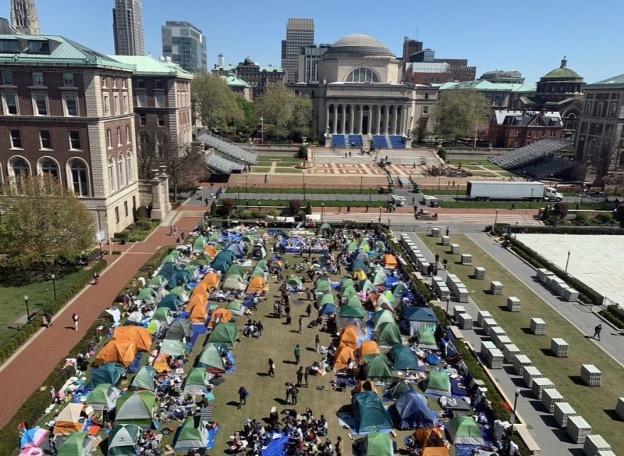
Student encampment at Columbia University. Photo courtesy Columbia Students for Justice for Palestine/X.

There are snipers on the roof of the school where I got my MA.

There are police beating students at the school where I got my PhD.

At each school, I studied authoritarian regimes and how they brainwash people into believing that state brutality is not only normal, but deserved.

—Sarah Kenzior, post on X, April 28, 2024

LBJ, LBJ, how many kids have you killed today?

To some of us of a certain age, 2024 is beginning to have a very 1968 feel about it. I turned 18 in 1968. When the Rolling Stones released “Street Fighting Man” that summer, many in my generation saw it as a call to arms.

The annus mirabilisannus horribilis began with North Vietnam’s Tet Offensive, which turned the tide of the Vietnam War and galvanized a worldwide anti-war movement. On March 17, mounted police charged down protesters outside the US embassy in Grosvenor Square in London, England. On April 4, civil rights leader Martin Luther King was murdered in Memphis, setting off riots in Washington, Baltimore, Chicago, and scores of other American cities. In May, student protests paralyzed Paris and triggered a general strike that brought General De Gaulle’s Fifth Republic to its knees. On June 4, Democratic presidential candidate Robert F. Kennedy was assassinated in Los Angeles. On the night of August 20-21, Soviet-led Warsaw Pact forces invaded Czechoslovakia, peremptorily ending Alexander Dubček’s Prague Spring.

A week later it was the police’s turn to riot at the Democratic national convention in Chicago, where they savagely beat anti-war protestors on Michigan Avenue. On October 2, armed forces opened fire on 10,000 demonstrators in the Plaza de las Tres Culturas in Mexico City, killing hundreds of university and high school students. When the Mexico Olympic Games opened ten days later, Tommie Smith and John Carlos raised their fists in Black Power salutes on the 200-metre medal podium and Czech gymnastics multi-gold medalist Věra Čáslavská turned her head and averted her eyes as the Soviet anthem began to play and the Soviet flag was raised. On October 21, International Anti-War Day, thousands of students occupied Shinjuku Station in Tokyo.

Two weeks later, Richard Nixon, the red-baiting veteran of the House Un-American Activities Committee (HUAC) , was elected US president.

Today’s circumstances are not the same, but the déja vu is inescapable. Then as now, the trigger for disorder has been an unpopular foreign war. Then as now, domestic opposition to involvement in that war has been met with widespread repression. Then as now, the repression has exposed power structures that would sooner hide behind bland facades of neoliberal normality. And then as now, young students have been in the vanguard of the protests.

Gaza is the moment of moral conscience for this generation, as Vietnam was for mine. I’m cheering for the kids.

Do you feel safe sending your child to a school which gives up its students to the police?

On April 17, Columbia University President Baroness Nemat “Minouche” Shafik, formerly vice president at the World Bank, deputy managing director of the IMF, deputy governor of the Bank of England, and president and vice chancellor of the London School of Economics, testified before the US House Education and Workforce Committee on “campus antisemitism.”

The committee, whose resident attack dog is New York’s 22nd congressional district representative and aspiring MAGA vice-presidential running mate Elise Stefanik, had previously claimed the scalps of University of Pennsylvania President Liz Magill and Harvard University President Claudine Gay.

Magill and Gay’s resignations were quickly hijacked for the Republicans’ wider “war on woke,” and in particular its war on Diversity, Equity and Inclusion (DEI) initiatives. GOP presidential candidate Vivek Ramaswamy couldn’t stop himself from saying the quiet bit out loud. “Better late than never,” he crowed. “It was a thinly veiled exercise in race & gender when they selected Claudine Gay”—the first Black president of Harvard and only the second Black woman to head an Ivy League university. Here as elsewhere, charges of antisemitism were a convenient vehicle for advancing—and concealing—other political agendas that have little to do with protecting Jews.

The House antisemitism investigations have been compared, not unreasonably, to HUAC’s witchhunting of “subversives” during the early years of the Cold War. No doubt mindful of Magill and Gay’s fate, Shafik turned out to be a more than friendly witness. She assured the committee that “Antisemitism has no place on our campus, and I am personally committed to doing everything I can to confront it directly.”

Conceding that “the events of October 7 brought to the forefront an undercurrent of antisemitism that is a major challenge for universities across the country”—a representation of the situation that has been fiercely contested by participants, who among other things point to the large numbers of Jewish students and faculty taking part in the pro-Palestine protests—Shafik detailed the steps Columbia had taken to combat antisemitism since October 7. The “central challenge,” she said, was “trying to reconcile the free speech rights of those who want to protest and the rights of Jewish students to be in an environment free of harassment or discrimination.”

Her opening statement detailed a raft of actions taken with the aim of monitoring, policing, and disciplining protesters, but offered little but platitudes in regard to free speech.

“We restricted access to our campus to those with valid Columbia identification, increased the public safety presence across all of our campuses, brought in external security firms,” Shafik explained. “We updated our policies and procedures … to make it easier to report allegations of hate speech, harassment, and other forms of disruptive behavior, including antisemitic behavior” via “enhanced reporting channels, and supplementing internal resources through a team of outside investigators.”

On October 12, “we brought law enforcement onto our Morningside Heights campus to ensure the safety of our community at a protest for the first time in more than 50 years”—that is to say, since Columbia was occupied back in 1968 (when the police raid on April 30 resulted in 712 arrests and 148 reports of injuries). Thereafter the university authorities have maintained “regular communication with the New York City Police Department, ensuring they were either present or on standby for all major events, including vigils and demonstrations.”

Shafik was “personally frustrated,” she told the committee, to discover that Columbia’s existing “policies and structures were sometimes unable to meet the moment.” The school’s event policy was hastily rewritten to restrict the places and times that protests would be permitted on campus, require two working day’s notice of intended demonstrations, and set out “a clear procedure for adjudication of alleged violations and consequences for students and student groups who break the rules.”

Following these revisions two student societies, Students for Justice in Palestine (SJP) and Jewish Voice for Peace (JVP), were suspended after leading an unauthorized student walkout on November 9, and several students were suspended on March 24 after “an event took place at a campus residential facility that the University had previously barred—twice—from occurring.”

Columbia concurrently established a Task Force on Antisemitism “led by three prominent Jewish members of our faculty,” whose brief was “first, to assess the events and other causes contributing to the pain in Columbia’s Jewish community; second, to review the relevant policies, rules, and practices that affect our campus; and third, to propose other methods to help the entire community understand the effects of antisemitism at Columbia.”

What is claimed to be an internal administration document leaked to SJP suggested that Dean of General Studies (GS) Lisa Rosen-Metsch, one of three members of the Task Force, had not only overseen “a serious and intentional misuse of GS institutional aid, where TAU [Tel Aviv University] Dual BA Program students receive disproportionately higher funds than others, without the required basis of demonstrated financial need,” but also “convened meetings with GS veterans who served in the Israel Defense Forces (IDF), directing them to counter pro-Palestinian student activities and to actively disrupt pro-Palestinian activity on campus.” If the document is genuine these are serious allegations, which undermine any confidence in the impartiality of the Task Force—or of Columbia University.

Notwithstanding Shafik’s acknowledgment—the only one in her entire statement—that “Our Palestinian students and faculty have also been affected as their families and friends suffer through a humanitarian crisis,” no such dedicated task force was set up to address their pain: a pain, it might be conjectured, that went deeper than merely being made to feel uncomfortable in the presence of students protesting the ongoing Israeli actions that were taking the lives and obliterating the homes of their friends and relatives in Gaza. Anti-Palestinian, -Arab, or -Muslim speech and actions were evidently not seen as deserving of comparable attention by the university either then or later.

This is despite the fact that three Palestinian students had been shot in Burlington, Vermont, on November 25, leaving one paralyzed from the chest down after a bullet lodged in his spine—and in full knowledge that several of Columbia’s own students had been sprayed with a noxious chemical substance, possibly Skunk, at a pro-Palestine rally on January 19, sending ten of them to hospital. Former IDF soldiers studying at Columbia were alleged to be involved in this attack.

Despite the deafening chorus from the pro-Israel lobby bemoaning Jewish students across the US being made to feel “unsafe” by protesters demanding Palestinian freedom (as distinct from Israeli sovereignty, as in Likud’s program) from the river to the sea, none—thankfully—have yet been subjected to remotely comparable violence.

Predictably, the Task Force on Antisemitism’s first report “endorsed Columbia’s new Interim University Policy for Safe Demonstrations” and “also called for stronger enforcement of our policies, a goal toward which we are diligently working.”

Disclose! Divest! We will not stop, we will not rest!

In the early morning hours of April 17, the same day Shafik testified before the House Education and Workforce Committee, students established a Gaza Solidarity Encampment of around 50 tents on the South Lawn of Columbia’s Morningside Heights campus in support of “divestment and an end to Columbia’s complicity in genocide.”

The protest was organized by Columbia University Apartheid Divest (CUAD), a coalition of over 120 groups, including the SJP and JVP, founded in 2016 to “call on the University to divest its stocks, funds, and endowment from companies that profit from the State of Israel’s violations of international law and Palestinian human rights through its ongoing system of settler colonialism, military occupation, and apartheid.”

Dressed in full riot gear, the NYPD cleared the encampment the next day and arrested over 100 people, 108 of whom were charged with trespass. NYPD Chief of Patrol John Chell later told the Columbia Spectator that “To put this in perspective, the students that were arrested were peaceful, offered no resistance whatsoever, and were saying what they wanted to say in a peaceful manner.”

It wasn’t the cops that initiated the sweep. Shafik had requested NYPD in writing to remove the students, claiming that “the encampment and related disruptions pose a clear and present dangerto the substantial functioning of the University.” The formulation I have italicized was likely included to justify Shafik’s acting without the imprimatur of the university’s senate executive committee, which she was statutorily bound to consult in such serious cases.

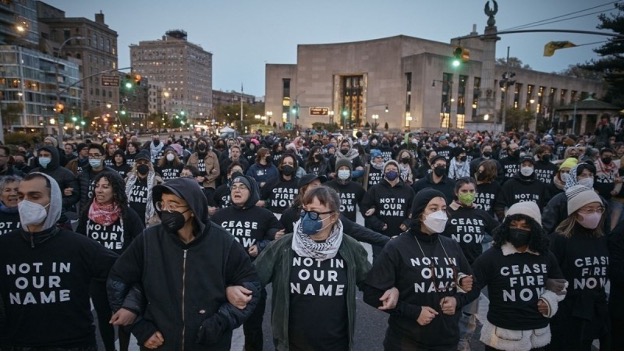
Protesters block traffic during a pro-Palestinian demonstration demanding a permanent ceasefire in Gaza, near the home of Senator Chuck Schumer in Brooklyn, April 23, 2024. Photo by Andres Kudacki/AP.

Columbia and its partner institution Barnard College then summarily suspended three students. Among them was Isra Hirsi, the daughter of congresswoman Ilhan Omar (D–MN05), who is one of a small but growing number of Democratic representatives to have opposed the Biden administration’s continuation of unconditional financial and military support for Israel despite the spiraling humanitarian crisis in Gaza. It is doubtless pure coincidence that Omar had given Shafik a stiff grilling at the House Education and Workforce Committee hearing.

On April 20 Columbia told all the arrested students that they had been suspended, meaning that many would be forced to vacate their student housing. At Barnard, students were given 15 minutes to pack their belongings.

Undeterred, protesters set up camp again on April 22. The following days saw an uneasy standoff, with negotiations between the students and the university authorities taking place against the threat of bringing the cops in again. On April 29, Columbia gave the students an ultimatum. The bold type is the university’s:

Please promptly gather your belongings and leave the encampment. If you voluntarily leave by 2 p.m., identify yourself to a University official, and sign the provided form where you commit to abide by all University policies through June 30, 2025, or the date of the conferral of your degree, whichever is earlier, you will be eligible to complete the remainder of the semester in good standing (and will not be placed on suspension) as long as you adhere to that commitment … If you do not leave by 2 p.m., you will be suspended pending further investigation.


Shafik issued a statement the same day in which the University offered “to develop an expedited timeline for review of new proposals from the students by the Advisory Committee for Socially Responsible Investing, the body that considers divestment matters”; “to publish a process for students to access a list of Columbia’s direct investment holdings”; “to convene a faculty committee to address academic freedom and to begin a discussion on access and financial barriers to academic programs and global centers”; and “to make investments in health and education in Gaza, including supporting early childhood development and support for displaced scholars.”

These concessions fell far short of the students’ demands, but to wring them at all from an administration whose first response had been to call in the NYPD says much for the power of protest. Shafik remained adamant, however, that “the University will not divest from Israel.”

The 2:00 p.m. deadline passed without the students leaving. On the evening of April 29, Columbia began issuing mass suspensions. Elise Stefanik meantime issued a statement that read:

Columbia has surrendered to the radical pro-Hamas antisemitic mob instead of securing campus and protecting Columbia’s Jewish students. There can be no more extensions or delays. There can be no negotiations with self-proclaimed Hamas terrorists and their sympathizers. 


Overnight, the students occupied Hamilton Hall, a building that had been a centre of the 1968 protests too. They hung a banner out of an upper floor window renaming it Hind’s Hall, in memory of six-year-old Hind Rajab, the little girl who was killed, likely by Israeli tank fire, in Gaza along with the Palestinian Red Crescent Society ambulance crew sent to rescue her after she had endured hours, trapped in a car with her dead relatives, as the sole survivor of an IDF strike.

Though the front pages of the American press have been filled for the last two weeks with breathless accounts of the campus protests, it is easy to lose sight of their objective.

As Maryam, a Barnard College student arrested in the NYPD sweep on April 18 and subsequently suspended (and made homeless) for her part in the encampment, urged on April 22,

I wish people would listen to Columbia student organizers and center Gaza. Our escalation is long overdue and we are escalating for Palestine & nothing else. Please have all eyes on Palestine and do not cease coverage of Gaza whatsoever. 

Israel bombs, NYU pays, how many kids have you killed today?

I have dwelt on Columbia not only because the current campus unrest first came to a head there, but also because both the students’ actions and the administration’s response foreshadowed events across North America and beyond.

The faceoff at Columbia unleashed a tsunami of encampments, occupations, and other forms of protest at dozens—likely by now hundreds—of US universities, ranging from Ivy League schools like YaleHarvardPrinceton, and Brown, top private universities like NYUEmoryStanford, and the University of Chicago, and large public universities like UCLAUC BerkeleyUSC, and the University of Texas (UT) at Austin, to small colleges and working-class campuses like Cal Poly Humbolt.

Per the New York Times the latter school, which is situated in redwood forests 275 miles north of San Francisco, has become “the site of the nation’s most entrenched campus protest. It has gone well beyond the encampments seen on many college quads elsewhere; at Cal Poly Humboldt, protesters took over the power centre of the campus and have rejected increasingly desperate entreaties from officials for them to vacate the premises.”

The movement has since spread to universities in Canada (McGillConcordia, the University of Ottawa, and UBC), France (Sciences-Po and the Sorbonne), Australia (Universities of Melbourneand Sydney), Italy (Sapienza University in Rome), and the UK (WarwickUCL). I am proud to say that the first international Gaza solidarity encampment was erected by students and faculty at the University of Alberta, where I taught for 20 years and remain a professor emeritus, on April 22.

Putting a whole new complexion on the hollow and tokenistic land acknowledgments with which McGill, like every other university in Canada, nowadays begins all its official functions, the Traditional Council of the Five Nations Longhouse Confederacy of the Kahnawake Kanienkehaka (Mohawk) Nation, upon whose territory McGill University sits, drew unwelcome attention to the enduring connections between settler colonies past and present across the globe.

Noting “the behavior of the european [sic] for the last five hundred years … in their systematic colonial genocide wars upon our Mother Earth and all Original Peoples and our territories here in Turtle Island and abroad, including Palestine,” and tartly observing that “any and all military actions are intrinsic with the more primitive and lower levels of human thought,” the Council stated:

in accordance with the Two Row Wampam Peace Treaty, we grant the full right to those who are occupying McGill and other campuses throughout Turtle Island to be upon the said lands, with the express intent of engaging their administrations to divest from the colonial genocide of israel [sic] upon the Palestinian People and from the war machine in general. 


Many encampments in the US have been violently broken up by police—at the university’s behest. On April 29 the New York Times published an incomplete list of campuses where protestors had been arrested, including Columbia (108 arrests), Yale (60), NYU (“dozens”), USC Los Angeles (93), UT Austin (57), Emerson College in Boston (118), Ohio State University in Columbus (36), Emory (28), Aurora campus in Denver (40), Arizona State University in Tempe (69), Northeastern University in Boston (98), Washington University in St. Louis (100 arrests, including Green Party presidential candidate Jill Stein), and Virginia Tech (91).

Police have since made further arrests at UT AustinCal Poly Humbolt, the University of UtahVirginia Commonwealth UniversityUNC Chapel Hill, and elsewhere. Raising the spectre of the killing of four students and wounding on nine others by the National Guard at Kent State University on May 4, 1970, police snipers were photographed on roofs overlooking demonstrations at Ohio State and Indiana University.

Though nobody has yet been killed, video offers plentiful evidence of vicious policing. There is likely an element of class resentment here, since the protesters have been widely portrayed in the media as spoiled rich brats. Clips from Emory showing philosophy department chair Noëlle McAfee being led away in handcuffs in her own words “like a criminal” and economics professor Caroline Fohlin being thrown to the ground and restrained by burly cops (even as she shouted “I’m a professor!”) went viral on social media. Neither of these academics were involved in the encampment, but they made the mistake of questioning police manhandling of their students.

As with Israel’s targeted killing of seven World Central Kitchen aid workers in Gaza on April 1, which momentarily grabbed the attention of Western politicians and media only because six of the victims hailed from Western countries (the IDF had previously killed at least 224 Palestinian humanitarian personnel in Gaza without arousing international indignation), the spectacle of middle-aged, upper-middle-class, professional white women being on the receiving end of police brutality brought home power dynamics that are routinely experienced by Black, brown, and Indigenous minorities on a daily basis but otherwise hidden from sight.

Since we are in Atlanta, Georgia, we might recall the name of another protester, 26-year-old Stop Cop City activist Manuel Terán, into whose head, torso, hands, and legs police pumped at least 57 bullets during a multi-agency “counter-insurgency” raid in January 2023.

This is not the only respect in which events in the US uncannily mirror events in Gaza, opening up power relations to the clarifying light of day.

Say it clear, say it loud, Palestine will make us proud

“It is kind of weird that the biggest story in the US about Israel-Palestine is about college campuses when there are multiple mass graves being uncovered and constant bombardment in Gaza right now,” Benjamin H. Bradlow, Assistant Professor of Sociology at Princeton University posted on Xon April 21.

The American Association of University Professors drew attention to the same jarring contrast in a post juxtaposing the phoney hysteria surrounding US campus protests with the very real scholasticide—the magnitude and systematicity of the horror cry out for the neologism—the IDF has let loose on the Palestinian education system in Gaza:

It’s worth reminding those critical of the student protests raging across the US: Gaza no longer has universities. Every single university in Gaza has been bombed into oblivion. Hundreds of academics, scholars, professors, & students have been killed since Oct. 7.


But if the material fabric of American universities remains intact, give or take the odd broken window or piece of “offensive” graffiti, the same can no longer be said of the cozy, liberal blanket of myth within which they have long nestled.

Columbia may have chairs, lectures, and reading rooms dedicated to the memory of Edward Said, the Palestinian scholar whose Orientalism (1978) was “perhaps the most influential scholarly book of the late twentieth century,” enshrine Frantz Fanon’s Wretched of the Earth in its core curriculum, and afford postcolonial theorists like Gayatri Spivak the space in which to speak, but when the chips are down the gloves come off.

The administration “deanlets” whose takeover Benjamin Ginsberg warned of a decade ago in his grimly prescient The Fall of the Faculty are now running the university show, and it is clear that their commitment to the humane values of free speech, academic freedom, open intellectual inquiry, and faculty governance that supposedly form the bedrock upon which the modern university is built count for little compared with the next check from a wealthy donor or threat from a rabble-rousing politician.

When New England Patriots owner Robert Kraft pulled support from Columbia because of “the virulent hate that continues to grow on campus and throughout our country” and MAGA Republican Speaker Mike Johnson warned President Biden “Antisemitism is a virus, and because the administration and woke university presidents aren’t stepping in, we’re seeing it spread … We have to act” after paying a photo-op visit to Morningside Heights, Columbia students and faculty might have expected some pushback on the part of their president against such slurs.

But no. Minouche went with the flow and abjectly accommodated to the entitlements of power.

In a lengthy open letter published on April 29 in the Boston Review, Robin D.G. Kelley, who is now Gary B. Nash Professor of American History at UCLA but who taught at Columbia from 2003-2006, castigates Shafik’s “draconian, unethical, illegal, and dishonest actions toward your own students and faculty.”

“In my nearly forty years as a faculty member,” he says,

I have never seen such brazen cruelty toward students and faculty, such cowardice before what amounts to a right-wing witch hunt, and such blatant dishonesty … In your desperate effort to deflect attacks from the likes of Elise Stefanik, you have abandoned the principles of academic freedom—including our obligation to engage in truthful, accurate, and nuanced discourse—and sacrificed the safety of our colleagues.


“I suspect that your previous executive and managerial posts in the World Bank, the International Monetary Fund, and the Bank of England did not prepare you to lead a university,” he acidly goes on. But that is surely why Shafik was hired. “You are keeping no one safe,” Kelley rages, “except for your donors, trustees, and Columbia’s endowment.”

In today’s upside-down Orwellian world, in which politicians gaslight the public into believing that a genocide carried out in plain sight is legitimate self-defense and anybody who suggests otherwise—including Jews—is “antisemitic,” are these not the only people—corporations, in the US, being people too—that really matter? The ones who are used to calling the shots?

The genocide in Gaza and the repression on American university campuses are intimately connected. It is time we lifted our heads from our everyday evasions and diversions, our compromises and complicities, and started to listen to the kids.

An entertainment in four acts

DEREK SAYER

First published on Substack, August 9, 2024

Act 1   The curtain rises

“When the clarinet slithers up a disjointed scale at the outset of the piece,” writes The New Yorker‘s opera critic Alex Ross, “the curtain effectively goes up on twentieth-century music.” 

The piece in question is Richard Strauss’s opera Salome, which had its world première at the Semper Opernhaus in Dresden on December 9, 1905. Like Igor Stravinsky’s Rite of Spring, which caused a (literal) riot when it made its debut at Paris’s Théâtre des Champs-Elysées eight years later on May 29, 1913, Salome was a succès de scandale. This was not just because of the modernist dissonance of its musical score.

The first Salome, soprano Marie Wittich, found Strauss’s reworking of Oscar Wilde’s notorious 1891 play “distasteful and obscene.”  She flat out refused to perform the Dance of the Seven Veils—a professional dancer took her place, as would become the norm in many later productions—or to kiss the severed head of John the Baptist at the climax of the opera. “I won’t do it, I’m a decent woman,” she protested. 

The audience had no such scruples. “It was received with unbounded enthusiasm,” Lawrence Gilman informed readers of The North American Review:

There were thirty-eight recalls for the singers, the conductor and the composer, when the curtain fell after the brief performance (the work lasts but an hour and a half). Since then, it has traversed the operatic stages of the Continent in a manner little short of triumphal. It has been jubilantly acclaimed as an epoch-making masterwork, and virulently denounced as a subversive and preposterous aberration: yet it has everywhere been eagerly listened to and clamorously discussed.

Over the next two years Salome was staged in more than fifty European opera houses. Having been banned by the censor in Vienna (where it was not performed until 1918), it had its Austrian première at the Stadtteater in Graz on May 16, 1906.  Such was its allure that Gustav Mahler, Arnold Schoenberg, Giacomo Puccini, and Alban Berg (and according to Richard Strauss, the young Adolf Hitler) were all in the Graz audience.

Salome’s New World première took place at the Metropolitan Opera House in New York on January 22, 1907, with Olive Fremstad in the title role.  According to the Met’s chief archivist Peter Clark, Fremstad was “a daring Salome … perhaps too daring in her fondling the severed head of John the Baptist.”  Two days later, the New York Times carried a letter from an eminent psychologist castigating Strauss’s opera as

a detailed and explicit exposition of the most horrible, disgusting, revolting features of degeneracy (using the word now in its customary social, sexual significance) I have ever heard, read of, or imagined … the fact that it is phrased in limpid language and sung to emotion-liberating music does not make it any the less ghastly to the sane man or woman with normal generic instincts.

Banker J. Pierpoint Morgan’s daughter Anne, who is nowadays remembered as a pioneering feminist and member of the “Mink Brigade” of wealthy society ladies who supported the New York garment workers’ strike of 1909, was equally distressed by the opera’s immorality. Luckily Daddy sat on the Met board.  Five days later Salome was pulled as “detrimental to the best interests of the Metropolitan Opera House.” 

The lone performance and abrupt cancelation of Strauss’s opera may not have been the only factor in the wave of “Salomania” (as the New York Times baptized it) that swept the US in 1907-9, but it certainly helped things along. Before long a Salome dance craze was conquering burlesque and vaudeville stages across the nation.

Never one to miss the opportunity to document a popular trend, the painter Robert Henri, founder of the Ashcan School, hired a vaudeville dancer to model Salome’s Dance of the Seven Veils for him in the privacy of his studio. He painted two versions of Salome Dancer in 1909, which today hang at the Mead Art Museum at Amherst College and the Ringling Museum of Art in Saratosa, Florida. One critic wrote

Her long legs thrust out with strutting sexual arrogance and glint through the over-brushed back veil. It has far more oomph than hundreds of virginal, genteel muses, painted by American academics. [Henri] has given it urgency with slashing brush marks and strong tonal contrasts. He’s learned from Winslow Homer, from Édouard Manet, and from the vulgarity of Frans Hals.

Others were less enamoured of this salacious European import. The actress Marie Cahill, who had previously “startled Broadway by entering a strong protest to theatrical managers against compelling chorus girls to wear tights and excessively short skirts against their will,” wrote to Teddy Roosevelt and other political leaders in August 1908 demanding “the establishment in the state of New York of a commission with powers of censorship over the dramatic stage.” She recommended the “very successful” Lord Chancellor’s censorship of London theaters as a model to follow.

Her fear, she said, was “for the young and innocent,” in particular “the large body of foreign youths and girls” thronging the city:

Is it not the duty … of the true citizen to protect the young from the contamination of such theatrical offerings as clothe pernicious subjects of the ‘Salome’ kind in a boasted artistic atmosphere, but which are really only an excuse for the most vulgar exhibition that this country has ever been called upon to tolerate?

The New York Times took a lighter view, reassuring its readers that “In spite of rumors which have been prevalent of late, it is extremely improbable that a ‘Salome’ dance will be substituted for the ‘Merry Widow’ waltz at the New Amsterdam.”

It is announced on good authority that the management there has been exceptionally active in guarding against outbreaks of Salomania among members of the company. As soon as any chorus girl shows the very first symptoms of the disease she is at once enveloped in a fur coat—the most efficacious safeguard known against the Salome dance—and hurriedly isolated.

Irving Berlin, who was then working as a waiter at Jimmy Kelly’s on Union Square, had his first hit with a little ditty called Sadie Salome (Go home!). There is a fine recording of him singing it with a mock Yiddish accent. The song was popularized by eighteen-year-old Fanny Brice, the original funny girl, in Max Spiegel’s burlesque musical The College Girls, in which she performed a spoof of Salome dancing. Florenz Ziegfeld, Jr. saw the show and immediately hired Fanny for his Follies of 1910.

It’s nice to know that the opera whose opening chords raised the curtain on twentieth-century music was indirectly responsible for Irving Berlin getting his first job in Tin Pan Alley and Fanny Brice joining the Ziegfeld Follies. But Irving’s story of a good Jewish girl gone to the bad confirmed all Marie Cahill’s worst fears: 

Sadie Cohen left her happy home
To become an actress lady
On the stage she soon became the rage
As the only real Salomy baby
When she came to town, her sweetheart Mose
Brought for her around a pretty rose
But he got an awful fright
When his Sadie came to sight
He stood up and yelled with all his might:

Refrain:
Don’t do that dance, I tell you Sadie
That’s not a bus’ness for a lady!
‘Most ev’rybody knows
That I’m your loving Mose
Oy, Oy, Oy, Oy
Where is your clothes?

Act 2   The return of the repressed

Writing in the Brooklyn Eagle in 1926 from Paris, where Salome had by then long been recognized as “an opera that undoubtedly ranks in importance with the greatest works of the post-Wagnerian period,” Edward Cushing lamented that “the severed head of John the Baptist remained among properties blackballed by the moralistic indignation of a Powerful Few.”  Salome would not be performed at the Met again until 1934.

Happily, New Yorkers with a taste for degeneracy were able to satisfy their perverse instincts when Salome was staged at Oscar Hammerstein’s Manhattan Opera House in 1909, with the Scottish-born, Chicago-raised, Paris-trained soprano Mary Garden as Strauss’s lascivious heroine. 

Famous for creating the leading role in Debussy’s Pelléas et Mélisande at the Opéra-Comique in 1902—she recorded a brief excerpt from Act 3 in 1904, accompanied by Debussy on the piano—Garden performed the Dance of the Seven Veils herself, stripping down to a bodystocking.  

After Hammerstein’s opera company folded, Mary took her Salome to her hometown, reprising the role in the Chicago Grand Opera Company’s inaugural season at the Auditorium Theater in 1910. The city’s guardians of public morality were not pleased by what they heard and saw.  The Chicago Tribune reported that patrons were ”oppressed and horrified. But of any real enjoyment, there was little or no evidence.”  

The Tribune’s theater critic Percy Hammond seems nevertheless to have relished the star’s erotic writhings:

She is a fabulous she-thing playing with love and death—loathsome, mysterious, poisonous, slaking her slimy passion in the blood of her victim … She is Salome according to the Wilde formulary—a monstrous oracle of beauty. 

Like Velasquez’s Rokeby Venus or Courbet’s L’Origine du mondeSalome hits that sweet spot where highbrow and lowbrow meet and transmute base instinct into high art. 

Chicago police chief Roy T. Stewart, who was invited to witness the spectacle for himself at the next showing, was having none of that. He threw his weight squarely behind the middlebrow:

It was disgusting. Miss Garden wallowed around like a cat in a bed of catnip. If the same show was produced on Halsted Street, the people would call it cheap, but over at the Auditorium they say it’s art.

Salome was scheduled for four performances—all of which were sold out in advance—but the company’s board of directors followed the Met’s moral compass and canceled the production after just three nights.

Back in the Old World, the Lord Chamberlainkept Salome off London’s stages until Thomas Beecham negotiated a compromise that permitted a censored production to be staged at the Royal Opera House in Covent Garden on December 8, 1910.

“We had successfully metamorphosed a lurid tale of love and revenge into a comforting sermon,” Beecham claimed. To soothe Christian sensibilities, the setting was shifted from Judea to Ancient Greece and all Biblical references were removed.  Jochanaan (John the Baptist) became simply “The Prophet,” and his severed head was replaced by a bloodied sword.  

Still the Freudian does have a habit of slipping, come what may, and the repressed insists on returning. As Beecham  related in his autobiography, the cast did not play ball with the censors. On opening night, 

Gradually I sensed […] a growing restlessness and excitement of which the first manifestation was a slip on the part of Salome, who forgot two or three sentences of the bowdlerised version and lapsed into the viciousness of the lawful text. The infection spread among the other performers, and by the time the second half of the work was well under way they were all giving in and shamelessly restoring it to its integrity, as if no such things existed as British respectability and its legal custodians. 

After two World Wars, opera audiences became more liberal—or at least more blasé.  Strauss’s onetime shocker took its place in the standard repertoire alongside The Marriage of FigaroCarmen, and La Bohème

When Salome was revived at the Met in 1949 under the baton of Fritz Reiner, the Bulgarian soprano Ljuba Welitsch sang and danced the title role, “her ripe form swathed in flimsy green garments that set off a mop of carrot-coloured hair.”  This time, “when the great gold curtains finally swept together, the audience set up a thunderous roar, an ovation that lasted for fifteen minutes.”[1]

New York Times opera critic Olin Downes hailed Salome as “a vital modern opera”:

The music is white hot … Strauss’s use of dissonance, which is now child’s play, but which in 1905, or 1907, was the last word of harmonic writing, is still very effective … It still seizes you. But the whole score, with its inherent banalities intact, remains an astonishingly unified and indestructible whole, which, as of 1949, stands up astonishingly well.

Downes went on to suggest that Salome’s place in the repertoire would be safe until producers began to find it “hopelessly old hat” and “impossible to take seriously. Then it will be interpreted superficially, and begin to sound frayed and of the past.”

Seventy-five years on, Salome seems in no danger of falling out of fashion. That has not stopped producers outdoing themselves in more or less successful attempts to recapture its shock factor. 

Adam Yegoyan thought it cool to stage the Dance of the Seven Veils as a gang rape for the Canadian Opera Company in 1996.  Lydia Steier’s production at the Paris Opera in 2022 also climaxed in a mass rape, with the added refinement of having her Salome stand stock still on a pedestal while her stepfather Herod danced around her, removing her garments once by one.

Catherine Malfitano has the distinction of being the first Salome to dispense with the bodystocking and bare her all for art in Peter Weigl’s production at the Deutsch Oper Berlin in 1990. Maria Ewing spectacularly did the same for (her husband) Peter Hall’s production at Covent Garden in 1992—a more than adequate atonement for Thomas Beecham’s bowdlerization in the same house eighty-two years before. 

The Met finally caved in 2004.   New York Times reviewer Anthony Thommasini couldn’t get enough of “attractive blonde-haired Finnish soprano” Karita Mattila:

Ms. Mattila was so intense, possessed and exposed in the role that she pummeled you into submission.

And I use the word exposed literally. For her slithering and erotic interpretation of Salome’s ”Dance of the Seven Veils,” cannily choreographed by Doug Varone and sensually conducted by Valery Gergiev, Ms. Mattila shed item after item of a Marlene Dietrich-like white tuxedo costume until for a fleeting moment she twirled around exultant, half-crazed and completely naked. 

Nowadays exposing the soprano seems to have become par for the course. Among recent interpreters, Mlada KhudoleyNicola Beller Carbone, and Patricia Racette have all ended Salome’s dance au naturel. 

In the end what endures is the music. As Lawrence Gilman told readers of the North American Review back in 1907,

in harmonic radicalism and in elaborateness and intricacy of orchestration [Salome] is [Strauss’s] most extreme performance. His use of dissonance—or, more precisely, of sheer cacophony—is as deliberate and persistent as it is unabashed. The entire score is a harmonic tour de force of the most amazing character—a practically continuous texture of new and daring combinations of tone.

Of the many recordings, Ljuba Welitch’s 1944 Vienna Radio broadcast of the closing scene, conducted by Lovro von Matacic, is hors de concours. In part, as Bryan Crimp writes in his liner notes, this is “because the voice is so youthful.”[2]  But only in part. It’s not just the voice, which indeed shines gloriously, but what Welitsch does with it.

Welitsch and Matacic rehearsed the performance with the composer himself, who was by then in his eightieth year. “Richard Strauss was terrific,” Welitsch told an interviewer for the magazine Opernwelt later, “he went through every bar, every phrase with Matacic and me. For example, this ‘Ich habe deinen Mmmmmuuuunnnd geküsst’ (I have kissed your mouth), this desire, he said, must come out in you, it was fantastic.”

Ljuba didn’t disappoint. Especially in that exultant, incandescent final passage. For Jürgen Kesting

In the 1944 recording, for the climactic phase, on the last syllable of “Jochanaan” … the slenderly sensual voice not only sparkles like a diamond, it burns. What Welitsch has left behind is not only the ominous best rendering or representation of this scene—but the only one ever.

Listen to it, if you dare. Here we really do have the Salome of Strauss’s dreams (or should I say nightmares?)—”a sixteen-year-old princess with the voice of an Isolde.”

Act 3   What is this shit?

Salome may have raised the curtain on twentieth-century music, but Strauss grew weary of being portrayed as the torch-bearer for modernism by his opponents and fans alike. As early as 1900 he had confessed to Romain Rolland that

I am not a hero; I haven’t got the necessary strength; I am not made for battle; I much prefer to go into retreat, to be peaceful and to rest. I haven’t enough genius … I don’t want to make the effort. At this moment what I need is to make sweet and happy music. No more heroisms.

Elektra (1909) took Salome’s dissonance even further, but with Der Rosenkavalier, which premiered in Dresden in 1911, Strauss and his librettist Hugo von Hoffmannsthal offered something completely different—a camp pastiche of Mozart and (Johann) Strauss’s comic operas which the critics panned and audiences loved.

On February 11, 1909 Hofmannsthal had written to Strauss, “My dear Doctor, I have spent three quiet afternoons here drafting the full and entirely original scenario for a new opera, full of burlesque situations and character.  It contains two big parts, one for baritone and one for a girl dressed up as a man, à la Farrar or Mary Garden.”  

Geraldine Farrar wanted too much money. Mary Garden turned down the role of Count Octavian “because it would bore me to make love to a woman.”  She was referring to the fact that at the beginning of the opera the curtain rises on 17-year-old Octavian in bed with the 33-year-old Marschallin, with whom he had spent the night. Strauss loved to write for the soprano voice, and casting Octavian as a trouser role enabled him to compose some luscious soprano duets and trios.

Der Rosenkavalier was the operatic equivalent of Bob Dylan’s infamous 1970 album Self-Portrait. Griel Marcus began his review of the latter in Rolling Stone with the words “What is this shit?”

Imagine a kid in his teens responding to Self-Portrait. His older brothers and sisters have been living by Dylan for years. They come home with the album and he simply cannot figure out what it’s all about. To him, Self-Portrait sounds more like the stuff his parents listen to than what he wants to hear; in fact, his parents have just gone out and bought Self-Portrait and given it to him for his birthday. He considers giving it back for Father’s Day.

But Richard Strauss had found his operatic métier, and he never looked back. He knew well indeed, he said, that as an art form opera was dead. Wagner was so gigantic a peak that nobody could rise higher. “‘But,’ he added, with a broad, Bavarian grin, ‘I solved the problem by making a detour around it.’” 

The detour produced a string of Strauss/Hoffmannsthal hits: Ariadne auf Naxos (1912), Die Frau ohne Schatten (1919), Die ägyptische Helena (1928), and Arabella (first performed in 1933). After Hoffmannsthal died in 1929 Strauss turned to the Jewish writer Stefan Zweig for his next opera, Die Schweigsame Frau (The Silent Woman).

By the time Adolf Hitler came to power in 1933, Strauss was Germany’s pre-eminent living composer. At first he thought he could quietly retreat to the villa in the Munich suburb of Garmisch he bought with the proceeds from Salome until the storm passed. 

“I made music under the Kaiser,” he supposedly told his family. “I’ll survive under this lot, as well.” Considering himself above politics, he assured them: “I just sit here in Garmisch and compose. Everything else is irrelevant to me.”  He soon discovered that for an artist of his stature, neutrality was not permitted.

Strauss “met frequently with Hitler, Goering, and Goebbels,” recalled Stefan Zweig, “and at a time when even [Wilhelm] Furtwängler was still in mutiny, allowed himself to be made president of the Nazi Chamber of Music.” 

Strauss’s open participation was of tremendous importance to the National Socialists at that moment. For, annoyingly enough, not only the best writers, but the most important musicians as well had openly snubbed them, and the few who held with them or came over to the reservation were unknown to the wide public. To have the most famous musician of Germany align himself with them at so embarrassing a moment meant, in its decorative aspect, an immeasurable gain to Goebbels and Hitler. Hitler, who had, as Strauss told me, during his Viennese vagabond years scraped up enough money to travel to Graz to attend the premiere of ‘Salome,’ was honouring him demonstratively; at all festive evenings at Berchtesgaden, besides Wagner, Strauss songs were sung almost exclusively.

The Reichsmusikkammer (Reich Chamber of Music) regulated all aspects of German musical life. Its brief was to make “good German music,” which meant such modernist deviations as expressionism and atonality, together with jazz (“Negro music”), swing, and anything by Jewish composers like Mendelssohn, Mahler, or Schoenberg—not to mention Irving Berlin—were banned. Fortunately Strauss’s years of dissonance were far behind him. 

Strauss’s works during his time at the Reichsmusikkammer include the suitably pompous Olympic Hymn for the 1936 Berlin Games. But by the time the hymn was played at the opening ceremony, he had been forced to resign his position. He was already in trouble over his insistence on including Stefan Zweig’s name in the program for the première of Die Schweigsame Frau, when a letter to Zweig in which Strauss criticized Nazi racial politics was intercepted by the Gestapo.  Die Schweigsame Frau was canceled after the second performance and banned throughout Germany.

Strauss was undoubtedly vain, loved fame and money, and hoped to use his position at the Reichsmusikkammer to improve the lot of German musicians. But as Zweig makes clear, the composer had other reasons for working with the Nazis too:

To be particularly co-operative with the National Socialists was … of vital interest to him, because in the National Socialist sense he was very much in the red. His son had married a Jewess, and thus he feared that his grandchildren whom he loved above everything else, would be excluded as scum from the schools; his new opera was tainted through me, his earlier operas through the half-Jew, Hugo von Hofmannsthal, his publisher was a Jew. 

After 1936 the regime kept Strauss on a tight leash, and his daughter-in-law Alice and grandsons Christian and Richard were hostages for his good behavior. Alice and her sons were harassed during the Kristallnacht pogrom of November 1938. After Alice’s grandmother Paula Neumann was detained in Prague in 1942, Strauss drove to the gates of Terezín concentration camp to demand her release. He was unsuccessful. Together with twenty-five other relatives of Alice’s, Paula Neumann perished in the camps. 

By the time Strauss came to rehearse that incandescent final scene of Salome with Lovro von Matacic and Ljuba Welitsch, he had been living in Vienna for two years. He moved there with Alice and her children in 1942, promised protection by Baldur von Schirach, the Gauleiter of Vienna. The Gestapo arrested Alice together with Strauss’s son Franz in 1944, but Strauss was able to secure their release and allowed to take them back to Garmisch, where they were held under house arrest till the war ended.

The final months of the war hit Strauss hard as he watched opera house after opera house where his works had played—the Lindenoper in Berlin, the Semper in Dresden, the Vienna State Opera house—reduced to rubble and ashes by Allied bombs. 

A famous photograph by Lee Miller shows the young Irmgard Seefried singing an aria from Madame Butterfly in the ruins of the Vienna State Opera in 1945. A year earlier, on June 11, 1944, at the outset of her career, Seefried was “a Composer of one’s dreams” in Ariadne auf Naxos, conducted in the same building by Karl Böhm in a special performance to celebrate Richard Strauss’s eightieth birthday. 

The performance was recorded.  “[Seefried] is in magnificent voice,”  writes Ken Melzer, 

and ever attentive to the character’s mercurial changes of moods; from frustrated artist, to inspired creator, to an impetuous young man in love (both with his art and, for a bit, with Zerbinetta). The Composer’s final apostrophe to his art is everything it should be, radiantly sung, and brimming with humanity.

Strauss poured his grief into the “solemn, dark, and resigned music from the end of a sorrowing composer’s life” of Metamorphosen, a suite for 23 solo strings composed between 13 March—the day after the destruction of the Vienna Opera House—and 12 April 1945. In its conclusion, Strauss quotes the opening bars of the Funeral March from Beethoven’s Eroica symphony, beneath which he wrote on the final page of the score: “In memoriam.” 

A few days after finishing Metamorphosen, he recorded in his diary:

The most terrible period of human history is at an end, the twelve-year reign of bestiality, ignorance, and anti-culture under the greatest criminals, during which Germany’s 2000 years of cultural evolution met its doom.

Listening to Metamorphosen, scored for ten violins, five violas, five cellos, and three double basses, one might well ask “Ist dies etwas der Tod?” (Is this perhaps death?)  In keening music of unrelenting ferocity, the 23 strings plumb the depths of sorrow, grief, misery, despair. 

Act 4   Ist dies etwas der Tod?

David Bowie’s favorite albums, as listed in Vanity Fair in November 2003, include The Fabulous Little Richard, Steve Reich’s Music for 18 Musicians, John Lee Hooker’s Tupelo BluesThe Velvet Underground and Nico, Charles Mingus’s Oh Yeah, The Fugs self-titled debut album, and Stravinsky’s Le Sacre du Printemps—the latter on Woolworth’s Music for Pleasure budget label with Australia’s Ayres Rock blazing red on the cover, which David bought in the late 1950s when he was in his early teens. That MFP recording was my introduction to The Rite of Spring too. 

In their time and in their way, all of these were “edgy.”  But Bowie’s “one album that I give to friends and acquaintances continually” may come as more of a surprise— 

Although Eleanor Steber and Lisa della Casa do fine interpretations of this monumental work, [Gundula] Janowitz’s performance of Strauss’s Four Last Songshas been described, rightly, as transcendental. It aches with love for a life that is quietly fading. I know of no other piece of music, nor any performance, which moves me quite like this.

“At the end of a long and successful career, when a composer still has the power to move his audience with a swansong of such sublime beauty that it takes your breath away—well, you know that work is a masterpiece,” writes Jane Jones: 

The words are all warm, wise and reflective with no hint of religious consolation as death approaches, but rather a deeply felt appreciation of the world before leaving. This isn’t some maudlin notion with the benefit of hindsight, although these songs do have a profound sense of longing and melancholy, but the overwhelming effect is one of a feeling of serene peace. It’s simply one of the most touchingly beautiful ways for a composer to end his career. 

“Strauss clearly is making a final statement, offering a credo of sorts, particularly in the song Im Abendrot (At Sunset), which describes death as a vast, tranquil peace after the weariness of wandering,” agrees soprano Renée Fleming, who has sung Strauss’s cycle more often than any other work in her repertoire. 

Strauss did not know that these would be his last songs when he composed them at the age of 84, less than a year before his death. The title was given by his publisher.  

In the same way that it is now almost impossible to look at photographer Francesca Woodman’s teenage self-portraits without seeing in them a foreshadowing of her suicide at 22, it is difficult today to hear the Four Last Songs as anything but an envoi. But would we hear them the same way if Strauss had lived ten more years? 

Ist dies etwas der Tod?” is the last line of Im Abendrot (At Sunset), the Alfred von Eichendorf poem that concludes the last of the Four Last Songs in the order in which they are usually performed (although it was actually the earliest of the four to be composed—its conventional placing at the end is for poetic and dramatic effect).

The musical mood could not be more different than that of Metamorphosen.  Here the strings soar, the soprano shimmers and shines, the horns softly glow, and the flutes trill in imitation of Eichendorff’s two skylarks nightdreaming as they climb into the sky at dusk. Despite the fact that three of the four poems Strauss chose to set (the others are by Hermann Hesse) ostensibly deal with death, the music makes us feel that all is for the best in the best of all possible worlds to leave behind.

When I was much younger I used to love these songs. They moved me as they did David Bowie. But at the age of 73, I am more ambivalent—and the more so, the more I have learned about the circumstances of their creation. 

In ill health, short of money, his reputation sullied by his association with the Nazi regime, Strauss and his wife, soprano Pauline de Ahna, left defeated Germany in October 1945 for Switzerland where they lived in hotels. The recent past continued to shadow him. 

Between finishing Im Abendrot in Montreux on May 6, 1948 and completing Frühling (Spring) on July 18 in Pontresena, Strauss faced a de-Nazification hearing. In the event, he was cleared of collaboration. He finished Beim Schlafengehen (Going to Sleep) in Pontresina 17 days later, and September in Montreux on September 20. 

There are undoubted moments of astonishing beauty in these works. The violin solo before the lines “Und die Seele unbewacht/will in freien Flügen schweben” (And the unguarded soul/wants to float in free flight) in Beim Schlafengehen is breathtaking. 

But—for me at least—it also brings back another violin solo, in Janáček’s opera Jenůfa, ascending from the orchestra pit up to the gods where I was sitting in Glasgow’s Theatre Royal way back when—only, that solo came at the climax of Kostelnička’s aria Co chvila (A Moment) in which the sextoness resolves to kill her daughter Jenůfa’s illegitimate baby. 

The violin ratchets up the tension unbearably as Kostelnička snatches up the child and rushes out into the icy night. Compared with this, the violin solo in Beim Schlafengehen feels like cheap artifice.

And this is my problem with Strauss’s entire cycle.  Not least, with those trilling skylarks with which Im Abendrot, and the cycle, concludes. What kind of shit is this? I ask. Especially coming from the composer whose scandalous, vulgar, cacophonous Salome lifted the curtain on twentieth-century music? 

When all is said and done, the poems are trite, the sentiments shallow, the music less a coming to terms with death than a determined looking away from it, cloaking its terrors in a blanket of saccharine loveliness with not a dissonant note to disturb the reverie.

The cycle is an ersatz envoi, a camp masquerade, fit to stand alongside Frank Sinatra’s My Way and John Lennon’s Imagine as an enduring memorial to the middlebrow.  There can be few better examples of kitsch as Milan Kundera defines it—“the need to gaze into the mirror of the beautifying lie and to be moved to tears of gratification at one’s own reflection.”

The Four Last Songs bear the same relation to Metamorphosen as Der Rosenkavalier does to Salome and Elektra. Richard is up to his old tricks again. Taking a detour. 

Or is he?

As I sat down to write this piece, I listened for the first time in years to Gundula Janowitz’s rendition of the Four Last Songs, the one recommended by David Bowie. 

This recording is frequently cited as a favourite for obvious reasons,” writes Ralph Moore in his review of forty-six of “the most notable” renditions of the cycle—there have been many more, for what soprano worth her salt could resist the challenge of such beauty? He praises

the silvery, soaring ecstasy of Janowitz’ lirico-spinto soprano, the mastery of Karajan’s control of phrasing and dynamics and the virtuosity of the Berlin Philharmonic at their peak. Janowitz’ voice has an instrumental quality which blends beautifully with the orchestra. The rapt quality essential to these songs making the necessary impact is present throughout; the requisite trance-like atmosphere is generated without risking torpor or languor. For me, as for many others this is as close to a flawless recording of these masterpieces as can be achieved.

I agree. Janowitz strikes the perfect balance between the lightness of a Lisa Della Casa or Elizabeth Schwarzkopf and the sumptuousness of Jessye Norman, whose recording, to my ears, drowns under the weight of its own splendor. Norman’s Im Abendrot clocks in at a stately 9 minutes and 56 seconds, where Janowitz is done and dusted in 7:09. 

Detail, Gustave Moreau, Salome Dancing, known as Salome Tattooed, 1874, oil on canvas, 92 x 60 cm (Musée Gustave Moreau, Paris)

By chance, as I was listening to Janowitz my laptop was open on Gustave Moreau’s 1874 oil painting Salome Dancing, aka Salome Tatooed, which I had downloaded while searching for possible illustrations for this essay. More high camp.  On the face of it, Moreau’s salacious painting and Strauss’s sublime music couldn’t be further apart.

This “fortuitous meeting of two distant realities on an inappropriate plane” (Max Ernst) produced a remarkable synesthesia. Call it hasard objectif. Letting the music wash over me, I continued to gaze—with, no doubt, a very male gaze—at Moreau’s Salome.

And Salome returned my gaze: while her head is modestly averted, the eyes tatooed beneath her breasts look full frontally into yours.  

Strauss’s lush orchestration mirrors all the dark richness of Moreau’s colors, the glowering reds, the glints of blue and gold. Janowitz’s voice, soaring effortlessly over the orchestra, is the perfect aural counterpart to Salome’s luminous dancer, exposed and vulnerable and yet commanding the rapt attention of all. 

I briefly wondered what might happen if we were to stage the final scene of Salome to the accompaniment of the Four Last Songs, or substituted the words “Ich habe deinen Mund geküsst, Jokanaan” for “O weiter, stiller Friede! so tief im Abendrot” (O vast, silent peace, so deep in the sunset) in Im Abendrot. The idea is not so preposterous.

After all, a mere four years separated Strauss’s Four Last Songs from that definitive recording of the final scene of Salome for Vienna Radio in 1944, when the old master coached Ljuba Welitsch on how to pour every last ounce of desire into the princess’s triumphant “Ich habe deinen Mmmmmuuuunnnd geküsst, Jokanaan.” 

Somewhere, I’m sure, Richard Strauss is grinning that broad Bavarian grin.


Notes

[1] Frank Merkling, sleevenotes to Ljuba Welitsch, Final Scene from Salome and Other Arias, CBS Legendary Performances 61088.

[2] Ljuba Welitsch, soprano. The HMV Treasury, HLM 7006

In memory of Hind Rajab and Sidra Hassouna


On April 3 the Israeli magazine +972 published an explosive article by Yuval Abraham based on interviews with six Israeli intelligence officers, all of whom have served in the army during the current war on Gaza. Its subject was the use of AI software named “Lavender” to generate targets for bombing. Abraham suggests that much of the death toll from the Israeli assault (which has now passed 33,000) is a result of the IDF treating the outputs of the AI machine “as if it were a human decision.”

Personally, I wouldn’t blame the killing on the software. The great fear about AI has always been of its escaping human control and taking over, as in the Matrix films. This is wrong. What the obliteration of Gaza has shown is that the greater danger comes when the awesome capabilities of AI are put at the disposal of human beings.


The Lavender software analyzes information collected on most of the 2.3 million residents of the Gaza Strip through a system of mass surveillance, then assesses and ranks the likelihood that each particular person is active in the military wing of Hamas or PIJ …

Lavender learns to identify characteristics of known Hamas and PIJ operatives, whose information was fed to the machine as training data, and then to locate these same characteristics … among the general population … An individual found to have several different incriminating features will reach a high rating, and thus automatically becomes a potential target for assassination. 


The Lavender system is designed to mark all suspected operatives in the military wings of Hamas and Palestinian Islamic Jihad (PIJ), including low-ranking ones, as potential bombing targets … during the first weeks of the war, the army almost completely relied on Lavender, which clocked as many as 37,000 Palestinians as suspected militants—and their homes—for possible air strikes.

One source stated that human personnel often served only as a “rubber stamp” for the machine’s decisions, adding that, normally, they would personally devote only about “20 seconds” to each target before authorizing a bombing—just to make sure the Lavender-marked target is male.


The Israeli army systematically attacked the targeted individuals while they were in their homes—usually at night while their whole families were present—rather than during the course of military activity. According to the sources, this was because, from what they regarded as an intelligence standpoint, it was easier to locate the individuals in their private houses. 

Additional automated systems, including one called “Where’s Daddy?” … were used specifically to track the targeted individuals and carry out bombings when they had entered their family’s residences.


When it came to targeting alleged junior militants marked by Lavender, the army preferred to only use unguided missiles, commonly known as “dumb” bombs (in contrast to “smart” precision bombs), which can destroy entire buildings on top of their occupants and cause significant casualties. 

“You don’t want to waste expensive bombs on unimportant people—it’s very expensive for the country and there’s a shortage [of those bombs],” said C., one of the intelligence officers. 

Another source said that they had personally authorized the bombing of “hundreds” of private homes of alleged junior operatives marked by Lavender, with many of these attacks killing civilians and entire families as “collateral damage.”


The following was posted on X (formerly Twitter) by Husam Zomlot, Palestinian ambassador to the UK, on February 14, accompanying several photos of Sidra Hassouna and her family:

This is 7 year old Sidra, the cousin of my wife. The impact of the Israeli missile was so powerful it flung her out, leaving her mutilated body dangling from the ruins of the destroyed building in Rafah 48 hours ago. My wife’s aunt Suzan, her husband Fouzy Hassouna, two of their sons, Muhammad and Karam, Karam’s wife Amouna and her three children (7-year-old twins Sidra and Suzan, and 15-month-old Malik) were all killed. The family had been displaced from the north of Gaza and took shelter in Rafah. We will be relentless until those responsible brought to justice.


All texts, except the last, are quotations from Yuval Abraham’s article “‘Lavender’: The AI machine directing Israel’s bombing spree in Gaza.” You can read more about Hind Rajab and Sidra Hassouna here and here

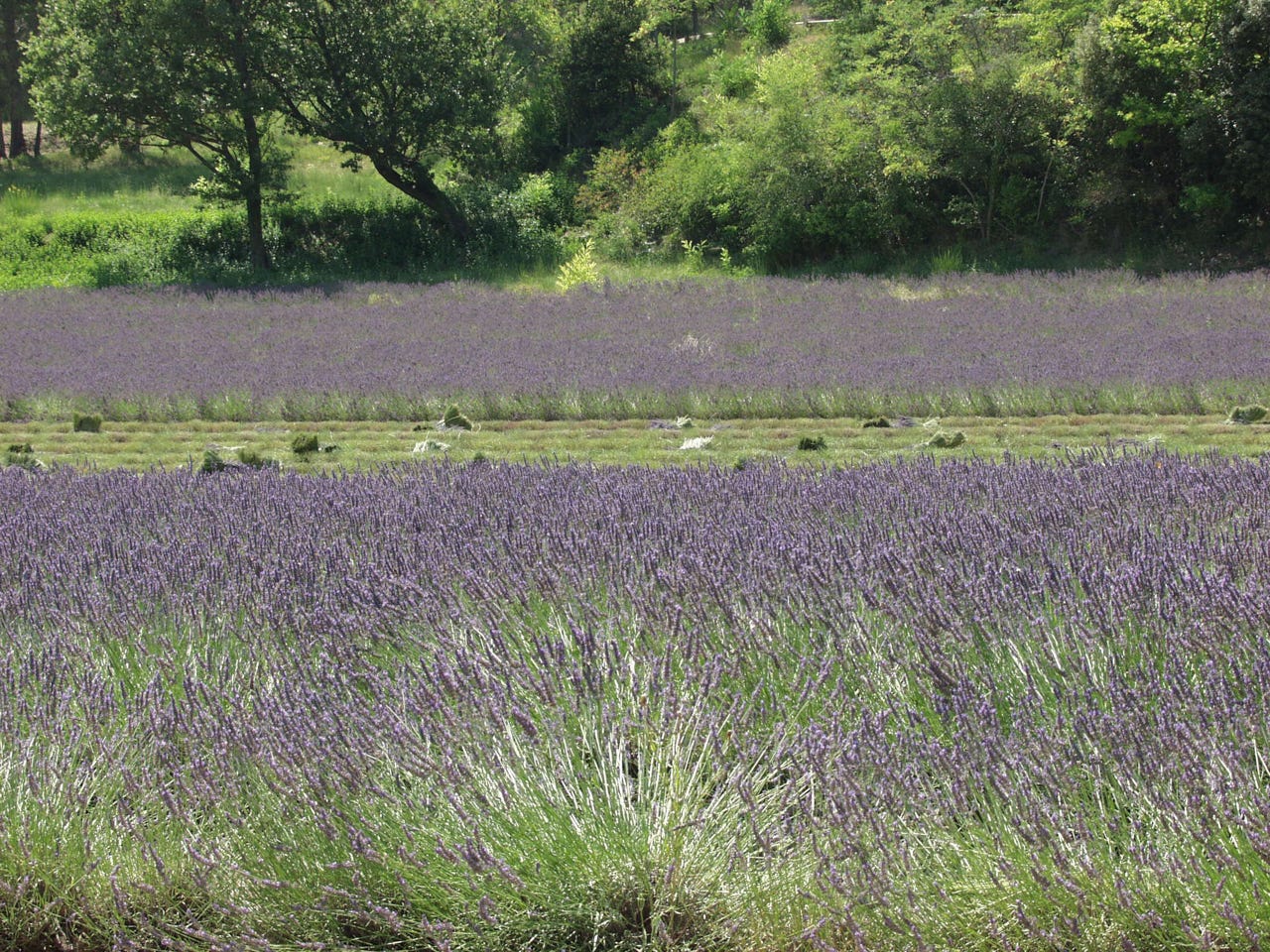
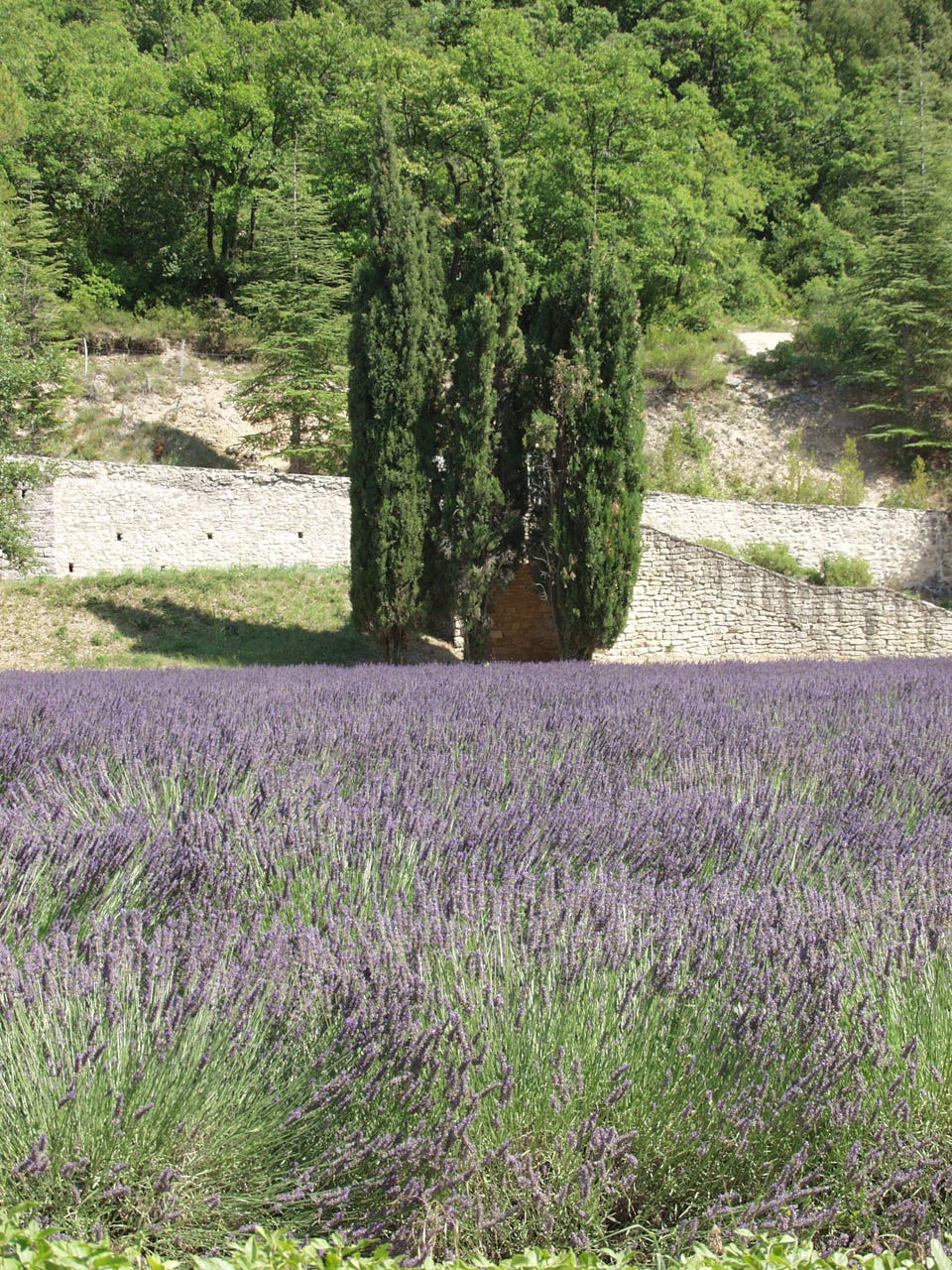
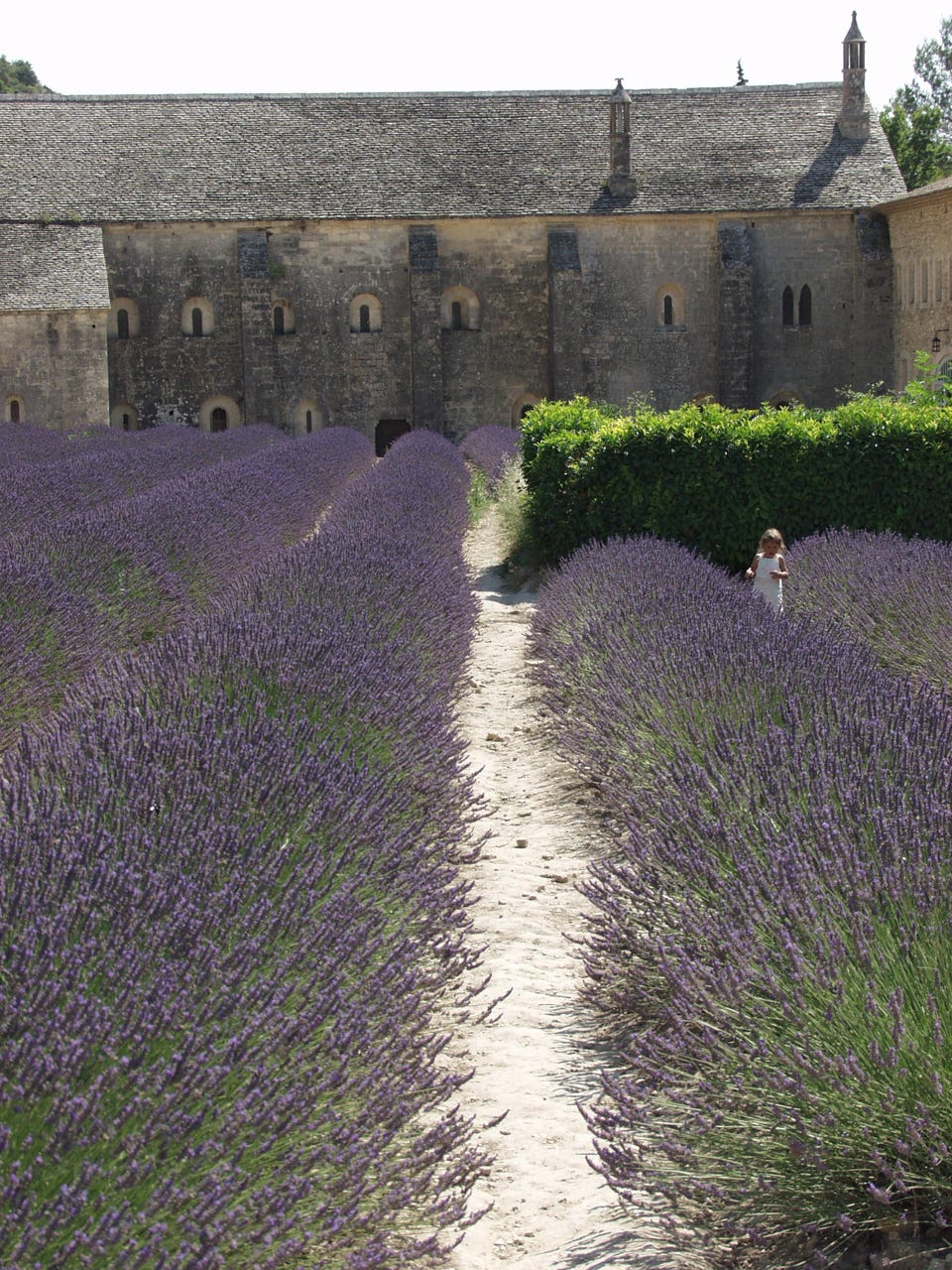
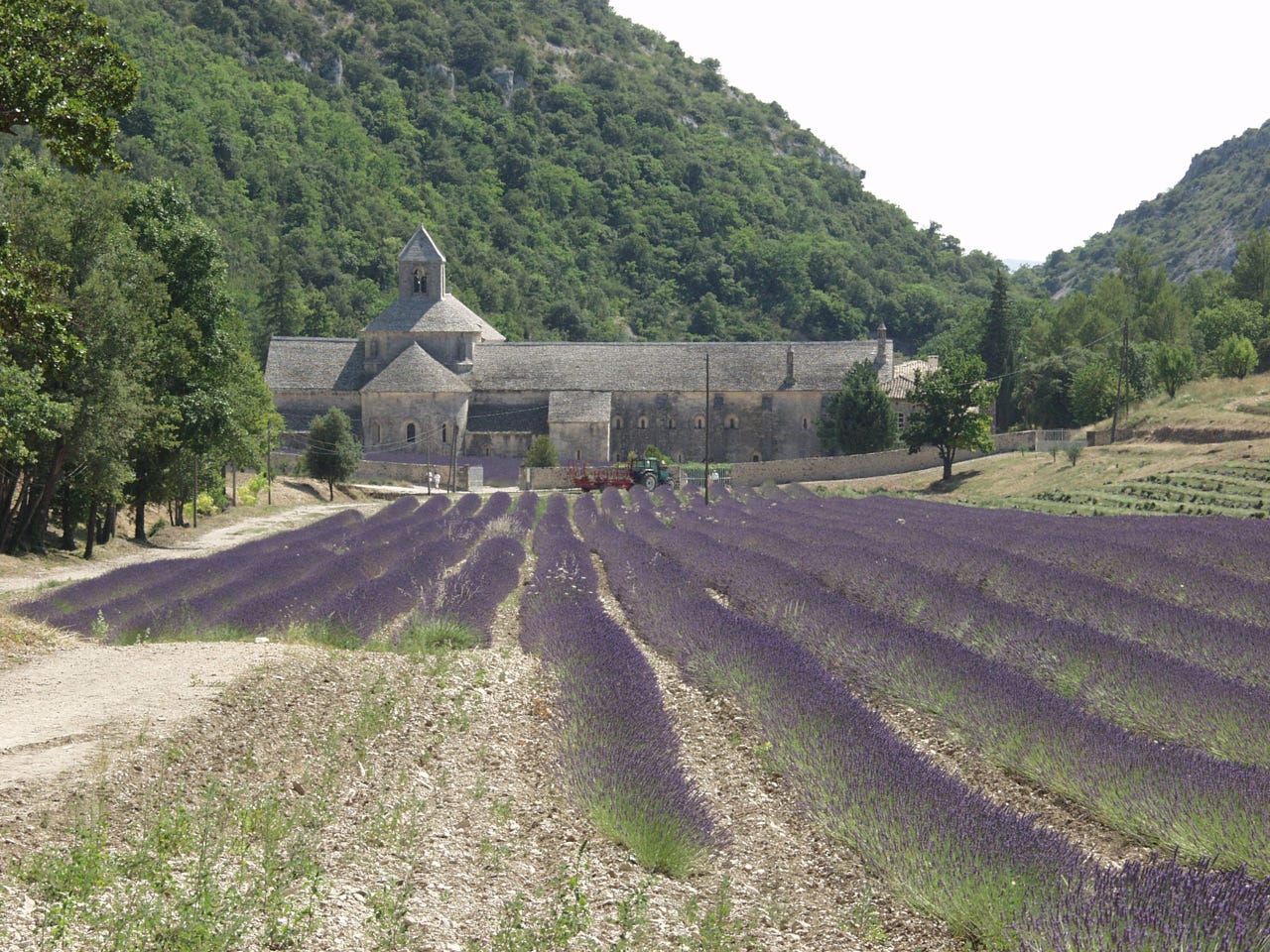
I took the photographs at Notre Dame de Sénanque abbey in Provence in July 2002.

Fars Media Corporation, CC BY 4.0 https://creativecommons.org/licenses/by/4.0, via Wikimedia Commons


Many of us like to ask ourselves, “What would I do if I was alive during slavery? Or the Jim Crow South? Or apartheid? What would I do if my country was committing genocide?”  The answer is, you’re doing it.  Right now.  

Aaron Bushnell

I don’t usually write on current political events outside of Facebook and Twitter posts, but there are limits. I will not keep my head down and my mouth shut in the face of what 15 out of 17 judges at the International Court of Justice rule is plausibly a GENOCIDE being committed by the Israeli Defense Forces in Gaza, with the support of the governments and major opposition parties of the two countries, Canada and the United Kingdom, of which I am a citizen.

Since January, I have posted a number of pieces on the conflict in Gaza (and its implications for civil liberties in North America and Europe) on my Substack, some of which I have subsequently revised and published in the online magazine Canadian Dimension. The fullest statement of my position (briefly, that “while I unreservedly condemn Hamas’s actions against civilians on October 7, I can see no moral standpoint from which I could do so that would not oblige me equally to condemn Israel’s retaliatory violence—and vice versa”) can be found in the long article “Eyeless in Gaza.”

Click on the links below for full texts:

—A massacre of thoughts: the weaponization of October 7, “antisemitism,” and the ousting of Claudine Gay (Substack, Jan 8)

—Are you, or have you ever been …: the ghost of Joe McCarthy comes to Harvard Yard (Substack, Jan 10)

—Eyeless in Gaza: paratexts, contexts, and the weaponization of October 7 (Substack, Jan. 10, subsequently revised and updated and published in Canadian Dimension, Feb 9)

—An open letter to Canadian foreign minister Mélanie Joly: some comments on Canada’s response to the ICJ ruling on Israel (Substack, Jan 27)

—The west responds to ICJ ruling of urgent risk of genocide in Gaza by defunding key aid agency: as Mahatma Gandhi once supposedly said, western civilization would be a good idea (Substack, Jan 28)

—A clarifying moment: Canada and the ICJ ruling on genocide in Gaza. Does this mark a coup de grâce for the ‘rules-based international order’? (Canadian Dimension, Jan 30)

—Who did the ICJ Gaza ruling vindicate? An unpublished letter to the Guardian newspaper (Substack, Feb 9)

—The time of monsters: 1.4 million starving Palestinian refugees await the Israeli assault on Rafah (Substack, Feb 12)

—Over the top? Does the Super Bowl Massacre mark a turning-point in western support for Israel’s Gaza war? (Substack, Feb 15)

—Is the tide turning on Israel? Western leaders seem finally to be waking up to the monstrosity of the horrors Israel has unleashed upon Gaza (Canadian Dimension, Feb 21)

—An extreme act of protest: Aaron Bushnell, Jan Palach, and resisting the normalization of the unthinkable (Substack, March 1; slightly revised version in Canadian Dimension, March 3; Czech translation in Britské listy, March 5)

I have recently launched my own Substack, as a vehicle for draft writing, experiments with text and image, and commentary on current events. A place to think with. Subscription is free—subscribers will receive a copy of each new post in their email.

Posts so far published include one long essay (eyeless in Gaza: paratexts, contexts, and the weaponization of october 7) and several shorter pieces on the history and politics of the current war in Gaza (a massacre of thoughts, 8 Jan; are you, or have you ever been, 10 Jan; an open letter to Canadian foreign minister mélanie joly, 27 Jan; the west responds to ICJ ruling of urgent risk of genocide in Gaza by defunding key aid agency, 28 Jan; who did the ICJ ruling on Gaza vindicate, 9 Feb); a four-part essay on Richard Strauss’s Salome and Four Last Songs (how middlebrow triumphs over death #1, #2, #3 and coda); an appreciation of John Prine and Iris DeMent (cryin’ into the skiller, 8 Jan); and a running series of photoessays juxtaposing image and text (unexpected encounters: introduction, 2 Feb; #1 the gaze, 2 Feb; #2 imaginary, symbolic, real, 5 Feb).


an unpublished letter to the Guardian newspaper

I sent this letter to the Guardian on January 26 in response to their call for comments on an article on the ICJ ruling on South Africa’s charge of genocide against Israel. I think it is safe to assume they are not intending to publish it. The only thing I would add is that to describe the ruling as “a win for the rule of law” is overly hopeful. The actions of Israel, the US, the UK, Germany, Canada, and most other so-called western democracies since, including the disgusting defunding of UNRWA on the basis of completely unsubstantiated allegations by Israel, demonstrate the exact contrary. 

I have written more on this extremely clarifying moment in Canadian Dimension.


Dear Guardian,

Kenneth Roth is right to stress that the ICJ ruling on Israel’s actions toward Palestinians in Gaza is a “win for the rule of law” (“The ICJ ruling is a repudiation of Israel and its western backers,” Jan. 26).

It is also a vindication of the millions whose protests have been denounced as “hate marches, chanting for the erasure of Israel from the map” (Suella Braverman); of US congresswoman Rashida Tlaib, who was censured by her House of Representatives colleagues for “promoting false narratives regarding the October 7, 2023, Hamas attack on Israel”; of Liz Magill and Claudine Gay, who were hounded out of office as presidents of the University of Pennsylvania and Harvard respectively for their alleged failure to deal with campus antisemitism; of Mehdi Hasan, whose popular news show was pulled by MSNBC; of Ai Weiwei and Candace Breitz, who had long-planned exhibitions cancelled at prestigious art galleries; of Palestinian novelist Adania Shibli, whose Frankfurt Book Fair award ceremony for the 2023 LiBeraturpreis for her novel Minor Detail was cancelled; of editors Michael Essen at eLife and David Velasco at Artforum, who were fired for supporting pro-Palestinian speech; of journalist Masha Gessen, who forfeited the Heinrich Böll Foundation’s sponsorship for her Hannah Arendt Prize because she dared compare Gaza with a Nazi ghetto; of actress Melissa Barrera, who lost her lead role in the next “Scream” film for describing Israel as “colonial”; of footballers Yousef Atal and Anwar El Ghazi, who were dropped at Nice and Mainz FC for pro-Palestinian posts on social media; and for a legion of others in the US, UK, Germany, Canada and elsewhere who have been vilified as “antisemites” and persecuted for daring to criticize Israel and/or support the Palestinian cause.

Derek Sayer

I was horrified at the mass shooting yesterday at Charles University in Prague, a location I know well. May the wounded recover and the dead rest in peace. Apparently the shooter, 24-year-old history student David Kozák, was inspired—if that’s the right word—by American examples. This is one bit of American culture Europe doesn’t need. I hope the Czechs fix their gun laws (as the UK, Australia, and New Zealand did after their own massacres) before, as in the US, it gets politically impossible to do so.   

It seems apt to repost this.

On 24 February 2022, the day Russia invaded Ukraine, I responded to an argument on a friend’s Facebook page that the West should give in to Vladimir Putin’s demands in order to avoid the prospect of World War III and possible global nuclear annihilation.

A few days later, to my great surprise, I was informed that my comment had violated Facebook’s “Community Standards” and my account would be subjected to multiple restrictions, including a ban on posting or commenting for a week, a ban on participating in groups for a month, and having all my posts moved down in Newsfeed for two months.

Facebook operates a system of escalating penalties, and this was not the first time I had fallen foul of their algorithms. I was reminded that “multiple posts from the last year didn’t follow our standards.” They listed three previous violations. One was for “bullying” (I had the temerity to suggest that to describe COVID-19 as “a little headache” when over 800,000 people had died of it in the United States was “stupid and dangerous”) and another was for “nudity” (I posted a picture of the newly published Czech translation of my book Prague, Capital of the Twentieth Century, whose cover utilizes a collage by Karel Teige featuring a bare-breasted woman). I can’t track down the third violation because “this content is no longer available.” This is hardly a litany of hate speech.

I checked the box disagreeing with the decision over my latest post. Facebook responded confirming that in their view, my post violated their standards. They told me, however, that I could appeal to Facebook’s (allegedly) independent Oversight Board, “which was created to help Facebook answer some of the most difficult questions around freedom of expression online: what to take down, what to leave up, and why.” There is no guarantee the board will review any particular individual case: “The Oversight Board will define the criteria that will ensure it selects eligible cases that are difficult, significant and globally relevant that can inform future policy.”

While I do not think my personal quarrels with Facebook are of any great importance in themselves, I believe how and in whose interests Facebook and other social media control the flow of information on the internet are among the most pressing political issues of our time.

Here are extracts from my submission to Facebook’s Oversight Board. If I get a response I will post it here. I’m not holding my breath.

Summary of case

I am a professional historian and an acknowledged expert on modern European history. Among other honors and awards, my book Prague, Capital of the Twentieth Century (Princeton University Press, 2013) won the George L. Mosse Prize for 2014, which is awarded annually by the American Historical Association for “an outstanding major work of extraordinary scholarly distinction, creativity, and originality in the intellectual and cultural history of Europe since 1500.”  This book was also chosen as one of the Financial Times History Books of the Year.

The comment Facebook removed read (in full): 

“This is my last territorial demand in Europe” (Adolf Hitler, speaking of the Sudetenland, September 1938).  

The Sudetenland is the German-speaking part of Czechoslovakia that the leaders of Britain and France agreed Nazi Germany could annex following the 1938 Munich Agreement in order to achieve “peace for our time” (Neville Chamberlain). It soon became clear that this appeasement policy did not work. Hitler occupied the rest of the Czech Lands in March 1939, and invaded Poland on 1 September 1939, triggering World War II.

The context in which I posted this comment was a discussion on a colleague’s timeline of Russia’s invasion of Ukraine on 24 February 2022. People were suggesting that the most prudent course of action was to appease Putin by agreeing to his demands to demilitarize Ukraine and prevent it joining NATO.  My point was that Putin’s behavior toward Ukraine was reminiscent of Hitler’s toward Czechoslovakia in 1938, and to appease him now would likely have the same result. Concessions would encourage further aggression elsewhere. I am far from the only person to have made this case on Facebook or elsewhere.

Nothing in my post can reasonably be construed as praising or endorsing Hitler or Nazism. And my scholarly record of opposition to fascism speaks for itself. This decision is preposterous, and sends out a chilling message for scholarly debate.

Why did I post this comment on Facebook

Russia’s invasion of Ukraine is arguably the greatest threat to peace in Europe and global security since World War II.  As a professional historian of modern Europe, I believe I have a right as well as an obligation to bring my knowledge of recent history to bear on current debates on Facebook and elsewhere.  In this case I was drawing attention to the strong parallels between Adolf Hitler’s behavior toward Czechoslovakia in 1938 and Putin’s behavior toward Ukraine in 2022. The quote I chose (“This is my last territorial demand in Europe”) was intended to suggest that Putin’s assurances on Ukraine should be treated with skepticism.  Historians know that appeasement of Hitler at Munich in 1938 did not prevent World War II breaking out a year later.  By using this quote I was implying that appeasing Putin over Ukraine is no more likely to stop him moving into (for example) the Baltic states if he is not resisted now.

Did Facebook misunderstand my reason for posting?

Yes, I do think Facebook misunderstood my reason for posing.  The context of the debate into which I was intervening should have sufficed to make it abundantly clear that I was in no way endorsing Hitler. For example another of my comments in the same exchange read: “If Joe Biden can seize all assets of Bank of Afghanistan in US and give them away to Americans, he can sure as hell do more to sanction Russia and Russians than he has done to date. Same goes for other western leaders. If they don’t, Putin’s troops may well think the road is open to Riga, Tallin and Vilnius … and who knows, Warsaw and Prague.”

Does this case raise issues of wider social importance?

Yes.  It is universally accepted that Russia’s invasion of Ukraine is a grave threat to world peace, and how best to respond has been debated in every western country.  The invasion gave rise to the first emergency UN General Assembly session since 1982 (and only the tenth such session since 1950). It is essential that academics be allowed to bring their professional knowledge to bear in commenting on such issues on Facebook and elsewhere. They cannot do so if mere quotation of Adolf Hitler or similar figures, irrespective of context, is treated by your algorithms or adjudicators of “community standards” as tantamount to endorsement.  If I know this is how Facebook acts, I will self-censor and avoid even mention of possibly controversial topics in order not to get banned from a network that is useful to me for other purposes (keeping up with family and friends across the world). If everyone responds similarly for fear of having their Facebook account disabled, the net effect will be to close down informed debate on important social and political issues – WITHOUT in any way deterring the real, organized, purveyors of hate speech, like white supremacist organizations, who have proved adept at taking advantage of your platform many times in the past.

Can you suggest improvements Facebook can make to avoid this happening?

The simplest measure you could take is not to treat the mere mention or quotation of a historical figure as an endorsement of their views, but to examine to context in which the mention or quotation is made. And, possibly, employ better educated adjudicators.

10 word summary of complaint

Quotation should not be treated as endorsement irrespective of context.