The big men are all deaf; they don't want to hear the little squeaking as they walk across the street in cleated boots (Sylvia Plath, 11 September 1950)
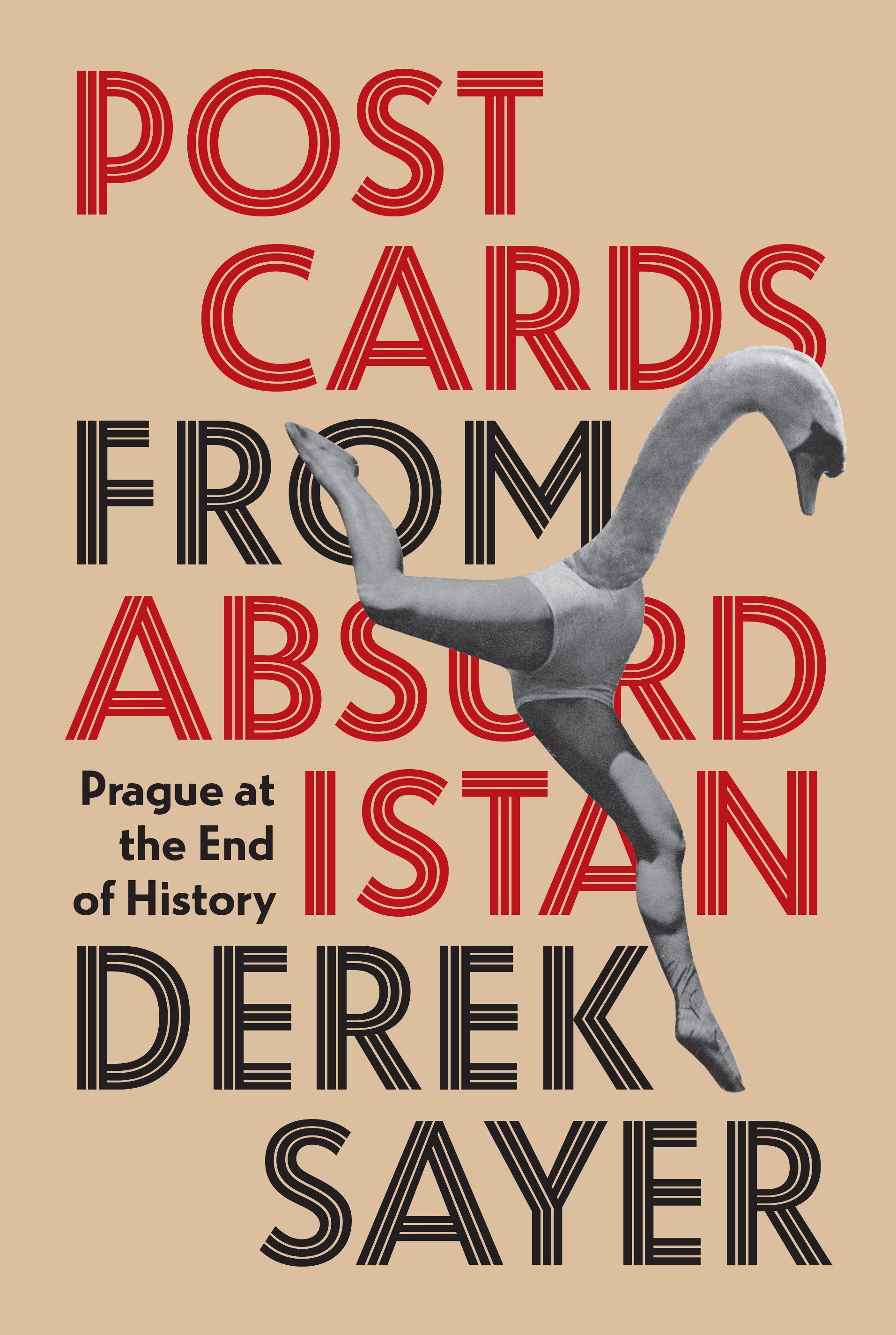
Volvox Globator, who previously published the Czech translation of Prague, Capital of the Twentieth Century, has now brought out a Czech translation of the third volume in my “Prague trilogy,” Postcards from Absurdistan: Prague at the End of History. I am most grateful to Jindřich Veselý for undertaking this translation, which cannot have been the easiest of assignments given the length and character of the book.
This is the Czech publisher’s blurb. English translation follows.
Kniha Pohlednice z Absurdistánu, napsaná britsko-kanadským bohemistou Derekem Sayerem, představuje jedinečný vhled do českých dějin dvacátého století. Ve své předchozí knize autor nazval Prahu hlavním městem 20. století (Praha, hlavní město dvacátého století, Surrealistická historie Volvox Globator, 2021) a tento pohled zůstává výchozím bodem i pro tuto knihu.
Derek Sayer se podrobně zabývá kulturním a společenským děním, odhaluje absurdity, které 20. století provázely, a zároveň poukazuje na křehkost demokratického systému. Podtitul knihy Praha na konci dějin odkazuje ke slavnému dílu, které napsal Francis Fukuyama v devadesátých letech dvacátého století, ale zároveň v sobě nese nadhled, který je Dereku Sayerovi vlastní.
V knize se prolínají dějinné, politické události spolu s osobními dějinami českých osobností, které si v nehostinných podmínkách velké části dvacátého století vydobývaly vlastní svobodu. Velká pozornost je věnována vývoji umění, které bylo nuceno, ať už jakýmkoli způsobem, na danou politickou situaci reagovat. Kniha nese veškeré parametry vědecké práce, autor však není spoutaný akademickým jazykem, naopak, jedná se o velice čtivý text, který je doprovázen více než sedmdesáti dobovými fotografiemi.
Z angličtiny přeložil Jindřich Veselý.
Postcards from Absurdistan, written by British-Canadian Czech scholar Derek Sayer, offers a unique insight into Czech history in the 20th century. In his previous book, the author called Prague the capital of the 20th century (Praha, hlavní město dvacátého století, Surrealistická historie, Volvox Globator, 2021), and this remains the vantage point for this book as well.
Derek Sayer takes a detailed look at cultural and social events, revealing the absurdities that accompanied the 20th century, while also pointing out the fragility of the democratic system. The subtitle of the book, “Prague at the End of History,” refers to the famous work written by Francis Fukuyama in the 1990s, but at the same time carries Derek Sayer’s characteristic perspective
The book intertwines historical and political events with the personal histories of Czech personalities who fought for their freedom in the inhospitable conditions of much of the 20th century. Much attention is paid to the development of art, which was forced, in one way or another, to respond to the political situation. The book has all the parameters of a scientific work, but the author is not bound by academic language; on the contrary, it is a very readable text accompanied by more than seventy period photographs.
“Postcards from Absurdistan is the third in a loose trilogy of books Derek Sayer has written about modern Czech cultural history … Put next to one another, the trilogy’s some 1,700 pages provide a tour de force of Czech cultural history … Sayer’s mise-en-scène and his analysis are always erudite, sometimes revisionist and frequently compelling … the book and the trilogy are tremendous achievements … this eminently readable book … is a well-balanced introduction to the Czech twentieth century for students and the wider public, and also offers many insights for expert scholars. Derek Sayer has written a deserving conclusion to his Czech trilogy.”—”The Last Postcard from Prague,” Felic Jeschke, CEU Review of Books
“Beginning with the intimate relationship between Franz Kafka and the Czech feminist, journalist, and writer Milena Jesenská, the book embarks on a colorful journey through the fates of hundreds of figures of Bohemian cultural life between 1918 and 1989. For Sayer, Prague is a loose starting point for the interweaving of the lives of the actors in his book, wherever these took place. He thus traces both the artistic activities and the private—and in many cases intimate—lives of countless Czech writers, architects, artists, and filmmakers, and of their partners, children, and extended families. He vividly shows the interconnectedness of their fates (and often their bedrooms), whether their lives’ vicissitudes took place in Prague, Paris, New York, or Tokyo, in their apartments, villas, or offices, in the torture chambers of the Nazi occupiers, in refugee camps, or in the interrogation rooms of the Communist secret police … Sayer displays a deeply impressive knowledge of modern Czech cultural history, which he manages to construct into an extremely appealing narrative … a literarily brilliant and empirically rich collage of stories from the history of Czech culture in the twentieth century.”—Rudolf Kučera, Journal of Modern History
“Sayer chronicles a world of the absurd but also contributes to it. Essentially he provides an episodic celebration of the Czech contribution to (post)modern civilization, with some brilliant aperçus … we learn much about the strategies of intellectuals and artists to frustrate successive orthodoxies of oppressive political regimes and especially about the genesis of the celebrated crop of Czech novelists and dramatists of the absurd headed by Bohumil Hrabal, Milan Kundera, and Václav Havel … In the absence of any comparative dimension to this book, it might well seem that Sayer exaggerates his case for Czech primacy in absurdism, in the spirit of Jára Cimrman, the larger-than-life inventor and discoverer whose exploits included leaving three missed-call messages on Alexander Graham Bell’s first telephone. Yet perhaps, on second thought, the cult of Cimrman, “the greatest Czech who never lived” (he was himself invented in 1960s Prague, initially as a radio character) is actually strong evidence that the claim, precisely in its flippancy, carries some weight.”—R.J.W. Evans, Common Knowledge
“Derek Sayer’s latest dive into Czech cultural history traces the winding paths of its protagonists through artistic movements, war, exile, and oppression … The absurdity implied in the title is shown repeatedly to be the result of the heavy hand of politics interfering with the life and work of the country’s cultural greats. Virtually no one escapes unscathed. Death, prison, and exile are as common among these Czech writers and artists as gallery openings and publication … The book’s main title is Postcards from Absurdistan, and the sense of absurdity is largely delivered. Yet the story branches out so internationally – from Prague to Paris to Moscow to Tokyo, India, and the Utah desert, among other places – and the absurdity presented seems so evenly shared, that it can make the world in general appear an Absurdistan. It very likely is, yet there is a particular style of absurdity found in 20th century Central and Eastern Europe, whether nationalist, communist, or a combination of the two, which the book effectively presents and defines.”—Michael Stein, “The Unsummoned Convention of Genius,” Transitions.
I was horrified at the mass shooting yesterday at Charles University in Prague, a location I know well. May the wounded recover and the dead rest in peace. Apparently the shooter, 24-year-old history student David Kozák, was inspired—if that’s the right word—by American examples. This is one bit of American culture Europe doesn’t need. I hope the Czechs fix their gun laws (as the UK, Australia, and New Zealand did after their own massacres) before, as in the US, it gets politically impossible to do so.
“To articulate the past historically … means to seize hold of a memory as it flashes up at a moment of danger … In every era the attempt must be made anew to wrest tradition away from a conformism that is about to overpower it. The Messiah comes not only as the redeemer, he comes as the subduer of Antichrist. Only that historian will have the gift of fanning the spark of hope in the past who is firmly convinced that even the dead will not be safe from the enemy if he wins. And this enemy has not ceased to be victorious.
Theses on the Philosophy of History—Walter Benjamin’s last text
Hope Obscured. Photo taken at Tate Modern, London, December 2019. Copyright Derek Sayer 2023.
I was one of those writers who were honored at the Canadian Jewish Literary Awards ceremony in Toronto last Sunday. What should have been a joyous celebratory occasion was inevitably overshadowed by the horrific events unleashed by Hamas’s brutal assault on Israeli civilians on October 7—which, let me be clear, I utterly and unreservedly condemn. After much soul-searching the organizers decided the ceremony should go ahead, as a gesture of affirmation of faith in the redemptive power of culture. I think this decision was the correct one even if the audience was much smaller than usual and there was a heavy security presence at the door.
Among those I talked with, there was no politicking but just profound sorrow, grief, and apprehension—above all fear for the fate of civilians, especially the children, who were already paying the price of politicians’ belligerence and intransigence on both sides. Fear, also, for the future, both immediate and longterm.
The proceedings began with a recitation of the Kaddish, the Jewish prayer for the dead. It put me in mind of two other recitations of the same prayer, which I had recounted in the book for which I received the award, Postcards from Absurdistan: Prague at the End of History.
The first recitation took place in the Terezín (Theresienstadt) concentration camp following one of the most infamous Nazi reprisals of World War II. In retaliation for the Prague assassination of Reinhard Heydrich, the Protector of Bohemia and Moravia (and architect of the Final Solution), by Czechoslovak paratroopers based in Britain, on 10 June 1942 German security forces sealed off the little village of Lidice, where they shot 173 adult males and deported 205 women to concentration camps. Ninety-eight children were taken to be “appropriately raised,” of whom 81 were subsequently murdered in the gas vans at Chelmno. None of the victims had played any part whatsoever in Heydrich’s assassination, though some had relatives fighting for the Czechoslovak resistance abroad. It was a collective punishment, of the sort the 1949 Geneva Convention (4) specifically outlawed (article 33) in the hope of preventing such atrocities ever happening again.
Following the shootings,
The troops doused the buildings with gasoline and set them on fire. Thirty Jewish prisoners were trucked in from Terezín. When they arrived in the burning village at 4:00 in the afternoon they were given pickaxes, shovels, 350 grams of bread, and 30 grams of margarine; taken to the place where the men’s bodies were heaped up; and told to dig a mass grave twelve meters long, nine meters wide, and three meters deep by six the next morning “or else they can quietly lay down with the others.” One of them, the journalist and broadcaster František R. Kraus, wrote a powerful account of his experience soon after the war ended. It was a Czech Jew who sang a requiem over the bodies of Lidice’s Christian dead:
“Suddenly the church breaks apart: a new metallic thundering breaks up the walls, the ringing of the bells resounds clearly, there is a thumping in the tower, flames roar up again, then suddenly the ringing stops, torn away from the roof the bell hurtles down, breaks through the wooden floor and ends with huge clattering on the stone floor, white smoke rolls out of the fallen nave. . . . Next to me stands Karl Langendorf, young, beautiful, the composer, he stands there like a marble statue, his mouth wide open, he raises and lowers his fists. . . . Then low singing sounds from his lips, it is Antonín Dvořák’s Requiem . . . Requiem aeternam dona eis domine et lux perpetua luceat eis [Eternal rest grant them, O Lord, and let perpetual light shine upon them] . . . Dies irae, dies illa [Day of wrath, that day] . . . a windy morning rises from the blood-drenched east and Karl Langendorf sings Sanctus, Sanctus, Sanctus . . . Dominus Deus Sabaoth [Holy, holy, holy . . . Lord God of the Sabbath] . . . bricks drop onto the empty church benches, jump high again and dance to and fro as if it were a festive church holiday, then the beams clatter down and break the roof, walls and vaultings shake, pictures of saints in gold frames fall from the old walls, and thunder to the ground . . . mass is being celebrated for the last time here.”
The grave diggers arrived back in Terezín to find candles burning at the heads of their bunks, “just as at that time, when the first of our comrades were hanged. Comrades are singing the monotonous melody of the Kadish [sic], stop, smother their joy.” “I sink back. My eyes pass over the barred windows. Outside the night is of the deepest black. And beneath me, on the lower bunk, Karl Langendorf sings quietly: ‘Requiem aeternam dona eis, Domine, et lux perpetua luceat eis. . . .’ Then he adds in a low voice: ‘But Lidice is in Europe!’ Kraus survived the war to write one of the earliest Holocaust memoirs, titled Plyn, plyn . . . , pak oheň: vězeň č. B 11632 (Gas, gas . . . , then fire: Prisoner #B 11632), published in Havlíčkův Brod in 1945. Karel Langendorf, as he is named in Czech sources, was transported to Auschwitz on 18 May 1944. He did not survive.
Postcards from Absurdistan, pp. 180–2
The second recitation of the Kaddish was by the great Prague Jewish reporter Egon Erwin Kisch, who spent most of World War II as a refugee in Mexico. It was in Mexico City that he learned of the murder of two of his brothers in the Holocaust.
“In Mexico Kisch suffered horribly from the fact that Prague was occupied,” Lenka [Reinerová, another Prague Jewish writer and Kisch’s fellow refugee in Mexico City] told a Czech TV interviewer in 2001. “When we were alone, Egon spoke in Czech with me in Mexico—out of nostalgia and homesickness.”
Nostalgia and homesickness did not blunt the raging reporter’s insatiable curiosity. Egon’s Entdeckungen in Mexiko (Discoveries in Mexico, 1945) contained twenty-four essays on a wide range of topics, including sports among the ancient Maya, how to make tortillas, the hallucinogenic properties of peyote, and the cultural history of the cactus. He attends a Sabbath service in the village of Venta Prieta, whose thirty-seven Jewish inhabitants, “in no way distinguishable from other Indians or Mestizos,” were descended from Spanish Jews who fled the Inquisition in the sixteenth century.
“My father and mother were born in Prague, lived there, and are buried there. It never could have occurred to them that one day one of their sons would be reciting the prayer for the dead for them amid a group of Indians, in the shadow of the silver-laden mountains of Pachuca. My parents, who lived their entire lives in the Bear House of Prague’s Old Town, never dreamt that their sons would sometime be driven out of the Bear House, one of them to Mexico, another to India, and the two who were unable to escape the Hitler terror, to unknown places of unimaginable horror. My thoughts roamed farther—to relatives, friends, acquaintances, and enemies, sacrifices of Hitler, all entitled to be remembered in the prayer for the dead.”
quoted in Postcards from Absurdistan, pp. 279–80.
Here, for the record, is the speech I gave at the Canadian Jewish Awards ceremony on Sunday. I shortened it a little in the delivery—this is the fuller text I had prepared in advance. Its resonances will, I hope, be obvious.
I am greatly honored to receive the Canadian Jewish Literary Award for Scholarship, and would like to thank all those involved—especially the jury, upon whom I inflicted a very much longer book than I sat down to write in the fall of 2018. I am particularly gratified for my work to be recognized in this way when I am not Jewish and Postcards from Absurdistan does not pretend to be a work of Jewish history. But one cannot write the history of Prague without foregrounding the part played by Jews in that history—for over a thousand years—and it means a lot to me that the jury thinks I have done them justice.
Postcards from Absurdistan is the final volume in a trilogy of books which take Prague as an alternative vantage-point on modernity. In his unfinished magnum opus The Arcades Project, the great German Jewish critic Walter Benjamin nominated Paris, the so-called “city of lights,” as the “capital of the nineteenth century,” and set out to discover “the prehistory of modernity” in the “dreamworlds” incarnated in its material fabric and cultural products. I thought Prague might be treated analogously, as a site in which to excavate the dreamworlds of the very much darker twentieth century.
My subtitle “Prague at the End of History“ is deliberately ironic, because history was declared at an end no fewer than three times during Bohemia’s turbulent twentieth century: by the Nazis, when they incorporated Prague into their ‘thousand-year Reich’ in March 1939; by the communists, who proclaimed socialism ‘achieved’ in 1960; and by many Western commentators, who were confident that the 1989 revolutions in Europe heralded (in Francis Fukuyama’s words) ‘the universalization of Western liberal democracy as the final form of human government.’
Each was the illusion of its epoch. Each proved spectacularly wrong. Prague is a place where modernist phantasmagoria of history-as-progress have repeatedly unraveled. The period covered in Postcards, from the Munich Agreement to the fall of communism, were the years of peak unraveling.
At a time in which democracy is once again under global assault, the dark half-century of Prague’s modernity considered in Postcards holds up a disturbing mirror to our own historical crossroads.
Postcards from Absurdistan is not a conventional academic history book, but a tapestry woven out of a multitude of fragments—a “collection of close readings, insightful narratives, obscure gems, and sometimes-funny, sometimes-wrenching reflections,” as the jury generously describes them. Like Benjamin, “I want to allow “the rags, the refuse” that gets lost in the grander narratives of modernity, to “come into their own.” These fragments are intended to function as dialecticalimages, to use Benjamin’s term, in which “It’s not that what is past casts its light on what is present, or what is present its light on what is past; rather, image is that wherein what has been comes together in a flash with the now to form a constellation.”
As well as providing a model (The Arcades Project) and a method (literary montage), Walter Benjamin makes a brief appearance in the book. This particular passage takes off from the First International Exhibition of Caricatures and Humor, a deliberate antifascist provocation that took place at the Prague gallery of the Mánes Artists’ Society in the spring of 1934,. The exhibition was organized by one of the main characters in my story, the cartoonist, writer, avant-garde artist, anti-fascist activist and sometime Czechoslovak ambassador to France, Adolf Hoffmeister.
At this point I read the following extract from Postcards from Absurdistan:
The exhibition drew protests from the German, Austrian, Italian, and Polish governments, not to mention that eternal censor of social morality the Vatican. The Czechoslovak government ordered several works to be removed; the ensuing brouhaha ensured that the show had sixty thousand visitors by the time it closed. All the leading Czech caricaturists of the time were represented. The most eminent foreign participants were George Grosz, Otto Dix, John Heartfield, Thomas Theodor Heine, and Erich Godal. By then, Grosz was already in America, and Dix had been fired from his position at the Dresden Academy (he would later be forbidden to paint anything but landscapes). Heartfield, Heine, and Godal had arrived in Prague as refugees in 1933.
Heartfield and Heine moved on again in 1938—Heartfield to England (where he was soon interned on the Isle of Man) and Heine to Oslo and then (in 1942) Stockholm. Godal made it to the United States, where he became a political cartoonist for Ken magazine and the New York newspaper PM. His widowed mother Anna Marien-Goldbaum, whom Godal had been forced to leave behind, was less fortunate. Finally given an exit visa from Germany in 1939, she was one of more than nine hundred Jewish passengers on the MS St. Louis, which sailed from Hamburg to Havana on 13 May. The ship was turned away from Cuba and was then refused permission to dock in the United States (by president Franklin D. Roosevelt) and Canada (by prime minister William Lyon Mackenzie King). A US State Department telegram sent while the ship was close enough to the coast to see the lights of Miami stated that the passengers must “await their turns on the waiting list and qualify for and obtain immigration visas before they may be admissible into the United States.” The New York Daily Mirror published two letters “from an aged mother on the wandering steamship to her son, an artist, in New York” on 6 June 1939. “It is so strange how near, and yet how much cut off we really are,” Mrs. Goldbaum wrote. The St. Louis turned back to Europe the same day. Anna Goldbaum was marooned in Belgium. She was deported to the death camps within a year.
Plus ça change, plus c’est la même chose. As the Western world faced another “refugee crisis” in 2015, the Nigerian American writer and photographer Teju Cole remembered Walter Benjamin—“not so much Benjamin the scholar of surrealism as Benjamin the despairing refugee. The Benjamin who fled, like millions of others, for fear of his life”—who committed suicide in 1940 in the little town of Port Bou on the Franco-Spanish border rather than be sent back to occupied France. “The receipt made out to the dead man, the difunto Benjamin Walter, by the Hotel de Francia, for the four-day stay . . . include[d] five sodas with lemon, four telephone calls, dressing of the corpse, plus disinfection of his room and the washing and whitening of the mattress.” “The itemization reminds me of two things,” writes Cole. “Less, of the usual little list of what I drank or ate (mineral water, Toblerone), what I spent, when I check out of these frequent hotels of my life. More, of the little plastic bags I saw at the public morgue in Tucson, containing the last few personal effects of unknown travelers recovered from the Sonora desert in Arizona. A few dollars, a few pesos, photograph of a family, a mother’s passport to remember her by.” These are the rags and the refuse, the dialectical images that condense the terrible recurrences of the past in the present, blowing Benjamin’s “phantasmagoria of history” to smithereens.
“Every refugee is alike, but each generation fails refugees in its own special way,” explains Teju Cole.
Right now the world is drowning in ancient memories—pogroms, expulsions, the Holocaust, the Nakba—whose contemporary mobilization is fueling hatred on both sides. I do not suggest that we can or should forget—any of the injustices, on either side. Those who have committed atrocities should be brought to account. But the one thing that needs to be remembered amid the fog and fury of war, and not just in the Middle East, is our common humanity. Otherwise what hope is there for any of us?
May there be abundant peace from heaven, and life, for us and for all Israel; and say, Amen.
He who creates peace in His celestial heights, may He create peace for us and for all Israel; and say, Amen.
Postcards from Absurdistan: Prague at the End of History (Princeton University Press), by Derek Sayer, is a kaleidoscopic romp across five decades of intellectual, artistic, cultural, and political foment and creativity in Prague, from the Nazi Anschluss to the collapse of communism. Brilliant and addictively readable, Postcards from Absurdistan highlights the influences and contributions of Czech Jews on cultural and sociopolitical Prague. Franz Kafka, one of the best-known Jewish denizens of Prague, sets the tone through the often surreal world he depicts. The book offers a magnificent and expansive collection of close readings, insightful narratives, obscure gems, and sometimes-funny, sometimes-wrenching reflections on Prague’s cultural elites, even as the geographic boundaries of the city itself cannot contain them. The Jewishness of these currents is steadily woven and subtly explored throughout the book. Postcards from Absurdistan represents the crowning achievement of Professor Sayer’s prodigious scholarship on Czech modernity.
A press release containing more information about the Canadian Jewish Literary Awards, detailing the composition of the jury and this year’s winners in other categories (which include the distinguished architect Moshe Safdie’s autobiography If Walls Could Speak: My Life in Architecture), can be found here.
Aleš Veselý, Gate of the Hereafter (Brána nenávratna, literally Gate of No Return). Holocaust memorial outside Bubny Station, Prague, installed 2015. Photo Derek Sayer.
It was from Bubny station that 50,000 Czech Jews were transported to concentration camps during the Nazi occupation of Bohemia and Moravia. The memorial was intended “to remember not only the victims of deportation, but to also focus on the stigma of those who organized the Final Solution and to remember the role of the passive silent majority that did nothing to stop them” as well as to “call attention to the face of prejudice, xenophobia, racial emnity, and discrimination on the basis of ‘otherness’ in the world today” (Memorial of Silence website, as quoted in Postcards from Absurdistan, p. 193).
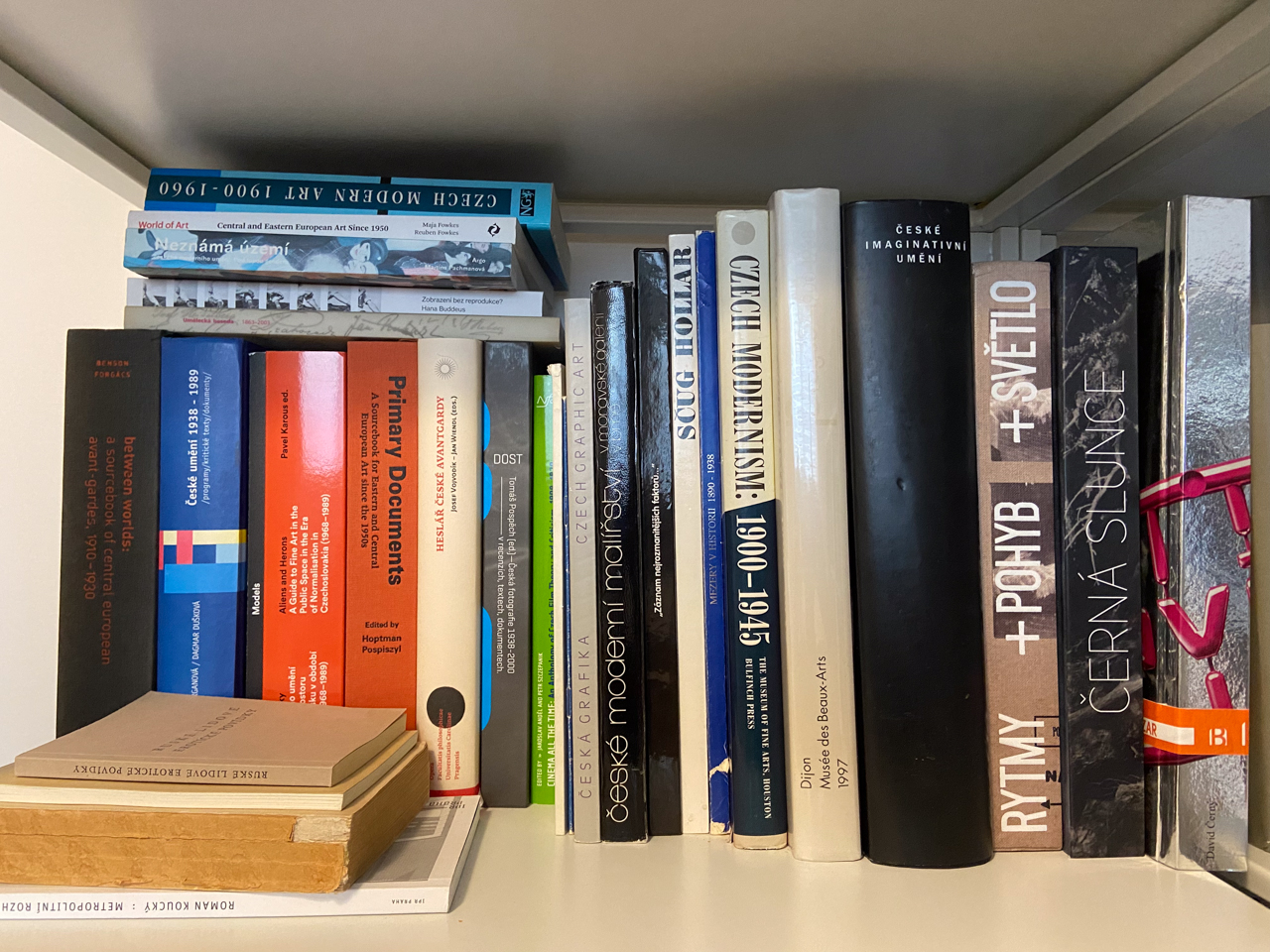
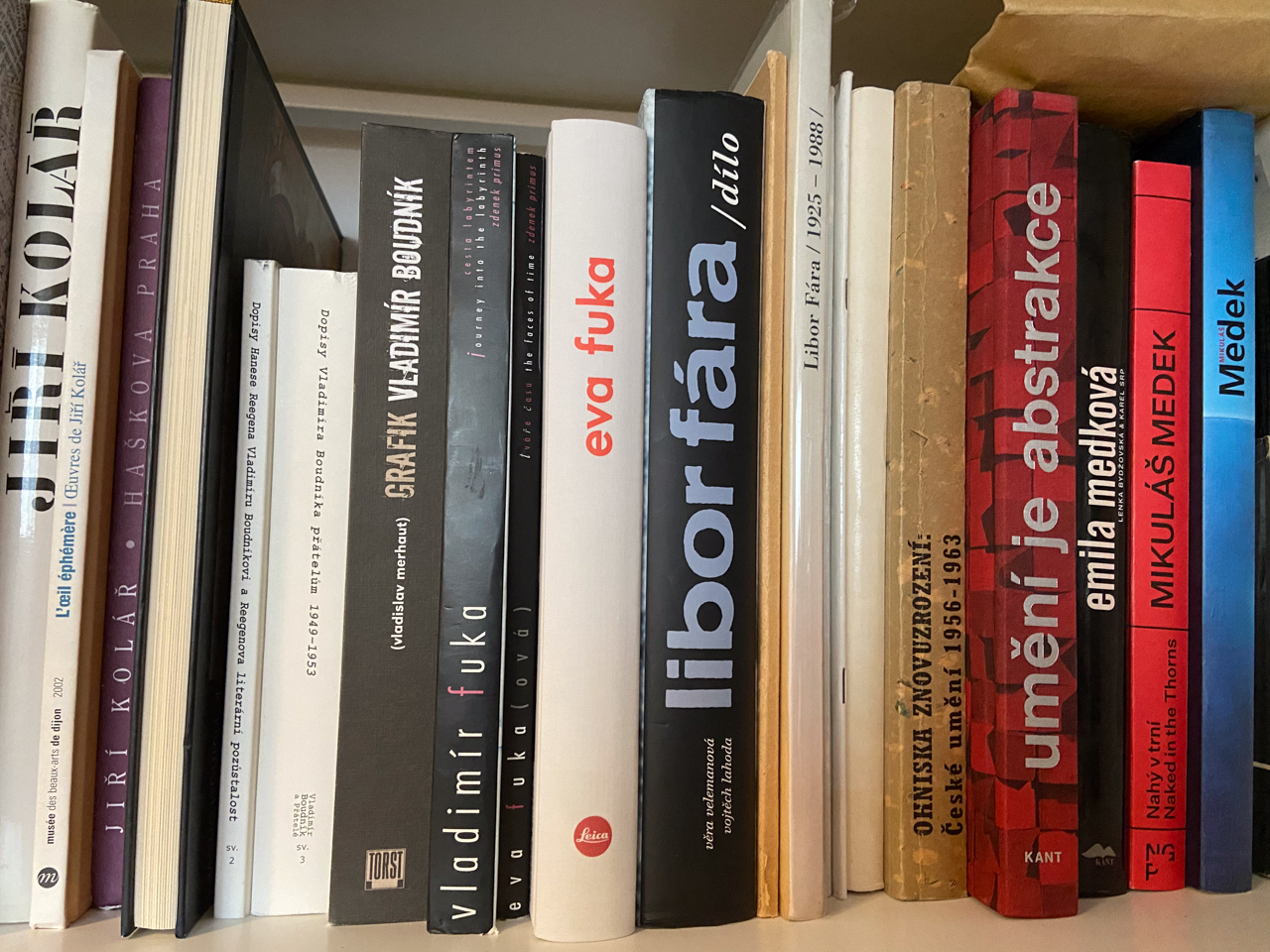
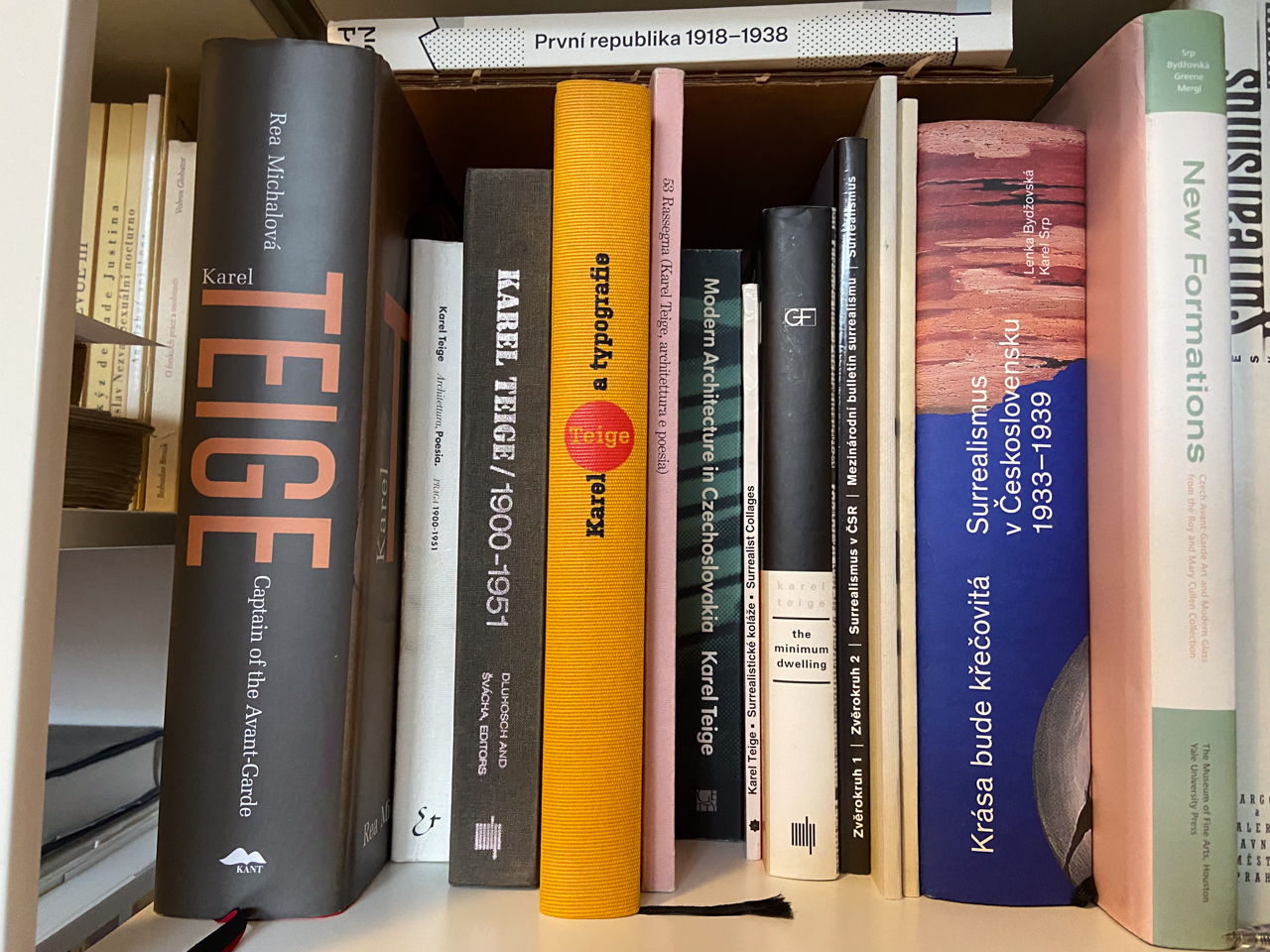
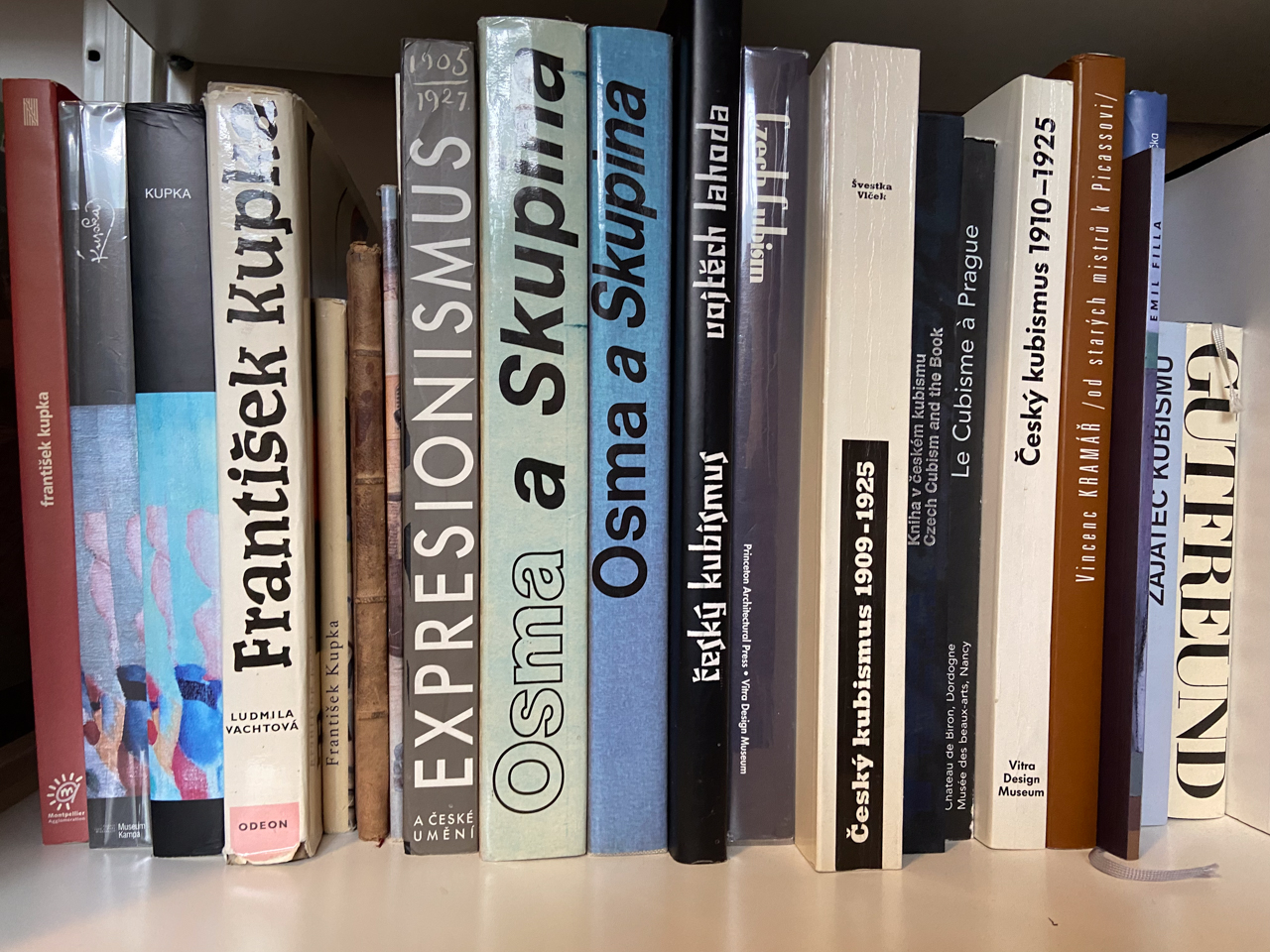
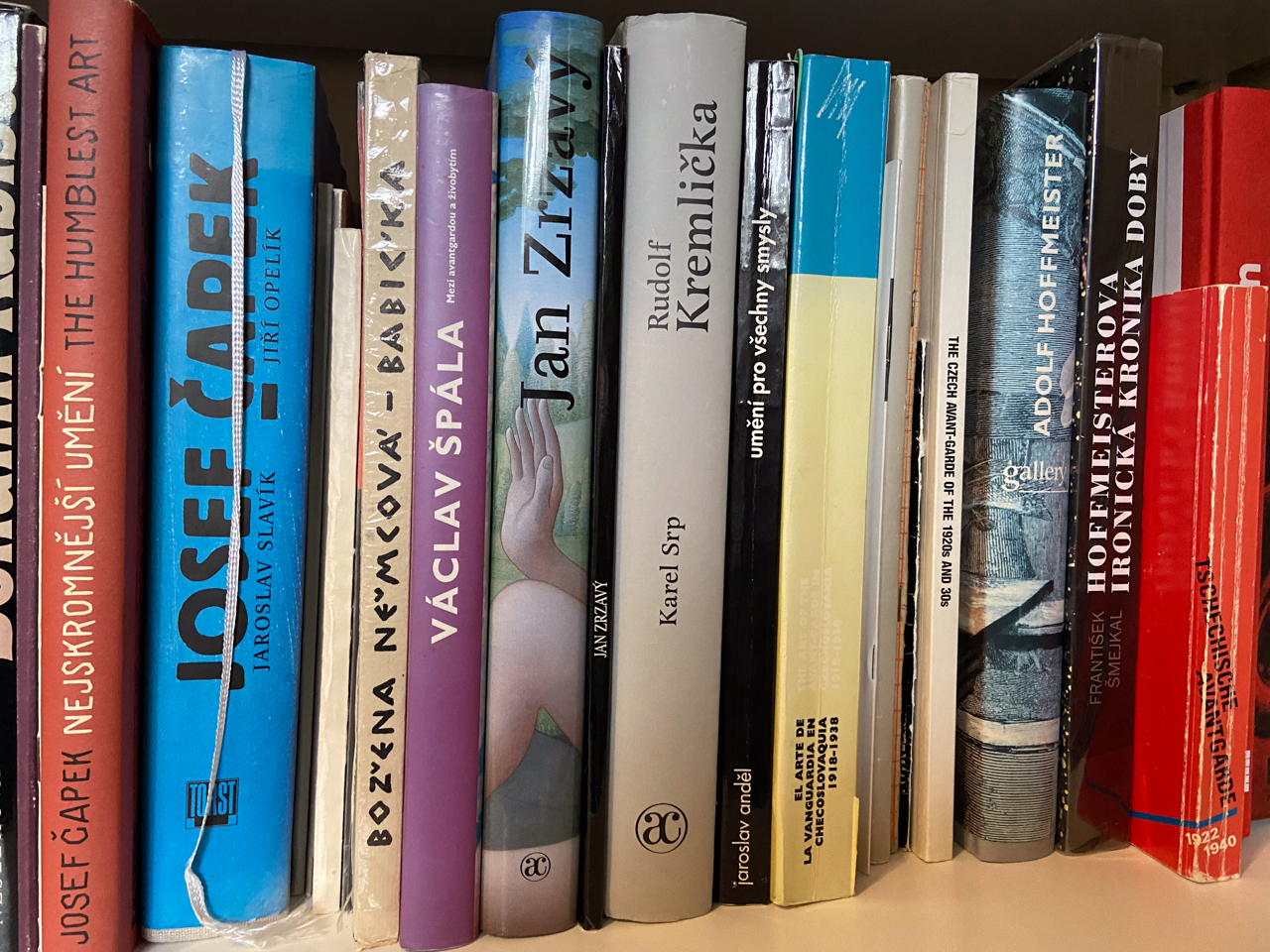
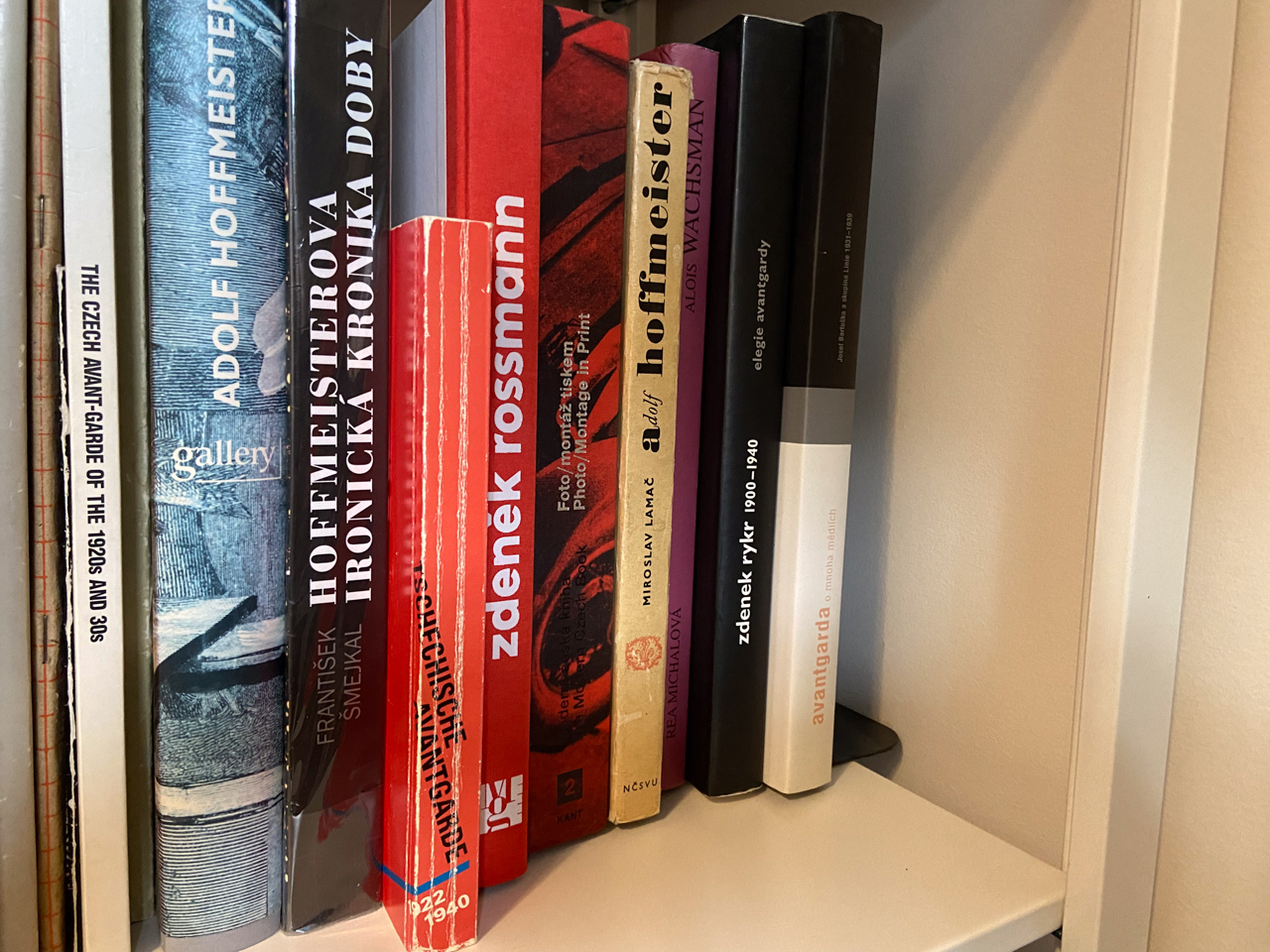
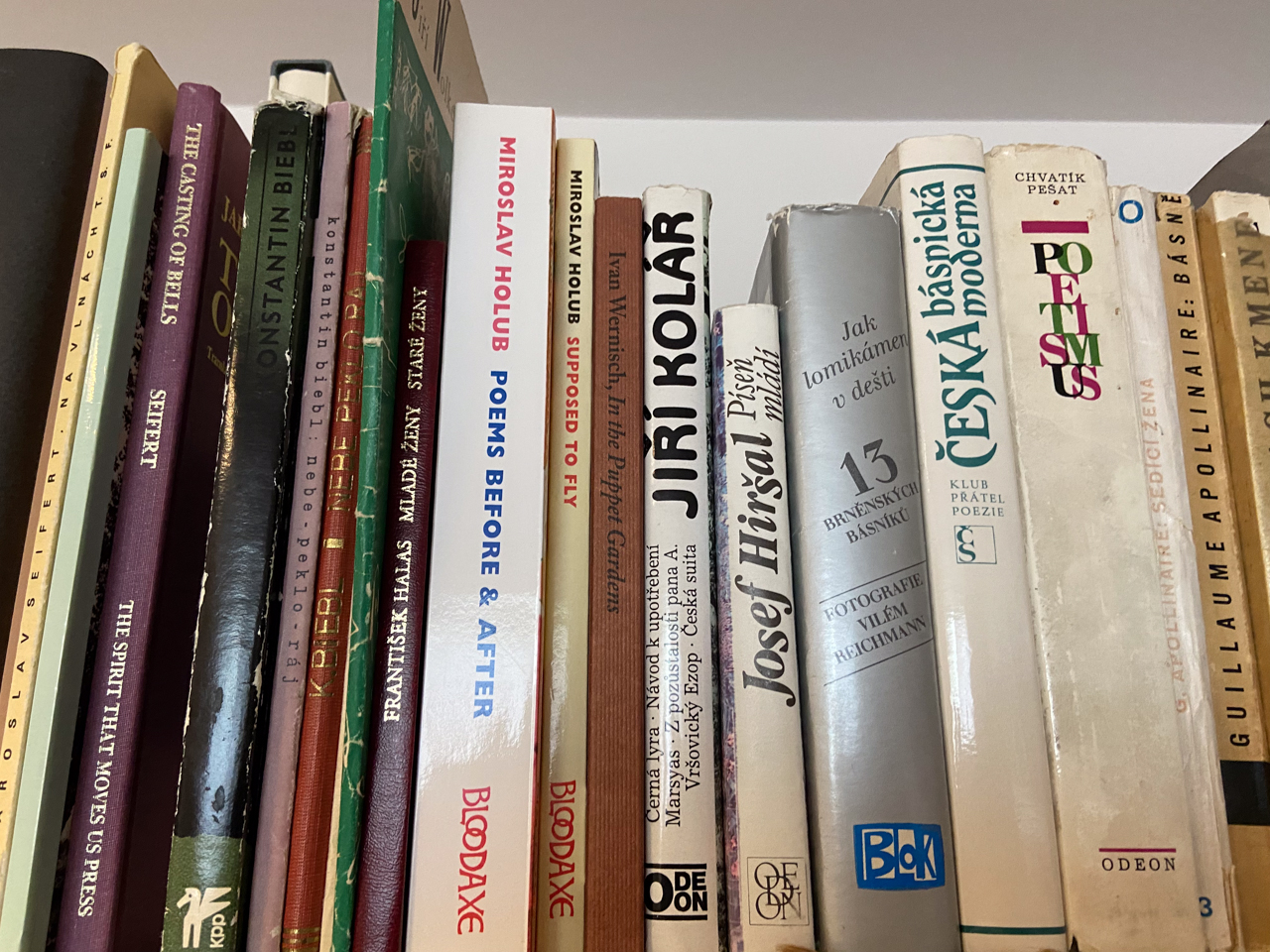
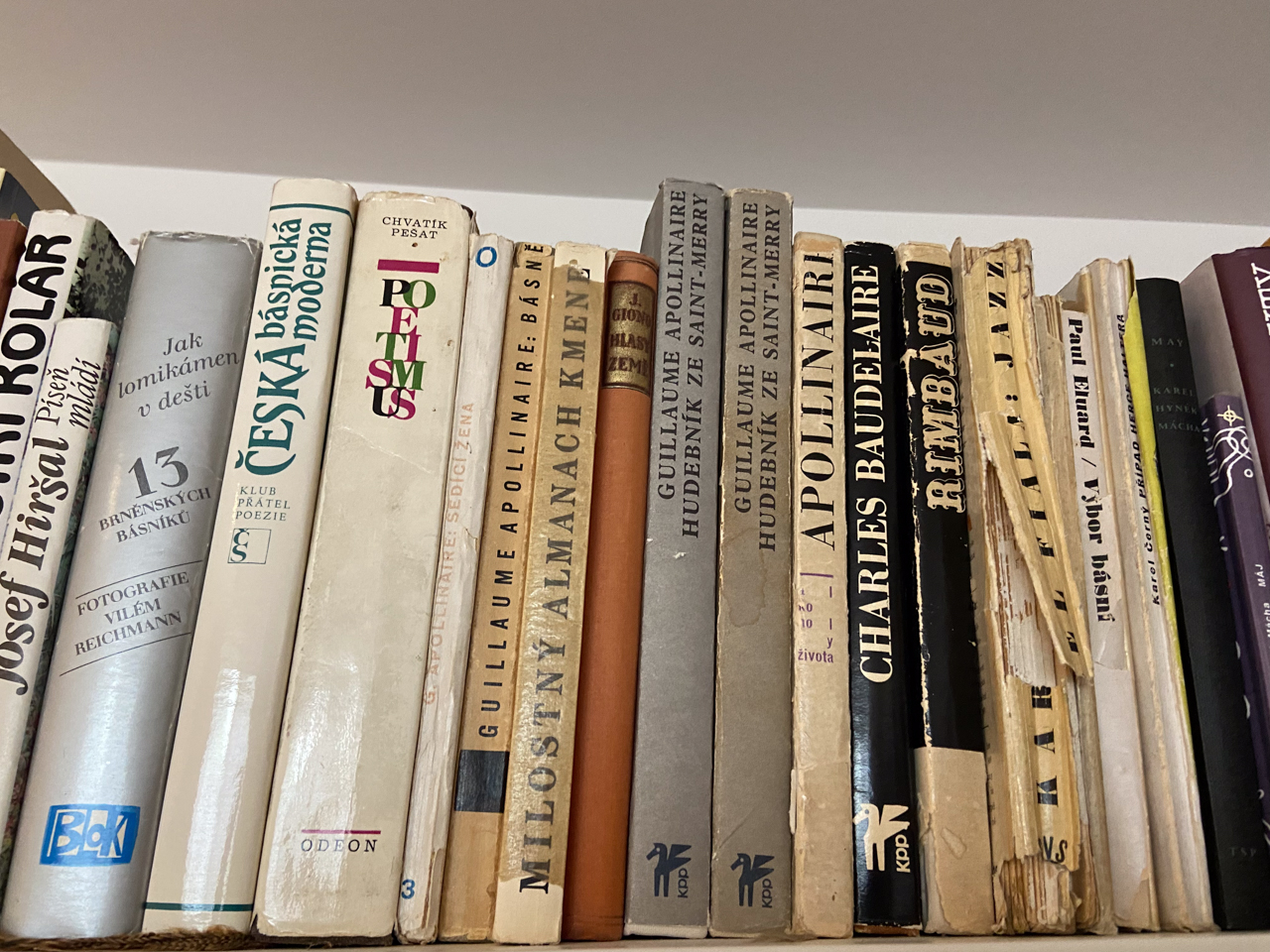
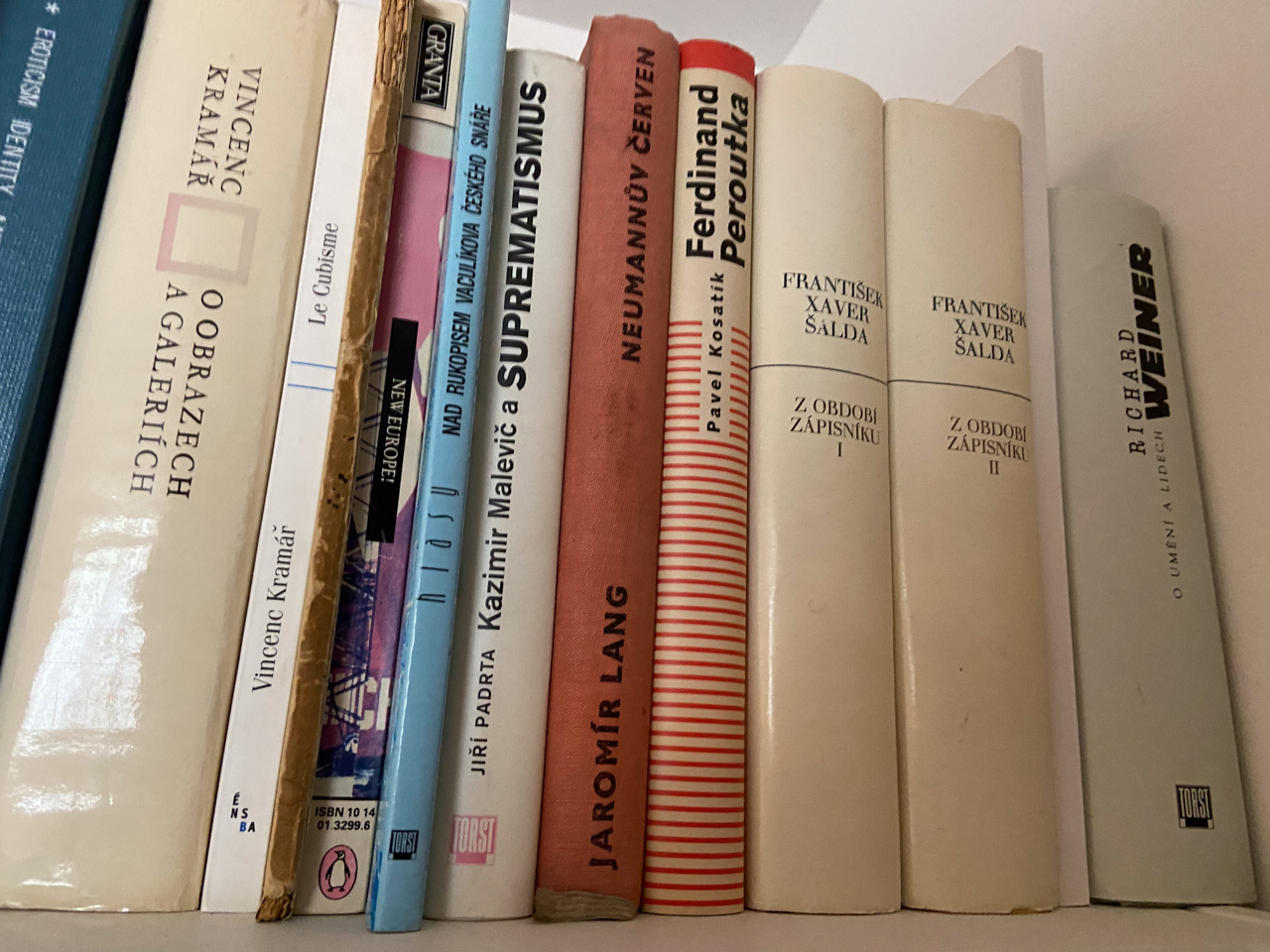
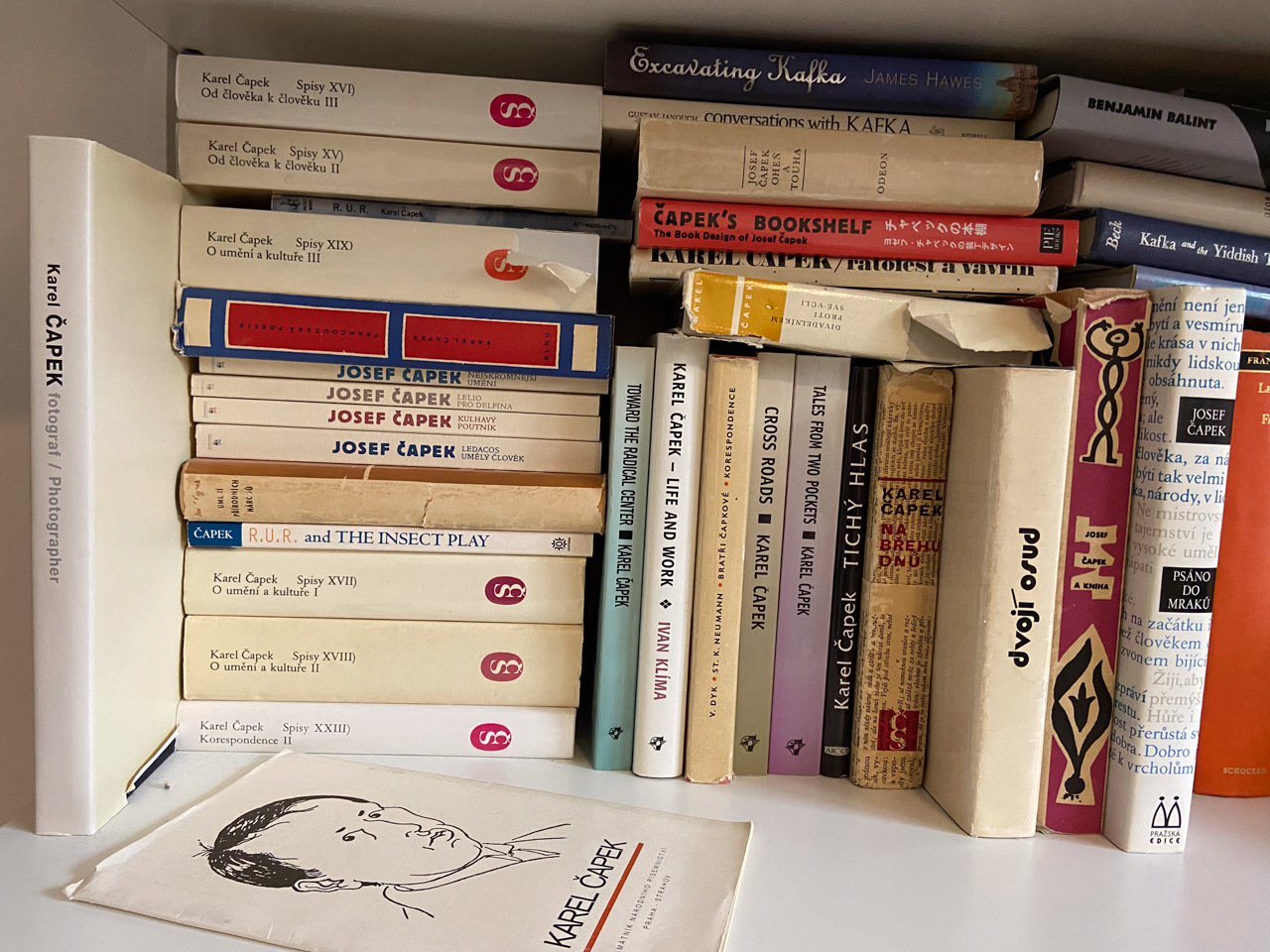
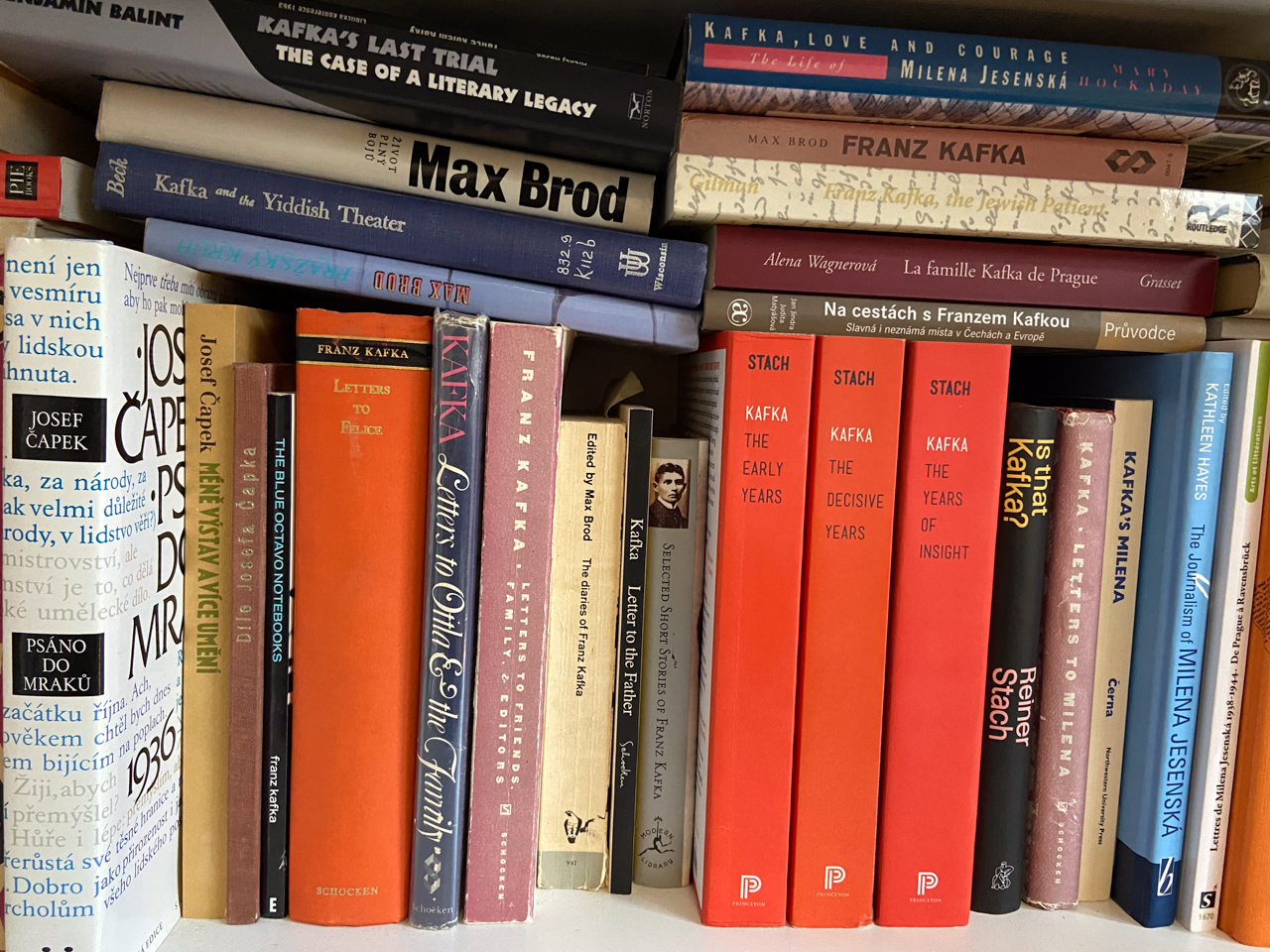
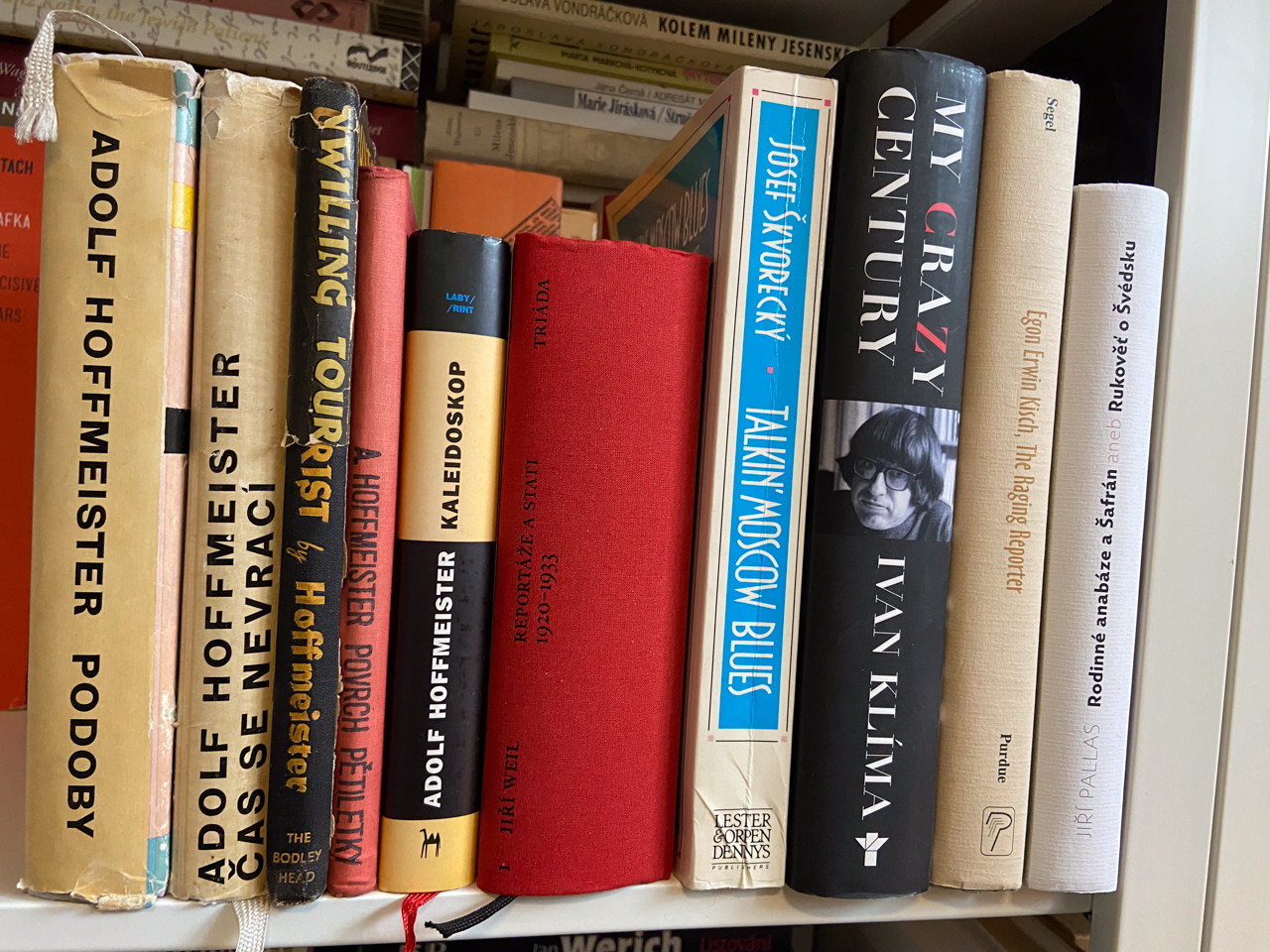
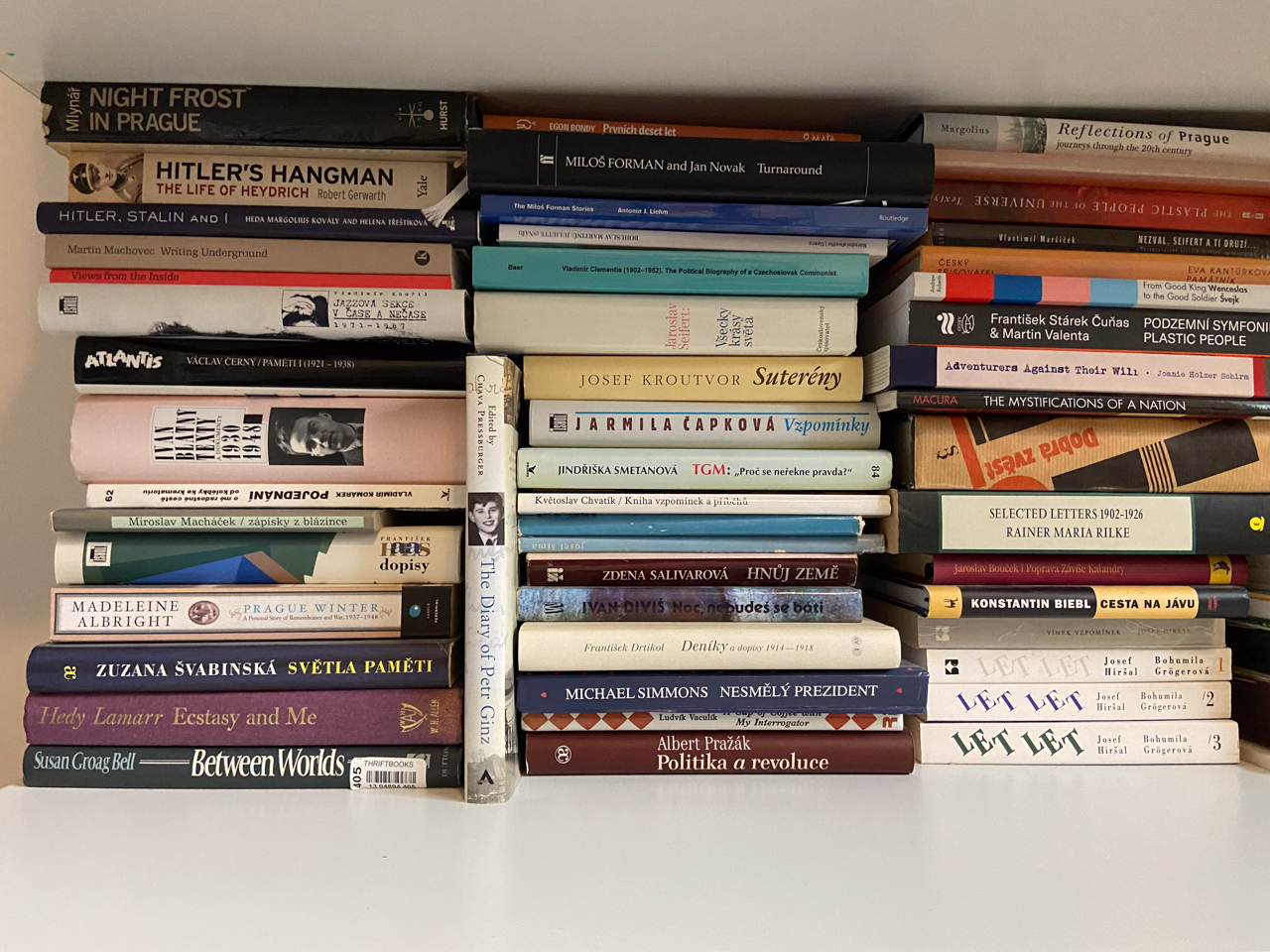
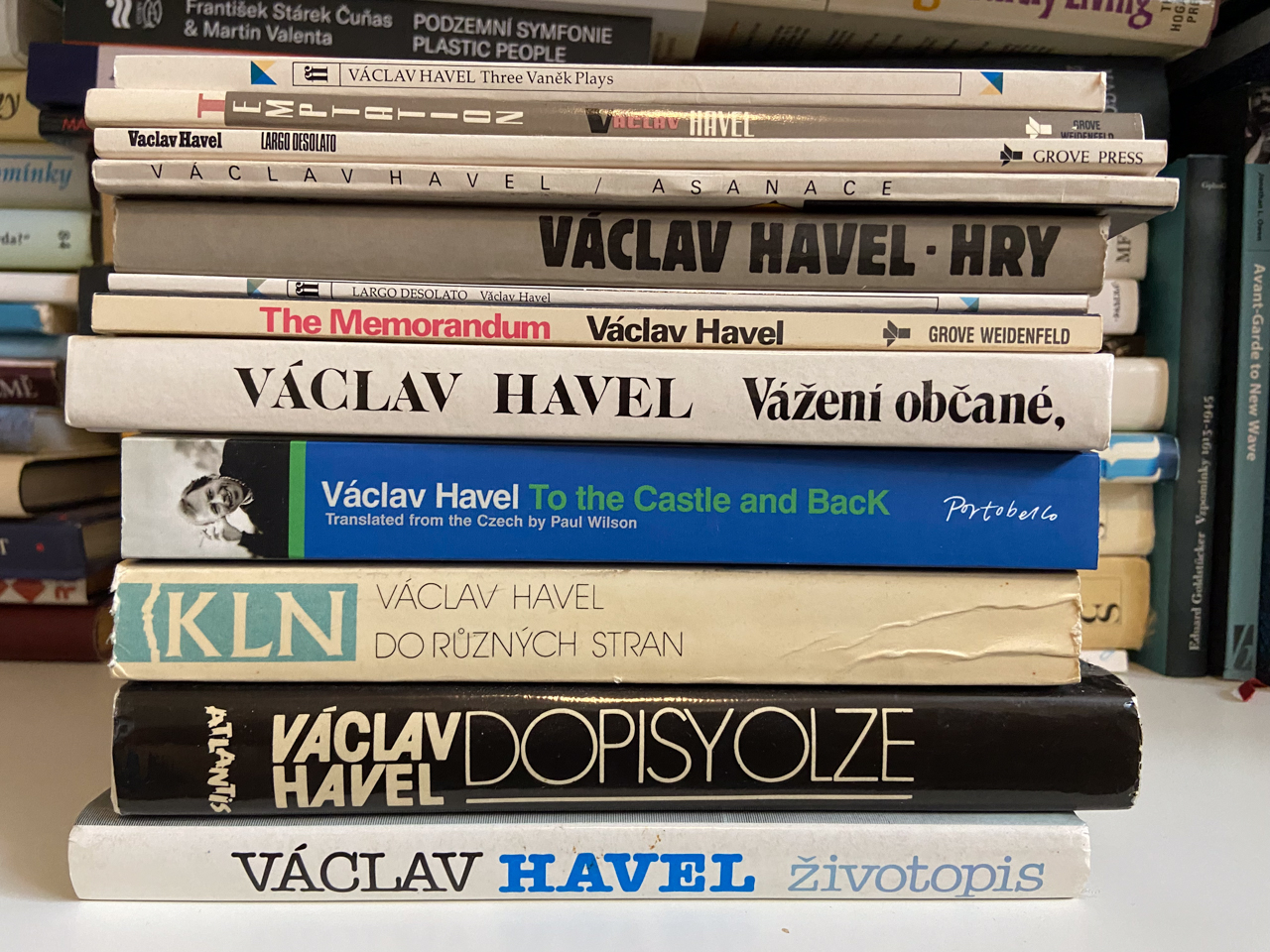
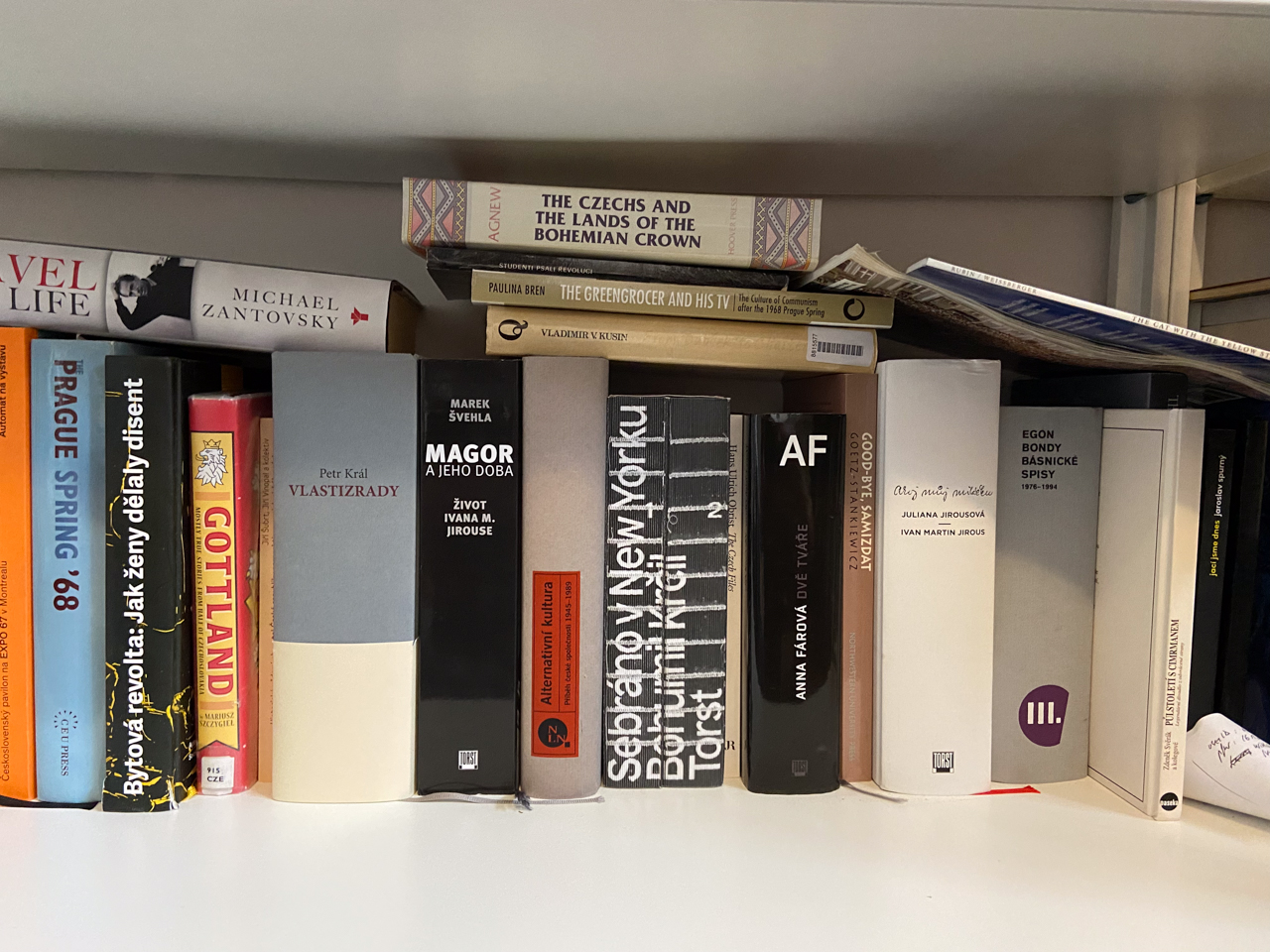
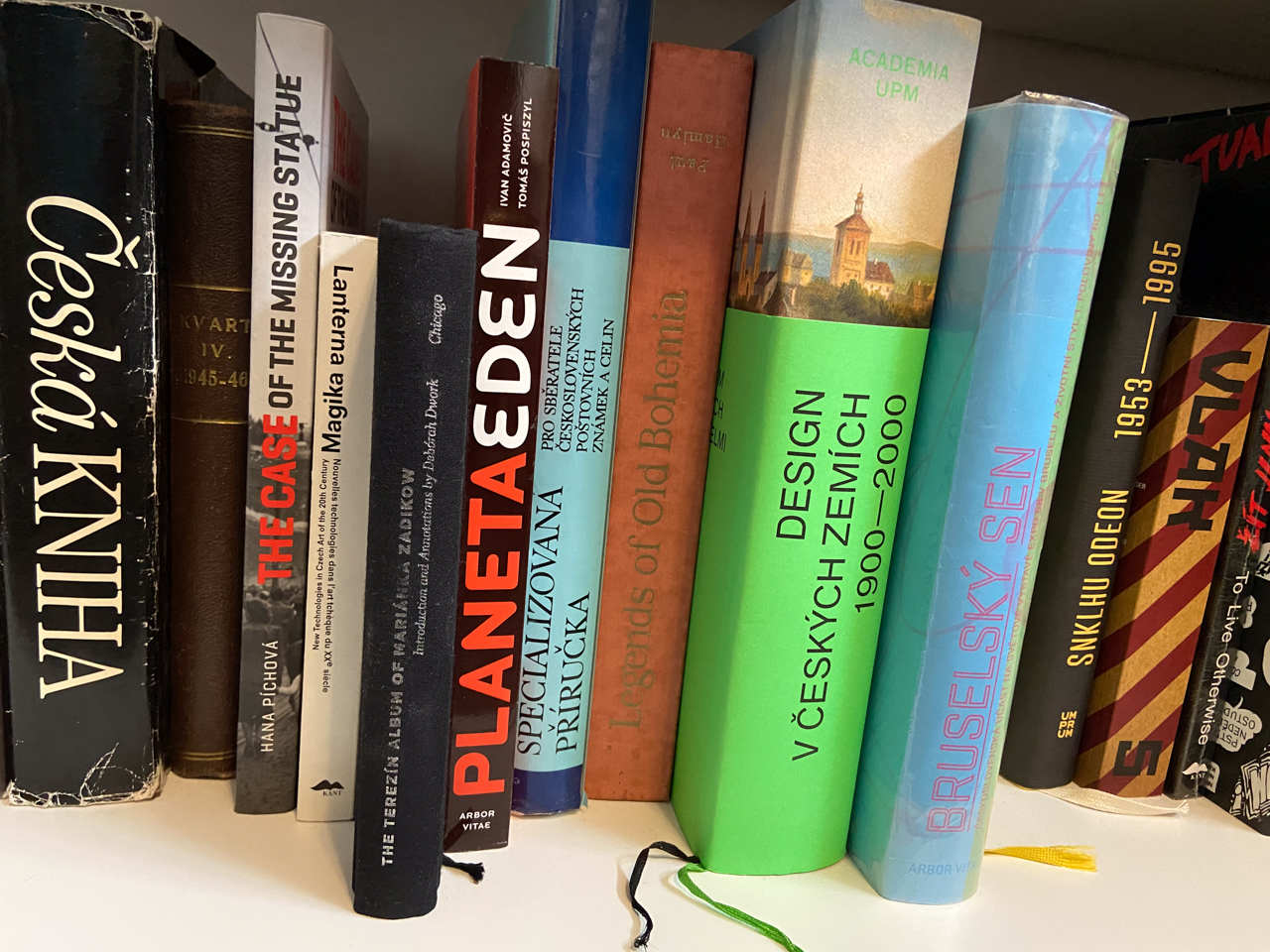
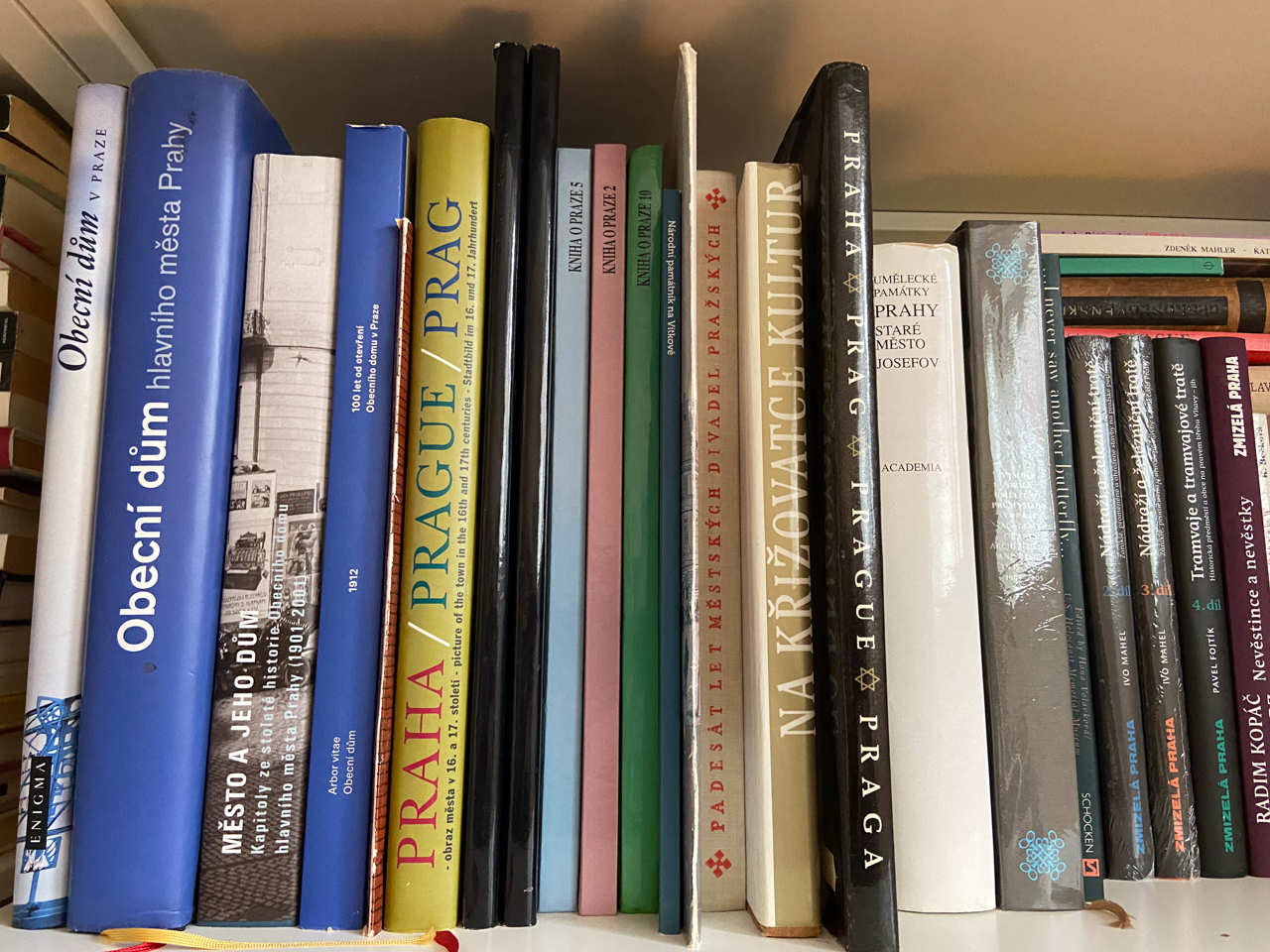
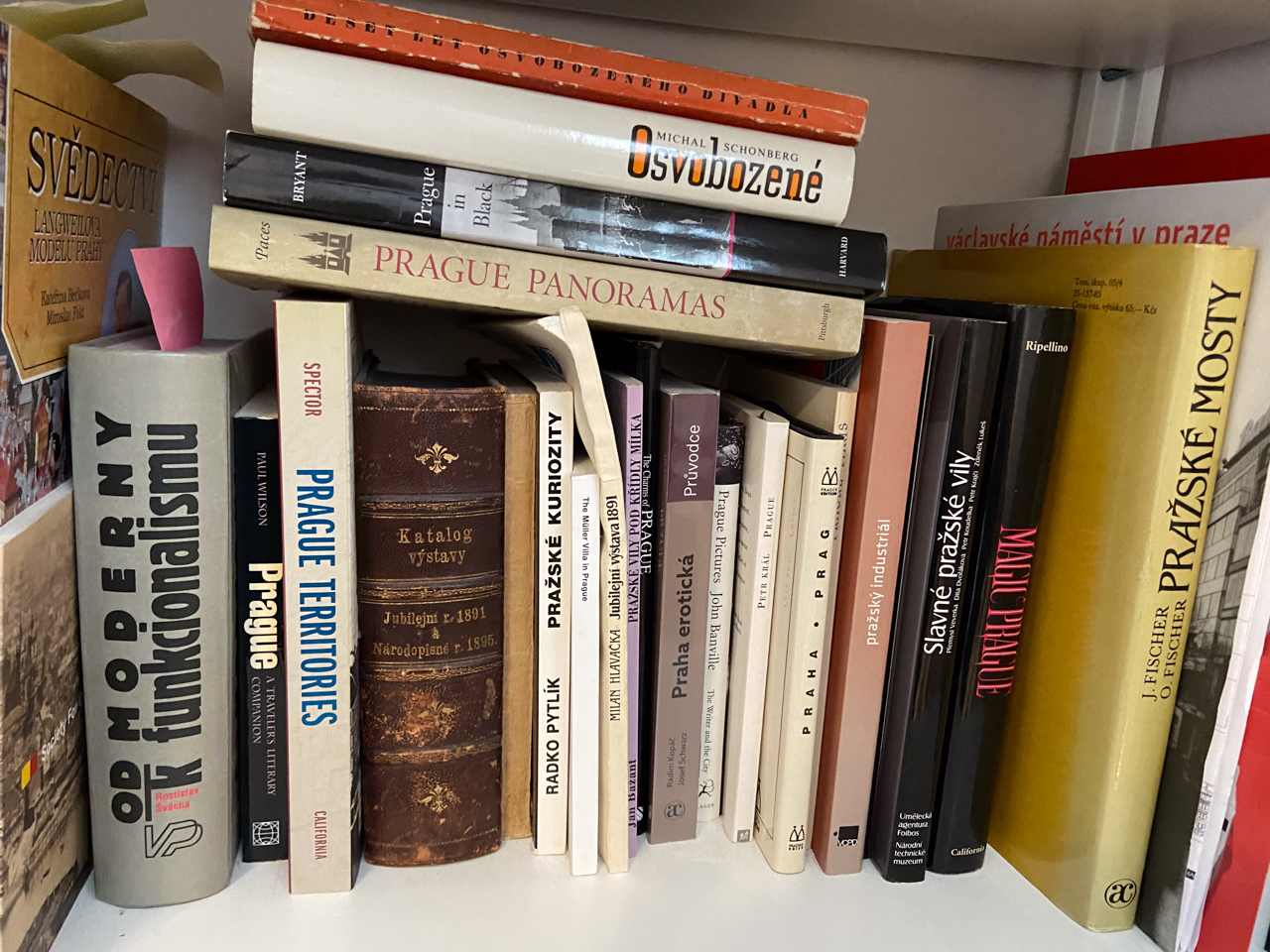
Over the last 25 years I have accumulated a large library of books relating to modern Czech cultural and political history and the city of Prague. These include works of literature (novels, plays, poems); anthologies of primary documents in art, architecture, film, etc.; biographies, memoirs and correspondence; art exhibition catalogues of various dates, covering many of the most significant 20th– and 21st–century exhibitions in Prague; works of reference; guidebooks and street directories; bound volumes of popular magazines; albums of historic photographs; and secondary works on history, politics, art, architecture, music, theater, film, and the city itself.
The photographs accompanying this post give an indication of the range of the collection, though not every individual item is included. There are around 1050 items in all. I have grouped them in galleries, each of which contains six photos. Click on the individual images to enlarge.
I am gratified that Postcards from Absurdistan: Prague at the End of History was chosen as one of three finalists for the Association of American Publishers PROSE Award for European History.
“The 2023 PROSE Award entries considered by our judges illustrate the wide breadth of excellence, diversity, and merit in scholarly works published today, in all areas of academic study,” commented Emily Bokelman, Manager, Member Programs, AAP. “Our 25-judge panel evaluated this year’s entries to select 105 titles as finalists, further naming 40 exceptional titles to be honored as Category Winners.”
I have recently published a short essay on the eventful life of the “Czech writer, publicist, dramatist, painter, illustrator, scenographer, caricaturist, translator, diplomat, lawyer, professor, and traveler” (as he is described in the Czech Wikipedia; French Wikipedia adds “and radio commentator”) Adolf Hoffmeister (1902–1973), known to his friends as Ada.
A central character in my book Postcards from Absurdistan: Prague at the End of History, Hoffmeister wrote the libretto for Hans Krása’s children’s opera Brundibár, which was staged 55 times in the notorious Terezín (Theresienstadt) ghetto during 1943-4 before the composer, the set designer František Zelenka, and most of the children in the cast were deported to Auschwitz and murdered.
I end the essay:
Hoffmeister died of a heart attack on July 24, 1973. His life was extraordinary, and yet it was thoroughly representative of Czechoslovakia’s twentieth century. Like countless other men and women—writers and politicians, architects and athletes, journalists and filmmakers, artists, musicians, and comedians—his story shows why Czech dissidents sardonically baptized their country Absurdistan. Biographies like Ada’s are why Prague provides a more revealing vantage point on the modern condition than the western capitals from which we are accustomed to look out, naively equating history with progress. Things look different when viewed from Central Europe. Prague’s modernity undermines easy distinctions between east and west, good and evil, right and wrong. Here, all choices come with costs, and the lines dividing collaboration and resistance, consent and dissent, dissolve into a blur of moral uncertainties. This is a landscape painted in infinite shades of gray. When authoritarianism is in the ascendant and democracy under global assault, we cannot afford to dismiss twentieth-century Czechoslovakia as a faraway country. Prague’s modern history should sound a warning to us all.





















 coasts of bohemia