Is Benjamin Netanyahu about to cross his Rubicon?

First published in Canadian Dimension March 14, 2024

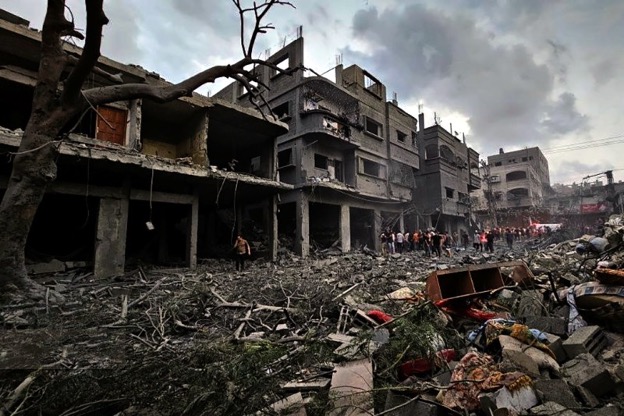
Palestinian children survey a series of destroyed apartment buildings in the northern Gaza Strip. Photo by Shareef Sarhan/United Nations/Flickr.

Seven weeks have now passed since the International Court of Justice (ICJ) in The Hague ruled that South Africa’s accusation that Israel was committing genocide in Gaza was “plausible.” A final verdict may take years. But on January 26, the ICJ imposed a number of “provisional measures” aimed at “preserving … the right of the Palestinians in Gaza to be protected from acts of genocide” (ICJ report, ¶59).

By a majority of 15 judges to two, the world’s highest court instructed Israel among other things to take “all measures within its power” to prevent:

(a) killing members of the group; (b) causing serious bodily or mental harm to members of the group; (c) deliberately inflicting on the group conditions of life calculated to bring about its physical destruction in whole or in part; and (d) imposing measures intended to prevent births within the group (¶78). 


Noting the “catastrophic humanitarian situation in the Gaza Strip” (¶72) in which “an unprecedented 93 percent of the population in Gaza is facing crisis levels of hunger” (¶48), the judges further ordered Israel to:

take immediate and effective measures to enable the provision of urgently needed basic services and humanitarian assistance to address the adverse conditions of life faced by Palestinians in the Gaza Strip (¶80). 


In this case, the majority was 16 to one, with even the judge Israel appointed as its representative for this case concurring.

As international human rights lawyer Akila Radhakrishnan observed, while the court did not mandate a ceasefire (it could hardly do so when it has no jurisdiction over Hamas as a non-state actor), it is difficult to see how these objectives could be achieved without Israel “halting or at least drastically curtailing its military operations.”

Responding to the ICJ judgment, Benjamin Netanyahu fumed that “the very claim that Israel is committing genocide against Palestinians is not just false, it is outrageous, and the court’s willingness to discuss it at all is a mark of disgrace that will not be erased for generations.” Other senior Israeli politicians dismissed not only South Africa’s charge of genocide but even the court itself as “antisemitic”—a term that is now bandied about so prodigally that it is in danger of losing all purchase on reality.

The carnage continues

Though ICJ rulings are supposed to be binding on all UN member states, Israel has to all intents and purposes ignored these orders and carried on its military campaign in Gaza regardless.

By March 11, the beginning of the Muslim holy month of Ramadan, the Palestinian death toll in Gaza had risen from the 25,700 cited in the ICJ report (¶46) to 31,112, with a further 72,760 wounded. These are confirmed deaths of named victims, compiled by Gaza’s health ministry. The IDF’s degradation of Gaza’s health services—as of March 9, Israeli forces had destroyed 155 health institutions and rendered 32 out of the strip’s 36 hospitals completely or partially out of service, killed over 400 health care workers, and abducted over 110 others—has made reliable death counts increasingly difficult, and the true figure is likely to be substantially higher.

If we include people missing and presumed buried under the rubble, the total rises to over 39,000. US Defense Secretary Lloyd Austin recently admitted that over 25,000 women and children alonehave been killed in Gaza since October 7. According to the UN, the Israeli offensive has killed more children (12,300) “in just four months of fighting than in four years of armed conflicts around the world combined.”

Genocide is not only measured in numbers of deaths but in the deliberate creation of “conditions of life calculated to bring about [the group’s] physical destruction in whole or in part.” As of March 5, Israeli actions had completely destroyed 106,000 Gazan homes and partially destroyed 250,900 others, as well as destroying or damaging 2,120 industrial facilities, 432 schools, 621 mosques, 279 health care facilities, and 175 press headquarters. In its determination to control the flow of information out of Gaza, the IDF had killed at least 95 journalists and media workers.

The Palestinian Ministry of Culture reports that out of 320 listed archaeological sites and buildings of cultural and historical significance, including old mosques, churches, cemeteries, museums, libraries, and archives, 207 have been reduced to rubble or severely damaged by Israeli strikes. Among them are the Orthodox Church of Saint Porphyrios, which is believed to be the world’s third oldest church; the 12th-century Great Omari Mosque, the Al-Qissariya medieval market, and over 140 other notable historic monuments in Gaza’s Old Town; and the Pasha’s Palace, which served as the governor’s residence during the Mamluk and Ottoman periods of Palestine’s history.

All of Gaza’s 12 universities have been destroyed. Al-Israa University in southern Gaza was blown up 70 days after the IDF had transformed it into a military barracks and later into a detention centre. Not content with wanton demolition of militarily insignificant but culturally pivotal buildings, “the Israeli army has targeted academic, scientific, and intellectual figures in the Strip in deliberate and specific air raids on their homes without prior notice,” killing 94 university professors as of January 20.

Others killed in IDF strikes include artists Muhammed Sami Qraiqea, Heba Zaqout, and Ali Nasman, poets Refaat Alareer, Hiba Abu Nada, and Muhamed Ahmed, writer Youssef Dawwas, novelist Nour Hajjej, and photographer Rushdi al-Sarraj. These are not mere collateral casualties of war. The material obliteration of the Gaza Strip is coupled with the systematic obliteration of Palestinian history and culture. Bodily and cultural genocide walk hand in hand.

Starvation as a weapon of war

An open letter issued by twelve prominent Israeli human rights organizations, which was reported in a Guardian exclusive on March 11, claims that “humanitarian aid to Gaza dropped by 50 percent in the month following the [ICJ] ruling.”

Since January 26, Israel has allowed protestors to block crossings to prevent food getting into the strip; withheld visas from vital UN and international aid agency personnel; denied, impeded, or postponed World Health Organization missions to supply medical essentials to Gaza’s devastated hospitals; and carried out the now infamous “flour massacre” in which IDF troops fired on a crowd awaiting a promised food delivery, killing over 100 Palestinians.

Faced with such sabotage of the ICJ order to “enable the provision of urgently needed basic services and humanitarian assistance,” Israel’s allies have hastily cobbled together other costly and inefficient alternative schemes to get aid to Gaza’s besieged and starving population. These range from parachuted air drops (which have already killed several Palestinian children) to a floating dock (which will take at least two months to build) to bring in supplies by sea from Cyprus.

An Israeli tank sits in a street surrounded by destroyed buildings in Gaza. Photo from Wikimedia Commons.

A rethink in the West?

While Israel continues to thumb its nose at the ICJ, the one-time united front of its Western backers has shown increasing signs of fracturing.

Most Western governments, including the government of Canada, initially downplayed the ICJ ruling—which I suspect surprised them by both its near-unanimity and its scope. In what looked suspiciously like a coordinated effort to distract from the ICJ bombshell, 16 Western countries ostentatiously demonstrated their support for Israel when the ruling was first announced by defunding UNRWA, the most important aid agency in Gaza, on the basis of unevidenced Israeli accusations that a dozen of its 13,000 personnel had been involved in Hamas’s October 7 attacks.

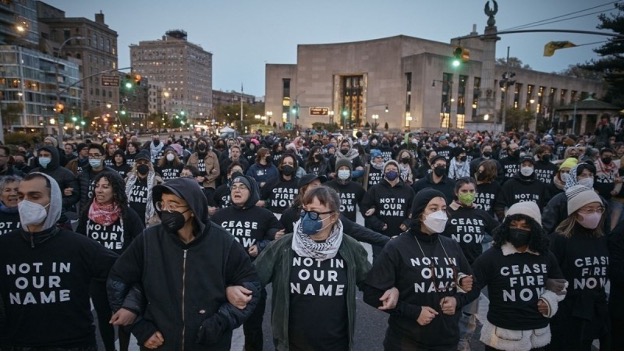
But as the death toll in Gaza continued to rise and domestic opposition grew throughout the West, second thoughts began to set in.

Belgium, Ireland, Luxembourg, Norway, Portugal, and Spain refused to join the UNRWA boycott. The Irish and Spanish prime ministers demanded that “the European Commission urgently review whether Israel is complying with its obligations to respect human rights in Gaza.” British, French, German, Australian, and Canadian foreign ministers voiced their newfound “concern” at civilian casualties.

Australia, Canada, and New Zealand issued a joint statement telling Israel that it “must listen to its friends and it must listen to the international community.” Belatedly pontificating that “Palestinian civilians cannot be made to pay the price of defeating Hamas”—as if they hadn’t been supporting Israel’s doing exactly that since October 7—Israel’s fellow settler-state Prime Ministers Anthony Albanese, Justin Trudeau, and Christopher Luxon reminded their errant ally that:

The International Court of Justice has been clear: Israel must ensure the delivery of basic services and essential humanitarian assistance and must protect civilians. The Court’s decisions on provisional measures are binding.


This latter point was one Mélanie Joly had conspicuously failed to make in her initial statement on the ICJ ruling, though on that occasion she did find space to reiterate that “Canada will continue to support Israel’s right to exist and defend itself.”

Canada, Sweden, and the EU Commission later quietly announced that they would be restoring their contributions to UNRWA.

And what of the US?

Speaking in Tel Aviv on February 7, Secretary of State Antony Blinken fired an opening shot over Israel’s bow, warning that “the daily toll that [Israel’s] military operations continue to take on innocent civilians remains too high.” The next day president Biden himself told journalists “I’m of the view, as you know, that the conduct of the [Israeli] response in the Gaza Strip has been over the top.”

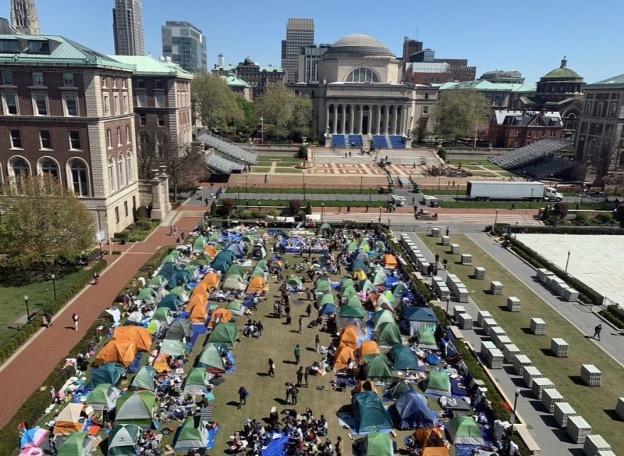
The unexpectedly large “uncommitted” vote in primaries in Michigan (13 percent), Minnesota (19 percent), and elsewhere, which resulted from a hastily organized campaign to register dissent at the Biden administration’s support for Israel’s military actions, seems to have concentrated Democrat minds wonderfully.

Congressman and Biden campaign surrogate Ro Khanna, who was long opposed to a ceasefire in Gaza, is now urging “if [Netanyahu] defies the United States, not allowing aid, or going into Rafah, [then] no more weapons transfers … unconditionally.”

Even Senate majority leader Chuck Schumer, whose Zionist credentials are unimpeachable, is now calling for new elections in Israel. Netanyahu, he says, has “has lost his way by allowing his political survival to take precedence over the best interests of Israel.” The current Israeli government “has been too willing to tolerate the civilian toll in Gaza, which is pushing support for Israel worldwide to historic lows. Israel cannot survive if it becomes a pariah.”

Talk of a “rift” between Netanyahu and Biden has led to speculation that Biden is contemplating cutting off further supplies of offensive weapons (though not the defensive Iron Dome) if Israel does not soon alter course (see CNNHaaretz and Politico).

Though Biden has still not committed to using America’s considerable leverage to pressure Israel into changing its policies, he did not pull any punches in his March 7 State of the Union address.

Thirty-two million viewers watched him put it on record that:

This war has taken a greater toll on innocent civilians than all previous wars in Gaza combined.

More than 30,000 Palestinians have been killed.

Most of whom are not Hamas.

Thousands and thousands are innocent women and children.

Girls and boys also orphaned.

Nearly 2 million more Palestinians under bombardment or displaced.

Homes destroyed, neighborhoods in rubble, cities in ruin.

Families without food, water, medicine.

It’s heartbreaking …


“Israel must allow more aid into Gaza and ensure that humanitarian workers aren’t caught in the crossfire,” the president went on. “Humanitarian assistance cannot be a secondary consideration or a bargaining chip. Protecting and saving innocent lives has to be a priority.”

We have come a long way from October 26, when Biden told reporters assembled in the White House rose garden: “I have no notion that the Palestinians are telling the truth about how many people are killed. I’m sure innocents have been killed, and it’s a price of waging war. But I have no confidence in the number that the Palestinians are using.” Where we are headed, on the other hand, still remains unclear.

Pro-Palestine rally in Columbus, Ohio. Photo by Becker1999/Wikimedia Commons.

At a crossroads

Facing down his critics, Benjamin Netanyahu continues to insist that Israel will fight on until “absolute victory” is achieved over Hamas. He is adamant that the IDF will invade Rafah, where one-and-a-half million “displaced” Palestinians have sought a last refuge, unmoved by German Foreign Minister Annalena Baerbock’s plea that “If the Israeli army were to launch an offensive on Rafah under these conditions, it would be a humanitarian catastrophe” or any other Western entreaties.

Rafah may prove to be Netanyahu’s Rubicon. Mounting an assault without first evacuating civilians would challenge the “red line” Biden laid down in an MSNBC interview after his State of the Union address, in which the American president told Israel that:

They cannot have 30,000 more Palestinians dead as a consequence of going after … there’s other ways to deal with the trauma caused by Hamas.


But if Netanyahu is facing his Rubicon, the West has finally arrived at its own moral crossroads.

After months of uncritical (and I would argue, unthinkingly racist) support for Israel’s assault on Gaza and weeks of equivocation as the magnitude of its inhumanity has become undeniable, there is still time to draw back from the abyss and defend the post-war rules-based international order whose highest legal authority is the ICJ.

“We find ourselves in an unprecedented situation,” writes Pankaj Mishra:

Never before have so many witnessed an industrial-scale slaughter in real time. Yet the prevailing callousness, timidity and censorship disallows, even mocks, our shock and grief. Many of us who have seen some of the images and videos coming out of Gaza—those visions from hell of corpses twisted together and buried in mass graves, the smaller corpses held by grieving parents, or laid on the ground in neat rows—have been quietly going mad over the last few months. Every day is poisoned by the awareness that while we go about our lives hundreds of ordinary people like ourselves are being murdered, or being forced to witness the murder of their children.


The West can end its complicity in what Naomi Klein, with a nod to Jonathan Glazer’s film The Zone of Interest, has called this “ambient genocide.” The film follows Auschwitz commandant Rudolf Höss’s everyday life with his wife and children in a stately home and lovingly-tended garden whose wall hides the sight, but not the sounds, of the extermination camp next door.

Glazer caused an uproar—and also garnered much applause—at this year’s Oscars when accepting the Academy Award for Best International Feature Film. He stated:

All our choices we made to reflect and confront us in the present. Not to say ‘look what they did then’—rather, ‘look what we do now.’ Our film shows where dehumanization leads at its worst. It shaped all of our past and present …

Right now, we stand here as men who refute their Jewishness and the Holocaust being hijacked by an occupation which has led to conflict for so many innocent people. Whether the victims of October 7 in Israel or the ongoing attack on Gaza—all the victims of this dehumanization, how do we resist?


Over to you, Mr Biden. Over to you, Messrs Joly, Hussen, and Trudeau. The choice is yours.

Closing in on a ‘final solution’ in Gaza?

First published Canadian Dimension March 26, 2024

Medic carrying a wounded Palestinian child in Gaza. Photo courtesy Fars Media Corporation/Wikimedia Commons.

On March 18, the world’s famine watchdog the Integrated Food Security Phase Classification (IPC), whose “main goal … is to provide decision-makers with a rigorous, evidence- and consensus-based analysis of food insecurity and acute malnutrition situations,” reported that:

The entire population in the Gaza Strip (2.23 million) is facing high levels of acute food insecurity. Between mid-March and mid-July, in the most likely scenario and under the assumption of an escalation of the conflict including a ground offensive in Rafah, half of the population of the Gaza Strip (1.11 million people) is expected to face catastrophic conditions (IPC Phase 5), the most severe level in the IPC Acute Food Insecurity scale …

It is vital to note that the projected Famine can be prevented or alleviated. All evidence points towards a major acceleration of death and malnutrition. The actions needed to prevent Famine require an immediate political decision for a ceasefire together with a significant and immediate increase in humanitarian and commercial access to the entire population of Gaza. All efforts must be made to ensure the provision of food, water, medicines, and protection of civilians, as well as to restore and provide health, water, and sanitation services, and energy (electricity, diesel, and other fuel).


The IPC’s warning and demand for a ceasefire were echoed by the World Health Organization, the UN Committee on the Rights of the ChildRefugees International, the International Rescue Committee (whose president, former UK Foreign Secretary David Miliband, called it “a failure of humanity”), and other NGOs. UN Secretary General António Guterres described the report as an “appalling indictment,” adding, “This is the highest number of people facing catastrophic hunger ever recorded by the Integrated Food Security Classification system—anywhere, anytime.” He continued:

I call on the Israeli authorities to ensure complete and unfettered access for humanitarian goods throughout Gaza and for the international community to fully support our humanitarian efforts. We must act now to prevent the unthinkable, the unacceptable and the unjustifiable.

The Israeli response

During the month after the International Court of Justice (ICJ) ruled that Israel must “take immediate and effective measures to enable the provision of urgently needed basic services and humanitarian assistance to address the adverse conditions of life faced by Palestinians in the Gaza Strip”—a 16-to-one decision in which the judge ad hoc appointed by Israel, Aharon Barak, concurred—aid deliveries to Gaza fell by a half. In February the number of aid trucks crossing into Gaza fell from an average of 170 per day in January to 98 per day. An average of 159 aid trucks per day crossed in the first 20 days of March, as compared with 500 a day before the war.

Responding to (since suspended) Israeli spokesman Eylon Levy’s outrageous claim that “there are NO limits on the entry of food, water, medicine, or shelter equipment into Gaza, and in fact the crossings have EXCESS capacity,” British Foreign Secretary David Cameron expressed his “enormous frustration” that UK aid has been routinely held up waiting for Israeli permissions:

For instance, I am aware of some UK-funded aid being stuck at the border just under three weeks waiting for approval. The main blockers remain arbitrary denials by the government of Israel and lengthy clearance procedures, including multiple screenings and narrow opening windows in daylight hours.


Trucks containing medical supplies have been turned back because they contain scissors, which could be used as weapons. Other items rejected as “dual use” include generators, tent poles, and pipes to restore water and sanitation infrastructure.

In David Miliband’s view, the key issues—on all of which Israel has been less than helpful—are the number of crossing points into Gaza, the number of trucks Israel allows through the crossings, what aid, above all food aid, the trucks are permitted to carry, and the transit of trucks inside Gaza, “so you’ve got a series of impediments, blockages, restrictions being put in place on lorries carrying the most basic humanitarian aid.”

Since the ICJ ruling, Israel has allowed protestors to repeatedly block the Kerem Shalom crossing into Gaza, at one point, grotesquely in the circumstances, with a gigantic bouncy castle; refused to renew visas of scores of senior and experienced international aid workers; and variously impededWHO missions to supply medical essentials to Gaza’s “overwhelmed and overflowing and undersupplied” hospitals (which the IDF continues to assault, the latest being al-Shifa, the strip’s largest hospital before the present conflict began).

Israel has denied many requests from UNRWA and other agencies to send aid convoys to the devastated north, which has the worst food security situation, two of them in the last week. It has killed Gazan police convoy escorts and assassinated Brigadier General Fayeq al-Mabhouh, the police commander in charge of coordinating relief distribution with UNRWA. In several cases, beginning with the “Flour Massacre” of February 29 in which over 100 Palestinians were killed, IDF troops have fired on civilians lining up for food.

Philippe Lazzarini, the head of UNRWA, is clear that “This is an artificially man-made situation that we can easily reverse if we want to. We know what needs to be done.” But Israel has declared war on UNRWA, which it has long sought to close down because it believes having a dedicated Palestinian refugee agency serves only to legitimate Palestinian grievances.

Israel’s claims that thirteen (out of 30,000) UNRWA employees were involved in Hamas’s October 7 attack and the agency is “perforated with Hamas”—which were presented, no doubt by pure coincidence, on the day the ICJ released its judgment on Israel’s “plausible genocide”—led 16 nations, including the US, UK, Germany, and Japan, to pause or strip funding from UNRWA. But Israel has so far failed to produce any convincing evidence to back up these allegations, and several states including Canada, Australia, and Sweden, as well as the EU commission, have since restored their funding.

On March 18, Philippe Lazzarini posted the following statement on X:

On the day new data is out on famine in #GAZA, the Israeli Authorities deny my entry to Gaza.

Famine is imminent in the northern Gaza Strip, expected to arrive between now and May. – Two million people= the entire population of Gaza is facing crisis levels of food insecurity or worse. – Half the population has completely exhausted food supplies and coping capacities. They are struggling with catastrophic hunger (IPC Phase 5) and starvation. – This is the highest number of people ever recorded as facing catastrophic hunger by the IPC system and double the number just three months ago. – Earlier, UNICEF warned that the # of children under two years old suffering from acute malnutrition has doubled in one month. – Children are now dying of dehydration & hunger.

@UNRWA has by far the largest presence among all humanitarian organisations in Gaza. My visit today was supposed to coordinate & improve the humanitarian response. This man-made starvation under our watch is a stain on our collective humanity. Too much time was wasted, all land crossings must open now. Famine can be averted with political will.

On March 24 Lazzarini had news of further devastating Israeli restrictions on UNRWA’s ability to provide aid to Gaza’s starving population:

Gaza: as of today, @UNRWA, the main lifeline for #Palestine Refugees, is denied from providing lifesaving assistance to northern Gaza. Despite the tragedy unfolding under our watch, the Israeli Authorities informed the UN that they will no longer approve any @UNRWA food convoys to the north. This is outrageous & makes it intentional to obstruct lifesaving assistance during a man made famine. These restrictions must be lifted. UNRWA is the largest organisation with the highest reach to displaced communities in Gaza. By preventing UNRWA to fulfill its mandate in Gaza, the clock will tick faster towards famine & many more will die of hunger, dehydration + lack of shelter. This cannot happen, it would only stain our collective humanity.

Israel seems to have taken the IPC warning of impending famine in Gaza as an invitation to bring it on.

The US response

Under pressure from foreign allies, who were beginning to get cold feet about supporting what the world’s highest court had determined is a plausible genocide, and rattled by discontent within his own party and from voters who checked the “uncommitted” box in Michigan, Minnesota, and elsewhere in Democratic primaries, Joe Biden adopted a sharper tone—though not much more—toward Israel in February, which culminated in his proclamation in his March 7 State of the Union address that:

Israel must allow more aid into Gaza and ensure that humanitarian workers aren’t caught in the crossfire. Humanitarian assistance cannot be a secondary consideration or a bargaining chip. Protecting and saving innocent lives has to be a priority. 


Asked in an interview the same evening whether Israel’s threatened invasion of Rafah, where over a million desperate Palestinians had taken refuge, would constitute a “red line,” Biden answered: “It is a red line, but I’m never going to leave Israel. The defense of Israel is still critical, so there’s no red line where I’m going to cut off all weapons so they don’t have the Iron Dome to protect them.”

He added: “But there’s redlines that if he [Netanyahu] crosses them … They cannot have 30,000 more Palestinians dead as a consequence of going after … there’s other ways to deal with the trauma caused by Hamas.” Some saw in this a hint that the US might condition future supplies of (at least) offensive weapons on Israel reining in its assault and allowing aid into Gaza.

One who explicitly suggested doing so was Chuck Schumer, the majority leader in the Senate and highest-ranking Jewish politician in the US. Rising in the Senate on March 14 to speak, he said, “for so many mainstream Jewish Americans—a silent majority—whose nuanced views on the matter have never been well represented in this country’s discussions about the war in Gaza,” he called for Israel to make “some significant course corrections”:

We should not let the complexities of this conflict stop us from stating the plain truth: Palestinian civilians do not deserve to suffer for the sins of Hamas, and Israel has a moral obligation to do better. The United States has an obligation to do better.

I believe the United States must provide robust humanitarian aid to Gaza, and pressure the Israelis to let more of it get through to the people who need it. 


He went on to argue that Israelis’ rejection of “the idea of Palestinian statehood and sovereignty … a negotiated two-state solution” was “a grave mistake”; denounced far-right Israeli ministers Itamar Ben Gvir and Bezalel Smotrich and the settler violence they have supported in the occupied territories; and charged that Netanyahu has “lost his way by allowing his political survival to take precedence over the best interests of Israel”:

He has put himself in coalition with far-right extremists like Ministers Smotrich and Ben Gvir, and as a result, he has been too willing to tolerate the civilian toll in Gaza, which is pushing support for Israel worldwide to historic lows. Israel cannot survive if it becomes a pariah.


He concluded:

The United States’ bond with Israel is unbreakable, but if extremists continue to unduly influence Israeli policy, then the Administration should use the tools at its disposal to make sure our support for Israel is aligned with our broader goal of achieving long-term peace and stability in the region.

The final solution?

Will there be any “significant course corrections”?

Canada, to its credit—even if the details remain murky—has announced that it is cutting off future arms supplies to Israel. This has provoked fury in Tel Aviv, leading Minister of Strategic Affairs Ron Dermer to fume: “you saw the Canadians announced no more arms sales, it’s going to be a badge of shame for Canada and it’s going to last for a really long time … That in Israel’s darkest moment they abandon it. That’s what they just did and frankly I think it’s shameful.”

This Canadian thinks otherwise: for the first time in a long while, I feel proud of my country. And I remember when Canada provided a haven for US draft dodgers during the Vietnam War; when Brian Mulroney faced down Margaret Thatcher at the 1986 Commonwealth Conference over sanctions against apartheid South Africa; and when Jean Chrétien refused to follow the US-led “coalition of the willing” into the mire of the Second Iraq War unless the invasion was authorized by the UN. When we had an independent foreign policy.

And the US? The omnibus 1.2 trillion dollar spending bill passed on March 22 and signed into law by Joe Biden suggests any course correction is at best cosmetic.

While the bill’s main purpose is to keep the US government funded through September, it bans all funding of UNRWA till at least 2025. Last year US contributions totaled $422 million, about 30 percent of UNRWA’s budget. This is a slap in the face to Canada and other countries that have resumed their contributions, but was greeted by Israeli Foreign Minister Israel Katz as a “historic ban” that “demonstrates what we knew all along: UNRWA is part of the problem and cannot be part of the solution.”

The bill also contains an odious provision cutting US aid to the Palestinian Authority if “the Palestinians initiate an International Criminal Court (ICC) judicially authorized investigation, or actively supports such an investigation, that subjects Israeli nationals to an investigation for alleged crimes against Palestinians.” So much for US respect for the rule of law.

In a remarkable speech to the House of Representatives opposing the bill—you can watch it here—Congresswoman Alexandra Ocasio Cortez for the first time declared Israel’s actions in Gaza to be a genocide. She was aware of the “gravity” of using this term (which she had hitherto avoided).

As we speak, in this moment, 1.1 million innocents in Gaza are at famine’s door. A famine that is being intentionally precipitated through the blocking of food and global humanitarian assistance by leaders in the Israeli government.

This is a mass starvation of people, engineered and orchestrated following the killing of another 30,000, 70 percent of whom were women and children killed.

There is hardly a single hospital left. And this was all accomplished, much of this accomplished, with U.S. resources and weapons. If you want to know what an unfolding genocide looks like, open your eyes. It looks like the forced famine of 1.1 million innocents. It looks like thousands of children eating grass as their bodies consume themselves, while trucks of food are slowed and halted just miles away. It looks like good and decent people who do nothing. Or too little. Too late.


Interviewed on March 24 on CNN, she defended her use of the term genocide, telling Jake Tapper “I believe we have crossed the threshold of intent.”

AOC is right. The impending famine in Gaza is the result of deliberate, conscious, informed choices, and nobody in the Israeli or American governments can be in any doubt as to where they are leading. We are on the threshold of a ‘final solution’ to the Palestinian problem. Ladies and gentlemen, this way for your ambient genocide.

Addendum

The Times of Israel (March 25) has just reported that “The US has deemed Israel to be in compliance with a new national security memorandum after it received a written assurance from Jerusalem that it is using American weapons in line with international law and is not blocking humanitarian assistance in Gaza.”

In the words of State Department spokesman Matthew Miller:

We’ve had ongoing assessments of Israel’s compliance with international humanitarian law. We have not found them to be in violation, either when it comes to the conduct of the war or the provision of humanitarian assistance. We view those assurances through that ongoing work we have done.


Had the US not certified this, the flow of American weapons to Israel would have had to stop.

As I said, choices are being made. The US choice remains to facilitate Israel’s genocide. 

Derek Sayer, March 25, 2024

Facts, fictions, and fabrications regarding Israel’s ‘Black Sabbath’

First published Canadian Dimension April 2, 2024 

Destruction in Gaza following an Israeli bombing raid. Photo courtesy Fars News Agency/Wikimedia Commons.

Red lines

In his State of the Union address, delivered on March 7, US President Joe Biden signaled an apparent shift in American policy toward the Gaza War—though so far, it has to be said, this has proved largely cosmetic.

Asked afterward by an MSNBC interviewer whether Israel’s threatened invasion of Rafah, where 1.5 million desperate Palestinians have taken refuge, would constitute a “red line,” Biden answered:

It is a red line, but I’m never going to leave Israel. The defense of Israel is still critical, so there’s no red line where I’m going to cut off all weapons so they don’t have the Iron Dome to protect them.


He then added:

But there’s redlines that if he [Benjamin Netanyahu] crosses them … They cannot have 30,000 more Palestinians dead as a consequence of going after … there’s other ways to deal with the trauma caused by Hamas. 


At the time, some interpreted this as a hint that Biden might condition the future supply of specifically offensive weapons on Israel’s reining in its assault.

Netanyahu’s response was defiant. “We’ll go there [Rafah],” he assured a Politico interviewer (and has repeated many times since):

We’re not going to leave them [Hamas]. You know, I have a red line. You know what the red line is? That October 7 doesn’t happen again. Never happens again.


A week later, stung among other things by Canada’s decision to suspend future arms sales to Israel, Netanyahu challenged “our friends in the international community”:

Is your memory so short? So quickly you forgot about October 7, the worst massacre committed against Jews since the Holocaust? So quickly you are ready to deny Israel the right to defend itself against the monsters of Hamas?


And so we return, as we always return, to October 7.

Hamas is ISIS

The events of October 7 are the alpha and omega of Israel’s representation of its assault on Gaza as “self-defense” against Hamas’s supposed “existential threat,” which Israel compares to ISIS and the Nazi Holocaust. 

Israel’s position can be summarized by saying that nothing Israel did to Palestinians before October 7 can possibly justify Hamas’s attack, whereas the horrors of that attack justify anything and everything Israel has done to Gaza since—or will do to Gaza in the future.

I have no wish to minimize the horrors Hamas perpetrated on October 7. But given what those horrors have been used to justify since—as of April 1, at least 32,845 Palestinians have been killed and 75,392 injured in pursuit Israel’s “absolute victory“—it is important to try to distinguish fact from fiction concerning “Black Sabbath.”

Netanyahu set out his stall on October 9:

We didn’t want this war.

It was forced upon us in the most brutal and savage way …

The savage attacks that Hamas perpetrated against innocent Israelis are mindboggling: slaughtering families in their homes, massacring hundreds of young people at an outdoor festival, kidnapping scores of women, children and elderly, even Holocaust survivors.

Hamas terrorists bound, burned and executed children.

They are savages.

Hamas is ISIS.

And just as the forces of civilization united to defeat ISIS, the forces of civilization must support Israel in defeating Hamas …


“We saw the wild animals,” he told his shaken compatriots in a televised address two days later:

We saw the barbarians we are facing. We saw a cruel enemy. An enemy worse than ISIS. We saw boys and girls, bound, shot in the head. Men and women burned alive. Young women raped and slaughtered. Fighters decapitated … In one place, they set fire to tires around them, and burned them alive.


Speaking on October 18 in Tel Aviv, which he was the first US president to visit in a time of war, Joe Biden echoed his host’s narrative:

More than 1,300 innocent Israelis killed, including at least 31 American citizens, by the terrorist group Hamas.

Hundreds—hundreds of young people at a music festival of—the festival was for peace—for peace—gunned down as they ran for their lives.

Scores of innocents—from infants to elderly grandparents, Israelis and Americans—taken hostage.

Children slaughtered. Babies slaughtered. Entire families massacred.

Rape, beheadings, bodies burned alive.

Hamas committed atrocities that recall the worst ravages of ISIS, unleashing pure unadulterated evil upon the world.

There is no rationalizing it, no excusing it. Period.


These are very serious accusations. The question is: how far are they warranted?

Imagined atrocities

On October 10 Israel announced that “more than 1,400 people” had been “killed by Hamas terrorists” in the October 7 attack. On November 10 the Israeli foreign ministry “updated” its estimate to “around 1,200 people.” The reason for the revision, said spokesman Lior Haiat, was that “there were a lot of corpses that were not identified and now we think those belong to terrorists … not Israeli casualties.”

That so many bodies were so badly burnt that it was difficult to establish who they were, let alone how they died, should have rung alarm bells, but it did not stop Haiat from baldly asserting (and Western media from mindlessly repeating) that “Hamas terrorists … brutally murdered about 1,200 people in cold blood.”

To this day, Western media reiterate again and again that “Some 1,200 people, mostly civilians, were killed in southern Israel during the Hamas-led incursion on Oct. 7.” It is not infrequently stated that “at least” or “more than” 1,200 were killed.

Yet a more authoritative and accurate count, compiled by Israel’s state social security agency Bituah Leumi and reported by Agence France-Presse (AFP) on December 15, has long been available to Western media. This gave a total of 1,139 deaths resulting from Hamas’s attack, of whom 695 were Israeli civilians, 373 were security forces, and 71 were foreigners. 

AFP reported a revised total based on new Israeli figures of 1163 on February 1, which included 20 hostages known to have died since in Gaza.

These figures conclusively debunk the tales of beheaded babies, babies baked in ovens, babies hung on clothes lines, babies ripped from their mothers’ wombs and stabbed, that were widely reported as fact in the Western press and propagated by politicians like Biden and US Secretary of State Anthony Blinken. Such stories did much to gain Israel support in the early weeks of its retaliatory assault on Gaza.

Golan Vach, head of the army’s search and rescue unit, related how he “personally” transported “a decapitated baby” found in its dead mother’s arms in Be’eri kibbutz. But only one baby appears in Bituah Leumi’s list of those killed in Be’eri, 10-month-old Mila Cohen, and she was shot (and not decapitated). The Israeli government claimed on October 10 that “forty babies” were murdered at Kfar Aza kibbutz, but Bituah Leumi lists 46 civilians killed at Kfar Aza in all, of whom the youngest was 14.

Full exposés of these and other fabrications can be found on The GrayzoneHaaretzMondoweiss, and Electronic Intifada websites, so I need not say any more here.

In fact, per Bituah Leumi’s figures, a total of 36 children were killed in Israel on October 7, twenty of whom were under 15 years old and ten of whom died in rocket attacks.  Only two of them were babies. Three children aged between two and six were killed in their home at Nir Oz kibbutz, and two brothers aged five and eight perished in their car with their parents when they drove into IDF–Hamas crossfire.

While all these deaths are to be mourned—as are those of 12,400 Palestinian children Israel killed between October 8 and February 20 in Gaza—they would seem to fall into the category of what Joe Biden, excusing the deaths of innocents in Gaza, called “a price of waging war” rather than recalling “the worst ravages of ISIS.”

Some might see Israel’s callously abandoning premature babies to die after the IDF assaulted Al-Nasr Children’s Hospital and forced medical staff to leave, on the other hand, as an unambiguous crime against humanity. We might also spare a thought for 12-year-old Sidra Hassouna, who was left hanging dead from a wall, ribbons of flesh all that was left of her legs after an earlier Israeli strike on Rafah.

Kibbutz Be’eri a few days after the Hamas attack of October 7. Photo by Micah Brickman/Wikimedia Commons.

Hasbara

One of the most creative purveyors of atrocity stories was Yossi Landau, southern commander of ZAKA, an Israeli religious voluntary organization that collects bodies and body parts from the sites of attacks and disasters.

ZAKA volunteers are often wrongly described in the Western media as “first responders,” but this is misleading. ZAKA’s concern is with proper burial of the dead according to Judaic ritual, and—crucially in this context—its volunteers have no forensics training. Indeed, they are actively hostile to the use of autopsies or other forensic procedures they regard as defiling the dead, even though these are often required to reliably establish the cause of a death (or physical evidence of a rape).

Landau is the sole source for a horrific story that went around the world, which Anthony Blinken repeated to the Senate Appropriations Committee on October 31:

A young boy and girl, six and eight years old, and their parents, around the breakfast table. The father, his eye gouged out in front of his kids. The mother’s breast cut off. The girl’s foot, amputated. The boy’s fingers cut off, before they were executed. And then their executioners sat down and had a meal. That’s what this society is dealing with, and no nation could tolerate that.


There is not a shred of corroborating evidence for this gruesome tale. And the Bituah Leumi list contains no siblings aged 6 to 8 recorded as killed in Be’eri.

An investigation published on January 31 in Haaretz details how “As part of the effort to get media exposure, Zaka spread accounts of atrocities that never happened, released sensitive and graphic photos, and acted unprofessionally on the ground.”

Since October 7 ZAKA has worked closely with the National Hasbara Headquarters in the Israeli prime minister’s office. Hasbara is a Hebrew term meaning “explanation,” or “public diplomacy,” but is more aptly translated here as government propaganda.

Meeting with ZAKA volunteers on November 23, Netanyahu told them:

These are powerful stories and we are in a major fight. This fight is not about to end at the moment … we need to buy time, which we also buy by turning to world leaders and to public opinion. You have an important role in influencing public opinion, which also influences leaders.

Demographics of the dead

The rhetoric of politicians and Western mainstream media has relentlessly sought to create the impression that the principal targets of Hamas’s attack were innocent, civilian victims—especially babies, children, women, and elderly people. Working from an earlier list of victims published by Haaretz on October 19, a report for Action on Armed Violence by Tamsin Westlake paints a significantly different picture.

“Of the total of 1,004 victims whose gender is identified, 735 (73.4 percent) … were male, and 278 (26.6 percent) female.” The gender imbalance was even more marked among victims belonging to the military (298 or 77.6 percent males, to 38 or 11.8 percent females) and police (86.44 percent males, 4.72 percent females).

The dead included 29 children under 18 and 57 people over the age of 61, who together formed less than seven percent of the total. By far the largest category of October 7 casualties fell into the 18–25 age group (447 people), followed by 26 to 40-year-olds (226 people).

This age and gender profile of victims is the exact opposite of what we would expect to find from listening to Netanyahu and Biden, reading the Daily Express or the New York Times, or watching ABC, BBC, CBC, or CNN.

The high number of 18- to 25-year-old victims includes many killed at the Nova music festival (332, a figure that was later revised upward to 364). But as Westlake points out, “One of the reasons the number of victims between 18-25 is large compared to the other categories is that most of the individuals in that age range were serving in the military—258 out of 447.”

While more civilians than military died on October 7, it is grossly misleading to say that the victims were “mostly civilians.” Per Bituah Leumi’s figures, one-third (32.75 percent) of the casualties were members of the IDF, police, or security guards. These were not “innocent civilians.” They were combatants.

Friendly fire

There can be no doubt that Hamas did murder large numbers of civilians in cold blood on October 7. Many were shot, often at close quarters. Some burned to death when Hamas fighters set fire to their homes to smoke them out of safe rooms. Others died when Hamas threw hand grenades into the bomb shelters in which they were hiding.

But there is also much to suggest that many civilian deaths, including at the Nova music festival and in Be’eri kibbutz—the sites of the worst casualty counts—resulted from IDF “friendly fire.” This has been well covered in MondoweissElectronic Intifada and Middle East Eye, so I shall give just a few examples here.

In Be’eri kibbutz, reported photographer Quique Kierszenbaum, “Building after building has been destroyed … walls reduced to concrete rubble from where Israeli tanks blasted the Hamas militants where they were hiding.” Tuval Escapa, a member of the Be’eri security team, told Haaretz that “the commanders in the field made difficult decisions—including shelling houses on their occupants in order to eliminate the terrorists along with the hostages.”

On being shown footage of the destruction at Be’eri and Kfar Aza for Al Jazeera’s excellent documentary October 7—the fullest and best-researched investigation to date—British military expert Chris Cobb-Smith concluded that “such catastrophic structural damage was clearly not caused by a structural collapse from a fire” and would have been “caused by some sort of heavy weapons system during combat.”

Hamas fighters only carried light weaponry—mainly assault rifles and rocket-propelled grenades (RPGs). This kind and scale of damage, as other analyses confirm, could only have been caused by fire from tanks, drones, or Apache helicopters, which only the IDF possessed.

The same applies to the large number of cars burnt out at the Nova music festival, which provided some of the most haunting images of the day’s horrors. As Jonathan Cook puts it, “The burnt cars piled up as a visual signifier of Hamas’ sadism are, in fact, evidence of, at best, Israel’s incompetence and, at worst, its savagery.”

Yasmin Porat’s testimony

Forty-four-year-old mother of three Yasmin Porat escaped the Nova festival with her partner to Be’eri kibbutz, only to be captured and held together with 11 other hostages in a house occupied by 40 Hamas fighters. “They treated us very humanely,” she says, “Because their objective was to kidnap us to Gaza. Not to murder us.”

After two hours Israeli security forces arrived. There was a fierce gun battle, during which one of the Hamas militants surrendered, taking Porat out of the house with him as a human shield.

Yasmin Porat: I see on the lawn, in the garden of the people from the kibbutz. There are five or six hostages lying on the ground outside, just like sheep to the slaughter, between the shooting of our [fighters] and the terrorists.

Aryeh Golan [interviewer]: The terrorists shot them?

Yasmin Porat: No, they were killed by the crossfire. Understand there was very, very heavy crossfire.

Aryeh Golan: So our forces may have shot them?

Yasmin Porat: Undoubtedly.


The fighting went on until 8:30, when:

They [i.e., the IDF] eliminated everyone, including the hostages. After insane crossfire, two tank shells were shot into the house … And at that moment everyone was killed. There was quiet, except for one survivor that came out of the garden, Hadas.


Porat’s account is corroborated by the other survivor, Hadas Dagan, as well as by Brig. Gen. Barak Hiram, who led the IDF forces. Hiram wanted the standoff resolved by nightfall. After the Hamas fighters fired an RPG, he ordered the tank commander: “The negotiations are over. Break in, even at the cost of civilian casualties.”

Liel Hetzroni

Among the victims were 12-year-old twins Liel and Yanai Hetzroni, whose screams for help, Dagan says, she will never forget.

A pretty little girl, Liel Hetzroni became a poster child for hasbara. On November 14, former Prime Minister Naftali Bennett tweeted:

12 year old Liel Hetzroni of Kibbutz Beeri was murdered in her home by Hamas monsters on Oct 7th. Her body has now been identified. Her brother and grandfather were also murdered. Look at her sweet smile. Liel harmed nobody. She was murdered just because she’s Jewish.


Bennett’s claim was repeated by the Jewish Chronicle and Lucy Manning of the BBC. Israeli news site Ynet reported that Hamas fighters “murdered them all. Afterwards, they set the house alight.”

The trigger-happy Brig. Gen. Barak Hiram, who gave the order that killed Liel and torched the house, was subsequently reprimanded for ordering the demolition of a building at Israa University in Gaza City without proper authorization. He is currently being considered for the post of Benjamin Netanyahu’s military secretary.

The fog of war

A detailed account of the events of October 7 by Israeli military correspondents Ronen Bergman and Yoav Zitun was published in the newspaper Yedioth Ahronoth’s weekend supplement 7 Days on 12 January 2024 and translated by Electronic Intifada on January 20. It makes uncomfortable reading:

On this Black Sabbath … some of the hardest, most embarrassing and infuriating chapters in the history of the army were also written. This includes a command chain that failed almost entirely and was entirely blindsided; orders to open fire on terrorist vehicles speeding towards Gaza even as there was a concern that they contained captives—some sort of renewed version of the Hannibal Directive; fighters who—due to lack of communications—had to direct aerial support using their cell phones … warplanes roaming the air in the critical moments of the attack without guidance … and even unmanned aircraft operators who had to join the kibbutz WhatsApp groups in order to let besieged civilians help them to build a list of targets. And everything was so crazy, chaotic, improvised, and haphazard that you have to read it to believe that this is what actually happened. 


At 8:10, with much of Israel’s observation and communications systems knocked out by Hamas, Zik UAV (drone) operators were told, “You have authority to fire at will.”

When at 8:30 the only two Apache helicopters then in the air in the Gaza envelope spotted “a tremendous river of human beings, flowing through the gaps [in the fence] toward the settlements of the south,” squadron commander Lt. Col. A ordered more helicopters to take off with the instruction “Shoot anyone who intrudes in our space, without [waiting for] authorization.”

“Twenty-eight fighter helicopters shot over the course of the day all of the ammunition in their bellies, in renewed runs to rearm,” wrote Zitun in an earlier article.

We are talking about hundreds of 30 millimeter cannon mortars (each mortar is like a hand grenade) and Hellfire missiles. The frequency of fire at the thousands of terrorists was enormous at the start, and only at a certain point did the pilots begin to slow their attacks and carefully choose the targets


It was difficult, if not impossible for drone operators or Apache pilots to distinguish between infiltrators from Gaza and civilians. One pilot confessed, “I find myself in a dilemma as to what to shoot at, because there are so many of them.”

A mass Hannibal

“At midday,” Bergman and Zitun claim, “the IDF instructed all its fighting units to perform the Hannibal Directive in practice, although it did so without stating that name explicitly.” First adopted in 1986, the Hannibal Directive says it is better that Israeli soldiers be killed than captured.

The instruction was to stop ‘at any cost’ any attempt by Hamas terrorists to return to Gaza … the primary goal was to stop the retreat of the Nukhba [Hamas] operatives. And if they took captives with them as hostages, then to do so even if this means the endangerment or harming of the lives of civilians in the region, including the captives themselves.


Reserve Israeli air force Lt. Col. Nof Erez described this in a Haaretz interview as a “mass Hannibal.”

In the area between the settlements and the fence, around 1000 bodies were later recovered along with 70 vehicles destroyed by fire from helicopters, tanks, or UAVs, in many cases incinerating all the occupants—whether intruders from Gaza or Israeli hostages being taken there.

It seems beyond reasonable doubt that a significant number of victims of Hamas’s October 7 attack were not “murdered in cold blood,” but killed by IDF friendly fire.

What is of particular importance here is not just their numbers—which we will never know for certain—but how they died.

Most of those who were burned to death—and especially those whose remains, like Liel Hetzroni’s, were so badly burnt as to be unrecognizable—are at least as likely to have been killed not by Hamas at all, but by fire from IDF tanks, helicopters, or drones.

It was exactly these that Israel utilized for the allegations of Hamas “burning people alive” that became such a central element of its narrative of Palestinian bestiality.

Sexual violence

If there is one issue that has swung support behind Israel as much as accusations of burning people alive, it is the claim that Hamas used rape as a weapon of war.

Establishing the truth, in this case, is far from easy. There is little or no visual or forensic evidence of systematic rape having occurred on October 7, and no rape survivors have come forward to tell their tales. This is perhaps not surprising, given that—in addition to the usual comprehensible reluctance of rape victims everywhere to come forward—victims in this case may not have survived but been murdered.

To date, there is only one first-person account from an Israeli woman who personally experienced sexual violence at the hands of Hamas. A released hostage, lawyer Amit Soussana, told the New York Times on March 26 that she had been compelled by her guard to perform an unspecified sex act on him while she was held captive in a Gaza apartment. Her account is certainly more than credible, but it does not speak to what happened in Israel under the very different circumstances of October 7.

The fullest (and most influential) coverage of the sexual violence allegations was in the New York Times feature “Screams without Words: How Hamas weaponized sexual violence on Oct. 7,” published on December 28 and credited to Jeffrey Gettleman, Anat Schwartz and Adam Sella. This extremely graphic account of horrific sexual violations and mutilations caused shockwaves, but it was soon widely challenged.

Among other problems, key testimonies upon which the more lurid sexual violence stories relied, including from Yossi Landau, have been debunked. The family of a supposed victim who was central to the Times story, Gal Abdush, denied that she was raped. The Israeli police have stated that they cannot locate any eyewitnesses of rape on October 7 or connect the Times testimonies with any independent evidence.

Most damningly, the main investigative reporter for “Screams without Words,” Anat Schwartz, an Israeli filmmaker and former air force intelligence official, had no prior reporting experience. She had also (inadvertently, she says) previously “liked” social media posts calling on Israel to “turn the strip into a slaughterhouse … Those in front of us are human animals who do not hesitate to violate minimal rules.”

Schwartz began her research, she says, by calling Israeli hospitals, rape crisis centers, trauma recovery facilities, and sex assault hotlines, but “She was told there had been no complaints made of sexual assaults” at any of them. “Did anyone call you? Did you hear anything?” she demanded of the manager of the South Israel sexual assault hotline, “How could it be that you didn’t?” She then called people at Be’eri and other kibbutzim targeted on October 7, with the same result. “Nothing. There was nothing. No one saw or heard anything.” It was only after hitting this brick wall that she turned to other sources, who like Landau were only too willing to talk.

Absence of reliable evidence of sexual violence on October 7, however, does not necessarily mean it did not occur. The most recent study, Pramila Patten’s report for the UN, concludes that:

there are reasonable grounds to believe that conflict-related sexual violence occurred during the 7 October attacks in multiple locations across Gaza periphery, including rape and gang rape, in at least three locations.


Though the methodological shortcomings and evidentiary deficiencies of the report (which Patten is aware of and acknowledges in the text) have been roundly critiqued, I believe this conclusion is not implausible—especially when we take into account the fact that thousands of armed and unarmed civilians flooded through the fence after it had been breached by Hamas’s elite Nukhba units. Rape is common in war, and Patten’s report provides sufficient reason to think that October 7 was no exception.

Patten goes on to say that her team were unable to establish “The overall magnitude, scope, and specific attribution of these violations”—i.e., whether to Hamas or others—which “would require a comprehensive investigation by competent bodies.” The case for systematic, mass rape by Hamas as a weapon of war remains unproven.

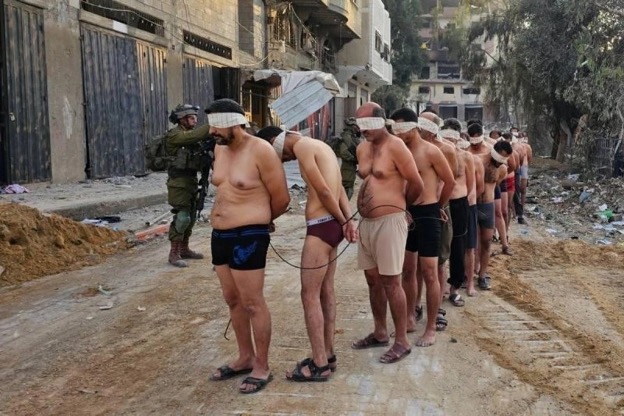
There are also many charges of sexual violence toward Palestinian detainees—many of whom are held without charge—in Israeli prisons, but these have received much less attention in the Western media. Both these and the accusations against Hamas urgently need independent investigation before any firm conclusions can be drawn.

Pure, unadulterated evil?

However many people died, Hamas’s October 7 attack on Israel was not in itself a war crime. The UN considers Gaza to have been occupied by Israel since 1967, and under international law occupied populations have the right to self-defense, including armed resistance. It is not against international law for resistance fighters to attack military targets, and some civilian deaths might be expected as collateral damage.

This is not to say that no war crimes were committed in the course of Hamas’s attack. The right to resist is “subject to the rules of international humanitarian law, including the respect of the principle of distinction between civilians and combatants.”

There is abundant evidence, not least from their own headcam and dashcam videos, that Hamas fighters deliberately massacred unarmed civilians. Members of other Palestinian militias and Gazan civilians who followed Hamas through the fence may also have perpetrated atrocities, including sexual violence. Hostage-taking is against international law (though Palestians would retort that Israel is holding thousands of their people hostage in its jails under “administrative law,” without charge or trial).

These were undoubted war crimes, whoever committed them, and need to be condemned as such.  If terrorism against civilians turns out to have been a deliberate strategy authorized by Hamas’s commanders, as distinct from acts of indiscipline by fighters or others on the ground, the ultimate responsibility lies with them.

Nevertheless, the narrative that Israel mobilized to cement global support for its retaliation in Gaza rested less on the war crimes that actually were committed on October 7 than the ones that weren’t. What we have seen is a triumph of hasbara.

Odious comparisons

After we discount the fabrications and correct for hasbara spin, what is left of the Israeli narrative of October 7?

Black Sabbath remains, in Joe Biden’s words, “the worst atrocity committed against the Jewish people in a single day since the Holocaust.” Whether it can reasonably be compared with the Holocaust—or in Netanyahu’s other favorite analogy, ISIS—in its brutality, its scale, or the actual threat it offers to Israel’s survival is another matter.

The Holocaust was an industrialized genocide, carried out over several years by a vast military and bureaucratic state apparatus, which killed six million Jewish civilians (and several million others). Hamas is a non-state actor, operating out of a besieged and blockaded territory, with limited resources and weaponry, facing a nuclear-armed state. To see these as in any way comparable as threats is palpably absurd. Hamas might wish to drive all Jews into the sea (though it is on record since 2017 as being open to a two-state solution on 1967 borders), but it lacks any capacity to do so.

Hamas committed undoubted war crimes on October 7. But nothing its fighters are so far proven to have done comes close to ISIS’s litany of “crimes of unspeakable cruelty … such as mass executions, sexual slavery, rape and other forms of sexual and gender-based violence, torture, mutilation, enlistment and forced recruitment of children and the persecution of ethnic and religious minorities, not to mention the wanton destruction of cultural property,” as listed by the International Criminal Court.

More to the point, perhaps, even if Hamas did commit every one of the ISIS-like atrocities of which it has been accused, this would not justify Israel’s collective punishment of Palestinian civilians in Gaza, either morally or in international law.

The comparison that needs to be made by the international community is rather with the infinitely greater horrors Israel has inflicted on Gaza since October 7, which its Black Sabbath narrative—a farrago of cherry-picked facts, half-truths, fabrications, and lies—has played an inordinate part in legitimating and enabling.

And the US?

In her report to the UN Human Rights Council titled “Anatomy of a Genocide,” issued on March 25, UN Special Rapporteur Francesca Albanese summarized these horrors:

After five months of military operations, Israel has destroyed Gaza. Over 30,000 Palestinians have been killed, including more than 13,000 children. Over 12,000 are presumed dead and 71,000 injured, many with life-changing mutilations. Seventy percent of residential areas have been destroyed. Eighty percent of the whole population has been forcibly displaced. Thousands of families have lost loved ones or have been wiped out. Many could not bury and mourn their relatives, forced instead to leave their bodies decomposing in homes, in the street or under the rubble. Thousands have been detained and systematically subjected to inhuman and degrading treatment. The incalculable collective trauma will be experienced for generations to come.


Albanese was, of course, immediately slandered by Matthew Miller, a spokesman for the US Department of State, as “antisemitic.”

Meantime, the Biden Administration quietly authorized a new $2.5 billion arms package to Israel including 1,800 MK84 2,000-pound bombs—one of which can demolish an entire city block, and which therefore “are almost never used anymore by Western militaries in densely populated locations due to the risk of civilian casualties.”

Some red line.

Israel’s human targeting software and the banality of evil

First published in Canadian Dimension April 18, 2024

Lavender fields near Hitchin, England. Photo by DeFacto/Wikimedia Commons.

Here’s the smell of the blood still. All the perfumes of Arabia will not sweeten this little hand.

—William Shakespeare, Macbeth, Act 5, Scene 1

Lavender

For some unknown, but no doubt morbidly humorous reason—the same sick humour, perhaps, that leads the Israel Defense Forces (IDF) to refer to their periodic punitive strikes on Gaza as “mowing the grass“—the IDF have decided that “Lavender” is an appropriate name for the artificial intelligence (AI) software they use to identify “human targets” in Gaza.

Since October 7, IDF strikes have killed at least 33,545 Palestinians including 8,400 women and over 13,000 children, injured another 76,049, and left 8,000 more missing, presumed buried under the rubble. The blitzkrieg has destroyed over 60 percent of Gaza’s housing stock, made two million people homeless, and left most of the strip uninhabitable.

Israel’s supporters deny that this bombing has been “indiscriminate” (as Joe Biden himself recently called it). They are right. It is worse. Seldom in the history of human conflict have so many bombs been so deliberately aimed at targeted individuals.

The great science fiction fear has always been of AI escaping human control and the machines taking over, as in The Matrix films. The story of Lavender suggests, on the contrary, that the real danger arises when the awesome data-crunching capacities of AI are put in the hands of human beings.

The Lavender software

On April 3 the Israeli–Palestinian magazine +972 published an explosive article by journalist and filmmaker Yuval Abraham on the IDF’s use of the Lavender software, based on interviews with six Israeli intelligence officers, all of whom have served in Gaza during the current campaign. The story was shared with the Guardian, who ran it as an exclusive the same day, and was picked up by the Washington Post (April 5) and subsequently discussed in an opinion column in the New York Times (April 10).

Though CBC Radio’s daily podcast Front Burner carried a 30-minute interview with Yuval Abraham on April 8, the Lavender revelations have gained little traction in the mainstream media. They have been crowded out in the din of swiftly moving events—the continuing political fallout from the IDF’s killing of seven World Central Kitchen aid workers on April 1 that brought the number of humanitarian personnel killed in Gaza to at least 224, an attack that became newsworthy only because six of the victims were Westerners; and more recently, Iran’s missile and drone attack on military bases in Israel on April 13 in retaliation for Israel’s bombing of its embassy in Damascus. This is unfortunate, because Lavender in many ways encapsulates all that is most chilling about Israel’s genocidal treatment of Palestinian civilians in Gaza.

“The Lavender software,” says Yuval Abraham, “analyzes information collected on most of the 2.3 million residents of the Gaza Strip through a system of mass surveillance, then assesses and ranks the likelihood that each particular person is active in the military wing of Hamas or PIJ [Palestinian Islamic Jihad]” on a scale of 1–100.

Mining data culled from a multiplicity of sources, it reaches its conclusions in much the same way as Amazon’s algorithm decides that given my demographic and my fondness for Bob Dylan’s Blonde on Blonde and the Rolling Stones’ Exile on Main Street, I must be a fan of the Beatles and the Beach Boys. How could Amazon’s algorithm possibly know that my idea of hell is being forced to listen to Pet Sounds and Sergeant Pepper’s Lonely Hearts Club Band for all eternity?

“Characteristics of known Hamas and PIJ operatives” are fed into the machine as training data, against which the general population is then compared. Features that can increase an individual’s rating include “being in a WhatsApp group with a known militant, changing cell phone every few months, and changing addresses frequently.”

“An individual found to have several different incriminating features will reach a high rating,” Abraham explains, “and thus automatically becomes a potential target for assassination.”

“The system … is known to occasionally mark individuals who have merely a loose connection to militant groups, or no connection at all,” but is reckoned to be accurate nine times out of ten on the basis of a sample manual check on several hundred Lavender-generated targets carried out at the beginning of the war.

A common error occurred, however, “if the [Hamas] target gave [his phone] to his son, his older brother, or just a random man. That person will be bombed in his house with his family. This happened often,” admitted one source.

From database to kill list

Prior to October 7, IDF policy restricted the category of “human target” to “a senior military operative who, according to the rules of the military’s International Law Department, can be killed in their private home even if there are civilians around.” This was to ensure adherence to the principle of proportionality under international law, which measures the acceptability of civilian casualties (so-called collateral damage) relative to the military advantage to be gained from the strike.

Killing human targets while they are at home often inevitably takes out other family members, including children. For that reason, the IDF’s human targets were very carefully—and always manually—vetted by intelligence officers, and they never numbered more than “a few dozen.”

But after October 7, “the army decided to designate all operatives of Hamas’ military wing as human targets, regardless of their rank or military importance. And that,” says Abraham, “changed everything.” What started as a database morphed into a kill list.

Under constant pressure from above to generate “more targets for assassination,” says officer B., the senior source interviewed by Abraham, “We attacked at a lower threshold”:

the numbers changed all the time, because it depends on where you set the bar of what a Hamas operative is. There were times when a Hamas operative was defined more broadly, and then the machine started bringing us all kinds of civil defense personnel, police officers, on whom it would be a shame to waste bombs. They help the Hamas government, but they don’t really endanger soldiers.


“Training the system based on [the latter’s] communication profiles made Lavender more likely to select civilians by mistake when its algorithms were applied to the general population,” says another of Abraham’s intelligence officers, resulting in its “including many people with a civilian communication profile as potential targets.”

On this basis the Lavender database “marked some 37,000 Palestinians as suspected ‘Hamas militants,’ most of them junior, for assassination”:

if Lavender decided an individual was a militant in Hamas, they were essentially asked to treat that as an order, with no requirement to independently check why the machine made that choice or to examine the raw intelligence data on which it is based.

Twenty-second verifications

While the IDF claims that “analysts must conduct independent examinations, in which they verify that the identified targets meet the relevant definitions in accordance with international law and additional restrictions stipulated in the IDF directives,” officer B. tells another story:

At 5 a.m., [the air force] would come and bomb all the houses that we had marked. We took out thousands of people. We didn’t go through them one by one—we put everything into automated systems, and as soon as one of [the marked individuals] was at home, he immediately became a target. We bombed him and his house.”


“At first,” B. said, “we did checks to ensure that the machine didn’t get confused. But at some point we relied on the automatic system, and we only checked that [the target] was a man—that was enough … I would invest 20 seconds for each target at this stage, and do dozens of them every day.” Ensuring the exclusion of women was not out of chivalry, but because women do not serve in Hamas’s military.

Another source, defending the use of Lavender, argued that “when it comes to a junior militant, you don’t want to invest manpower and time in it … So you’re willing to take the margin of error of using artificial intelligence, risking collateral damage and civilians dying, and risking attacking by mistake, and to live with it.”

“Everything was statistical, everything was neat—it was very dry,” said B. The Israeli military “essentially treated the outputs of the AI machine ‘as if it were a human decision,’” substituting the one for the other.

Palestinians inspect the ruins of Watan Tower destroyed in Israeli airstrikes in Gaza City, on October 8, 2023. Photo by Naaman Omar/Wikimedia Commons.

Where’s Daddy?

The extraordinarily high casualty rate from bombing, both in absolute terms and in relation to other recent conflicts like the Ukraine War, especially during the early stages of Israel’s bombardment, was a direct result of the application of Lavender.

When combined with two other AI programs, “Gospel” (which located buildings associated with Hamas operations) and the cutely-named “Where’s Daddy?” (which tracked individuals’ movements in real time), the whereabouts of those on the Lavender-generated kill list could be determined with a lethal degree of accuracy.

While the IDF claims that “analysts must conduct independent examinations, in which they verify that the identified targets meet the relevant definitions in accordance with international law and additional restrictions stipulated in the IDF directives,” officer B. tells another story:

“We were not interested in killing [Hamas] operatives only when they were in a military building or engaged in a military activity,” said A., an intelligence officer. “On the contrary, the IDF bombed them in homes without hesitation, as a first option. It’s much easier to bomb a family’s home. The system is built to look for them in these situations.”

By adding a name from the Lavender-generated lists to the Where’s Daddy? home tracking system, A. explained, the marked person would be placed under ongoing surveillance, and could be attacked as soon as they set foot in their home, collapsing the house on everyone inside …


Eventually everyone on Lavender’s list was entered into the Where’s Daddy? tracking program.

“You put hundreds [of targets] into the system and wait to see who you can kill,” explained another source. “It’s called broad hunting: you copy-paste from the lists that the target system produces.” “Even if an attack is averted,” adds officer C., “you don’t care—you immediately move on to the next target. Because of the system, the targets never end. You have another 36,000 waiting.”

In the first 45 days of bombing, at least 6,120 of the 11,078 reported Palestinian deaths in Gaza came from just 825 families. Many entire families were wiped out in single strikes. Among several cases documented by Amnesty International early on in the war:

On 10 October, an Israeli air strike on a family home killed 12 members of the Hijazi family and four of their neighbours, in Gaza City’s al-Sahaba Street. Three children were among those killed. The Israeli military stated that they struck Hamas targets in the area but gave no further information and did not provide any evidence of the presence of military targets. Amnesty International’s research has found no evidence of military targets in the area at the time of the attack.

Amnesty International spoke to Kamal Hijazi, who lost his sister, his two brothers and their wives, five nieces and nephews, and two cousins in the attack. He said: “Our family home, a three-storey house, was bombed at 5:15 pm. It was sudden, without any warning; that is why everyone was at home.”

Collateral damage degrees and dumb bombs

The likelihood of Lavender-directed strikes producing inordinately high civilian casualties was compounded by two further factors.

First, the thresholds for acceptable collateral damage were raised early in the war. From a situation in which at most a few dozen senior Hamas operatives were marked as human targets and the probability of attendant civilian casualties was manually assessed and decisions made on a case-by-case basis, the army decided that “for every junior Hamas operative that Lavender marked it was permissible to kill up to 15 or 20 civilians.”

Strikes were authorized on the basis of a “predetermined and fixed collateral damage degree” (as the ratio of civilians killed relative to targets was called). In the case of a battalion or brigade commander, “the army on several occasions authorized the killing of more than 100 civilians.” Abraham’s article documents several such mass killings.

Second—in sharp contrast to the high precision weaponry Israel used to take out senior figures in of the Islamic Revolutionary Guard Corps (IRGC) in its April 1 attack on the Iranian embassy in Damascus—the IDF’s preferred munitions for assassinating low-level Hamas targets identified by Lavender have been so-called “dumb bombs,” which collapse entire buildings on their occupants. The reasoning is impeccable:

“You don’t want to waste expensive bombs on unimportant people—it’s very expensive for the country and there’s a shortage [of those bombs],” said C., one of the intelligence officers. Another source said that they had personally authorized the bombing of “hundreds” of private homes of alleged junior operatives marked by Lavender, with many of these attacks killing civilians and entire families as “collateral damage.”


“In practice,” said source officer A., “the principle of proportionality did not exist.”

Without regard for persons

A century ago, the great German sociologist Max Weber argued that in contrast to systems of authority in pre-modern societies, modern state bureaucracies—of which the army is an extreme example—operate “without regard for persons.” “Modern loyalty,” he says, “does not establish loyalty to a person, like the vassal’s or disciple’s faith in feudal or in patrimonial relations of authority. Modern loyalty is devoted to impersonal and functional purposes.”

“The more the bureaucracy is ‘dehumanized,’” he explains, “the more completely it succeeds in eliminating from official business love, hatred, and all purely personal, irrational and emotional elements which escape calculation,” the more efficient its operations will be. If this sounds soulless, it is.

But paradoxically, the functioning of this thoroughly amoral machine rests, rather paradoxically, on a specific moralization of the individual’s relation to it. In Weber’s words:

the honor of the civil servant is vested in his ability to execute conscientiously the order of the superior authorities, exactly as if the order agreed with his own convictions. This holds even if the order appears wrong to him and if, despite the civil servants’ remonstrances, the authority insists on the order … without this moral discipline and self-denial, in the highest sense, the whole apparatus would fall to pieces.


It was precisely the moral imperative of following orders in the name of duty, with the concomitant abnegation of individual responsibility, that was repeatedly appealed to by defendants (and rejected by the court) at the Nuremberg trials. Hannah Arendt, discussing the trial of Adolf Eichmann, famously described this as “the fearsome, word-and-thought-defying banality of evil.”

Zygmunt Bauman extends this line of analysis in his classic Modernity and the Holocaust—a work not much liked in Israel—in which he argues that “The light shed by the Holocaust on our knowledge of bureaucratic rationality is at its most dazzling once we realize the extent to which the very idea of the Endlosung [Final Solution] was an outcome of the bureaucratic culture.”

Lavender takes this abnegation of personal responsibility—in this case, for thousands of innocent deaths—demanded by bureaucratic organization a quantum leap further, outsourcing moral judgment to a literal machine. Automation of the selection of “human targets” relieves the burden of responsibility—and guilt.

For me, the most chilling admission in Abraham’s article came from his most senior source, officer B.

There’s something about the statistical approach that sets you to a certain norm and standard … And I have much more trust in a statistical mechanism than a soldier who lost a friend two days ago. Everyone there, including me, lost people on October 7. The machine did it coldly. And that made it easier.


There has been much comment on the left, rightly, on how integral dehumanization of Palestinians—“human animals,” according to Israeli Defense Minister Yoav Gallant—is to the ongoing genocide in Gaza. The moral of the Lavender story is that genocide dehumanizes not only its victims but its perpetrators, enablers, and defenders as well.

The student protests and the Gaza genocide

First published in Canadian Dimension May 1, 2024

Student encampment at Columbia University. Photo courtesy Columbia Students for Justice for Palestine/X.

There are snipers on the roof of the school where I got my MA.

There are police beating students at the school where I got my PhD.

At each school, I studied authoritarian regimes and how they brainwash people into believing that state brutality is not only normal, but deserved.

—Sarah Kenzior, post on X, April 28, 2024

LBJ, LBJ, how many kids have you killed today?

To some of us of a certain age, 2024 is beginning to have a very 1968 feel about it. I turned 18 in 1968. When the Rolling Stones released “Street Fighting Man” that summer, many in my generation saw it as a call to arms.

The annus mirabilisannus horribilis began with North Vietnam’s Tet Offensive, which turned the tide of the Vietnam War and galvanized a worldwide anti-war movement. On March 17, mounted police charged down protesters outside the US embassy in Grosvenor Square in London, England. On April 4, civil rights leader Martin Luther King was murdered in Memphis, setting off riots in Washington, Baltimore, Chicago, and scores of other American cities. In May, student protests paralyzed Paris and triggered a general strike that brought General De Gaulle’s Fifth Republic to its knees. On June 4, Democratic presidential candidate Robert F. Kennedy was assassinated in Los Angeles. On the night of August 20-21, Soviet-led Warsaw Pact forces invaded Czechoslovakia, peremptorily ending Alexander Dubček’s Prague Spring.

A week later it was the police’s turn to riot at the Democratic national convention in Chicago, where they savagely beat anti-war protestors on Michigan Avenue. On October 2, armed forces opened fire on 10,000 demonstrators in the Plaza de las Tres Culturas in Mexico City, killing hundreds of university and high school students. When the Mexico Olympic Games opened ten days later, Tommie Smith and John Carlos raised their fists in Black Power salutes on the 200-metre medal podium and Czech gymnastics multi-gold medalist Věra Čáslavská turned her head and averted her eyes as the Soviet anthem began to play and the Soviet flag was raised. On October 21, International Anti-War Day, thousands of students occupied Shinjuku Station in Tokyo.

Two weeks later, Richard Nixon, the red-baiting veteran of the House Un-American Activities Committee (HUAC) , was elected US president.

Today’s circumstances are not the same, but the déja vu is inescapable. Then as now, the trigger for disorder has been an unpopular foreign war. Then as now, domestic opposition to involvement in that war has been met with widespread repression. Then as now, the repression has exposed power structures that would sooner hide behind bland facades of neoliberal normality. And then as now, young students have been in the vanguard of the protests.

Gaza is the moment of moral conscience for this generation, as Vietnam was for mine. I’m cheering for the kids.

Do you feel safe sending your child to a school which gives up its students to the police?

On April 17, Columbia University President Baroness Nemat “Minouche” Shafik, formerly vice president at the World Bank, deputy managing director of the IMF, deputy governor of the Bank of England, and president and vice chancellor of the London School of Economics, testified before the US House Education and Workforce Committee on “campus antisemitism.”

The committee, whose resident attack dog is New York’s 22nd congressional district representative and aspiring MAGA vice-presidential running mate Elise Stefanik, had previously claimed the scalps of University of Pennsylvania President Liz Magill and Harvard University President Claudine Gay.

Magill and Gay’s resignations were quickly hijacked for the Republicans’ wider “war on woke,” and in particular its war on Diversity, Equity and Inclusion (DEI) initiatives. GOP presidential candidate Vivek Ramaswamy couldn’t stop himself from saying the quiet bit out loud. “Better late than never,” he crowed. “It was a thinly veiled exercise in race & gender when they selected Claudine Gay”—the first Black president of Harvard and only the second Black woman to head an Ivy League university. Here as elsewhere, charges of antisemitism were a convenient vehicle for advancing—and concealing—other political agendas that have little to do with protecting Jews.

The House antisemitism investigations have been compared, not unreasonably, to HUAC’s witchhunting of “subversives” during the early years of the Cold War. No doubt mindful of Magill and Gay’s fate, Shafik turned out to be a more than friendly witness. She assured the committee that “Antisemitism has no place on our campus, and I am personally committed to doing everything I can to confront it directly.”

Conceding that “the events of October 7 brought to the forefront an undercurrent of antisemitism that is a major challenge for universities across the country”—a representation of the situation that has been fiercely contested by participants, who among other things point to the large numbers of Jewish students and faculty taking part in the pro-Palestine protests—Shafik detailed the steps Columbia had taken to combat antisemitism since October 7. The “central challenge,” she said, was “trying to reconcile the free speech rights of those who want to protest and the rights of Jewish students to be in an environment free of harassment or discrimination.”

Her opening statement detailed a raft of actions taken with the aim of monitoring, policing, and disciplining protesters, but offered little but platitudes in regard to free speech.

“We restricted access to our campus to those with valid Columbia identification, increased the public safety presence across all of our campuses, brought in external security firms,” Shafik explained. “We updated our policies and procedures … to make it easier to report allegations of hate speech, harassment, and other forms of disruptive behavior, including antisemitic behavior” via “enhanced reporting channels, and supplementing internal resources through a team of outside investigators.”

On October 12, “we brought law enforcement onto our Morningside Heights campus to ensure the safety of our community at a protest for the first time in more than 50 years”—that is to say, since Columbia was occupied back in 1968 (when the police raid on April 30 resulted in 712 arrests and 148 reports of injuries). Thereafter the university authorities have maintained “regular communication with the New York City Police Department, ensuring they were either present or on standby for all major events, including vigils and demonstrations.”

Shafik was “personally frustrated,” she told the committee, to discover that Columbia’s existing “policies and structures were sometimes unable to meet the moment.” The school’s event policy was hastily rewritten to restrict the places and times that protests would be permitted on campus, require two working day’s notice of intended demonstrations, and set out “a clear procedure for adjudication of alleged violations and consequences for students and student groups who break the rules.”

Following these revisions two student societies, Students for Justice in Palestine (SJP) and Jewish Voice for Peace (JVP), were suspended after leading an unauthorized student walkout on November 9, and several students were suspended on March 24 after “an event took place at a campus residential facility that the University had previously barred—twice—from occurring.”

Columbia concurrently established a Task Force on Antisemitism “led by three prominent Jewish members of our faculty,” whose brief was “first, to assess the events and other causes contributing to the pain in Columbia’s Jewish community; second, to review the relevant policies, rules, and practices that affect our campus; and third, to propose other methods to help the entire community understand the effects of antisemitism at Columbia.”

What is claimed to be an internal administration document leaked to SJP suggested that Dean of General Studies (GS) Lisa Rosen-Metsch, one of three members of the Task Force, had not only overseen “a serious and intentional misuse of GS institutional aid, where TAU [Tel Aviv University] Dual BA Program students receive disproportionately higher funds than others, without the required basis of demonstrated financial need,” but also “convened meetings with GS veterans who served in the Israel Defense Forces (IDF), directing them to counter pro-Palestinian student activities and to actively disrupt pro-Palestinian activity on campus.” If the document is genuine these are serious allegations, which undermine any confidence in the impartiality of the Task Force—or of Columbia University.

Notwithstanding Shafik’s acknowledgment—the only one in her entire statement—that “Our Palestinian students and faculty have also been affected as their families and friends suffer through a humanitarian crisis,” no such dedicated task force was set up to address their pain: a pain, it might be conjectured, that went deeper than merely being made to feel uncomfortable in the presence of students protesting the ongoing Israeli actions that were taking the lives and obliterating the homes of their friends and relatives in Gaza. Anti-Palestinian, -Arab, or -Muslim speech and actions were evidently not seen as deserving of comparable attention by the university either then or later.

This is despite the fact that three Palestinian students had been shot in Burlington, Vermont, on November 25, leaving one paralyzed from the chest down after a bullet lodged in his spine—and in full knowledge that several of Columbia’s own students had been sprayed with a noxious chemical substance, possibly Skunk, at a pro-Palestine rally on January 19, sending ten of them to hospital. Former IDF soldiers studying at Columbia were alleged to be involved in this attack.

Despite the deafening chorus from the pro-Israel lobby bemoaning Jewish students across the US being made to feel “unsafe” by protesters demanding Palestinian freedom (as distinct from Israeli sovereignty, as in Likud’s program) from the river to the sea, none—thankfully—have yet been subjected to remotely comparable violence.

Predictably, the Task Force on Antisemitism’s first report “endorsed Columbia’s new Interim University Policy for Safe Demonstrations” and “also called for stronger enforcement of our policies, a goal toward which we are diligently working.”

Disclose! Divest! We will not stop, we will not rest!

In the early morning hours of April 17, the same day Shafik testified before the House Education and Workforce Committee, students established a Gaza Solidarity Encampment of around 50 tents on the South Lawn of Columbia’s Morningside Heights campus in support of “divestment and an end to Columbia’s complicity in genocide.”

The protest was organized by Columbia University Apartheid Divest (CUAD), a coalition of over 120 groups, including the SJP and JVP, founded in 2016 to “call on the University to divest its stocks, funds, and endowment from companies that profit from the State of Israel’s violations of international law and Palestinian human rights through its ongoing system of settler colonialism, military occupation, and apartheid.”

Dressed in full riot gear, the NYPD cleared the encampment the next day and arrested over 100 people, 108 of whom were charged with trespass. NYPD Chief of Patrol John Chell later told the Columbia Spectator that “To put this in perspective, the students that were arrested were peaceful, offered no resistance whatsoever, and were saying what they wanted to say in a peaceful manner.”

It wasn’t the cops that initiated the sweep. Shafik had requested NYPD in writing to remove the students, claiming that “the encampment and related disruptions pose a clear and present dangerto the substantial functioning of the University.” The formulation I have italicized was likely included to justify Shafik’s acting without the imprimatur of the university’s senate executive committee, which she was statutorily bound to consult in such serious cases.

Protesters block traffic during a pro-Palestinian demonstration demanding a permanent ceasefire in Gaza, near the home of Senator Chuck Schumer in Brooklyn, April 23, 2024. Photo by Andres Kudacki/AP.

Columbia and its partner institution Barnard College then summarily suspended three students. Among them was Isra Hirsi, the daughter of congresswoman Ilhan Omar (D–MN05), who is one of a small but growing number of Democratic representatives to have opposed the Biden administration’s continuation of unconditional financial and military support for Israel despite the spiraling humanitarian crisis in Gaza. It is doubtless pure coincidence that Omar had given Shafik a stiff grilling at the House Education and Workforce Committee hearing.

On April 20 Columbia told all the arrested students that they had been suspended, meaning that many would be forced to vacate their student housing. At Barnard, students were given 15 minutes to pack their belongings.

Undeterred, protesters set up camp again on April 22. The following days saw an uneasy standoff, with negotiations between the students and the university authorities taking place against the threat of bringing the cops in again. On April 29, Columbia gave the students an ultimatum. The bold type is the university’s:

Please promptly gather your belongings and leave the encampment. If you voluntarily leave by 2 p.m., identify yourself to a University official, and sign the provided form where you commit to abide by all University policies through June 30, 2025, or the date of the conferral of your degree, whichever is earlier, you will be eligible to complete the remainder of the semester in good standing (and will not be placed on suspension) as long as you adhere to that commitment … If you do not leave by 2 p.m., you will be suspended pending further investigation.


Shafik issued a statement the same day in which the University offered “to develop an expedited timeline for review of new proposals from the students by the Advisory Committee for Socially Responsible Investing, the body that considers divestment matters”; “to publish a process for students to access a list of Columbia’s direct investment holdings”; “to convene a faculty committee to address academic freedom and to begin a discussion on access and financial barriers to academic programs and global centers”; and “to make investments in health and education in Gaza, including supporting early childhood development and support for displaced scholars.”

These concessions fell far short of the students’ demands, but to wring them at all from an administration whose first response had been to call in the NYPD says much for the power of protest. Shafik remained adamant, however, that “the University will not divest from Israel.”

The 2:00 p.m. deadline passed without the students leaving. On the evening of April 29, Columbia began issuing mass suspensions. Elise Stefanik meantime issued a statement that read:

Columbia has surrendered to the radical pro-Hamas antisemitic mob instead of securing campus and protecting Columbia’s Jewish students. There can be no more extensions or delays. There can be no negotiations with self-proclaimed Hamas terrorists and their sympathizers. 


Overnight, the students occupied Hamilton Hall, a building that had been a centre of the 1968 protests too. They hung a banner out of an upper floor window renaming it Hind’s Hall, in memory of six-year-old Hind Rajab, the little girl who was killed, likely by Israeli tank fire, in Gaza along with the Palestinian Red Crescent Society ambulance crew sent to rescue her after she had endured hours, trapped in a car with her dead relatives, as the sole survivor of an IDF strike.

Though the front pages of the American press have been filled for the last two weeks with breathless accounts of the campus protests, it is easy to lose sight of their objective.

As Maryam, a Barnard College student arrested in the NYPD sweep on April 18 and subsequently suspended (and made homeless) for her part in the encampment, urged on April 22,

I wish people would listen to Columbia student organizers and center Gaza. Our escalation is long overdue and we are escalating for Palestine & nothing else. Please have all eyes on Palestine and do not cease coverage of Gaza whatsoever. 

Israel bombs, NYU pays, how many kids have you killed today?

I have dwelt on Columbia not only because the current campus unrest first came to a head there, but also because both the students’ actions and the administration’s response foreshadowed events across North America and beyond.

The faceoff at Columbia unleashed a tsunami of encampments, occupations, and other forms of protest at dozens—likely by now hundreds—of US universities, ranging from Ivy League schools like YaleHarvardPrinceton, and Brown, top private universities like NYUEmoryStanford, and the University of Chicago, and large public universities like UCLAUC BerkeleyUSC, and the University of Texas (UT) at Austin, to small colleges and working-class campuses like Cal Poly Humbolt.

Per the New York Times the latter school, which is situated in redwood forests 275 miles north of San Francisco, has become “the site of the nation’s most entrenched campus protest. It has gone well beyond the encampments seen on many college quads elsewhere; at Cal Poly Humboldt, protesters took over the power centre of the campus and have rejected increasingly desperate entreaties from officials for them to vacate the premises.”

The movement has since spread to universities in Canada (McGillConcordia, the University of Ottawa, and UBC), France (Sciences-Po and the Sorbonne), Australia (Universities of Melbourneand Sydney), Italy (Sapienza University in Rome), and the UK (WarwickUCL). I am proud to say that the first international Gaza solidarity encampment was erected by students and faculty at the University of Alberta, where I taught for 20 years and remain a professor emeritus, on April 22.

Putting a whole new complexion on the hollow and tokenistic land acknowledgments with which McGill, like every other university in Canada, nowadays begins all its official functions, the Traditional Council of the Five Nations Longhouse Confederacy of the Kahnawake Kanienkehaka (Mohawk) Nation, upon whose territory McGill University sits, drew unwelcome attention to the enduring connections between settler colonies past and present across the globe.

Noting “the behavior of the european [sic] for the last five hundred years … in their systematic colonial genocide wars upon our Mother Earth and all Original Peoples and our territories here in Turtle Island and abroad, including Palestine,” and tartly observing that “any and all military actions are intrinsic with the more primitive and lower levels of human thought,” the Council stated:

in accordance with the Two Row Wampam Peace Treaty, we grant the full right to those who are occupying McGill and other campuses throughout Turtle Island to be upon the said lands, with the express intent of engaging their administrations to divest from the colonial genocide of israel [sic] upon the Palestinian People and from the war machine in general. 


Many encampments in the US have been violently broken up by police—at the university’s behest. On April 29 the New York Times published an incomplete list of campuses where protestors had been arrested, including Columbia (108 arrests), Yale (60), NYU (“dozens”), USC Los Angeles (93), UT Austin (57), Emerson College in Boston (118), Ohio State University in Columbus (36), Emory (28), Aurora campus in Denver (40), Arizona State University in Tempe (69), Northeastern University in Boston (98), Washington University in St. Louis (100 arrests, including Green Party presidential candidate Jill Stein), and Virginia Tech (91).

Police have since made further arrests at UT AustinCal Poly Humbolt, the University of UtahVirginia Commonwealth UniversityUNC Chapel Hill, and elsewhere. Raising the spectre of the killing of four students and wounding on nine others by the National Guard at Kent State University on May 4, 1970, police snipers were photographed on roofs overlooking demonstrations at Ohio State and Indiana University.

Though nobody has yet been killed, video offers plentiful evidence of vicious policing. There is likely an element of class resentment here, since the protesters have been widely portrayed in the media as spoiled rich brats. Clips from Emory showing philosophy department chair Noëlle McAfee being led away in handcuffs in her own words “like a criminal” and economics professor Caroline Fohlin being thrown to the ground and restrained by burly cops (even as she shouted “I’m a professor!”) went viral on social media. Neither of these academics were involved in the encampment, but they made the mistake of questioning police manhandling of their students.

As with Israel’s targeted killing of seven World Central Kitchen aid workers in Gaza on April 1, which momentarily grabbed the attention of Western politicians and media only because six of the victims hailed from Western countries (the IDF had previously killed at least 224 Palestinian humanitarian personnel in Gaza without arousing international indignation), the spectacle of middle-aged, upper-middle-class, professional white women being on the receiving end of police brutality brought home power dynamics that are routinely experienced by Black, brown, and Indigenous minorities on a daily basis but otherwise hidden from sight.

Since we are in Atlanta, Georgia, we might recall the name of another protester, 26-year-old Stop Cop City activist Manuel Terán, into whose head, torso, hands, and legs police pumped at least 57 bullets during a multi-agency “counter-insurgency” raid in January 2023.

This is not the only respect in which events in the US uncannily mirror events in Gaza, opening up power relations to the clarifying light of day.

Say it clear, say it loud, Palestine will make us proud

“It is kind of weird that the biggest story in the US about Israel-Palestine is about college campuses when there are multiple mass graves being uncovered and constant bombardment in Gaza right now,” Benjamin H. Bradlow, Assistant Professor of Sociology at Princeton University posted on Xon April 21.

The American Association of University Professors drew attention to the same jarring contrast in a post juxtaposing the phoney hysteria surrounding US campus protests with the very real scholasticide—the magnitude and systematicity of the horror cry out for the neologism—the IDF has let loose on the Palestinian education system in Gaza:

It’s worth reminding those critical of the student protests raging across the US: Gaza no longer has universities. Every single university in Gaza has been bombed into oblivion. Hundreds of academics, scholars, professors, & students have been killed since Oct. 7.


But if the material fabric of American universities remains intact, give or take the odd broken window or piece of “offensive” graffiti, the same can no longer be said of the cozy, liberal blanket of myth within which they have long nestled.

Columbia may have chairs, lectures, and reading rooms dedicated to the memory of Edward Said, the Palestinian scholar whose Orientalism (1978) was “perhaps the most influential scholarly book of the late twentieth century,” enshrine Frantz Fanon’s Wretched of the Earth in its core curriculum, and afford postcolonial theorists like Gayatri Spivak the space in which to speak, but when the chips are down the gloves come off.

The administration “deanlets” whose takeover Benjamin Ginsberg warned of a decade ago in his grimly prescient The Fall of the Faculty are now running the university show, and it is clear that their commitment to the humane values of free speech, academic freedom, open intellectual inquiry, and faculty governance that supposedly form the bedrock upon which the modern university is built count for little compared with the next check from a wealthy donor or threat from a rabble-rousing politician.

When New England Patriots owner Robert Kraft pulled support from Columbia because of “the virulent hate that continues to grow on campus and throughout our country” and MAGA Republican Speaker Mike Johnson warned President Biden “Antisemitism is a virus, and because the administration and woke university presidents aren’t stepping in, we’re seeing it spread … We have to act” after paying a photo-op visit to Morningside Heights, Columbia students and faculty might have expected some pushback on the part of their president against such slurs.

But no. Minouche went with the flow and abjectly accommodated to the entitlements of power.

In a lengthy open letter published on April 29 in the Boston Review, Robin D.G. Kelley, who is now Gary B. Nash Professor of American History at UCLA but who taught at Columbia from 2003-2006, castigates Shafik’s “draconian, unethical, illegal, and dishonest actions toward your own students and faculty.”

“In my nearly forty years as a faculty member,” he says,

I have never seen such brazen cruelty toward students and faculty, such cowardice before what amounts to a right-wing witch hunt, and such blatant dishonesty … In your desperate effort to deflect attacks from the likes of Elise Stefanik, you have abandoned the principles of academic freedom—including our obligation to engage in truthful, accurate, and nuanced discourse—and sacrificed the safety of our colleagues.


“I suspect that your previous executive and managerial posts in the World Bank, the International Monetary Fund, and the Bank of England did not prepare you to lead a university,” he acidly goes on. But that is surely why Shafik was hired. “You are keeping no one safe,” Kelley rages, “except for your donors, trustees, and Columbia’s endowment.”

In today’s upside-down Orwellian world, in which politicians gaslight the public into believing that a genocide carried out in plain sight is legitimate self-defense and anybody who suggests otherwise—including Jews—is “antisemitic,” are these not the only people—corporations, in the US, being people too—that really matter? The ones who are used to calling the shots?

The genocide in Gaza and the repression on American university campuses are intimately connected. It is time we lifted our heads from our everyday evasions and diversions, our compromises and complicities, and started to listen to the kids.

Observations on the deadliest attack on the Palestinian people since the Nakba

First published in Canadian Dimension August 5, 2024

Gazan children. Photo by gloucester2gaza/Wikimedia Commons

“It’s been 300 days since October 7—the deadliest attack on the Jewish people since the Holocaust,” posted UK Foreign Secretary David Lammy on X on August 1. “Many who were brutally abducted and taken hostage remain in captivity,” he added. “Today we renew our call for an immediate ceasefire and for Hamas to release all hostages now.”

That’s it? That’s the tweet? I thought, floored—though not surprised—by Lammy’s sidelining of everything else that had happened during that 300 days in Gaza.

Less than 24 hours earlier, Israel had assassinated Hamas’s political leader Ismail Haniyeh in Tehran—the chief negotiator in the ongoing Cairo ceasefire talks, and a (relative) moderate who is on record as being open to Hamas laying down its arms in exchange for a two-state solution on Israel’s 1967 borders. This was hardly a move calculated to bring about an immediate ceasefire or the release of Hamas’s hostages.

Nor was the passage on July 19 of a resolution in the Knesset, Israel’s parliament, by a majority of 68 to nine rejecting any two-state solution to the Israeli-Palestinian conflict—the declared policy of the British government of which Lammy is a part—on grounds that “The establishment of a Palestinian state in the heart of the Land of Israel will pose an existential danger to the State of Israel and its citizens, perpetuate the Israeli-Palestinian conflict and destabilize the region.”

The unbearable lightness of Palestinian being

What incensed me more in Lammy’s post was his total erasure of the horrors Israel has inflicted on Palestinians since October 7. That day is seemingly frozen in aspic, a measure of “pure, unadulterated evil” that can only be compared to the Holocaust.

Israel’s no less evil and infinitely more destructive retaliation, in the deadliest attack on the Palestinian people since the Nakba of 1948, does not even merit a mention.

Has Lammy forgotten—to take a few atrocities at random—the murder of five-year-old Hind Rajab, together with the paramedics sent to rescue her, by Israeli tank fire as she waited, terrified, trapped in a car with the corpses of the rest of her family?

Israel’s targeted drone strike on a World Central Kitchen convoy that killed seven aid workers after it had been given the go-ahead to travel by the IDF?

The Flour Massacre, in which Israeli troops fired on Palestinians waiting to collect food aid in Gaza City, killing at least 112 people and injuring 760?

The mass graves uncovered after the IDF withdrew from the Nasser and al-Shifa hospitals, containing almost 400 bodies, some showing evidence of being buried alive?

The blockade of roads and crossings and the destruction of food aid packages destined for Gaza by Israeli settlers, while the army looked on?

The IDF soldiers prancing around with looted Palestinian women’s underwear and children’s toys, images they themselves proudly posted on social media?

The torture and rape of Palestinian prisoners at Israel’s notorious Sde Teiman detention centre—and the riots and protests in the Knesset that erupted when some of those responsible were arrested and charged with abuse?

The abuses at Sde Teiman are no anomaly. According to a lengthy story published on August 5 in the Guardian following a recent report by the Israeli human rights group B’tselem,

Violence, extreme hunger, humiliation and other abuse of Palestinian prisoners has been normalised across Israel’s jail system, according to Guardian interviews with released prisoners, with mistreatment now so systemic that rights group B’Tselem says it must be considered a policy of “institutionalised abuse.”

Former detainees described abuse ranging from severe beatings and sexual violence to starvation rations, refusal of medical care, and deprivation of basic needs including water, daylight, electricity and sanitation, including soap and sanitary pads for women.

The quantum of killing

What is the measure of our evil? The evil that Lammy overlooks because he refuses to see beyond the (undoubted) evils committed by Hamas on October 7?

Is it the 39,324 Palestinians, including 15,000 children, who have been confirmed killed by Israeli actions in Gaza since October 7—an undoubted understatement of the true death toll, because Israel has destroyed the administrative machinery for counting Palestinian deaths along with its annihilation of Gaza’s health service?

Is it the 592 people, including more than 143 children, who have died in the same period at the hands of Israeli security forces or settlers in the occupied West Bank?

Is it the 10,000-plus Palestinians who are missing, presumed dead, in the rubble of Gaza, of whom 40 percent are believed to be children?

Is it the 186,000 Palestinian deaths that a recent article in The Lancet predicted will be the likely eventual outcome of Israel’s protracted assault?

Even if the conflict ends immediately, there will continue to be many indirect deaths in the coming months and years from causes such as reproductive, communicable, and non-communicable diseases. The total death toll is expected to be large given the intensity of this conflict; destroyed health-care infrastructure; severe shortages of food, water, and shelter; the population’s inability to flee to safe places; and the loss of funding to UNRWA, one of the very few humanitarian organizations still active in the Gaza Strip.


Or is a more telling measure of evil the monstrous disproportionality between the death toll in Israel from October 7, and the death toll in Gaza since?

According to official Israeli figures, 1,139 people were killed in Israel in Hamas’s attack, of whom one-third (32.75 percent) were members of the Israel Defense Forces (IDF), police, or kibbutz security guards.

Just 36 of these victims were children. Only two of them were babies, neither of whom were beheaded, burned alive, baked in ovens, or hung on clothes lines. An unknown, but likely substantial, number of people perished from IDF “friendly fire” or implementation of its notorious Hannibal Directive.

For every victim of October 7 in Israel, 35 Palestinians—a majority of whom were women and children—have now paid with their lives in Gaza. For every Israeli child killed on October 7, Israel has now slaughtered 416 Palestinian children.

Other comparisons underline the magnitude of Israel’s killing spree. As of January 15, three months into the war, the average number of deaths per day in Gaza—250—was “higher than any recent major armed conflict including Syria (96.5 deaths per day), Sudan (51.6), Iraq (50.8), Ukraine (43.9), Afghanistan (23.8) and Yemen (15.8).”

As of March 14, “at least 12,300 youngsters [had] died in the enclave … compared with 12,193 globally between 2019 and 2022.”

By April 24, “Israel [had] dropped more than 70,000 tons of bombs on the Gaza Strip … far surpassing the [tonnage] of Dresden, Hamburg, and London combined during World War II.”

Mutilés de la guerre

Should the measure of our evil include the 17,000 Gazan children left unaccompanied or separated from their parents (as of February 2—there have been many more since)—each “a child who is coming to terms with this horrible new reality” of loss and grief?

The anguish of the thousands of Palestinian parents who have watched their children die, often in agony, or salvaged their body parts from the rubble in plastic bags?

The indelible memory of seven-year-old Sidra Hassouna, who was left hanging dead from a wall, ribbons of flesh all that was left of her legs after an Israeli air strike on Rafah?

The appalling number of wounded—more than 90,830 people so far, out of a pre-war population of 2.3 million?

After just a month of war, in November 2023, UNICEF estimated that approximately 1,000 Palestinian children had one or both legs amputated, adding recently that “it is exceedingly likely that this number has been far surpassed in the past four months.”

Surgeons working in Gaza have testified to the horror of these operations, which often have had to be done without anaesthetic. Dr. Seema Jilani, who served as a senior emergency health adviser for the International Rescue Committee, described “a hellscape full of nightmarish scenes” for the New York Times:

There was the 6-year-old boy, covered in burns, whose foot had been severed. A girl missing both feet. A toddler whose right arm and right leg had been torn off and who appeared to be hemorrhaging. He needed a chest tube, but none were available. Nor were any stretchers—and he hadn’t been given anything for his pain.


Is it a measure of our evil that the weapons Israel employs in Gaza—many of them manufactured by Western companies—are designed to produce such mutilations? Or that IDF decisions about targeting of individuals are routinely outsourced to AI?

These weapons include white phosphorus, which burns down to the bone, causing wounds that are slow to heal and prone to infection; MK-84 2,000-pound bombs, which when dropped onto densely-populated areas (as they were at Jabalia refugee camp) cause hundreds of casualties; and Israeli-made “missiles and shells … packed with additional metal designed to fragment into tiny pieces of shrapnel … that leave barely discernible entry wounds but create extensive destruction inside the body.”

Described by Amnesty International as “a more sophisticated version of the ball-bearings or nails and bolts which armed groups often pack into crude rockets and suicide bombs”—a nice irony given the standard Israeli description of Palestinian resistance groups as “terrorists”—Israel’s fragmentation weapons are specifically “designed to create large numbers of casualties.” The cruelty is the point.

A state of exception

For those who have so far escaped death or injury, Israel has left little in Gaza but what Italian philosopher Giorgio Agamben calls bare life—a “state of exception,” as in Guantanamo Bay or the Nazis’ concentration camps in which life is reduced to mere biological survival outside of the protection of law (sorry IHRA, I make no apology for “drawing comparisons of contemporary Israeli policy to that of the Nazis”).

Drawing on the testimony of soldiers and defence officials, the Israeli newspaper Haaretz describes how the IDF has created literal “kill zones” in Gaza, where anyone who ventures into them will be shot. Al Jazeera captured graphic video of one such incident, in which four Palestinian civilians were killed by drone fire.

American doctors who have worked in Gaza hospitals testify to the IDF’s targeting of Palestinian children. On one occasion, relates reconstructive surgeon Dr Irfan Alaria,

a handful of children, all about ages 5 to 8, were carried to the emergency room by their parents. All had single sniper shots to the head. These families were returning to their homes in Khan Yunis, about 2.5 miles away from the hospital, after Israeli tanks had withdrawn. But the snipers apparently stayed behind. None of these children survived.


On July 26, 45 American physicians and nurses who had worked in Gaza wrote to US President Joe Biden and Vice President Kamala Harris, describing how “every one of us on a daily basis treated pre-teen children who were shot in the head and chest.”

We wish you could see the nightmares that plague so many of us since we have returned: dreams of children maimed and mutilated by our weapons, and their inconsolable mothers begging us to save them. We wish you could hear the cries and screams our consciences will not let us forget.

Displacement and disease

Should our measure of evil include what is euphemistically called “displacement”—the eviction of people from their homes as they are ordered to move from one “safe zone” to another, which often turn out not to be safe at all? Is this not itself a form of terror?

The UN estimates that 1.9 million people—90 percent of Gaza’s population—have now been internally displaced, in some cases fleeing up to ten times. Some 110,000 made it out into Egypt before Israel stormed and closed the Rafah crossing. The rest are living in tents or bombed-out buildings or sheltering in UNRWA and other international aid agency premises.

As has been repeatedly demonstrated in the course of the last ten months, none of these temporary refuges are safe from Israeli shells, missiles, and bombs.

Nor, increasingly, do they provide protection against those other two horsemen of the Apocalypse, famine and pestilence.

Back in December the world’s famine watchdog, the Integrated Food Security Phase Classification (IPC) Famine Review Committee, warned that “Famine may occur by the end of May 2024 if an immediate cessation of hostilities and sustained access for the provision of essential supplies and services to the population did not take place.”

On July 9, the UN Human Rights Office reported that “famine has spread across the entire Gaza strip.”

The International Rescue Committee warned in April of an impending “public health catastrophe,” in which:

With Gaza’s health system decimated by Israel, diseases once easily controlled are now spreading, and children, especially malnourished children, are the most susceptible. Projections suggest that the spread of cholera, measles, polio, and meningococcal meningitis pose a mortal threat.


On July 29 Gaza’s Health Ministry declared a polio epidemic across the Gaza Strip, which, it said, “poses a health threat to the residents of Gaza and neighbouring countries” and represents a “setback” to the global polio eradication program.

Israel responded with a crash program of polio vaccinations for IDF soldiers serving in Gaza or due to be sent to Gaza, while offering no such protection to Palestinians. This is as graphic an illustration of apartheid as we could ask for.

Meantime, following orders from their brigade commanders, soldiers of the 401st Brigade of the IDF Armored Corps blew up the main water reservoir serving the city of Rafah. They filmed themselves and posted the video on social media with the caption “Destruction of the Tel Sultan water reservoir in honour of Shabbat.”

If I must die

Should our measure of evil include the material destruction and cultural devastation Israel has visited upon the Gaza Strip?

On April 2, a joint report by the World Bank, the UN, and the EU estimated the cost of damage to Gaza’s physical infrastructure at the end of January at $18.5 billion. An estimated 37 million tons of debris would need to be cleared before reconstruction could even begin. “On the most optimistic scenario,” rebuilding Gaza’s homes would take until 2040.

Israel has damaged or destroyed 88 percent of Gaza’s schools, 80 percent of its commercial facilities, 65 percent of its roads, 62 percent of its homes, and 267 places of worship.

Gaza’s water, sanitation, electricity, and telecommunications infrastructure has largely collapsed as a result of Israeli action. Some 84 percent of Gaza’s health facilities are destroyed or damaged, and only 16 out of 35 hospitals are even partially functioning.

Around 63 percent of Gaza’s heritage sites have sustained damage, out of which 31 percent have been completely demolished. Among the scores of archives and libraries destroyed are the Central Archives of Gaza City and the Rafah Museum.

All 12 universities in Gaza were bombed and damaged or destroyed during the first hundred days of the war. Israeli soldiers filmed themselves gleefully setting fire to the library in al-Aqsa university in Gaza City and posted the video online.

The IDF blew up Gaza’s last surviving university, Israa University, on January 17, more than two months after it occupied the school and converted it into a military barracks—in other words, long after it had ceased to pose any conceivable military threat.

This scholasticide extends beyond buildings, books, and artifacts. As of April 2024, according to a UN Human Rights report, “more than 5,479 students, 261 teachers and 95 university professors [had] been killed in Gaza, and over 7,819 students and 756 teachers [had] been injured—with numbers growing each day.”

Palestinian doctors have been detained en masse, beaten, humiliated, and tortured. As of August 2, the Committee to Protect Journalists’ “preliminary investigations showed at least 113 journalists and media workers were killed since the war began, making it the deadliest period for journalistssince CPJ began gathering data in 1992.”

Even artists and poets are not safe. In the best-known case—there have been many others—scholar and poet Refaat Alareer, a professor of literature and creative writing at the Islamic University of Gaza, was killed along with his brother, his brother’s son, his sister, and four of her children, in a targeted Israeli airstrike on December 7.

His last poem, “If I Must Die,” has echoed around the world.

The ICJ

Not everyone has been as indifferent to Palestinian suffering or oblivious to Israeli culpability as David Lammy. It is not only the protestors on university campuses and demonstrators in Western capitals who refuse to look away from the carnage, but the International Court of Justice (ICJ) and the International Criminal Court (ICC).

On July 19, the ICJ—the world’s highest authority on the interpretation of international law—delivered a long-awaited advisory opinion on “Legal Consequences arising from the Policies and Practices of Israel in the Occupied Palestinian Territory, including East Jerusalem.” Unambiguous and uncompromising, the ruling was a bombshell.

press release issued by the court bullet-pointed the judges’ main conclusions. The key takeaways included:

  • the State of Israel’s continued presence in the Occupied Palestinian Territory is unlawful;
  • the State of Israel is under an obligation to bring to an end its unlawful presence in the Occupied Palestinian Territory as rapidly as possible;
  • the State of Israel is under an obligation to cease immediately all new settlement activities, and to evacuate all settlers from the Occupied Palestinian Territory; [and]
  • the State of Israel has the obligation to make reparation for the damage caused to all the natural or legal persons concerned in the Occupied Palestinian Territory.

Of particular relevance to the US, the UK, Canada, and other Western states that have supported Israel, the ICJ also ruled that:

all States are under an obligation not to recognize as legal the situation arising from the unlawful presence of the State of Israel in the Occupied Palestinian Territory and not to render aid or assistance in maintaining the situation created by the continued presence of the State of Israel in the Occupied Palestinian Territory.


The court was clear that it regards Gaza as part of the Occupied Palestinian Territory because Israel “continue[s] to exercise, certain key elements of authority … including control of the land, sea and air borders, restrictions on movement of people and goods, collection of import and export taxes, and military control over the buffer zone, despite the withdrawal of its military presence in 2005.”

For the avoidance of any doubt, it adds “This is even more so since October 7, 2023.”

The ICC

Neither this, nor ICJ Justice Charlesworth’s separate declaration, in which he emphasized that “the population in the occupied territory does not owe allegiance to the occupying Power, and … is not precluded from using force in accordance with international law to resist the occupation,” exonerates Hamas from criminal responsibility for actions carried out on October 7 that were contrary to international law.

And per the ICC, Hamas—or others who followed them through the breaches in the fence—indeed did commit some grievous crimes.

On May 20, ICC prosecutor Karim Khan asked the court to issue arrest warrants for the Hamas leaders Yahya Sinwar, Mohammed Deif, and Ismail Haniyeh, whom he charged with committing “war crimes and crimes against humanity” on October 7.

These crimes included “murder,” “taking hostages,” “rape and other acts of sexual violence, “torture,” “cruel treatment,” and “outrages upon personal dignity.”

Khan also sought arrest warrants for Israeli prime minister Benjamin Netanyahu and defense minister Yoav Gallant. He itemized their crimes as:

  • Starvation of civilians as a method of warfare as a war crime contrary to article 8(2)(b)(xxv) of the [Rome] Statute;
  • Wilfully causing great suffering, or serious injury to body or health contrary to article 8(2)(a)(iii), or cruel treatment as a war crime contrary to article 8(2)(c)(i);
  • Wilful killing contrary to article 8(2)(a)(i), or Murder as a war crime contrary to article 8(2)(c)(i);
  • Intentionally directing attacks against a civilian population as a war crime contrary to articles 8(2)(b)(i), or 8(2)(e)(i);
  • Extermination and/or murder contrary to articles 7(1)(b) and 7(1)(a), including in the context of deaths caused by starvation, as a crime against humanity;
  • Persecution as a crime against humanity contrary to article 7(1)(h);
  • Other inhumane acts as crimes against humanity contrary to article 7(1)(k).

However heinous the crimes Hamas committed on October 7, they do not justify—or excuse—the crimes committed by Israel since. That is why Khan wants to see Sinwar and Netanyahu side by side in the dock at the Hague.

Dief, like Haniyeh, is now dead, another victim of Israel’s patented brand of summary justice. Haniyeh was taken out by a precision strike—the full details have not yet been made public—on the house where he was a diplomatic guest in Tehran. Dief, on the other hand, was “eliminated” in an Israeli air raid on Khan Younis on July 13.

It should not by now surprise us to learn that at least 90 Palestinians were killed and around 300 wounded in the strike.

Bringing it all back home

There are many ways of measuring the evil that Israel has done to Palestinians, both during the decades of occupation before October 7, and in the ten months since.

But the true measure of our evil lies in the West’s complicity in maintaining Israel’s illegal occupation of Palestinian land, and in particular, in the support it has offered Israel in its genocidal assault on Gaza in response to October 7.

That support runs from supplying Israel with weapons, economic aid, and diplomatic cover, through mass media recycling Israeli propaganda and suppressing Palestinian voices, to university presidents firing faculty and unleashing police on students who are peacefully protesting Israel’s genocidal war. Seldom has the postwar West seen such a concerted crackdown on freedom of expression and political dissent.

The world’s highest courts have now made it clear that to continue this support is to act as an accessory to war crimes, crimes against humanity, and (possibly) the worst crime of all—genocide. Israel is not fighting a “war of civilization against barbarism” (Netanyahu) and nor are we.

The West has long since lost any right to pontificate about human rights or the rule of law. Its vaunted “rules-based order” died on the killing fields of Gaza.

Is it ‘antisemitic’ to accuse Israel of genocide in Gaza?

First published in Canadian Dimension August 28, 2024

Stripped, blindfolded, and bound Palestinian civilians are taken prisoner and ordered into a line by Israeli occupation forces in Gaza in December 2023. Photo from a social media post by an Israeli soldier.

Bad men need nothing more to compass their ends, than that good men should look on and do nothing.
—John Stuart Mill


Supporters of Israel’s current “war” against Gaza often ask why critics don’t show equal concern for the victims of no less horrific conflicts elsewhere.

The implication, which is spelled out in the Holocaust Remembrance Alliance (IHRA) “working definition” of antisemitism, is that while “criticism of Israel similar to that leveled against any other country cannot be regarded as antisemitic,” we are guilty of antisemitism if we single out Israel for criticism while remaining silent on comparable atrocities in Sudan, or Myanmar, or Yemen.

While the IHRA definition has been accepted by many Western governments (including Canada), it has been challenged as “unclear in key respects and widely open to different interpretations” by 350 leading international scholars in the fields of Holocaust history, Jewish studies, and Middle East studies who came together to sign the alternative Jerusalem Declaration on Antisemitism (JDA) in 2020.

Pointing out that “The IHRA Definition includes 11 ‘examples’ of antisemitism, 7 of which focus on the State of Israel,” the JDA offers an alternative set of guidelines and examples.

The authors caution:

In general, when applying the guidelines each should be read in the light of the others and always with a view to context. Context can include the intention behind an utterance, or a pattern of speech over time, or even the identity of the speaker, especially when the subject is Israel or Zionism. So, for example, hostility to Israel could be an expression of an antisemitic animus, or it could be a reaction to a human rights violation, or it could be the emotion that a Palestinian person feels on account of their experience at the hands of the State. In short, judgement and sensitivity are needed in applying these guidelines to concrete situations.


Since October 7 I have published more on the Gaza genocide—I choose the word advisedly, for reasons that have recently been eloquently spelled out by former Israeli Defense Forces (IDF) soldier and world-renowned historian of genocide Omer Bartov—than I have ever published on any contemporary conflict in my 73 years on this planet, which have seen genocides in Bangladesh, East Timor, Cambodia, Somalia, Bosnia, Rwanda, Congo, and elsewhere, in many cases resulting in more deaths. This is an exception to my usual writing. As a rule, I seldom comment on current affairs.

Does this make me an antisemite?

Or is there something truly exceptional in the Gaza situation itself that calls for exceptional attention—and action?

Self-defence?

What has been going on in Gaza for almost a year now is not a conventional war between states. Indeed, to describe it as a war at all is misleading.

According to the International Court of Justice (ICJ) Advisory Opinion of July 19 on “Legal Consequences Arising from the Policies and Practices of Israel in the Occupied Palestinian Territory,” Gaza remains an occupied Palestinian territory because Israel:

continue[s] to exercise, certain key elements of authority … including control of the land, sea and air borders, restrictions on movement of people and goods, collection of import and export taxes, and military control over the buffer zone, despite the withdrawal of its military presence in 2005.


“This is even more so,” the judgment pointedly adds, “since October 7, 2023.”

What triggered Israel’s latest assault on Gaza was thus not an attack by a foreign state, like Russia’s assault on Ukraine or Israel’s 1973 Yom Kippur war, but an uprising by an occupied populace exercising a right of armed resistance that is recognized in international law.

This does not mean that Hamas committed no war crimes on October 7, but that Israel’s retaliation cannot be construed as self-defence.

A state cannot defend itself against a population whose land, per the ICJ, it has been illegally occupying for the last 67 years. This is not a war but a policing operation, albeit one of exceptional savagery.

October 7 may have seen “the worst horrors perpetrated on Jews since the Holocaust,” as Benjamin Netanyahu admonished Justin Trudeau when the latter questioned Israel’s “killing of women, of children, of babies” in the Gaza Strip. But contrary to its leaders’ frequent comparisons with the Holocaust, Israel is not facing an existential threat.

Hamas’s founding covenant promised “to raise the banner of Allah over every inch of Palestine” by Holy War—a statement that may be, but need not be interpreted as threatening a genocide of the Jewish population rather than elimination of an Israeli state in which “the right to exercise national self-determination … is unique to the Jewish people.” But Hamas is no more in a position to achieve this aim than it was in 1988.

It has no nukes, nor fighter planes, nor warships, nor tanks, nor high-tech drones and bombs. October 7 was launched on the back of hang-gliders, motorbikes, bulldozers, and the kind of assault rifles Americans can buy at Walmart.

In any case, Hamas revised its covenant in 2017 to accept a two-state solution, which has supposedly been the cornerstone of Western foreign policy since the 1993-5 Oslo Accords.

Managing terrorism

The total death toll on October 7—including those killed by IDF friendly fire—was 1,139 people, and one-third of the Israeli victims were not civilians, but members of the security forces. Horrific as the Hamas massacres were, this is paltry compared with the slaughter and destruction Israel has wreaked upon Gaza since.

The figure for known deaths in Gaza from Israeli military action now exceeds 40,000, while a recent article in the Lancet conservatively estimates the likely cumulative death toll from all war-related causes, including famine and disease, at upward of 186,000.

There was never any military necessity for Israel to cause so many civilian casualties. Hamas’s future threat could have been handled as Spanish governments did the Basque separatist terrorists of ETA or British governments did the IRA, by a combination of military containment and political engagement.

Instead, Israel consciously and deliberately chose the genocidal Amalek option. Sending his soldiers off to war, Benjamin Netanyahu recalled an episode from the Bible:

“This is what the Lord Almighty says,” the prophet Samuel tells Saul. “‘I will punish the Amalekites for what they did to Israel when they waylaid them as they came up from Egypt. Now go, attack the Amalekites and totally destroy all that belongs to them. Do not spare them; put to death men and women, children and infants, cattle and sheep, camels and donkeys.’”


According to official Israeli figures, 4,688 people were killed in “Palestinian terrorist attacks” since 1948, including the October 7 victims. For comparison, around 3,500 people died in the Irish Troubles between 1969 and 1998—meaning that the number of deaths from terrorism per annum in the Troubles was almost double that of Israel.

Despite this, neither Margaret Thatcher—who narrowly escaped death when the IRA bombed the Grand Hotel in Brighton in 1984 during the Conservative Party annual conference, killing five people and injuring 34 others—nor any other British prime minister responded by bombing West Belfast and Derry back into the Stone Age, even if the IRA was as embedded in the Catholic civilian population as Hamas is in Gaza.

Nor did Northern Ireland’s British occupiers cut off electricity, water, food, and fuel to Republican areas, as Israeli Defence Minister Yoav Gallant promised he would do to Gaza’s Palestinian “human animals” on October 9 (a promise Israel largely fulfilled).

The IRA’s indiscriminate pub bombings (and “kneecapping” of suspected informants and collaborators) were appalling too. But I suggest that had the British or Spanish authorities acted like Netanyahu or Gallant toward Gaza, the reaction among other Western governments—not least, the US government—would have been very different.

As a response to a terrorist attack from an occupied territory, Israel’s Gaza campaign is wholly exceptional, at least among Western democracies that claim to be governed by international law—the club to which Israel repeatedly and proudly claims to belong, and on whose behalf, Netanyahu frequently says, it is fighting.

Israel exists in a state of exception, to use the German jurist Carl Schmitt’s concept, in which the rule of law is suspended and the normal rules don’t apply.

Tooling genocide

Although a handful of countries have broken ranks as the conflict has ground on, the majority of Western states, led by the US, the UK, and Germany, have unconditionally supported Israel irrespective of the ever-rising death toll and destruction in Gaza.

Such unanimity is exceptional. Under President Eisenhower, the US condemned the British, French, and Israeli 1956 invasion of Suez, while Canada, like France and Germany, refused to participate in the US-led “coalition of the willing” that invaded Iraq in 2003.

As remarkably, this consensus extends across the mainstream democratic political spectrum, with so-called centre-left governments—Joe Biden and Kamala Harris’s Democrats in the US, Keir Starmer’s Labour Party in the UK, Olaf Scholz’s Social Democrats in Germany, Anthony Albanese’s Labour Party in Australia, Justin Trudeau’s Liberals in Canada—being as “ironclad” in their support for Israel (and as McCarthyite in their tarring of Israel’s critics as “antisemitic”) as their right-wing counterparts.

This support includes massive provision of arms, without which Israel could not continue its genocide. The US is Israel’s largest supplier of armaments (69 percent in 2019-23), followed by Germany (30 percent in 2019-23).

On August 13 the Biden administration approved a further $20 billion in weapons sales to Israel, including 50 F-15 fighter jets, 30 medium range air-to-air missiles, tactical vehicles, 32,739 tank cartridges of 120-mm rounds and 50,400 120-mm high-explosive cartridges for mortars.

The US’s one and only brief suspension of a munitions shipment (of 1,800 2,000-pound and 1,700 500-pound bombs) was lifted after Biden quietly forgot his threat to withhold further supplies of offensive weapons if Israel invaded Rafah.

Genocide Joe has now thankfully bowed out, but his anointed successor Kamala Harris has let it be known that her administration will not countenance an arms embargo on Israel either.

To be sure that the world got the message, no Palestinian American was permitted to speak on the main stage at the recent Democratic National Convention in Chicago—despite the risks of alienating Arab American voters in swing states like Michigan, which the Democrats need to win in November to hold the White House.

Canada has supposedly officially halted its arms sales to Israel, though it has now emerged that $60 million of made in Québec military hardware is still destined for murdering Palestinian children as part of the US$20 billion package.

Despite pro forma calls for a ceasefire by their foreign ministers, Germany and the UK are still providing Tel Aviv with arms. Having repeatedly called upon the previous Tory government to make public the legal advice it had received on doing so, the new British Foreign Secretary David Lammy has so far resisted calls to publish the advice himself.

At best, Western governmental representatives have criticized this or that individual IDF action or Israeli politician’s inflammatory statement or expressed “heartbreak” at the Palestinian people’s “suffering”—as if it were the result of an earthquake or tsunami rather than a war in which Western governments themselves are deeply implicated.

These mild admonishments are invariably prefaced (and thereby framed) by affirmations of Israel’s “right to defend itself” and ritual invocation of the horrors of October 7, as if these could somehow mitigate the evils perpetrated by Israel since.

US Defense Secretary Lloyd Austin meeting with Israeli Prime Minister Benjamin Netanyahu and Israeli Defense Minister Yoav Gallant in Tel Aviv, October 13, 2023. Photo by US Department of Defense/Wikimedia Commons.

Diplomatic cover

Recent calls for a ceasefire from the USUK, and the settler-colony troika of Canada, Australia and New Zealand are long on pieties and short on proposals that might actually achieve the purported objective—like UN Security Council mandated sanctions on Israel or an embargo on the supply of arms.

David Lammy, for example, issued a statement on July 14 that began: “The death and destruction in Gaza is intolerable. This war must end now, with an immediate ceasefire, complied with by both sides.” He continued:

I am meeting with Israeli and Palestinian leaders to stress the UK’s ambition and commitment to play its full diplomatic role in securing a ceasefire deal and creating the space for a credible and irreversible pathway towards a two-state solution. The world needs a safe and secure Israel alongside a viable and sovereign Palestinian state.


Nothing came of Lammy’s Middle East trip. Netanyahu refused to meet with the British foreign secretary, following the incoming Labour government’s decision to withdraw its predecessor’s objection to the International Criminal Court (ICC) chief prosecutor’s pursuit of an arrest warrant for Netanyahu and the Israeli defence minister.

Since October 7 the US and its allies have consistently blocked any effective diplomatic initiatives to end the war through the international body that is best placed to do so, the United Nations. This sharply contrasts with America’s unsuccessful attempts to use the UN as a cloak for its unprovoked invasion of Iraq in 2003.

Having vetoed two earlier UNSC attempts to mandate a ceasefire, the US finally abstained on resolution 2728 demanding “an immediate ceasefire for the month of Ramadan, the immediate and unconditional release of hostages and the urgent need to expand the flow of aid into Gaza,” allowing it to pass on March 25 on a vote of 14-0.

In a press conference immediately afterwards, US State Department spokesman Max Miller sought to undermine the resolution by repeatedly denying that it was binding.

Israel predictably ignored this resolution, as it has since ignored resolution 2735, which was presented by the US and passed unanimously on June 10 with one abstention (Russia). This endorses the three-stage US “roadmap to an enduring ceasefire and the release of all hostages” that Joe Biden unveiled in a televised address to the nation on May 31 as “a comprehensive new proposal” which, he said, “Israel has now offered.”

The ball was now firmly in Hamas’s court, US representative Linda Thomas-Greenfield assured the Security Council:

“The only way to bring about a durable end to this war” is a ceasefire deal between Israel and Hamas, she stressed, adding that Israel has agreed to a comprehensive deal on the table, which is nearly identical to Hamas’ own proposal. “Now we are all waiting for Hamas to agree to the ceasefire deal it claims to want, but we cannot allow to wait and wait,” she stated, noting that “with every passing day, needless suffering continues.”


Either Biden and Thomas-Greenfield were lying or the Israeli government was stringing them along.

The day after Biden’s TV address, senior Hamas official Sami Abu Zuhri told Reuters that “Hamas accepts a UN Security Council ceasefire resolution and is ready to negotiate over the details,” adding that “it was up to Washington to ensure that Israel abides by it.”

Benjamin Netanyahu meantime declared, contrary to Biden, that Israel’s “conditions for ending the war have not changed”:

The destruction of Hamas’ military and governing capabilities, the freeing of all hostages and ensuring that Gaza no longer poses a threat to Israel … The notion that Israel will agree to a permanent ceasefire before these conditions are fulfilled is a non-starter.


Negotiations have continued in Doha and Cairo, but every time a breakthrough seems in sight Israel moves the goal posts and comes up with new conditions it knows are likely to be unacceptable to Hamas. The latest have included continuing IDF military occupation of the Philadelphi Corridor on the Gaza-Egypt border and the newly-bulldozed Netzarim corridor that now divides the north and south of the Gaza Strip.

Crucially for Hamas, Netanyahu has repeatedly refused to commit to what Biden, in his May 31 address, assured the American people would be the outcome of the process—namely, that in phase two of the proposal,

Israeli forces would withdraw from Gaza; and as long as Hamas lives up to its commitments, a temporary ceasefire would become, in the words of … the Israeli proposal, “the cessation of hostilities permanently.”

Notwithstanding these repeated attempts to derail the talks—not to mention Israel’s assassination of Hamas’s political leader Ismail Haniyeh, the chief negotiator in the Cairo ceasefire talks, in Tehran on July 31—the US continues to blame the failure to reach an agreement on Hamas.

These are not good faith negotiations. They are political theatre.

Legal aid

On January 26, in response to South Africa’s request that the ICJ impose provisional measures “preserving … the right of the Palestinians in Gaza to be protected from acts of genocide and related prohibited acts,” the court ruled that there was a “plausible” risk of genocide in Gaza. It required Israel, inter alia, to:

take all measures within its power to prevent … (a) killing members of the group [Palestinians]; (b) causing serious bodily or mental harm to members of the group; (c) deliberately inflicting on the group conditions of life calculated to bring about its physical destruction in whole or in part; and (d) imposing measures intended to prevent births within the group.


A US state department spokesperson dismissed the ICJ findings (and the extensive and compelling evidence on which they were based), with the blithe assertion: “We continue to believe that allegations of genocide are unfounded.”

This is typical of US attempts to undermine the authority and discredit the judgments of the world’s two highest courts.

While paying lip-service to the ICJ’s “work in upholding the international rules-based order,” Canada made clear that “Our support for the ICJ does not mean that we accept the premise of the case brought by South Africa.” As ever, Mélanie Joly’s statement, which conspicuously ignored the question of genocide, went on to affirm “Israel’s right to exist and defend itself” and condemn “Hamas’s brutal attacks of October 7.”

On May 20, Chief Prosecutor Karim Khan asked the ICC to issue arrest warrants for Israeli Prime Minister Benjamin Netanyahu and Defence Minister Yoav Gallant for war crimes and crimes against humanity that included “starvation of civilians as a method of warfare,” “wilfully causing great suffering, or serious injury to body or health,” “wilful killing … or murder as a war crime,” “intentionally directing attacks against a civilian population,” “extermination,” “persecution,” and “other inhumane acts.”

Khan concurrently requested warrants for three Hamas leaders for crimes including “murder,” “taking hostages,” “rape and other acts of sexual violence,” “torture,” “cruel treatment,” and “outrages upon personal dignity.” Dispensing its own brand of summary justice, Israel has since assassinated two of them, Mohammed Deif and Ismail Haniyeh.

Predictably and ludicrously, Israeli politicians branded the ICC, as they previously had the ICJ, as “antisemitic.”

“We haven’t seen such a show of hypocrisy and hatred of Jews like that of the Hague Tribunal since Nazi propaganda,” proclaimed far-right Finance Minister Bezalel Smotrich. This is a man who recently complained to a conference in support of Jewish settlements that:

It’s not possible in today’s global reality to manage a war—no one will allow us to starve two million people, even though that might be just and moral until they return the hostages.


By ignoring the rulings of its own highest international courts, the West, led by the US, is allowing Israel to do exactly that.

Ignoring the substance of Khan’s charges, many Western governments—this time France and Germany were more circumspect—responded to his request for arrest warrants for Israeli leaders with outrage. Urged on by the US, Rishi Sunak’s UK government launched proceedings at the ICC challenging its jurisdiction in Gaza.

Joe Biden issued a White House statement that read, in full:

The ICC prosecutor’s application for arrest warrants against Israeli leaders is outrageous. And let me be clear: whatever this prosecutor might imply, there is no equivalence—none—between Israel and Hamas. We will always stand with Israel against threats to its security. 


Secretary of State Antony Blinken wrote that:

We reject the Prosecutor’s equivalence of Israel with Hamas. It is shameful. Hamas is a brutal terrorist organization that carried out the worst massacre of Jews since the Holocaust and is still holding dozens of innocent people hostage, including Americans.


On June 4, the US House of Representatives passed a bill “To impose sanctions with respect to the International Criminal Court engaged in any effort to investigate, arrest, detain, or prosecute any protected person of the United States and its allies.”

This time Mélanie Joly refrained from any official Canadian comment beyond noting that “All parties must make sure that they abide by international law.” But Justin Trudeau, too, found “the sense of an equivalency between the democratically elected leaders of Israel and the bloodthirsty terrorists that lead up Hamas” “troubling.”

For these Western leaders, what was outrageous or troubling was Kamil Khan’s even-handed focus on the crimes committed, irrespective of the status of their perpetrators.

What is more troubling is the unspoken assumption that elected representatives of “democracies” deserve different treatment to those whom the West has branded as terrorists—even if their crimes are the same (or worse). Do I need to remind today’s politicians that Adolf Hitler was democratically elected as German Chancellor too?

In a press release summarizing its advisory opinion of July 19 on “Legal Consequences Arising from the Policies and Practices of Israel in the Occupied Palestinian Territory,” the ICJ unambiguously spelled out the obligations of states regarding Israel’s behaviour in the occupied Palestinian territories, including Gaza:

all States are under an obligation not to recognize as legal the situation arising from the unlawful presence of the State of Israel in the Occupied Palestinian Territory and not to render aid or assistance in maintaining the situation created by the continued presence of the State of Israel in the Occupied Palestinian Territory.


The West’s continuing military and diplomatic support of Israeli action in Gaza and the other occupied Palestinian territories, in short, has been and continues to be in flagrant violation of international law.

Israel again inhabits that state of exception, beyond and outside the law, rather like the absolute immunity the US Supreme Court has recently granted Donald Trump.

States of exception

If Israel inhabits one state of exception, Palestinians inhabit another—and the two are mutually complementary.

The Palestinian state of exception is one of perpetual homelessness, hunger, disease, and violence. It is policed by IDF snipers who shoot Palestinian children in the head, the torturers and rapists of Sde Teiman and other Israeli detention camps and prisons, and the depraved young soldiers of “the most moral army in the world” who post videos of themselves prancing around in underwear stolen from displaced—or dead—Palestinian women on social media.

It is Israel’s state of exception, guaranteed by the West, that enables this reduction of Palestinian existence to bare life.

So to return to the question with which I began: is it antisemitic to single out Israel for criticism over Gaza while remaining silent on comparable atrocities elsewhere?

I do not think I—or the thousands of others across the West who are appalled by the genocide in Gaza—have suddenly morphed into antisemites. We refuse, rather, to make Palestinians an exception to human rights or Israelis an exception to human obligations.

My short answer to the question “Why Gaza?” and not Sudan, Myanmar, or Yemen—or East Timor, Bosnia, or Rwanda—is that inadequate as their responses to other atrocities may often have been, Western governments (and other institutions, like corporations, the mainstream media, or universities) were rarely actively complicit in perpetrating these horrors. Gaza is different. We are up to our necks in it.

I refuse to turn away and pretend the genocide in Gaza is a quarrel in a faraway country between people of whom we know nothing.

As a citizen of two Western democracies, Canada and the UK, I want to say, loud and clear: not in my name.

‘Unwavering support’ versus ‘ironclad commitment’—a tale of two strategies

First published in Canadian Dimension October 1, 2024 / 14 min read

The Great Mosque of Gaza in the late nineteenth century. Photo by Maison Bonfils/Library of Congress.

The discrepancy between Western framing of the conflicts in Ukraine and Gaza has often been noted. In the words of one critic, Kari McKern, writing in July 2024:

In Gaza, Palestinian suffering is often sanitised or contextualised to diminish its horror. When an Israeli airstrike hit a UN school sheltering civilians in July 2024, killing dozens, many Western outlets led with the Israeli military’s claims of militant activity in the area rather than centring the civilian deaths. Meanwhile, Ukrainian civilian casualties are presented as unambiguous tragedies, with individual stories examined and highlighted to evoke empathy. This asymmetry extends to the language used to describe combatants and their actions. Hamas fighters are invariably “terrorists,” while Ukrainian forces are “defenders” or “freedom fighters.” Israel “responds” or “retaliates,” while Russia “invades” or “attacks” …

The human toll in both conflicts is staggering, yet the West’s reaction has been wildly inconsistent. [When] Ukrainian apartment buildings are destroyed Western leaders were quick to decry war crimes. But similar accusations against Israel for its actions in Gaza are absent, muted or included so as to be dismissed entirely. As one Palestinian journalist put it, “Our dead don’t seem to count the same way.”


There is one instance of the West’s double standards, however, that has received little if any comment. Arguably, it is the most important—and revealing—inconsistency of all. It concerns Western, and especially American, policies regarding arms supplies to “allies.”

When US President Joe Biden and UK Prime Minister Keir Starmer met in Washington, DC, two weeks ago for “an in-depth discussion on a range of foreign policy issues of mutual interest,” the conflicts in Ukraine and Gaza dominated their conversation.

According to the official White House readout of their September 13 meeting, “The two leaders reaffirmed their unwavering support for Ukraine as it continues to defend against Russia’s aggression.” In that connection, they “expressed deep concern about Iran and North Korea’s provision of lethal weapons to Russia and the People’s Republic of China’s support to Russia’s defense industrial base.”

While paying lip-service to “the urgent need for a ceasefire deal that will free the hostages and enable increased relief in Gaza, and the need for Israel to do more to protect civilians and address the dire humanitarian situation in Gaza,” the self-appointed leaders of the free world “reiterated … their ironclad commitment to Israel’s security.”

No doubt diplomats can explain the subtle differences between “unwavering support” and “ironclad commitment.” On previous form, they would seem to be considerable.

Unwavering support, or the “slow yes” Ukraine strategy

Kari McKern’s point was nicely illustrated in Keir Starmer’s address to the UN Security Council on September 25.

Directly addressing the Russian representative, he said he deplored the 35,000 Ukrainian civilians killed or injured, the six million forced to flee and the 20,000 Ukrainian children kidnapped since Russia invaded Ukraine on 24 February 2022—not to mention “Six hundred thousand Russian soldiers … killed or wounded in this war.”

And for what? The UN charter, which they [Russian representatives] sit here to uphold, speaks of human dignity. Not treating your own citizens as bits of meat to fling into the grinder.


“I think of Yaroslav Bazylevych, whose wife and three daughters were killed earlier this month by a Russian strike on civilians in Lviv,” the British PM went on. “And I wonder how Russia can show its face in this building.”

We must ensure accountability for those violating the UN charter and this council must recommit to the values that it sets out. This should go without saying. Yet, the greatest violation of the charter in a generation has been committed by one of this council’s permanent members.


We have yet to hear Starmer shedding any tears over Israel’s killings of five-year-old Hind Rajab and seven-year-old Sidra Hassouna, or the assassination of Palestinian poet Refaat Alareer, who was murdered along with his brother, his brother’s son, his sister, and four of her children in a targeted Israeli airstrike on his Gaza apartment on December 7—or any criticism of Israel’s condemnation of scores of its own citizens to fiery deaths at IDF hands on October 7 as a result of applying the Hannibal Directive.

The British PM also had little to say about “flagrant violations of the charter” when Israel disregarded four UN Security Council ceasefire resolutions this year, ignored two rulings by the International Court of Justice (ICJ) on the plausible risk of genocide in Gaza and the illegality of its continuing occupation of the Palestinian territories seized during the 1967 Six Day War, and refused to cooperate with the International Criminal Court (ICC) investigation into possible war crimes in the Occupied Territories. But let that pass.

The crucial point, in the present context, is that despite what Starmer (rightly) represents as a blatant act of aggression by Russia—and notwithstanding the ICC issuing an arrest warrant for Russian President Vladimir Putin for “the war crime of unlawful deportation of population (children)”—the West has consistently not provided Ukraine with all the armaments it has requested, nor permitted their unconditional use against Russia.

Ukrainian President Volodymyr Zelensky’s repeated pleas that these restrictions harm Ukraine’s ability to defend itself have so far fallen on deaf ears—not least in the US.

Though the line is not always an easy one to draw, the Biden administration has mostly limited its “unwavering support” to provision of defensive weapons for use in fighting within Ukraine or immediately adjacent border areas, and conditioned supplies of arms on their not being used to strike the Russian heartland.

Hardware requested in the course of the war by Ukraine and denied or delayed by Western states includes Patriot air-defence missiles (not supplied by the US until 300 days into the war), US Abrams and German Leopard and Marder tanks, long-range high precision HIMARS artillery, and F-16 fighter jets (which the US embargoed until 29 months after the Russian invasion).

Provision of ATACAMS (Army Tactical Missile Systems), which have a range of around 190 miles and could hit many Russian cities, has so far remained a particular no-no.

While the UK now wishes to give Zelensky permission to deploy British-made Storm Shadow long-range ballistic missiles to strike targets deep within Russia, the US, which makes some components for the missiles, has so far refused to entertain this. Despite the urgings of Starmer and UK Foreign Secretary David Lammy on their recent visits to Washington, at the time of writing the US is continuing to veto Britain’s suggestion.

Criticizing what he calls the Biden administration’s “slow yes” strategy in Time magazine in December 2023, Elliot Ackerman wrote that:

This has led to a kind of phony war, in which the US and NATO cheer Ukraine’s victories and gradually provide Ukraine with high-end weapons, but dole them out slowly and in numbers small enough to allow Ukraine to fight but not to win.


The key considerations behind this strategy, at least as publicly stated by Biden and other American officials, appear to be avoidance of provoking a potentially nuclear escalation, as Putin has threatened, and fear of exacerbating disagreements among NATO European members, whose support for the Ukrainian cause differs widely.

These are eminently reasonable concerns. We might therefore equally reasonably ask: why has similar caution not prevailed when it comes to arming Israel?

Ironclad commitment, or the “we never say no” strategy

While the united Western support for Israeli action that followed Hamas’s attacks of October 7 has slowly fractured as the carnage in Gaza has grown, with Ireland, Spain, Norway, Belgium, Portugal, and even France among others becoming more critical of Israel and supportive of the Palestinian cause—though not of Hamas—Israel’s major Western arms suppliers have stood fast in their commitment to the Jewish state.

The UK and Germany have recently introduced (very) limited restrictions on licenses for arms sales to Israel following the ICJ advisory opinion of July 19 on the illegality of Israel’s occupation of the Palestinian territories—presumably in the hope that this will protect them against any future charges of complicity in Israeli war crimes in Gaza.

A German government spokesman was nonetheless adamant that “There is no ban on arms exports to Israel, and there will be no ban,” while David Lammy assured the UK Parliament that it was “with regret” that “we are announcing the suspension of around 30 export licences to Israel,” affirming once again that “The UK continues to support Israel’s right to self-defence in accordance with international law.” Those 30 licenses represented a mere eight percent of the UK’s total arms sales to Israel.

According to Foreign Minister Mélanie Joly, Canada officially ceased approving new arms supplies to Israel in March. The details, however, including continuing use of Canadian-made components in US-supplied weapons, remain distinctly murky.

Michael Bueckert, vice president of Canadians for Peace and Justice in the Middle East, is one of many who argues that because of lack of clarity and loopholes in the law:

this government is misleading Canadians into thinking that we aren’t exporting weapons to Israel at all. As Canadians increasingly demand that their government impose an arms embargo on Israel, politicians are trying to pretend that the arms trade doesn’t exist.


Most consequentially, the US (which supplies around 70 percent of Israel’s arms imports) has remained determinedly immune to any pressure to restrict or condition these supplies, whether from international bodies like the UN, the ICJ, the ICC, and a raft of human rights and charitable NGOs, or from domestic critics.

I am not just referring here to the usual left-wing suspects like Jill SteinBernie Sanders, or “Squad” members Ilhan Omar and Alexandra Ocasio-Cortez.

Even the self-described “highest-ranking Jewish elected official in our government, and a staunch defender of Israel,” Senate Majority Leader Chuck Schumer, warned back on March 14:

If Prime Minister Netanyahu’s current coalition … continues to pursue dangerous and inflammatory policies that test existing US standards for assistance, then the United States will have no choice but to play a more active role in shaping Israeli policy by using our leverage to change the present course.

The United States’ bond with Israel is unbreakable, but if extremists continue to unduly influence Israeli policy, then the Administration should use the tools at its disposal to make sure our support for Israel is aligned with our broader goal of achieving long-term peace and stability in the region.


While Schumer did not explicitly call for conditioning future US arms supplies on Israel “changing course,” the inference is difficult to avoid.

Despite widespread speculation at the time that “There is a very real chance that the United States will halt the sale of offensive weaponry to Israel by month’s end should it fail to dramatically improve the amount of aid entering Gaza, or if it launches a military operation in Rafah without a credible plan for the million-plus Palestinians sheltering there,” the Biden administration instead doubled down on arming the genocide.

On May 8 Biden told CNN that “I made it clear that if they go into Rafah … I’m not supplying the weapons that have been used historically to deal with Rafah, to deal with the cities—that deal with that problem.” The subsequent US suspension of a shipment of 1,700 500-pound bombs and 1,800 2,000-pound bombs—its only restriction of arms supplies to date—proved to be short-lived. Israel ignored Biden’s “red line” and launched its bloody assault on Rafah. The US lifted its halt on 500-pound bombs on July 10.

Meanwhile, Secretary of State Antony Blinken reportedly twice played fast and loose with US law in cases that would have required the US to cease supplying arms to Israel.

In late April, Blinken allegedly ignored misgivings in the State Department over whether Israel’s use of US-supplied arms in Gaza was “consistent with all applicable international and domestic law and policy, including international humanitarian law and international human rights law,” and certified Israel’s own assurances as “credible and reliable.” This was required under the Biden administration’s National Security Memorandum (NSM) 20, a measure adopted on February 8 with the declared aim of ensuring accountability.

Around the same time, per a recent scoop in Politico, Blinken was aware of both a US Agency for International Development (USAID) 17-page memo to the State Department claiming that Israel was “subjecting US humanitarian aid destined for Gaza to ‘arbitrary denial, restriction and impediments,’” and emails from the head of the State Department Bureau of Population, Refugees and Migration which asserted that “Israel was blocking humanitarian aid and that the Foreign Assistance Act should be triggered to freeze almost $830 million in taxpayer dollars earmarked for weapons and bombs to Israel.”

Blinken chose to ignore both sets of recommendations, testifying to Congress on May 10 that “We do not currently assess that the Israeli government is prohibiting or otherwise restricting the transport or delivery of US humanitarian assistance.”

On July 2, 12 former Biden administration officials who had resigned over US policy toward Gaza issued a joint statement in which they argued that:

America’s diplomatic cover for, and continuous flow of arms to Israel has ensured our undeniable complicity in the killings and forced starvation of a besieged Palestinian population in Gaza.


Ongoing weapons transfers to Israel despite its actions in Gaza, they added, have “put a target on America’s back.”

Notwithstanding the Rafah offensive and other subsequent Israeli atrocities including airstrikes on schools and hospitals, on August 13 the Biden administration approved a further $20 billion in weapons sales to Israel, including 50 F-15 fighter jets, 30 medium range air-to-air missiles, tactical vehicles, 32,739 tank cartridges of 120-mm rounds and 50,400 120-mm high-explosive cartridges for mortars.

America’s “ironclad commitment” to Israel seems unlikely to change whoever wins the November US presidential election. Interviewed on CNN on August 30, the only person standing in the way of a second Donald Trump presidency offered little “joy”—am I the only one who finds this campaign motif obscene in the circumstances?—to Palestinians:

Let me be very clear: I am unequivocal and unwavering in my commitment to Israel’s defense and its ability to defend itself. And that’s not going to change …


Asked whether this means there would be “no change in policy in terms of arms and so forth?” Kamala Harris responded: “No, I—we have to get a deal done.”

This refusal to countenance any deviation from Biden’s policy is all the more remarkable given that opinion polls suggest the election is likely to be extremely close.

According to a recent YouGov poll in the crucial swing states of Arizona, Pennylvania, and Georgia, “80% or more of Democrats and Independents support a permanent cease-fire and 60% or more disapprove of more weapons to Israel.” Polls cannot be treated as reliable predictors, but the successes of the “uncommitted” campaign in the Democratic primaries earlier this year suggest that in refusing to reconsider the party position on arms to Israel Harris is risking losing substantial Arab American, Muslim American, and youth support and votes in the swing states where she needs them most.

There could be no more eloquent—or sadder—testimony to the US “ironclad commitment” than the Democrats’ apparent willingness to throw the election to Donald Trump rather than even consider conditioning arms supplies to Israel on its behaving in accordance with international law.

Beyond realpolitik?

The contrast between Western, and especially US, policies on arms supply to Ukraine and Israel, is glaring. It is also difficult to rationally comprehend, let alone morally justify.

While the figures for Ukrainian casualties cited by Keir Starmer in his September 25 address to the UN are undoubtedly horrific, they look positively benign when compared with the casualties in Gaza. In eleven months of war (compared with two years and eight months of war in Ukraine), at least 41,534 Palestinians have been killed and more than 96,092 injured. More than 10,000 are missing, presumed buried under the rubble.

Though Gaza’s Health Ministry casualty figures do not differentiate between civilians and combatants, even Joe Biden conceded back in March that “more than 30,000 Palestinians have been killed—most of whom are not Hamas” (my emphasis).

Israel has slaughtered nearly 16,500 children in Gaza—surely a more heinous war crime than Russia’s kidnappings of Ukrainian kids. Around 1.9 million people—nearly nine in ten Gazans—have been “displaced,” i.e., forced to flee from their homes, at least once.

In making these comparisons, we need to remember that while the pre-war population of Ukraine was 37.9 million, that of Gaza was a mere 2.3 million.

If ever there was a case for embargoing or at least conditioning arms supplies on purely humanitarian grounds, Gaza provides it. The IDF makes Putin’s butchers of Chechnya, Georgia, and Syria—not to mention Mariupol—look like the most moral army in the world.

Ukraine is facing a genuine existential crisis provoked by an invasion by a great power that possesses the largest nuclear armory on the planet. Should Russia win this war, the implications for European—and Western—security are potentially profound.

By contrast, however appalling (or criminal) the events of October 7 may have been, Israel is confronting what some have likened to a prison breakout by a people whose territories it has been illegally occupying for 67 years, in an area around twice the size of Washington, DC, whose borders it has blockaded since 2007.

Hamas might wish to destroy Israel but it does not remotely have the capacity to do so. October 7 is not evidence of an existential threat to the Israeli state, but of unforgiveable lapses in security while its leaders’ minds were on other things.

The costs to the West of its “ironclad commitment” to Israel far outweigh any benefits. Whatever potential geopolitical, economic, or domestic political advantages may once have been conferred by support for Israel are forever buried in the rubble of Gaza. We are beyond realpolitik, and the world is slowly realizing it.

On September 18 the United Nations General Assembly overwhelmingly adopted “a historic text demanding that Israel brings to an end its unlawful presence in the Occupied Palestinian Territory, no later than 12 months from the adoption of the resolution,” in accord with the ICJ advisory opinion of July 19.

With a recorded vote of 124 nations in favour, 14 against, and 43 abstentions, the resolution calls for Israel to comply with international law and withdraw its military forces, immediately cease all new settlement activity, evacuate all settlers from occupied land, and dismantle parts of the separation wall it constructed inside the occupied West Bank.

The General Assembly further demanded that Israel return land and other “immovable property”, as well as all assets seized since the occupation began in 1967, and all cultural property and assets taken from Palestinians and Palestinian institutions.

The resolution also demands Israel allow all Palestinians displaced during the occupation to return to their place of origin and make reparation for the damage caused by its occupation.


Apart from Israel and the US, the opponents of the resolution were Argentina, Czechia, Hungary, Malawi, Papua New Guinea, Paraguay, and the Pacific states of Fiji, Micronesia, Nauru, Palau, Tonga, and Tuvalu—a tiny minority of the international community.

Several European nations, including the UK, Germany, and Italy, abstained, as did Australia, Canada, India—and Ukraine, whose supply of US arms, as we have seen, has always been conditional on doing what Uncle Sam says.

It is noteworthy—and shows how far opinion has shifted over the last eleven months—that supporters of the resolution included Belgium, Estonia, Finland, France, Greece, Iceland, Ireland, Japan, Latvia, Luxembourg, New Zealand, Norway, Portugal, and Spain. Most of the BRICS countries, including Russia, China, South Africa, and Brazil, voted in favor of the resolution.

Israel and the United States are increasingly isolated in the court of world opinion.

Yet still the carnage continues and still the arms flow. On September 27, in what may prove to be a cataclysmic escalation of the war to Lebanon, Israel dropped US-supplied 2,000-pound bunker-buster bombs on the Dahiya residential area of Beirut, flattening six apartment blocks and killing Hezbollah leader Hassan Nasrallah. Benjamin Netanyahu authorized the strike by telephone from his hotel room in New York, where he was addressing the UN General Assembly and scores of delegates walked out.

The cost of Nasrallah’s scalp was likely several hundred Lebanese civilian lives. The Palestinian journalist got it right. Their dead don’t seem to count the same way.

An entertainment in four acts

DEREK SAYER

First published on Substack, August 9, 2024

Act 1   The curtain rises

“When the clarinet slithers up a disjointed scale at the outset of the piece,” writes The New Yorker‘s opera critic Alex Ross, “the curtain effectively goes up on twentieth-century music.” 

The piece in question is Richard Strauss’s opera Salome, which had its world première at the Semper Opernhaus in Dresden on December 9, 1905. Like Igor Stravinsky’s Rite of Spring, which caused a (literal) riot when it made its debut at Paris’s Théâtre des Champs-Elysées eight years later on May 29, 1913, Salome was a succès de scandale. This was not just because of the modernist dissonance of its musical score.

The first Salome, soprano Marie Wittich, found Strauss’s reworking of Oscar Wilde’s notorious 1891 play “distasteful and obscene.”  She flat out refused to perform the Dance of the Seven Veils—a professional dancer took her place, as would become the norm in many later productions—or to kiss the severed head of John the Baptist at the climax of the opera. “I won’t do it, I’m a decent woman,” she protested. 

The audience had no such scruples. “It was received with unbounded enthusiasm,” Lawrence Gilman informed readers of The North American Review:

There were thirty-eight recalls for the singers, the conductor and the composer, when the curtain fell after the brief performance (the work lasts but an hour and a half). Since then, it has traversed the operatic stages of the Continent in a manner little short of triumphal. It has been jubilantly acclaimed as an epoch-making masterwork, and virulently denounced as a subversive and preposterous aberration: yet it has everywhere been eagerly listened to and clamorously discussed.

Over the next two years Salome was staged in more than fifty European opera houses. Having been banned by the censor in Vienna (where it was not performed until 1918), it had its Austrian première at the Stadtteater in Graz on May 16, 1906.  Such was its allure that Gustav Mahler, Arnold Schoenberg, Giacomo Puccini, and Alban Berg (and according to Richard Strauss, the young Adolf Hitler) were all in the Graz audience.

Salome’s New World première took place at the Metropolitan Opera House in New York on January 22, 1907, with Olive Fremstad in the title role.  According to the Met’s chief archivist Peter Clark, Fremstad was “a daring Salome … perhaps too daring in her fondling the severed head of John the Baptist.”  Two days later, the New York Times carried a letter from an eminent psychologist castigating Strauss’s opera as

a detailed and explicit exposition of the most horrible, disgusting, revolting features of degeneracy (using the word now in its customary social, sexual significance) I have ever heard, read of, or imagined … the fact that it is phrased in limpid language and sung to emotion-liberating music does not make it any the less ghastly to the sane man or woman with normal generic instincts.

Banker J. Pierpoint Morgan’s daughter Anne, who is nowadays remembered as a pioneering feminist and member of the “Mink Brigade” of wealthy society ladies who supported the New York garment workers’ strike of 1909, was equally distressed by the opera’s immorality. Luckily Daddy sat on the Met board.  Five days later Salome was pulled as “detrimental to the best interests of the Metropolitan Opera House.” 

The lone performance and abrupt cancelation of Strauss’s opera may not have been the only factor in the wave of “Salomania” (as the New York Times baptized it) that swept the US in 1907-9, but it certainly helped things along. Before long a Salome dance craze was conquering burlesque and vaudeville stages across the nation.

Never one to miss the opportunity to document a popular trend, the painter Robert Henri, founder of the Ashcan School, hired a vaudeville dancer to model Salome’s Dance of the Seven Veils for him in the privacy of his studio. He painted two versions of Salome Dancer in 1909, which today hang at the Mead Art Museum at Amherst College and the Ringling Museum of Art in Saratosa, Florida. One critic wrote

Her long legs thrust out with strutting sexual arrogance and glint through the over-brushed back veil. It has far more oomph than hundreds of virginal, genteel muses, painted by American academics. [Henri] has given it urgency with slashing brush marks and strong tonal contrasts. He’s learned from Winslow Homer, from Édouard Manet, and from the vulgarity of Frans Hals.

Others were less enamoured of this salacious European import. The actress Marie Cahill, who had previously “startled Broadway by entering a strong protest to theatrical managers against compelling chorus girls to wear tights and excessively short skirts against their will,” wrote to Teddy Roosevelt and other political leaders in August 1908 demanding “the establishment in the state of New York of a commission with powers of censorship over the dramatic stage.” She recommended the “very successful” Lord Chancellor’s censorship of London theaters as a model to follow.

Her fear, she said, was “for the young and innocent,” in particular “the large body of foreign youths and girls” thronging the city:

Is it not the duty … of the true citizen to protect the young from the contamination of such theatrical offerings as clothe pernicious subjects of the ‘Salome’ kind in a boasted artistic atmosphere, but which are really only an excuse for the most vulgar exhibition that this country has ever been called upon to tolerate?

The New York Times took a lighter view, reassuring its readers that “In spite of rumors which have been prevalent of late, it is extremely improbable that a ‘Salome’ dance will be substituted for the ‘Merry Widow’ waltz at the New Amsterdam.”

It is announced on good authority that the management there has been exceptionally active in guarding against outbreaks of Salomania among members of the company. As soon as any chorus girl shows the very first symptoms of the disease she is at once enveloped in a fur coat—the most efficacious safeguard known against the Salome dance—and hurriedly isolated.

Irving Berlin, who was then working as a waiter at Jimmy Kelly’s on Union Square, had his first hit with a little ditty called Sadie Salome (Go home!). There is a fine recording of him singing it with a mock Yiddish accent. The song was popularized by eighteen-year-old Fanny Brice, the original funny girl, in Max Spiegel’s burlesque musical The College Girls, in which she performed a spoof of Salome dancing. Florenz Ziegfeld, Jr. saw the show and immediately hired Fanny for his Follies of 1910.

It’s nice to know that the opera whose opening chords raised the curtain on twentieth-century music was indirectly responsible for Irving Berlin getting his first job in Tin Pan Alley and Fanny Brice joining the Ziegfeld Follies. But Irving’s story of a good Jewish girl gone to the bad confirmed all Marie Cahill’s worst fears: 

Sadie Cohen left her happy home
To become an actress lady
On the stage she soon became the rage
As the only real Salomy baby
When she came to town, her sweetheart Mose
Brought for her around a pretty rose
But he got an awful fright
When his Sadie came to sight
He stood up and yelled with all his might:

Refrain:
Don’t do that dance, I tell you Sadie
That’s not a bus’ness for a lady!
‘Most ev’rybody knows
That I’m your loving Mose
Oy, Oy, Oy, Oy
Where is your clothes?

Act 2   The return of the repressed

Writing in the Brooklyn Eagle in 1926 from Paris, where Salome had by then long been recognized as “an opera that undoubtedly ranks in importance with the greatest works of the post-Wagnerian period,” Edward Cushing lamented that “the severed head of John the Baptist remained among properties blackballed by the moralistic indignation of a Powerful Few.”  Salome would not be performed at the Met again until 1934.

Happily, New Yorkers with a taste for degeneracy were able to satisfy their perverse instincts when Salome was staged at Oscar Hammerstein’s Manhattan Opera House in 1909, with the Scottish-born, Chicago-raised, Paris-trained soprano Mary Garden as Strauss’s lascivious heroine. 

Famous for creating the leading role in Debussy’s Pelléas et Mélisande at the Opéra-Comique in 1902—she recorded a brief excerpt from Act 3 in 1904, accompanied by Debussy on the piano—Garden performed the Dance of the Seven Veils herself, stripping down to a bodystocking.  

After Hammerstein’s opera company folded, Mary took her Salome to her hometown, reprising the role in the Chicago Grand Opera Company’s inaugural season at the Auditorium Theater in 1910. The city’s guardians of public morality were not pleased by what they heard and saw.  The Chicago Tribune reported that patrons were ”oppressed and horrified. But of any real enjoyment, there was little or no evidence.”  

The Tribune’s theater critic Percy Hammond seems nevertheless to have relished the star’s erotic writhings:

She is a fabulous she-thing playing with love and death—loathsome, mysterious, poisonous, slaking her slimy passion in the blood of her victim … She is Salome according to the Wilde formulary—a monstrous oracle of beauty. 

Like Velasquez’s Rokeby Venus or Courbet’s L’Origine du mondeSalome hits that sweet spot where highbrow and lowbrow meet and transmute base instinct into high art. 

Chicago police chief Roy T. Stewart, who was invited to witness the spectacle for himself at the next showing, was having none of that. He threw his weight squarely behind the middlebrow:

It was disgusting. Miss Garden wallowed around like a cat in a bed of catnip. If the same show was produced on Halsted Street, the people would call it cheap, but over at the Auditorium they say it’s art.

Salome was scheduled for four performances—all of which were sold out in advance—but the company’s board of directors followed the Met’s moral compass and canceled the production after just three nights.

Back in the Old World, the Lord Chamberlainkept Salome off London’s stages until Thomas Beecham negotiated a compromise that permitted a censored production to be staged at the Royal Opera House in Covent Garden on December 8, 1910.

“We had successfully metamorphosed a lurid tale of love and revenge into a comforting sermon,” Beecham claimed. To soothe Christian sensibilities, the setting was shifted from Judea to Ancient Greece and all Biblical references were removed.  Jochanaan (John the Baptist) became simply “The Prophet,” and his severed head was replaced by a bloodied sword.  

Still the Freudian does have a habit of slipping, come what may, and the repressed insists on returning. As Beecham  related in his autobiography, the cast did not play ball with the censors. On opening night, 

Gradually I sensed […] a growing restlessness and excitement of which the first manifestation was a slip on the part of Salome, who forgot two or three sentences of the bowdlerised version and lapsed into the viciousness of the lawful text. The infection spread among the other performers, and by the time the second half of the work was well under way they were all giving in and shamelessly restoring it to its integrity, as if no such things existed as British respectability and its legal custodians. 

After two World Wars, opera audiences became more liberal—or at least more blasé.  Strauss’s onetime shocker took its place in the standard repertoire alongside The Marriage of FigaroCarmen, and La Bohème

When Salome was revived at the Met in 1949 under the baton of Fritz Reiner, the Bulgarian soprano Ljuba Welitsch sang and danced the title role, “her ripe form swathed in flimsy green garments that set off a mop of carrot-coloured hair.”  This time, “when the great gold curtains finally swept together, the audience set up a thunderous roar, an ovation that lasted for fifteen minutes.”[1]

New York Times opera critic Olin Downes hailed Salome as “a vital modern opera”:

The music is white hot … Strauss’s use of dissonance, which is now child’s play, but which in 1905, or 1907, was the last word of harmonic writing, is still very effective … It still seizes you. But the whole score, with its inherent banalities intact, remains an astonishingly unified and indestructible whole, which, as of 1949, stands up astonishingly well.

Downes went on to suggest that Salome’s place in the repertoire would be safe until producers began to find it “hopelessly old hat” and “impossible to take seriously. Then it will be interpreted superficially, and begin to sound frayed and of the past.”

Seventy-five years on, Salome seems in no danger of falling out of fashion. That has not stopped producers outdoing themselves in more or less successful attempts to recapture its shock factor. 

Adam Yegoyan thought it cool to stage the Dance of the Seven Veils as a gang rape for the Canadian Opera Company in 1996.  Lydia Steier’s production at the Paris Opera in 2022 also climaxed in a mass rape, with the added refinement of having her Salome stand stock still on a pedestal while her stepfather Herod danced around her, removing her garments once by one.

Catherine Malfitano has the distinction of being the first Salome to dispense with the bodystocking and bare her all for art in Peter Weigl’s production at the Deutsch Oper Berlin in 1990. Maria Ewing spectacularly did the same for (her husband) Peter Hall’s production at Covent Garden in 1992—a more than adequate atonement for Thomas Beecham’s bowdlerization in the same house eighty-two years before. 

The Met finally caved in 2004.   New York Times reviewer Anthony Thommasini couldn’t get enough of “attractive blonde-haired Finnish soprano” Karita Mattila:

Ms. Mattila was so intense, possessed and exposed in the role that she pummeled you into submission.

And I use the word exposed literally. For her slithering and erotic interpretation of Salome’s ”Dance of the Seven Veils,” cannily choreographed by Doug Varone and sensually conducted by Valery Gergiev, Ms. Mattila shed item after item of a Marlene Dietrich-like white tuxedo costume until for a fleeting moment she twirled around exultant, half-crazed and completely naked. 

Nowadays exposing the soprano seems to have become par for the course. Among recent interpreters, Mlada KhudoleyNicola Beller Carbone, and Patricia Racette have all ended Salome’s dance au naturel. 

In the end what endures is the music. As Lawrence Gilman told readers of the North American Review back in 1907,

in harmonic radicalism and in elaborateness and intricacy of orchestration [Salome] is [Strauss’s] most extreme performance. His use of dissonance—or, more precisely, of sheer cacophony—is as deliberate and persistent as it is unabashed. The entire score is a harmonic tour de force of the most amazing character—a practically continuous texture of new and daring combinations of tone.

Of the many recordings, Ljuba Welitch’s 1944 Vienna Radio broadcast of the closing scene, conducted by Lovro von Matacic, is hors de concours. In part, as Bryan Crimp writes in his liner notes, this is “because the voice is so youthful.”[2]  But only in part. It’s not just the voice, which indeed shines gloriously, but what Welitsch does with it.

Welitsch and Matacic rehearsed the performance with the composer himself, who was by then in his eightieth year. “Richard Strauss was terrific,” Welitsch told an interviewer for the magazine Opernwelt later, “he went through every bar, every phrase with Matacic and me. For example, this ‘Ich habe deinen Mmmmmuuuunnnd geküsst’ (I have kissed your mouth), this desire, he said, must come out in you, it was fantastic.”

Ljuba didn’t disappoint. Especially in that exultant, incandescent final passage. For Jürgen Kesting

In the 1944 recording, for the climactic phase, on the last syllable of “Jochanaan” … the slenderly sensual voice not only sparkles like a diamond, it burns. What Welitsch has left behind is not only the ominous best rendering or representation of this scene—but the only one ever.

Listen to it, if you dare. Here we really do have the Salome of Strauss’s dreams (or should I say nightmares?)—”a sixteen-year-old princess with the voice of an Isolde.”

Act 3   What is this shit?

Salome may have raised the curtain on twentieth-century music, but Strauss grew weary of being portrayed as the torch-bearer for modernism by his opponents and fans alike. As early as 1900 he had confessed to Romain Rolland that

I am not a hero; I haven’t got the necessary strength; I am not made for battle; I much prefer to go into retreat, to be peaceful and to rest. I haven’t enough genius … I don’t want to make the effort. At this moment what I need is to make sweet and happy music. No more heroisms.

Elektra (1909) took Salome’s dissonance even further, but with Der Rosenkavalier, which premiered in Dresden in 1911, Strauss and his librettist Hugo von Hoffmannsthal offered something completely different—a camp pastiche of Mozart and (Johann) Strauss’s comic operas which the critics panned and audiences loved.

On February 11, 1909 Hofmannsthal had written to Strauss, “My dear Doctor, I have spent three quiet afternoons here drafting the full and entirely original scenario for a new opera, full of burlesque situations and character.  It contains two big parts, one for baritone and one for a girl dressed up as a man, à la Farrar or Mary Garden.”  

Geraldine Farrar wanted too much money. Mary Garden turned down the role of Count Octavian “because it would bore me to make love to a woman.”  She was referring to the fact that at the beginning of the opera the curtain rises on 17-year-old Octavian in bed with the 33-year-old Marschallin, with whom he had spent the night. Strauss loved to write for the soprano voice, and casting Octavian as a trouser role enabled him to compose some luscious soprano duets and trios.

Der Rosenkavalier was the operatic equivalent of Bob Dylan’s infamous 1970 album Self-Portrait. Griel Marcus began his review of the latter in Rolling Stone with the words “What is this shit?”

Imagine a kid in his teens responding to Self-Portrait. His older brothers and sisters have been living by Dylan for years. They come home with the album and he simply cannot figure out what it’s all about. To him, Self-Portrait sounds more like the stuff his parents listen to than what he wants to hear; in fact, his parents have just gone out and bought Self-Portrait and given it to him for his birthday. He considers giving it back for Father’s Day.

But Richard Strauss had found his operatic métier, and he never looked back. He knew well indeed, he said, that as an art form opera was dead. Wagner was so gigantic a peak that nobody could rise higher. “‘But,’ he added, with a broad, Bavarian grin, ‘I solved the problem by making a detour around it.’” 

The detour produced a string of Strauss/Hoffmannsthal hits: Ariadne auf Naxos (1912), Die Frau ohne Schatten (1919), Die ägyptische Helena (1928), and Arabella (first performed in 1933). After Hoffmannsthal died in 1929 Strauss turned to the Jewish writer Stefan Zweig for his next opera, Die Schweigsame Frau (The Silent Woman).

By the time Adolf Hitler came to power in 1933, Strauss was Germany’s pre-eminent living composer. At first he thought he could quietly retreat to the villa in the Munich suburb of Garmisch he bought with the proceeds from Salome until the storm passed. 

“I made music under the Kaiser,” he supposedly told his family. “I’ll survive under this lot, as well.” Considering himself above politics, he assured them: “I just sit here in Garmisch and compose. Everything else is irrelevant to me.”  He soon discovered that for an artist of his stature, neutrality was not permitted.

Strauss “met frequently with Hitler, Goering, and Goebbels,” recalled Stefan Zweig, “and at a time when even [Wilhelm] Furtwängler was still in mutiny, allowed himself to be made president of the Nazi Chamber of Music.” 

Strauss’s open participation was of tremendous importance to the National Socialists at that moment. For, annoyingly enough, not only the best writers, but the most important musicians as well had openly snubbed them, and the few who held with them or came over to the reservation were unknown to the wide public. To have the most famous musician of Germany align himself with them at so embarrassing a moment meant, in its decorative aspect, an immeasurable gain to Goebbels and Hitler. Hitler, who had, as Strauss told me, during his Viennese vagabond years scraped up enough money to travel to Graz to attend the premiere of ‘Salome,’ was honouring him demonstratively; at all festive evenings at Berchtesgaden, besides Wagner, Strauss songs were sung almost exclusively.

The Reichsmusikkammer (Reich Chamber of Music) regulated all aspects of German musical life. Its brief was to make “good German music,” which meant such modernist deviations as expressionism and atonality, together with jazz (“Negro music”), swing, and anything by Jewish composers like Mendelssohn, Mahler, or Schoenberg—not to mention Irving Berlin—were banned. Fortunately Strauss’s years of dissonance were far behind him. 

Strauss’s works during his time at the Reichsmusikkammer include the suitably pompous Olympic Hymn for the 1936 Berlin Games. But by the time the hymn was played at the opening ceremony, he had been forced to resign his position. He was already in trouble over his insistence on including Stefan Zweig’s name in the program for the première of Die Schweigsame Frau, when a letter to Zweig in which Strauss criticized Nazi racial politics was intercepted by the Gestapo.  Die Schweigsame Frau was canceled after the second performance and banned throughout Germany.

Strauss was undoubtedly vain, loved fame and money, and hoped to use his position at the Reichsmusikkammer to improve the lot of German musicians. But as Zweig makes clear, the composer had other reasons for working with the Nazis too:

To be particularly co-operative with the National Socialists was … of vital interest to him, because in the National Socialist sense he was very much in the red. His son had married a Jewess, and thus he feared that his grandchildren whom he loved above everything else, would be excluded as scum from the schools; his new opera was tainted through me, his earlier operas through the half-Jew, Hugo von Hofmannsthal, his publisher was a Jew. 

After 1936 the regime kept Strauss on a tight leash, and his daughter-in-law Alice and grandsons Christian and Richard were hostages for his good behavior. Alice and her sons were harassed during the Kristallnacht pogrom of November 1938. After Alice’s grandmother Paula Neumann was detained in Prague in 1942, Strauss drove to the gates of Terezín concentration camp to demand her release. He was unsuccessful. Together with twenty-five other relatives of Alice’s, Paula Neumann perished in the camps. 

By the time Strauss came to rehearse that incandescent final scene of Salome with Lovro von Matacic and Ljuba Welitsch, he had been living in Vienna for two years. He moved there with Alice and her children in 1942, promised protection by Baldur von Schirach, the Gauleiter of Vienna. The Gestapo arrested Alice together with Strauss’s son Franz in 1944, but Strauss was able to secure their release and allowed to take them back to Garmisch, where they were held under house arrest till the war ended.

The final months of the war hit Strauss hard as he watched opera house after opera house where his works had played—the Lindenoper in Berlin, the Semper in Dresden, the Vienna State Opera house—reduced to rubble and ashes by Allied bombs. 

A famous photograph by Lee Miller shows the young Irmgard Seefried singing an aria from Madame Butterfly in the ruins of the Vienna State Opera in 1945. A year earlier, on June 11, 1944, at the outset of her career, Seefried was “a Composer of one’s dreams” in Ariadne auf Naxos, conducted in the same building by Karl Böhm in a special performance to celebrate Richard Strauss’s eightieth birthday. 

The performance was recorded.  “[Seefried] is in magnificent voice,”  writes Ken Melzer, 

and ever attentive to the character’s mercurial changes of moods; from frustrated artist, to inspired creator, to an impetuous young man in love (both with his art and, for a bit, with Zerbinetta). The Composer’s final apostrophe to his art is everything it should be, radiantly sung, and brimming with humanity.

Strauss poured his grief into the “solemn, dark, and resigned music from the end of a sorrowing composer’s life” of Metamorphosen, a suite for 23 solo strings composed between 13 March—the day after the destruction of the Vienna Opera House—and 12 April 1945. In its conclusion, Strauss quotes the opening bars of the Funeral March from Beethoven’s Eroica symphony, beneath which he wrote on the final page of the score: “In memoriam.” 

A few days after finishing Metamorphosen, he recorded in his diary:

The most terrible period of human history is at an end, the twelve-year reign of bestiality, ignorance, and anti-culture under the greatest criminals, during which Germany’s 2000 years of cultural evolution met its doom.

Listening to Metamorphosen, scored for ten violins, five violas, five cellos, and three double basses, one might well ask “Ist dies etwas der Tod?” (Is this perhaps death?)  In keening music of unrelenting ferocity, the 23 strings plumb the depths of sorrow, grief, misery, despair. 

Act 4   Ist dies etwas der Tod?

David Bowie’s favorite albums, as listed in Vanity Fair in November 2003, include The Fabulous Little Richard, Steve Reich’s Music for 18 Musicians, John Lee Hooker’s Tupelo BluesThe Velvet Underground and Nico, Charles Mingus’s Oh Yeah, The Fugs self-titled debut album, and Stravinsky’s Le Sacre du Printemps—the latter on Woolworth’s Music for Pleasure budget label with Australia’s Ayres Rock blazing red on the cover, which David bought in the late 1950s when he was in his early teens. That MFP recording was my introduction to The Rite of Spring too. 

In their time and in their way, all of these were “edgy.”  But Bowie’s “one album that I give to friends and acquaintances continually” may come as more of a surprise— 

Although Eleanor Steber and Lisa della Casa do fine interpretations of this monumental work, [Gundula] Janowitz’s performance of Strauss’s Four Last Songshas been described, rightly, as transcendental. It aches with love for a life that is quietly fading. I know of no other piece of music, nor any performance, which moves me quite like this.

“At the end of a long and successful career, when a composer still has the power to move his audience with a swansong of such sublime beauty that it takes your breath away—well, you know that work is a masterpiece,” writes Jane Jones: 

The words are all warm, wise and reflective with no hint of religious consolation as death approaches, but rather a deeply felt appreciation of the world before leaving. This isn’t some maudlin notion with the benefit of hindsight, although these songs do have a profound sense of longing and melancholy, but the overwhelming effect is one of a feeling of serene peace. It’s simply one of the most touchingly beautiful ways for a composer to end his career. 

“Strauss clearly is making a final statement, offering a credo of sorts, particularly in the song Im Abendrot (At Sunset), which describes death as a vast, tranquil peace after the weariness of wandering,” agrees soprano Renée Fleming, who has sung Strauss’s cycle more often than any other work in her repertoire. 

Strauss did not know that these would be his last songs when he composed them at the age of 84, less than a year before his death. The title was given by his publisher.  

In the same way that it is now almost impossible to look at photographer Francesca Woodman’s teenage self-portraits without seeing in them a foreshadowing of her suicide at 22, it is difficult today to hear the Four Last Songs as anything but an envoi. But would we hear them the same way if Strauss had lived ten more years? 

Ist dies etwas der Tod?” is the last line of Im Abendrot (At Sunset), the Alfred von Eichendorf poem that concludes the last of the Four Last Songs in the order in which they are usually performed (although it was actually the earliest of the four to be composed—its conventional placing at the end is for poetic and dramatic effect).

The musical mood could not be more different than that of Metamorphosen.  Here the strings soar, the soprano shimmers and shines, the horns softly glow, and the flutes trill in imitation of Eichendorff’s two skylarks nightdreaming as they climb into the sky at dusk. Despite the fact that three of the four poems Strauss chose to set (the others are by Hermann Hesse) ostensibly deal with death, the music makes us feel that all is for the best in the best of all possible worlds to leave behind.

When I was much younger I used to love these songs. They moved me as they did David Bowie. But at the age of 73, I am more ambivalent—and the more so, the more I have learned about the circumstances of their creation. 

In ill health, short of money, his reputation sullied by his association with the Nazi regime, Strauss and his wife, soprano Pauline de Ahna, left defeated Germany in October 1945 for Switzerland where they lived in hotels. The recent past continued to shadow him. 

Between finishing Im Abendrot in Montreux on May 6, 1948 and completing Frühling (Spring) on July 18 in Pontresena, Strauss faced a de-Nazification hearing. In the event, he was cleared of collaboration. He finished Beim Schlafengehen (Going to Sleep) in Pontresina 17 days later, and September in Montreux on September 20. 

There are undoubted moments of astonishing beauty in these works. The violin solo before the lines “Und die Seele unbewacht/will in freien Flügen schweben” (And the unguarded soul/wants to float in free flight) in Beim Schlafengehen is breathtaking. 

But—for me at least—it also brings back another violin solo, in Janáček’s opera Jenůfa, ascending from the orchestra pit up to the gods where I was sitting in Glasgow’s Theatre Royal way back when—only, that solo came at the climax of Kostelnička’s aria Co chvila (A Moment) in which the sextoness resolves to kill her daughter Jenůfa’s illegitimate baby. 

The violin ratchets up the tension unbearably as Kostelnička snatches up the child and rushes out into the icy night. Compared with this, the violin solo in Beim Schlafengehen feels like cheap artifice.

And this is my problem with Strauss’s entire cycle.  Not least, with those trilling skylarks with which Im Abendrot, and the cycle, concludes. What kind of shit is this? I ask. Especially coming from the composer whose scandalous, vulgar, cacophonous Salome lifted the curtain on twentieth-century music? 

When all is said and done, the poems are trite, the sentiments shallow, the music less a coming to terms with death than a determined looking away from it, cloaking its terrors in a blanket of saccharine loveliness with not a dissonant note to disturb the reverie.

The cycle is an ersatz envoi, a camp masquerade, fit to stand alongside Frank Sinatra’s My Way and John Lennon’s Imagine as an enduring memorial to the middlebrow.  There can be few better examples of kitsch as Milan Kundera defines it—“the need to gaze into the mirror of the beautifying lie and to be moved to tears of gratification at one’s own reflection.”

The Four Last Songs bear the same relation to Metamorphosen as Der Rosenkavalier does to Salome and Elektra. Richard is up to his old tricks again. Taking a detour. 

Or is he?

As I sat down to write this piece, I listened for the first time in years to Gundula Janowitz’s rendition of the Four Last Songs, the one recommended by David Bowie. 

This recording is frequently cited as a favourite for obvious reasons,” writes Ralph Moore in his review of forty-six of “the most notable” renditions of the cycle—there have been many more, for what soprano worth her salt could resist the challenge of such beauty? He praises

the silvery, soaring ecstasy of Janowitz’ lirico-spinto soprano, the mastery of Karajan’s control of phrasing and dynamics and the virtuosity of the Berlin Philharmonic at their peak. Janowitz’ voice has an instrumental quality which blends beautifully with the orchestra. The rapt quality essential to these songs making the necessary impact is present throughout; the requisite trance-like atmosphere is generated without risking torpor or languor. For me, as for many others this is as close to a flawless recording of these masterpieces as can be achieved.

I agree. Janowitz strikes the perfect balance between the lightness of a Lisa Della Casa or Elizabeth Schwarzkopf and the sumptuousness of Jessye Norman, whose recording, to my ears, drowns under the weight of its own splendor. Norman’s Im Abendrot clocks in at a stately 9 minutes and 56 seconds, where Janowitz is done and dusted in 7:09. 

Detail, Gustave Moreau, Salome Dancing, known as Salome Tattooed, 1874, oil on canvas, 92 x 60 cm (Musée Gustave Moreau, Paris)

By chance, as I was listening to Janowitz my laptop was open on Gustave Moreau’s 1874 oil painting Salome Dancing, aka Salome Tatooed, which I had downloaded while searching for possible illustrations for this essay. More high camp.  On the face of it, Moreau’s salacious painting and Strauss’s sublime music couldn’t be further apart.

This “fortuitous meeting of two distant realities on an inappropriate plane” (Max Ernst) produced a remarkable synesthesia. Call it hasard objectif. Letting the music wash over me, I continued to gaze—with, no doubt, a very male gaze—at Moreau’s Salome.

And Salome returned my gaze: while her head is modestly averted, the eyes tatooed beneath her breasts look full frontally into yours.  

Strauss’s lush orchestration mirrors all the dark richness of Moreau’s colors, the glowering reds, the glints of blue and gold. Janowitz’s voice, soaring effortlessly over the orchestra, is the perfect aural counterpart to Salome’s luminous dancer, exposed and vulnerable and yet commanding the rapt attention of all. 

I briefly wondered what might happen if we were to stage the final scene of Salome to the accompaniment of the Four Last Songs, or substituted the words “Ich habe deinen Mund geküsst, Jokanaan” for “O weiter, stiller Friede! so tief im Abendrot” (O vast, silent peace, so deep in the sunset) in Im Abendrot. The idea is not so preposterous.

After all, a mere four years separated Strauss’s Four Last Songs from that definitive recording of the final scene of Salome for Vienna Radio in 1944, when the old master coached Ljuba Welitsch on how to pour every last ounce of desire into the princess’s triumphant “Ich habe deinen Mmmmmuuuunnnd geküsst, Jokanaan.” 

Somewhere, I’m sure, Richard Strauss is grinning that broad Bavarian grin.


Notes

[1] Frank Merkling, sleevenotes to Ljuba Welitsch, Final Scene from Salome and Other Arias, CBS Legendary Performances 61088.

[2] Ljuba Welitsch, soprano. The HMV Treasury, HLM 7006

Girl in lavender, Sénanque Abbey, Provence, July 2002


Since January, I have posted a number of pieces on the current conflict in Gaza (and its implications for civil liberties in North America and Europe) on my Substack, some of which I have subsequently revised and published in the online magazine Canadian Dimension.

The fullest statement of my position (briefly, that “while I unreservedly condemn Hamas’s actions against civilians on October 7, I can see no moral standpoint from which I could do so that would not oblige me equally to condemn Israel’s retaliatory violence—and vice versa”) can be found in the long article “Eyeless in Gaza.”

My most recent Substack/Canadian Dimension articles are:

Powerful stories: facts, fictions, and fabrications regarding Israel’s Black Sabbath, Substack, April 1, 2004, and Canadian Dimension, April 2, 2002

All the perfumes of Arabia: Israel’s human targeting software and the banality of evil, Substack, April 15, 2004, and Canadian Dimension, April 18, 2024.

My earlier Gaza articles are listed here and here.