We warned you: the wholesale destruction of Gaza was not an exception, it was a blueprint to crush anyone who opposes the plutocratic imperialism embodied by US/Israel and their global allies.
Act now: defend int[ernational] law from lawlessness, before the rupture becomes irreversible.Francesca Albanese, post on X, March 1, 2026

A bloodstained backpack left after the Israeli-US missile strike on Minab elementary girls’ school, Iran, February 28, 2026. BDS.
On February 28, Mark Carney issued a statement on what he delicately termed the “Iran-related hostilities throughout the Middle East.” He did not call them the “Israel-initiated hostilities” or the “US-initiated hostilities,” despite the fact that the hostilities originated in a so-called “preemptive strike” on Iran by Israel and the US earlier that day.
“Canada,” the PM’s statement proclaimed, “supports the United States acting to prevent Iran from obtaining a nuclear weapon and to prevent its regime from further threatening international peace and security” (my emphasis). This was a clear endorsement not only of the (purported) political objectives of the US military action, but of the action itself.
Preemptive massacres
So what, exactly, is Canada supporting? Equally to the point, what is it opposing?
During the first round of strikes, Israeli and US missiles assassinated Iran’s Supreme Leader, Ayatollah Ali Khamenei, along with his daughter, son-in-law, grandchild, and daughter-in-law. Khamenei’s wife died from her injuries on March 2. The IDF boasted of taking out 40 top Iranian commanders “in the first minute” of the attack, including armed forces chief of staff Maj.-Gen. Abdolrahim Mousavi.
So successful were these targeted assassinations that on March 3 Donald Trump told reporters that “Most of the people we had in mind [to succeed Khameini] are dead … And now we have another group. They may be dead also based on reports. So, I guess you have a third wave coming in. Pretty soon we’re not going to know anybody.”
Military and political leaders were not the only casualties. According to the Iranian Red Crescent, the first day of the war left 555 dead across Iran. Bombings have continued every day since, with the capital Tehran being especially hard hit. By March 5 the death toll had reached 1,230—more than the number of people killed in the Hamas attack on Israel of 7 October 2023, which appalled the world and precipitated Israel’s Gaza “war.”
Thousands of kilometers away off the coast of Sri Lanka “an American submarine sank an Iranian warship that thought it was safe in international waters. Instead, it was sunk by a torpedo. Quiet death.” I quote US secretary of war—he’s no longer called secretary of defense—Pete Hegseth. Eighty-seven bodies were recovered.
The war has meantime spread to Lebanon, where Israel is carpet-bombing and has ordered more than half-a-million people to evacuate Beirut’s southern suburbs.
Most horrifically, a missile attack on the Shajareh Tayyebeh girls’ elementary school in Minab in southern Iran killed at least 165 people, most of them schoolgirls aged 7 to 12.
Israel disowns the Minab massacre, stating that it has not “found any connection to our operations.” The Pentagon is “investigating,” but Pete Hegseth has assured the world that “we of course never target civilian targets” and US secretary of state Marco Rubio protests “The United States would not deliberately target a school.”
Neither Carney nor foreign minister Anita Anand have yet uttered a word of regret about the Minab slaughter. In fact, they haven’t mentioned it at all. But while remaining silent on what—at the least—is a tragic instance of collateral damage, they rushed to condemn the “strikes carried out by Iran on civilian infrastructure across the Middle East.”
According to Anand, it is Iran’s retaliatory strikes, not the the Israeli-US aggression that Canada supports, that “represent an unacceptable escalation and a blatant attempt to further destabilize the region.” The first European leader to publicly react to the war, EU commissioner Ursula von der Leyen, also denounced Iran’s “reckless and indiscriminate strikes” as “a blatant violation of … sovereignty and a clear breach of international law,” without mentioning, still less condemning, the Israeli-US actions that provoked them.
This is self-evidently absurd. Asked by NBC News why Iran was attacking US bases in neighboring Gulf states, the Iranian foreign minister gave the only appropriate response: “Um, because you’re bombing us from those bases? What do you want me to say?”
Value-based realism?
Carney’s backing for the Israeli-US strikes on Iran came as a nasty shock to many in Canada and abroad in light of his widely-acclaimed address at the World Economic Forum in Davos little more than a month earlier.
Carney began his Davos speech by acknowledging “a rupture in the world order, the end of a pleasant fiction, and the beginning of a harsh reality where geopolitics—where the large, main power—is submitted to no limits, no constraints.” But, he argued,
the other countries, particularly intermediate powers like Canada, are not powerless. They have the capacity to build a new order that encompasses our values, like respect for human rights, sustainable development, solidarity, sovereignty, and territorial integrity of the various states.
The power of the less powerful starts with honesty.
Invoking former Czech president Václav Havel’s parable of the Prague greengrocer who places a sign in his window every morning reading “Workers of the World Unite” not because he believes it but “to avoid trouble, to signal compliance, to get along,” Carney urged: “Friends, it is time for companies and countries to take their signs down.”
Middle powers like Canada should adopt “value-based realism” in foreign policy. He presented this approach as
both principled and pragmatic—principled in our commitment to fundamental values, sovereignty, territorial integrity, the prohibition of the use of force, except when consistent with the UN Charter, and respect for human rights, and pragmatic and recognizing that progress is often incremental, that interests diverge, that not every partner will share all of our values.
Carney’s value-based realism seems to have crumbled in the face of its first test.
Odious as the ayatollahs’ regime may be when judged from the standpoint of human rights as proclaimed—though not always honored—by the West, the Israeli-US attack has unquestionably violated Iran’s sovereignty and territorial integrity and is manifestly not consistent with the UN Charter or international law.
Article 2(4) of the UN Charter states categorically that “All Members shall refrain in their international relations from the threat or use of force against the territorial integrity or political independence of any state.” However evil a regime may be, force may only be used in pursuit of regime change if the UN Security Council has authorized it.
While Article 51 permits the use of force in self defence, this has been understood to mean “in response to an actual or truly imminent armed attack.” Preemptive defensive action is admissible only when the risk of attack is “instant, overwhelming, and leaving no choice of means, and no moment for deliberation” (the so-called Caroline Test).
This was not the case here. Notwithstanding White House press secretary’s Karoline Leavitt’s assertion that “The president had a feeling … based on fact, that Iran was going to strike the United States,” administration officials told congressional staff in private briefings on March 1 that “U.S. intelligence did not suggest Iran was preparing to launch a preemptive strike against the U.S.” Do Trump’s feelings now override international law?
A war of choice
Whether the US action was undertaken to prevent Iran from obtaining a nuclear weapon, as Carney says, must also be seriously doubted. It is more likely a pretext for war, just like George W. Bush’s false claim that Saddam Hussein possessed weapons of mass destruction during the lead-up to the 2003 Gulf War. The difference in this case is that the US has not even gone through the motions of seeking UN support for the attack.
Trump has repeatedly claimed that the US “completely and totally obliterated” Iran’s nuclear capabilities when it bombed them back in June 2025. This may just be typical Trumpian bluster, but on March 3 Rafael Grossi, the director general of the International Atomic Energy Agency (IAEA), said his inspectors had not uncovered any evidence of “a systematic and structured program to manufacture nuclear weapons.”
Before the attack, negotiations on the nuclear issue were well underway between Iran and the US, and seemed headed for a favorable outcome. The Omani foreign minister, who was mediating the talks, told CBS News “Face the Nation” moderator Margaret Brennan on February 27 that he was confident “a peace deal is within our reach.”
Iran, he explained, was prepared to agree to a deal in which it “will never, ever have a nuclear material that will create a bomb”; its existing stockpiles of enriched uranium would be “down blended to the lowest level possible … and converted into fuel”; and there would be “full and comprehensive verification by the IAEA.”
Asked whether he feared that “Israel is planning to take a first strike, even though the U.S. and Iran are agreeing to talk,” Albusaidi replied “I hope that is not the case.”
This fear likely explains why the Omani minister went public in the first place. As Triti Parsi points out, he wanted to make clear to the world that although “what has actually been achieved in the negotiations is quite unprecedented … everything indicates that Trump won’t take yes for an answer. That he will start a war of choice very soon.”
Marco Rubio later let the cat out of the bag when he told the press that the “imminent armed attack” that led the US to launch its so-called “preemptive defensive strike” was in fact Israel’s strike on Iran. The logic is straight out of Joseph Heller’s Catch-22:
The president made the very wise decision—we knew that there was going to be an Israeli action [against Iran], we knew that that would precipitate an attack against American forces, and we knew that if we didn’t preemptively go after them before they launched those attacks, we would suffer higher casualties.
Stung by the suggestion that he could possibly be Bibi Netanyahu’s puppet, Donald Trump subsequently denied that the US was “pushed into war” by Israel (“I think they [Iran] were going to attack first, and I didn’t want that to happen. So, if anything, I might have forced Israel’s hand”). But this only confirms that this indeed was a war of choice.
The fault line in our foreign policy
Carney’s support for the Israeli-US attack has copped a lot of flak in Canada and beyond. Lloyd Axworthy—no “radical left lunatic,” but a well-respected former foreign minister in Jean Chrétien’s government—called out the glaring hypocrisy:
Canada’s response to the U.S.–Israeli strikes on Iran exposes a fault line at the heart of our foreign policy.
We invoke international law and the “rules based international order” when adversaries engage in unlawful actions, but abandon those same rules entirely when it’s the Americans—whose current government 60 per cent of Canadians now see as a threat—doing the bombing.
Axworthy is only echoing Carney’s own admission in Davos “that international law [was] applied with varying rigour depending on the identity of the accused or the victim.”
“The double standard is obvious,” Axworthy goes on: “when Russia uses force without lawful grounds [as in the invasion of Ukraine], it is condemned as an outlaw; when the U.S. does something legally analogous, we kowtow in an effort to curry favour.”
More importantly, in the context of this article, Axworthy questions whether supporting the US in this illegal war is remotely in Canada’s national interest—precisely because of the new world disorder (or as Sandra Kendzior dubs it, the “no world order”) described by Carney, within which “the middle powers must act together, because if we’re not at the table, we’re on the menu … ”
“We shouldn’t allow the rise of hard power to blind us to the fact that the power of legitimacy, integrity and rules will remain strong, if we choose to wield them together,” Carney continued. This means, among other things, “acting consistently, applying the same standards to allies and rivals” (my emphasis).
Not only, then, is Canada’s support for the Israeli-US war on Iran unprincipled. It is also, on Carney’s own premises, unpragmatic. “For a country that depends on law more than force for its own security,” Axworthy concludes, “that is not realism; it is recklessness.”
If Canada condones the US attack on Iran, then what will we say if Trump decides to make good on his repeated threats to absorb Greenland (“I think we’re going to have it”) and make Canada “a cherished and beautiful 51st state”? Who will be there for us?
Putting the signs back up
Mark Carney is far from stupid, and though he may be a novice in politics his experience of moving in the top circles of international governance is unrivalled among Canadians. He knows that—as he later admitted to a Toronto Star reporter—”the United States and Israel have acted without engaging the United Nations or consulting allies, including Canada” and that the attack is “prima facie inconsistent with international law.”
He must also be well aware that his endorsement of the US action will dismay many of his supporters—not just among the progressive left, but more centrist Canadian opinion—not least because what allowed him to overturn the enormous lead Pierre Poiliévre had in opinion polls and win the federal election was his perceived willingness to stand up to American bullying. His slogan “Elbows Up!” was a stroke of genius, summoning up the shades of Gordie Howe and Terry Fox to come to the aid of the nation in its hour of need.
The first Canadian opinion poll since the Israeli-US strike on Iran, from Angus Reid, does not bode well for Carney: 35% supported the attack, 48% opposed it, and 17% were unsure. Most worrying for the Liberal government was the finding that just 17% of past Liberal voters—in other words, those who elected Carney—supported his position.
Carney’s support for the Israeli-US attack also manifestly does nothing for our standing with the middle powers with whom he sought to cooperate in “building what we claim to believe in, rather than waiting for the old order to be restored … something bigger, better, stronger, more just …” So what gives?
Carney didn’t have to endorse Trump’s attack on Iran. So the inevitable question arises: why did he?
For Spain read spine
Carney is not the only one to find himself impaled on the horns of this dilemma. The US-Israel attack on Iran led to uncertainty as to how to respond across western capitals.
Though Norway’s PM Gahr Støre complained that “The attacks this morning and the spreading of the conflict to Iran’s neighbouring countries is not in line with international law,” Spain was the only EU member to condemn the US-Israeli attack outright.
Prime minister Pedro Sánchez refused the US permission to use jointly-operated bases for launching strikes on Iran, leading Trump to threaten “We’re going to cut off all trade with Spain. We don’t want anything to do with Spain.” Sanchez was unbowed, stating thathis country “will not be complicit in something that is bad for the world—and that is also contrary to our values and interests—simply out of fear of reprisals from someone.”
On March 4 Karoline Leavitt assured reporters “I think [Spain] heard the president’s message yesterday loud and clear. It is my understanding over the past several hours they’ve agreed to cooperate with the US military.”
Whether this is a sign of American insecurity or just another regular White House Lie™ I can’t say, but José Manuel Albares soon set the record straight:
The Spanish government’s position on the war in the Middle East, the bombings in Iran, and the use of our bases has not changed one iota. Our ‘no to war’ stance remains clear and unequivocal … She may be the White House press secretary, but I’m the foreign minister of Spain and I’m telling her that our position hasn’t changed at all.
Take note Mr Carney. This might be what “value-based realism” looks like. As Václav Havel knew better than most, when the going gets tough living in truth takes cojones.
The devil or the deep blue sea?
Other EU leaders were more circumspect. In the immediate aftermath most denounced the Iranian regime and several welcomed the death of Khamenei. Needless to say, there was widespread condemnation of Iran’s retaliatory strikes. But it is noteworthy that while nobody followed Sánchez in rejecting the Israeli-US action, nobody followed Carney in voicing support for it either. For that he had to wait for Australia and New Zealand.
Even Germany, whose Middle Eastern policy seems to comprise atoning for its part in the Holocaust by facilitating genocide in Palestine, prefers not to jump too visibly on Trump’s bandwagon. Pressed on the legality of the Israeli-US operation, Chancellor Friedrich Merz diplomatically evaded the question: “Categorizing the events under international law will have relatively little effect. This is not the moment to lecture our partners and allies. Despite our reservations, we share many of their objectives.” He again dodged the issue when questioned after meeting with Trump on March 4.
Britain, France, and Germany issued a joint statement on March 1 condemning “the indiscriminate and disproportionate missile attacks launched by Iran against countries in the region” in which they promised “to work together with the US and allies in the region … potentially through enabling necessary and proportionate defensive action to destroy Iran’s capability to fire missiles and drones at their source.” Again, they stopped short of expressing support for the Israeli-US attack itself, on which the statement was silent.
The next day France’s Minister for Europe and Foreign Affairs Jean-Noël Barrot began to distance France from Israel and the US. Asked by a journalist whether “France today believes this war is justified, because you haven’t condemned it,” he responded: “we weren’t informed and didn’t take part in the military operations launched by the United States and Israel … only by facing the Security Council could such operations have had the legitimacy of international law.”
Addressing the nation on the Middle Eastern situation on French TV on March 3, President Emmanuel Macron flatly stated that the Israeli-US attacks were “outside of international law” and France “cannot approve of them.” Italy’s foreign minister Guido Crosetto likewise told his parliament on March 5 that the US-Israeli attack was “in violation of the international law” and confirmed that Italy had no prior knowledge of it.
Caught between not wanting to provoke the wrath—and economic or other retaliation—from “Daddy” (as NATO secretary-general Mark Rutte called Trump), and being dragged into an illegal war that could easily spiral out of control, the Europeans are squirming.
And that “special relationship”?
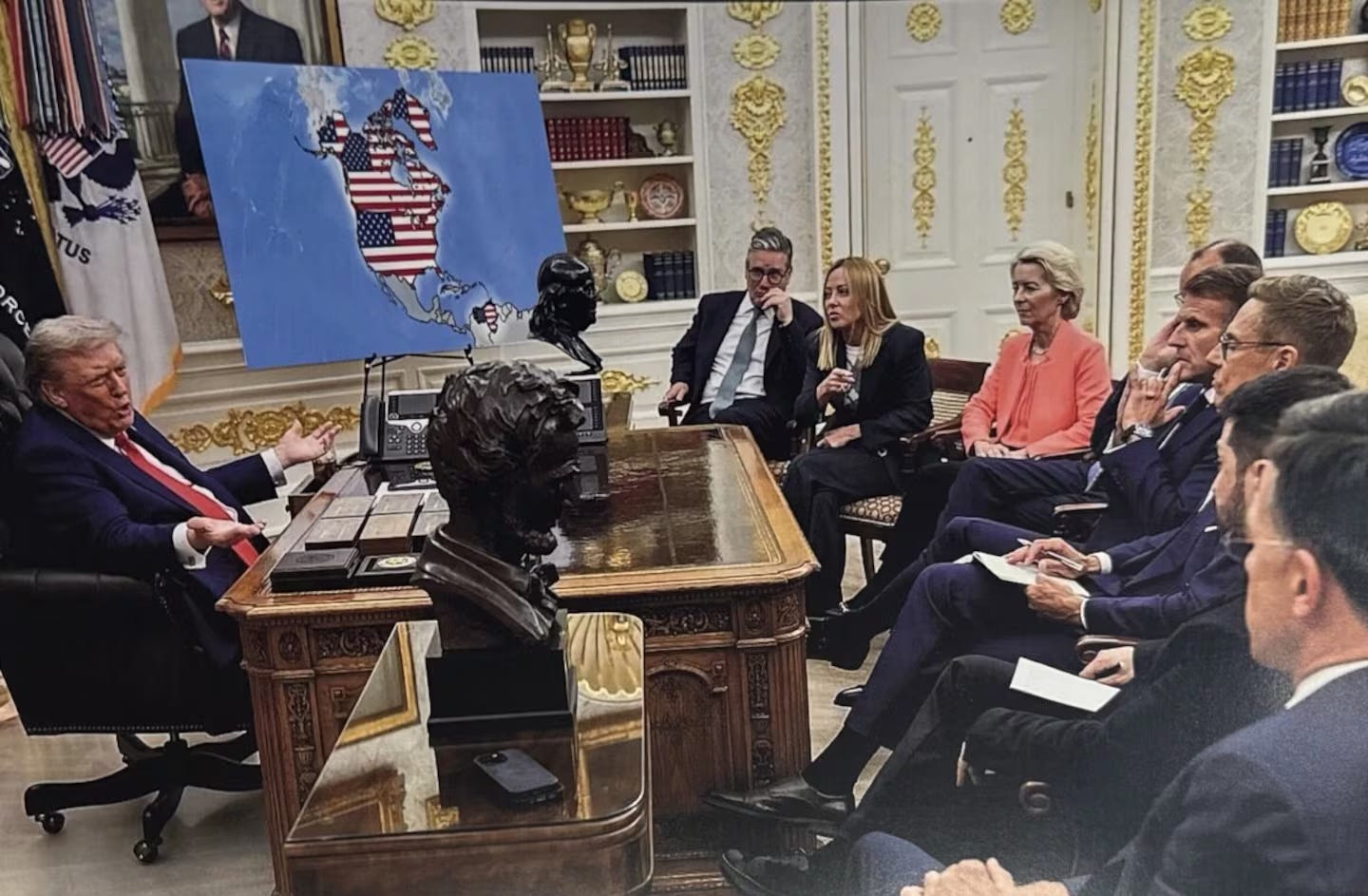
Perhaps the most entertaining contortions have come from UK prime minister Keir Starmer. Keir cannot have been happy with Trump and Netanyahu putting him on the spot less than a week after his hammering in the Gorton and Denton by-election by the Green Party, whose leader Zack Polanski is a vocal critic of Israel’s genocide in Gaza.
Walking a tightrope between appeasing Trump and fending off his domestic critics to both the right and the left, Starmer predictably ended up satisfying neither. Speaking in the House of Commons on March 2, he made clear that “The United Kingdom was not involved in the initial US and Israeli strikes on Iran” and “That decision was deliberate.”
Indeed, Starmer denied US requests to use British military bases for its initial attack on Iran. Furious, Trump complained that “we are not happy with the UK” and “This is not Winston Churchill that we’re dealing with.” “He should be giving us, without question or hesitation, things like bases,” he told the New York Post on March 5.
However, Starmer continued, “it is now clear that Iran’s outrageous response has become a threat to our partners, to our interests, and to our allies.” For this reason, he was now prepared to modify Britain’s stance to allow the US to use British bases “to destroy the [Iranian] missiles at source, in their storage depots or at their launchers.”
“To be clear,” he emphasized, “the use of British bases is strictly limited to agreed defensive purposes. The UK has not joined US offensive operations.”
A lawyer by trade—once upon a time a civil rights lawyer, as well as the UK’s Director of Public Prosecutions—Starmer was certainly, as Trump suggested, “worried about the legality.” He told MPs that government would publish its legal advice (it did), explaining
We all remember the mistakes of Iraq, and we have learned those lessons. Any UK actions must always have a lawful basis, and a viable thought-through plan. That is the principle that I applied to the decisions that I made over the weekend.
Unlike Macron, nowhere in his speech—or, as far as I am aware, anywhere else—did Starmer comment on the legality of the Israeli-US attack on Iran itself.
On March 5 German foreign minister Johann Wadephul told reporters in Berlin that “Germany is not participating in this war. And that will remain the case,” and on March 6 Macron was reported as assuring a social media user that “France is not part of this war. We are not in the fight and we are not going to get involved in this war.”
By contrast, Britain’s deputy PM David Lammy caused consternation when he told BBC Breakfast viewers the same morning that “there was a “legal basis” for the Royal Air Force to participate in strikes on Iranian missile sites” (as distinct from the UK merely allowing the US to use British bases to launch them). Mark Carney, too, has refused to“categorically rule out participation. We will stand by our allies when it makes sense.”
Britain and France have meantime moved ships, planes, and troops into the Middle East, ostensibly for the purposes of aiding the US in its “defensive” strikes on missile facilities or protecting their citizens and allies. It is not hard to see how things might go south.
Why?
Whatever else this circus might be, it is certainly not middle powers banding together to fight power with value-based realism. The abandonment of principles (while paying lip-service to international law) is undeniable.
But as Lloyd Axworthy observed in relation to Canada, this is hardly good pragmatics either. What do Canada, Australia, the UK, or the EU countries have to gain from getting drawn into an Israeli-US war which if previous experience (Libya, Iraq, Afghanistan, Syria) is anything to go by will only create further chaos in the Middle East and floods of new refugees?
So we must ask, once again, why are they doing this? No doubt there are a multiplicity of reasons, including fear of US tariffs and sanctions, strength of Zionist lobby groups, and (for some) the prospect of money to be made out of armaments, oil, or postwar reconstruction of bombsites into rivieras.
We also cannot ignore the deep racism underlying Benjamin Netanyahu and Donald Trump’s framing of these wars as “a battle of civilization against barbarism.” If there is one thing that unites the US, Canada, Australia, and the Europeans, it is whiteness. Europeans found it easier to stand up to Trump when he took a fancy to Greenland.
Speaking at the Munich Security Conference on February 14, Marco Rubio laid out an unashamedly imperialist agenda for “a new Western century”:
We are part of one civilization—Western civilization. We are bound to one another by the deepest bonds that nations could share, forged by centuries of shared history, Christian faith, culture, heritage, language, ancestry, and the sacrifices our forefathers made together for the common civilization to which we have fallen heir … And that is what we are defending: a great civilization that has every reason to be proud of its history, confident of its future, and aims to always be the master of its own economic and political destiny.
But if we ask how any of this was possible—how the western world got to where it is now—I believe the answer lies under the rubble in Gaza.
For more than two years, during much of which Joe Biden, not Donald Trump, was in the White House, the West participated in, endorsed, or at best turned a blind eye to overt war crimes in Gaza. While the UN, ICJ, ICC, and every major human rights organization on the planet warned of genocide, the Western democracies supplied Israel with arms, gave it diplomatic protection at the UN, and punished dissenters at home, while from the BBC to the New York Times an obliging media became a mouthpiece for Israeli hasbara. The US and other governments recklessly shredded international law and sabotaged its key institutions—the UN and its agencies, ICJ, and ICC—in the process.
This is a deeply corrupting process for everyone involved. If you don’t believe me, read Václav Havel’s “Power of the Powerless.”
Asked in February 2025 why he thought the Democratic Party was powerless to resist Donald Trump’s assault on democracy, the writer Ta-Nahisi Coates replied: “I would submit to you that if you can’t draw the line at genocide, you probably can’t draw the line at democracy.” His point applies more generally.





 coasts of bohemia