Canadian Dimension / July 9, 2025 / 17 min read

Displaced Palestinians roam the shattered streets of the Gaza Strip. Photo by Jaber Jehad Badwan.

As I write this, the press are reporting that a third ceasefire in Gaza is imminent, with Donald Trump committing to “ensuring negotiations continue until a final agreement is reached.” Whether this will end Israel’s “war,” which began on October 7, 2023 and has now raged for 21 months, killing a documented 57,012 Palestinians (as of July 2) and in all likelihood many thousands more, remains to be seen.

In the meantime, a stocktaking of some of the key events of the last momentous month seems in order.

The “12-Day War

Israel launched what it called a “pre-emptive strike” against Iran during the night of June 13. More than 200 IDF fighter jets hit more than 100 nuclear and military facilities and residential neighbourhoods in Tehran and other cities, and Israel assassinated 30 of Iran’s top military commanders and 11 of its nuclear scientists in targeted individual strikes.

Between June 12 and June 23 Israel carried out at least 146 air strikes on Iran. By the time the “12-Day War” ended with the US-brokered ceasefire of June 24, the Israeli air force had hit over 900 targets.

Iran retaliated by attacking Israel with successive barrages of ballistic missiles. As of June 24, the IDF had killed 610 people in Iran, including 49 women and 13 children, and injured 4,746. Iran’s missiles killed 28 people in Israel and injured 3,238.

The excuse for Israel’s unprovoked attack—for which, as has become customary for Israel, no evidence was ever provided—was that Iran was “on the verge of acquiring a nuclear weapon.” Benjamin Netanyahu has periodically made this claim since 1992.

Though US National Intelligence Director Tulsi Gabbard told Congress in March that Iran “was not building a nuclear weapon, and its supreme leader had not reauthorized the dormant program even though it had enriched uranium to higher levels,” Donald Trump chose to disregard his intelligence agencies’ assessment. “I don’t care what she said,” he told reporters on June 17. Heknew Iran was “very close” to having a nuclear bomb.

The US entered the conflict directly on June 22, dropping big, beautiful™ bunker-buster bombs on Iran’s Fordow, Natanz, and Isfahan nuclear facilities. Trump claimed that the strike had “completely and totally obliterated” Iran’s nuclear program, but the US’s own intelligence assessments (which the White House soon trashed) suggested the program had maybe been set back at best by a few months. For whatever it is worth, the latest Pentagon assessment is that “We have degraded their program by one to two years.”

At the point when Israel attacked, Iran was engaged in ongoing talks with the US to renew the nuclear agreement Donald Trump torpedoed in 2018. One of those targeted in Israel’s first strike was the lead Iranian negotiator, Ali Shamkhani. The IDF bombed his Tehran home, leaving him buried under the rubble with serious injuries. Three weeks earlier Trump boasted of “real progress, serious progress” in the talks, describing them as “very, very good.”

None of this inspires confidence in Israel or the US as trustworthy negotiating partners in any future peace process. Why should Iran—or anyone else—believe a word they say?

Circling the wagons

After Israel reneged on its ceasefire agreement with Hamas and launched a renewed Gaza offensive on March 18, killing over 400 people in one single night of terror, and imposed a complete blockade on power, food, and medical aid to the Strip, sections of the press and other influential opinion in the West had increasingly challenged its “self-defence” narrative. For a time at least, political leaders appeared to be listening.

This changed abruptly after June 13. Despite the fact that Israel, not Iran, was the clear aggressor—and notwithstanding the well established principle that pre-emptive actions are permissible under international law only “if the threat is imminent, overwhelming, and leaves no alternative but to act”—most Western states swallowed whatever misgivings they had previously expressed about Gaza and once again fell in line behind Israel.

The calls for “all parties to exercise maximum restraint and to de-escalate” (Emmanuel Macron) were invariably accompanied by reiterations of “Israel’s right to defend itself”—which is not, on any reasonable view, what it was doing—and an insistence that (in the words of Canadian Foreign Minister Anita Anand) “Iran cannot obtain nuclear weapons.”

Nothing was said about Iran’s right to defend itself, even though it was the attacked party. Nor did it seem to matter that unlike Iran, Israel does possess nuclear weapons, has never signed the Nuclear Non-Proliferation Treaty (NPT), and refuses to allow the International Atomic Energy Agency (IATA) to inspect its nuclear facilities.

Despite Israel carrying out what international organizations, leading Israeli academics and genocide scholars agree is a genocide in Gaza for nearly two years—during which time it has also invaded Lebanon and southern Syria and bombed Yemen—the West portrays Iran as (to quote Anand again) the “persistent threat to regional stability.”

Absurdly, the politicians took the fact that Iran responded militarily to Israel’s aggression—which is to say, defended itself—as confirmation of this alleged threat.

Writing on behalf of the EU on June 18, Kaja Kallas insisted that “Israel has the right to protect its security and people, in line with international law,” while “Iran must take decisive steps to return to negotiations and pave the way for a diplomatic solution.” What law she had in mind she didn’t say. Article 51 of the United Nations Charter only recognizes the “right of individual or collective self-defence if an armed attack occurs.”

“Canada condemns Iran’s attack on Israel” began Anand’s June 13 post, without any mention of the Israeli strikes that provoked itGermany, too, “strongly condemn[ed] the indiscriminate Iranian attack on Israeli territory,” adding that “Iran’s nuclear program violates the Non-Proliferation Treaty and poses a threat to the entire region—especially to Israel.” Once again there was silence on the threat posed by Israel’s nuclear arsenal.

German Chancellor Friedrich Merz said the quiet bit out loud during the G7 summit on June 17, letting slip to a journalist: “This is dirty work that Israel is doing for all of us.”

A “Zionist Palestinian state”

On June 24 Mark Carney told CNN’s Christiane Amanpour the Iran-Israel ceasefire offered an “opportunity” not only to end the war in Gaza but for “lasting peace in the Middle East” built around—wait for it—“a Zionist, if you will, Palestinian state.”

This goes beyond anything ventured by Carney’s predecessors Justin Trudeau (who proudly declared “I am a Zionist” on March 3, the same day as Israel cut off Gaza’s electricity supply and blockaded all aid for 11 weeks), and Stephen Harper. At the least, it is tone deaf. Worse, as the Canadian Muslim Public Affairs Council (CMPAC) put it:

By suggesting that Palestinians must be a “Zionist” state as the condition for their own statehood, Carney denies them the basic right to define their own national character and political future. Self-determination is a core principle of international law, affirmed in the UN Charter and multiple human rights treaties, and it cannot be made contingent on adopting the ideological identity of their occupier.


The UN General Assembly resolution calling for an immediate ceasefire in Gaza and “strongly condemning the use of starvation as a weapon of war, demanding a full lifting of the Israeli blockade on humanitarian aid, and insisting on the protection of civilians under international law,” which passed with an overwhelming majority of 149 to 12 on June 12—the day before Israel’s attack on Iran—with the backing of the UK, France, Germany, Canada, Italy, Australia, and New Zealand, was quietly forgotten.

So was an international conference co-hosted by France and Saudi Arabia scheduled to take place on June 17-20 at the United Nations in New York, at which, it was suggested, all parties should accept that “Palestinian statehood should not be a result of peace, but rather its prerequisite.” It was even briefly hinted that France might recognize Palestine at the conference pour encourager les autres. But after June 13 all bets were off.

The conference has now been indefinitely postponed. As Colombia’s President Gustavo Petro has written, this “has left a critical void in multilateral leadership, precisely when it is needed most.” The only Palestinian statehood still left on the table seems to be Mark Carney’s “Zionist Palestine.”

Shifting public opinion

Notwithstanding this backtracking to business as usual on the part of Western leaders, Western publics seem less and less willing to overlook the continuing genocide in Gaza. The genie is out of the bottle, and the gaslighting isn’t working any more.

YouGov EuroTrack survey conducted in Britain, Denmark, France, Germany, Italy and Spain published on June 3 found that while there was little evidence of support for Hamas (only five to nine percent of respondents believed the October 7 attack on Israel was justified), just six to 16 percent believed Israel was “right to send troops into Gaza” and “responded in a proportionate way to the Hamas attacks.” Between seven and 18 percent said they sympathized with Israel, while 18–33 percent said their sympathies lay with the Palestinians. Germany was the only country where the results were evenly matched (17 percent for Israel, 18 percent for Palestine).

In Britain, in a poll conducted on June 18 by YouGov for Action For Humanity and the International Centre for Justice for Palestinians, over half of respondents opposed Israel’s military campaign in Gaza (55 percent) and only 15 percent supported it. A large proportion of those opposed to the campaign thought Israel was committing genocide (82 percent).

Even in the US, where support for Israel has long been an item of faith for both major political parties, the landscape seems to be shifting. A Quinnipiac University poll in early June showed 37 percent of Americans sided with and 32 percent opposed the Israelis—which is a historically narrow margin. This is consistent with several other polls earlier in 2025. 

A Harris-Harvard poll commissioned by the Israeli Knesset reported in the Jerusalem Post on June 26 showed a drop from 53 percent to 41 percent in the percentage of Americans who view Israel favourably, and—most worryingly for Israel’s supporters—found young people were closely split (53 to 47 percent) between supporting Israel and supporting Hamas.

An upset in New York

Zohran Mamdani’s decisive victory over establishment candidate Andrew Cuomo in the June 24 Democratic primary election for mayor of New York City has been universally described as a major upset not only because he is a member of Democratic Socialists of America campaigning on an avowedly progressive platform, but—above all—because of his unequivocal support for the Palestinian cause.

Despite refusing to back down on his criticism of Israel’s “genocidal” conduct of its Gaza campaign and being comprehensively vilified as a Muslim (which he is) and a jihadist supporter of Hamas (which he is not), Mamdani won 56 percent of the vote to Cuomo’s 44 percent. His 545,000 votes are the most in a Democratic mayoral New York City primary since David Dinkins beat incumbent Ed Koch in 1989.

Nobody is suggesting that Mamdani’s stance on Gaza is the only reason he won—though his victory does lend weight to the argument that Kamala Harris’s refusal to deviate from Joe Biden’s “ironclad” support for Israel played a significant part in the Democrats’ loss to Donald Trump in the 2024 presidential election.

But that a candidate who supports the Boycott, Divestment, and Sanctions movement, called for the release of detained Columbia activist Mahmoud Khalil, and promised to arrest Benjamin Netanyahu if he ever sit foot in New York, could win so emphatic a victory in the most Jewish city in America, attracting broad-based support across different ethnic groups—including large numbers of Jews—testifies to just how out of touch with the public the official narratives have become.

Predictably, Republicans responded to Mamdani’s win with outraged pearl clutching and unconcealed Islamophobia. But what is most concerning is that while the success of Mamdani’s campaign might point to a road back to power for a Democratic Party still reeling from its 2024 defeat, establishment Democrats were no more enthusiastic.

“Top Democratic donors” are quoted as finding the primary outcome “disgusting,” and Barack Obama has declined to congratulate Mamdani. House minority leader Hakeem Jeffries, New York’s Democratic Governor Kathy Hochul, and New York Congressman Tom Suozzi are all holding backon endorsing Mamdani in the mayoral election.

They prefer to confine their “resistance,” it seems, to the gestural theatrics of renaming Trump’s “One Big Beautiful Bill Act” and making marathon speeches to which nobody listens. Just as in November’s presidential election, they would rather lose than antagonize Israel.

The protests grow

In Britain, judges, lawyers, and legal academics and prominent writers have issued open letters condemning the UK’s complicity in Israel’s genocide and government and media attempts to quash dissent. Even the august British Medical Association voted by large majorities at its annual conference on July 3 to break off relations with the Israel Medical Association and seek its suspension from the World Medical Association over Gaza.

On the eve of the Cannes Film Festival, more than 370 actors and filmmakers proclaimed that “As artists and cultural players, we cannot remain silent while genocide is taking place in Gaza,” condemning “propaganda that constantly colonizes our imaginations.” The signatories included Joaquin Phoenix, Pedro Pascal, Juliette Binoche, Rooney Mara, Omar Sy, Jim Jarmusch, Richard Gere, Mark Ruffalo, Guy Pearce, Javier Bardem, Ralph Fiennes, Michael Moore, David Cronenberg, Pedro Almodovar, and Guillermo del Toro.

On June 9 “532 Canadians, including academics, lawyers, former and retired ambassadors (including to the United Nations), ministers and public servants, UN human rights experts, and civil society, labour and faith leaders,” wrote to Mark Carney urging “decisive action to end genocide in Gaza.” On July 5 the Anglican Church of Canada adopted a resolution “calling on the Canadian government to uphold their moral responsibilities and impose full and immediate arms embargo on Israel.”

Protest marches continue across the world.  From London and Paris to Sydney and Melbourne, from Athens and Barcelona to Dublin and Toronto, hundreds of thousands have hit the streets. This year’s bull-running San Fermin festival in Pamplona, Spain, turned into a massive show of solidarity with Palestine. On June 15, in one of the biggest demonstrations ever seen in the Netherlands, 150,000 people dressed in red and marched for Gaza in The Hague. On June 21, for the first time on such a scale, 50,000 people marched for Gaza in Berlin.

Revulsion at Israel’s genocide in Gaza is no longer confined to student activists and “lunatic left” professors at Columbia and Harvard, and it can no longer be dismissed as the result of “antisemitism.” The chasm between Western political establishments and the people they claim to represent grows wider by the day.

This is a pervasive crisis of legitimacy.

Ructions at the BBC

Nowhere is that crisis better illustrated than in recent events at the British Broadcasting Corporation.

recent report by the Centre for Media Monitoring, based on analysis of more than 35,000 pieces of BBC content, found that despite Palestinians suffering 34 times as many deaths as Israelis since the present Gaza “war” began, Israeli deaths were given 33 times more coverage and described in much more emotive language. The BBC interviewed significantly fewer Palestinians than Israelis, and presenters shut down interviewees’ claims of genocide while making no mention of Israeli leaders’ genocidal statements (including Benjamin Netanyahu’s notorious invocation of the biblical Amalek).

In May the corporation fired Gary Lineker, Britain’s most popular soccer commentator and longtime host of Match of the Day, the BBC’s equivalent of Hockey Night in Canada, for social media posts critical of Israel. Lineker had previously blotted his copybook by daring to speak out over government heartlessness toward refugees and migrants.

On June 20, after months of delays, the BBC cancelled a documentary it had itself commissioned on Israel’s attacks on Gaza’s health service on grounds that showing the film would create “a perception of partiality.” Based entirely on first-hand testimonies, the film detailed “how hospitals in the territory have been overwhelmed, bombed and raided. Medics recount being detained and claim to have been tortured.”

Channel 4 showed Gaza: Doctors Under Attack in the UK on July 2 and Mehdi Hassan’s Zeteo media platform made it available for streaming internationally. It was widely hailed as “a crucial film” that “the world needs to see.”

On the same day as the film was broadcast, more than 400 BBC staff, freelancers and industry figures, including 111 BBC journalists—who signed anonymously for fear of reprisals—wrote an open letter to BBC management expressing “concerns over opaque editorial decisions and censorship at the BBC on the reporting of Israel/Palestine.”

The letter expressed particular concern that board member Robbie Gibbs, “an individual with close ties to the Jewish Chronicle… has a say in the BBC’s editorial decisions in any capacity, including the decision not to broadcast Gaza: Medics Under Fire [sic].”

Death, death to the IDF

In the midst of the row over Gaza: Doctors Under Attack, a new confrontation erupted over the BBC’s coverage of Glastonbury, Britain’s most popular music festival, which regularly attracts over 200,000 spectators and has long been televised live by the BBC.

In the weeks preceding the festival, pressure was put on the organizers by members of the government, including Keir Starmer, as well as the Conservative opposition leader Kemi Badenoch, to drop the Irish band Kneecap from the roster. Kneecap had made themselves notorious with their earlier performances at the Coachella music festival in California, at which they led the audience in chants of “Free, free Palestine.”

On June 18 Kneecap fans “mobbed sidewalks outside a London court” as the trial opened of band member Mo Chara under Britain’s draconian Terrorism Act. His offense was waving a Hezbollah flag at a concert in North London on November 21 “in a manner that aroused ‘reasonable suspicion’ he supported the Lebanese militant group.”

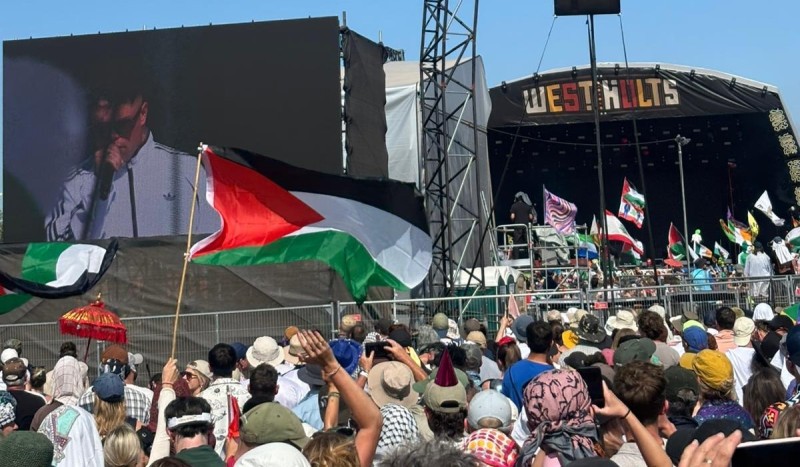
The Glastonbury organizers refused to cancel Kneecap’s performance, and the band took the stage on June 28. Reportedly “thousands of fans chanted ‘free Palestine’ and waved Palestinian flags,” but BBC viewers were not allowed to see this because the corporation pulled the plug on the live feed. The broadcaster later uploaded an edited version of the performance to BBC iPlayer as part of its on-demand Glastonbury sets.

Kneecap performs at Glastonbury. Photo by Katherine Hajiyianni.

Unfortunately for the BBC, another even more controversial set, by the punk-rap duo Bob Vylan, slipped under the wire. Looking out from the West Holts stage on a sea of Palestinian flags, rapper Bobby Vylan led the 45,000-strong crowd in chants of “Free, free Palestine” and “Death, death to the IDF.”

Bob Vylan’s entire performance was broadcast live, although “a warning was issued on screen about the very strong and discriminatory language” and it was decided not to make the set available on demand via iPlayer. This did not stop pressure mounting on the BBC, as the police announced a criminal investigation into Kneecap and Bob Vylan’s performances and lurid headlines filled the conservative and tabloid press.

Whacking the moles

Two days later, BBC Chair Samir Shaw issued a contrite statement, which apologized “to all our viewers and listeners and particularly the Jewish community for allowing… Bob Vylan to express unconscionable antisemitic views live on the BBC” and acknowledged that continuing the broadcast was “an error of judgement.”

He promised that “The Executive have agreed to put in place a set of strengthened editorial practices and policies for live music programming” and was “initiating a process to ensure proper accountability for those found to be responsible for the failings in this incident.”

On July 7, the Times reported that Lorna Clarke had resigned her position as BBC director of music “after UK Culture Secretary Lisa Nandy condemned the “appalling and unacceptable scenes,” adding that “other senior BBC staff have also temporarily relinquished their day-to-day roles over the Glastonbury controversy—pending an investigation.” Needless to say Robbie Gibbs is still in place.

Clarke’s is not the only scalp Nandy is after. She is also demanding to know why nobody had yet been fired at the corporation for permitting an earlier documentary, Gaza: How to Survive a Warzone, to slip through the censorship net and be broadcast in February.

The BBC pulled the program from its iPlayer after it emerged that its 13-year-old narrator was the son of a deputy agriculture minister in the Hamas-controlled Gaza administration. By then the damage was done. Palestinian children had been allowed to speak of their own experiences in their own words, and we can’t have that, can we?

Nandy told the Times that:

I have asked the question to the board [of the BBC]. Why has nobody been fired? What I want is an explanation as to why not. If it is a sackable offence then obviously that should happen. But if the BBC, which is independent, considers that it is not, I think what all parliamentarians want to know is why.


It seems not to have occurred to her that if parliamentarians—or a government minister—can interfere in the BBC’s internal affairs to the extent of demanding to know why staff have not been sacked, its independence is (to say the least) seriously compromised.

Doubling down

Bob Vylan have now been dropped by their agency, banned from several music festivals in the UK and elsewhere, had a number of European gigs cancelled, and seen their US visas revoked by the State Department, scuppering their upcoming US tour. Their following on Spotify has meantime soared and their 2024 album Humble as the Sun has re-entered the charts. Currently it is number one on the UK hip-hop and R&B albums chart, and number seven on the album downloads chart and number eight on the independent albums chart.

It is difficult to think of a clearer indication of today’s societal rifts over Israel and Gaza.

On the one hand, we have ever-growing public revulsion over Western complicity in the Gaza genocide. On the other, we see the political establishment doubling down on a narrative of Israeli self-defence that is losing whatever emotional purchase it once had—a doubling down that is increasingly enforced by the full power of the state.

In the US, they are deporting pro-Palestine activists and withholding research funding from universities they falsely accuse of being “antisemitic.” In Britain, parliament has just proscribed Palestine Action, a protest group whose most violent action to date has been throwing red paint over military aircraft, as a “terrorist organization”—on a par with al-Qaida, Hezbollah, or Hamas. To support it now carries a sentence of 14 years in prison.

The first arrests have just been made by the Metropolitan Police. They include an emeritus professor, several health professionals, and a 83-year-old retired priest, Sue Parfitt, who said the ban was “a very dangerous move that has to be challenged.”

Wither the West?

On June 21, 75 German professors published a letter to the German government arguing that “Your current actions, like those of the previous government, are violating international law and are politically highly dangerous: Germany is actively undermining the international legal system that was established after the Second World War, partly as a response to German crimes.”

It concluded by demanding “an immediate end to the restrictions on academic freedom and freedom of speech in Germany”:

Currently, critical voices on Israel’s actions and its occupation are being defamed using scientifically questionable definitions of antisemitism, events are being cancelled, and protests—including student protests at universities—are being criminalized … The systematic suppression and marginalization of voices expressing criticism and solidarity contribute to Germany’s complicity in Israeli violations of international law—both those already committed and those ongoing—and must end.


The point does not only apply to Germany—or to academia. The demolition of the rule of law in the international arena goes hand in hand with the destruction of liberties at home.

We might well ask, as the Irish poet W.B. Yeats did in an earlier time of troubles:

And what rough beast, its hour come round at last,

Slouches towards Bethlehem to be born?

I stumbled across several recent reviews of my book Postcards from Absurdistan. Here are some extracts.

Postcards from Absurdistan is the third in a loose trilogy of books Derek Sayer has written about modern Czech cultural history … Put next to one another, the trilogy’s some 1,700 pages provide a tour de force of Czech cultural history … Sayer’s mise-en-scène and his analysis are always erudite, sometimes revisionist and frequently compelling … the book and the trilogy are tremendous achievements … this eminently readable book … is a well-balanced introduction to the Czech twentieth century for students and the wider public, and also offers many insights for expert scholars. Derek Sayer has written a deserving conclusion to his Czech trilogy.”—”The Last Postcard from Prague,” Felic Jeschke, CEU Review of Books

“Beginning with the intimate relationship between Franz Kafka and the Czech feminist, journalist, and writer Milena Jesenská, the book embarks on a colorful journey through the fates of hundreds of figures of Bohemian cultural life between 1918 and 1989. For Sayer, Prague is a loose starting point for the interweaving of the lives of the actors in his book, wherever these took place. He thus traces both the artistic activities and the private—and in many cases intimate—lives of countless Czech writers, architects, artists, and filmmakers, and of their partners, children, and extended families. He vividly shows the interconnectedness of their fates (and often their bedrooms), whether their lives’ vicissitudes took place in Prague, Paris, New York, or Tokyo, in their apartments, villas, or offices, in the torture chambers of the Nazi occupiers, in refugee camps, or in the interrogation rooms of the Communist secret police … Sayer displays a deeply impressive knowledge of modern Czech cultural history, which he manages to construct into an extremely appealing narrative … a literarily brilliant and empirically rich collage of stories from the history of Czech culture in the twentieth century.”—Rudolf Kučera, Journal of Modern History

“Sayer chronicles a world of the absurd but also contributes to it. Essentially he provides an episodic celebration of the Czech contribution to (post)modern civilization, with some brilliant aperçus … we learn much about the strategies of intellectuals and artists to frustrate successive orthodoxies of oppressive political regimes and especially about the genesis of the celebrated crop of Czech novelists and dramatists of the absurd headed by Bohumil Hrabal, Milan Kundera, and Václav Havel … In the absence of any comparative dimension to this book, it might well seem that Sayer exaggerates his case for Czech primacy in absurdism, in the spirit of Jára Cimrman, the larger-than-life inventor and discoverer whose exploits included leaving three missed-call messages on Alexander Graham Bell’s first telephone. Yet perhaps, on second thought, the cult of Cimrman, “the greatest Czech who never lived” (he was himself invented in 1960s Prague, initially as a radio character) is actually strong evidence that the claim, precisely in its flippancy, carries some weight.”—R.J.W. Evans, Common Knowledge

“Derek Sayer’s latest dive into Czech cultural history traces the winding paths of its protagonists through artistic movements, war, exile, and oppression … The absurdity implied in the title is shown repeatedly to be the result of the heavy hand of politics interfering with the life and work of the country’s cultural greats. Virtually no one escapes unscathed. Death, prison, and exile are as common among these Czech writers and artists as gallery openings and publication … The book’s main title is Postcards from Absurdistan, and the sense of absurdity is largely delivered. Yet the story branches out so internationally – from Prague to Paris to Moscow to Tokyo, India, and the Utah desert, among other places – and the absurdity presented seems so evenly shared, that it can make the world in general appear an Absurdistan. It very likely is, yet there is a particular style of absurdity found in 20th century Central and Eastern Europe, whether nationalist, communist, or a combination of the two, which the book effectively presents and defines.”—Michael Stein, “The Unsummoned Convention of Genius,” Transitions.

First published in Canadian Dimension / June 17, 2025

Aftermath of Israeli airstrike in Tehran, June 13, 2025. Photo courtesy Tasnim News Agency/Wikimedia Commons.

Gaslighting, nounpsychological manipulation of a person usually over an extended period of time that causes the victim to question the validity of their own thoughts, perception of reality, or memories and typically leads to confusion, loss of confidence and self-esteem, uncertainty of one’s emotional or mental stability, and a dependency on the perpetrator. (Merriam-Webster Dictionary)


I woke on Saturday, June 14, to Guardian headlines explaining: “Strikes on Iran ease pressure on Israel to end starvation in Gaza. Critics of war will be more reluctant to press for its end while missiles from Tehran are killing people in Tel Aviv.”

I had two immediate reactions. Both were accompanied by a strong desire to vomit.

First reaction: speak for your f***ing self. I am not going to keep my mouth shut about Israel’s ongoing genocide in Gaza just because Benjamin Netanyahu has chosen this moment to launch a “pre-emptive strike”—that is, an unprovoked act of war—against Iran, nor because Iran, not altogether surprisingly, is defending itself against this aggression.

Initial reports suggest that as well as the military commanders and nuclear scientists Israel individually targeted (whose families were “collateral damage”), the first strike killed at least 60 people in residential neighbourhoods in Tehran and other Iranian cities, including 29 children, and injured many more. This is par for the Israeli course.

By the end of Sunday, Israel’s continuing strikes had killed at least 224 people in Iran and wounded another 1,277. Netanyahu promises the world that this is just the beginning, warning: “We will hit every site and every target of the Ayatollahs’ regime and what they have felt so far is nothing compared with what they will be handed in the coming days.”

Meantime, the carnage in Gaza has not stopped but intensified. On Saturday June 14 alone, reports Al Jazeera, “Israeli fire and air strikes… killed at least 58 Palestinians across the Gaza Strip, many of them near an aid distribution site operated by the United States-backed Gaza Humanitarian Foundation (GHF).” This brought the number of those killed while attempting to obtain food for their families through the controversial GHF sites (which Israel reluctantly set up under international pressure after banishing UNRWA, the principal supplier of aid to Gaza) to at least 274 people, with more than 2,000 wounded.

Second reaction: what does it say about us that these headlines can be true? That these things can be said at all? Into what new moral abyss has “Western civilization” fallen?

Are we—Canada, the US, Germany, France, the UK—really so morally bankrupt that we will allow Netanyahu’s cynical maneuver, an act of naked aggression in flagrant breach of international law, to divert us from our responsibilities to end Israel’s genocide in Gaza?

Do we really want to say that the relative handful of deaths so far reported in Israel from Iran’s response (13, as of June 15) count for more than the hundreds of deaths Israel has already caused with its latest strikes on Iran—let alone the more than 55,000 people, the majority of them women and children, Israel has killed in the last twenty months in Gaza? That when the chips are down, Israeli lives are worth that much more than Iranian lives or Palestinian lives—irrespective of the fact that Israel initiated this latest round of fighting?

From the first responses of Western political leaders, it would appear that the answer to all of these questions is unfortunately an unhesitating and emphatic yes.

Was the West getting cold feet about Israel’s genocide?

Significantly, Israel’s attack on Iran came against a backdrop of the beginnings of a sea-change in Western media coverage of Israel’s conduct of its “war” in Gaza and the Israeli government’s encouragement of settler violence in the West Bank. Coincidence? Some might suspect that the attack was designed to nip this dangerous shift in the bud.

Recent weeks had seen a widespread acknowledgment that since its declaration of “war” on Hamas following the latter’s attacks of October 7, 2023, Israel has committed war crimes and crimes against humanity—and likely genocide—not as aberrations but as de facto state policy. This tectonic shift in media coverage was echoed by a number of political leaders in Israel and the West (the US apart), who adopted a more critical stance toward Israel’s conduct of the “war” than they had at any point during the last two years.

Within Israel, former Prime Minister Ehud Olmert, who had long rejected charges that Israel was guilty of war crimes or genocide in Gaza, wrote an editorial for Haaretz on May 27 in which he recorded his recent change of mind. He didn’t mince his words:

What we are doing in Gaza now is a war of devastation: indiscriminate, limitless, cruel and criminal killing of civilians. We’re not doing this due to loss of control in any specific sector, not due to some disproportionate outburst by some soldiers in some unit. Rather, it’s the result of government policy—knowingly, evilly, maliciously, irresponsibly dictated. Yes, Israel is committing war crimes.


A week earlier, Yair Golan, a retired general and the leader of the Israeli opposition Democrats, caused outrage among Netanyahu’s supporters when he told Reshed Bet radio: “A sane country doesn’t engage in fighting against civilians, doesn’t kill babies as a hobby and doesn’t set for itself the goals of expelling a population.”

Similar misgivings were expressed by some of Israel’s staunchest Western allies—though notably not by the Trump administration or the Democratic leadership in the US.

Having told the UK parliament on March 17 that Israel’s blockade on aid to Gaza, which began on March 2, was a “breach of international law”—only to be rebuked at the time by PM Keir Starmer and forced to backpedal—Britain’s Foreign Secretary David Lammy gave a passionate speech in the Commons on May 20 in which he denounced Israeli Finance Minister Bezalel Smotrich’s dreams of “‘cleansing’ Gaza, of ‘destroying what’s left’ and of resident Palestinians being ‘relocated to third countries.’” He too did not mince his words:

We must call this what it is: it is extremism, it is dangerous, it is repellent, it is monstrous and I condemn it in the strongest possible terms… Israel’s plan is morally unjustifiable, wholly disproportionate and utterly counterproductive…

An entente cordiale

The previous day Keir Starmer, French President Emmanuel Macron, and Canadian Prime Minister Mark Carney had issued a joint statement which offered the most unequivocal condemnation of Israeli actions in Gaza by any G7 leaders yet. It began:

We strongly oppose the expansion of Israel’s military operations in Gaza. The level of human suffering in Gaza is intolerable. Yesterday’s announcement that Israel will allow a basic quantity of food into Gaza is wholly inadequate. We call on the Israeli Government to stop its military operations in Gaza and immediately allow humanitarian aid to enter Gaza. This must include engaging with the UN to ensure a return to delivery of aid in line with humanitarian principles…

The Israeli Government’s denial of essential humanitarian assistance to the civilian population is unacceptable and risks breaching International Humanitarian Law. We condemn the abhorrent language used recently by members of the Israeli Government, threatening that, in their despair at the destruction of Gaza, civilians will start to relocate. Permanent forced displacement is a breach of international humanitarian law.


The three leaders went on to express opposition to “any attempt to expand settlements in the West Bank,” insisting that “Israel must halt settlements which are illegal and undermine the viability of a Palestinian state.” If Israel continued in its “egregious actions,” they threatened, “we will take further concrete actions in response… including targeted sanctions.”

“By asking Israel to end a defensive war for our survival before Hamas terrorists on our border are destroyed and by demanding a Palestinian state, the leaders in London, Ottowa [sic] and Paris are offering a huge prize for the genocidal attack on Israel on October 7 while inviting more such atrocities,” Benjamin Netanyahu responded in a post on X.

Netanyahu added: “Israel accepts President Trump’s vision and urges all European leaders to do the same.” That “vision” is to turn an ethnically cleansed Gaza into the “Riviera of the Middle East” under American auspices. As Trump says, he’s a real estate guy at heart. So is Israel, which has been gobbling up Palestinian land and “displacing” its owners since 1948.

On May 29, Israeli Defence Minister Israel Katz and Finance Minister Bezalel Smotrich announced approval of 22 new settlements, some of which already existed as illegal “outposts”—the biggest such expansion in decades. Katz was clear that the point was to “prevent… the establishment of a Palestinian state that would endanger Israel.”

Destruction in the Gaza Strip. Photo by Jaber Jehad Badwan/Wikimedia Commons.

The Western dilemma

Though disappointingly little in the way of “concrete actions” has followed the British, French, and Canadian leaders’ entente cordiale, the UK did suspend talks on a trade deal with Israel and impose individual sanctions on a few extremist settlers in the West Bank.

Of greater import—though still more of a symbolic gesture than anything else—on June 12, the foreign ministers of Australia, Canada, New Zealand, Norway, and the UK jointly announced “sanctions targeting [Israeli ministers] Itamar Ben-Gvir and Bezalel Smotrich for inciting violence against Palestinians in the West Bank.” They noted that:

Today’s measures focus on the West Bank, but of course this cannot be seen in isolation from the catastrophe in Gaza. We continue to be appalled by the immense suffering of civilians, including the denial of essential aid. There must be no unlawful transfer of Palestinians from Gaza or within the West Bank, nor any reduction in the territory of the Gaza Strip.


The problem with this position is that Ben-Gvir and Smotrich are not rogue extremists, but key ministers in Netanyahu’s government. They respectively hold the ministerial portfolios of national security and finance. The policies and words for which they are being individually censured are collectively those of Israel’s government as a whole.

The statement concludes: “We will continue to work with the Israeli Government and a range of partners,” but the main obstacle to its attaining its objectives, “an immediate ceasefire, the release now of the remaining hostages and for the unhindered flow of humanitarian aid including food,” and “a reconstructed Gaza no longer run by Hamas and a political pathway to a two-state solution,” is precisely the Israeli government itself. As, of course, Messrs. Carney, Starmer, and Macron very well know.

Their position, like much else in the West’s response to Israel’s actions since Hamas’s October 7, 2023 attacks, is incoherent. But the incoherence is revealing. The West is being tossed on the horns of an irresolvable dilemma—as it has been, in one form or another, since the foundation of the State of Israel and the Nakba of 1947-1948. This dilemma has assumed acute form since October 7.

If the West continues to support Israel’s “right to defend itself” as Israel interprets that “right,” then—as has become crystal clear over the last twenty months, and has once again been proven by Israel’s latest “pre-emptive strike” on Iran—it can do so only at the cost of trashing the norms of international humanitarian law and the cherished “Western” values of human rights and the universal rule of law upon which they supposedly rest. The supreme irony here is that Israel has repeatedly claimed to be waging this “war” in defense of the humanist values of Western civilization and against Islamist barbarism.

If, on the other hand, Western democracies are seriously to uphold those values and enforce the rule of law, they are morally and legally bound not simply to condemn Israel’s crimes but to take whatever concrete actions lie within their power to prevent them—including, at a minimum, stopping all arms supplies and applying economic and other sanctions (as has been done in the case of Russia following its invasion of Ukraine).

Stronger action might include international military intervention under United Nations auspices, like that which followed Saddam Hussein’s invasion of Kuwait in 1990.

As just one example of this, in its landmark judgment on the legal status of the Israeli occupation of Palestinian territories—within which it counted blockaded Gaza—of July 19, 2024, the International Court of Justice (ICJ) ruled that “Israel’s continued presence in the Occupied Palestinian Territory is unlawful,” and Israel must “end its unlawful presence… as rapidly as possible,” “cease immediately all new settlement activities, and… evacuate all settlers from the Occupied Palestinian Territory.”

The court unambiguously spelled out the resulting obligations of all UN member states, including Canada:

all States are under an obligation not to recognize as legal the situation arising from the unlawful presence of the State of Israel in the Occupied Palestinian Territory and not to render aid or assistance in maintaining the situation created by the continued presence of the State of Israel in the Occupied Palestinian Territory.


In the same way, all 125 countries that signed the 1998 Rome Statute that established the International Criminal Court (ICC)—the US is not among them, but Britain, France, Canada, the rest of the G7, Australia, New Zealand, and most members of the EU and NATO are—are legally bound to execute the court’s arrest warrants against Benjamin Netanyahu and former defence minister Yoav Gallant for war crimes and crimes against humanity, whether they approve of them or not.

The West cannot have its cake and eat it. Either it supports Israel, or it supports the rule of law. Israel’s “right to self-defense” does not permit war crimes or genocide, period.

More theatre for public consumption?

Two other recent initiatives that signalled apparent shifts in Western attitudes toward Israel’s ongoing Gaza “war” are worth mentioning here. Both have now been rudely sidelined by events.

The first was a conference, co-hosted by France and Saudi Arabia under UN auspices and scheduled to take place on June 17-20 in New York, at which it was hoped to make progress toward a two-state solution to “the Palestinian problem.” This “solution” is one to which Israel and its Western supporters have been nominally committed since the Oslo Accords of 1993-5, even though Netanyahu has repeatedly stated his opposition to any “attempt to coerce us to a reality that would endanger the state of Israel” on grounds that Israel “must have security control over the entire territory west of the Jordan River… That collides with the idea of [Palestinian] sovereignty. What can we do?”

It was widely rumoured that France and Britain might recognize a Palestinian state at the conference in order to maintain pressure on Israel to stop the war in Gaza and return to the negotiating table. This led Donald Trump to call upon the world’s governments on June 10 to boycott the conference and threaten “diplomatic consequences” if they took “any steps that would unilaterally recognise a conjectural Palestinian state.”

Faced with this US threat, Macron was already backtracking on recognizing Palestine when Israel launched its “pre-emptive strike” on Iran. The new situation gave him the perfect off-ramp. On the same day as Israel attacked Iran, he announced that the two-state conference was indefinitely postponed “for logistical and security reasons.”

The second initiative—a poignant one, in retrospect—occurred at the UN. Meeting in an emergency session on June 12 , “the UN General Assembly overwhelmingly adopted a resolution demanding an immediate, unconditional and lasting ceasefire in Gaza,” which:

strongly condemn[ed] the use of starvation as a weapon of war, demand[ed] a full lifting of the Israeli blockade on humanitarian aid, and insist[ed] on the protection of civilians under international law.


A week earlier a similar resolution had failed to pass at the Security Council due to a lone veto by the US. Secretary of State Marco Rubio explained that the US government could not support any resolution that “draws a false equivalence between Israel and Hamas, or disregards Israel’s right to defend itself.” The rest of the UNSC voted in favour.

The General Assembly resolution passed with 149 votes in favour, 12 against, and 19 abstentions. Joining Israel, the US, and a sprinkling of US Pacific dependencies in the No lobby were Argentina, Hungary, and Paraguay—hardly paragons of liberal democracy. The rest of the G7, and most members of the EU and NATO,1 supported the motion.

The day after this near-universal condemnation of Israel by the international community, Israel attacked Iran. And everything changed overnight.

Come back Bibi, all is forgiven

“Game on. Pray for Israel,” posted the reliably odious US Senator Lindsey Graham on X upon hearing the news of Israel‘s strikes on Iran. His recent contributions to peace in the Middle East included the post “Hope Greta [Thunberg] and her friends can swim!”—an invitation for the IDF to attack the Madleen, on which activists were sailing to Gaza to draw attention to Israel’s use of starvation as a weapon of war.

Before long, the mantra “pray for Israel” was broadcast far and wide, and sob stories of poor Israeli families having to spend the night in air-raid shelters began to appear in the Western press.

One could be forgiven for believing that Iran had launched a pre-emptive strike on Israel that killed and wounded hundreds of civilians in Tel Aviv and Haifa rather than the other way around.

Worse was to follow. Speaking with Israeli President Isaac Herzog “concerning the escalating situation in the Middle East” on June 13, President of the EU Commission Ursula von der Leyen“reiterated Israel’s right to defend itself and protect its people.” She made no mention of the fact that Israel struck first.

On the same day Emmanuel Macron called “on all parties to exercise maximum restraint and to de-escalate” in an English-language statement on X that began: “France has repeatedly condemned Iran’s ongoing nuclear program” and continued “France reaffirms Israel’s right to defend itself and ensure its security.” He made no mention of Iran’s right to self-defense against Israeli strikes.

In a still more blatant masterpiece of Orwellian doublespeak, the German foreign ministry squarely blamed Iran for Israel’s latest aggression:

The situation in the Middle East has escalated dramatically overnight. Israel has carried out targeted strikes against Iranian nuclear facilities. Iran is responding with hundreds of drone attacks on Israel. This development is more than alarming.

We strongly condemn the indiscriminate Iranian attack on Israeli territory. Iran’s nuclear program violates the Non-Proliferation Treaty and poses a threat to the entire region—especially to Israel.

Israel has the right to defend its existence and the security of its citizens. At the same time, we call on all parties to avoid further escalation. Germany remains committed to diplomacy—together with our partners in Europe and the United States.


This conveniently overlooks the facts that unlike Iran, Israel declines to sign the Non-Proliferation Treaty, possesses a nuclear arsenal, and has refused to let the International Atomic Energy Agency (IAEA) inspect its facilities; that in 2015 Iran agreed a deal with China, France, Russia, the UK, the US, and Germany to limit its nuclear program in exchange for relief on sanctions, which Donald Trump unilaterally scuppered in 2018; that negotiations between Iran and the US to renew such a deal were well advanced when Israel launched its attack (one of those assassinated in the first wave of targeted missiles was the leader of the Iranian negotiating team, Ali Shamkhani); and that as the IAEA has emphasized in a statement of June 13, “any military action that jeopardizes the safety and security of nuclear facilities risks grave consequences for the people of Iran, the region, and beyond.” But who cares when Germany’s Staatsräson, as Angela Merkel famously defined German support for Israel, is at issue?

UK Finance Minister Rachel Reeves joined the chorus of condemnation of Iran, telling Sky News on June 15 that British military assets—including fighter jets—were being moved to the conflict zone “to protect ourselves and also potentially to support our allies.” While “this does not mean we are at war,” she said, these assets could “potentially” be used to help defend Israel and the government is “not ruling anything out.”

Canada’s about-turn is perhaps the most despicable of all. At least Germany had the honesty to acknowledge that Iran’s “indiscriminate attacks” came in response to Israel’s “targeted strikes.” Canadian Foreign Affairs Minister Anita Anand’s June 13 post fails to admit even this. For all we are told, “Iran’s attack upon Israel” came out of nowhere.

The sheer chutzpah boggles the mind. Anand remained silent on Israel’s attack on Iran. But as soon as Tehran retaliated, she was quick to announce that:

Canada condemns Iran’s attack on Israel, and urges restraint on both sides. Further actions can cause devastating consequences for the broader region. The US-Iran negotiations represent the best path to achieving a lasting and peaceful resolution to Iran’s nuclear program. Diplomatic engagement remains essential to ensuring long-term regional stability and international security. Iran cannot obtain nuclear weapons. Iran’s continued efforts to pursue nuclear weapons, support for terrorists, and direct attacks on civilian centres embody Iran’s persistent threat to regional stability and to Israel, which has the right to defend itself.


Once again, Israel’s absolute right to possess nuclear weapons, support terrorists, and direct attacks on civilian centers in Iran and elsewhere (Gaza, Lebanon, Syria, Yemen …) in the name of “self-defense” goes unquestioned. If these are not “persistent threats to regional stability” I don’t know what that phrase means.

The next day Anand thanked Israeli Foreign Minister Gideon Saar “for the conversation this evening,” adding: “Thank you to the brave firefighters who helped a Canadian embassy staff member in a building that was struck by a missile in Tel Aviv. She was eventually rescued, along with other occupants of the building, and is safe and sound.” How sweet.

They say a week is a long time in politics. As Nesrine Malik wrote in the Guardian on June 16, two days after I was nauseated by any such suggestion:

Stories of people dying of starvation in Gaza or of the hungry being killed while queueing for food, have fallen away from the headlines. The relentless assault on the West Bank and the expansion of illegal settlements has receded from view. The pressure that was beginning to build on Israel to let in more aid and honour a ceasefire has been replaced with the same mealy-mouthed defences that we saw in the early days of the war in Gaza, plus the same pabulum of urging “restraint.” The clock is reset.


Hats off to you, Bibi. With one small act of war, you’ve gaslit the whole Western world into dancing to your genocidal tune yet again.

First published in Canadian Dimension/ June 7, 2025

Fire engulfs a classroom at the Fahmi Al-Jargawi School in Gaza City following an Israeli strike, May 26, 2025.

One of the most remarkable—not to say shameful—features of the last 20 months of carnage in Gaza has been the near-unanimity of support for Israel’s assault from Western governments and political parties of otherwise sharply opposed persuasions, regardless of how criminally Israel has conducted its “war.”

Joe Biden and Donald Trump, Rishi Sunak and Keir Starmer, Justin Trudeau and Pierre Poiliévre, Emmanuel Macron and Marine Le Pen, Olaf Scholz and Friedrich Merz, not to mention Viktor Orban, Antony Albanese, Donald Tusk, Geert Wilders, Ursula von der Leyen and Kaja Kallas are unlikely bedfellows, but all have come together on Israel’s “right to defend itself” against Hamas “terrorism.”

In the name of this principle—whose legality is dubious, given that Gaza is not a foreign power but (according to the world’s highest court) a territory that Israel has de facto occupied since 1967, whose civilian population it therefore has a legal duty to protect—even the mildest Western expressions of “concern” over this or that IDF “excess” have invariably been prefaced (“balanced”) by obligatory ritualistic condemnations of Hamas.

With the partial exception of the Guardian, which has allowed its columnists like Arwa Mahdawi and Nesrine Malik to pen op-eds that were critical of Israel, the mainstream Western media from the BBC to the New York Times, CNN to the Washington Post, have all generally been content to toe this official line. While Israel’s justifications—and lies—have been amplified, its atrocities have been sidelined, minimized, or not reported at all.

Under the sign of October 7

Such partiality was perhaps comprehensible in the immediate aftermath of October 7, when images of the horror were fresh in people’s minds. But little changed either with revelations that what happened on October 7 was less clearcut than Israeli propaganda had presented it or with the mounting deaths, destruction, and undeniable evidence over the ensuing weeks and months that Israel was routinely committing war crimes in Gaza.

It mattered not that the final figure for deaths in Israel on October 7 was 1,139, not the 1,400 at first reported; nor that one-third of these were soldiers, police, or security guards—in other words, combatants—rather than “mostly civilians”; nor that most of the atrocity stories that did so much to mobilize Western opinion behind Israel in the ensuing weeks were either totally discredited, like the fairy tales of 40 beheaded babies, babies baked in ovens, and babies ripped from their mothers’ wombs, or, like the “mass rape” allegations, lacked any convincing supporting evidence. Politicians like Biden, Blinken, and Trudeau continued to repeat these myths long after they had been debunked in the Israeli press.

It mattered not that many of the Israelis who perished on October 7 were later shown to have died from IDF “friendly fire,” resulting either from the fog of war or implementation of Israel’s Hannibal Directive, which authorizes killing one’s own rather than letting them be taken prisoner. Many of the young people killed at the Nova music festival were likely casualties of fire from IDF helicopter gunships; the burned-out hulks of their cars, which could not have been produced by Hamas’s light weaponry, strongly suggest as much.

Nor did it matter that 18 months ago, on January 24, 2024, the International Court of Justice (ICJ) ruled that there was “a real and imminent risk” of genocide occurring in Gaza and mandated six provisional measures aimed at “preserving … the right of the Palestinians in Gaza to be protected from acts of genocide.” The court imposed further measures on March 28 and May 24. All were simply ignored by Israel, with the open or tacit support of the United States and Israel’s other Western allies, including Canada.

It is difficult to think of a more blatant snub to the international rule of law—unless it be the howls of Western outrage that greeted the arrest warrants issued by the International Criminal Court (ICC) last November 21 for Israeli Prime Minister Benjamin Netanyahu and Defence Minister Yoav Gallant for “the war crime of starvation as a method of warfare; and the crimes against humanity of murder, persecution, and other inhumane acts.” The US has now instituted sanctions against the judges who authorized the arrest warrants.

Only one thing mattered. For 20 months it sufficed to invoke “the deadliest day for the Jewish people since the Holocaust” to forestall further debate. In democracies that pride themselves on their respect for freedom of expression and human rights, anyone who questioned Israel’s narrative, from journalistsartistsactors and novelists to sports commentatorschildren’s entertainers, and rap musicians, were vilified as “antisemites,” harassed by the agencies of the state, and “canceled” from the public domain.

If not now, when?

One of the first signs that this unholy consensus among the major Western powers might at long last be cracking was a striking shift in tone in some leading British newspapers.

What appears to have tipped the scales this time were warnings of imminent famine in Gaza resulting from the total blockade on supplies of food, water, power, and medicine Israel had imposed on the Strip since March 2, two weeks before it unilaterally broke the truce it had agreed with Hamas in January and resumed its full-scale military offensive.

On May 4, the Guardian ran a lead editorial titled “Israel’s aid blockade of Gaza: hunger as a weapon of war,” which concluded:

What is shameful is that almost half the children in Gaza questioned in a study said that they wished to die. What is shameful is that so many civilians have been killed, and so many more pushed to the brink of starvation. What is shameful is that this has, indeed, been allowed to happen.


The next day the Daily Mirror, historically the most left-wing of Britain’s tabloids, devoted its front page as well as two inside pages to a story by Defense Editor Chris Hughes titled “Horror in Gaza.” The headline read “OUR CHILDREN ARE STARVING.”

On May 6 the Financial Times—the most establishment of UK establishment papers—openly challenged Israel’s “self-defence” protestations in a powerful editorial headed “The west’s shameful silence on Gaza”:

Each new offensive makes it harder not to suspect that the ultimate goal of Netanyahu’s far-right coalition is to ensure Gaza is uninhabitable and drive Palestinians from their land. For two months, Israel has blocked delivery of all aid into the strip. Child malnutrition rates are rising, the few functioning hospitals are running out of medicine, and warnings of starvation and disease are growing louder. Yet the US and European countries that tout Israel as an ally that shares their values have issued barely a word of condemnation. They should be ashamed of their silence, and stop enabling Netanyahu to act with impunity.


Martin Sandbu’s June 2 op-ed, which argued that “it is in Europe’s interest to impose sanctions on Israel,” is something the FT would never have countenanced previously.

“End the deafening silence on Gaza—it is time to speak up,” proclaimed a lead editorial in The Independent on May 10, explaining that times had changed:

The world was stunned by the horrific Hamas atrocity of October 7, 2023, in southern Israel, in which 1,200 people were killed and 251 hostages seized—the youngest just nine months old. Despite its fierce retaliation raising immediate alarm, Israel found international backing for the right to defend itself …

But now any initial moral justification for continuing to prosecute the war 18 months on has been lost—and the disgust we once reserved for Hamas militants transferred to the brutal and relentless assaults by the Israel Defense Forces and the humanitarian disaster caused by its blockade.


Ramming its message home with a picture of hungry Palestinian children, the next day’s Independent devoted its entire front page to Gaza, calling upon “Britain and its allies to force Israel to end a cruel war that… has long since lost any moral justification.”

“The unfolding famine in Gaza is an obscenity the world must no longer tolerate,” the Independentagain thundered on May 29. “It is an outrage that Israel, the occupying power ignoring its obligations to treat civilians properly, should behave in this manner; it is an even greater act of shame that the world should continue to tolerate it.”

On May 8 the Economist published an article suggesting that the Gaza Health Ministry death toll was a significant undercount and that “between 77,000 and 109,000 Gazans have been killed, 4-5% of the territory’s pre-war population,” and the lead editorial demanded that “The war in Gaza must end.” Even Rupert Murdoch’s reliably pro-Israel Times carried an editorial titled “Israel’s friends cannot be blind to suffering in Palestine.”

On May 11, the Guardian broke the taboo on the dreaded G-word, whose application to Gaza by correspondents or interviewees the BBC, the New York Times, and CNN have all done their utmost to ban, asking:

Now [Israel] plans a Gaza without Palestinians. What is this, if not genocidal? When will the US and its allies act to stop the horror, if not now?

The lawyers and the literati weigh in

On May 26, more than 800 UK legal professionals published a letter to British Prime Minister Keir Starmer asserting that Israel’s actions in Gaza constituted war crimes, crimes against humanity, and possible genocide. They went on to demand that the UK government honour the ICC warrants against Netanyahu and Gallant, impose sanctions, and trigger the suspension of Israel’s UN membership by invoking Article 6 of the UN Charter.

These were not Donald Trump’s “radical left lunatic” judges and lawyers. Signatories included former Supreme Court justices Lady Hale, Lord Sumption, and Lord Wilson; former Court of Appeal judges Sir Stephen Sedley, Sir Anthony Hooper, and Sir Alan Moses; and more than 70 King’s Counsel, including former chairs of the Bar Council of England and Wales, the Criminal Bar Association, and the Bar of Northern Ireland.

Two days later, 380 writers from England, Wales, Scotland, Northern Ireland, and the Republic of Ireland issued a statement begging “the peoples of the world to join us in ending our collective silence and inaction in the face of horror.” Among the self-styled “Writers for Gaza” were Ian McEwan, Hanif Kureshi, Geoff Dyer, Jeannette Winterton, Pico Iyer, Russell T. Davis, and Zadie Smith, all eminent figures in British cultural life.

Pointing out that “The use of the words ‘genocide’ or ‘acts of genocide’ to describe what is happening in Gaza is no longer debated by international legal experts or human rights organizations”—the letter referenced Amnesty InternationalMédecins Sans FrontièresHuman Rights Watch, the International Federation for Human Rights, and the United Nations Human Rights Council—the writers’ condemnation of Israel was unequivocal:

The term “genocide” is not a slogan. It carries legal, political, and moral responsibilities. Just as it is true to call the atrocities committed by Hamas against innocent civilians on October 7, 2023 crimes of war and crimes against humanity, so today it is true to name the attack on the people of Gaza an atrocity of genocide, with crimes of war and crimes against humanity, committed daily by the Israel Defence Forces, at the command of the government of the State of Israel.


The writers went on to demand an immediate ceasefire and unrestricted distribution of aid to Gaza through the UN, with the imposition of sanctions if Israel refused to comply.

While musician Brian Eno and historian William Dalrymple have repeatedly called out Israeli crimes over the last 20 months, the same cannot be said for all of the letter’s signatories. Many had remained silent up to now, and some have shifted their positions.

Zadie Smith, for example, copped a lot of social media flak for having described the language of student protestors in a May 2024 New Yorker article as “weapons of mass destruction” while refusing to take sides on Gaza.

To be fair, she had hardly represented Hamas’s and Israel’s crimes as comparable in scale:

The monstrous and brutal mass murder of more than eleven hundred people, the majority of them civilians, dozens of them children, on October 7th, has been followed by the monstrous and brutal mass murder (at the time of writing) of a reported fourteen thousand five hundred children. And many more human beings besides …


Are these instances of better late than never? Or are they, as some have argued, efforts to launder reputations while there is still time, to escape charges of complicity in what is increasingly being recognized as a genocide? As Omar El Akkad grimly predicted in his book of the same title, One Day, Everyone Will Always Have Been Against This.

Bringing up in the rear, the politicians

Other public figures have also been having second thoughts on Gaza. UK broadcaster Piers Morgan recently told Mehdi Hasan: “Listen, you and I have talked about this war in Gaza ever since it started, this phase of the 75-year conflict. I have resisted going as far as you have done in your criticism of the Israeli government. I resist no more.”

Former US State Department spokesman Matthew Miller, who made himself notorious for his smirking defences of Israeli actions under the Biden administration, admitted in a Sky Newsinterview that “I don’t think it’s a genocide, but I think, I think it is without a doubt true that Israel has committed war crimes.”

Asked why he lied about this at the time, Miller responded:

When you’re at the podium, you’re not expressing your personal opinion.

You’re expressing the conclusions of the United States government. The United States government had not concluded that they committed war crimes, still have not concluded [that].


In other words, he was only following orders. This defence didn’t wash at the Nuremberg Trials, and is unlikely to wash today should Miller—or anybody else who has helped Israel carry out or cover up its crimes in Gaza—find themselves in the ICC dock in the Hague.

No doubt this consideration is beginning to weigh with the West’s political leaders, some of whom now appear to be in an unseemly rush to cover their asses.

In October 2024, British Foreign Secretary David Lammy—who like Prime Minister Keir Starmer is a long-standing member of Labour Friends of Israel—told Parliament that to speak of genocide in Gaza “undermines the seriousness of that term,” which he wanted to reserve for “when millions of people lost their lives in crises like Rwanda, the Second World War and the Holocaust.”

This is a definition that not only (willfully?) misinterprets international law but conflicts with the British government’s own stance on genocides in Srbenica and Myanmar.

Questioned as to whether Lammy spoke for the government, Keir Starmer responded with a characteristic deflection:

It would be wise to start a question like that by a reference to what happened in October of last year [2023]. I am well aware of the definition of genocide, and that is why I have never described this or referred to it as genocide.


He cannot do so, of course, without laying open both his government and his person to criminal charges of complicity in the most heinous of all crimes.

All the more significant then, that David Lammy told Parliament on March 17 that though Israel “quite rightly must defend its own security,” its latest blockade was a “breach of international law.” The next day Starmer publicly rebuked his foreign secretary for saying the quiet bit out loud (“The government is not an international court, and, therefore, it is up to courts to make judgments”), but nevertheless conceded that “Israel’s actions in Gaza are at clear risk of breaching international humanitarian law.”

Several senior British Conservative MPs are also seemingly having a change of heart on Gaza. On May 6 Kit Malthouse organized a letter to Keir Starmer signed by seven MPs and six members of the House of Lords calling upon the government to stand “against indefinite occupation” and “reinforce international law,” and recognize the state of Palestine “as a necessary step to reinforce international law and diplomacy.” That same day, Conservative MP Mark Pritchard told the House of Commons, “I have supported Israel, pretty much at all costs. But today, I want to say that I got it wrong.”

Against this background, Keir Starmer for the UK, Emmanuel Macron for France, and Mark Carney for Canada issued an unusually strongly worded statement on May 19 threatening that “If Israel does not cease the renewed military offensive and lift its restrictions on humanitarian aid, we will take further concrete actions in response.”

Though the three leaders did not—for perhaps obvious reasons—use the word genocide, they left no doubt as to their disgust at Israel’s “egregious actions”:

The Israeli Government’s denial of essential humanitarian assistance to the civilian population is unacceptable and risks breaching International Humanitarian Law. We condemn the abhorrent language used recently by members of the Israeli Government, threatening that, in their despair at the destruction of Gaza, civilians will start to relocate. Permanent forced displacement is a breach of international humanitarian law.


The statement went on to condemn “any attempt to expand settlements in the West Bank … which are illegal and undermine the viability of a Palestinian state and the security of both Israelis and Palestinians,” threatening that in this case, too, “We will not hesitate to take further action, including targeted sanctions.”

The following day David Lammy addressed the Commons again. “We are now entering a dark new phase in this conflict,” he told MPs:

Netanyahu’s Government plan to drive Gazans from their homes into a corner of the strip to the south and permit them a fraction of the aid that they need. Yesterday, Minister Smotrich even spoke of Israeli forces ‘cleansing’ Gaza, of ‘destroying what’s left’ and of resident Palestinians being ‘relocated to third countries’. We must call this what it is: it is extremism, it is dangerous, it is repellent, it is monstrous and I condemn it in the strongest possible terms … Israel’s plan is morally unjustifiable, wholly disproportionate and utterly counterproductive, and whatever Israeli Ministers claim, it is not the way to bring the hostages safely home.


Though Lammy’s speech was passionate, the accompanying actions were modest: the suspension of trade talks with Israel, which were stalled anyway, and a largely symbolic imposition of sanctions on a handful of settler extremists in the West Bank.

Are these indications that the rats are finally preparing to abandon Israel’s sinking ship? Or are they just cosmetic gestures, designed to cover up Western complicity in the Gaza genocide while doing nothing serious to stop it? Only time will tell. Unfortunately time is a luxury the starving people of Gaza do not have.

The official death toll in Gaza—Israel’s payback for the 1,139 deaths on October 7—now stands at nearly 55,000, the majority of them women and children. Where are those “concrete actions,” Mr. Starmer, Mr. Macron—Mr. Carney? As you convene for your G7 summit in Kananaskis, the world awaits.

Are you prepared to face down Donald Trump, who has thrown his full support behind Israel and is salivating at the prospect of America rebuilding an ethnically cleansed Gaza as the “Riviera of the Middle East”?

Three weeks have now passed since your declaration of intent, and so far we have seen nothing but words.

It’s only words

In the contentious New Yorker article mentioned earlier, Zadie Smith’s intent was to draw attention to “the use of words to justify bloody murder, to flatten and erase unbelievably labyrinthine histories, and to deliver the atavistic pleasure of violent simplicity to the many people who seem to believe that merely by saying something they make it so.”

Under other circumstances, I would be the first to agree that in this case as in others, “language and rhetoric are and always have been weapons of mass destruction”:

It is no doubt a great relief to say the word “Hamas” as if it purely and solely described a terrorist entity. A great relief to say “There is no such thing as the Palestinian people” as they stand in front of you. A great relief to say “Zionist colonialist state” and accept those three words as a full and unimpeachable definition of the state of Israel, not only under the disastrous leadership of Benjamin Netanyahu but at every stage of its long and complex history, and also to hear them as a perfectly sufficient description of every man, woman, and child who has ever lived in Israel or happened to find themselves born within it. It is perhaps because we know these simplifications to be impossible that we insist upon them so passionately.


But these are not other circumstances. And however belatedly, more people like Zadie Smith—and even a few politicians—may be waking up to that fact. This is not a time for nuance.

Ta-Nehisi Coates probably said it best when, commenting on the part played by Biden’s Gaza policy in Kamala Harris’s electoral defeat by Donald Trump, he argued:

We are at a moment right now where people are asking themselves why can’t the Democratic Party defend [Trump’s] assault on democracy … and I would submit to you that if you can’t draw the line at genocide, you probably can’t draw the line at democracy.


The “labyrinthine” complexity of the Israel-Palestine conflict—whose century-long history includes plentiful atrocities on both sides—cannot be used to obscure the simple moral truth that lies at the foundation of all international humanitarian law.

It is necessary to condemn war crimes, crimes against humanity, and genocide wherever and whenever they occur—irrespective of the identity of their perpetrators or the justice of the causes in whose name they are committed.

If we forget this, the genocide in Gaza will point the way to a future without law for the whole of humanity, and Western democracies’ selfishness, cowardice, and indifference will have let it.

The great institutions of liberal America are falling to Trump like dominoes, one by one

Canadian Dimension Derek Sayer / April 7, 2025 / 20 min read

Republished in Monthly Review Online, April 9, 2025.

US President Donald Trump in the White House Rose Garden. Photo by Daniel Torok.

A non-political civil service, diversity, equity and inclusion (DEI) programs, USAID, the National Endowment for the Humanities, Fulbright Scholarships, federal funding for scientific and medical research—the Washington Post, the Kennedy Center, the National Gallery of Art, the Smithsonian Institution, Ivy League universities, “big law”—the great institutions of liberal America are falling to Trump like dominoes, one by one. Those with the biggest reputations have all too often capitulated, starting with the Fourth Estate.

Anticipatory obedience

Obeying in advance began well before Trump’s inauguration on January 15. Last October Washington Post owner Jeff Bezos, the billionaire founder and ex-CEO of Amazon, sniffed the way the wind was blowing and intervened to cancel the editorial board’s proposed endorsement of Kamala Harris in the upcoming presidential election.

The owner’s interference in the editorial independence of the storied paper whose journalists ended Richard Nixon’s presidency provoked the resignation of Editor-at-Large Robert Kagan and the loss of over 250,000 subscribers. Editorial board members David Hoffman and Molly Roberts and columnist Michele Norris, the first Black female host for National Public Radio (NPR), followed Kagan out the door.

The Los Angeles Times also backed out of endorsing any candidate on the orders of billionaire owner Patrick Soon-Shiong, which led Editorials Editor Mariel Garza to quit, together with editorial board members Karin Klein and Robert Greene. When Soon-Shiong’s 31-year-old daughter, Nika Soon-Shiong, claimed that the family declined to endorse Harris “to repudiate justifications for the widespread targeting of journalists and ongoing war on children” in Gaza, her father hastened to deny any such suggestion.

Early in January, the Washington Post refused to publish a cartoon by Pulitzer Prize-winner Ann Telnaes that depicted Bezos, Soon-Shiong, and tech billionaires Mark Zuckerberg (founder and CEO of Meta) and Sam Altman (co-founder and CEO of OpenAI) offering “bags of money to a larger-than-life Trump statue standing on a decorated pedestal with its head just out of view.” Telneis resigned from the Post, where she had worked since 2008, in protest at this blatant act of political censorship.

Zuckerberg and Bezos have had their disagreements with Trump in the past. But along with other billionaires, both were a prominent presence at his inauguration. So was Elon Musk. Well before their current bromance bloomed, Musk had tried to ingratiate himself with Trump by reinstating his account on X (formerly Twitter). His Latin comment “Vox populi, vox dei” (the voice of the people is the voice of God) reads ominously in retrospect.

Meta hastened to pay $25 million to settle a lawsuit Trump filed after his banning from Facebook following the January 6, 2020 assault on the Capitol, and obligingly replaced independent fact-checkers on Facebook and Instagram with X-style user-generated “community notes.” Independent fact-checkers were “too politically biased,” explained Zuckerberg, and it was “time to get back to our roots around free expression.”

On February 26 Bezos instructed Washington Post editorial staff that from now on only opinions supportive of “personal liberties” and “free markets” would be accepted for the opinion pages of the paper, and that “viewpoints opposing those pillars will be left to be published by others.” The Post’s opinion editor, David Shipley, promptly resigned. Bezos says he asked Shipley whether he wanted to stay on, suggesting “if the answer wasn’t ‘hell yes,’ then it had to be ‘no.’” Ain’t free expression great?

Billionaires have much to gain from cozying up to Trump—like a $4.5 trillion tax cut and a bonfire of environmental and other regulations—and even more to lose if they don’t. For those less willing to kiss the ring, the administration has other means of persuasion.

Muzzling the media

Speaking at the Conservative Policy Action Conference (CPAC) on February 23, 2024, MAGA cheerleader Kash Patel urged:

We [must] collectively join forces to take on the most powerful enemy that the United States has ever seen, and no it’s not Washington, DC, it’s the mainstream media and these people out there in the fake news. That is our mission!


A year later, MAGA’s war against the media is raging on all fronts.

Among other “intimidation tactics” (as the New York Times rightly describes them) designed to control the news, the Trump administration has removed Associated Press reporters from the White House press pool; stripped the White House Correspondents’ Association of its historic role in deciding which journalists have access to the president; and attempted to dismantle Voice of AmericaRadio Free Europe, and Radio Free Asia, which Trump accuses of a “leftist bias” and failing to project “pro-American” values.

The New York Times may complain about Trump vilifying its star correspondents, but it is not above self-censorship when it matters. Per CNN, on April 5, “1,400 “Hands Off!” mass-action protests were held at state capitols, federal buildings, congressional offices, Social Security’s headquarters, parks and city halls throughout the entire country,” and involved “millions of people.” One of the largest marches stretched for 20 city blocks on New York’s Fifth Avenue. The Times reported it on page 18 of its Sunday print edition.

The DOGE Subcommittee of Congress, headed by Trump’s ally Marjorie Taylor Greene, has threatened the public broadcast networks NPR and PBS, whose CEOs it summoned on March 26 “to explain why the demonstrably biased news coverage they produce for an increasingly narrow and elitist audience should continue to be funded by the broad taxpaying public.”

Trump has meanwhile extorted $15 million from ABC News in an out-of-court settlement of a defamation case over its reporting of the E. Jean Carroll trials, and his campaign is suing the Daily Beast for defamation in “a transparent attempt to intimidate The Beast and silence the independent press.” Other intimidatory litigation is ongoing against CBS News, the Des Moines Register, and the Pulitzer Board.

“Hands Off!” protesters rally against the second administration of President Donald Trump in Washington, DC, April 5, 2025. Photo by G. Edward Johnson/Wikimedia Commons.

Mugging the lawyers

Trump has used executive orders to go after several top law firms who have taken cases and represented clients he doesn’t like. An order against the law firm Jenner & Block, for example, punished it for pro bono representation of transgender people and immigrants. The sanctions imposed on this and other practices include removing their lawyers’ security clearances, barring federal agencies from doing business with them, and excluding them from federal government buildings—including the courts.

An executive memorandum of March 22, aimed at immigration lawyers in particular, directs “the Attorney General to seek sanctions against attorneys and law firms who engage in frivolous, unreasonable, and vexatious litigation against the United States,” rendering pursuit of any lawsuit against any government agency a risky proposition.

While Jenner & Block and two other firms are challenging these orders in court, four other “big law” outfits—Paul Weiss, Skadden Arps, Milbank, and Willkie Farr—have not only caved to Trump’s demands, but agreed to commit millions of dollars in pro bono legal work to causes that Trump supports in order to avoid being sanctioned. Best keep on the right side of the boss, even if the boss is clearly on the wrong side of the law.

Defending “all firms and lawyers who fight against this president’s lawless executive actions,” senior partners of the law firm Keker, Van Nest & Peters wrote:

We sympathize. We take seriously our obligations to our clients, our associates, our staff and their families. But at this crucial moment, clients need to find their courage, too. And partners at big firms—who often earn millions a year—must be willing to take financial risks when the fate of our nation, the future of our profession and the rule of law itself are at stake.

You can support a lawyer’s right to represent unpopular clients and causes against powerful forces—essentially the oath we all took when becoming members of the bar. Or you can sit back, check your bank balance and watch your freedoms, along with the legal system and the tripartite system of government we should not take for granted, swirl down the drain.

Playing the terrorism card

Citing a provision of the 1952 Immigration and Nationality Act that empowers the government to deport people if there are “reasonable grounds” to believe their presence in the country “would have potentially serious adverse foreign policy consequences for the United States,” ICE agents arrested Mahmoud Khalil, a US permanent resident and recent graduate student at Columbia University, in front of his eight-months pregnant wife—who is an American citizen—and have since detained him first in New Jersey, then in Louisiana. The only thing preventing him from being deported is a court challenge.

Khalil’s offense is the leading role he played in last year’s protests at Columbia University against Israel’s genocide in Gaza. However, as his lawyers emphasize:

Mr. Khalil has never been accused, charged or convicted of any crime. He was ripped from his home, detained and threatened with deportation in retaliation for his political beliefs. His case represents a clear attempt by the Trump administration to silence dissent, intimidate our universities and attack our freedom.


Khalil’s case is the first of many. Others (we know of) include Badar Khan SuriYunseo ChungRanjani SrinivasanAlireza Doroudi, and Momodou Taal.

Tufts University PhD student Rümeysa Öztürk, who is in the US on an F-1 visa, was snatched off the street by masked and anonymous ICE agents, transferred to a detention facility 1,500 miles away with no access to a lawyer, and threatened with deportation for no other “crime” than that she coauthored an op-ed for the school’s student newspaper whose contents Secretary of State Marco Rubio doesn’t like.

According to his own testimony, Rubio has since retrospectively revoked the visas of hundreds other foreign student “lunatics” on grounds that their social media posts show them to be a threat to national security, leaving them liable to deportation without due process, “potentially to countries other than a student’s homeland” (my emphasis).

This is exactly what happened to 238 Venezuelan migrants, who have been deported to El Salvador and imprisoned without trial in the notoriously brutal Terrorism Confinement Center in Tecoluca. They were alleged members of the “terrorist” criminal gang Tren de Aragua, but this has never been established in court. In this case Trump has perverted the 1798 Enemies Alien Act to define Tren de Aragua as “invaders” of the United States. The sole “evidence” connecting the gay makeup artist Andry José Hernández Romero with the gang was his crown tattoos—which are traditional in his Venezuelan hometown.

The message is: keep your head down, your nose clean, and your mouth shut and you’ll be OK. Don’t say you weren’t warned.

Against this backdrop, Trump’s appointment of Kash Patel as FBI director has set many alarm bells ringing. Patel’s resumé is long on “counter-terrorism,” and boasts of “working with our nation’s tier one special forces units to conduct collaborative global targeting operations in almost every theater of war worldwide.” Now he’s bringing it all back home. Specious associations of “terrorism” are being used to launch a real reign of terror.

The Trump Kennedy Center

On February 7, Trump posted a surprise announcement on Truth Social regarding the John F. Kennedy Center for the Performing Arts, whose annual awards ceremony he had ostentatiously shunned during his first term in the White House:

At my direction, we are going to make the Kennedy Center in Washington D.C., GREAT AGAIN. I have decided to immediately terminate multiple individuals from the Board of Trustees, including the Chairman, who do not share our Vision for a Golden Age in Arts and Culture. We will soon announce a new Board, with an amazing Chairman, DONALD J. TRUMP!


Trump went on to fire two dozen members of the traditionally bipartisan board and replaced them with MAGA loyalists, including the wives of Vice President J.D. Vance and Commerce Secretary Howard Lutnick, White House Chief of Staff Susie Wiles (and her mother Cheri Summerall), mega-donor Patricia Duggan, Fox News personalities Laura Ingraham and Maria Bartilomo, and the spouses of several business allies.

Trump then had the trustees elect him chairman in place of billionaire philanthropist David Rubenstein; ousted the center’s long-serving director Deborah Sutter and other senior staff members; and installed Richard Grenell, a former acting director of national intelligence, as interim president. Grenell told CPAC that his vision for the center was “to make art great again,” with “a big, huge celebration of the birth of Christ at Christmas.”

Trump promised his supporters that “Just last year, the Kennedy Center featured Drag Shows specifically targeting our youth—THIS WILL STOP.” Instead, he wants the center to stage CamelotHello Dolly!Fiddler on the RoofCats, and The Phantom of the Opera. The fact that only Phantom is currently playing in North America—these respectively premiered in 1960, 1963, 1964, 1981, and 1986—seems not to have deterred him.

Meantime, in one of those richly symbolic details where the devil likes to lurk, records of the 2023 production of 1776, in which a multiracial cast of female, trans, and non-binary performers donned breeches, buckle shoes, and wigs to impersonate America’s all-white Founding Fathers, have been disappeared from the center’s website.

A dozen center staff, including Ellen Palmer, vice president of corporate engagement, and Leslie Miller, the senior vice president of development, quit over the MAGA takeover. Actor Issa Rae, TV producer (of Scandal and Bridgerton fame) Shonda Rhimes, opera singer Renée Fleming, and musicians Rhiannon Giddens and Ben Folds and other artists cut ties with the center or canceled upcoming performances.

Lin-Manuel Miranda’s hit musical Hamilton, which had been scheduled to run for several weeks in 2026—and would likely have been the highest-grossing event of the season—was pulled by its producer. Miranda explained: “The Kennedy Center was not created in this spirit, and we’re not going to be a part of it while it is the Trump Kennedy Center.”

Donations are drying up, ticket sales have plummeted, and revenues have tanked. No matter. The Great American Cultural Revolution must go on.

Inside the museums diversity goes up on trial

Back in 2021, the National Gallery of Art in Washington, DC announced that its “strategic priority” was to “focus on diversity, equity, access and inclusion throughout our work to diversify the stories we tell, the ways in which we tell them, and our staff.”

Metrics for measuring the plan’s success included increasing gender, racial, and ethnic diversity in acquisitions, as well as “progress toward special exhibitions and installations of the permanent collection … that tell non-Euro-centric art stories … [and] include a significant percentage of non-white artists and women artists.”

Over the next three years the museum “hired its first curator of African American art, recruited trustees of color to the board and began mounting more shows by women and artists of color.” That process of liberal enlightenment has now come to an abrupt halt.

In response to Trump’s executive order of January 20 banning “illegal and immoral discrimination programs, going by the name ‘diversity, equity, and inclusion’ (DEI)” in all agencies and entities of the federal government, the NGA announced that it had “closed its office of belonging and inclusion and removed related language from our website.”

The NGA is not an agency or entity of the federal government, and the US is not the Soviet Union or North Korea. The president cannot (yet) simply decree what the NGA and other museums are permitted to exhibit. But the NGA receives 80 percent of its operating budget from the federal government and was hardly in a position to argue.

Fears of losing federal funding likely also explain why the National Endowment for the Arts has eliminated Challenge America grants designed to “extend the reach of the arts to underserved groups/communities,” instead prioritizing “projects that celebrate the nation’s rich artistic heritage and creativity by honoring the semiquincentennial of the United States of America (America250).” Discretion is the better part of valour.

Whitewashing the past

Perhaps the most ominous piece of MAGA cultural regulation to date is Trump’s March 27 executive order titled “Restoring Truth and Sanity to American History.” Trump begins:

Over the past decade, Americans have witnessed a concerted and widespread effort to rewrite our Nation’s history, replacing objective facts with a distorted narrative driven by ideology rather than truth. This revisionist movement seeks to undermine the remarkable achievements of the United States by casting its founding principles and historical milestones in a negative light. Under this historical revision, our Nation’s unparalleled legacy of advancing liberty, individual rights, and human happiness is reconstructed as inherently racist, sexist, oppressive, or otherwise irredeemably flawed.


Remembering, perhaps, the widespread interrogation of exactly whose histories were being commemorated in public spaces that followed the Black Lives Matter protests of 2020, the order directs the secretary of the interior to:

take action … to ensure that all public monuments, memorials, statues, markers, or similar properties within the Department of the Interior’s jurisdiction do not contain descriptions, depictions, or other content that inappropriately disparage Americans past or living (including persons living in colonial times), and instead focus on the greatness of the achievements and progress of the American people.


Trump reserves his fiercest fire for the Smithsonian Institution—whose 21 museums, 21 libraries, and 14 education and research centres in Washington, DC make it one of the largest and most influential knowledge complexes on the planet. He is appalled that:

the Smithsonian American Art Museum today features “The Shape of Power: Stories of Race and American Sculpture,” an exhibit representing that “[s]ocieties including the United States have used race to establish and maintain systems of power, privilege, and disenfranchisement.” The exhibit further claims that “sculpture has been a powerful tool in promoting scientific racism” and promotes the view that race is not a biological reality but a social construct, stating “Race is a human invention.”


The clear implication is that if white people dominate American society, the reasons must lie in the biological superiority of the white “race,” not in a history built on the twin pillars of genocide of Native Americans and enslavement of millions of Africans. The undisguised fascist roots of Trump’s worldview are on display here for all to see.

The order goes on to direct J.D. Vance, in his capacity as a member of the board of regents, to “remove improper ideology” from the Smithsonian and “ensure that future appropriations … prohibit expenditure on exhibits or programs that … promote programs or ideologies inconsistent with Federal law and policy.”

The Smithsonian has yet to formally respond. But again, though it is not part of any branch of US government, two-thirds of the institution’s $1.25 billion annual budget comes from federal allocations. Secretary Lonnie Bunch, who founded the National Museum of African American History and Culture (NMAAHC), faces a difficult choice.

NMAAHC was another target of Trump’s executive order. The poet Kevin Young, Bunch’s successor as NMAAHC director, was put on indefinite leave on March 10. He resigned “to focus on his writing” on April 4.

The war on science and education

The administration started softening up America’s universities early in Trump’s second term, with cuts to federal research funding causing hiring freezes, lab closures, layoffs, cuts in graduate admissions, and the withdrawal of job offers. MIT, Stanford, Johns Hopkins, and the University of Pennsylvania were among the schools affected.

At the National Institutes of Health (NIH), which now falls under the jurisdiction of vaccine skeptic Robert Kennedy Jr., grant review panels were suspended, blocking millions of dollars in funding for medical research.

On March 27, Kennedy announced 10,000 job losses, including leaders of divisions regulating food and drugs, studying chronic diseases and the risks of environmental disasters, and targeting HIV prevention. Among those fired were eleven principal investigators, who lead research teams. One senior NIH scientist predicted the result would be “chaos,” with cutting-edge neurological research particularly at risk.

It speaks volumes that the hundreds of “words federal agencies are now discouraged from using” (per a New York Times compilation of government documents) include not only Black, disabilities, equality, gender, historically, indigenous community, transgender, and women, but also clean energy, climate crisis, and climate science.

During the night of April 3, state humanities councils and recipients of grants from the National Endowment for the Humanities (NEH) began receiving emails telling them their funding was ending immediately because the agency would be “repurposing its funding allocations in a new direction in furtherance of the president’s agenda.”

The new acting director of the agency, Michael McDonald, who was appointed after his predecessor Sally Lowe was forced to resign “at the direction of president Trump,” told senior NEH staff that upward of 85 percent of the agency’s current grants would be canceled. In the future, NEH would focus on “patriotic programming.” The New York Times had previously reported that DOGE wanted to cut 80 percent of NEH’s 180 staff.

Though the NEH is not about to find a cure for cancer—that prospect just grew a lot more distant thanks to the cuts at the NIH—we should be in no doubt of the magnitude of the stakes here. According to its website:

NEH is the only federal agency in the United States dedicated to funding the humanities. Since its founding in 1965, NEH has awarded over $6 billion in grants to museums, historic sites, colleges, universities, K–12 teaching, libraries, public television and radio stations, research institutions, independent scholars, and to its humanities council affiliates in each of the nation’s 56 states and jurisdictions. Panels of independent, external reviewers examine and select top-rated proposals to receive grants.


Who needs experts? On this as on everything else, the self-professed stable genius in the White House knows best.

The antisemitism canard

Alongside these cuts, Trump’s administration has attacked academic freedom under cover of combatting “antisemitism”—which in Trump’s America, like in Biden’s America, has been redefined to encompass virtually any criticism of Israel’s “plausibly genocidal” actions in Gaza, even when the critics are Jewish.

On March 7, Trump’s so-called Federal Task Force to Combat Antisemitism announced the immediate cancellation of $400 million in federal grants and contracts to Columbia University in New York “due to the school’s continued inaction in the face of persistent harassment of Jewish students.” The statement went on:

The decisive action by the DOJ, HHS, ED, and GSA to cancel Columbia’s grants and contracts serves as a notice to every school and university that receives federal dollars that this administration will use all the tools at its disposal to protect Jewish students and end anti-Semitism on college campuses.


On March 10, the Department of Education—a body Trump is committed to abolishing, but which in the meantime has its uses—put sixty elite institutions on notice that they were under investigation for “antisemitic discrimination and harassment.”

In fact, under President Minouche Shafik, who resigned under Republican pressure in August 2024, and her successor Katrina Armstrong, Columbia bent over backwards to protect Jewish students.

Among other measures, the university restricted access to campus to those carrying Columbia ID; tightened up event policies; revamped procedures “to report allegations of hate speech, harassment, and other forms of disruptive behavior, including antisemitic behavior”; “enhanced reporting channels … supplementing internal resources through a team of outside investigators”; established an antisemitism task force; banned student societies, including Jewish Voice for Peace; twice invited NYPD armed riot police onto campus to break up protests, leading to scores of arrests; disciplined student protestors; removed three deans for allegedly antisemitic text messages; and forced law professor Katherine Franke into early retirement for her claim that “students who “come right out of their military service” have “been known to harass Palestinian and other students on our campus”—a reference to a case in which ex-IDF Columbia students sprayed protestors with an unknown substance, sending several of them to hospital.

It is difficult to see what more the university could reasonably have done to protect its Jewish community—many of whose members were (and are) active in the protests. But facts (and Jews) are not what matter here. It’s all about messaging.

As New York Congressmen Jerry Nadler and Adriano Espaillat wrote in a joint statement:

Revoking federal grants to Columbia University isn’t about combating anti-Semitism; it’s about the Trump administration’s war on education and science … Today’s announcement does nothing to keep Jewish students safe and sends a chilling message that universities must align with the MAGA agenda or face financial ruin.


The administration has since threatened to axe billions of dollars in federal funding from PrincetonHarvardBrown, and other elite universities over their alleged tolerance of antisemitism, and has suspended $175 million in research grants to the University of Pennsylvania over a transgender swimmer who last represented the school in 2022.

Bending the knee

Faced with the threat of further cuts in funding, Columbia caved to Trump’s blackmail, agreeingamong other measures to ban face masks, hire 36 “special officers” to arrest individuals, and install a “senior vice-provost” to take over running the Department of Middle Eastern, South Asian and African Studies and the Center for Palestine Studies, with a mandate to “review all aspects of leadership and curriculum.”

Scores of schools, including UCLA, the University of Florida, Georgia Tech, Iowa State University, the University of Michigan, Texas A & M, the United States Naval Academy, the University of Virginia, and the entire University of North Carolina and University of Texas systems hastened to close DEI offices, dismantle DEI programs, and purge DEI statements from their websites.

Harvard—the richest university in the world, with an endowment of $53.2 billion—suspended its research partnership with Birzeit University in the West Bank and dismissed the director and associate director of its Center for Middle Eastern Studies, Cemal Kafadar and Rosie Bsheer. NYU cancelled a talk on challenges in humanitarian crises by Dr Joanne Liu, a former head of Médecins Sans Frontières, over the content of some of her slides. They dared to mention casualties in Gaza and cuts at USAID.

Yale fired the Iranian legal scholar Helyeh Doutaghi, a prominent critic of Israel’s war in Gaza, for her alleged connections with a Palestinian charity the US government has designated as a fundraiser for terrorism. Johns Hopkins instructed faculty, staff, and students not to obstruct ICE officers if they try to arrest any member of the university community on campus, nor tip off anyone that ICE was hunting them, “or engage in any behavior in an effort to enable them to leave the premises or hide.”

A few brave holdouts like BrownTufts, the Rutgers University Senate, and one lonely University of Michigan dean at the Penny W. Stamps School of Art & Design have stood up against the Trump administration’s pressure, but many more institutions have not.

Even Barack Obama—who like former Presidents Bill Clinton, George Bush, and Joe Biden has kept disgracefully quiet about Trump’s assault on liberal America—was moved to comment:

If you are a university, you may have to figure out, are we in fact doing things right? Have we in fact violated our own values, our own code, violated the law in some fashion?

If not, and you’re just being intimidated, well, you should be able to say, that’s why we got this big endowment.

The chickens come home to roost

With a handful of exceptions—the most notable being Alexandra Ocasio Cortez, Ilhan Omar, Rashida Tlaib, Summer Lee, and other members of “the Squad”—the Democrats have mounted no significant opposition to Trump’s blitzkrieg.

Rather than boycotting—or even showing up and turning their backs on—Trump’s address to both houses of Congress on March 3, Hakeem Jeffreys called upon his colleagues to maintain a “strong, determined and dignified” presence. Under the leadership of Chuck Schumer, enough Senate Democrats voted with the Republicans to confirm almost all Trump’s appointments and pass a funding bill House Democrats characterized as “an assault on critical programs for vulnerable Americans.”

Kamala Harris made herself notorious for shutting up hecklers who dared protest her policy on Gaza during the election campaign with her catchphrase “I’m speaking”—a stance that may well have cost her the election. A YouGov poll released on January 20 showed that “29 percent of Americans who voted for Biden in 2020 and didn’t vote for Harris in 2024 cited ‘ending Israel’s violence in Gaza’ as their reason for withholding their vote.” This may have been enough to tip the balance in the key swing states of Michigan, Wisconsin, and Pennsylvania, which would have put Harris in the White House had the vote gone the other way. Now, the only speaking Harris is doing is to real estate conventions in Australia (where she is listed as giving “no interviews” to the media).

The high point of the Democrats’ “resistance” is Cory Booker’s 25-hour Senate speech, which beat the previous record for bloviating set by the arch-segregationist Strom Thurmond filibustering the Civil Rights Act in 1957. In all of that time Booker did not once mention the genocide in Gaza—or the repression of protests in the US.

Two days later Booker voted against Bernie Sanders’ attempt to block $8.8 billion in new arms sales to Israel, including more than 35,000 2000-pound bombs whose sale the Biden administration had suspended. His two motions were defeated by majorities of 83-15 and 82-15. Only 14 Democrats (out of 45) strayed from the party line.

And here, in a nutshell, is the problem. The Democrats cannot credibly lead resistance to Trump’s trampling on democratic norms and the rule of law in America because that is exactly what the Biden–Harris administration—along with most other Western governments—had been doing in relation to Gaza for the last 18 months.

In the words of the activist writer Ta-Nehisi Coates, speaking to an audience of students at the University of Michigan on February 21:

We are in a moment right now where people are asking themselves, ‘Why can’t the Democratic Party defend this assault on democracy?’” However you take the state of democracy in America to be … I would submit to you that if you can’t draw the line at genocide, if you can’t fight for something that is so blatantly and obviously unjust, if you can’t oppose the 2,000 [pound] bombs dropped on schools and on hospitals, what does everything else mean?

US in meltdown, Palestine genocide back on, West very concerned

Canadian Dimension, Derek Sayer / March 24, 2025 / 16 min read

Illustration of Humpty Dumpty from Through the Looking Glass, by John Tenniel, 1871.

“When I use a word,” Humpty Dumpty said in rather a scornful tone, “it means just what I choose it to mean—neither more nor less.”

“The question is,” said Alice, “whether you can make words mean so many different things—that’s all.”

“The question is,” said Humpty Dumpty, “which is to be master—that’s all.”


—Lewis Carroll, Through the Looking Glass


Not for the first time in the last 18 months, recent events in the Middle East and the United States have had me marvelling at the shiftiness of words.

On Saturday, March 15, three days before Donald Trump’s promised all hell once again broke loose in Gaza, I read in the Guardian that:

The current fragile pause in hostilities in Gaza has come under further threat with Hamas hardening its negotiating positions amid new Israeli airstrikes in the devastated territory.

The first phase of the ceasefire agreement ended two weeks ago but Israel is refusing to implement the scheduled second phase, which is supposed to end with its withdrawal from Gaza, the freedom of all remaining hostages held by Hamas, and a definitive end to the conflict.

Currently, both sides have refrained from returning to war, though Israel has conducted an intensifying series of airstrikes in Gaza that have killed dozens of Palestinians. (My emphasis)


If conducting “an intensifying series of airstrikes that have killed dozens of Palestinians” is not a “return to war,” I exploded, then what was it?

When is a ceasefire not a ceasefire?

The “ceasefire agreement” was announced on January 15—just in time for Donald Trump’s inauguration—and came into operation four days later. It was a funny sort of ceasefire. Hamas kept its side of the bargain and didn’t fire a single rocket into Israel during the truce. But between January 22 and March 11 at least 700 Palestinians were killed by the IDF or their bodies retrieved from areas medics could not access before.

Just one Israeli was killed in Gaza during that same period, a contractor Israeli forces “misidentifiedas [a] threat as he arrived at IDF post in civilian clothing” and shot.

Israel also failed to withdraw its troops from the so-called Philadelphi Corridor between Gaza and Egypt, as promised in the agreement. Instead of moving on to Phase 2 of the ceasefire, it demanded that Hamas accept a new proposal from Donald Trump’s special Middle East envoy Steve Witkoff to prolong Phase 1 through Ramadan and Passover in exchange for immediate release of half of Hamas’s remaining hostages, but with no guarantee that Israel would implement the already agreed terms of Phase 2 thereafter.

Hamas’s reluctance to accept this unilateral shifting of the goalposts was what the Guardian meant when it spoke of Hamas “hardening its negotiating positions.”

Although the agreement mandated the provision of humanitarian aid to Gaza, Israel obstructed the delivery of tents, prefabricated homes, and heavy machinery into the strip, where over 90 percent of the population have been (to use the media’s favoured euphemism) “displaced” and are attempting to survive the winter in the bombed-out hellscape in which their homes have been reduced to piles of rubble. While for a time Israel did allow the flow of food aid to increase, it continued to block everything else it considered “dual use,” from scalpels and scissors to scaffolding and generators.

On March 2 the Israeli government went further and decided “to prevent any entry of goods and supplies into Gaza”—whether from aid agencies or commercial sources—in order to pressurize Hamas to accept the Witkoff proposal. Since that date, no trucks have been allowed through the Gaza crossings, all of which Israel controls.

Tightening the screw, a week later Israel cut off all remaining electricity supplies (most had already been stopped after Hamas’s attacks on October 7, 2023), crippling the desalination plant that supplies Gaza’s already depleted supply of clean drinking water.

This reimposition of seige conditions on Gaza’s desperate civilian population was widely condemned internationally—though not, needless to say, by the United States. The foreign ministers of France, Germany, and the UK issued a joint statement warning that “Humanitarian aid should never be contingent on a ceasefire or used as a political tool.”

Britain’s Foreign Secretary David Lammy, normally a staunch defender of Israel, went so far as to tell the House of Commons on March 17 “This is a breach of international law.”

Prime Minister Keir Starmer soon slapped him down. A Downing Street spokesperson later clarified that in Britain’s view “Israel’s actions in Gaza are at clear risk of breaching international humanitarian law,” without accusing Israel of actually having done so. They added: “The government is not an international court, and … it is up to courts to make judgments.”

They neglected to mention that the world’s two highest courts, the International Court of Justice (ICJ) and the International Criminal Court (ICC) have both (severally) ruled that Israel is in flagrant breach of international humanitarian law.

Four months ago the ICC issued an arrest warrant for Benjamin Netanyahu and former Israeli defense minister Yoav Gallant for war crimes and crimes against humanity, including “the war crime of starvation as a method of warfare.” The indictment states:

both individuals intentionally and knowingly deprived the civilian population in Gaza of objects indispensable to their survival, including food, water, and medicine and medical supplies, as well as fuel and electricity … [as well as] impeding humanitarian aid in violation of international humanitarian law …


These are the very things Israel resumed doing while the ceasefire was still in operation.

Two days after the ceasefire went into effect in Gaza, the IDF launched a major offensive in the occupied West Bank, attacking Jenin, Tulkarem and Nur al-Shams refugee camps and “displacing” 40,000 residents. Israeli defence minister Israel Katz told the troops to prepare for an “extended stay” of at least a year and “prevent the return of residents.”

Per UNRWA, this is “by far the single longest Israeli Forces’ operation in the West Bank since the second intifada in the early 2000s … causing the largest population displacement since the 1967 war.” As of March 4, 90 Palestinians, including at least 17 children, had been killed in the West Bank since the beginning of this year.

Through the looking glass

While for the Guardian all this still did not amount to “returning to war,” the word “war” was taking on a whole new range of meanings in Washington.

In pursuit of his objective of ridding America of the “illegal immigration … poisoning the blood of our nation,” Trumpty Dumpty has now invoked the Alien Enemies Act to deport hundreds of Venezuelan migrants not to Venezuela but to a third country, El Salvador. They have been imprisoned in the notoriously brutal Terrorism Confinement Center in Tecoluca, condemned to hard labor for a year—a term that is indefinitely renewable.

The similarities to Israel’s “administrative detention,” in which 3,327 prisoners/hostages were held as of December 31, 2024 without charge and (as documented in multiple reports) beaten, starved, raped, tortured, and brutalized, have been duly noted.

These deportees have not been given access to due process in either the US or El Salvador. The only proof of their alleged involvement in the criminal gang Tren de Aragua (TdA), which was designated a “terrorist organization” by the State Department in February, is the US administration’s assertion of their membership. Evidence of that involvement has not been presented in the courts of either country, and the accused have been given no opportunity to access lawyers or to defend their case. In several instances, distraught family members have convincingly attested their innocence.

Compounding the illegality, the flights violated US judge James E. Boasberg’s court order temporarily forbidding the deportations (and his verbal injunction that the planes must turn back if they were already in the air). Trump’s “border Tsar” Tom Homan was unapologetic, telling Fox News “I don’t care what the judges think. I don’t care.”

Passed in 1798 in anticipation of hostilities with France, the Alien Enemies Act has only been used three times in its entire history, all of them during actual wars.

Its most notorious invocation was by Franklin D. Roosevelt after the 1941 Japanese attack on Pearl Harbor to facilitate the internment of Japanese, German, and Italian nationals in the US (the internment of Japanese American citizens had a different legal basis). Internment was later acknowledged to be a grave injustice. The Civil Liberties Act of 1988 gave survivors reparations and a formal apology by President Reagan.

The Alien Enemies Act states:

Whenever there shall be a declared war between the United States and any foreign nation or government, or any invasion or predatory incursion shall be perpetrated, attempted, or threatened against the territory of the United States, by any foreign nation or government, and the President of the United States shall make public proclamation of the event, all natives, citizens, denizens, or subjects of the hostile nation or government, being males of the age of fourteen years and upwards, who shall be within the United States, and not actually naturalized, shall be liable to be apprehended, restrained, secured and removed, as alien enemies.


Pretty clearly—to anybody who understands plain English, which is now, thanks to Trump, the sole official language of the United States—the US is not involved in a “declared war” with the Venezuelan nation or government, TdA is not a part of the Venezuelan military, and nobody has “perpetrated, attempted, or threatened” an “invasion or predatory incursion” into US territory in any usual sense of the words.

The US president, incidentally, does not have the authority to declare war. That power exclusively belongs to Congress.

But the Master makes words mean exactly what he chooses them to mean—neither more nor less. According to Trump’s presidential proclamation,

Over the years, Venezuelan national and local authorities have ceded ever-greater control over their territories to transnational criminal organizations, including TdA. The result is a hybrid criminal state that is perpetrating an invasion of and predatory incursion into the United States, and which poses a substantial danger to the United States … Evidence irrefutably demonstrates that TdA has invaded the United States and continues to invade, attempt to invade, and threaten to invade the country; perpetrated irregular warfare within the country; and used drug trafficking as a weapon against our citizens.


So, we must conclude, while in Gaza an intensifying series of air strikes killing dozens—or more accurately, hundreds—of Palestinians does not constitute an act of war, the US is the victim of a “invasion” launched by Venezuela involving neither ground troops nor air power, but whose “devastating effects” nevertheless justify the suspension of normal due process rights under the US constitution. Truly we are living in the upside-down.

The never-ending, ever-expanding “war on terror”

Just how upside-down our reality has become is well illustrated in an affidavit filed on March 17 in Justice Boasberg’s court. Attempting to justify the summary deportation of the Venezuelans, Robert L. Cerna, acting field office director for ICE’s enforcement and removal operations in part of Texas, argued that:

While it is true that many of the TdA members removed under the AEA do not have criminal records in the United States, that is because they have only been in the United States for a short period of time. The lack of a criminal record does not indicate they pose a limited threat. In fact, based upon their association with TdA, the lack of specific information about each individual actually highlights the risk they pose. It demonstrates that they are terrorists with regard to whom we lack a complete profile. (My emphasis)


Read it again. Perverse as it sounds, Cerna is saying that the absence of evidence of criminal activity on the part of the alleged TdA gang members should itself be taken as proof of their being “terrorists”! This is the dystopian world imagined in George Orwell’s Nineteen Eighty-Four, where the party slogan is “War is peace, freedom is slavery, ignorance is strength.”

The Oxford Dictionary defines terrorism as “the unlawful use of violence and intimidation, especially against civilians, in the pursuit of political aims.” This is a relatively restrictive definition, which limits the use of the term to illegal uses of violence or threats thereof, principally against civilians, in support of political objectives.

Unfortunately in recent years—and in particular, since George W. Bush declared a “Global War on Terror” following the September 11, 2001 attacks on the World Trade Center and the Pentagon—the semantic boundaries of the term “terror” have been expanded, while its meanings have become less and less precise.

Because of, rather than in spite of, this imprecision, “terror” has become the perfect floating signifier, in which the horror that is evoked by memories of 9-11, or the 2015 Charlie Hebdo killings, or the 2017 massacre at Ariana Grande’s Manchester Arena concert, is transferred onto whoever and whatever governments choose to demonize and provides the justification for taking extraordinary measures against them.

Meaning is assigned, in other words, acording to the dictates of power. As with Humpty Dumpty, the question is which is to be master—that’s all.

The “war on terror” provided the cover for the American-led invasions of Afghanistan in 2001, and Iraq in 2003—a conflict based on faulty intelligence that Saddam Hussein was in possession of weapons of mass destruction, which led to from 150,000 to one million civilian deaths.

It also gave us the CIA’s “enhanced interrogation techniques” such as waterboarding, extraordinary renditions, and Guantánamo Bay internment camp, which despite many promises remained in use throughout the Obama and Biden presidencies (and is now being refashioned by the Trump administration to warehouse deported migrants).

These latter operate in a shadowy state of exception beyond the reach of law, but the law itself has also been mobilized in the war on terror in ways that are no less detrimental to civil liberties. In many western jurisdictions legislation that is ostensibly designed to prevent support for organizations designated by governments as “terrorist” has the effect of criminalizing speech or actions, like protest demonstrations, that otherwise would be perfectly legal, and empowering the state to surveil and intimidate a wide range of dissident opinion which goes well beyond “terrorism” as usually understood.

In the UK, for example, last August a police swat team conducted a dawn raid on the London home of Asa Winstanley, associate editor at The Electronic Intifada news site, and seized his electronic devices. Earlier in the month another pro-Palestinian journalist, Richard Medhurst, was detained and questioned for 24 hours at Heathrow Airport.

Both times the police were acting under the “Encouragement of Terrorism” and “Dissemination of Terrorist Publications” sections of the UK’s 2006 Terrorism Act, which carry a maximum sentence of 15 years’ imprisonment. This “disturbing pattern of weaponizing counter-terrorism laws against reporters,” argued the Committee for the Protection of Journalists, is having “a chilling effect on journalism and public service reporting in the United Kingdom.”

Donald Trump and his minions have also discovered they can make “terrorism” mean many different things, depending on the political needs of the moment.

Trump has designated international drug cartels as “Foreign Terrorist Organizations,” despite the fact that their aims are criminal rather than political. He is reportedly also considering designating “illicit fentanyl” as a “weapon of mass destruction.” While the former order provided the basis for invoking the Enemy Aliens Act in the case of the Venezuelan deportees, the latter could be used to justify military action against Mexico or Canada, both of which he has accused of supporting the trafficking of fentanyl across the US border, while repeatedly threatening to annex Canada as the “51st state.”

More recently, when asked whether the wave of vandalism against Tesla dealerships should be treated as “domestic terrorism,” Donald Trump replied:

I’ll do it. I’m going to stop them … because they’re harming a great American company. When you hurt an American company, especially a company like this that supplies so many jobs that others are unable to do.


Attorney General Pam Bondi followed up with a statement that described “the swarm of violent attacks on Tesla property” as “nothing short of domestic terrorism” and promised “We will continue investigations that impose severe consequences on those involved in these attacks, including those operating behind the scenes to coordinate and fund these crimes.”

I am not for a moment suggesting that such violent attacks should go unpunished. The point is that the administration doesn’t need to invoke “domestic terrorism”—which hitherto, in the US, has mostly been the province of the extreme right—to prosecute vandalism or arson. The existing legal framework suffices. But this is not about the law.

Trumping constitutional rights

The Trump administration has made its intention to use the canard of “terrorism” to go after political dissidents crystal clear. While the main target at this time is academic and other critics of Israel, there is no reason to believe the persecution will stop there.

Commenting on March 10 on what is rightly being seen as one of the most critical legal cases of modern times, Trump posted the following on his Truth Social network:

Following my previously signed Executive Orders, ICE proudly apprehended and detained Mahmoud Khalil, a Radical Foreign Pro-Hamas Student on the campus of Columbia University. This is the first arrest of many to come. We know there are more students at Columbia and other Universities across the Country who have engaged in pro-terrorist, anti-Semitic, anti-American activity, and the Trump Administration will not tolerate it. Many are not students, they are paid agitators. We will find, apprehend, and deport these terrorist sympathizers from our country—never to return again. If you support terrorism, including the slaughtering of innocent men, women, and children, your presence is contrary to our national and foreign policy interests, and you are not welcome here. We expect every one of America’s Colleges and Universities to comply. Thank you! (My emphasis)


Khalil was a leading figure in last year’s student protests against Columbia University’s links with Israel. He is not, however, by any stretch a “terrorist sympathizer,” and can only be misrepresented as such if all criticism of Israel is equated with support for Hamas.

The details of Khalil’s arrest, transfer from New Jersey to an ICE detention facility in Louisiana, and attempted deportation (which at the time of writing has temporarily been blocked by the courts) have been well covered in the mainstream media.

What matters here that Khalil is a Green Card holder, which is to say, a legal permanent resident of the United States, who has not been accused, let alone convicted, of any crime. He is being expelled from the US, in his own words, for “exercising my right to free speech as I advocated for a free Palestine and an end to the genocide in Gaza“—a right that is supposedly protected by the First Amendment to the US constitution.

The sole basis for Khalil’s attempted deportation is that “that the Secretary of State has reasonable grounds to believe that his presence or activities in the United States would have potentially serious adverse foreign policy consequences for the United States.” The secretary of state is not required to provide any evidence in support of that belief.

The administration maintains that judges who interfere in the use of executive fiat to deport are exceeding their authority. “This judge, like many of the Crooked Judges I am forced to appear before, should be IMPEACHED!!!” Trump fumed apropos Justice Boasberg, whom he called a “Radical Left Lunatic of a Judge” and a “troublemaker.”

“We will be revoking the visas and/or green cards of Hamas supporters in America so they can be deported,” Secretary of State Marco Rubio announced after Khalil’s arrest. “He’s going to leave—and so are others. We’re going to keep doing it,” he reiterated on Face the Nation.

In another recent case, Dr. Rasha Alawieh, a kidney transplant specialist at a medical center affiliated with Brown University, was denied re-entry to the US after visiting her parents in Lebanon because immigration officials deemed her to be a supporter of Hezbollah. The “evidence” for this was photos and videos on her phone of the funeral of Hezbollah leader Hassan Nasrallah, who was assassinated in an Israeli air strike, which was attended by “hundreds of thousands” of mourners. It was only “common sense security,” Trump officials claimed. Once again, Dr Alawieh was denied due process.

We can expect many more summary deportations to follow. This is an administration that means business, and shows little inclination to be restrained by the niceties of law.

In Israel, back in October, the Knesset adopted two laws designating UNRWA—the principal channel for distributing humanitarian aid in Gaza—as a “terrorist organization,” banning it from operating in Israel or the occupied territories. Donald Trump has meantime publicly mused about removing Gaza’s surviving Palestinian population and repurposing the strip, under American auspices, as a “Riviera of the Middle East.”

Terror is as terror does

The Guardian finally acknowledged that Israel had “returned to war” in Gaza on March 18, when it reported that the IDF had “launched attacks that killed more than 400 people in the devastated Palestinian territory, in the bloodiest single day of violence since the first months of the war in 2023.”

The next day the paper carried an editorial which laid the blame for “shattering the two-month ceasefire that had brought a fragile peace and relief to Gaza” squarely on Israel.

Among the casualties of Israel’s air strikes in the early morning hours of March 18, when most people will have been asleep in their tents or makeshift shelters, were 174 children and 89 women. I mention this not because I consider the lives of Palestinian men of any less importance but because it underlines the fact that now, as throughout the war, the principal victims—and indeed targets—of Israel’s actions in Gaza have been civilians.

I was wrong, however, when I asked earlier what this was if not a “return to war.”

What Israel has done to Gaza in the last 18 months is obscenely violent, not to say monstrously disproportionate—as of March 20, the official death toll in Gaza had climbed to 49,617, as compared with the 1,139 killed in Israel during Hamas’s October 7 attack, of whom one-third were members of the IDF, police, or kibbutz security guards and an unknown number died from IDF “friendly fire.”

But this is not a war, in the accepted meaning of the word. It is, rather, a collective punishment by an occupying power, in which Hamas’s October 7 attacks—which also according to the ICC involved war crimes and crimes against humanity, albeit on a much smaller scale—provided the Israeli state with the opportunity to further the process of ethnic cleansing, if necessary by genocide, of the indigenous inhabitants of Palestine that began with the Nakba of 1948 and now appears to be reaching its Final Solution.

In a video broadcast on March 19, Yoav Gallant’s successor as Defense Minister Israel Katz didn’t even try to hide his government’s agenda. His remarks were addressed not to Hamas, but to Gaza’s civilian population:

Residents of Gaza, this is a final warning. If all the Israeli hostages are not released and Hamas is not eliminated from Gaza Israel will act with forces you have never known before. Take the advice of the US president. Return the hostages and eliminate Hamas, and other options will open up for you—including going to other places in the world for those who wish. The alternative is complete destruction and devastation.


There is a word for “the unlawful use of violence and intimidation, especially against civilians, in the pursuit of political aims.” It’s called terrorism.

It’s hard to avoid the conclusion that we’re watching a not-so-slow-motion coup in real time

Canadian Dimension, Derek Sayer / March 10, 2025 / 11 min read

Vladimir Putin and Donald Trump in 2019. Photo from Wikimedia Commons.

“This is going to be great television, I will say that,” said Donald Trump at the end of the February 28 “Oval Office showdown” with Ukrainian President Volodymyr Zelensky.

When Vice President JD Vance complained that Zelensky was “trying to fight it out in the American media” rather than “litigating” their disagreements behind closed doors, Trump cut in:

But you see, I think it’s good for the American people to see what’s going on. I think it’s very important. That’s why I kept this going so long.


The president made by reality TV knew exactly what he was doing. The “Oval Office showdown” was one in a procession of choreographed spectacles—Trump signing a tsunami of executive orders surrounded by his adoring disciples, Elon Musk brandishing a symbolic chainsaw at CPAC—designed to shock and awe the world into submission.

The MAGA revolution

As anybody not living on a desert island without internet access cannot fail to have noticed, Donald Trump has begun his second term in the White House with a flourish.

A Republican budget promising $5 trillion in tax cuts for the rich and enhanced funds for the military and immigration enforcement, to be financed by $880 billion in cuts to public expenditure, threatening the social security and medicare and medicaid on which poorer Americans rely, was only to be expected from the party of Jesus.

But the speed and comprehensiveness of the rest of Trump’s MAGA revolution has left many reeling, not just in the US (or Canada) but across the globe. It is astonishing just how much has been done—and undone—in just six weeks.

The following list is not exhaustive.

Foreign relations

Trump has:

  • Withdrawn the US from the World Health Organization (WHO), the Paris Climate Agreement, and the United Nations Human Rights Council, and ordered a review of US funding and involvement in the UN, including the “anti-American” UNESCO.
  • Frozen all foreign aid while dismantling the US Agency for International Development (USAID), cancelling “about 90 percent of the agency’s work and tens of billions of dollars in spending” and devastating humanitarian aid projects across the world.
  • Voted against a UN General Assembly resolution condemning Russia’s invasion of Ukraine; stopped offensive cyber-operations against Russia; and directed the State and Treasury departments to draw up a plan to give Russia relief from sanctions.
  • Trashed EU and NATO states (see speeches by Vance and Defense Secretary Pete Hegseth), and threatened not to defend NATO allies “if they don’t pay”
  • Suspended military support for Ukraine and paused the flow of intelligence to Kyiv.
  • Floated a plan to expel Gaza’s two-million-strong Palestinian population and transform the strip into a “Riviera of the Middle East” under US control.
  • Sanctioned International Criminal Court officials and family members for the court’s indictment of Israeli PM Benjamin Netanyahu and Defense Minister Yoav Gallant.
  • Rescinded the Biden administrations temporary pause on supplying 2,000-pound bombs to Israel, and used emergency powers to bypass Congress and “expedite the delivery of approximately $4 billion in military assistance to Israel.”
  • Threatened to annex Greenland (“I think we’re going to get it—one way or the other, we’re going to get it”), “take back” the Panama Canal, and apply economic pressure on Canada to force it to become “a cherished and beautiful 51st state.”
  • Imposed 20 percent tariffs on Chinese goods and 25 percent tariffs on goods from Canada and Mexico, and promised unspecified tariffs on the EU (which Trump says “was formed to screw the United States”).

Immigration and the border

Trump has:

  • Declared a national emergency and halted asylum at the US–Mexico border; suspended the refugee resettlement program; revoked deportation protections for Venezuelans; detained the first of a promised 30,000 migrants in Guantánamo; threatened to prosecute officials who impede ICE operations and remove federal funding from “sanctuary cities”; and pushed the IRS to provide the addresses of 700,000 undocumented immigrants to the Department of Homeland Security.
  • Moved to end birthright citizenship for children of undocumented immigrants.
  • Reportedly considered revoking the temporary legal status of 240,000 Ukrainian refugees in the US.

Diversity, equity and inclusion

Trump has:

  • Terminated programs promoting diversity, equity and inclusion (DEI) in “virtually all aspects of the Federal Government … from airline safety to the military,” and halted new civil rights cases or investigations by the Justice Department.
  • Required all government-issued documents, including passports, to reflect sex assigned at birth; ordered transgender women inmates to be transferred to male prisons; barredtransgender soldiers from the US military; restricted all gender-affirming treatments for minors under 19; ordered federal employees to remove “any gender identifying pronouns” from their email signatures; and moved to exclude transgender athletes from women’s sports.
  • Taken down thousands of government web pages with content related to diversity and “gender ideology,” including information about vaccines, scientific and medical research, hate crimes, and veterans’ care (among the images caught in this cull by AI was the Enola Gay, the plane that dropped the atomic bomb on Hiroshima).

Science, arts, media

Trump has:

  • Canceled scheduled biomedical scientific meetings, including grant review panels, at the National Institutes of Health (NIH)—thereby blocking millions of dollars in funding for research on cancer, addiction, and other health threats—and imposed a moratorium on all public communications from federal health officials.
  • Halted funding to Fulbright Scholarships and other US international exchange and study abroad programs, leaving thousands of students stranded abroad in limbo.
  • Created “chaos” across American university campuses with cuts to “billions of dollars in research” that amount to “a complete, utter, destruction of the United States research infrastructure” and have led to hiring freezes or layoffs at MIT, Stanford, Brown, Johns Hopkins and numerous other schools.
  • Stripped the White House Correspondents’ Association (WHCA) of its 70-year-old role in deciding which journalists have access to the president in the Oval Office and on Air Force One and taken control of the White House press pool.
  • Appointed himself chair of the John F. Kennedy Center for the Performing Arts, firing board members who don’t “share our Vision for a Golden Age in Arts and Culture.”

“Antisemitism”

Under the pretext of combatting antisemitism, Trump has:

  • Ordered US colleges to “report activities by alien students and staff” that “could be considered antisemitic or supportive of terrorism,” threatening that “All Federal Funding will STOP for any College, School, or University that allows illegal protests. Agitators will be imprisoned/or permanently sent back to the country from which they came. American students will be permanently expelled or, depending on on the crime, arrested. NO MASKS!”
  • Cancelled “approximately $400 million in federal grants and contracts to Columbia University due to the school’s continued inaction in the face of persistent harassment of Jewish students,” and warned that “additional cancelations are expected to follow.”
  • Given notice “to every school and university that receives federal dollars that this Administration will use all the tools at its disposal to protect Jewish students and end anti-Semitism on college campuses.”
  • Changed the Student Loan Forgiveness Program (affecting approximately two million people) to allow disqualification of federal and non-profit employees, teachers, police, and pastors, among others, who engage in “improper activities,” including providing legal support, advocacy, or education work on behalf of undocumented immigrants, or “whose work had been tied to foreign terrorist groups.”

On previous experience at Columbia and elsewhere, virtually any criticism of Israel—including from Jewish organizations and individuals—is regarded as “antisemitic” and virtually any support for Palestine considered to be “support for terrorism.”

Environmental policy

Trump has:

  • Declared a “national energy emergency”; halted federal approvals for new offshore windfarms; opened up wilderness areas of Alaska to mining and drilling; ordered a 60-day pause on approvals for renewable energy developments on public lands; revoked Biden’s prohibitions on offshore oil drilling; and instructed federal agencies to end subsidies for electric vehicles.

Other domestic initiatives

Trump has:

  • Restored the federal death penalty.
  • Designated English as “the official language of the United States.”
  • Renamed the Gulf of Mexico the Gulf of America (and banned Associated Press from presidential press conferences and news events until it adopts the name change).
  • Granted a “full, complete and unconditional” pardon to almost all the 1,600 rioters charged in the January 6, 2021 assault on the Capitol, some of whom injured police officers, and commuted the sentences—in one case, of 22 years—imposed on 14 members of the Proud Boys and Oath Keepers militias for seditious conspiracy.

You’re fired!

Since the US is not—yet—a dictatorship, some of this is being challenged in the courts. Whether or not the administration will abide by their judgments remains to be seen.

Ominously, a recent executive order from Trump instructs government agencies to request judges to require anyone suing the government to post a bond in advance to cover government legal costs should the suit not succeed. While judges are not bound to grant such requests, the clear intent is to discourage court challenges by putting them beyond the pocket of most potential plaintiffs.

Emboldened by the US Supreme Court’s July 1, 2024 ruling that “presidents can never be prosecuted for actions relating to the core powers of their office, and that there is at least a presumption that they have immunity for their official acts more broadly,” Trump is clearly testing the limits of his power.

Among other measures whose legality is dubious, he has asserted the supremacy of the president over all federal independent agencies, which regulate critical areas of the US economy and society, including the stock marketproduct safetyfraud and corruption, the money supplylabour relationsmonopoliesnuclear power, the media and elections.

Trump’s newly-created so-called “Department of Government Efficiency” (DOGE), a shadowy entity that operates entirely outside the previous framework of US governance, with no mandate from Congress, no requirement that its billionaire head, Elon Musk, be confirmed by the Senate, and no security clearances for the handful of young tech bros it employs, has taken a chainsaw to federal departments—and the men and women who staff them. Its depredations have reportedly already caused pushback from cabinet heads of government departments, including secretary of state Marco Rubio.

In the supposed interests of “cutting costs,” Trump and Musk’s assault on the machinery of US governance has included:

  • Freezing all federal government hiring “except for members of the military” or “positions related to immigration enforcement, national security, or public safety.”
  • Offering all federal employees “inducements” to resign or face being fired, beginning with the “Fork in the Road” offer to two million federal employees to receive nine months pay if they quit now—which was accepted, it is claimed, by about 75,000 workers.
  • Ending remote work for federal workers and requiring “employees to return to work in-person at their respective duty stations on a full-time basis” (the assumption being this will push many of them into quitting their jobs).
  • Terminating at least 20,630 federal employees during the probationary period of their contracts—including not only newly hired but newly promoted workers.
  • Demanding that all federal agencies provide a detailed list of divisions to be consolidated or cut by March 13 and submit plans for relocating Washington DC offices to areas of the country where the cost of living is lower by April 14.
  • Putting all federal staff in DEI programs on paid administrative leave and closing all DEI program-related offices; cutting thousands of jobs at USAID, with the goal of reducing its workforce from over 10,000 to 290 employees; and closing six out of 10 regional Social Security Administration offices, eliminating 7,000 jobs.
  • Inflicting substantial job losses at the Consumer Financial Protection Bureau, prior to its anticipated closure; the National Oceanic and Atmospheric Administration; the State Department’s Bureau of Democracy, Human Rights, and Labor; and the Pentagon, which plans a “5-8 percent reduction in its civilian workforce.”
  • Reportedly planning to cut the IRS workforce of roughly 100,000 by a half, and to lose 82,000 out of 400,000 employees at Veterans Affairs.

No less worrying than this often arbitrary slashing is Trump’s targeted purge—the term, with its Stalinist echoes, is the appropriate one—of individuals, and their replacement by MAGA loyalists.

Among the people Trump has so far removed from office are:

Trump has also revoked security clearances for political opponents, including former President Joe Biden, former Secretary of State Tony Blinken, and National Security Advisor Jake Sullivan; 51 senior former intelligence officials who (allegedly) “engaged in misleading and inappropriate political coordination with the 2020 Biden presidential campaign”; a raft of lawyers with whom Trump has crossed swords, including New York Attorney General Letitia James, Manhattan District Attorney Alvin Bragg, and Deputy Attorney General Lisa Monaco; and Trump’s one time National Security Advisor John Bolton.

While some of these targeted actions against individuals send out ideological messages, and others are clearly about Trump settling personal scores, their cumulative effect is to sideline or neutralize potential sources of opposition to the implementation of the MAGA agenda in the government apparatus—including, crucially, the judiciary, the military, and the police.

A not-so-slow-motion coup?

It is hard to avoid the conclusion that we are watching a not-so-slow-motion coup in real time, involving the simultaneous unraveling of American democracy and the destruction of the post-war “rules-based order,” and its replacement by—at best—a Viktor Orban-style “illiberal democracy.”

The characteristics of the latter have been ably summarized by one political scientist as follows:

  • Consolidation of power in the executive
  • Charismatic leader
  • Erosion of the independence of the judiciary
  • Weakening status of the parliament
  • Recourse to direct democracy (plebiscites/referenda)
  • Populist rhetoric/propaganda
  • Discrimination of minorities
  • Monitoring and moulding of civil society
  • Media and internet censorship
  • Curbs on academia and educational curricula
  • Targeted repression of opponents
  • Restrictions on freedom of speech and assembly
  • Disregard for rule of law and human rights
  • Misuse of state resources (cronyism)
  • Emasculation of the electoral process
  • Forging of external enemies

Almost every one of these has accelerated in the United States since Donald Trump’s inauguration on January 20. What used to be called the free world has ample reason to worry—and little time to act. Maintaining Hakeem Jeffries’ “dignified presence” will not be enough to save us.

But it does make for great TV—which we mostly watch, these days, on the two-way Orwellian telescreens we carry in our pockets that monitor and monetize our every move as we sleepwalk on into the darkness, mesmerized by a spectacle that lies somewhere between Antonin Artaud’s theatre of cruelty and Samuel Beckett’s theatre of the absurd.

I stumbled across this text—notes for a talk at a graduate summer school organized by Yoke-Sum Wong at Lancaster University in June 2010—while trawling through old files on my computer looking for something else. As was common during my talks at that time and since, I worked from a Powerpoint slide presentation containing images and quotations (NOT bullet points) around which I ad libbed (and broke often for discussion), working with only skeletal notes, of which these are typical. The Powerpoint has long since disappeared, leaving me with this torso. I thought it nevertheless worth reproducing, as the ghost of a provocative article that never got written. I have provided as many hyperlinks to the images that likely would have been on the slides as I can manage—I have no permissions to reproduce the images themselves—as well as restoring some of the quotes I would have used on the slides.


Slide 1   Title

This talk is not an exposition of Foucault so much as a riff on themes emerging from his History of Sexuality, Part 1, centred also around the other two texts I asked you to read: the opening section of Jean-Jacques Rousseau’s Confessions, and the first two pages of Georges Bataille’s Story of the Eye.  

The image on the slide is from Toyen (Marie Čermínová), illustration for Sade, Justine (Prague 1933, 69 Editions, limited edition “for subscribers only”).

Slide 2   Warning

This is a warning—obligatory these days in academic contexts.  The show contains images many would deem offensive or obscene. You are not obliged to stay/watch.  The wording is that which precedes showing of True Blood on UK TV.  Some might think it an advertisement: we are promised fun, fun, fun “From the outset …”  Here goes … 


PART 1 PURITY AND DANGER

Slide 3   Sally Mann Immediate Familyintro

First section of the talk is built around the controversial images in Sally Mann’s Immediate Family (1992).  I’ve called it “purity and danger” (Mary Douglas) because it highlights the uneasiness of borderlines, in this case of sexuality and innocence.  Oxymoron of the sexualized child.

Mann is one of America’s most respected and renowned contemporary photographers, but these images caused great controversy at time of publication and even more since.  Why?  She sees them as natural, normal, family photos: a mother’s view of her kids as they grow <quote on slide, note sarcasm>

Slide 4   Immediate Family, examples

(Open for discussion).  Note:  1. Nudity (photos).  2.  Signifiers of adult sexiness (pearl necklace<candy> cigarettelaced-up boots/roller skates: think Julia Roberts in Pretty Woman).  3.  Body poses (come hither/look at me).  Or is it just “dressing up”: childhood mimicry of adult behaviour?  Close to the bone …

Slide 5   “Venus after School

(Open for discussion)  Note:  1. Pose of body on couch, gaze, positioning of hand on crotch.  2.  Background figure.   3.  Title (again the titillating oxymoron).

Does this remind you of anything?

Slide 6   Manet “Olympia

Why was Olympia so inflammatory?  Because Manet took a classical nude pose (after Titian) and used a famous contemporary courtesan (i.e. a prostitute) as his model.  Note directness of her gaze.  Also the black ribbon around the neck—not functional clothing, emphasizes nudity.

Key issue here resonances between Mann’s Venus and Manet’s Olympia, transferring the attributes of the hooker onto the pre-pubescent girl, sexualizing the adolescent body by association  (Derrida: the trace.  Issue here is not representation but signification—what do the visual elements of the image conjure up, signify, connote).

Slide 7  Kate Moss “Obsession”

A notorious—but not censored or withdrawn—Calvin Klein ad featuring an 18-year-old naked Kate Moss, shot by her then boyfriend Mario Sorrenti.  Plays on same oxymoronic borderlines.  Note the androgeny of the body (breasts hidden)—she could almost be a boy—the same direct gaze.  But also, in this case, the association of word and image: (1) the product being advertised, a perfume, is called Obsession (2) it is a perfume for men.  Is the implication that this is what men clandestinely obsess about?

We can debate the morality of such ads later, but the main point I want to establish now is that sexuality is irreducibly caught up in (and arguably constituted by) the field of language, verbal and visual—the play of signification—and language, conversely, is shot through with sexuality.  Which is why it is difficult to talk, appropriately, about today’s topic.  What language do we use that is not either complicit in the phenomenon we are studying (therefore obscene + pornographic) or does violence to the subject-matter by abstracting from precisely what makes the erotic what it is?


PART 2 UPENDING THE REPRESSION HYPOTHESIS

Slide 8   Diverted traffic

Photo shot (by me) in London 2002.  That pearl necklace again. I liked the juxtaposition of the nude, the phallic traffic light, and the sign “Diverted Traffic.”  But the notion of diverted traffic is central to the classical “repression hypothesis” that Foucault is attacking.  Central to his argument is a reversal: far from society’s taboos and prohibitions repressing/diverting primeval sexual drives that are always already there, it is they that constitute and differentiate human sexualities in the first place. 

Slide 9   Dangers of Pollution

Surrealists were major critics of what they saw as the “bourgeois” organization of sexuality, drawing on Freud as potential liberating force.  Max Ernst’s 1931 article “Danger de pollution” is attacking the detailed, almost bureaucratic, moral classification of the relative sinfulness of various sexual activities, orifices, etc. in medieval Catholic texts. 

“Thanks to the prescience of the Church doctors, the female body is now divided by horribly precise borders into decent and indecent areas.  Irresistible passion may sometimes cause these borders to disappear, but they continually return with nauseating sharpness―until the glorious day when a happy massacre will rid the earth of clerical pests forever.”

A Foucauldian response would be to say that it is precisely the zoning of the body and division of sexual activities into decent and indecent that eroticizes them in the first place, creating the pleasures and gradations of perversion.

Slides 10  + 11   Hooker postcards 

Which is well exemplified by the sex trade.  Hooker postcards in London telephone boxes (but also small ads, internet sites, etc.).  <Gloss photos>: fine-grained national/racial divisions (busty black lady, new Italian goddess, Asian spanking delights, French kissing); lexicon of activities—O and A levels, water sports, bubble bath, tie n’tease, 2-way spanking; details of “toys”­—strap and slipper, uniforms, sexy lingerie; and a galaxy of masquerades­—school girl, naughty nurse, French maid.

The lexicon of perverted pleasures is as detailed as in the notorious DSM—which in many ways it parodies.  I am reminded of Foucault’s Chinese encyclopedia in The Order of Things

To repeat my earlier point about language, this cornucopia of illicit delights depends in its very constitution upon an elaborate, if not always readily intelligible, system of classification.


PART 3 THE PLEASURES OF DISCIPLINE

Slide 12   The duplicity of the subject

Title is an allusion to the doubled nature­—the duplicity—of the Foucauldian subject (subject/agent, but also subjected).  Disciplines do not only repress, they constitute agents and agency: as PhD students should know!  They have their pleasures.  Extreme, almost parodic exemplification of this thesis in the field of human sexuality is masochism.

Slide 13    Man is born free …

Celebrated example of such a masochistic sexuality is Jean-Jacques Rousseau, author of Social ContractEmile, or Education, and Discourse on the Origins of Inequality.  Rousseau is the very embodiment of the Enlightenment.  Keystones of his philosophy include (a) innate goodness of Man and (b) his infinite perfectibility through the application of Reason to social organization.  Stands at the head of progressive political philosophies, influencing Marx among others.  A key icon of modernity (opposite of Catholic doctrines of the Fall and original sin).  But he had a dark and dirty secret, which saw the light of day at the beginning of his Confessions.  He harbored a lifelong longing to be put over a woman’s knee and spanked.

Slide 14   Dominatrix

Rousseau attributed his “bizarre taste” to a spanking he received at the hands of his adoptive mother, Mlle Rambercier, at the age of eight.

“Just as Mlle Lambercier had the affections of a mother for us,” he relates, “she also had the authority of one, and sometimes carried it to the point of inflicting children’s punishments on us, when we deserved it.” 

For a rather long time she confined herself to the threat, and this threat of a punishment that was completely new to me seemed very frightening; but after its execution, I found the experience of it less terrible than the expectation had been, and what is most bizarre in this is that this punishment increased my affection even more for the one who had inflicted it on me.

“It even required all the truth of that affection,” he goes on, “to keep me from seeking the repetition of the same treatment by deserving it: for I had found in the suffering, even in the shame, an admixture of sensuality which had left me with more desire than fear to experience it a second time from the same hand.”  

Elaborate on passage: what is so erotic?  Not just the physical sensation of pain.  The admixture of suffering, shame, and sensuality.

Comment on the dominatrix image on slide.  She doesn’t have to be dressed like that to administer a spanking.  Proximity of cane and buttocks­—intimation of what the sub is about to receive, transposed onto the female body.

Slide 15   Hello Kitty

Such masochism is not an exclusively male preserve. An episode recounted in Kenneth Tynan’s diaries:

The most unexpected thing I ever heard said: after a dinner party in the mid-fifties. The host desultorily asked the guests to name the three things they loved the most in the world. The answers ranged from the predictably serious (‘Schubert’s Quartets’) to the predictably skittish (‘onyx cufflinks’) until Kitty Freud shook her dark hair and said with trembling candour:

‘Travel, good food, and being spanked on my bottom with a hairbrush.’

Could/would a man have said this—or got away with it?  The (socially-constructed) feminine is—or was in Bohemian London in the 1950s—arguably a space in which masochism can be “play” in a way in which it is not for men, because it fundamentally subverts what defines masculinity (being on top).  For good or ill …

Slide 16   Secretary

Not just the 1950s. Would the film have been such a success—or the poster be so sexy—if the roles had been reversed? 

Possibly the erotic attraction of being spanked, especially for a man, lies precisely in the reversal itself.  Is submission (to irrational desire) the ultimate transgression of an order based upon the fantasy of (male, rational) domination?


PART 4 SEX AND THE SIGNIFIER

Slide 17   Language games

I want to return, at this point, to the question of the interface between language and the body, addressed at the beginning in connection with Sally Mann.  Dramatized by Hans Bellmer in his 1930s dolls (elaborate). 

“I tried to rearrange the sexual elements of a girl’s body like a sort of plastic anagram,” Bellmer told an interviewer in 1972. “I remember describing it thus: the body is like a sentence that invites us to rearrange it, so that its real nature becomes clear through a series of anagrams.” 

Frequently banned as obscene, Bellmer’s dolls are anathema to many feminists because of how they are seen to represent the female body.  But playing on the signification of dolls is not confined to surrealist sickos …

Slide 18   Pussycat dolls

The transvestite Thai Band Venus FlyTrap (Venus again: but in this case also a carnivorous plant) play (transgressively) on the visual signifiers of feminine sexiness illustrated by the Pussycat Dolls.  But the Pussycat Dolls themselves are no less inscribed in the field of language, playing on not only the whole repertoire of dollishness (Hello Dolly, Guys and Dolls, dollybirds, etc. etc.) which Bellmer perverts but also the connotations of pussy …  Which brings me to Georges Bataille.

Slide 19   The pleasures of the text

At the beginning of Bataille’s The Story of the Eye 15-year-old Simone asks: 

“milk is for the pussy, isn’t it? Do you dare me to sit in the saucer?” Then I lay down at her feet without her stirring and for the first time, I saw her ‘pink and dark flesh,’ cooling in the white milk.”

Why is Bataille’s text sexy?  Indeed powerfully erotic?  There is nothing intrinsically sexual, after all, about a saucer of milk for the cat.

English translation works because of pun on pussy.  The French chat has same double meaning (and the chapter title is “L’oeil du chat”—which is also where the book ends/climaxes).  The French works through a different pun (“Les assiettes, c’est fait pour s’asseoir, n’est-ce pas, me dit Simone.  Paries-tu?  Je m’assois dans l’assiette”).  Roland Barthes’ analysis: the eroticism lies in the play of signifiers.  

Bellmer’s photographic illustration of this scene, I suggest, would have been less powerful, less erotic, here, because it is too literal: a crude representation rather than a playful and productive signification.

Slide 20   Exchanging glances with a cat

So I will leave you with an image which—in the context of this talk, and juxtaposed with another image from Picasso—might lead us to a different reading of Levi-Strauss’s famous closing words to Tristes Tropiques

Farewell to savages, then, farewell to journeying! And instead, during the brief intervals in which humanity can bear to interrupt its hive-like labours, let us grasp the essence of what our species has been and still is, beyond thought and beneath society: an essence that may be vouchsafed to us in a mineral more beautiful than any work of Man; in the scent, more subtly evolved than our books, that lingers in the heart of a lily; or in the wink of an eye, heavy with patience, serenity, and mutual forgiveness, that sometimes, through an involuntary understanding, one can exchange with a cat.


I am afraid I have no memory whatsoever of what image I might have chosen to end the presentation with, though Gustave Courbet’s L’Origine du monde is a distinct possibility. In which case the Picasso would likely have been his Two Figures and a Cat (1903).

In 2024 I published a series of articles on the Israel–Hamas conflict for Canadian Dimension (CD), many of which were translated into Czech and republished by Britské listy (BL). Most have also been reposted to this website. They are as follows:

A clarifying moment.  Canada and the ICJ ruling on genocide in Gaza.  CD January 30.  French translation, Presse-toi à gauche, February 6.

Eyeless in Gaza.  Paratexts, Contexts, and the Weaponization of October 7.  CDFebruary 9.

Is the tide turning on Israel?  CD, February 21.

An extreme act of protest.  Aaron Bushnell, Jan Palach, and resisting the normalization of the unthinkable.  CD March 3/BL March 5.

A moral crossroads for the West. Is Benjamin Netanyahu about to cross his Rubicon?  CD March 14.

The threshold of intent.  Closing in on a ‘final solution’ in Gaza.  CD March 26.

Powerful stories.  Facts, fictions, and fabrications regarding Israel’s ‘Black Sabbath.’ CD April 2/BL April 3.

All the perfumes of Arabia.  Israel’s human targeting software and the banality of evil.  CD April 18.

First we take Manhattan.  The student protests and the Gaza genocide.  CD May 1/BL May 2.

The measure of our evil.  Observations on the deadliest attack on the Palestinian people since the Nakba.  CD August 5/BL August 7.

States of exception.  Is it ‘antisemitic’ to accuse Israel of genocide in Gaza?  CD August 28/BL August 30.

Our dead don’t seem to count the same way.  ‘Unwavering support’ versus ‘ironclad commitment’—a tale of two strategies.  CD October 1/BL October 3.

Is the West finally seeing sense on Gaza? The Blinken-Austin letter could be a game-changer, or just another electoral gimmick.  CD October 15/BL October 16.

Not even the main event.  As America votes, the genocide in Gaza goes on—and on and on.  CD November 4/BL November 5.

I’m speaking! (and you’re not). Nowhere was the suppression of Palestinian voices and erasure of the Gaza genocide more evident than in Harris’s campaign.  CD November 21/BL November 22.

One law for the West and another for the rest? A presidential pardon and the killing fields of Gaza.  CD December 10/BL December 30.

Don’t you know me, I’m your native son?

First published on Derek’s Substack on November 06, 2024, but it seems apt to archive this as we enter into season 2 of the Trump saga. Please do not forget what led up to it.


(with apologies to Steve Goodman)

There will be plentiful post mortems. I’ll keep this one short.

It’s awful. It’s also chickens coming home to roost. There are many reasons for Trump’s win, but it also has to be said, and forcefully, that the Democrats did much to bring this on themselves. Not just in the election campaign, but over the years.

I don’t think Gaza was in itself the decisive issue, except maybe in Michigan, where both Trump and Stein beat Harris in Dearborn, which Biden took with 88 percent of the vote in 2020, and the Dems managed to lose most every college town. 

But Harris’s “I’m speaking!,” the exclusion of Palestinian speakers from the DNC stage, and Bill Clinton’s condescending intervention were all symptomatic of a wider mindset that affects the Democrats’ approach to (or ignoring of) other issues too—the arrogant, cynical, contemptuous mindset of an entrenched, entitled political elite that has long lost touch with the American people, including the Democrats’ own party base.

Gaza was also important in another respect. If you campaign on “ironclad support” for Israel’s genocide and ethnic cleansing in Palestine, you are saying there are no moral limits on the means you use so long as the ends are worthy. Don’t be surprised if people then conclude it’s OK to vote for mass deportations, internment camps, jailing of political opponents, and using the military to quash dissent at home in support of THEIR (decent, Christian, patriotic) agenda. Sow the wind, reap the whirlwind.

In its contempt for the rule of law in international affairs, the Biden/Harris administration has helped prepare the ground for the coming Trump tyranny at home. Trump’s victory could be seen as Gaza’s revenge for the Democrats’ indifference to—not to say enabling of—Palestinian suffering. Now liberal America will suffer too.

So, unfortunately, will many others.