The big men are all deaf; they don't want to hear the little squeaking as they walk across the street in cleated boots (Sylvia Plath, 11 September 1950)
Volvox Globator, who previously published the Czech translation of Prague, Capital of the Twentieth Century, has now brought out a Czech translation of the third volume in my “Prague trilogy,” Postcards from Absurdistan: Prague at the End of History. I am most grateful to Jindřich Veselý for undertaking this translation, which cannot have been the easiest of assignments given the length and character of the book.
This is the Czech publisher’s blurb. English translation follows.
Kniha Pohlednice z Absurdistánu, napsaná britsko-kanadským bohemistou Derekem Sayerem, představuje jedinečný vhled do českých dějin dvacátého století. Ve své předchozí knize autor nazval Prahu hlavním městem 20. století (Praha, hlavní město dvacátého století, Surrealistická historie Volvox Globator, 2021) a tento pohled zůstává výchozím bodem i pro tuto knihu.
Derek Sayer se podrobně zabývá kulturním a společenským děním, odhaluje absurdity, které 20. století provázely, a zároveň poukazuje na křehkost demokratického systému. Podtitul knihy Praha na konci dějin odkazuje ke slavnému dílu, které napsal Francis Fukuyama v devadesátých letech dvacátého století, ale zároveň v sobě nese nadhled, který je Dereku Sayerovi vlastní.
V knize se prolínají dějinné, politické události spolu s osobními dějinami českých osobností, které si v nehostinných podmínkách velké části dvacátého století vydobývaly vlastní svobodu. Velká pozornost je věnována vývoji umění, které bylo nuceno, ať už jakýmkoli způsobem, na danou politickou situaci reagovat. Kniha nese veškeré parametry vědecké práce, autor však není spoutaný akademickým jazykem, naopak, jedná se o velice čtivý text, který je doprovázen více než sedmdesáti dobovými fotografiemi.
Z angličtiny přeložil Jindřich Veselý.
Postcards from Absurdistan, written by British-Canadian Czech scholar Derek Sayer, offers a unique insight into Czech history in the 20th century. In his previous book, the author called Prague the capital of the 20th century (Praha, hlavní město dvacátého století, Surrealistická historie, Volvox Globator, 2021), and this remains the vantage point for this book as well.
Derek Sayer takes a detailed look at cultural and social events, revealing the absurdities that accompanied the 20th century, while also pointing out the fragility of the democratic system. The subtitle of the book, “Prague at the End of History,” refers to the famous work written by Francis Fukuyama in the 1990s, but at the same time carries Derek Sayer’s characteristic perspective
The book intertwines historical and political events with the personal histories of Czech personalities who fought for their freedom in the inhospitable conditions of much of the 20th century. Much attention is paid to the development of art, which was forced, in one way or another, to respond to the political situation. The book has all the parameters of a scientific work, but the author is not bound by academic language; on the contrary, it is a very readable text accompanied by more than seventy period photographs.
I was delighted to belatedly discover that my potted history/guidebook Prague: Crossroads of Europe, published by Reaktion Books (London) in their Cityscopes series in 2018, was published in Chinese translation in October 2021 by the Shanghai Literature and Art Publishing House. Here are the Chinese publication details and blurb—English translation follows, courtesy of DeepL.
金天,口笔译硕士。先后获伦敦国王学院及诺丁汉大学一等荣誉学位、伦敦圣三一学院对外英语教学证书。峰会口译员;曾任剑桥国际之友(Friends International Cambridge)领队,为当地语言学校开设有多场英语学术讲座。共计有英汉互译作品约七十万字。译有《孟买:欲望丛林》《巴黎:光影流动的盛宴》等。
目 录
003 序
昔日布拉格
003 我见一城俊伟
011 普舍美斯王朝
027 查理四世的黄金时代
041 反对一切!
055 金杯毒酒
077 白山之后
099 为了祖国,为了艺术
119 我们说斯拉夫语
145 十字路口
161 阴云笼罩
175 来自东方的共产主义
191 重回欧洲
今日布拉格
197 布拉格咖啡馆
211 啤酒实乃琼浆玉液!
221 立体主义者的塑造梦
231 当之无愧现代风
241 旧貌新颜查理镇
253 小河内
263 跳舞的房子
275 附录
315 译后记
319 大事年表
325 索引
Translation
Prague: Crossroads of Europe Author: Derek Sayer Publisher: Shanghai Literature and Art Publishing House Publication Date: October 2021 ISBN: 9787532178353 Price: ¥108.00
Synopsis As a Fellow of the Royal Society of Canada, Derek Sayer chronicles Prague’s turbulent past while detailing its vibrant present. Dubbed “Europe’s most beautiful capital,” Prague boasts breathtaking natural scenery along the Vltava River and a kaleidoscope of architectural wonders—from Romanesque rotundas to Gothic towers, Renaissance palaces to Baroque cathedrals, Art Nouveau cafés to Cubist apartment buildings. Situated at the crossroads of Europe, Prague has been a crucible where diverse ideologies and cultures have collided for over a millennium. By revisiting Europe’s intricate historical tapestry, Sayer unfolds a sweeping panorama of Prague’s past for readers. His exploration delves into the minutiae, leaving the narrative rich with meaning beyond its words.
Author Biography Derek Sayer, an expert on Bohemian history and former professor of cultural history at Lancaster University, UK, is the author of numerous works including The Bohemian Coast: A Czech History, Capitalism and Modernity: An Introduction to Marxist and Weberian Thought, Prague: A Surreal History of the Twentieth Century, and Trouble in the Making: Surrealism and the Social Sciences. Elected a Fellow of the Royal Society of Canada, Sayer currently resides in Calgary, known as “Cowboy City,” and is an Emeritus Professor in the Department of Social Theory and Cultural Studies at the University of Alberta.
Translator Profile Jin Tian holds a Master’s degree in Interpreting and Translation. She earned First-Class Honours degrees from King’s College London and the University of Nottingham, along with a Certificate in Teaching English to Speakers of Other Languages (CELTA) from Trinity College London. She has served as a conference interpreter and previously led groups for Friends International Cambridge, delivering numerous academic English lectures for local language schools. Total English-Chinese translation output exceeds 700,000 words. Translations include Mumbai: Jungle of Desire and Paris: Feast of Light and Shadow.
Table of Contents 003 Preface Prague of Yore 003 I Beheld a Magnificent City 011 The Přemyslid Dynasty 027 The Golden Age of Charles IV 041 Against Everything! 055 The Golden Cup of Poison 077 After White Mountain 099 For the Fatherland, For Art 119 We Speak Slavic 145 The Crossroads 161 Dark Clouds Gather 175 Communism from the East 191 Return to Europe Prague Today 197 Prague Cafés 211 Beer Is the Nectar of the Gods! 221 The Cubists’ Dream of Form 231 Undeniably Modern Style 241 Charles Town: Old Faces, New Looks 253 Malá Strana 263 The Dancing House 275 Appendix 315 Translator’s Afterword 319 Chronology 325 Index
I have added a new section to this website called MY TEXTS. You can navigate there from the main menu. This is why.
For at least a decade now, like many other academics, I have used Academia.edu as a repository for my writings and a place where others can easily and freely assess them, consistently with terms of copyright. While I have never used the (monetized) “premium” features of the site, I always thought the basic idea of such an open repository an inspired one that I was very happy to support.
I found the site especially useful for posting complete texts of books that were out-of-print to which I had regained the rights, including Marx’s Method, The Violence of Abstraction, and my 1985 book with Philip Corrigan The Great Arch, which has so far had 7,535 views. I also find the site useful for posting drafts, articles published in out-of-the-way places, and occasional unpublished materials.
Reluctant as I am to remove texts from this facility, I am deeply disturbed by and feel duty-bound to resist Academia.edu’s recent unilateral change in terms and conditions. The relevant clause reads:
By creating an Account with Academia.edu, you grant us a worldwide, irrevocable, non-exclusive, transferable license, permission, and consent for Academia.edu to use your Member Content and your personal information (including, but not limited to, your name, voice, signature, photograph, likeness, city, institutional affiliations, citations, mentions, publications, and areas of interest) in any manner, including for the purpose of advertising, selling, or soliciting the use or purchase of Academia.edu’s Services.
I had a disconcerting example of this when the company proudly informed me that it had “made a podcast” from one of my articles without my knowledge, involvement or permission.
Like many others, I am contemplating discontinuing my Academia.edu account or at least drastically cutting the amount of material I leave on the site for its corporate management to plunder “in any manner” as they see fit.
Until I find an alternative repository that provides the services Academia.edu used to offer without asserting effective ownership over member content and personal information, I am making my work freely available—consistently with publishers’ rights—on my personal website at coastsofbohemia.com.
Most of what was formerly available for download at Academia.edu can now be downloaded from My Texts. I will be adding new materials as time goes on.
United States envoy Morgan Ortagus casts the lone veto against a UN Security Council draft resolution calling for a Gaza ceasefire, aid access, and hostage release. The measure, supported by 14 members, failed due to the US veto. Photo by Laura Jarriel/United Nations.
It will soon be two years since Hamas launched its “Al-Aqsa Flood” attack on southern Israel. Israel’s retaliatory “war” has since reduced Gaza to an uninhabitable wasteland and caused—at a very conservative minimum—more than 66,000 Palestinian deaths, with some 83 percent of them, according to Israeli Defense Forces (IDF) data, being civilians. Since Israel broke its January ceasefire agreement and resumed its offensive in March, 15 of every 16 out of the 16,000 Palestinians the IDF has killed have been civilians.
In the aftermath of October 7 there was enormous support for Israel, especially in the West. But as the “war” ground on, with no apparent end in sight and ever-mounting civilian casualties, the tide of Western public opinion turned. Recent pressure led several Western governments to reluctantly berate Israel for its “intolerable and unacceptable” and “utterly reckless and appalling” actions—while doing precious little to stop them.
Despite the chorus of condemnation, we have seen nothing approaching the battery of sanctions that played such a large part in bringing down the apartheid regime in South Africa, not to mention the swingeing economic, political, and cultural sanctions imposed on Vladimir Putin’s Russia immediately following its February 2022 invasion of Ukraine.
This paralysis on the part of the “international community” is remarkable, given that what is at issue is increasingly being recognized as a genocide—the worst of all crimes under international humanitarian law. But it is not, perhaps, surprising. Given their previous support for Israel, not to mention their vulnerability to economic bullying by Trump’s US, Western leaders found themselves tossed on the horns of an impossible dilemma.
The genocide dilemma
As far back as January 2024, the International Court of Justice (ICJ) ruled that there was a “plausible risk” of genocide in Gaza and ordered Israel to take several measures to avert this outcome. At that point the official death toll stood at 27,500—less than half of what it is now. Israel ignored these and further ICJ orders of March and May 2024.
It will likely be years before the ICJ reaches a final verdict on whether or not Israel is guilty of genocide. The world’s highest court on war crimes, the International Criminal Court (ICC), has however already issued arrest warrants in November 2024 for Israeli Prime Minister Benjamin Netanyahu and former Defence Minister Yoav Gallant for using “starvation as a method of warfare” and other war crimes and crimes against humanity.
On September 16, 2025, an authoritative new report by a UN Independent Commission of Inquiry, based on two years of investigation, concluded that:
Israeli authorities and Israeli security forces committed four of the five genocidal acts defined by the 1948 Convention on the Prevention and Punishment of the Crime of Genocide, namely killing, causing serious bodily or mental harm, deliberately inflicting conditions of life calculated to bring about the destruction of the Palestinians in whole or in part, and imposing measures intended to prevent births.
It takes some chutzpah to contend that all of these are part of some global antisemitic conspiracy to discredit Israel. Denying the genocide—the US position—is becoming less and less credible, while refusing to take a stance until the final ICJ verdict is in, which the British and Canadian governments are doing, simply looks evasive.
The problem for Western politicians is that the 1948 Genocide Convention—to which all members of the G7 apart from Japan are parties, as is Israel—requires them not only to refrain from committing genocide themselves, but “to prevent and to punish” genocide “whether [its perpetrators] are constitutionally responsible rulers, public officials or private individuals.”
The argument made by Joe Biden, Justin Trudeau, and others against the ICC warrants that “there is no equivalence—none—between Israel and Hamas“ has no standing in international law. A war crime is a war crime and a genocide is a genocide, no matter who is committing it, guerrilla “terrorists” or the elected leaders of a democratic nation state.
Complicating things further, “complicity in genocide” is also a punishable offense. If Israel is committing genocide, then it is a genocide in which Western governments have been complicit throughout the last two years, by supplying arms, providing diplomatic cover, ignoring their own intelligence assessments that Israel has been obstructing aid, and suppressing protest. No wonder some politicians are beginning to get cold feet.
A rift in the West?
On September 18 all members of the UN Security Council except the United States voted to adopt a resolution calling for an immediate and permanent ceasefire in Gaza, the release of all hostages, and for Israel to immediately and unconditionally lift all restrictions on the entry of humanitarian aid. The US vetoed the measure. This is the sixth time in the last two years that the US has (ab)used its veto power to block a ceasefire in Gaza.
Though France and the UK voted for the resolution, no Western government has yet been prepared to defy America and trigger the nuclear option, which would be to put a United for Peace resolution to the General Assembly. If passed by a two-thirds majority, this would override any Security Council veto and could pave the way for armed UN intervention in Gaza. This procedure was invoked 13 times between 1951 and 2022.
There were nevertheless straws in the wind suggesting that some Western governments were more prepared to risk Israeli and (more importantly) US wrath and take baby steps toward pressuring Israel to end its genocide than at any time during the present “war”—if only to retrospectively cover their collective asses and avoid indictments from the ICC.
The EU Commission has finally proposed to strip Israeli goods of privileged access to European markets, with new tariffs imposed on billions of euros of exports, as well as sanctioning extremist individual Israeli ministers—though such a measure may still not pass, given continuing support for Israel by Germany and some other EU states.
Recognition of Palestine—an empty gesture?
Canada, the UK, Australia, France, and several other Western countries announced with great fanfare at the 80th UN General Assembly session in September in New York—or the day before it, “out of respect for the Jewish new year”—that they were recognizing the State of Palestine. They were very late to the party. One hundred and forty seven states had recognized Palestine prior to their move, including Spain, Ireland, Norway, and Slovenia in 2024.
While it would be wrong to dismiss the legal significance of recognition out of hand, in the absence of other measures it will likely have limited practical impact on the ground. That does not mean it is insignificant. It underlines the tensions between the US and some of its most important Western allies (as well as splits within Europe itself).
Canadian Prime Minister Mark Carney was refreshingly candid about why his government was changing tack:
The current Israeli government is working methodically to prevent the prospect of a Palestinian state from ever being established. It has pursued an unrelenting policy of settlement expansion in the West Bank, which is illegal under international law. Its sustained assault in Gaza has killed tens of thousands of civilians, displaced well over one million people, and caused a devastating and preventable famine in violation of international law. It is now the avowed policy of the current Israeli government that ‘there will be no Palestinian state’.
Netanyahu responded with predictable fury—and in the process confirmed that Carney’s charges were amply justified:
I have a clear message to those leaders who are recognizing a Palestinian state after the horrendous October 7 massacre: You are rewarding terror with an enormous prize.
And I have another message for you: It’s not going to happen. There will be no Palestinian state to the west of the Jordan River.
For years I have prevented the creation of that terror state, against tremendous pressure, both domestic and from abroad.
We have done this with determination, and with astute statesmanship. Moreover, we have doubled the Jewish settlement in Judea and Samaria [i.e., the West Bank], and we will continue on this path.
In the face of such clarity on the part of Israel, we have to ask why Western leaders are still peddling the fantasy of a “two-state solution” at all. The suspicion must be that it is yet another evasion, designed to cover up their unwillingness to tackle the role played by ethnic cleansing and genocide in Israel’s Zionist project head on.
Trumpery at the UN
The US, by contrast, has made its opposition to recognizing Palestine at this point in time crystal clear. Interviewed recently by Tony Dokoupil of CBS Mornings, US Secretary of State Marco Rubio insultingly dismissed recognition as “almost a vanity project for a couple of these world leaders who want to be relevant, but it really makes no difference.”
In between gratuitously insulting America’s Western allies (“I look at London where you have a terrible mayor, a terrible, terrible mayor and it’s been so changed, so changed. Now they want to go to Sharia law”) and trumpeting his own imaginary achievements (“I have ended seven unendable wars… Everyone says that I should get the Nobel Peace Prize for each one of these achievements”), Trump found time to briefly mention Gaza in his address to the UN General Assembly on September 23.
His concern was not the ongoing genocide:
Now, as if to encourage continued conflict, some of this body [the UN] is seeking to unilaterally recognize a Palestinian state. The rewards would be too great for Hamas terrorists for their atrocities. This would be a reward for these horrible atrocities, including October 7th…
Three days later, in his own address to the UN General Assembly, Netanyahu accused Carney and company of capitulating “under pressure of a biased media, radical Islamist constituencies, and antisemitic mobs.”
The Israeli prime minister said little that did not repeat what he had told the same body in 2023 and 2024. What was different this time was that Netanyahu’s plane was forced to take a circuitous route to New York in order to avoid the airspace of countries that were legally bound to enforce the ICC arrest warrant. And he spoke to a largely empty hall.
On his entry, over 100 delegates from over 50 countries walked out in protest. Of those that remained, the UK and even the US filled their seats with junior staff instead of senior diplomats. The majority of those who left were from the Global South.
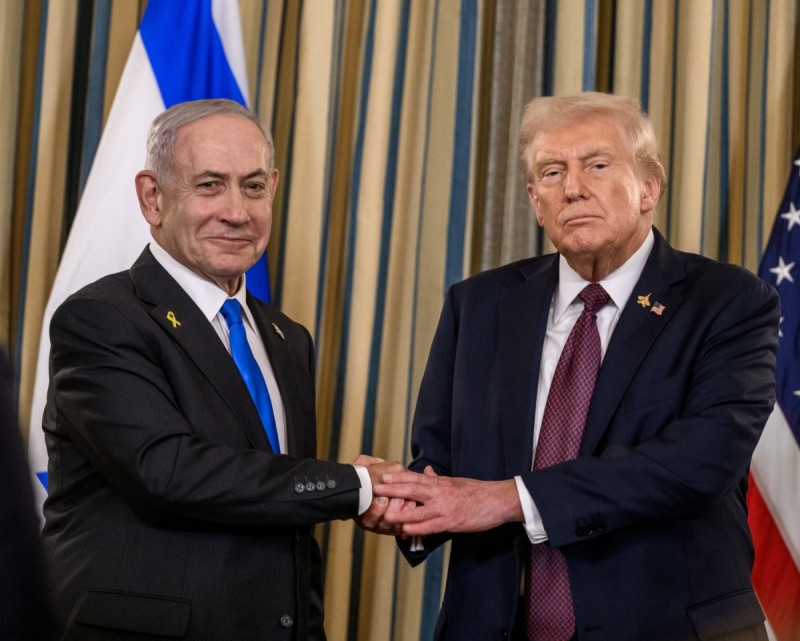
This is the background against which, on September 29, Trump and Netanyahu jointly unveiled the latest US “peace plan” at a White House press conference. Netanyahu had reportedly made several last-minute changes to the draft drawn up by Trump’s team, all to Israel’s advantage.
The 20-point plan calls for immediate suspension of all military operations, followed by the release of all Israeli captives within a 72-hour period. Israel will then release “250 life sentence prisoners plus 1,700 Gazans who were detained after Oct. 7, 2023, including all women and children detained in that context.”
This is only a fraction of more than 10,000 Palestinians languishing in Israeli jails, 3,600 of whom are held without charge or trial in “administrative detention”—many more hostages, as they are, than the 251 Israelis captured by Hamas in the October 7 attack.
It is grim testimony to the disproportionality of this “war” that “For every Israeli hostage whose remains are released, Israel will release the remains of 15 deceased Gazans.”
After the hostages are released, an amnesty will be extended to Hamas members who “commit to peaceful coexistence and to decommission their weapons,” while any who wish to leave Gaza “will be provided safe passage to receiving countries.” Hamas will disarm and “all military, terror, and offensive infrastructure, including tunnels and weapon production facilities, will be destroyed and not rebuilt.” Hamas and other factions “agree to not have any role in the governance of Gaza, directly, indirectly, or in any form.”
Once the agreement has been accepted, full aid “will proceed without interference from the two parties through the United Nations and its agencies, and the Red Crescent,” as well as unspecified third parties (likely a reference to the US-based private so-called Gaza Humanitarian Foundation, which has been responsible for the deaths of hundreds of Palestinians queuing for food).
Though this provision is likely to play badly in Israel, which has banned the UN’s Palestinian refugee agency UNRWA from operating within its boundaries, this is is the only role envisaged for the UN in the entire document.
The plan stipulates that “Israel will not occupy or annex Gaza” and promises that “No one will be forced to leave Gaza,” while “those who wish to leave will be free to do so and free to return.” As “a temporary International Stabilization Force” put together by “The United States… with Arab and international partners” trains “vetted Palestinian police forces in Gaza,” the IDF will gradually withdraw from the Strip to a perimeter “security zone.”
Gaza will meantime be governed by “a technocratic, apolitical Palestinian committee… of qualified Palestinians and international experts, with oversight and supervision by a new international transitional body… headed and chaired by President Donald J. Trump, with other members and heads of State… including Former Prime Minister Tony Blair.”
This “Board of Peace” will “set the framework and handle the funding for the redevelopment of Gaza until such time as the Palestinian Authority has completed its reform program… and can securely and effectively take back control of Gaza.”
As Patrick Wintour has perceptively noted in the Guardian, though it is not explicitly stated in the document, this “reform program” requires that the Palestinian Authority ends its participation in legal proceedings against Israel at the ICJ and ICC. (The text refers to the reform programme “as outlined in various proposals, including president Trump’s peace plan in 2020,” and the latter demands this.)
The Board of Peace will oversee a “Trump economic development plan to rebuild and energize Gaza”—is Trump’s dream of a “Riviera of the Middle East” about to come true?—and “A special economic zone will be established with preferred tariff and access rates to be negotiated with participating countries.”
Surrender or annihilation
It is significant that Hamas—whose negotiators Israel had attempted to assassinate in a September 9 air strike on Qatar—was not involved in drafting the plan or even provided with an advance copy. Palestinians are being presented with an ultimatum reminiscent of the one the Germans gave Rotterdam in 1940: surrender or your city will be destroyed.
And indeed, even while Hamas is considering the plan—for which Trump has demanded their answer “within three or four days”—Israel’s Defence Minister Israel Katz has issued a “final warning” on October 1 that “This is the last opportunity for Gaza residents who wish to do so to move south and leave Hamas operatives isolated in Gaza City,” making clear that “Those who remain… will be considered terrorists and terrorist supporters.”
If the Palestinians reject the plan, then in Donald Trump’s words at the White House press conference:
Israel would have my full backing to finish the job of destroying the threat of Hamas.
But I hope that we’re going to have a deal for peace, and if Hamas rejects the deal… Bibi, you’d have our full backing to do what you would have to do.
Netanyahu added: “If Hamas rejects your plan, Mr President, or if they supposedly accept it and then do everything to counter it, then Israel will finish the job by itself. This can be done the easy way or it can be done the hard way, but it will be done.”
The only positives in the Trump plan for the Palestinians are that it offers a possible road to ending the genocide—as is desperately needed—without Israel annexing Gaza or expelling its people, as the extreme rightwing ministers in Netanyahu’s government have demanded. In his earlier musings on a “Riviera of the Middle East” Trump too had envisaged “cleaning out” all of the Palestinians.
But even these modest consolations for the loss of Palestinian lives, homes, and hopes over the last two years are very far from guaranteed.
The plan requires Hamas to hand over all of the Israeli hostages before any Palestinian prisoners are released and to disarm on the basis of promises of amnesty while the IDF remains in Gaza. The timetable for withdrawal, by contrast, is vague and dependent on transfer of power to new security forces whose composition remains undetermined.
Once Hamas has given up its hostages and its weapons, there is nothing to stop Israel from reneging on the agreement—as it previously did with the January 2025 ceasefire—and “finishing the job” of genocide and ethnic cleansing against a defenceless Gazan population.
It is scarcely reassuring that after his return from Washington, Netanyahu put out a video reassuring Israelis that “the IDF stays in the majority of the Strip.”
Asked in the same video whether he had agreed to a Palestinian state, the Israeli prime minister replied: “Not at all, and it is not written in the agreement. One thing was made clear: We will strongly oppose a Palestinian state.”
This gives the lie to Emmanuel Macron’s claim—echoed by among others Antony Albanese and Mark Carney—that the Trump plan provides a foundation “to build a lasting peace in the region, based on the two-state solution.”
If Bibi has anything to do with it, there will be no such thing. Ever.
The plan does in fact mention Palestinian statehood, only to locate it firmly in the realms of the never-never:
While Gaza redevelopment advances and when the P.A. [Palestinian Authority] reform program is faithfully carried out, the conditions may finally be in place for a credible pathway to Palestinian self-determination and statehood, which we recognize as the aspiration of the Palestinian people. (My emphasis)
A week is a long time in politics
Little more than a week ago, Canada, Australia, Britain, France, and other Western allies broke ranks with Israel and the US and recognized a Palestinian state. Mark Carney and others made it clear that they were taking this step, in part, to forestall Israel’s attempts—about which Benjamin Netanyahu has been quite open—to sabotage any possibility of a two-state solution to the Israeli/Palestinian conflict.
Today, those same states are falling over backwards to lean on Hamas to accept a deal that disarms the Palestinian resistance, requires it to forgo any legal recourse for Israeli war crimes and/or genocide through the ICJ and ICC, hands Gaza over to an unelected foreign junta headed by Donald Trump and Tony Blair—onetime cheerleader of the Iraq War that left over a million Iraqis dead—to “redevelop,” and indefinitely postpones any prospect of Palestinian statehood. The word for this is betrayal.
French President Emmanuel Macron, German Chancellor Friedrich Merz, UK Prime Minister Keir Starmer, Australian Prime Minister Anthony Albanese, President of the EU Commission Ursula von der Leyen, and EU Foreign Minister Kaja Kallas, have all hastened to issue statements lauding “President Trump’s leadership” (Starmer) and hailing the plan as “the best immediate chance to end the war” (Kallas). “Elbows up” Mark Carney was the most sycophantic of them all, welcoming the deal as “historic.”
All agree that “Hamas has no choice but to immediately release all hostages and follow this plan,” with only Macron adding “I expect Israel to engage resolutely on this basis.”
One can almost hear the huge collective sigh of relief that went up in Western capitals as soon as the Trump plan was announced. The cracks are papered over, the delinquent allies are back in the US fold, and our craven leaders are off the genocide hook.
If Hamas fails to “seize this opportunity” (von der Leyen), we must infer, it has only itself to blame for the consequences.
The rewards of terror
Hamas senior leader Mahmoud Mardawi is bang on when he characterizes the Trump plan as offering “an end to this criminal war in exchange for ending the Palestinian people’s right to their state and their rights to their land, homeland, and holy sites.”
Mardawi is adamant that “no Palestinian will accept that,” but genocide is a powerful persuader.
Whether, out of desperation, Palestinians will buy this sordid “deal” remains to be seen. If they do, Israel gets its hostages back and it’s game over for the Palestinian resistance.
If they don’t, Israel will “finish the job” with full US backing and blame Hamas for forcing it to kill yet more Palestinian babies in order to ensure its security. Either way this is a win–win situation for Israel.
If, as Netanyahu says, a purely symbolic recognition of a non-existent Palestinian state is “an enormous prize” for the terror of Hamas’s October 7 attack, then how much greater are the rewards for the IDF’s two years of live-streamed genocide in Gaza?
The flag of the International Criminal Court at The Hague. Photo by Tony Webster/Wikimedia Commons.
A long time ago
“It was an extraordinary moment,” remembered Stephen Lewis, Canada’s ambassador to the United Nations from 1984 to 1988. “I was at the UN for four glorious years. I had never seen anything like it before, and I never saw anything like it afterwards…”
On October 23, 1985, Canadian Prime Minister Brian Mulroney gave an “electrifying” speech to the UN General Assembly, in which he not only denounced the evil of South African apartheid but promised Canada would to do everything in its power to end it:
Canada is ready, if there are no fundamental changes in South Africa, to invoke total sanctions against that country and its repressive regime. More than that, if there is no progress in the dismantling of apartheid, relations with South Africa may have to be severed absolutely.
At the next year’s Commonwealth Conference in Vancouver, Mulroney famously faced down British Prime Minister Margaret Thatcher over her opposition to sanctions, pointedly asking her whether she would respond in the same way “if she was dealing with a country with a population of 25 million whites that was ruled by four million blacks.”
Less than four years after Mulroney threw down the gauntlet at the UN, South African President F.W. de Klerk, under heavy international pressure from sanctions, began to dismantle the odious edifice of apartheid, legalizing the African National Congress and releasing its leader Nelson Mandela after 27 years imprisonment on February 11, 1990.
Mandela and de Klerk jointly won the Nobel Peace Prize in 1993, and Mandela went on to become South Africa’s first democratically elected president in 1994. That did not stop the US listing him as a “terrorist” until a few days before his 90th birthday in 2013, weeks before his death.
“On the 10th anniversary of our democracy,” Mandela wrote in a personal letter to Brian Mulroney in 2004:
one recalls the momentous time of our transition and remembers the people involved both within and outside South Africa. As prime minister of Canada and within the Commonwealth, you provided strong and principled leadership in the battle against apartheid. This was not a popular position in all quarters, but South Africans today acknowledge the importance of your contribution to our eventual liberation and success.
In a galaxy far, far away
A few months after his release, Mandela addressed the Canadian Parliament. Introducing his guest, Mulroney recalled “with pride, the stand taken by Canada’s prime minister, John Diefenbaker, at the Commonwealth Conference of 1961, which resulted in South Africa’s withdrawal from that body”:
Prime Minister Diefenbaker brought the Commonwealth to declare unequivocally that racial discrimination was totally contrary to its fundamental principles and that, if South Africa did not change, Mr. Diefenbaker said then South Africa must leave. He did so against some considerable opposition, but with the strong conviction and the certain knowledge that it was right. Mr. Diefenbaker’s action marked the beginning of international pressure on the apartheid regime.
The opposition came principally from the UK, together with Australia and New Zealand—countries that were once collectively referred to, alongside South Africa, Canada, and Newfoundland, as the British Empire’s “White Dominions.” The US was also not happy with Canada rocking the apartheid boat, since it saw South Africa as an important ally in the global fight against communism and the ANC as dangerously pro-communist. Not for the first or the last time in American history, geopolitics trumped any moral concerns.
Both Diefenbaker and Mulroney were Conservative politicians, and Mulroney had campaigned on a platform of improving relations with the US after the tensions of the Lester Pearson and Pierre Trudeau years—a promise that was to give us NAFTA. But this did not stop either of them from defying the United States when they believed it was necessary. They did not regard Canada’s membership of NATO (or the “Free World”) as requiring automatic deference to Washington’s priorities, or overlooking palpable evils like apartheid in the interests of maintaining a united Western front in the Cold War.
Canada’s Liberal governments, too, agreed on the need for an independent Canadian foreign policy, and were not afraid to break with the “elephant to the south” (as Pierre Trudeau characterized the US) when called for either. This might even be seen as a hallmark of Canadian identity—an essential one, if we must sleep next to the beast.
Diefenbaker refused to station US nuclear warheads on Canadian soil and gave only lukewarm backing to John F. Kennedy during the Cuban missile crisis. Lester Pearson criticized America’s Vietnam War (allegedly leading Lyndon B. Johnson to grab him by the lapels and yell “Don’t you come into my house and piss on my rug!”) and Pierre Trudeau provided sanctuary to American draft dodgers. Jean Chrétien declined to follow the US-led “Coalition of the Willing” into the Iraq War without approval by the UN.
This is not to say that Canada’s conduct on the world stage was above criticism. As Yves Engler and others have pointed out, Canada is a settler colony whose treatment of its Indigenous population—now as well as then—leaves much to be desired. Canada’s pivot to opposing apartheid in South Africa came late in the day, and its enforcement of sanctions was half-hearted. Thousands of Canadians were allowed to enlist in the US military and fought in Vietnam, while Canadian governments of both parties provided the US with multiple forms of covert support even while not officially joining the war effort.
All the same, there is a yawning moral gulf between Canadian policies then and now.
Canada and the ICC—then
The guiding principle of Canadian foreign policy during the latter part of the twentieth century was multilateralism. Governments of both parties portrayed Canada’s role in the world as advancing universal human rights rather than defending narrowly conceived national interests. Their preferred self-image was of Canada as a global peacemaker.
At times—as in the case of apartheid—the human rights agenda called for intervention, and the proper vehicle for this was international organizations like the UN, because they alone could alone provide legitimacy for such actions. The corollary was solid Canadian support for the institutional and legal framework established after the Second World War, above all the UN and its agencies, the Geneva Conventions, and international humanitarian law.
An important addition to this legal framework was the International Criminal Court (ICC), which was established by the Rome Statute in 1998, in part in response to the genocides in Rwanda and Bosnia. The ICC was intended to be “an independent, permanent court of last resort with jurisdiction to investigate and prosecute the most serious crimes of international concern, namely genocide, crimes against humanity, war crimes and aggression.”
Canada played a “pivotal role”—I quote the Canadian government official website here—in the ICC’s foundation.
Canada chaired the “Like-Minded Group,” a coalition of states “that helped to motivate the wider international community to adopt the Rome Statute.” A senior Canadian diplomat, Philippe Kirsch, was chosen to chair the conference in Rome that negotiated and drafted the statute “under Canada’s leadership.” Kirsch was subsequently elected as an ICC judge in February 2003 and served as the ICC’s first president until 2009.
Canada became “the first country in the world to adopt comprehensive legislation implementing the Rome Statute” in the form of the Crimes Against Humanity and War Crimes Act passed by the Canadian parliament in June 2002. This law for the first time “officially criminalizes genocide, crimes against humanity and war crimes based on customary and conventional international law, including the Rome Statute.”
In December 2017 a second Canadian, Kimberly Prost, was elected an ICC judge for a nine-year term. Prost’s previous experience had included 18 years at Canada’s justice department and positions with the Commonwealth Secretariat and the UN Office on Drugs and Crime. In 2006, she was appointed as a judge of the International Criminal Tribunal for the former Yugoslavia in a major trial related to the Srebrenica genocide.
Opposition to the ICC
Not all states welcomed the establishment of the ICC. At the end of the 1998 Rome conference, 120 countries (including almost all of the United States’ allies) voted in favor of the treaty. Seven countries opposed it—the US, China, Libya, Iraq, Qatar, Yemen, and Israel. Twenty-one countries abstained.
One hundred and twenty-five countries have signed and ratified the Rome Statute and as such are legally bound to co-operate with the court, including in arresting and transferring indicted persons or providing evidence and witnesses for ICC prosecutions.
All member states of the EU are ICC members (though Hungary has now signalled its intention to withdraw from the court), as are Australia, New Zealand, and all G7 members—apart from the United States. The US signed but did not ratify the Rome Statute under Bill Clinton, and John Bolton informed the UN in May 2003 on behalf of the George W. Bush administration that “the United States does not intend to become a party to the treaty,” and “has no legal obligations arising from its signature on December 31, 2000.”
Other states that have never signed up to and/or ratified the Rome Statute include Russia, China, and India—existing or aspiring regional superpowers who, like the US, are unwilling to let a multilateral court intrude on their sovereignty—and Israel. Among the reasons Israel gives for opting out is the ICC’s definition of “the transfer of parts of the civilian population of an occupying power into occupied territory” as a war crime.
Bush, Obama and Trump
US relations with the ICC remained fractious during the Bush administration. The American Service-Members’ Protection Act (ASPA) passed in January 2002 prohibited US cooperation with the ICC, blocked US funding of the ICC, and required the US “to enter into agreements with all ICC signatory states to shield American citizens abroad from ICC jurisdiction” under pain of sanctions if they did not comply.
That same year, the US threatened to veto renewal of all UN peacekeeping missions unless its troops were granted immunity from ICC prosecution. It withdrew this demand in 2004, after pictures emerged of US troops abusing Iraqi prisoners in Abu Ghraib.
The Obama administration cooperated with the ICC in various ways, including supporting the UN Security Council’s referral of Libya to the court in 2011 and sharing intelligence on ICC-indicted fugitives. But it never ratified the treaty—or repealed ASPA.
The first Trump administration reverted to hostility. When the ICC prosecutor’s office requested in March 2019 to open a probe into possible war crimes in Afghanistan, the US responded by threatening to revoke visas for any ICC staff seeking to investigate not only Americans, but also Israelis and other US allies.
The ICC wished to “look into methods that the US military and CIA used to interrogate detainees” in Afghanistan, because:
There is reasonable basis to believe that, since May 2003, members of the US armed forces and the CIA have committed the war crimes of torture and cruel treatment, outrages upon personal dignity, and rape and other forms of sexual violence pursuant to a policy approved by US authorities.
The US responded by taking the unprecedented step of individually sanctioning two top ICC officials, prosecutor Fatou Bensouda and head of jurisdiction Phakiso Monochoko.
Biden and the ICJ
On April 2, 2021, US President Joe Biden wrote to Congress announcing that he was ending Trump’s visa restrictions and sanctions on ICC officials. When the ICC issued an arrest warrant against Vladimir Putin in March 2023 for war crimes in Ukraine, Biden commented “Well, I think it’s justified… I think it makes a very strong point.”
Despite these signs of détente, the Biden administration’s “ironclad” defense of Israeli actions in Gaza increasingly brought the US into open conflict again with both the ICC and the International Court of Justice (ICJ)—the principal judicial organ of the United Nations, which is regarded as world’s highest court in matters of international law.
On December 29, 2023 South Africa brought an application to the ICJ charging the State of Israel with committing genocide in Gaza, and requested the court to order provisional measures to “protect against further, severe and irreparable harm to the rights of the Palestinian people under the Genocide Convention.”
On January 26, 2024 the court ruled that the risk of genocide in Gaza was “plausible,” and ordered Israel to take immediate steps to prevent the situation deteriorating further. These and further measures ordered by the ICJ on March 28 and May 24 were flouted by Israel and essentially ignored in Washington and other Western capitals. The US meantime used its UN Security Council veto to forestall any binding ceasefire motion.
Responding to the January 26 judgment, the US State Department emphasized that “Israel has the right to take action to ensure the terrorist attacks of October 7 cannot be repeated” and reasserted its belief that “allegations of genocide are unfounded.”
Canadian Foreign Affairs Minister Mélanie Joly issued a statement that paid lip service to “the ICJ’s critical role in the peaceful settlement of disputes and its work in upholding the international rules-based order,” while emphasizing that “Our support for the ICJ does not mean that we accept the premise of the case brought by South Africa.” Like the US, Joly spent more time discussing “Israel’s right to exist and defend itself” and Hamas’s brutalities on October 7 than addressing the ICJ orders, on which she had little to say.
The ICC arrest warrants
Relations between the international courts and the US reached their nadir on November 21, when the ICC issued arrest warrants for Benjamin Netanyahu and Israeli Defense Minister Yoav Gallant for “the war crime of starvation as a method of warfare” and “the crimes against humanity of murder, persecution, and other inhumane acts.”
Western politicians erupted. “The ICC issuance of arrest warrants against Israeli leaders is outrageous,” thundered Biden. “Let me be clear once again: whatever the ICC might imply, there is no equivalence—none—between Israel and Hamas. We will always stand with Israel against threats to its security.”1
Though he undertook to abide by the ICC ruling, Justin Trudeau found “the sense of an equivalency between the democratically elected leaders of Israel and the bloodthirsty terrorists that lead up Hamas” “troubling.”
The point both seem to have missed was that the equivalency lay in the war crimes both sides were alleged to have committed, which were equally contrary to international law.
0n February 6, 2025, just two weeks after he began his second term as US president, Donald Trump signed an executive order titled “Imposing Sanctions on the International Criminal Court.”
The first person to be individually sanctioned was ICC chief prosecutor Karim Khan, the man who was responsible for preparing the arrest warrants for Netanyahu and Gallant. Four more judges were sanctioned on June 5. Two more judges and two ICC assistant prosecutors were sanctioned on August 20. One of them was Canadian Kimberly Prost.
Canada and the ICC—now
The ICC denounced this latest US move as “a flagrant attack against the independence of an impartial judicial institution which operates under the mandate from 125 States Parties from all regions.” Belgium, Denmark, France, Finland, Estonia, the Netherlands, Norway, Senegal, Slovenia, Spain, and Sweden all condemned the US sanctions, as did Amnesty International, Human Rights Watch, the International Bar Association, and the European Parliament Subcommittee on Human Rights.
But from Canada—crickets. Well, to be precise, on August 20 Canada’s UN ambassador Bob Rae, responding to a CTV News report on the sanctions, angrily posted on X:
This US attack on the International Criminal Court and its judges is disgraceful. Judge Kim Prost are [sic] carrying out their public duties. Attacks on them by Russia, Israel and the US are intended to weaken and intimidate the international legalsystem. They must not succeed.
But for whatever reason—some have suggested that he was pressurized into doing so by the Canadian government—Rae quickly deleted the post. And that was that.
Ten days have passed since the US sanctioned Canada’s senior international judge, and there has been no official response from the Government of Canada.
Mark Carney supposedly had “a productive and wide-ranging conversation” with Trump on August 21 in which “We focused on trade challenges, opportunities, building a new economic and security relationship between Canada and the US, and supporting long-term peace and security for Ukraine and Europe.” Neither his post on X nor the official readout from the call contains any reference to Kimberly Prost. Carney has since made public pronouncements on the economy, Canada–US trade, Ukraine, and a new Canada–Poland Strategic Partnership, but he has remained silent on the issue of the ICC.
Foreign minister Anita Anand, whose brief this surely is, was reported to have expressed disquiet about Prost’s sanctioning in her meeting with Marco Rubio on August 21, but her own account of the meeting makes no mention of it. Her brief X post reads, “Today, I had a productive meeting with Secretary @SecRubio in Washington. We discussed collaboration on shared priorities, including: supporting Ukraine, advancing Arctic security, addressing the security crisis in Haiti and continuing to provide humanitarian aid in Gaza.”
So far as I am aware, no other statement regarding American strongarming of the ICC—the court Canada worked so hard to establish back in the day—or the sanctioning of Kimberly Prost has been issued by any Canadian government agency or senior officials.
Elbows down
On Friday August 22, two days after Marco Rubio sanctioned Kimberly Prost, the Integrated Food Security Phase Classification (IPC), the world’s hunger watchdog, declared a state of famine in and around Gaza City. Its report emphasized that “This famine is entirely man-made, it can be halted and reversed.”
This seems highly unlikely since Israel is now in the early stages of a new offensive to recapture Gaza City, and is in the process of clearing out an estimated 1m inhabitants.
If not yet a truth universally acknowledged, it is certainly a truth that is increasingly recognized that since 1967, Israel has enforced a cruel apartheid regime within the Occupied Palestinian Territories, and that since October 8, 2023, the IDF has been engaged in war crimes, crimes against humanity, and probable genocide in Gaza.
Many Palestinians would argue that the genocide is merely the culmination of a Zionist program of ethnic cleansing that began with the establishment of the state of Israel and the attendant Nakba in wars of 1947-8.
It would be nice, even at this very late stage in the day, if some Western leader were to electrify the UN with a speech calling for total sanctions against Israel and its repressive regime and threatening absolute severance of relations with Israel—or even a UN-led peacekeeping military intervention—if there is no progress in dismantling the apartheid regime or halting the ethnic cleansing and genocide.
Of one thing we can be sure. That leader will not be Mark Carney. We can be equally confident that Anita Anand will not emulate Dutch foreign minister Caspar Veldkamp and several of his cabinet colleagues in quitting the government in protest at its refusal to implement stronger sanctions against Israel.
I hold no particular brief for Brian Mulroney—or John Diefenbaker, or Lester Pearson, or Pierre Elliott Trudeau, or Jean Chrétien. They all had their faults. But they were Titans compared with the moral Lilliputians who govern Canada today. I can’t imagine any of them would have thrown Kim Prost under the bus to get “the best trade deal with the United States… better than that of any country.” Even the language echoes Trump.
Nor, I suspect, would they have stood by for two years while Israel obliterated Gaza and bombed, shelled, and finally starved hundreds of thousands of Palestinian men, women and children to death—whatever the reason. Never again means never again.
While most have carefully avoided using the word genocide, the list of politicians who have been staunch defenders of Israel’s “right to defend itself” but are now condemning its actions in the strongest of words—but not doing very much more—is growing fast.
Following the Israeli war cabinet’s decision on August 8 to launch a new offensive to recapture Gaza City—an action likely to cause thousands more deaths and certain to displace a million more starving Palestinians to the overcrowded “evacuation zones” in southern Gaza—Carney and Starmer condemned this “escalation.” But there is no sign of the “concrete actions” the UK, France, and Canada threatened on May 19 if Israel did not “cease the renewed military offensive and lift its restrictions on humanitarian aid.”
The foreign ministers of Australia, Germany, Italy, New Zealand, and the United Kingdom (later joined by Austria, Canada, France, Norway, and the EU commission) got together to rush out a statement on August 9 “strongly rejecting” the Israeli decision to expand the war and urging “the parties and the international community to make all efforts to finally bring this terrible conflict to an end now.”
This was followed on August 12 with a statement signed by no less than 25 foreign ministers and two high representatives of the EU, lamenting that “humanitarian suffering in Gaza has reached unimaginable levels.”
The ministers complained that:
due to restrictive new registration requirements, essential international NGOs may be forced to leave the OPTs [Occupied Palestinian Territories] imminently which would worsen the humanitarian situation still further. We call on the government of Israel to provide authorisation for all international NGO aid shipments and to unblock essential humanitarian actors from operating. Immediate, permanent and concrete steps must be taken to facilitate safe, large-scale access for the UN, international NGOs and humanitarian partners. All crossings and routes must be used to allow a flood of aid into Gaza, including food, nutrition supplies, shelter, fuel, clean water, medicine and medical equipment. Lethal force must not be used at distribution sites, and civilians, humanitarians and medical workers must be protected.
Neither of these statements threatened any sanctions if Israel chose not to comply.
Surprisingly, German Chancellor Friedrich Merz came closest to actually doing anything to restrain Israel when he announced that “Under these circumstances, the German government will not authorise any exports of military equipment that could be used in the Gaza Strip until further notice.” Because of its past role in the Holocaust, Germany regards the security of Israel as a raison d’être of the German state (Staatsräson) and is Israel’s second-largest supplier of arms after the US.
Giorgia Meloni’s Italy, too, says it is contemplating sanctions on Israel “as a way to save its citizens from a government that has lost its reason and humanity.” “We are not facing a military operation with collateral damage,” Defense Minister Guido Crosetto said in an interview with La Stampapublished on August 11, “but the pure denial of the law and the founding values of our civilization.”
France’s President Emmanuel Macron has spearheaded a move to get Western powers to join the 147 countries (out of 193 UN member states) that already recognize the state of Palestine. Britain, Canada, and Australia have undertaken to do so in September at the UN, albeit with conditions. Whether or not such recognition happens, in the absence of stronger measures this too will remain little more than an empty symbolic gesture.
The Trump administration in the US has meantime doubled down on its support for Israel. But fractures are appearing in the Democratic Party, which provided the Israeli government with “ironclad” backing throughout the Biden-Harris administration.
Thirty Democratic members of Congress have signed onto Delia Ramirez’s Block the Bombs Act to block offensive weapons sales to Israel, while on July 31, in the words of Senator Bernie Sanders:
By a vote of 27-17, Senate Democrats voted to stop sending arms shipments to a Netanyahu government which has waged a horrific, immoral and illegal war against the Palestinian people. The tide is turning. Americans don’t want to spend billions to starve children in Gaza.
Even Trump’s MAGA ally Marjorie Taylor Greene has gone on record saying “It’s the most truthful and easiest thing to say that October 7 in Israel was horrific and all hostages must be returned, but so is the genocide, humanitarian crisis, and starvation happening in Gaza.”
This is all way too little and way too late for the people of Gaza. Whether it is better than nothing at all remains to be seen. As of now, this performative Western outrage is little more than a sideshow that leaves the IDF free, as Donald Trump put it, to “finish the job.”
Seeing the light
Politicians are not the only ones claiming to have had their eyes recently opened to the full horror of Israel’s crimes. Many credit photos of famine victims for their conversion. We can now add the no less horrifying photographs and powerful video footage of the “wasteland of rubble, dust and graves” to which two years of Israeli bombardment have reduced Gaza, shot by journalists from Jordanian planes dropping aid packages.
It was with “immense pain and a broken heart,” Israel’s most celebrated living writer David Grossman told the Italian daily La Repubblica on August 1, that “For many years, I refused to use that term, ‘genocide.’ But now, after the images I have seen and after talking to people who were there, I can’t help but use it…” Quoting Grossman’s words later got left-wing lawmaker Ofer Cassif expelled from Israel’s Knesset chamber.
Grossman was one of over 2,300 cultural figures to sign two recent Israeli petitions denouncing the “killing of children and civilians, the starvation and displacement of the population, and the destruction of cities across the Gaza Strip” as “atrocities on a historic scale,” which are “currently taking place in our name against a population that is only several kilometers away, in an impossible reality and terrible suffering.”
Across the democratic world, hundreds of writers, artists, film makers and others in the cultural industries have signed petitions condemning Israel’s actions. In Canada, “500+ law professors, lawyers, academics, former ambassadors, and civil society, faith and labour leaders” sent Mark Carney an open letter prior to the June 15 Kananaskis G7 summit imploring him “to catalyze G7 action to end the genocide.” It has yet to receive an acknowledgment from the prime minister’s office, let alone an official response.
Something is clearly changing when Bob Geldof, of “Do They Know It’s Christmas (Feed the World)” fame, breaks his silence to accuse Israel of “lying. Netanyahu lies, is a liar. The [Israeli forces] are lying.” He added:
It enrages me to a point beyond comprehension when I see the images published by Sky News and what [former Gaza-based British surgeon] Dr [Nick] Maynard has been reporting from inside Gaza. And at that point, I thought, the 40th anniversary of Live Aid, my own past and history with this—I thought I should say something now.
Now? Where have you been for the last two years, Bob? Remember five-year-old Hind Rajab? Seven-year-old Sidra Hassouna, hanging dead from the wall of a bombed-out apartment building in Rafah, her legs shredded to ribbons of flesh in an Israeli air strike?
Remember Rafah, which Joe Biden once said was his “red line,” a city of 200,000 people that the IDF has now pulverized to unrecognizable ruins?
Purity and danger
In the US, Jewish Currents Editor-at-Large Peter Beinart has suggested that “a kind of dam has broken… in mainstream media discourse and public discourse more generally”:
people are much more willing to say things that they were reluctant to say in the past, that there is starvation in Gaza, that it is Israel’s fault, and that beyond that, that this slaughter and starvation, this assault on the people of Gaza, has to end, and that it’s immoral.
This applies even more in other Western countries, where popular support for Israel has never been as strong as in America and opinion polls indicate it is now in steep decline. Up to 300,000 people marched across Sydney Harbour Bridge for Gaza on August 3, completely wrongfooting Australia’s government. These were not your usual suspects.
Nor were the 522 people arrested in Parliament Square in London on August 9 as they protested the UK government’s proscription of Palestine Action under the Terrorism Act. The signs they were carrying—for which they can now be sentenced to up to 14 years in prison—read “I oppose genocide, I support Palestine Action.” This was the most arrests the Metropolitan Police had made in a single operation in at least the last decade. Half of those detained were over 60, nearly 100 were in their 70s, and 15 were in their 80s.
While Beinart welcomes latecomers and converts to the cause, “even if they come painfully late, and much, much later than one would like,” and counsels that “to gain the power to change policy, [you] have to swell beyond the initial group of activists and bring in people who may not be as morally pure as those people,” he is equally insistent that:
it’s also really, really important to remember and… elevate the voices of people who were correct initially, who said things early on that I think have turned out to be factually and morally correct. Because the danger is, if you don’t do that, then you… end up, you just replicate, you don’t change the… structure of discourse.
Among those voices, he instances Rabbis for Ceasefire; the student protestors who “were greeted… for being prematurely correct… with being suspended and being expelled and by beaten up by the police who were called in”; and “the writers, the intellectuals who said things about Israel’s attack that have proven to be correct.”
He name-checks several Palestinian writers and activists, including Representative Rashida Tlaib, who was censured by Congress in 2023 for “representing the deadliest day for Jews since the Holocaust… as justified ‘resistance’ to the ‘apartheid state.’”
The danger now is that in our outrage at the awful images that are overwhelming our newsrooms and the pious statements proliferating from our politicians we will forget Beinart’s “prematurely correct” voices and reproduce the same discursive tropes that have enabled, sustained, and gaslit the Gaza slaughter even as we criticize Israel.
We need to face up to the conditions that produced these horrors—and this requires us to jettison some widespread liberal illusions not only about Israel, but also about the part played in this human calamity by the free, democratic, civilized West.
An ancestral homeland?
The congressional motion censuring Rashida Tlaib in November 2023 began “Whereas Israel has existed on its lands for millennia and the United States played a critical role in returning Israel to those lands in 1948… in recognition of its right to exist…”
Western politicians habitually frame the Israel-Palestine conflict in terms of “the Jewish people’s right to self-determination in their ancestral homeland” (I quote Justin Trudeau). But the modernconnection between the Jewish people and Israel is tenuous. It is the Palestinians who have existed on this land for millennia—who are its Indigenous inhabitants—and the Israelis who are immigrants. Israeli historian Shlomo Sand argues that a majority of present-day Israeli Jews are in fact the descendants of converts.
Nobody disputes the existence of Jewish kingdoms in what is now Israel during the first millennium BCE. But Jews were never the only people living in the area—what was the Biblical Samson doing among the Philistines in Gaza? Many Jews were expelled by the Romans after defeat of rebellions in 70-71 and 132-36 CE. Most of those who remained converted to Christianity under the Byzantine Empire or Islam after the Muslim conquest in 635-7 CE, without the ethnic composition of the land being significantly altered.
Were we to apply the Zionists’ “ancestral homeland” logic and timeframe elsewhere in the modern world, we would have to return England to the Celts, kick the Hungarians and Slavs out of Central Europe, and expel everyone of European descent from the Americas, Australia, and New Zealand. It is a poor justification for a genocide.
Or a settler colony?
By any sane definition, present-day Israel is a settler colony, which was established and has since been maintained by often extreme violence against the indigenous population.
In 1878, according to Ottoman records, Palestine had 462,465 inhabitants, of whom 403,795 (87 percent) were Muslim, 43,659 (10 percent) were Christians, and just 15,011 (three percent) were Jewish. Zionist-inspired Jewish immigration from Europe began in the 1890s, fuelled by pogroms in the Russian Empire. By the end of World War I, when the Ottoman Empire was broken up, Palestine’s population was still 90 per cent Palestinian.
Encouraged by Britain, which governed Palestine under a League of Nations mandate from 1922, Jewish immigration snowballed, particularly after the rise of the Nazis in Germany. By 1944 Jews made up 30 percent of Palestine’s population. Tensions between Palestinians and Jewish incomers peaked in the Great Arab Revolt of 1936-9.
Jewish numbers grew by 100,000 (including 70,000 Holocaust survivors) immediately after World War II. Seeking to establish a Jewish state, the Irgun (led by future Israeli PM Menachem Begin), and Lehi (led by future Israeli PM Yitzhak Shamir) militias used terrorist tactics against the British, including hanging captured British soldiers held as hostages and bombing the King David Hotel in Jerusalem with the loss of 91 lives.
Things came to a head in 1947, when Britain informed the UN of its intention to leave Palestine. A UN plan to partition the territory into two states, which would have given the minority Jewish community 56 percent of the land, was rejected by the Palestinians.
Civil war between Jews and Palestinians broke out at the end of November 1947, in which both sides committed atrocities. During the Deir Yassin massacre of April 9, 1948, Irgun and Lehi slaughtered over 100 Palestinian villagers, including women and children.
On the day British forces withdrew, May 14, 1948, David Ben-Gurion unilaterally declared “the establishment of a Jewish state in Eretz-Israel.” Troops from Egypt, Jordan, Syria, and Iraq, later joined by units from Lebanon, Saudi Arabia, and Yemen, poured across the borders. The Jewish militias were meanwhile absorbed into the newly-created IDF.
After ten months of fighting Israel not only held the land allotted to it by the UN partition plan but 60 percent of the land intended for the Arab state, as well as West Jerusalem.
Jaffa, Palestine, 1920.
The great replacement
The population of Gaza is largely made up descendants of at least 750,000 refugees driven out during the 1947-8 war in what Palestinians call the Nakba (catastrophe), boosted by refugees from the 1967 Six Day War. Israeli historian Ilan Pappé writes that:
In a matter of seven months, 531 villages were destroyed and eleven urban neighborhoods emptied. The mass expulsion was accompanied by massacres, rape, and the imprisonment of males over the age of ten in labor camps for periods of over a year. (Ten Myths About Israel, chapter 1)
The total population of Palestine fell from 1,970,000 in 1947 to 872,700 in 1948. In 1947, Jews made up 32 percent of that population; by 1948, 82.1 percent. If you want to know what a real demographic “great replacement” looks like, this is it.
Between 15 May 1948 and the end of 1951, more than 684,000 new Jewish immigrants—many, now, fleeing from Arab lands where they had lived for centuries—settled in Israel. According to the UN:
Of the 370 Jewish settlements established between 1948 and the beginning of 1953, 350 were established on land abandoned by the Palestinians. In 1954 more than one-third of Israel’s Jewish population, plus 250,000 new Jewish immigrants, settled in whole cities that had been completely deserted by the Palestinians as a result of the military operations of 1948.
The so-called Law of Return, granting every Jew in the world the right to settle in Israel, was passed by the Knesset on July 5, 1950. More than 3.25 million Jews have availed themselves of this right since 1948.
In flagrant violation of international law, Palestinians driven out in the Nakba have no right of return to the lands they and their forbears had lived in and cultivated for millennia.
The “war” didn’t start on October 7
Israel’s supporters insist that the present “war” in Gaza “began”—to quote the stock phrasing that has been repeated in hundreds of news articles over the last two years—”when Hamas-led militants killed around 1,200 people, mostly civilians, in the October 7 attack and abducted 251 hostages.” Not only is this inaccurate as regards the actual events of October 7. More importantly, it totally ignores their immediate context.
Gaza is part of the occupied Palestinian territory (OPT) Israel seized from Egypt and Jordan in the 1967 Six Day War. After that war, the UN Security Council unanimously—that is, with American, British, and French support—adopted Resolution 242 mandating “withdrawal of Israel armed forces from territories occupied in the recent conflict.”
Despite further UN resolutions, Israel has not only failed to comply with this demand for 58 years, but has established Jewish settlements in the OPT in defiance of international law. The rate of settlement has increased hugely in recent years, with a 40 percent rise in the West Bank since the formation of Netanyahu’s government at the end of 2022.
While this context cannot justify the war crimes and crimes against humanity that the ICC charged Hamas leaders with committing during the October 7 attack, it goes a long way toward explaining why Hamas launched such a desperate attack in the first place.
Hamas’s attack was not unprovoked
In a landmark ruling of July 19, 2024, the ICJ held not only that “Israel’s continued presence in the Occupied Palestinian Territory is unlawful,” but also that Gaza remains part of the OPT because Israel:
continue[s] to exercise, certain key elements of authority… including control of the land, sea and air borders, restrictions on movement of people and goods, collection of import and export taxes, and military control over the buffer zone, despite the withdrawal of its military presence in 2005 […] This is even more so since October 7, 2023.
As B’Tselem summarized the situation in January 2021, “the military occupation has not ended: Palestinians in the West Bank remain its direct subjects, while in the Gaza Strip they live under its effective control, exerted from the outside.”
Hamas narrowly won elections in 2006 and expelled its rival Fatah, which nominally governs in the West Bank, from the Gaza Strip the following year. Israel responded by imposing a tight land, sea and air blockade in June 2007, turning the beleagured enclave into what Human Rights Watch has described as the world’s largest open-air prison.
Conflict has flared intermittently ever since, with Hamas and other militias firing rockets into Israel, which has responded with periodic military operations the IDF derisively calls “mowing the lawn.”
This is not an equal contest. Between January 2008 and October 6, 2023, Israel killed 6,540 Palestinians (5,360 of them in Gaza). In the same period 309 Israelis were killed by Palestinian action—a fatality ratio of 21 to 1. The disproportion speaks for itself.
IDF snipers, firing through the perimeter fence, killed 266 people and injured 30,000 during the (peaceful) weekly Great March of Return demonstrations of 2018-19. In May 2022, Israeli forces shot and killed journalist Shireen Abu Akleh—one of many more such killings to come (the most recentbeing the assassination of Al Jazeera journalist Anas al-Sharif and his crew in a targeted airstrike on their tent near al-Shifa Hospital in Gaza City on August 10). Two days before Hamas’s October 7 attack, 832 Jewish settlers stormed the al-Aqsa mosque in Jerusalem—the third holiest site in Islam.
If these are not provocations, the word has lost all meaning.
Israel’s response was not self-defense
As the occupying power in the OPT—including Gaza—Israel’s responsibilities toward the Palestinians under international humanitarian law include:
the obligation to ensure humane treatment of the local population and to meet their needs, the respect of private properties, management of public properties, the functioning of educational establishments, ensuring the existence and functioning of medical services, allowing relief operations to take place as well as allowing impartial humanitarian organizations such as the ICRC [Red Cross] to carry out their activities.
Israel’s conduct toward Gaza’s civilian population since October 2023 flagrantly ignores any and all of these legal obligations.
Leaving aside for the moment Palestinian deaths and injuries, the IDF had damaged more than 190,000 buildings by early April 2025—roughly 70 percent of Gaza’s structures—of which 102,000 were destroyed. This translates to roughly 300,000 homes lost.
By August 6, 80 percent of Gaza’s commercial facilities, 88 percent of school buildings, and 68 percent of road networks had been destroyed or significantly damaged, and only 50 percent of Gaza’s hospitals were even partly functioning. According to the latest UN data, Palestinians now have access to only 1.5 percent of cropland suitable for cultivation. The IDF demolished Gaza’s only functioning cancer hospital on March 21. The same fate was suffered by Al Israa University—the last remaining university in Gaza—in January 2024.
In an appendix to the ICJ July 19, 2024 judgment, Justice Hilary Charlesworth explained that:
the population in the occupied territory does not owe allegiance to the occupying Power, and … is not precluded from using force in accordance with international law to resist the occupation.
“On the assumption that Israel is the victim of an armed attack triggering the right to self-defence,” she goes on:
The use of force in self-defence … is directed at restoring the situation as it was prior to the armed attack. This purpose distinguishes lawful self-defence from measures that aim to punish the aggressor for the harm inflicted. The latter measures constitute armed reprisals, which are prohibited under international law.
“Whether the use of force employed by the victim of an armed attack serves the purpose of self-defence,” she concludes,” is determined by “standards of necessity and proportionality.”
An existential threat?
As of August 6 at least 61,709 people, including 17,492 children, had been killed in Gaza a direct result of IDF military action; more than 111,588 people had been injured; and more than 14,222 are missing and presumed dead. These figures, which come from the Gazan health ministry, are widely believed to be a serious undercount. The IDF lost 454 soldiers in Gaza during the same period. This is disproportionate by any criteria.
But was this killing and destruction militarily necessary? In order to restore the status quo ante, which is all international law allows?
Or was it an armed reprisal—a collective punishment inflicted on Gaza’s civilians in order to demonstrate, in Benjamin Netanyahu’s promise to Israelis at the outset of the present war, that “We will exact a price that will be remembered by them and Israel’s other enemies for decades to come”? A reprisal that also serves the Zionist longterm objective of ridding Eretz Israel, by one means or another, of its indigenous Palestinian population?
At the outset of hostilities the IDF estimated Hamas to have some 30,000 fighters. In contrast to Israel—a nuclear power with one of the strongest, most experienced, and technologically sophisticated militaries in the world—Hamas has no navy or air force, tanks or armoured vehicles. Its armoury is made up of light automatic weapons, grenades, mortars, explosives, improvised rockets, and anti-tank guided missiles and shoulder-launched anti-aircraft missiles. It is, we might say, a David to Israel’s Goliath.
“Brutal,” “savage,” and “barbaric” as Hamas’s October 7 attack may have been, it was in essence a DIY assault from paragliders, small boats, bulldozers, pickup trucks, and motorbikes. It revealed serious failures in Israel’s security (which Benjamin Netanyahu has repeatedly refused to have investigated until after the “war” is over) but it hardly adds up to what Israel’s supporters have loudly proclaimed to be an existential threat.
Hamas is even less of a threat now, when Israel claims to have eliminated at least 20,000 of its fighters and destroyed its command structure. Much as it might wish to wipe Israel from the face of the earth and reestablish Islamic domination from the river to the sea, Hamas doesn’t remotely have the capacity to do so—either now, or in any foreseeable future.
At this point it must be asked—as it should have been long, long ago—if this has long ceased to be (and possibly never was) a war of self-defense, why is Israel still fighting?
It’s not a “humanitarian crisis,” it’s a genocide
For whatever reasons—geopolitics, economics, guilt at turning a blind eye to the Holocaust, Islamophobia, racism—for the last two years Western politicians, with the overwhelming support of the mainstream media, have supported Israel’s genocidal campaign in Gaza and done their best to brand all opposition as “antisemitism.”
Not only have they provided Israel with arms and diplomatic cover at the UN and elsewhere, frustrating any coordinated international response to impose a ceasefire. They have repeatedly ignored orders from and sought to discredit the world’s two highest courts, the ICJ and the ICC. They have eroded their citizens’ civil liberties by criminalizing pro-Palestinian actions and vilifying pro-Palestinian speech.
They have gaslit their populations, requiring us to believe that when Israel destroys a hospital or a school in Gaza it is because Hamas has a tunnel underneath it; that the doctors, nurses, aid workers, and journalists it has killed, often with their whole families, are all Hamas operatives; and that the IDF is “the most moral army in the world.”
Perhaps most insidiously—and here Islamophobia and racism do work their evil—they have tried to convince us that when Hamas commits war crimes they are the result of primitive, barbaric, fanatical religious hatred, but when Israel commits the same crimes on a massively greater scale, it is defending not only itself but “Western civilization.”
I predict that in the coming days and weeks we will see plenty of blame for the “humanitarian crisis” in Gaza being laid at the door of Benjamin Netanyahu, who will seemingly do anything to survive in office (and keep out of jail). But the problems go far deeper than Bibi appeasing his extremist right-wing ministers to keep his coalition intact and his government in power.
The West may now be finally waking up to the full enormity of the horrors Israel has inflicted in Gaza. It needs also to wake up to the evils it has nurtured not just for the last two years, but for over a century, under the banner of “the Jewish people’s right to self-determination in their ancestral homeland.” It is time we started listening to Palestinian voices, while there are still Palestinians left alive to speak truth to power.
Girl in Gaza on her way to get food. Photo by Jaber Jehad Badwan/Wikimedia Commons.
After reneging on its January ceasefire agreement with Hamas, Israel imposed a total blockade on aid into Gaza on March 2 and cut off remaining electricity supplies a week later. It resumed its military assault on March 18. Since then, Gaza’s health authorities have recorded a further 8,196 fatalities and 30,094 injuries. The death toll from IDF actions since the present “war” began on October 7, 2023 has now passed 60,000.
United Nations data show that throughout July the IDF has been killing one person every 12 minutes. “An average of 119 Palestinians are being killed daily so far in July—the highest rate since January 2024. More than 401 Palestinians a day are being wounded, the highest figure since December 2023.”
To put this in perspective, this means that in the last month Israel has killed, on average, more people in Gaza every week than the 736 Israeli civilians who died during Hamas’s October 7 attack on southern Israel (many of them casualties of Israeli “friendly fire”)—the event that triggered, and has repeatedly been used to justify, Israel’s present “war.”
For Pity’s Sake, Stop This Now!
Aid agencies have been warning of imminent famine for months, threatening the lives of Gaza’s 2.1 million inhabitants—or whatever portion of them have survived nearly two years of IDF bombardment—who have no means of escape from the besieged enclave. Deaths from hunger are now rising exponentially, beginning with the most vulnerable.
The children die first. In conditions of starvation, their growing bodies’ nutritional needs are higher than those of adults, and so their reserves are depleted faster. Their immune systems, not yet fully developed, become weaker, more susceptible to disease and infection. A bout of diarrhoea is lethal. Their wounds don’t heal. The babies cannot be breastfed as their mothers have not eaten. They die at double the rate of adults.
On July 29, the Integrated Food Security Phase Classification, or IPC—the world’s official famine watchdog—for the first time issued a famine alert, as distinct from a warning, for Gaza, stating that:
The worst-case scenario of Famine is currently playing out in the Gaza Strip. Conflict and displacement have intensified, and access to food and other essential items and services has plummeted to unprecedented levels.
Mounting evidence shows that widespread starvation, malnutrition, and disease are driving a rise in hunger-related deaths. Latest data indicates that Famine thresholds have been reached for food consumption in most of the Gaza Strip and for acute malnutrition in Gaza City.
Immediate action must be taken to end the hostilities and allow for unimpeded, large-scale, life-saving humanitarian response. This is the only path to stopping further deaths and catastrophic human suffering.
Recent days have seen a tsunami of horrific headlines, illustrated by graphic photos of starving children. In the UK, the Guardian’s July 23 lead story blared: “‘We faced hunger before, but never like this’: skeletal children fill hospital wards as starvation grips Gaza.” The article was illustrated with a mother-and-dying-child image that seems destined to become as iconic as Nick Ut’s famous Vietnam War photo “Napalm Girl.”
The front page of the Daily Express—a right-wing populist tabloid—carried the same photo, captioning the image “For Pity’s Sake, Stop This Now.” The accompanying article was headlined “The suffering of little Muhammad clinging on to life in Gaza hell shames us all.” The paper’s head of news Callum Hoare posted on X:
The brutal suffering in Gaza must end. The shocking image shows Muhammad Zakariya Ayyoub al-Matouq, one, who weighs the same as [a] three-month old baby due to the humanitarian crisis following the continued blocking of basic aid to civilians by Israel.
Spain’s El País showed a child’s outstretched hand holding a crust of bread under the headline, “Hunger in Gaza sparks global outcry to stop the war.” India’s Economic Timespaired a front-page editorial calling Israel’s actions “genocidal” with a photo of empty cooking pots outside a damaged building. The Washington Post led with “Mass Starvation Stalks Gaza” and a photo of a another Palestinian woman holding another emaciated infant.
Is “balance” finally giving way to truth?
Western newsrooms are no longer taken in by IDF propaganda videos purportedly showing “senior Hamas terrorists boasting about their meals in underground terror tunnels” while gorging on fresh fruit—a tall order, since Israel has been blockading the Strip since March 2. Nor are they uncritically accepting Israeli official statements as statements of fact, as most of them have shamefully done for the last two years.
BBC News—which has repeatedly, and justifiably, been accused of systematically downplayingPalestinian sufferings and whitewashing Israeli war crimes—issued a joint statement on July 24 with AFP, AP, and Reuters, which backhandedly conceded that the IDF indeed is using starvation as a weapon of war in Gaza. It began:
We are desperately concerned for our journalists in Gaza, who are increasingly unable to feed themselves and their families. For many months, these independent journalists have been the world’s eyes and ears on the ground in Gaza. They are now facing the same dire circumstances as those they are covering.
Journalists endure many deprivations and hardships in warzones. We are deeply alarmed that the threat of starvation is now one of them.
The statement neglected to mention that in the interests of keeping the genocidal truth under wraps, Israel has banned international media from Gaza and so far killed 232 local journalists in the course of its current “war”—more than the number of journalists killed in the US Civil War, the First and Second World Wars, the Korean War, the Vietnam War, the wars in Yugoslavia, and the post-9/11 war in Afghanistan combined.
Even the New York Times, which has been steadfast in its support for Israel throughout its “war” on Gaza, carried a long and damning essay by the renowned Israeli Holocaust scholar Omer Bartov headlined “I’m a Genocide Scholar. I Know It when I See It.” To be fair, the paper carried an op-ed by Bret Stephens a few days later arguing “No, Israel Is Not Committing Genocide in Gaza,” in the interests not of truth but of “balance.”
Despite Israel’s increasingly implausible attempts to deny that there is famine in Gaza—or to shift the blame to Hamas (which a recent USAID investigation found is not “stealing aid,” a conclusion that was repeated later by IDF senior officers interviewed by the New York Times) or the UN (ignoring Israel’s own ban on UNRWA in Israel and the occupied Palestinian territories and refusal of visas to UN agency personnel)—the dam has broken.
When “aid distribution centres” become killing fields
In late May, under international pressure, Israel permitted the US-backed so-called Gaza Humanitarian Foundation (GHF) to distribute meagre and inappropriate aid packages through four centres set up to replace the 400-plus distribution points previously run by UNRWA and other international aid agencies. The GHF is a private body, staffed largely by US contractors, with no prior experience of supplying humanitarian aid in war zones.
Benjamin Netanyahu admitted that allowing this “minimal” aid was only done to keep US politicians onside. Israel’s National Security Minister Itamar Ben Gvir denounced the change in policy as “a grave mistake,” while Heritage Minister Amichay Eliyahu argued that “letting humanitarian aid in now directly harms the war effort to achieve victory.”
On July 8, following the death of five Israeli soldiers in a Hamas ambush—a drop in the ocean compared with the daily Palestinian civilian casualties—Ben Gvir demanded “a total siege, a military crushing, encouraging immigration and settlements” and Finance Minister Bezalel Smotrich called on Netanyahu to “immediately halt” aid for Gaza. They could hardly have made it clearer that Israeli combatants’ deaths will be paid for many times over by Palestinian civilian lives, whatever the Geneva Conventions might say.
Outside of the so-called “humanitarian zones,” to which over 90 percent of Gaza’s inhabitants have been compulsorily evacuated and now live in squalid tents—which the IDF still regularly hits, claiming to target “Hamas militants” but killing and maiming many more civilians with every strike—82.6 percent of the Gaza Strip is now within the Israeli-militarized zone or under displacement orders. Three of the GHF centres are located in the ruins of Rafah in the south, the other in Deir al-Balah in central Gaza.
Hundreds of Palestinians have been massacred when lining up for food at GHF centres or trying to reach them. As of July 15, per the Office of the United Nations High Commissioner for Human Rights (OHCHR), 875 people had been killed trying to access food for their families, 674 of them in the vicinity of GHF sites. That number has now passed 1,000.
Interviewed for the BBC World Service on July 25, retired US special forces officer Lt. Col. Anthony Aguilar, a former Green Beret, explained why he had quit his job with GHF:
I witnessed the Israeli Defense Forces shooting at the crowds of Palestinians… Without question I witnessed war crimes by the [IDF], using artillery rounds, mortar rounds, and tank rounds against unarmed civilians… I have never witnessed such a level of brutality and use of indiscriminate and unnecessary force against a civilian population—an unarmed, starving population.
Lies, damned lies, and hasbara
Charging that “Today, Palestinians in Gaza face an impossible choice: starve or risk being shot while trying desperately to reach food to feed their families,” on June 30 more than 240 international charities and NGOs, including Oxfam, Save the Children, and Amnesty International, issued a joint statement calling for “immediate action to end the deadly Israeli distribution scheme (including the so-called Gaza Humanitarian Foundation) in Gaza, revert to the existing UN-led coordination mechanisms, and lift the Israeli government’s blockade on aid and commercial supplies.”
Donald Trump’s Ambassador to Israel Mike Huckabee, former Republican governor of Arkansas, knows better. On July 24 he posted on X two photographs, which we are to assume were shot in Gaza though no date or location is given, with the comment:
Here are photos of UN trucks & enough food to feed all of Gaza but it sits rotting! UN is a tool of Hamas! US based GHF is actually delivering food FOR FREE and SAFELY. UN food is either looted by Hamas or rots in the sun! Photos from yesterday.
Huckabee, whose “evangelical Christian beliefs,” per the official US embassy website, “include support for Israeli control over their ancient and indigenous homeland,” clearly believes his responsibilities including shilling for hasbara (Israeli public diplomacy aimed at explaining and promoting Israel’s policies and image internationally). It would be nice to see him apply the same argument about ancestral homelands to the Indigenous inhabitants of the United States, but let that pass. Israel’s rights are judged by different standards.
Huckabee also believes that “There is no such thing as a Palestinian” and “no such thing as a West Bank. It’s Judea and Samaria. There’s no such thing as a settlement. They’re communities, they’re neighborhoods, they’re cities. There’s no such thing as an occupation.” This is of course music to Ben Gvir, Smotrich, and Netanyahu’s ears.
UN spokesperson Farhan Haq has cited “a number of interdependent factors” that have stopped UN aid being delivered even when it has reached Gaza, including “bureaucratic, logistical, administrative, and other operational obstacles imposed by Israeli authorities”—something former British Foreign Secretary and one-time Prime Minister David Cameron complained about back in March 2024—and “shooting incidents that have killed and injured people gathering to offload aid supplies along convoy routes.”
One recent shooting incident is related by Cindy McCain, the widow of US Senator John McCain and head of the World Food Program:
Shortly after passing the final checkpoint beyond the Zikim crossing point into Gaza, the convoy encountered large crowds of civilians anxiously waiting to access desperately needed food supplies… As the convoy approached, the surrounding crowd came under fire from Israeli tanks, snipers and other gunfire. We are deeply concerned and saddened by this tragic incident resulting in the loss of countless lives.
Today’s violent incident comes despite assurances from Israeli authorities that humanitarian operational conditions would improve; including that armed forces will not be present nor engage at any stage along humanitarian convoy routes. There should never, ever, be armed groups near or on our aid convoys, as reiterated on many occasions to all parties to the conflict.
Without these fundamental conditions in place, we cannot continue providing life-saving support across the Gaza strip.
The politicians react
If key sections of the Western media are now changing their tune on Gaza, disgust with Israel’s treatment of Palestinians is even more pronounced among the wider public.
A survey carried out by Pew Research Center published on June 3 found that in 20 of 24 countries surveyed, half of adults or more have a negative view of Israel. Among Western or Western-aligned nations, Israel was viewed “very” or “somewhat unfavourably” by 79 percent of respondents in Japan, 78 percent in the Netherlands, 75 percent in Spain and Sweden, 74 percent in Australia, 72 percent in Greece, 66 percent in Italy, 64 percent in Germany, 63 percent in France, 62 percent in Poland, 61 percent in the UK, 60 percent in Canada and South Korea, and even—remarkably, in view of bipartisan support for Israel among both Republican and Democrat party leaderships—53 percent in the US.
This was before the recent blanket press coverage of the growing famine and almost daily massacres of Palestinians seeking food at the GHF distribution centres.
Wrong-footed by events, and under immense pressure from their respective publics, Western politicians have been falling over themselves to take back the narrative.
On July 21, Canada joined 24 other Western nations and the EU Commissioner for Equality, Preparedness and Crisis Management in a statement that firmly rapped Israel over the knuckles for its most recent transgressions in Gaza:
The suffering of civilians in Gaza has reached new depths. The Israeli government’s aid delivery model is dangerous, fuels instability and deprives Gazans of human dignity. We condemn the drip feeding of aid and the inhumane killing of civilians, including children, seeking to meet their most basic needs of water and food. It is horrifying that over 800 Palestinians have been killed while seeking aid. The Israeli Government’s denial of essential humanitarian assistance to the civilian population is unacceptable. Israel must comply with its obligations under international humanitarian law.
On July 25 the leaders of Britain, France, and Germany issued another statement reminding Israel that “withholding essential humanitarian assistance” is “unacceptable” and describing the situation in Gaza as a “humanitarian catastrophe.” They added that they “stand ready to take further action to support an immediate ceasefire and a political process that leads to lasting security and peace for Israelis, Palestinians and the entire region,” without saying what that action might comprise.
No doubt Keir Starmer and Emmanuel Macron would rather we forgot that they had signed a joint statement with Canada’s Mark Carney calling on the Israeli government “to stop its military operations in Gaza and immediately allow humanitarian aid to enter Gaza,” and threatening “If Israel does not cease the renewed military offensive and lift its restrictions on humanitarian aid, we will take further concrete actions in response,” two months ago, on May 19. Needless to say no actions of any consequence were taken.
The time for covering asses is at hand
Aware, perhaps, of their potential liability under the Geneva Conventions for not doing everything within their power to prevent genocide—or at least war crimes and crimes against humanity—in Gaza, individual Western politicians have meantime been lining up to put their immense sympathy for the Palestinian people on record.
Keir Starmer proclaims “The suffering and starvation unfolding in Gaza is unspeakable and indefensible. While the situation has been grave for some time, it has reached new depths and continues to worsen. We are witnessing a humanitarian catastrophe.”
Starmer’s Foreign Secretary David Lammy says he is he is “appalled, sickened” by the “grotesque” targeting of starving Palestinians. “These are not words that are usually used by a foreign secretary who is attempting to be diplomatic,” he adds, “but when you see innocent children holding out their hand for food, and you see them shot and killed in the way that we have seen in the last few days, of course Britain must call it out.”
Australia’s PM Antony Albanese laments that “The situation in Gaza has gone beyond the world’s worst fears… Gaza is in the grip of a humanitarian catastrophe. Israel’s denial of aid and the killing of civilians, including children, seeking access to water and food cannot be defended or ignored.”
EU foreign policy supremo Kaja Kallas (who stated on July 15 that “the EU will not move forward with sanctions against Israel”) protests that “The killing of civilians seeking aid in Gaza is indefensible.” “The images from Gaza are unbearable,” posts Ursula von der Leyen, President of the European Commission, “Israel must deliver on its pledges.”
Canadian government representatives have been more reticent in their condemnations—a good deal more reticent than when they denounce instances of alleged “antisemitism.”
But noting on July 24 that “denial of humanitarian aid is a violation of international law,” Mark Carney stated that “Canada condemns the Israeli government’s failure to prevent the rapidly deteriorating humanitarian disaster in Gaza.”
Foreign Affairs Minister Anita Anand echoed her boss, posting on X the same day:
The humanitarian crisis in Gaza worsens by the day. Women and children are starving, without adequate access to food and water, the most basic of needs. It is inexcusable and must end… the Israeli government must allow the uninhibited flow of humanitarian aid to reach Palestinians civilians, who are in urgent need.
New Democrat Party MP (and candidate for NDP leader) Heather McPherson asks, not altogether unreasonably:
For nearly 21 months @NDP has urged action from Canada: recognize Palestinian statehood, impose sanctions, suspend CIFTA, implement arms embargo. In a caucus of 169 MPs only a handful of Liberals have spoken out for Palestine. Why the Liberal silence? Cowardice? Racism?
It’s only words
Several things need to be said about this belated outpouring of sympathy for innocent Palestinians on the part of politicians who have been arming, diplomatically supporting, and repressing domestic criticism of Israel’s genocide for the last two years.
First, however tough their language, they never use the word genocide—or the terms war crimes and crimes against humanity. The reason is pretty clear. To do so would not only acknowledge these governments’ past complicity in the worst crimes known to the law, but legally require them to act immediately to end that complicity in the future.
The preferred term is always “humanitarian catastrophe,” which naturalizes the event—equating it with other things that cause famine, like crop failures, floods or drought—and shifts the focus away from the human actors and actions that have caused it.
Second, there is a systematic attempt to suggest that it is only now that the situation has become catastrophic. The implication is that it was legitimate to support Israel’s assault on Gaza previously. As one puzzled comment on X put it:
I have been wondering why the Zionists’ stepped up use of hunger as a mass murder weapon has suddenly triggered a Western outcry, but two years of pre-announced, and equally vile, mass murder via bombs and bullets did not generate the same outcry.
Third—and most importantly—none of these statements, however strongly worded, have been followed by any action that would put real pressure on Israel to change its behaviour. And knowing this, Israel continues to largely ignore Western protests.
Even Emmanuel Macron’s historic promise to recognize a Palestinian state—a largely symbolic gesture, albeit a significant one—has been attacked by Donald Trump, and Britain and Canada, who at one time looked prepared to join him, are now reportedly getting cold feet for fear of angering the US.
It is not as if the international community doesn’t have plenty of weapons at its disposal to force compliance on rogue states.
Apartheid South Africa was kicked out of the UN and subjected to stringent economic, sporting, and cultural sanctions and boycotts that eventually brought the system to its knees. The first Gulf War against Iraq was fought under UN auspices, and the second by a US-led “coalition of the willing.”
The most obvious contemporary example of such international action—which contrasts sharply with the West’s pusillanimous avoidance of any meaningful action to stop Israel’s carnage in Gaza—was the coordinated response to Russia’s invasion of Ukraine, which has been met with wave after wave of sanctions.
For whatever reasons—be they geopolitical, economic, or racist—not to take comparable action against Israel is a choice. Our choice.
Our genocide
Faced with widespread Western condemnation, Netanyahu has now agreed to allow air drops of aid into Gaza and daily 10-hour “humanitarian pauses” in three areas of the Strip to enable UN convoys and other aid organizations to safely distribute food and medicine. As in his earlier pivot in May, he explained that given the international reaction, Israel “needs to continue to allow the entry of a minimum amount of humanitarian aid.”
I see this as a purely tactical retreat, like Netanyahu’s earlier acceptance under US pressure of two ceasefire deals which he subsequently broke. He went on to reassure Israelis that “We will continue to fight, we will continue to act until we achieve all of our war goals—until complete victory.” His fundamental objectives have not changed.
On July 28, the day after Netanyahu’s announcement, Israel’s leading human rights organization B’Tselem announced the publication of a report titled Our Genocide on social media. They did not pull their punches or mince their words:
Israel is committing genocide in Gaza.
It sounds inconceivable. But it’s the truth.
Israel is taking deliberate, coordinated action to destroy the Palestinians in the Gaza Strip. Explicit statements by Israeli officials, combined with a consistent policy of destructive attacks and other practices of annihilation, prove beyond a doubt that Israel’s target is the entire population of Gaza.
Entire cities razed to the ground; medical, educational, religious and cultural infrastructure systematically destroyed; 2 million Palestinians forcibly displaced with the aim of expelling them from Gaza; and, of course, mass starvation and killing—all this amounts to an explicit attempt to destroy the population of Gaza and impose living conditions so catastrophic that Palestinian society cannot continue to exist there.
That is the exact definition of genocide.
They continued:
The international community has not only failed in its duty to stop the atrocities, but the leaders of the Western world, particularly the United States and Europe, also share responsibility by providing support that enables Israel’s acts of destruction. It is the duty of the international community to stop the genocide Israel is carrying out in Gaza…
Displaced Palestinians roam the shattered streets of the Gaza Strip. Photo by Jaber Jehad Badwan.
As I write this, the press are reporting that a third ceasefire in Gaza is imminent, with Donald Trump committing to “ensuring negotiations continue until a final agreement is reached.” Whether this will end Israel’s “war,” which began on October 7, 2023 and has now raged for 21 months, killing a documented 57,012 Palestinians (as of July 2) and in all likelihood many thousands more, remains to be seen.
In the meantime, a stocktaking of some of the key events of the last momentous month seems in order.
The “12-Day War”
Israel launched what it called a “pre-emptive strike” against Iran during the night of June 13. More than 200 IDF fighter jets hit more than 100 nuclear and military facilities and residential neighbourhoods in Tehran and other cities, and Israel assassinated 30 of Iran’s top military commanders and 11 of its nuclear scientists in targeted individual strikes.
Iran retaliated by attacking Israel with successive barrages of ballistic missiles. As of June 24, the IDF had killed 610 people in Iran, including 49 women and 13 children, and injured 4,746. Iran’s missiles killed 28 people in Israel and injured 3,238.
The excuse for Israel’s unprovoked attack—for which, as has become customary for Israel, no evidence was ever provided—was that Iran was “on the verge of acquiring a nuclear weapon.” Benjamin Netanyahu has periodically made this claim since 1992.
Though US National Intelligence Director Tulsi Gabbard told Congress in March that Iran “was not building a nuclear weapon, and its supreme leader had not reauthorized the dormant program even though it had enriched uranium to higher levels,” Donald Trump chose to disregard his intelligence agencies’ assessment. “I don’t care what she said,” he told reporters on June 17. Heknew Iran was “very close” to having a nuclear bomb.
The US entered the conflict directly on June 22, dropping big, beautiful™ bunker-buster bombs on Iran’s Fordow, Natanz, and Isfahan nuclear facilities. Trump claimed that the strike had “completely and totally obliterated” Iran’s nuclear program, but the US’s own intelligence assessments (which the White House soon trashed) suggested the program had maybe been set back at best by a few months. For whatever it is worth, the latest Pentagon assessment is that “We have degraded their program by one to two years.”
At the point when Israel attacked, Iran was engaged in ongoing talks with the US to renew the nuclear agreement Donald Trump torpedoed in 2018. One of those targeted in Israel’s first strike was the lead Iranian negotiator, Ali Shamkhani. The IDF bombed his Tehran home, leaving him buried under the rubble with serious injuries. Three weeks earlier Trump boasted of “real progress, serious progress” in the talks, describing them as “very, very good.”
None of this inspires confidence in Israel or the US as trustworthy negotiating partners in any future peace process. Why should Iran—or anyone else—believe a word they say?
Circling the wagons
After Israel reneged on its ceasefire agreement with Hamas and launched a renewed Gaza offensive on March 18, killing over 400 people in one single night of terror, and imposed a complete blockade on power, food, and medical aid to the Strip, sections of the press and other influential opinion in the West had increasingly challenged its “self-defence” narrative. For a time at least, political leaders appeared to be listening.
This changed abruptly after June 13. Despite the fact that Israel, not Iran, was the clear aggressor—and notwithstanding the well established principle that pre-emptive actions are permissible under international law only “if the threat is imminent, overwhelming, and leaves no alternative but to act”—most Western states swallowed whatever misgivings they had previously expressed about Gaza and once again fell in line behind Israel.
The calls for “all parties to exercise maximum restraint and to de-escalate” (Emmanuel Macron) were invariably accompanied by reiterations of “Israel’s right to defend itself”—which is not, on any reasonable view, what it was doing—and an insistence that (in the words of Canadian Foreign Minister Anita Anand) “Iran cannot obtain nuclear weapons.”
Nothing was said about Iran’s right to defend itself, even though it was the attacked party. Nor did it seem to matter that unlike Iran, Israel does possess nuclear weapons, has never signed the Nuclear Non-Proliferation Treaty (NPT), and refuses to allow the International Atomic Energy Agency (IATA) to inspect its nuclear facilities.
Absurdly, the politicians took the fact that Iran responded militarily to Israel’s aggression—which is to say, defended itself—as confirmation of this alleged threat.
Writing on behalf of the EU on June 18, Kaja Kallas insisted that “Israel has the right to protect its security and people, in line with international law,” while “Iran must take decisive steps to return to negotiations and pave the way for a diplomatic solution.” What law she had in mind she didn’t say. Article 51 of the United Nations Charter only recognizes the “right of individual or collective self-defence if an armed attack occurs.”
“Canada condemns Iran’s attack on Israel” began Anand’s June 13 post, without any mention of the Israeli strikes that provoked it. Germany, too, “strongly condemn[ed] the indiscriminate Iranian attack on Israeli territory,” adding that “Iran’s nuclear program violates the Non-Proliferation Treaty and poses a threat to the entire region—especially to Israel.” Once again there was silence on the threat posed by Israel’s nuclear arsenal.
German Chancellor Friedrich Merz said the quiet bit out loud during the G7 summit on June 17, letting slip to a journalist: “This is dirty work that Israel is doing for all of us.”
A “Zionist Palestinian state”
On June 24 Mark Carney told CNN’s Christiane Amanpour the Iran-Israel ceasefire offered an “opportunity” not only to end the war in Gaza but for “lasting peace in the Middle East” built around—wait for it—“a Zionist, if you will, Palestinian state.”
This goes beyond anything ventured by Carney’s predecessors Justin Trudeau (who proudly declared “I am a Zionist” on March 3, the same day as Israel cut off Gaza’s electricity supply and blockaded all aid for 11 weeks), and Stephen Harper. At the least, it is tone deaf. Worse, as the Canadian Muslim Public Affairs Council (CMPAC) put it:
By suggesting that Palestinians must be a “Zionist” state as the condition for their own statehood, Carney denies them the basic right to define their own national character and political future. Self-determination is a core principle of international law, affirmed in the UN Charter and multiple human rights treaties, and it cannot be made contingent on adopting the ideological identity of their occupier.
The UN General Assembly resolution calling for an immediate ceasefire in Gaza and “strongly condemning the use of starvation as a weapon of war, demanding a full lifting of the Israeli blockade on humanitarian aid, and insisting on the protection of civilians under international law,” which passed with an overwhelming majority of 149 to 12 on June 12—the day before Israel’s attack on Iran—with the backing of the UK, France, Germany, Canada, Italy, Australia, and New Zealand, was quietly forgotten.
So was an international conference co-hosted by France and Saudi Arabia scheduled to take place on June 17-20 at the United Nations in New York, at which, it was suggested, all parties should accept that “Palestinian statehood should not be a result of peace, but rather its prerequisite.” It was even briefly hinted that France might recognize Palestine at the conference pour encourager les autres. But after June 13 all bets were off.
The conference has now been indefinitely postponed. As Colombia’s President Gustavo Petro has written, this “has left a critical void in multilateral leadership, precisely when it is needed most.” The only Palestinian statehood still left on the table seems to be Mark Carney’s “Zionist Palestine.”
Shifting public opinion
Notwithstanding this backtracking to business as usual on the part of Western leaders, Western publics seem less and less willing to overlook the continuing genocide in Gaza. The genie is out of the bottle, and the gaslighting isn’t working any more.
A YouGov EuroTrack survey conducted in Britain, Denmark, France, Germany, Italy and Spain published on June 3 found that while there was little evidence of support for Hamas (only five to nine percent of respondents believed the October 7 attack on Israel was justified), just six to 16 percent believed Israel was “right to send troops into Gaza” and “responded in a proportionate way to the Hamas attacks.” Between seven and 18 percent said they sympathized with Israel, while 18–33 percent said their sympathies lay with the Palestinians. Germany was the only country where the results were evenly matched (17 percent for Israel, 18 percent for Palestine).
In Britain, in a poll conducted on June 18 by YouGov for Action For Humanity and the International Centre for Justice for Palestinians, over half of respondents opposed Israel’s military campaign in Gaza (55 percent) and only 15 percent supported it. A large proportion of those opposed to the campaign thought Israel was committing genocide (82 percent).
Even in the US, where support for Israel has long been an item of faith for both major political parties, the landscape seems to be shifting. A Quinnipiac University poll in early June showed 37 percent of Americans sided with and 32 percent opposed the Israelis—which is a historically narrow margin. This is consistent with several other polls earlier in 2025.
A Harris-Harvard poll commissioned by the Israeli Knesset reported in the Jerusalem Post on June 26 showed a drop from 53 percent to 41 percent in the percentage of Americans who view Israel favourably, and—most worryingly for Israel’s supporters—found young people were closely split (53 to 47 percent) between supporting Israel and supporting Hamas.
An upset in New York
Zohran Mamdani’s decisive victory over establishment candidate Andrew Cuomo in the June 24 Democratic primary election for mayor of New York City has been universally described as a major upset not only because he is a member of Democratic Socialists of America campaigning on an avowedly progressive platform, but—above all—because of his unequivocal support for the Palestinian cause.
Despite refusing to back down on his criticism of Israel’s “genocidal” conduct of its Gaza campaign and being comprehensively vilified as a Muslim (which he is) and a jihadist supporter of Hamas (which he is not), Mamdani won 56 percent of the vote to Cuomo’s 44 percent. His 545,000 votes are the most in a Democratic mayoral New York City primary since David Dinkins beat incumbent Ed Koch in 1989.
Nobody is suggesting that Mamdani’s stance on Gaza is the only reason he won—though his victory does lend weight to the argument that Kamala Harris’s refusal to deviate from Joe Biden’s “ironclad” support for Israel played a significant part in the Democrats’ loss to Donald Trump in the 2024 presidential election.
But that a candidate who supports the Boycott, Divestment, and Sanctions movement, called for the release of detained Columbia activist Mahmoud Khalil, and promised to arrest Benjamin Netanyahu if he ever sit foot in New York, could win so emphatic a victory in the most Jewish city in America, attracting broad-based support across different ethnic groups—including large numbers of Jews—testifies to just how out of touch with the public the official narratives have become.
Predictably, Republicans responded to Mamdani’s win with outraged pearl clutching and unconcealed Islamophobia. But what is most concerning is that while the success of Mamdani’s campaign might point to a road back to power for a Democratic Party still reeling from its 2024 defeat, establishment Democrats were no more enthusiastic.
“Top Democratic donors” are quoted as finding the primary outcome “disgusting,” and Barack Obama has declined to congratulate Mamdani. House minority leader Hakeem Jeffries, New York’s Democratic Governor Kathy Hochul, and New York Congressman Tom Suozzi are all holding backon endorsing Mamdani in the mayoral election.
They prefer to confine their “resistance,” it seems, to the gestural theatrics of renaming Trump’s “One Big Beautiful Bill Act” and making marathon speeches to which nobody listens. Just as in November’s presidential election, they would rather lose than antagonize Israel.
The protests grow
In Britain, judges, lawyers, and legal academics and prominent writers have issued open letters condemning the UK’s complicity in Israel’s genocide and government and media attempts to quash dissent. Even the august British Medical Association voted by large majorities at its annual conference on July 3 to break off relations with the Israel Medical Association and seek its suspension from the World Medical Association over Gaza.
On the eve of the Cannes Film Festival, more than 370 actors and filmmakers proclaimed that “As artists and cultural players, we cannot remain silent while genocide is taking place in Gaza,” condemning “propaganda that constantly colonizes our imaginations.” The signatories included Joaquin Phoenix, Pedro Pascal, Juliette Binoche, Rooney Mara, Omar Sy, Jim Jarmusch, Richard Gere, Mark Ruffalo, Guy Pearce, Javier Bardem, Ralph Fiennes, Michael Moore, David Cronenberg, Pedro Almodovar, and Guillermo del Toro.
On June 9 “532 Canadians, including academics, lawyers, former and retired ambassadors (including to the United Nations), ministers and public servants, UN human rights experts, and civil society, labour and faith leaders,” wrote to Mark Carney urging “decisive action to end genocide in Gaza.” On July 5 the Anglican Church of Canada adopted a resolution “calling on the Canadian government to uphold their moral responsibilities and impose full and immediate arms embargo on Israel.”
Protest marches continue across the world. From London and Paris to Sydney and Melbourne, from Athens and Barcelona to Dublin and Toronto, hundreds of thousands have hit the streets. This year’s bull-running San Fermin festival in Pamplona, Spain, turned into a massive show of solidarity with Palestine. On June 15, in one of the biggest demonstrations ever seen in the Netherlands, 150,000 people dressed in red and marched for Gaza in The Hague. On June 21, for the first time on such a scale, 50,000 people marched for Gaza in Berlin.
Revulsion at Israel’s genocide in Gaza is no longer confined to student activists and “lunatic left” professors at Columbia and Harvard, and it can no longer be dismissed as the result of “antisemitism.” The chasm between Western political establishments and the people they claim to represent grows wider by the day.
This is a pervasive crisis of legitimacy.
Ructions at the BBC
Nowhere is that crisis better illustrated than in recent events at the British Broadcasting Corporation.
A recent report by the Centre for Media Monitoring, based on analysis of more than 35,000 pieces of BBC content, found that despite Palestinians suffering 34 times as many deaths as Israelis since the present Gaza “war” began, Israeli deaths were given 33 times more coverage and described in much more emotive language. The BBC interviewed significantly fewer Palestinians than Israelis, and presenters shut down interviewees’ claims of genocide while making no mention of Israeli leaders’ genocidal statements (including Benjamin Netanyahu’s notorious invocation of the biblical Amalek).
In May the corporation fired Gary Lineker, Britain’s most popular soccer commentator and longtime host of Match of the Day, the BBC’s equivalent of Hockey Night in Canada, for social media posts critical of Israel. Lineker had previously blotted his copybook by daring to speak out over government heartlessness toward refugees and migrants.
On June 20, after months of delays, the BBC cancelled a documentaryit had itself commissioned on Israel’s attacks on Gaza’s health service on grounds that showing the film would create “a perception of partiality.” Based entirely on first-hand testimonies, the film detailed “how hospitals in the territory have been overwhelmed, bombed and raided. Medics recount being detained and claim to have been tortured.”
Channel 4 showed Gaza: Doctors Under Attack in the UK on July 2 and Mehdi Hassan’s Zeteo media platform made it available for streaming internationally. It was widely hailed as “a crucial film” that “the world needs to see.”
On the same day as the film was broadcast, more than 400 BBC staff, freelancers and industry figures, including 111 BBC journalists—who signed anonymously for fear of reprisals—wrote an open letter to BBC management expressing “concerns over opaque editorial decisions and censorship at the BBC on the reporting of Israel/Palestine.”
The letter expressed particular concern that board member Robbie Gibbs, “an individual with close ties to the Jewish Chronicle… has a say in the BBC’s editorial decisions in any capacity, including the decision not to broadcast Gaza: Medics Under Fire [sic].”
Death, death to the IDF
In the midst of the row over Gaza: Doctors Under Attack, a new confrontation erupted over the BBC’s coverage of Glastonbury, Britain’s most popular music festival, which regularly attracts over 200,000 spectators and has long been televised live by the BBC.
In the weeks preceding the festival, pressure was put on the organizers by members of the government, including Keir Starmer, as well as the Conservative opposition leader Kemi Badenoch, to drop the Irish band Kneecap from the roster. Kneecap had made themselves notorious with their earlier performances at the Coachella music festival in California, at which they led the audience in chants of “Free, free Palestine.”
On June 18 Kneecap fans “mobbed sidewalks outside a London court” as the trial opened of band member Mo Chara under Britain’s draconian Terrorism Act. His offense was waving a Hezbollah flag at a concert in North London on November 21 “in a manner that aroused ‘reasonable suspicion’ he supported the Lebanese militant group.”
The Glastonbury organizers refused to cancel Kneecap’s performance, and the band took the stage on June 28. Reportedly “thousands of fans chanted ‘free Palestine’ and waved Palestinian flags,” but BBC viewers were not allowed to see this because the corporation pulled the plug on the live feed. The broadcaster later uploaded an edited version of the performance to BBC iPlayer as part of its on-demand Glastonbury sets.
Kneecap performs at Glastonbury. Photo by Katherine Hajiyianni.
Unfortunately for the BBC, another even more controversial set, by the punk-rap duo Bob Vylan, slipped under the wire. Looking out from the West Holts stage on a sea of Palestinian flags, rapper Bobby Vylan led the 45,000-strong crowd in chants of “Free, free Palestine” and “Death, death to the IDF.”
Bob Vylan’s entire performance was broadcast live, although “a warning was issued on screen about the very strong and discriminatory language” and it was decided not to make the set available on demand via iPlayer. This did not stop pressure mounting on the BBC, as the police announced a criminal investigation into Kneecap and Bob Vylan’s performances and lurid headlines filled the conservative and tabloid press.
Whacking the moles
Two days later, BBC Chair Samir Shaw issued a contrite statement, which apologized “to all our viewers and listeners and particularly the Jewish community for allowing… Bob Vylan to express unconscionable antisemitic views live on the BBC” and acknowledged that continuing the broadcast was “an error of judgement.”
He promised that “The Executive have agreed to put in place a set of strengthened editorial practices and policies for live music programming” and was “initiating a process to ensure proper accountability for those found to be responsible for the failings in this incident.”
On July 7, the Timesreported that Lorna Clarke had resigned her position as BBC director of music “after UK Culture Secretary Lisa Nandy condemned the “appalling and unacceptable scenes,” adding that “other senior BBC staff have also temporarily relinquished their day-to-day roles over the Glastonbury controversy—pending an investigation.” Needless to say Robbie Gibbs is still in place.
Clarke’s is not the only scalp Nandy is after. She is also demanding to know why nobody had yet been fired at the corporation for permitting an earlier documentary, Gaza: How to Survive a Warzone, to slip through the censorship net and be broadcast in February.
The BBC pulled the program from its iPlayer after it emerged that its 13-year-old narrator was the son of a deputy agriculture minister in the Hamas-controlled Gaza administration. By then the damage was done. Palestinian children had been allowed to speak of their own experiences in their own words, and we can’t have that, can we?
I have asked the question to the board [of the BBC]. Why has nobody been fired? What I want is an explanation as to why not. If it is a sackable offence then obviously that should happen. But if the BBC, which is independent, considers that it is not, I think what all parliamentarians want to know is why.
It seems not to have occurred to her that if parliamentarians—or a government minister—can interfere in the BBC’s internal affairs to the extent of demanding to know why staff have not been sacked, its independence is (to say the least) seriously compromised.
Doubling down
Bob Vylan have now been dropped by their agency, banned from several music festivals in the UK and elsewhere, had a number of European gigs cancelled, and seen their US visas revoked by the State Department, scuppering their upcoming US tour. Their following on Spotify has meantime soared and their 2024 album Humble as the Sun has re-entered the charts. Currently it is number one on the UK hip-hop and R&B albums chart, and number seven on the album downloads chart and number eight on the independent albums chart.
It is difficult to think of a clearer indication of today’s societal rifts over Israel and Gaza.
On the one hand, we have ever-growing public revulsion over Western complicity in the Gaza genocide. On the other, we see the political establishment doubling down on a narrative of Israeli self-defence that is losing whatever emotional purchase it once had—a doubling down that is increasingly enforced by the full power of the state.
In the US, they are deporting pro-Palestine activists and withholding research funding from universities they falsely accuse of being “antisemitic.” In Britain, parliament has just proscribed Palestine Action, a protest group whose most violent action to date has been throwing red paint over military aircraft, as a “terrorist organization”—on a par with al-Qaida, Hezbollah, or Hamas. To support it now carries a sentence of 14 years in prison.
The first arrests have just been made by the Metropolitan Police. They include an emeritus professor, several health professionals, and a 83-year-old retired priest, Sue Parfitt, who said the ban was “a very dangerous move that has to be challenged.”
Wither the West?
On June 21, 75 German professors published a letter to the German government arguing that “Your current actions, like those of the previous government, are violating international law and are politically highly dangerous: Germany is actively undermining the international legal system that was established after the Second World War, partly as a response to German crimes.”
It concluded by demanding “an immediate end to the restrictions on academic freedom and freedom of speech in Germany”:
Currently, critical voices on Israel’s actions and its occupation are being defamed using scientifically questionable definitions of antisemitism, events are being cancelled, and protests—including student protests at universities—are being criminalized … The systematic suppression and marginalization of voices expressing criticism and solidarity contribute to Germany’s complicity in Israeli violations of international law—both those already committed and those ongoing—and must end.
The point does not only apply to Germany—or to academia. The demolition of the rule of law in the international arena goes hand in hand with the destruction of liberties at home.
We might well ask, as the Irish poet W.B. Yeats did in an earlier time of troubles:
And what rough beast, its hour come round at last,
“Postcards from Absurdistan is the third in a loose trilogy of books Derek Sayer has written about modern Czech cultural history … Put next to one another, the trilogy’s some 1,700 pages provide a tour de force of Czech cultural history … Sayer’s mise-en-scène and his analysis are always erudite, sometimes revisionist and frequently compelling … the book and the trilogy are tremendous achievements … this eminently readable book … is a well-balanced introduction to the Czech twentieth century for students and the wider public, and also offers many insights for expert scholars. Derek Sayer has written a deserving conclusion to his Czech trilogy.”—”The Last Postcard from Prague,” Felic Jeschke, CEU Review of Books
“Beginning with the intimate relationship between Franz Kafka and the Czech feminist, journalist, and writer Milena Jesenská, the book embarks on a colorful journey through the fates of hundreds of figures of Bohemian cultural life between 1918 and 1989. For Sayer, Prague is a loose starting point for the interweaving of the lives of the actors in his book, wherever these took place. He thus traces both the artistic activities and the private—and in many cases intimate—lives of countless Czech writers, architects, artists, and filmmakers, and of their partners, children, and extended families. He vividly shows the interconnectedness of their fates (and often their bedrooms), whether their lives’ vicissitudes took place in Prague, Paris, New York, or Tokyo, in their apartments, villas, or offices, in the torture chambers of the Nazi occupiers, in refugee camps, or in the interrogation rooms of the Communist secret police … Sayer displays a deeply impressive knowledge of modern Czech cultural history, which he manages to construct into an extremely appealing narrative … a literarily brilliant and empirically rich collage of stories from the history of Czech culture in the twentieth century.”—Rudolf Kučera, Journal of Modern History
“Sayer chronicles a world of the absurd but also contributes to it. Essentially he provides an episodic celebration of the Czech contribution to (post)modern civilization, with some brilliant aperçus … we learn much about the strategies of intellectuals and artists to frustrate successive orthodoxies of oppressive political regimes and especially about the genesis of the celebrated crop of Czech novelists and dramatists of the absurd headed by Bohumil Hrabal, Milan Kundera, and Václav Havel … In the absence of any comparative dimension to this book, it might well seem that Sayer exaggerates his case for Czech primacy in absurdism, in the spirit of Jára Cimrman, the larger-than-life inventor and discoverer whose exploits included leaving three missed-call messages on Alexander Graham Bell’s first telephone. Yet perhaps, on second thought, the cult of Cimrman, “the greatest Czech who never lived” (he was himself invented in 1960s Prague, initially as a radio character) is actually strong evidence that the claim, precisely in its flippancy, carries some weight.”—R.J.W. Evans, Common Knowledge
“Derek Sayer’s latest dive into Czech cultural history traces the winding paths of its protagonists through artistic movements, war, exile, and oppression … The absurdity implied in the title is shown repeatedly to be the result of the heavy hand of politics interfering with the life and work of the country’s cultural greats. Virtually no one escapes unscathed. Death, prison, and exile are as common among these Czech writers and artists as gallery openings and publication … The book’s main title is Postcards from Absurdistan, and the sense of absurdity is largely delivered. Yet the story branches out so internationally – from Prague to Paris to Moscow to Tokyo, India, and the Utah desert, among other places – and the absurdity presented seems so evenly shared, that it can make the world in general appear an Absurdistan. It very likely is, yet there is a particular style of absurdity found in 20th century Central and Eastern Europe, whether nationalist, communist, or a combination of the two, which the book effectively presents and defines.”—Michael Stein, “The Unsummoned Convention of Genius,” Transitions.