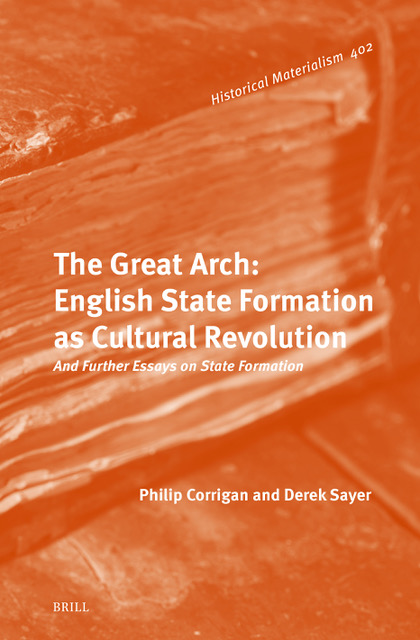
I am delighted to announce that Philip Corrigan’s and my book The Great Arch: English State Formation as Cultural Revolution, first published by Basil Blackwell in 1985, has just been republished in the Historical Materialism series by Brill. The e-book version was made available on October 27. A hardback edition will follow on November 5.

As with other volumes in this series, whose aim is to “publish important theoretical contributions as the basis for vigorous intellectual debate and exchange on the left,” a much more affordable paperback edition will be issued in the fall of 2027 from Haymarket Books.

This volume is a reprint of the Blackwell 1991 edition (which contained a new preface, postscript, and bibliographic supplement), plus Philip’s “State Formation (entry for a dictionary)” and nine further essays on state formation and cultural revolution written by me and/or Philip. All but one of these date from 1987-1994 and variously extend or clarify our arguments in The Great Arch. I have also provided a new introduction. This edition of The Great Arch is dedicated to Philip’s memory.

I am reproducing the Table of Contents and Introduction to the Historical Materialism Series Edition below. The entire post–peer review manuscript is available (with permission of the publisher) here.
In the United Kingdom November 5 is Guy Fawkes Night. When we were kids we used to collect wood for the bonfire for weeks beforehand—it was my favorite day of the year. Guy Fawkes was popularly reputed to be the only man ever to enter the English parliament with honest intentions. It seems an appropriate anniversary on which to reissue the hard copy of our book.

Remember, remember, the 5th of November,
Gunpowder, treason and plot.
I see no reason
Why gunpowder treason
Should ever be forgot.


The Great Arch: English State Formation as Cultural Revolution

And Further Essays on State Formation

Philip Corrigan and Derek Sayer


Table of Contents

Acknowledgments

Introduction to the Historical Materialism Series Edition

Part 1 The Great Arch: English State Formation as Cultural Revolution Philip Corrigan and Derek Sayer

Foreword by G. E. Aylmer

Acknowledgements

Introduction

1   ‘A Remarkably Centralized Country’: State Formation in Medieval England

2   ‘This Realm of England Is an Empire’: The Revolution of the 1530s

3   An Elect Nation: The Elizabethan Consolidation

4   Mortall God Enthroned: One Bourgeois Revolution (Of Many)

5   From Theatre to Machine: ‘Old Corruption’

6   ‘The Working Class Question’: ‘Society’ and society

7   Epilogue: ‘There Is, Above All, an Agency’

Afterthoughts

Bibliography

Additions to 1991 edition

Preface to 1991 edition

Postscript

Bibliographical Supplement

Part 2   Organising the Subject: Further Essays on State Formation

1   State Formation (entry for a dictionary) Philip Corrigan

2   From ‘The Body Politic’ to ‘The National Interest’: English State Formation in Comparative and Historical Perspective (An Argument Concerning ‘Politically Organized Subjection’) Philip Corrigan and Derek Sayer

3   Introduction to ‘The Making of the Boy’ Paul Corrigan

4   The Making of the Boy: Meditations on What Grammar School Did with, to, and for My Body Philip Corrigan

5   Untying the Knots: TheTexts of the State (From the Battle of the Books to the Books of the Battle). Remarks for Ludwig and Michel Philip Corrigan

6   British Reaction to the Amritsar Massacre 1919-1920 Derek Sayer

7   A Notable Administration: English State Formation and the Rise of Capitalism Derek Sayer

8   Bread and Knowledge Politics: E. P. Thompson (1924-1993) Philip Corrigan

9   Everyday Forms of State Formation: Some Dissident Remarks on Hegemony Derek Sayer

10   Undoing the Overdone State Philip Corrigan

11   Great Arches Viewed from the Coasts of Bohemia: Reflections Inspired by Tables of Kings Derek Sayer

References for Part 2: Organizing the Subject

Index


Introduction to the Historical Materialism Series Edition

Derek Sayer

Bliss was it in that dawn to be alive,

But to be young was very heaven! O times…

When Reason seemed the most to assert her rights

When most intent on making of herself

A prime enchanter to assist the work

Which then was going forwards in her name.

William Wordsworth, The Prelude

The Great Arch has had a checkered history.  It was first handsomely published by Basil Blackwell, at an affordable price and with J. M. W. Turner’s splendid Burning of the Houses of Parliament on the cover, in simultaneous hardback and paperback editions in 1985.  Aside from a brace of deplorables who tried to strangle the book at birth,[2] the initial response was everything we could have hoped for. The Great Arch was widely, and for the most part very favorably, reviewed in history, sociology, anthropology, and political science journals internationally.[3] It was commended by scholars as diverse as the anthropologist Eric Wolf (‘The processes of English state formation are not usually on the docket of anthropological research priorities, but this book carries several important messages for anthropologists’), the Anglo-Saxon historian James Campbell (who chided his colleagues for leaving ‘the largest issues and the most arresting questions… to foreigners and to sociologists’), and the sociologist Pierre Bourdieu (who saw The Great Arch as a ‘quite exemplary’ attempt to theorize ‘the genesis of the state’ and devoted an entire lecture to it in his 1990-1991 course on the state at the Collège de France)’.[4] Three months after Bourdieu’s lecture, participants in a major international conference on state formation and popular culture in modern Mexico at the University of California at San Diego were encouraged to engage with the theoretical frameworks offered in two influential recent publications.  One was James C. Scott’s Weapons of the Weak.  The other was The Great Arch.[5] Ironically, it was around this time that the first edition of The Great Arch went out of print.

When we reminded Blackwell of an undertaking to reprint given by our editor Sean Magee, who had by then left the firm, we were offered the option of a paperback ‘reprint with revisions’ in the Ideas series in 1991.  For the cover we replaced Turner’s Burning of the Houses of Parliament with a photograph of the Soviet avant-garde artist Liubov Popova’s set for The Earth in Turmoil (1923), which seemed to us to be equally apt. We left the main text of the 1985 edition unchanged but added a postscript in which we discussed reviewers’ criticisms of the first edition, some of which we took on board, as well as updating the bibliography with an extensive supplement.  Blackwell did little to publicize this 1991 reprint and we discovered much later that it had a miniscule print-run, so that most readers had no opportunity to see the new material. The Great Arch was not reprinted again and has never been published in an electronic format.  Philip and I only recovered publication rights years later.  Dismayed at the prices being asked for secondhand copies, I made the text available on academia.edu, where it garnered thousands of views. The Great Arch remains the most frequently cited work either of us has written, and citations have increased rather than decreased over the years.[6] So when Steve Edwards wrote me a month or so after Philip’s death on 24 April 2021, inquiring about the possibility of reissuing The Great Arch, I was delighted.  The Historical Materialism series, with its aim to ‘publish important theoretical contributions as the basis for vigorous intellectual debate and exchange on the left’, was an ideal venue that promised to give our book a new lease of life (and a venue of which I am sure Philip would have approved).

But the passage of time since The Great Arch was published makes introducing the present edition difficult.  Though Philip and I worked closely together for nearly two decades, we ceased to collaborate after 1992, when Philip retired from formal academic life following a series of breakdowns.[7] I was then on research leave in Prague, embarking on a new project whose starting-point was a suspicion that the Czech capital’s remarkable range of modern experiences – Bohemia was part of the Austrian Empire up to 1918, an independent bourgeois-democratic republic from 1918-1938, a Nazi-occupied protectorate from 1939-1945, a people’s democracy from 1945-1948, and a communist state from 1948-1989 – might make Prague a better vantage point from which to observe the diverse modalities of twentieth-century modernity than London, Paris, or New York.  This was the start of an intellectual journey that would detain me for the next thirty years and radically shake up my ideas on just about everything in the process.   It led to a trilogy of books with Princeton University Press in which I endeavored to treat twentieth-century Prague as Walter Benjamin had nineteenth-century Paris, as a site in which to excavate the dreamworlds of the era.[8] Living on different continents, Philip and I meantime drifted apart.  At the time of his death, we had not spoken or corresponded in twenty years.  Though there are many connections between my post-1990 work and my earlier writings, the gulf between where I stood then and where I stand now is immense.

Since I have not kept up with the scholarly literature on Marxist theory, state formation, or English history in any systematic way during the last thirty years, it would be laughable for me to try to situate the book or evaluate its arguments in relation to current academic debates in these fields, as might normally be expected in such a reissue.  What I have attempted is more modest: a reprint of The Great Arch (including the new materials added in the 1991 edition), supplemented by a selection of essays by Philip and/or myself that variously amplify, qualify, or in some cases go beyond its arguments.  Most of these texts date from the period in which we were still working together and planned to go on doing so.

In the 1991 edition of The Great Arch, we announced that ‘Over the next few years we will be working on a larger project: Capitalism’s Cultural Revolution.  Volume 1 will be a second edition of The Great Arch, extensively revised and enlarged by some 100 pages.  Volume 2, Organizing the Subject, will address the cultural and moral logics, practices, productions and uses without which we cannot make sense of ‘the state’ as both totalizing and individualizing, the collective misrepresentation of an illusory community which claims all of us (albeit differently) yet belongs to none of us’.[9] That project (which we already envisaged some version of when we were writing The Great Arch) [10] was never realized.  But Part 2 of this book, which I have followed our 1991 plan in titling ‘Organizing the Subject’, gives an indication, as a preliminary sketch for a painting might, of some of what Capitalism’s Cultural Revolution might have contained.

Part 1 of the present edition is a straightforward reprint of the 1985 text of The Great Arch, together with the material added in the 1991 reprint.  The text itself is unaltered except for correction of a handful of errors.  There is no need to say any more here by way of introduction, since that is done in the introduction to the book itself.  The essays in Part 2 are presented chronologically. In all but one case the texts are also exactly as they were originally published except for correction of typographical or minor factual errors. To avoid undue duplication and (we hope) make for greater ease of reading, however, in both Part 1 and Part 2 we have shifted all in–text references to the notes.  While we have left the original bibliography and the 1991 bibliographical supplement to The Great Arch as they stood, we have provided a single consolidated bibliography for Part 2 rather than separate references for each essay.  We have replaced the original index to The Great Arch with a composite index for the present book.

Part 2 begins with Philip’s brief article ‘State Formation’, which he originally wrote as an entry for a dictionary in 1986 and updated for Everyday Forms of State Formation, the book Gilbert Joseph and Daniel Nugent edited from the papers at the 1991 conference on state formation and popular culture in Mexico mentioned above.  In my view, this is the clearest and most concise summary of the paradigm shift we were attempting to inaugurate with The Great Arch that either of us ever managed.  We wrote ‘From the Body Politic to the National Interest’ for the second Mellon Symposium on Historical Anthropology, which Bernard S. Cohn and Nicholas Dirks organized at California Institute of Technology in May 1987.  The symposium theme was ‘Culture and Colonialism: Deployments of Power and Resistance’.[11] Though there is undoubted overlap between this essay and The Great Arch, the arguments in ‘Body Politic’ are organized thematically rather than chronologically, and we extend our discussions of routines and rituals of rule and regulated representation and address the intrinsically gendered character of English state formation and state forms more comprehensively than in the book.  As it turned out, ‘From the Body Politic to the National Interest’ would be our last jointly authored text on state formation (or anything else).  I first published it in the Journal of Historical Sociology in January 2022, as a tribute to Philip’s memory.

My own articles ‘A Notable Administration’, ‘British Reaction to the Amritsar Massacre’, and ‘Great Arches Viewed from the Coasts of Bohemia’ also extend or complement specific areas of argument in The Great Arch.  Conceived as an intervention in historical sociological debates over ‘the rise of the West’, ‘A Notable Administration’ was our fullest statement of the case for seeing the ‘peculiarities’ of English state formation as an important part of why England became Marx and Weber’s ‘classic ground’ of capitalism in the first place, despite the course of English history strikingly deviating from Marxist and Weberian expectations.  ‘British Reaction to the Amritsar Massacre’ is a case study of one of the bloodiest episodes in Britain’s imperial history, which, I argued, needs to be understood not as an aberration but in terms of the moral conceptions that legitimated General Dyer’s punitive action.  Gruesomely exemplifying our wider thesis on moral relations, this essay goes some way (albeit not far enough) toward redressing what Philip and I both later recognized as a major failing of The Great Arch, our inadequate attention to the constitutive role of centuries of empire in English/British state (and subject) formation.  It speaks volumes that despite my public school education and my A grade History A Level, I first learned of the Jallianwala Bagh massacre from Richard Attenborough’s film Gandhi (1982). [12] I return to this lacuna in ‘Great Arches Viewed from the Coasts of Bohemia’, which is the only text in which I have ever explicitly revisited The Great Arch in light of my subsequent work on Czech history.  This started out as a presentation for an invited panel on the state at the 2003 American Anthropology Association meetings in Chicago[13] and went through several iterations before I finally published a first version of it in 2016.   I have made some further changes here.

‘Everyday Forms of State Formation’ began life as a verbal response to the papers delivered at the 1991 UCSD conference on Mexican state formation, on which I had been asked to comment.  Resisting attempts by some participants to counterpose The Great Arch and Weapons of the Weak as ‘history from above’ vs. ‘history from below’, I used Václav Havel’s famous parable of the Prague greengrocer, who obediently hangs the slogan ‘Workers of the World, Unite!’ in the window of his store, to upset the dichotomy.[14] Havel’s analysis, I argued, rested ‘less on the greengrocer’s being fooled than on his, and everyone else’s, knowing complicity.  It is cynicism, not ideological conformity, that makes this system work’.  This was ‘the exact opposite of ‘mystification’ or ‘false consciousness’.  This power works through the way it forcibly organizes, and divides, subjectivities, and thereby produces and reproduces quite material forms of sociality’.  I was trying simultaneously to draw attention to the irreducible agency of the subject – people are not mere animals, machines, or ‘hands’ – and to the fact that this agency is always confined, limited, and more or less crippled by the social forms through which subjects are permitted/forced, enabled/constrained to act.   Such agency, I went on, comes ‘at the cost of a corrosive derangement of ‘private’ and ‘public’ selves’.   This social schizophrenia, as we called it in ‘From the Body Politic to the National Interest’, is a central motif in Philip’s essays ‘Untying the Knots: TheTexts [sic] of the State’, which focuses on schooling as a state form, and ‘Undoing the Overdone State’, which like my ‘Everyday Forms’ paper questions conventional uses of Gramscian notions of hegemony. The ‘identifications on offer within repertoires of state forms’, Philip argues in the latter, ‘are violently contradictory. The much desired and much worked for ‘Individual’ is a situation of tormented and twisted loyalties, performances, positions, and regulated persona’.

In a rather different – autoethnographic – vein, Philip’s 1988 essay ‘The Making of the Boy’ blew me away when I first read it and reads equally powerfully today.  Here, Philip documents the ‘bodily terror’, as well as the psychological brutality, of the education he received at a South London grammar school in the 1950s, recalling ‘the random violence of the cuff against the ear, the slap around the face, the book thrown hard into the face, the twisting of the arm, the enforced placing of a growing, gangly body into a desk far too small, the slipper/plimsoll applied to the bum, multiply; and there, at the end of the chamber of horrors, the cane’.  ‘All I am trying to say’, he concluded (in a Coda annotated: ‘for Derek Sayer who shares ‘it” – which I did),[15] ‘is that bodies matter… They/we are the subjects who are taught, disciplined, measured, evaluated, examined, passed (or not), assessed, graded, hurt, harmed, twisted, re-worked, applauded, praised, encouraged, enforced, coerced, condensed… To have around volumes of educational theory (however radical) that never mentions bodies, and their differentiation, seems to me now, slightly stupid… bodies may be what (who) is being schooled because by now – I hope – we cannot so easily separate minds, psyches, emotions off from bodies’.  I am grateful to Paul Corrigan for his introduction to this most angry and insightful of his brother’s writings, which Paul wrote for this volume.

‘Intellectuals… seem to lack that starting point from which their scriptures come: where are our bodies? This is the simple question I wish to register’, Philip wrote elsewhere, adding ‘but it is noticeable how amongst male intellectuals this is the most remarkable yet unremarked absence: a silence, which is, of course, thunderously, necessarily there’.[16] The body was largely absent from The Great Arch, too, except as a perennial object of whipping, branding, mutilation, and sundry theatrical modes of execution at the hands of The Law.  It is here, I think, that Organizing the Subject would have made its greatest advances. The Great Arch was already unorthodox in the range of theoretical resources on which it drew; our Marxism, inflected (infected?) by the culturalist heresies of Edward Thompson and Raymond Williams, was abundantly leavened with Weber and Durkheim as well as with Elias and Foucault.  During his time at the Ontario Institute of Education (OISE) in Toronto from 1993-98, Philip deepened his intellectual engagement not only with poststructuralist theory, to which he became more receptive while continuing to adamantly reject the reduction of everything to an idealist conception of discourse, but also – and above all – with feminist scholarship.  My own dalliance with Barthes, Lacan, and Derrida came later.[17] In his 1988 article ‘Social Forms/Human Capacities: Further Remarks on Authority and Difference’, Philip characterized social forms as ‘a cartography, a dictionary, a repertoire, whose central social organization entails a social grammar organized around a Figure in Dominance: that of the white, heterosexual, male ‘possessed’ of the dominant features of the division of labour’.[18] I suspect that had Philip and I gone on to write Organizing the Subject, we might have ended up placing less emphasis than The Great Arch on capitalism as Marx’s ‘general illumination’ and paying more attention to other features of that enduringly dominant figure.  For me, this would require cracking the Marxist mold.  For Philip, I can’t say.

The last of Philip’s texts I have chosen to reproduce here is ‘Bread and Knowledge Politics’ (1993).  ‘On the news of Edward Thompson’s death Philip Corrigan scrapped the article he was working on for left history and sent us this immediate tribute’, the editors of left history explain.  I have included this piece less for what it says about state formation than what it says about where we came from.  I first met Philip in my first year as a graduate student at Durham University, back in the heady days between the miners’ strikes of 1972 (best remembered for Arthur Scargill’s flying pickets and the Battle of Saltley Gate) and 1974 (which brought down Edward Heath’s government after he called an election on the issue of ‘Who governs Britain?’).  I was twenty-one.  Eight years older, Philip was in his final year as an undergraduate in the same department.  He entered the Durham PhD program that fall.  ‘Perhaps because I came ‘late’ to university life… and certainly because the earlier years were spent working as a librarian (together with my own writing of poetry, stories, and – voluminously – letters)’, Philip once explained, ‘I have never been properly ‘disciplined’’.[19] The years spent in the stacks left their stamp on his footnotes and bibliographies, which (as readers of this book will discover) were no less voluminous.  Lovingly compiled with the purest of intentions, they overwhelmed – much like the man himself.  A voracious and catholic reader, Philip was a firm believer in liberating knowledge from the disciplinary walls that fence it in and making it accessible to the multitudes outside the ivory towers.[20] Sometimes he put me in mind of Haňt’a, the hero of Bohumil Hrabal’s Too Loud a Solitude, suffocating under the weight of the books he has saved from being pulped.[21]

Bliss it might have been in that dawn to be alive, but the world has changed mightily in the half-century since Philip and I embarked on our collaboration.  Gerald Aylmer asked in his foreword how far it is possible to be persuaded of the historical case put forward in The Great Arch without accepting the political conclusions drawn from it.  I remain generally persuaded of the historical case, though I might now demur on many points of detail.  The political conclusions are another matter.  The miners’ strike with which we began The Great Arch, that of 1984-85, ended very differently than those of the seventies, in a bitter defeat for the labor movement that put the seal on more than just the destruction of Britain’s mining communities.  In retrospect, it was a turning point in the long march of capitalist triumph that began with Margaret Thatcher’s Big Bang in 1986, swept all before it as the Berlin Wall fell in 1989 and the Soviet Union collapsed in 1991, and has led us to the brink of the abyss into which the world is staring today.

We ended The Great Arch with an injunction to imagine.  If I allow myself to imagine the future today, what I see is not Marx’s ‘resumption by the people for the people of its own social life’, but a burning and drowning planet ravaged by famine, pestilence, and wars, in which pitiful authoritarian remnants of ‘the West’ cower behind Trumpian walls built to keep out never-ending hordes of refugees.  Such a nightmare scenario could, perhaps, be averted, though I am not hopeful.  We are at another historical turning-point: one in which, this time around, the very existence of sustainable human life on earth is in jeopardy.  It may be that humanity’s long-term future, if it is to have one, can only be secured within some kind of socialist framework.  Our present capitalist path is a certain road to ruin.  But the immediate task of the day, it seems to me, must be to defend whatever is left of bourgeois democracy, Enlightenment thought and values, civil and human rights, and the rule of law, against the onslaughts of a new global fascism – without losing sight of the enduringly raced, classed, and gendered features of all these social forms, just in case we survive.  Nothing in The Great Arch leads me to think otherwise.

Calgary, April 2026

References

Bourdieu, Pierre 2014, On the State: Lectures at the College de France, 1989-1992, trans. David Fernbach, London: Polity.

Campbell, James 1989, ‘Stubbs and the English State’, Stenton Lecture, University of Reading, 1989.

Corrigan, Philip 1975, ‘On the Politics of Bibliography’, Journal of Contemporary Asia, 5, 1.

Corrigan, Philip 1990, ‘The Body of Intellectuals/The Intellectuals’ Body’, in Social Forms/Human Capacities: Essays in Authority and Difference, London: Routledge.

Elkins, Caroline 2002, Legacy of Violence: A History of Empire, New York: Knopf.

Gilbert, Joseph M. and Daniel Nugent (eds) 1994, Everyday Forms of State Formation: Revolution and the Negotiation of Rule in Modern Mexico, Durham NC and London: Duke University Press.

Havel, Václav 1987, ‘The Power of the Powerless’, in his Living in Truth, Boston and London: Faber and Faber.

Hrabal, Bohumil 1990, Too Loud a Solitude, trans. Michael Henry Heim, New York: Harcourt Brace Jovanovich.

Sayer, Derek 1989, The Coasts of Bohemia: A Czech History, Princeton, NJ: Princeton University Press.

Sayer, Derek 2002, ‘Gerald Aylmer and DGOS: In Memoriam’, Journal of Historical Sociology, Vol. 15, No. 1, 60-62

Sayer, Derek 2004a, Going Down for Air: A Memoir in Search of a Subject, Boulder, CO: Paradigm Press.

Sayer, Derek 2004b, ‘Incognito Ergo Sum: Language, Memory and the Subject’, Theory, Culture and Society, 21, 5.

Sayer, Derek 2013, Prague, Capital of the Twentieth Century: A Surrealist History, Princeton, NJ: Princeton University Press.

Sayer, Derek 2022a, ‘Prefatory Note: On ‘From the Body Politic to the National Interest’’, Journal of Historical Sociology, Vol. 35, No. 1, pp. 107-8.

Sayer, Derek 2022b, Postcards from Absurdistan: Prague at the End of History, Princeton, NJ: Princeton University Press.

Wolf, Eric 1987, review of The Great Arch in American Ethnologist, 14, 2.


Notes

[1] Translated in Mark Polizzotti, Revolution of the Mind: The Life of André Breton, New York: Da Capo, 1997, pp. 622-3.

[2] Mark Kishlansky ridiculed our endeavors in the Times Higher Education Supplement as ‘A-level history’ (12 September 1986), while J. G. A. Pocock penned a nasty little limerick that began: ‘There was a professor from OISE’ and ended ‘His reading of history/While laudably herstory/Was less for the men than the boys’ (Albion, Vol. 18, No. 2, 1986, pp. 294-96). The cadences of white, entitled masculine privilege to which we had drawn attention were evidently alive and well in Johns Hopkins University as well as the University of Chicago, where Professor Kishlansky plied his pugnacious trade before moving on to Harvard in 1991.

[3] Publication details of all reviews of The Great Arch known to us at the time, including those quoted here, are given in the Bibliographical Supplement to the 1991 edition of The Great Arch (see below, p. 000).

[4] Wolf 1987; Campbell 1989; Bourdieu 2014, pp. 374-5

[5] See Joseph and Nugent (eds) 1994, p. 4.  ‘The volume’s purposefully ironic title’, wrote the editors, ‘juxtaposes ‘everyday forms’ from James Scott’s penetrating analysis of peasant resistance in rural Southeast Asia and ‘state formation’ from Philip Corrigan and Derek Sayer’s study of the formation of the bourgeois state in England as a cultural revolution’.

[6] The Great Arch had 7,546 views on academia.edu as of 12 April 2026.  On the same date, Google Scholar recorded 2726 lifetime citations (plus 317 of the partial Spanish translation).  Though the book was published in 1985, it continues to be widely cited, averaging over 60 citations per year since 2020.

[7] Our writings together and with Harvie Ramsay up to 1985 are listed in the bibliography to The Great Arch, below, pp. 000-000.  I would also mention our foundation with Gerald Aylmer of the Discussion Group on the State (DGOS), which met annually at St Peter’s College, Oxford, from 1982-2001 (see Sayer 2002, 60-62), and the Journal of Historical Sociology, which was published quarterly from 1988-2022.

[8] Sayer 1989; 2013; 2022b

[9] See below, p. 00

[10] A work called Capitalism’s Cultural Revolution: Organizing the Subject is listed under both our names in the bibliography as forthcoming (with Macmillan) in 1986. See below, p. 000

[11] For more details on the background to this essay, see Sayer 2022a, pp. 107-8

[12] The massacre remains disturbingly peripheral to both British historiography and popular conceptions of empire, but Jallianwala Bagh has more recently been given its appropriate place as a paradigm of the ‘legalized lawlessness’ fundamental to ‘liberal imperialism’ in Elkins’s superb Legacy of Violence: A History of Empire (Elkins 2022, pp. 129-44).

[13] The other panelists were Saskia Sassen, Jane Schneider, and James C. Scott.

[14] See Havel 1987.

[15] The cane was the fetish (I use the term advisedly) that ruled over us at King’s School, Rochester, the minor English public school I attended as a scholarship boy from 1959-1968, too; I have explored its lasting imprint on my psyche in Sayer 2004a.

[16] Corrigan 1990, p. 186.  This is one of three incandescent essays Philip wrote while at OISE in 1986-88 (the others being ‘Social Forms/Human Capacities’ and ‘Masculinity as Right’) that I would have liked to include here had I more space.  They are all reproduced in Social Forms/Human Capacities, which is still in print in paperback and electronic forms.

[17] See the long theoretical essay with which I concluded Going Down for Air, a modified version of which was published as Sayer 2004b, and more generally my Undisciplined: Essays in History and Theory, forthcoming in the Historical Materialism series.

[18] Corrigan 1990, p. 199

[19] Corrigan 1990, p. xi.

[20] ‘Footnotes should be provided in double or treble profusion in a socialist periodical’, Philip once wrote, ‘which should aim before all else to establish the class configurations of the recorded knowledge which we have. Socialist periodicals should give much space to facts, to review essays, to bibliographical listing, since they must be keys, leads, linkages and powers encouraging any reader to follow up their interest in this or that facet’ (Corrigan 1975).

[21] Hrabal 1990.

[In the published version these are footnotes, not endnotes.]

Earlier this summer I gave a wide-ranging interview with the Czech literary magazine HOST on my books on the history of Prague. Here is the published Czech text. The original English version from which the Czech text was edited follows (below).

Derek Sayer

H > Články > Praha, hlavní město 20. století

Aktuální číslo

07/26

PRAHA, HLAVNÍ MĚSTO 20. STOLETÍ

V létě v Praze proběhl velký kongres zahraničních bohemistů. K rozhovorům, které jsme přinesli v předstihu, přidáváme nyní ten závěrečný, a sice s britsko-kanadským sociologem Derekem Sayerem, známým svými interdisciplinárními přesahy a trilogií o české kultuře.

V posledních několika desetiletích jste se věnoval české kulturní historii, dokončil jste svou pražskou trilogii a nabídl nový pohled na modernitu. Existuje v Praze nějaká budova, dílo nebo památka, která pro vás tuto modernitu vystihuje?

Nenapadá mě sice konkrétní místo, které by představovalo modernitu v koncentrované podobě, ale Veletržní palác se tomu velmi blíží. Byl obdivován La Corbusierem a svého času platil za jeden z nejrozsáhlejších funkcionalistických objektů v Evropě. Nejen Teigem byl právem oslavován jako ikona progresivního modernismu. Jenže stavba zároveň vznikla jako ústřední bod „veletržního“ města, jinými slovy, byla navržena, aby prezentovala český průmysl. Otevření paláce neprovázela avantgardní výstava, ale uvedení vysoce nacionalistické Slovanské epopeje Alfonse Muchy, cyklu, který většina moderních umělců a kritiků té doby považovala za zpátečnický a reakcionářský.

Působil jste na univerzitách v Anglii i Kanadě a sám sebe popisujete jako Angličana místem narození a Kanaďana volbou, můžete k tomu říct víc?

Narodil jsem se v Londýně a v Británii jsem žil do svých pětatřiceti. V roce 1986 jsem se přestěhoval do Kanady, abych nastoupil na Univerzitu v Albertě, kde jsem dvacet let učil a zastával jednu z prvních Canada Research Chairs (prestižní výzkumný titul v rámci národního programu). Do Británie jsem se z rodinných důvodů vrátil v roce 2006, ale po odchodu z Lancaster University v roce 2016 jsem do Kanady odjel na důchod. Mám dvojí občanství.

Národnost není něco, co si vyberete, vybral jsem si tedy emigraci. Část mě zůstane Britem, ale poté, co jsem polovinu dospělého života prožil v Kanadě, je jiná část mě zase Kanaďanem. Stýská se mi po rozlehlých pláních, širé prérijní obloze a jasném slunečním svitu při dvaceti stupních pod nulou. Nebo po úžasně různorodé kuchyni, kterou si užívám v Calgary — mimochodem ve městě, kde se třetina obyvatel narodila v zahraničí a přes čtyřicet procent patří k etnickým menšinám. Toto by bezpochyby pobouřilo mnoho Čechů, tedy alespoň ty, kteří volili Zemana a Babiše a jsou k přistěhovalcům nepřátelští. Já se ale cítím nejvíc doma právě v místě plném mně podobných vykořeněných kosmopolitů.

Jak do toho zapadá Česko?

To je vlastně náhoda. Nemám formální vzdělání ve slavistice nebo bohemistice, bakalářský i doktorský titul jsem získal v sociologii. Má první žena, Alena, byla Češka, možná bych měl říct Moravanka, pocházela z Ostravy. Seznámili jsme se jako bakalářští studenti na Essex University v roce 1970. Československo opustila ke konci roku 1967, tedy ještě před pražským jarem, aby strávila rok v zahraničí jako au pair před tím, než začne studovat anglistiku na Univerzitě Karlově. Získat výjezdní víza tehdy ještě nebylo snadné, ale její otec měl i jako nekomunista dobré kontakty na ministerstvu zahraničí, navázal je při svém pobytu v Sachsenhausenu během války. Byl jedním z dvanácti set českých studentů zatčených 17. listopadu 1939 při „dni studenstva“. Týden před tím, než se Alena měla vracet domů, ale začala okupace a ona zůstala v Británii. Vrátila se až po revoluci.

To znamenalo, že ještě než jsem poprvé vkročil na českou půdu, udržoval jsem s Českem téměř dvacet let v moha ohledech intimní, jakkoli zprostředkované pouto. Podivná situace, když se nad tím zamyslíte, ale v rodinách emigrantů a uprchlíků po celém světě naprosto běžná.

Kdy jste se poprvé do Česka či Československa podíval?

Na jaře roku 1990, v období mezi revolucí a volbami. Většinu času jsme trávili s rodinou v Ostravě, ale povedlo se nám na pár dní zavítat do Prahy. Právě tehdy, na Smetanově nábřeží, mě napadlo využít zkušeností z novodobé historie pro konceptualizaci Prahy jako vyhlídky na modernitu a vytvořit tak alternativu k místům tradičně západním, jako je Paříž, Londýn, New York. V Praze jsem následně žil od prosince 1991 do léta 1993 a snažil jsem se co nejlépe naučit česky, zatímco jsem pracoval na prvním díle mé pražské trilogie, The Coasts of Bohemia.

Zmínil jste, že myšlenka uchopit Prahu jako nový úhel pohledu na modernitu vás napadla na Smetanově nábřeží. Byla to náhoda, nebo inspirace tím místem?

Když jsem se na jaře roku 1990 procházel po Smetanově nábřeží v Praze, napadlo mě, že by mohlo být plodné přistoupit k evropské historii vyprávěné ze západního pohledu kopernikánsky. Místo, kde mě to napadlo, nebylo bez významu: v průběhu 20. století bylo nábřeží postupně pojmenováno po císaři Františkovi I., prvním prezidentovi Československa Tomášovi Masarykovi, nacistickém říšském protektorovi Reinhardu Heydrichovi. A protože komunisté považovali vzpomínku na Masaryka za nepřijatelnou, nakonec i po českém „národním skladateli“ devatenáctého století, Bedřichu Smetanovi.

Tehdy jsem samozřejmě neznal tolik souvislostí. Muselo tedy jít víc o tušení než o cokoli jiného. Spíš než na jednom konkrétním nábřeží bylo pravděpodobně založené na té neskutečné architektonické koláži, kterou Praha nabízí — je v ní všechno od středověku a baroka až po nejrůznější podoby moderny, často promíchané.

Jedno místo na Smetanově nábřeží je pro mě však obzvlášť dojemné, socha Františka I. Když jsem ji poprvé viděl a také po celou dobu, co jsem v Praze žil, byl podstavec prázdný, protože socha byla po vyhlášení nezávislosti v roce 1919 přesunuta do lapidária Národního muzea. Vzhledem k honosnému rámování památníku působilo toto prázdné místo až surrealisticky. František byl na svoje právoplatné místo nakonec v tichosti vrácen v roce 2003.

Otisklo se vaše někdejší pozorování přímo i do knihy The Coasts of Bohemia, na které jste další rok začal pracovat?

Ano, celá ta procházka po Smetanově nábřeží. A pak ta socha: pro mě ztělesňuje ústřední téma mé práce o Praze, dialektiku paměti a zapomínání a její projevy ve veřejném prostoru — názvy ulic, sochy, památníky, pamětní desky, nástěnné malby a fresky, fasádu i vnitřní výzdobu budov. Z různých důvodů mi připadá dojemné také Smetanovo muzeum spojené se Zdeňkem Nejedlým, který se zasadil o jeho založení v roce 1926. Souvislosti mezi diskurzy národního obrození a KSČ po roce 1945 jsou důležitými tématy mých knih, ačkoli se jedná o něco, co Češi obecně neslyší rádi.

Vzpomínáte si na nějaký konkrétní okamžik také z pobytu v Ostravě, když jste poprvé přijel do Československa?

Z mé první cesty mi v paměti nejvíc utkvěla událost v tehdejším Divadle Zdeňka Nejedlého, kterou jsem později popsal ve své knize [Going Down for Air: A Memoir in Search of a Subject, 2004]:

Nabucco, Verdiho první velký hit, má premiéru v La Scale 9. března 1842. Třetí dějství. Poprvé zaznívá velký vlastenecký sbor „Va, pensiero“. Publikum vybuchne a požaduje přídavek za přídavkem. Po skončení představení propuknou nepokoje. Rakouské úřady od té chvíle zakazují operním domům hrát přídavky.

Před svou smrtí zanechává Giuseppe Verdi přísné pokyny vyžadující, aby na jeho pohřbu nehrála žádná hudba. Staré novinové fotografie ukazují Piazza del Duomo až po okraj zaplněné lidmi, čtvrt milionu, půl milionu, milion lidí, kdo ví? Když se smuteční průvod pomalu prodírá obrovským davem, někdo začne zpívat, přidá se další a další, slova napsaná před šedesáti lety na jiném místě pro jinou dobu, slova, která přesto všichni znají nazpaměť:

Va, pensiero, sull’ali dorate,

va, ti posa sui clivi, sui colli

ove olezzano tepide e molli

l’aure dolci del suolo natal!

Překlopí se století.

Staré severomoravské město založené na uhlí a oceli, počátek roku 1990, to nejisté období mezi sametovou revolucí a prvními svobodnými volbami po dvaačtyřiceti letech. Jednoho volného večera jsem se rozhodl zajít do místního operního domu, kde zrovna hráli Nabucca. Před začátkem představení vystoupí zpoza opony na jeviště nějaký muž. Očekávám, že se dozvím, že jeden z hlavních představitelů je indisponován. Namísto toho však jménem svých kolegů umělců vášnivě vyzývá publikum, aby hlasovalo pro Občanské fórum. Napětí je hmatatelné, svírá hrdlo a štípe jako kyselý déšť, který visí ve vzduchu nad Ostravou.

„Va, pensiero“ zazní do absolutního ticha — jev, který jsem nezažil při žádném operním vystoupení jinde na světě. Žádné pokašlávání, popotahování nebo šuškání. Nevzpomínám si ani, že bych kdy předtím nebo potom slyšel žádat diváky o přídavek sboru. Až když dozní ozvěna posledního tónu, ani o vteřinu dřív, divadlo vybuchne. Lidé vyskočí na nohy a volají po přídavku. Té noci zaznělo „Va, pensiero ještě třikrát“, než mohla opera pokračovat. Později jsem se doslechl, že k témuž došlo v Národním divadle v Praze po sovětské invazi v roce 1968, což vedlo k zákazu Nabucca na českých jevištích na následujících dvacet let.

Vaše knihy se soustředí na individuální příběhy. Zaujalo mě, že téměř čtvrtina té poslední, Pohlednice z Absurdistánu, je vyprávěna skrz život Mileny Jesenské. Té je sice věnována stále větší pozornost, ale zároveň se málokomu podařilo přenést její dílo do širších souvislostí. Čím myslíte, že to je?

Milena Jesenská byla nepochybně významnou osobností své doby, což se po její smrti z různých důvodů opomíjelo. Odborná edice její žurnalistické práce vyšla až v roce 2016. Kvůli svým politickým názorům zůstávala po většinu komunistického období persona non grata — z KSČ vystoupila po moskevských procesech a ve svých článcích otevřeně odsoudila stalinismus. Jako žena Jaromíra Krejcara byla prominentní osobností meziválečné avantgardy, k níž byla KSČ nepřátelská od roku 1948 do počátku 60. let (jak popisuji v Pohlednicích) a znovu potom od roku 1969 do konce 80. let. Navíc byla spřátelená s Židy (za což jí Yad Vashem udělil vzácné ocenění „Spravedlivá mezi národy“), přičemž poválečná KSČ příliš neskrývala antisemitismus.

Na Západě, a zvláště pak v anglofonním světě, se její odkaz potýká s jiným problémem. Jesenská je známá především — dle mého názoru nepřesně — jako „múza“ Franze Kafky. Zčásti je to tím, že první text, který o ní na Západě vyšel, byla kniha Milena, Kafkas Freundin od Margarete Buber Neumann. Většina západní literatury o Kafkovi nepracuje s českými zdroji, Milena proto bývá nahlížena výhradně německou optikou, která ji obvykle exotizuje. Hlavní anglicky psanou výjimkou je Kafka, Love and Courage od Mary Hockaday. Kniha z roku 1997 se navzdory svému názvu zaměřuje na Milenin život jako celek, nikoli pouze na její vztah k Frankovi, jak Milena Kafkovi říkala. Pokud vím, jediným anglickým překladem Jesenské článků je kniha Kathleen Hayese The Journalism of Milena Jesenská, vydaná v roce 2003.

Může mít na její omezené zobrazování vliv také gender? Byla historie psána příliš „mužsky“?

Udělejme si myšlenkový experiment. Řekněme, že by Milena byla talentovaným novinářem, třeba jako Egon Erwin Kisch. Představme si, že by takový muž vedl vášnivou milostnou korespondenci s mezinárodně proslulou modernistickou spisovatelkou a poté psal nejen informativní články o avantgardě, architektonické a módní scéně, ale i ty nejpronikavější novinářské texty své doby o aktuální politice — od Stalinových gulagů přes anšlus po nacistickou okupaci Čech a Moravy. A navíc by se během okupace stal členem odboje, pomáhal Židům uprchnout ze země, byl zatčen a nakonec zemřel v koncentračním táboře. — Byla by jako takový muž známější? Ta otázka si odpovídá sama. Ve skutečnosti je těžké najít mužský protějšek.

Čím život a dílo Mileny Jesenské zaujaly vás?

Hlavním důvodem mého zájmu o Milenu Jesenskou je právě pozoruhodný život, jaký vedla. Je to ale také dáno mou metodikou. Rozhodl jsem se psát historii jako mozaiku poskládanou z fragmentů, čerpal jsem z životů jednotlivců spíše než z velkolepých abstrakcí. Pozornost, kterou jsem věnoval Jesenské, mi otevřela dveře do mnoha různých, vzájemně se prolínajících světů, které dohromady tvoří ústřední téma nejen zmíněné knihy, ale celé mé trilogie. Patří sem žurnalistika, avantgarda, modernistická architektura, komunismus, válka, uprchlíci, okupace, holokaust, tábory. Milena Jesenská mě také přivedla k dalším lidem, jejichž životy se staly leitmotivy knihy, zejména ke Kafkovi, Adolfu Hoffmeisterovi nebo k druhému manželovi Jesenské, architektu Jaromíru Krejcarovi, a pozoruhodné i tragické postavě její dcery Jany, zvané Honza Krejcarová/Černá, kterou Bohumil Hrabal nazval „perlou na dně propasti“. Skrz Janu jsem se potom seznámil s Vladimírem Boudníkem, Egonem Bondym, Mikulášem Medkem a dalšími „pražskými beatníky“, kteří se v 50. letech scházeli s Hrabalem v Libni. Bondy mě později spojil s Ivanem Martinem Jirousem, skupinou Plastic People of the Universe a pražským undergroundem po roce 1968 a tak dále. Pohlednice jsou plné takových souvislostí.

Jednou z výhod pokusu psát historii z „hadrů a odpadu“, jimiž pohrdá většina konvenčních akademických narativů, je to, že se člověk může s čistým svědomím dívat jinam, než kam ukazuje převážně maskulinní mainstream. V mém případě se zdroje rozpínají od Domácí kuchařky Magdalény Dobromily Rettigové až po erotiku Toyen. Jde o různé přístupy k tomu, co Walter Benjamin nazýval snovými světy dané doby.

Takže přece jen máme především „mužské“ dějiny?

Myslím, že ano. Jedním z důvodů „maskulinismu“ tolika historiků je dle mého názoru nejen jejich (záměrný či nevědomý) sexismus, ale také zaujatost zdrojů, ze kterých čerpají. Po většinu období, kterým se zabývá moje trilogie, tj. přibližně od 80. let 18. století do 90. let 20. století, byli muži nejmocnějšími osobnostmi ve většině oblastí života, včetně politiky a umění, jejichž vztah byl jedním z mých hlavních zájmů. A o jejich činech potom psali většinou opět muži.

Zejména v Pohlednicích jsem vynaložil záměrné úsilí nepsat dějiny „mužsky“. Kromě Jesenské a její dcery figurují v knize další ženy, od jejichž životů se příběh odvíjí: spisovatelky Lenka Reinerová, Marie Majerová a Zdena Salivarová, tanečnice Mira Holzbachová, političky Marie Švermová a Milada Horáková, herečky Lída Baarová, Marie Burešová a Vlasta Chramostová, gymnastka Věra Čáslavská, režisérka Věra Chytilová a zpěvačka a disidentka Marta Kubišová — abychom jmenovali jen některé. Nemluvě o hrdinkách odboje z operace Anthropoid Marii Moravcové, Marii Kovárníkové, Ludmile Soukupové a Anně Malinové. Nebo Ince Bernáškové, dceři umělce Vojtěcha Preissiga, která po zatčení svého otce a zbytku skupiny po dobu deseti měsíců sama vydávala čísla odbojového časopisu „V boj!“. První česká žena popravená nacisty 26. srpna 1942.

Pokud jde o začlenění příběhů těchto žen do dějin, mluvíte o vědomé snaze čelit předsudkům. Musel jste se při zpracovávání české historie vyrovnat i s jinými — ať už osobními, nebo obecnými, řekněme západními — předsudky?

Předsudky nejsou to správné slovo, evokují spíše osobní rozměr než společensky zakořeněné perspektivy. Mluvil bych raději o konceptuálních geografiích, myšlenkových rámcích, uvnitř kterých jsme podmíněni vnímat svět pod určitým úhlem a do kterých zasazujeme psaní dějin.

Svou první knihu o Česku, Coasts of Bohemia, jsem zahájil úvodem s názvem „Orientace“. Chtěl jsem zde naznačit, že navzdory geografické poloze Prahy v centru evropského kontinentu a jejímu historickému umístění na rozhraní konfliktů, které formovaly moderní evropskou historii, Praha zaujímá v anglicky psaných historických narativech okrajovou pozici a zůstává neviditelná — jedině snad s výjimkou jednotlivých let 1620, 1938—1939 nebo 1968, kdy byly události v Praze uznány jako určující pro širší západní příběh.

Čím to bylo?

V té době bylo Česko ve Velké Británii pomyslně odsunuto do ghetta tzv. „regionálních studií“, kde působila jen hrstka obskurních odborníků a existovala pouze jedna vedoucí akademická pozice zaměřená na česká studia. Tu zastával Robert Pynsent, který mimo jiné považoval Karla Čapka za „spisovatele maloměšťáckých buržoustů“ a napsal do London Times protest proti udělení Nobelovy ceny Jaroslavu Seifertovi, protože byl „průměrným básníkem“. Tehdy i dnes je v anglicky mluvícím světě bohemistika či samostatná čeština vyučována pouze hrstkou univerzit. Zůstává vysoce specializovaným, menšinovým oborem, a to dává těm, kteří v oblasti pracují, neobvyklou autoritu jako jakýmsi strážcům brány.

Z historického i koncepčního hlediska byl obor formován dědictvím studené války. Výmluvná je i skutečnost, že hlavní mezinárodní odbornou asociací, k níž patří anglicky mluvící čeští vědci — kromě sdružení, která se zaměřují konkrétně na Česko a často i Slovensko — je Asociace pro slovanská, východoevropská a euroasijská studia (ASEEES). Ta byla založena v roce 1948 jako „přední mezinárodní organizace věnující se rozvoji poznání o Střední Asii, Kavkazu, Rusku a východní Evropě v regionálních a globálních souvislostech“. ASEEES udělila v roce 2013 mé knize Praha, hlavní město dvacátého století čestné uznání, za což jsem náležitě vděčný. Ale stále si kladu otázku, zda je to vhodný referenční rámec pro studium země, jejíž historie byla po tisíciletí historií zemí Svaté říše římské a která, navzdory panslavismu 19. století a meziválečným komunistickým sympatizantům, měla před rokem 1945 jen malý kulturní kontakt s Ruskem.

Máte doktorát v oboru sociologie, ovlivňuje to váš postoj k takovým společensky zakořeněným názorům?

V rámci studia jsem se zaměřoval zejména na historickou sociologii a Praha pro mě začala mít intelektuální význam především v souvislosti s ústředními tématy klasických sociologických teoretiků, jako byli Karl Marx, Max Weber, Émile Durkheim a Georg Simmel, ale i pozdějších autorů, jako Walter Benjamin. Témata, která bych mohl shrnout otázkou: Co je moderního na modernitě?

Domníval jsem se, že Praha nabízí k prozkoumání této otázky lepší výchozí bod než jakékoli západní město, a to díky šíři a rozmanitosti svých historických zkušeností v moderní éře. Například Londýn či New York nezažily ani fašismus, jak tomu bylo v Praze během šesti let německé okupace, ani komunismus. Paříž sice byla během druhé světové války také okupována nacisty, nikdy však nezažila komunistickou vládu. Berlín, který se mi jeví jako nejbližší Praze coby domnělému „hlavnímu městu dvacátého století“, zažil komunismus i fašismus, stejně jako liberální demokracii. Nenabízí ale nic srovnatelného s českým národním obrozením v 19. století jako procesem boje proti imperialismu. Berlín také nezažil etnické konflikty, které hrály tak významnou roli v životě Prahy od poloviny 19. století až do odsunů v poválečných letech 1945—1946, ani celou škálu forem komunistické vlády. Pražská kulturní a umělecká tvorba byla touto jedinečnou škálou moderních zkušeností formována a vyjadřuje je.

Jak vám tedy tato zkušenost pomáhá osvětlit modernu jako takovou?

Uvedu příklad. Václav Havel napsal Moc bezmocných jako úvahu o normalizaci. Má však také univerzální platnost, a to jako analýza toho, jak v moderním světě funguje moc díky aktivní spoluúčasti subjektů, jako je zmíněný pražský zelinář. Kanadský premiér Mark Carney ji citoval ve svém projevu v Davosu a pro mě je Havlova analýza stejně důležitá jako například myšlenky Michela Foucaulta. Hledáte dnes ve světě pražské zelináře? Podívejte se, jak se americké univerzity, včetně Kolumbijské a Harvardovy, poníženě přizpůsobují Trumpově administrativě.

Skutečnost, že jsem Prahu v tomto velmi specifickém smyslu označil za „hlavní město 20. století“, většinová akademická veřejnost přijala s pozitivním ohlasem, včetně mnohých odborníků v Česku — například renomovaná historička umění Lenka Bydžovská. Výjimkou bylo několik anglicky mluvících bohemistů, kteří můj názor zesměšňovali. Podle mého to poukazuje právě na limity jejich konceptuálních geografií.

V Pohlednicích se často opakuje výraz kafkárna, dal by se podle vás považovat za univerzální?

Ano, dokonce mám za to, že tento pojem by měl být považován za univerzální. Existuje snad přesnější popis modernity tak, jak jsem ji zachytil ve své pražské trilogii — zejména v Pohlednicích —, kde každý pokus o nastolení údajně racionálního řádu skončí jako kafkárna? Oproti tomu cynické chování Havlova pražského zelináře lze vnímat jako zcela racionální, byť nemorální a nedůstojný vzor toho, jak se jednotlivci mohou protloukat ve světě, který je kafkárnou. Je to svět, v němž se za život v pravdě platí vysoká cena a v němž bude takový postoj většina zcela logicky pokládat za šílenství.

V poslední době se na Substacku (česky v Britských listech) často věnujete globálním událostem. Které narativy považujete za nejproblematičtější?

Jak kanadský premiér Mark Carney zdůraznil ve svém projevu v Davosu, poválečný „řád založený na pravidlech“ umírá nebo již zemřel a je rychle nahrazován scénářem ve stylu Divokého západu. Podle tohoto scénáře několik velmocí bojuje o nadvládu — nebo si mezi sebou rozděluje svět —, aniž by je omezovalo mezinárodní právo či multilaterální instituce jako OSN. Poslední roky začínají stále více připomínat 30. léta 20. století: s nástupem neofašistických „populistických“ hnutí v celé Evropě, Velké Británii a Severní Americe, rostoucím autoritářstvím, omezováním občanských svobod a xenofobií i ze strany „centristických“ vlád a uchylováním se k ozbrojeným konfliktům (zejména, ale nejen na Blízkém východě) k řešení politických sporů.

V této souvislosti působí progresivní narativy o „konci dějin“ — v jakékoli variantě —, které jsem kritizoval v Pohlednicích, naivně. Můj důraz na složitost, nejednoznačnost, iracionalitu a „šedou zónu“, ve které se hranice mezi správným a špatným stírají, nabízí přesnější pohled na současnou politiku. Například zmíněný Carney: navzdory svému projevu v Davosu podpořil izraelsko-americký útok na Írán, ačkoli útok byl zjevným porušením mezinárodního práva a Charty OSN. Stejně tak učinili Ursula von der Leyen, Starmer, Macron a Merz, kteří dříve hlasitě odsoudili ta samá porušení mezinárodního práva, když na Ukrajinu vtrhl Vladimir Putin.

Jakou roli hraje Česko, nebo konkrétně Praha, ve vašem současném životě v Calgary? Na co se při plánované návštěvě nejvíc těšíte?

Neřekl bych, že Česko je součástí mého současného života v Calgary, až na to, že některá česká jídla patří k základům naší domácí kuchyně. Vařím fakt skvělý segedínský guláš.

V průběhu let jsem Česko navštěvoval často, ale už jsem tam nějakou dobu nebyl. Dálkové lety nejsou v mém věku zrovna snadné, a navíc jsou dost drahé při financování z důchodu.

Kdy jste Prahu navštívil naposledy?

V srpnu 2021, při první cestě mimo Kanadu po covidových omezeních. Bylo to poněkud tísnivé, tolik podniků zavřelo, obchody a restaurace měly stažené rolety, ulice byly prázdné. Ale v jistém smyslu mi to také připomnělo, jaká Praha bývala, když jsem tu žil a teprve se začala otevírat světu. „Zpátky do Evropy“ bylo tak trochu dvojsečné.

Kam se v Praze rád vracíte?

Kdysi jsem miloval Staré Město, ale dnes se cítím lépe v Holešovicích, Karlíně, Smíchově nebo Troji, kde jsem žil v letech 1991—1993. Nebo se vydávám ještě dál, třeba do Bohnic, kde mám přátele. Cestovní ruch sice přináší peníze, ale také velké problémy, stejně jako v Barceloně nebo Amsterdamu.

Těším se na obhlídnutí nových budov, jako je komplex od Zahy Hadid za Masarykovým nádražím nebo bytový dům Fragment v Karlíně „podpíraný“ Lilit od Davida Černého. Láká mě procházet knihkupectví a galerie, objevovat nové restaurace a vrátit se do těch starých osvědčených, znovu si pochutnat na chlebíčcích ve Zlatém kříži, vařeném hovězím krku s křenovou omáčkou v Lokálu a smaženém vepřovém řízku s bramborovým salátem v Café Savoy. A to vše zapít dobrým českým pivem.

17/09/2026

|

rozhovor

Kristýna Pavlík Vaněčková

Derek Sayer (nar. 1950) je britskokanadský sociolog známý svým interdisciplinárním přesahem, emeritní profesor Univerzity v Albertě. Mimo Kanadu se proslavil zejména jako autor úspěšné trilogie o české kulturní historii, ve které upozorňuje na mozaikovitost příběhů a narušuje tak zavedené historické narativy — The Coasts of Bohemia: A Czech History (1998), Prague, Capital of the Twentieth Century: A Surrealist History (2013), Postcards from Absurdistan: Prague at the End of History (2022). Za své knihy obdržel řadu cen, mimo jiné je jako jediný autor díla v cizím jazyce laureátem Ceny F. X. Šaldy (2014).

source: https://www.h7o.cz/clanky/14608-praha-hlavni-mesto-20-stoleti


English version 

You’ve spent the last few decades writing your Prague trilogy and focusing on offering a different view on “modernity”. Is there any building, work or monument in Prague that represents modernity in a condensed form? 

I can’t think of any single location that represents “condensed” modernity, but Veletržní palác [the Trade Fair Palace] goes a long way toward fitting that bill. Built in 1926-8, critically admired by Le Corbusier, and one of the largest functionalist buildings in Europe at that time, it has been hailed by Karel Teige and others as an icon of progressive modernism. But the building started life as the centerpiece of a “trade fair city” designed to showcase Czech industry. The palace opened not with some avant-garde exhibition but the first showing of Alfons Mucha’s highly nationalistic Slovanská epopej [Slav Epic], a cycle that was seen as backward and reactionary by most modern artists and critics at the time. During WW2 the Veletržní compound became the assembly-point for deportation of Jews to Terezín and other concentration camps from nearby Bubny station. Subsequently the building housed various state offices (including Tuzex and Strojimport) before it burned down in 1974. Subsequently it was reconstructed “like a phoenix” and now houses the National Gallery collections of 19th and 20th-century art and is a big tourist attraction. I’ve written about Veletržní palác at length in Prague, Capital of the Twentieth Century.

You describe yourself as English by birth and Canadian by choice. How does Czechia fit into that?

I was born in London and lived in Britain until I was 35. I moved to Canada in 1986 to take up a position at the University of Alberta, where I taught for twenty years and held one of the first Canada Research Chairs. I returned to Britain for family reasons in 2006, but moved back to Canada in 2016 after I retired from Lancaster University. I have dual citizenship.

Nationality is not something you choose, whereas I chose to emigrate. Part of me will always remain British—but having lived half my adult life in Canada, another part of me is Canadian too, whether it’s missing the wide open spaces and big prairie skies and bright sunshine at 20 degrees below or the astonishing variety of cuisines I enjoy in Calgary, a city where a third of the population is foreign-born and over 40 percent belong to ethnic minorities. No doubt this would appal many Czechs, at least those that voted for Zeman and Babiš and are hostile to immigrants, but I feel most at home in a place full of rootless cosmopolitans like me.

My connection with your country was serendipitous. I was not formally trained in Slavics or Czech studies—my BA and PhD were in sociology. My first wife, Alena, was Czech, or maybe I should say Moravian, from Ostrava. We met as undergraduate students at Essex University in 1970. She had left Czechoslovakia at the end of 1967—i.e., before the Prague Spring—to spend a year abroad as an au pair prior to starting a degree in English at Univerzita Karlova [Charles University]. Getting an exit visa was still not easy then, but her father, who was not a communist, had good contacts in the foreign ministry that he made in Sachsenhausen [concentration camp] during the war. He was one of the 1200 Czech students arrested on November 17, 1939, the “day of the students.” A week before Alena was due to return home the Russians invaded and she stayed in the UK. She didn’t return until after the Velvet Revolution of November 1989.

What this meant was that I had what was in many ways an intimate but completely vicarious relationship with Czechia for nearly 20 years before I ever set foot on Czech soil—a bizarre state of affairs, if you think about it, but one that is common in families of émigrés and refugees the world over. My first trip to Czechia was in March-April 1990, after the revolution but before the elections. We spent most of our time with family in Ostrava, but managed a few days in Prague. It was then, on the Smetana Embankment, that I got the idea of using Prague’s variety of modern historical experiences as a different vantage point on “modernity” than the conventional western ones—Paris, London, New York, etc.

I subsequently lived in Prague from December 1991 through June or July 1993, doing my best to learn the language while researching The Coasts of Bohemia, the first book in my Prague trilogy.

I believe that not entering Czech studies through the usual academic routes, and not being part of those “area studies” networks, has given me a significantly different orientation to that of most Anglophone scholars working in the field. Whether for good or ill, I leave to readers to judge.

You mentioned you got the idea of using Prague as a different vantage point on “modernity” on the Smetana Embankment. Was this accidental or inspired by the place?

I commented on the Smetana Embankment in the introduction to Coasts of Bohemia:

Walking along the Smetana Embankment in Prague in the spring of 1990, it occurred to me that a Copernican turn on this history [i.e., European history as narrated from the West] might be fruitful. The location is not irrelevant: suffice it to say, for the moment, that in the course of the twentieth century the Embankment has been successively named after Emperor Francis I of Austria, Czechoslovakia’s first president Tomáš Masaryk, Nazi Reichsprotektor Reinhard Heydrich, and (the communists finding the memory of Masaryk unacceptable) the nineteenth-century Czech “national composer” Bedřich Smetana. (p. 13)

Of course I didn’t know this level of detail at the time; I learned it later. So it must have been a hunch, as much as anything else, likely based on the incredible architectural collage that Prague presents—everything from medieval and baroque to many varieties of modern, all as often as not jumbled together—rather than anything specific to the Smetana Embankment. But one location on that embankment is especially poignant for me: the statue of [Austrian Emperor] Francis I. When I first saw it and throughout the time I lived in Prague the plinth was empty because the statue had been removed to the lapidarium of the National Museum in 1919 following independence. The vacancy looked surreal, given the ornate housing of the monument. Francis was eventually quietly restored to his rightful place in 2003. For me this history epitomises the dialectic of memory and forgetting, as materialized in public spaces (streetnames, statues, memorials, plaques, murals and frescoes, the architecture and internal decor of buildings) that have been central concerns of my work on Prague. I also find the Smetana Museum poignant for different reasons—the association with Zdeněk Nejedlý, who was instrumental in founding the museum in 1926. The connections between the discourses of the národní obrození [national revival] and the KSČ [Communist Party of Czechoslovakia] after 1945 have been important themes of my books, though this is not something that Czechs generally like to be reminded of. This might take us to Letohrádek Hvězda [Star Castle], the onetime Jirásek and Aleš Museum, which I have also written about at length in The Coasts of Bohemia.

Getting back to your first encounter with Czechoslovakia, it was not dominantly set in Prague. Do you recall any inspirative moment from your stay in Ostrava?

What probably sticks in my mind most from that first trip was an incident in what was then the Divadlo Zdenka Nejedlého [Zdeněk Nejedlý Theater] that I made use of in a later book:

Nabucco, or to give it its full title Nabuccodonzor, Verdi’s first big hit, premieres at La Scala on March 9, 1842. Act III. The great patriotic chorus Va, pensiero is heard for the first time. The audience erupts, demanding encore after encore. After the performance ends there is a riot. Henceforth, the Austrian authorities decree, no encores will be allowed in opera houses.

Before his death Giuseppe Verdi leaves strict instructions that no music is to be played at his funeral. Old newspaper photographs show the Piazza del Duomo packed to the walls with people, a quarter million, a half million, a million people, who will ever know? As the cortège slowly feels its way through the immense crowd somebody starts to sing, and then another, and another, and another, the words written sixty years before in another place for another time, words that they nevertheless all know by heart:

Va, pensiero, sull’ali dorate,

va, ti posa sui clivi, sui colli

ove olezzano tepide e molli

l’aure dolci del suolo natal!

A century turns.

An old coal and steel town in Northern Moravia, early in 1990, that uncertain time between the Velvet Revolution and the first free elections in forty-two years. At a loose end one evening I decide to take myself to the local opera house, where Nabuccohappens to be playing. Before the performance begins a man steps through the curtain to the front of the stage. I expect to learn that one of the principals is indisposed. Instead he makes a passionate plea on behalf of his fellow-artists for the audience to vote for Civic Forum, the opposition coalition formed in November 1989 around Václav Havel. The tension is palpable, catching in the throat, acrid as the acid rain that hangs in the Ostrava air.

Va, pensiero is heard in absolute silence — something I have never experienced at an operatic performance anywhere in the world. No coughing, no shuffling, no whispering. Nor, I think, have I ever before or since heard a demand for a chorus to be encored.

When the last echo of the last note dies, but not before, the theater explodes. People are on their feet, yelling for it to be played again. Va, pensiero was encored three times that night before the opera could go on. I was later told that the same thing had happened at the National Theater in Prague after the Soviet invasion of 1968, leading to Nabucco being banned from Czech stages for the next twenty years.

Your books pay close attention to individual destinies. I found it interesting that nearly a quarter of your last book, Postcards from Absurdistan, is narrated through the life of Milena Jesenská. Although she is receiving increasing attention, few have managed to place her work in a broader context. Why do you think this is?

Milena Jesenská was clearly a significant figure of her time, and one who was for various reasons neglected after her death. It took until 2016 before a proper scholarly edition of her journalism was published, Torst’s monumental Křižovatky. She remained persona non grata for much of the communist period due to her politics—a one-time KSČ member who left the party over the Moscow trials and denounced Stalinism in print. She was also a friend to Jews (awarded the rare honor of “righteous among the gentiles” by Yad Vashem) while the postwar KSČ was pretty openly antisemitic, and as Jaromír Krejcar’s wife she was a prominent associate of the interwar Prague avant-garde, to which the KSČ was hostile from 1948 until the early 60s (as I trace in Postcards) and again from 1969 to the late 1980s. Neither of these things favored her posthumous rehabilitation. Her daughter Jana Černá’s (née Krejcarová) memoir of her mother Adresát Milena Jesenská was scheduled to come out in 1969 but never reached the bookstores, a casualty of the 68 invasion and normalization. It was first published by Concordia in Prague in 1991, that is to say, ten year’s after Jana’s death. Jaroslava Vondráčková’s reminiscence Kolem Mileny Jesenské came out the same year. Alena Wagnerová’s Milena Jesenská, which I think was the first Czech biography, came out only in 1994.

In the West, and in particular the Anglophone world, the problem is a different one. Jesenská is known primarily (and in my view inaccurately, even during the brief time of their relationship) as Franz Kafka’s “muse.” This is partly because the first text published on her in the West was Margarete Buber-Neumann’s Milena, Kafka’s Freundin. More generally, a majority of western scholarship on Kafka does not avail itself of Czech-language sources: Milena is visible only through Germanic lenses (which typically exoticize her). The main exception in English, published in 1997, is Mary Hockaday’s Kafka, Love and Courage, which despite the title focuses on Milena’s life as a whole and not just in relation to Frank (as Milena called Kafka). So far as I know the only English translation of Jesenská’s articles—a relatively small selection, but including several of her most important 1937-9 articles for Přítomnost—was Kathleen Hayes’s The Journalism of Milena Jesenská, published in 2003. 

Could her gender also have an impact on the representation? Has history been written too “masculinely”?

Let’s try a thought experiment. If Milena had been a talented male journalist (like, say, Egon Erwin Kisch), who at one time (let us imagine) had a hot romantic correspondence with an internationally famous modernist female writer, then went on to write not only informative pieces on the avant-garde, architectural, and fashion scenes and some of the most incisive journalism of its time on the politics of the day—from Stalin’s gulag through the Anschluss to the Nazi occupation of Bohemia and Moravia—and who during the occupation became a resistance member who aided Jews to escape the country, was arrested, and finally died in a concentration camp, would she be better known? The question answers itself. In fact, it is hard to find a male counterpart.

The main reason for my interest in Milena Jesenská is this remarkable life she led. But it is also a result of my method. I set out to write history as a collage woven out of fragments, drawn from the lives of individuals, rather than in grand abstractions. Focusing on Jesenská gave me entry to many different overlapping worlds central to the book and, indeed, the trilogy—journalism; the avant-garde; modernist architecture; communism; war, refugees, occupation; the Holocaust; the camps, etc. etc. She also connected me with other people whose lives became leitmotifs of the book, notably Kafka, Adolf Hoffmeister, her second husband the architect Jaromír Krejcar, and her remarkable, if tragic, daughter Jana (”Honza”) Krejcarová/Černá, whom Bohumil Hrabal called “a pearl at the bottom of a chasm.” Jana in turn connected me to Vladimír Boudník, Egon Bondy, Mikuláš Medek and the other “Prague beatniks” who hung out with Hrabal in Libeň in the 1950s. Bondy connected later on to Ivan Martin Jirous, the Plastic People of the Universe, and the post-1968 Prague underground, and so on. Postcards is full of such filiations.

One of the reasons for so many historians’ “masculinism,” I think, lies in the biases in their sources as much as any (deliberate or unconscious) sexism on their parts. For much of the period dealt with in my trilogy, c. 1780s–1990s, the most powerful figures in most walks of life—including politics and the arts, whose relation has been one of my key concerns—have been men, and it is their actions that have been written about, mostly by other men. One of the benefits of trying to write history from the “rags and refuse” that is scorned by most conventional academic historical narratives is that one can with a clean conscience look elsewhere, ranging, in my case, from Magdaléna Dobromila Rettigová’s Home Cookery (Coasts, pp. 79-80) to Toyen’s erotica (Prague, pp. 214-16, 262-4) as different ways of accessing what Walter Benjamin called the dreamworlds of the age.

I have made a deliberate effort, especially in Postcards, not to be “masculinist.” Apart from Jesenská and her daughter, figures around whose lives the narrative is woven include the writers Lenka Reinerová, Marie Majerová, and Zdena Salivarová, the dancer Mira Holzbachová, the politicians Marie Švermová and Milada Horáková, the actresses Lída Baarová, Marie Burešová, and Vlasta Chromostová, the gymnast Věra Čáslavská, the film director Věra Chytilová, and the pop singer and prominent dissident Marta Kubišová (to name but a few)—not to mention the resistance heroines of Operation Anthropoid Marie Moravcová, Marie Kovárníková, Ludmila Soukupová, and Anna Malinová—or Inka Bernášková, daughter of the artist Vojtěch Preissig, who single-handedly produced issues of the resistance newspaper V boj! for ten months after her father and the rest of the group were arrested. She was the first Czech woman to be guillotined by the Nazis, on 26 August 1942.

You speak about the deliberate effort to face the bias you made through including many important women in your books. Were there any other biases or stereotypes – personal or generally Western – you faced while working on Czech history?

I’m not sure biases is the right word—it suggests personal prejudice rather than socially embedded viewpoints—so I would rather speak of conceptual geographies: frameworks of thought within which we are conditioned to see the world and frame the writing of histories.

I began Coasts of Bohemia with an introduction I titled “Bearings,” in which I suggested that despite Prague’s geographic location at the center of the European continent and its historical location on the faultlines of the conflicts that have shaped modern history from the religious wars of the 17th century, through the national revivals of the 19th century, to the struggles between communism, fascism, and democracy in the 20th century, it has occupied a marginal position in Anglophone historical narratives, remaining invisible except when (as in 1620, 1938-9, or 1968) events there were acknowledged as impinging on the wider western story.

Bohemia was relegated to an “area studies” ghetto staffed by a small number of esoteric Czech specialists: in the UK, at that time, there was just one Chair in Czech Studies, which was held by Robert Pynsent (who among other things considered Karel Čapek a “petty-bourgeois writer” and wrote to the London Times objecting to the award of the Nobel Prize to Jaroslav Seifert because he was a “mediocre poet”). Then and now, only a handful of universities in the English-speaking world offered degrees in Czech studies or a training in Czech language. It remains a specialized, minority field. This gives those who work in the area unusual authority as gatekeepers.

Historically and conceptually, this field has been shaped by the legacy of the Cold War. It says much, I think, that the major international professional association to which Anglophone Czech scholars belong, other than those that are focused specifically on Česko (and often Slovensko), is the Association for Slavic, East European, and Eurasian Studies (ASEEES), which was founded in 1948 as “the leading international organization dedicated to the advancement of knowledge about Central Asia, the Caucasus, Russia, and Eastern Europe in regional and global contexts.” ASEEES gave Prague, Capital of the Twentieth Century an honorable mention in their awards for 2013, for which I am duly grateful, but I still question whether this is an appropriate frame of reference in which to study a land whose history has been that of the lands of the Holy Roman Empire for a millennium and which—nineteenth-century pan-Slavism and interwar communist fellow-travelers notwithstanding—had little cultural involvement with Russia before 1945.

Similarly, Steven A. Mansbach’s Modern Art in Eastern Europe: From the Baltic to the Balkans, ca. 1890–1939, was justly hailed as a major work of historical revisionism, challenging western-centric canons and demanding a rethink of how we conceive modern art, when it was published in 1999. But it still treats Bohemia as part of a homogenous “region” stretching “from the Baltic to the Balkans,” ignoring the fact that Czech artists during the period it covers were part of networks that included Paris (where many of them, from Mucha and Kupka to Štyrský and Toyen spent years), Munich, Berlin, and—for the interwar avant-garde—Moscow, while they had relatively little to do with artists elsewhere in Mansbach’s “Eastern Europe.” Inspection of Prague’s exhibition history or artists’ periodicals makes this international orientation very clear.

You are a Doctor of Sociology, does that influence your position on such socially embedded viewpoints?

I was trained with a particular focus on historical sociology, and for me Prague first became intellectually significant in relation to the central concerns of classical sociological theorists like Karl Marx, Max Weber, Emile Durkheim and Georg Simmel as well as later writers like Walter Benjamin—concerns I might summarize in the question “what is ‘modern’ in ‘modernity?”

I believed Prague offered a superior vantage-point from which to investigate this question than any western city because of the range and variety of its historical experiences during the modern era. For instance, London and New York have experienced neither fascism, as Prague did during six years of German occupation, nor communism. Though Paris was also occupied by the Nazis during WW2 it has never experienced communist rule. Berlin (which for me comes closest to Prague as a putative “capital of the twentieth century”) has experienced communism and fascism as well as liberal democracy, but offers nothing comparable to the 19th-century Czech national revival as a process of anti-imperial struggle. Nor did Berlin experience the ethnic conflicts that played so large a part in Prague’s life from the mid-19th century until the odsun of 1945-6, or the full gamut of forms of communist rule, from the show trials of the 1950s to Dubček’s attempted “reform communism” of 1968 and the “normalization” that followed. Prague’s cultural and artistic products have been shaped by and articulate this singular range of modern experiences.

To take just one example of how this experience for me illuminates “modernity” more generally, Václav Havel’s “Power of the Powerless” was produced as a meditation on normalization. But as an analysis of how power works in the modern world through the active complicity of subjects—like the Prague greengrocer—it has universal relevance. Canadian PM Mark Carney cited it in his recent speech on Davos. For me, Havel’s analysis is as important as, say, Michel Foucault. If you want to find Prague greengrocers around the world today, look at how US universities—including Columbia and Harvard—are abjectly accommodating to the Trump administration.

My treating Prague as a “capital of the 20th century” in this very specific sense was widely welcomed, including by Czech scholars like the distinguished art historian Lenka Bydžovská. The exceptions were several (though by no means all) Anglophone Czech studies scholars, who ridiculed the claim. For me, this shows the limitations of their conceptual geographies.

In Postcards, the term kafkárna reoccurs often, could it be considered universal as well?

There is no single equivalent for the term kafkárna in English, which is why I retained the Czech throughout having explained what it meant. I quoted the following definition, from Naše řeč:

This word that is difficult to interpret, let alone translate, denotes an absurd feeling of hopelessness, disarray, and dislocation that is typical of Franz Kafka’s work … Most commonly, the word is used to describe a nonsensical, logically inexplicable, chaotic, ridiculous, or hopeless situation, state and feeling to which one gradually resigns oneself, although one does not identify with it and it escapes one’s conscious understanding … The word may also describe a place that is peculiar, strange, out of the ordinary in a negative sense, a place governed by absurd laws. (Postcards, p. 25)

Yes, I do think the term should be universalized—what more accurate description can you find of the modernity I mapped in my Prague trilogy (and especially Postcards), in which every attempt to impose what is claimed to be a rational order eventually collapses into a kafkárna? Conversely, the cynical behavior of Havel’s Prague greengrocer may be seen as a thoroughly rational, if immoral and undignified, template for how individuals can get by in a world that is a kafkárna. This is a world in which living in truth comes at a very high price, and will quite logically be regarded by most people as crazy.

Recently, you’ve been on your substack focusing more on global events (in Czech accessible in Bristké listy). Which narratives do you see as the most problematic, and could Central European experience be helpful in this regard?

As Canadian PM Mark Carney pointed out in his speech at Davos, the post-WW2 “rules-based order” is dying or dead, and is rapidly being replaced by a Wild West scenario in which a few great powers struggle for pre-eminence (or carve up the world between them), unrestrained by international law or multilateral institutions like the UN. The last few years are beginning to look increasingly like the 1930s, with the rise of neofascist so-called “populist” movements across Europe, the UK, and North America, increasing authoritarianism, crackdown on civil liberties, and xenopobia even on the part of “centrist” governments, and resorts to armed conflict—notably but not only in the Middle East—to resolve political disputes.

In this context the progressive “end of history” narratives—in whatever variant—I criticized in Postcards look pretty naive. My emphasis on complexities, ambiguities, irrationalities, the “grey zone” where rights and wrongs shade into one another, offers a more accurate handle on present-day politics. Thus, for instance, despite his Davos speech, Carney supported the Israeli-US attack on Iran even though the attack was manifestly in breach of international law and the UN Charter. So did Ursula von der Leyen, Starmer, Macron, and Merz, all of whom had noisily denounced exactly the same breaches of international law when it was Vladimir Putin invading Ukraine.

Is Central European experience relevant in this context? I would say yes, obviously—providing it is read in all its complexity, rather than as simplified in Cold War and post-Cold War western narratives. And that is what I tried to do in my Prague trilogy.

How present is Česko, or specifically Prague, in your current life in Calgary? What are you looking forward to during your planned visit?

I wouldn’t say Česko is part of my current life in Calgary except that some Czech dishes are staples of our home cooking. I cook a kickass segedínský guláš.

I have visited Česko often over the years but haven’t been back for a while. Long-haul flights are not so easy at my age, and they are also expensive on a pension (I retired from teaching in 2016).

The last time I was in Prague was in August 2021, our first trip out of Canada after the Covid lockdowns. It was eerie—so many businesses closed down and shops and restautants shuttered, the streets empty—but also in some ways a reminder of what the city used to be like when I was living there and it was just beginning to open up. “Zpátky do Evropy” was a mixed blessing. I used to love the Old Town but nowadays I’m more at ease in Holešovice or Karlín or Smíchov or Troja, where I lived in 1991-3. Or venturing further out, like Bohnice, where I have friends, or Sapa, which I wrote about in my little 2017 guidebook-cum-potted history Prague, Crossroads of Europe. Tourism may bring in the dollars, but it has also brought major problems, just like in Barcelona or Amsterdam.

What am I looking forward to during my visit? Seeing new buildings, like the Zaha Hadid development behind Masarykovo nádraží or the Fragment apartment block “held up by” David Černý’s Lilit in Karlín, surfing the bookstores and art galleries, and discovering new restaurants and revisiting old favorites—reacquainting myself with chlebíčky at Zlatý kříž, vařený hovězí krk s křenovou omáčkou at Lokál, and smažený vepřový řízek s bramborovým salátem at Café Savoy, all washed down with good Czech beer.