Note. A lightly edited version of this was article published in Canadian Dimension on January 22, 2026.
I’ll speak today about the rupture in the world order, the end of the pleasant fiction and the dawn of a brutal reality in which great-power geopolitics is unconstrained.
Canadian prime minister Mark Carney, opening his speech at the World Economic Forum in Davos on January 20, 2026
Before dawn on January 3, the US launched “a large-scale strike against Venezuela” during which its president Nicolás Maduro and his wife Cilia Flores were kidnapped and flown out of the country. They were subsequently arraigned in a New York court on drug and weapons charges. Though there were no American deaths, at least 100 people were killed in the assault, including Venezuelan civilians and 32 Cubans.
Four days later, in Minneapolis, MN, a masked ICE agent, Jonathan E. Ross, fatally shot a 37-year-old American woman, Renée Nicole Good, three times in the face at point-blank range. Video analysis by the New York Times of “bystander footage, filmed from different angles, appears to show the agent was not in the path of the victim’s SUV when he fired.” Contrary to the claims put out by the Department of Homeland Security within two hours, this was a brutal murder—not self-defense.
What has any of this to do with Gaza? The short answer is: everything. For it was above all in Gaza that the New World Order of which these are symptoms was forged.
The Donroe Doctrine
Later on January 3, Trump told journalists that “We’re going to run the country [Venezuela] until such time as we can do a safe, proper, and judicious transition.”
With a nod to the 1823 Monroe Doctrine (which he has modestly renamed the “Donroe Doctrine”), Trump warned that “Under our new national security strategy, American dominance in the Western hemisphere will never be questioned again.”
“I understand the anxiety over the use of military force,” vice-president J. D. Vance posted on X, “but are we just supposed to allow a communist to steal our stuff in our hemisphere and do nothing? Great powers don’t act like that. The United States, thanks to President Trump’s leadership, is a great power again. Everyone should take note.“
By “steal our stuff” he meant Venezuela’s nationalization of foreign oil companies in 2007 under Hugo Chávez.
When Britain, France, and Israel invaded Egypt in 1956 aiming to depose president Gamal Abdel Nasser following his nationalization of the Suez Canal, US president Dwight D. Eisenhower pressured them to accept a United Nations ceasefire and voted for UN resolutions publicly condemning the invasion and approving the creation of a UN peacekeeping force. That was under the old post–WW2 “rules-based” order.
Today, according to Trump’s deputy chief of staff Stephen Miller,;
We live in a world in which you can talk all you want about international niceties and everything else. But we live in a world, in the real world … that is governed by strength, that is governed by force, that is governed by power. These are the iron laws of the world. We’re a superpower. And under President Trump, we are going to conduct ourselves as a superpower.
Move fast and break things
As Maya Angelou once said, when someone shows you who they are, believe them the first time.
Trump made his determination not to have American hands tied by involvement in multilateral organizations, treaties, or agreements very clear from the get-go. On his first day in office, he withdrew the US from the World Health Organization (WHO) and the Paris Climate Agreement.
Two weeks later he pulled the US out of the United Nations Human Rights Council, prohibited any future US funding for the UN Relief and Works Agency (UNRWA), and ordered a review of US funding and involvement in the UN, including what he called the “anti-American” UNESCO (from which he would withdraw the US in July 2025).
Following that review, which was led by secretary of state Marco Rubio, on January 7 this year Trump withdrew from a further “35 non-United Nations organizations and 31 UN entities that operate contrary to U.S. national interests, security, economic prosperity, or sovereignty” and “advance globalist agendas over U.S. priorities.”
One of these was the UN Framework Convention on Climate Change (UNFCCC), to which all other countries in the world belong. This frees up the US from any future international obligations regarding action on carbon emissions and global warming. Trump has long made it clear to the world that he proposes to “Drill, baby, drill!”
More recently (and very ominously), in the words of former UK prime minister Gordon Brown Trump has made “the momentous decision to constitute an alternative” to the United Nations, a so-called “‘board of peace’, with a remit for interventions far beyond Gaza, and with membership offered to about 60 favoured states, including Russia.”
That the UN opened the road for this when it cravenly endorsed Trump’s “Gaza Peace Plan” on November 17 is indicative of just how moribund the old order has become.
Triumph of the will
The invasion of Venezuela is not a one-off. Despite running on an anti-war platform, the use of force (or threat thereof) has been a defining feature of Trump’s presidency.
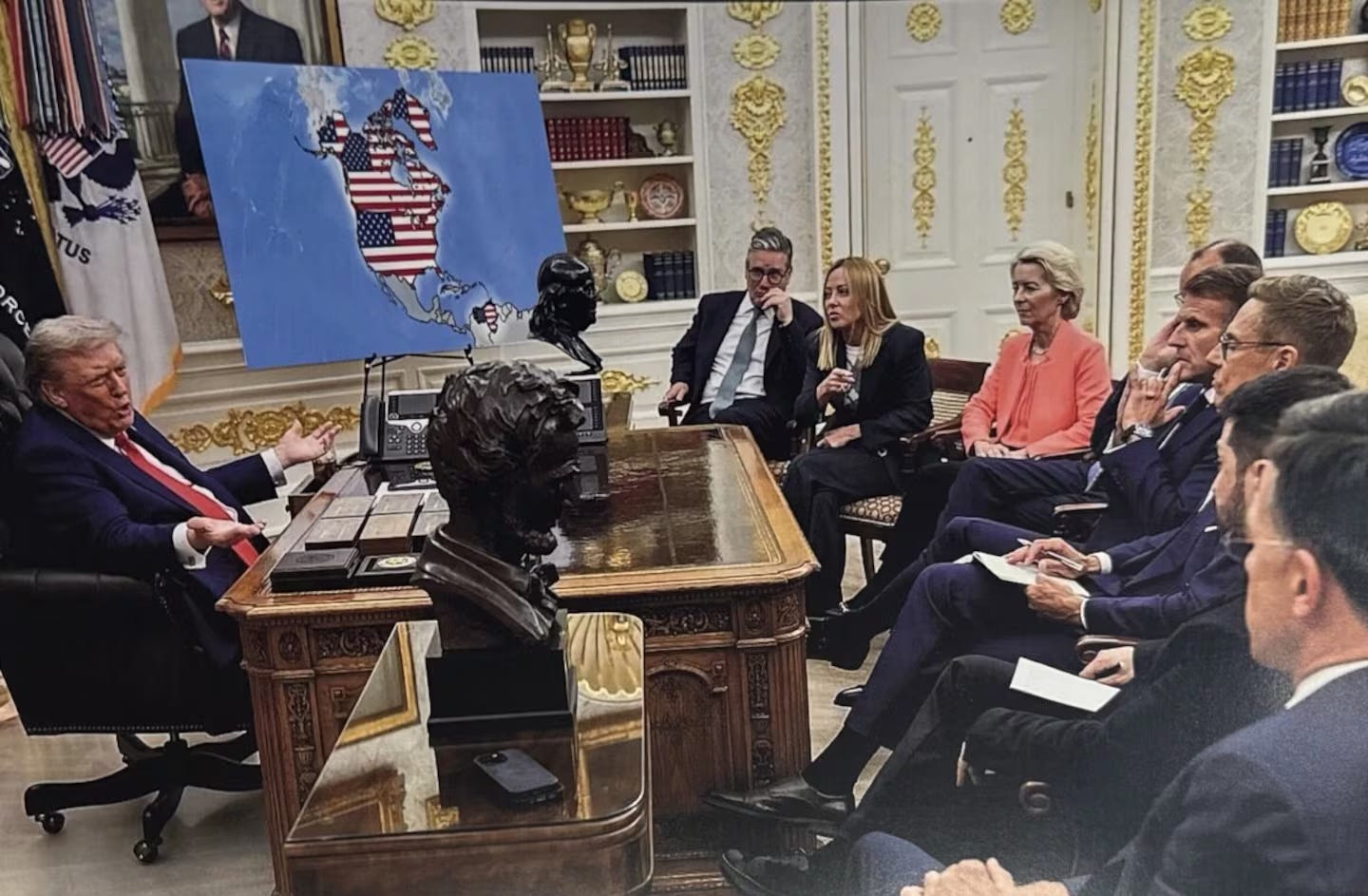
He has threatened to annex Greenland, “take back” the Panama Canal, and employ economic force to compel Canada to become “a cherished and beautiful 51st state.”
Notwithstanding his petulant lobbying for a “Noble Peace Prize” (like Obama) and his specious claim to have “ended eight wars,” in 2025 Trump bombed Yemen, Somalia, Iraq, Iran, Syria, Nigeria, and Venezuela, and the US has killed at least 112 people in strikes on alleged drug-smuggling boats in the Caribbean and Pacific. Asked whether “killing the citizens of another nation who are civilians without any due process is called a war crime,” J. D. Vance responded: “I don’t give a shit what you call it.”
On December 16 Trump declared “A TOTAL AND COMPLETE BLOCKADE OF ALL SANCTIONED OIL TANKERS going into, and out of, Venezuela … Until such time as they return to the United States of America all of the Oil, Land, and other Assets that they previously stole from us.” As of January 13, the US Navy had seized five tankers. Asked what would happen to the oil, Trump responded “We’re gonna keep it.”
Trump has now extended the blockade to Cuba, warning “THERE WILL BE NO MORE OIL OR MONEY [from Venezuela] GOING TO CUBA — ZERO! I strongly suggest they make a deal, BEFORE IT IS TOO LATE.” He has also threatened to take military action in his quarrels with Mexico and Colombia. Nothing like showing them who’s boss.
Asked in a lengthy interview for the New York Times in January 2026 whether there was any limit on his powers, Trump replied: “Yeah, there is one thing. My own morality. My own mind. It’s the only thing that can stop me … I don’t need international law.”
A global protection racket
In a sharp reversal of the free trade consensus that has governed the world economy since World War II, Trump has imposed tariffs ranging from 10–41 percent on imports from all US trading partners, and certain goods (e.g. steel, aluminum, critical minerals, automobiles, pharmaceuticals, semiconductors, lumber) face higher levies. As I write, the legality of Trump’s use of tariffs is being litigated before the US Supreme Court.
On February 1, 2025 he imposed 25 percent tariffs on most goods from Canada and Mexico, supposedly because neither country was doing enough to stem the flow of fentanyl (and in Mexico’s case immigrants) across the US border. On March 24 he imposed 25% tariffs on all goods from countries that import Venezuelan oil—a tactic he extended on January 12, 2026 to “any country doing business with” Iran.
On July 30, 2025, Trump put tariffs on various goods from Brazil “due to Brazil’s actions regarding the prosecution of former President Bolsonaro, the regulation of online platforms, and other issues.” In August he imposed a whopping 50 percent tariff on India, which included a 25 percent punishment for continuing to buy Russian oil. In October he made a $20 billion line of credit to Argentina contingent upon his rightwing ally Javier Milei’s party winning the upcoming parliamentary elections.
On January 17 he threatened a 10 percent tariff, rising to 25 percent, on Denmark, Norway, Sweden, France, Germany, the UK, the Netherlands, and Finland, which would “be due and payable until … a Deal is reached for the Complete and Total purchase of Greenland”—despite having signed recent trade agreements with the UK and EU. Following pushback from European powers he backed down, announcing that talkswith NATO chief Mark Rutte had “formed the framework of a future deal.”
When French president Emmanuel Macron declined to join his Board of Peace, Trump threatened to impose 200 percent tariffs on French wine and champagne.
It is clear is that irrespective of prior agreements or treaties, Trump will not hesitate to use economic means to achieve political ends. He’s running a global protection racket.
Strongarming the courts
Not only has Trump flouted international law. He has gone out of his way to discredit international legal institutions, including the world’s two highest courts.
Accusing South Africa of taking “aggressive positions towards the United States and its allies, including accusing Israel, not Hamas, of genocide in the International Court of Justice” (ICJ) the Trump administration instituted a series of measures intended to discredit South Africa’s moral authority to bring the case, pressurize South Africa to drop it, and discourage other countries from joining it.
In February 2025, Donald Trump imposed sanctions on the International Criminal Court (ICC) for indicting Israeli PM Benjamin Netanyahu and defense minister Yoav Gallant for war crimes. ICC chief prosecutor Karim Khan was the first victim. The US sanctioned four more judges on June 5, adding two more judges (one of them was Canadian justice Kimberly Prost) and two assistant prosecutors on August 20. Rubio sanctioned two more judges in December, and the administration is now leaning onthe court to amend its guiding documents to exempt US citizens from its jurisdiction.
Such sanctions include an asset freeze, a prohibition on Americans doing business with sanctioned individuals, and a ban on their entering the United States. Unable to access the world banking system, victims—who also include UN Special Rapporteur Francesca Albanese—cannot even use credit cards or book a flight or a hotel online.
“The purpose is clear,” Prost told the Irish Times:
Effectively, they are interfering directly with the independence of a judge. I can’t think of any other way to describe it but an attack on the independence of the judiciary and the International Criminal Court’s independence as an institution.
Securing the home front
Trump has moved just as fast on the domestic front, in ways that test the legal limits of his executive power. His actions have resulted in at least 583 challenges in the courts. While lower courts have overturned many of his orders, the conservative-dominated Supreme Court—which previously gave him immunity for “actions relating to the core powers of his office”—has so far generally proved more compliant.
The administration took an axe to the federal government and its programs, with the loss of 317,000 jobs by the end of 2025. Elon Musk’s Department of Governmental Efficiency (DOGE), which was created by executive order on Trump’s first day outside the normal machinery of government, was responsible for much of the early carnage. The now-defunct DOGE has been widely criticized as “illegal and unconstitutional.”
The 26 executive orders Trump signed on his first day—more than any previous US president—included a ban on diversity, equity and inclusion (DEI) programs across the federal government, attempts to limit birthright citizenship, and the declaration of a “national energy emergency” that has led to a bonfire of environmental regulations.
From removing over 8,000 government web pages related to DEI initiatives, “gender identity, public health research, environmental policy, and various social programs,” to excluding transgender soldiers from the military and athletes from women’s sports, waging a “war on science” and whitewashing how history is presented in the nation’s museums, Trump has used his executive powers to advance MAGA’s culture wars.
He also found time on his first day to unconditionally pardon almost all 1,600 rioters convicted in the January 6, 2021 assault on the Capitol and commute the sentences imposed on Proud Boys and Oath Keepers militia members for seditious conspiracy. While this was within his powers as president, it shows scant respect for the courts. House Democrats are now asking how many of the rioters have joined Immigration and Customs Enforcement (ICE), which increasingly looks like Trump’s Gestapo.
The same contempt for the rule of law is shown by the fact that nearly a month after Congress set a deadline of December 19 for the release of all files relating to the Jeffrey Epstein case, Trump’s Department of Justice has made public only 12,285 out of over 2 million relevant documents, and many of these have been heavily redacted.
I am your retribution
Not content with stacking the governing bodies of public institutions from the Kennedy Center for the Performing Arts—now renamed the Trump-Kennedy Center—to the Consumer Financial Protection Bureau with loyalists, Trump has good on his promise to his MAGA supporters that “I am your justice … I am your retribution.”
The president has purged the US military, the justice department, immigration judges, and at least 17 inspectors general (the independent watchdogs who oversee federal government departments). The list of those whose security clearances been revoked in retaliation for past actions deemed hostile to Trump is growing very long indeed.
Weaponizing the justice department, Trump has opened criminal investigations or prosecutions against among others Letitia James, Jack Smith, James Comey, John Bolton, Eric Swalwell, Adam Schiff, Mark Kelly, John Brennan, and Jerome Powell, all of whom he has crossed swords with in the past. The administration’s response to pushback against the murder of Renée Good from elected city and state officials has been to issue subpoenas against governor Tim Walz and mayor Jacob Frey.
Trump has sanctioned big law firms (e.g., WilmerHale, Jenner and Block, Covington & Burling) because they represented clients of which he disapproved. Rather than face being shut out of business with federal agencies, excluded from federal buildings (including courtrooms), and losing security clearances, several firms have caved to Trump’s demands and promised millions in pro bono work to causes he supports.
Silencing speech
The administration has dismantled Voice of America, Radio Free Europe, and Radio Free Asia and defunded PBS and NPR on grounds that the former has “a “leftist bias” and fails to project “pro-American” values and the latter do not offer “a fair, accurate, or unbiased portrayal of current events to taxpaying citizens.”
Trump removed Associated Press from the White House press pool and stripped the White House Correspondents’ Association of its traditional power to decide which journalists have access to the president. In October, reporters from all but one news organization—including even the regime-friendly Fox News—turned in their Pentagon access badges rather than agree to new rules from secretary of defence (now styled “secretary of war”) Pete Hegseth restricting what they were allowed to report.
Trump has personally sued among others ABC News (obtaining $15 million in an out-of-court settlement), the Daily Beast, CBS News (a $16 million settlement), the Des Moines Register, the Wall Street Journal, and the New York Times. He is suing the BBCfor defamation for no less than $10 billion, a sum that would bankrupt the UK’s public broadcaster (whose entire income in 2025 was £5.9 billion, or $US 7.88).
CBS canceled The Late Show with Stephen Colbert after Colbert criticized Trump. The next month, ABC suspended Jimmy Kimmel Live! after Kimmel commented on the assassination of rightwing darling Charlie Kirk, leading Trump to muse: “They’re giving me all this bad press, and they’re getting a license. I would think maybe their license should be taken away.” This is hardly a climate conducive to free speech.
Kneecapping the universities
A recent report by PEN America documents how
From executive orders and memos, to investigations, the withholding of funds for research and financial aid, and efforts to detain, deport, or deny visas to international students and academics, the federal administration has weaponized every imaginable lever to bring the higher education sector to its knees.
The report instances 90+ Title VI investigations, $3.7 billion in cuts from federal research dollars from previously awarded grants, and NIH and NSF funding cuts with an estimated annual cost of $10-15 billion in decreased US economic output.
The federal government has proposed suspending 38 universities including Harvard and Yale from a research partnership program because they engage in DEI hiring, fined UCLA $1.2 billion, and required that it not enroll “foreign students likely to engage in anti-Western, anti-American, or antisemitic disruptions or harassment.” Since January 2025 the State Department has revoked over 8,000 student visas, targeting in particular those who have taken part in pro-Palestinian demonstrations.
Faced with these pressures many schools, including New York’s Columbia University, have traded academic freedom for federal dollars and accepted unprecedented political oversight of their hiring practices and the content of their research and teaching.
Others have resisted—up to a point. Though Harvard is suing the administration, it has suspended its research partnership with Birzeit University in the West Bank and dismissed the director and associate director of its Center for Middle Eastern Studies.
The cruelty is the point
Trump’s One Big Beautiful Act allocated a mindblowing $75 billion over four years (in addition to $10 billion already appropriated for 2025) to ICE to arrest, detain, and deport immigrants. The law provided $45 billion to increase ICE detention capacity and $46.6 billion for the construction of border barriers and surveillance systems.
Advertising “You do not need an undergraduate degree,” a generous pay and benefits package, and a $50,000 signing bonus, ICE recruited 12,000 additional agents during 2025, expanding its workforce by 120 percent. Mobilizing “Uncle Sam” imagery, the ads are crafted to attract MAGA supporters, if not outright white nationalists.
DHS boasts that in 2025 “nearly 3 million illegal aliens … left the U.S. … including an estimated 2.2 million self-deportations and more than 675,000 deportations.” The conditions in Florida’s “Alligator Alcatraz” and other ICE detention centers are grim. A record 32 people died in ICE custody in 2025. The cruelty is the point—to strike fear.
An unknown number of those deported have not been given due process and in some cases have been sent to third countries with which they have no connection. In what is perhaps the most notorious case of denial of legal rights, the administration defied court orders and summarily deported 238 Venezuelan men to the CECOT prison in El Salvador, which is notorious for torture and “life-threatening prison conditions.”
ICE has conducted large-scale raids across the US aiming at 3,000 arrests per day. Though DHS claims its targets are “criminal illegal aliens across the country, including gang members, rapists, kidnappers, and drug traffickers,” ICE’s goons have rounded up people from factories, farms, meatpacking plants, restaurants, churches, schools, and even immigration courts. In Minnesota Trump’s Gestapo are going from house to house, breaking down doors and arresting people. Seventy-five percent of those held by ICE in December had no criminal convictions. This is a reign of terror.
Trump has deployed the National Guard to Los Angeles, Washington DC, Chicago and Portland, Oregon, in the latter case to support ICE. He has threatened to invoke the Insurrection Act in order to dispatch troops to end the protests in Minnesota. “If I feel it’s important to invoke the Insurrection Act,” he told the New York Times, “I have the right to do pretty much what I want to do.” L’état, c’est moi.
Signs in the window
What has any of this to do with Gaza?
Invoking Václav Havel’s parable of the Czech greengrocer who places a sign in his window reading “Workers of the World Unite” not because he believes it, but to signal his conformity—and thereby helps reproduce the system that oppresses him—Mark Carney’s 2026 Davos speech showed rare honesty from a western political leader.
“For decades, countries like Canada prospered under what we called the rules-based international order,” he begins. But
We knew the story of the international rules-based order was partially false, that the strongest would exempt themselves when convenient, that trade rules were enforced asymmetrically. And we knew that international law applied with varying rigour, depending on the identity of the accused or the victim.
This fiction was useful … So we placed the sign in the window. We participated in the rituals, and we largely avoided calling out the gaps between rhetoric and reality.
Then came Gaza. When the gaps became chasms.
When George H. W. Bush went to war with Iraq over Saddam Hussein’s invasion of Kuwait in 1990, he sought and got authorization from the UN Security Council. When his son, George W. Bush, wanted to fight Saddam again in 2003, he and UK PM Tony Blair—the same Blair that is now on Trump’s “Board of Peace”—used fake intelligence to get support for going to war from the US Congress and UK parliament. The UN was unpersuaded by their claims, but they went through the motions of playing by the rules before going ahead with a “coalition of the willing” anyway. When Vladimir Putin annexed Crimea in 2014 and invaded Ukraine in 2024, western powers, including the US, EU, UK, and Canada, responded with ever-escalating rounds of sanctions.
But with Gaza, it is different. As I have documented in more than 25 articles over the last two years, not only have western governments, with the support of mainstream political parties and mass media across the political spectrum, armed, funded, and provided diplomatic cover for the genocide. They have thrown international law out of the window and perhaps fatally undermined the institutions that support it—the UN and its agencies, the ICJ, and the ICC. And they have sacrificed human rights and civil liberties at home, persecuting Israel’s critics under the specious banner of “combatting antisemitism.”
This was not Donald Trump’s doing. The responsibility lies squarely with Joe Biden, Antony Blinken, and Kamala Harris; with Rishi Sunak, David Cameron, Keir Starmer, David Lammy, and Yvette Cooper; with Justin Trudeau, Mélanie Joly, Anita Anand, and—it must be said—Mark Carney; with Emmanuel Macron, Anthony Albanese and Penny Wong, Olaf Scholz and Friedrich Merz, not to mention Kaja Kallas and Ursula von der Leyen. They dealt the final blows to the old order. Trump is just picking up where they left off.
Gaza’s revenge
Asked by Democracy Now on December 26, 2025, to comment on “what’s happening in Gaza,” the Indian novelist and activist Arundhati Roy replied:
What is there to discuss when you’re murdering children, destroying hospitals, destroying universities, murdering journalists, and boasting about it, boasting about it? And everybody’s sort of ambiguous—I mean, what we are witnessing also is, I think, there are surveys that say that almost 90% of the population of the world wants this to stop, but there is no connection between democratically elected governments and the will of the people. It’s ended. So, the whole charade of Western liberal democracy is as much of a corpse under the rubble as the tens of thousands of Palestinians.
Trump’s triumph might be seen as Gaza’s revenge. Revenge for the West’s complicity in the worst crimes of the century. Revenge for its repeated trampling on international law. Revenge, above all, on the American Democrats who demanded everyone’s vote despite Biden’s “ironclad” support for Israel and Kamala Harris’s refusal to break with his legacy—and told protestors against genocide to shut up because “I’m speaking!”
She is not speaking any more. Donald Trump is Aimé Césaire’s imperial boomerang. Sow the wind, reap the whirlwind. The imperial chickens are coming home to roost.

 coasts of bohemia