Derek Sayer / Canadian Dimension / July 29, 2025 

Girl in Gaza on her way to get food. Photo by Jaber Jehad Badwan/Wikimedia Commons.

After reneging on its January ceasefire agreement with Hamas, Israel imposed a total blockade on aid into Gaza on March 2 and cut off remaining electricity supplies a week later. It resumed its military assault on March 18. Since then, Gaza’s health authorities have recorded a further 8,196 fatalities and 30,094 injuries. The death toll from IDF actions since the present “war” began on October 7, 2023 has now passed 60,000.

United Nations data show that throughout July the IDF has been killing one person every 12 minutes. “An average of 119 Palestinians are being killed daily so far in July—the highest rate since January 2024. More than 401 Palestinians a day are being wounded, the highest figure since December 2023.”

To put this in perspective, this means that in the last month Israel has killed, on average, more people in Gaza every week than the 736 Israeli civilians who died during Hamas’s October 7 attack on southern Israel (many of them casualties of Israeli “friendly fire”)—the event that triggered, and has repeatedly been used to justify, Israel’s present “war.”

For Pity’s Sake, Stop This Now!

Aid agencies have been warning of imminent famine for months, threatening the lives of Gaza’s 2.1 million inhabitants—or whatever portion of them have survived nearly two years of IDF bombardment—who have no means of escape from the besieged enclave. Deaths from hunger are now rising exponentially, beginning with the most vulnerable.

As Nesrine Malik explains:

The children die first. In conditions of starvation, their growing bodies’ nutritional needs are higher than those of adults, and so their reserves are depleted faster. Their immune systems, not yet fully developed, become weaker, more susceptible to disease and infection. A bout of diarrhoea is lethal. Their wounds don’t heal. The babies cannot be breastfed as their mothers have not eaten. They die at double the rate of adults.


On July 29, the Integrated Food Security Phase Classification, or IPC—the world’s official famine watchdog—for the first time issued a famine alert, as distinct from a warning, for Gaza, stating that:

The worst-case scenario of Famine is currently playing out in the Gaza Strip. Conflict and displacement have intensified, and access to food and other essential items and services has plummeted to unprecedented levels.

Mounting evidence shows that widespread starvation, malnutrition, and disease are driving a rise in hunger-related deaths. Latest data indicates that Famine thresholds have been reached for food consumption in most of the Gaza Strip and for acute malnutrition in Gaza City.

Immediate action must be taken to end the hostilities and allow for unimpeded, large-scale, life-saving humanitarian response. This is the only path to stopping further deaths and catastrophic human suffering.


Recent days have seen a tsunami of horrific headlines, illustrated by graphic photos of starving children. In the UK, the Guardian’s July 23 lead story blared: “‘We faced hunger before, but never like this’: skeletal children fill hospital wards as starvation grips Gaza.” The article was illustrated with a mother-and-dying-child image that seems destined to become as iconic as Nick Ut’s famous Vietnam War photo “Napalm Girl.”

The front page of the Daily Express—a right-wing populist tabloid—carried the same photo, captioning the image “For Pity’s Sake, Stop This Now.” The accompanying article was headlined “The suffering of little Muhammad clinging on to life in Gaza hell shames us all.” The paper’s head of news Callum Hoare posted on X:

The brutal suffering in Gaza must end. The shocking image shows Muhammad Zakariya Ayyoub al-Matouq, one, who weighs the same as [a] three-month old baby due to the humanitarian crisis following the continued blocking of basic aid to civilians by Israel.


Spain’s El País showed a child’s outstretched hand holding a crust of bread under the headline, “Hunger in Gaza sparks global outcry to stop the war.” India’s Economic Times paired a front-page editorial calling Israel’s actions “genocidal” with a photo of empty cooking pots outside a damaged building. The Washington Post led with “Mass Starvation Stalks Gaza” and a photo of a another Palestinian woman holding another emaciated infant.

Is “balance” finally giving way to truth?

Western newsrooms are no longer taken in by IDF propaganda videos purportedly showing “senior Hamas terrorists boasting about their meals in underground terror tunnels” while gorging on fresh fruit—a tall order, since Israel has been blockading the Strip since March 2. Nor are they uncritically accepting Israeli official statements as statements of fact, as most of them have shamefully done for the last two years.

BBC News—which has repeatedly, and justifiably, been accused of systematically downplayingPalestinian sufferings and whitewashing Israeli war crimes—issued a joint statement on July 24 with AFP, AP, and Reuters, which backhandedly conceded that the IDF indeed is using starvation as a weapon of war in Gaza. It began:

We are desperately concerned for our journalists in Gaza, who are increasingly unable to feed themselves and their families. For many months, these independent journalists have been the world’s eyes and ears on the ground in Gaza. They are now facing the same dire circumstances as those they are covering.

Journalists endure many deprivations and hardships in warzones. We are deeply alarmed that the threat of starvation is now one of them.


The statement neglected to mention that in the interests of keeping the genocidal truth under wraps, Israel has banned international media from Gaza and so far killed 232 local journalists in the course of its current “war”—more than the number of journalists killed in the US Civil War, the First and Second World Wars, the Korean War, the Vietnam War, the wars in Yugoslavia, and the post-9/11 war in Afghanistan combined.

Even the New York Times, which has been steadfast in its support for Israel throughout its “war” on Gaza, carried a long and damning essay by the renowned Israeli Holocaust scholar Omer Bartov headlined “I’m a Genocide Scholar. I Know It when I See It.” To be fair, the paper carried an op-ed by Bret Stephens a few days later arguing “No, Israel Is Not Committing Genocide in Gaza,” in the interests not of truth but of “balance.”

Despite Israel’s increasingly implausible attempts to deny that there is famine in Gaza—or to shift the blame to Hamas (which a recent USAID investigation found is not “stealing aid,” a conclusion that was repeated later by IDF senior officers interviewed by the New York Times) or the UN (ignoring Israel’s own ban on UNRWA in Israel and the occupied Palestinian territories and refusal of visas to UN agency personnel)—the dam has broken.

When “aid distribution centres” become killing fields

In late May, under international pressure, Israel permitted the US-backed so-called Gaza Humanitarian Foundation (GHF) to distribute meagre and inappropriate aid packages through four centres set up to replace the 400-plus distribution points previously run by UNRWA and other international aid agencies. The GHF is a private body, staffed largely by US contractors, with no prior experience of supplying humanitarian aid in war zones.

Benjamin Netanyahu admitted that allowing this “minimal” aid was only done to keep US politicians onside. Israel’s National Security Minister Itamar Ben Gvir denounced the change in policy as “a grave mistake,” while Heritage Minister Amichay Eliyahu argued that “letting humanitarian aid in now directly harms the war effort to achieve victory.”

On July 8, following the death of five Israeli soldiers in a Hamas ambush—a drop in the ocean compared with the daily Palestinian civilian casualties—Ben Gvir demanded “a total siege, a military crushing, encouraging immigration and settlements” and Finance Minister Bezalel Smotrich called on Netanyahu to “immediately halt” aid for Gaza. They could hardly have made it clearer that Israeli combatants’ deaths will be paid for many times over by Palestinian civilian lives, whatever the Geneva Conventions might say.

Outside of the so-called “humanitarian zones,” to which over 90 percent of Gaza’s inhabitants have been compulsorily evacuated and now live in squalid tents—which the IDF still regularly hits, claiming to target “Hamas militants” but killing and maiming many more civilians with every strike—82.6 percent of the Gaza Strip is now within the Israeli-militarized zone or under displacement orders. Three of the GHF centres are located in the ruins of Rafah in the south, the other in Deir al-Balah in central Gaza.

Hundreds of Palestinians have been massacred when lining up for food at GHF centres or trying to reach them. As of July 15, per the Office of the United Nations High Commissioner for Human Rights (OHCHR), 875 people had been killed trying to access food for their families, 674 of them in the vicinity of GHF sites. That number has now passed 1,000.

Interviewed for the BBC World Service on July 25, retired US special forces officer Lt. Col. Anthony Aguilar, a former Green Beret, explained why he had quit his job with GHF:

I witnessed the Israeli Defense Forces shooting at the crowds of Palestinians… Without question I witnessed war crimes by the [IDF], using artillery rounds, mortar rounds, and tank rounds against unarmed civilians… I have never witnessed such a level of brutality and use of indiscriminate and unnecessary force against a civilian population—an unarmed, starving population.

Lies, damned lies, and hasbara

Charging that “Today, Palestinians in Gaza face an impossible choice: starve or risk being shot while trying desperately to reach food to feed their families,” on June 30 more than 240 international charities and NGOs, including Oxfam, Save the Children, and Amnesty International, issued a joint statement calling for “immediate action to end the deadly Israeli distribution scheme (including the so-called Gaza Humanitarian Foundation) in Gaza, revert to the existing UN-led coordination mechanisms, and lift the Israeli government’s blockade on aid and commercial supplies.”

Donald Trump’s Ambassador to Israel Mike Huckabee, former Republican governor of Arkansas, knows better. On July 24 he posted on X two photographs, which we are to assume were shot in Gaza though no date or location is given, with the comment:

Here are photos of UN trucks & enough food to feed all of Gaza but it sits rotting! UN is a tool of Hamas! US based GHF is actually delivering food FOR FREE and SAFELY. UN food is either looted by Hamas or rots in the sun! Photos from yesterday.

Huckabee, whose “evangelical Christian beliefs,” per the official US embassy website, “include support for Israeli control over their ancient and indigenous homeland,” clearly believes his responsibilities including shilling for hasbara (Israeli public diplomacy aimed at explaining and promoting Israel’s policies and image internationally). It would be nice to see him apply the same argument about ancestral homelands to the Indigenous inhabitants of the United States, but let that pass. Israel’s rights are judged by different standards.

Huckabee also believes that “There is no such thing as a Palestinian” and “no such thing as a West Bank. It’s Judea and Samaria. There’s no such thing as a settlement. They’re communities, they’re neighborhoods, they’re cities. There’s no such thing as an occupation.” This is of course music to Ben Gvir, Smotrich, and Netanyahu’s ears.

UN spokesperson Farhan Haq has cited “a number of interdependent factors” that have stopped UN aid being delivered even when it has reached Gaza, including “bureaucratic, logistical, administrative, and other operational obstacles imposed by Israeli authorities”—something former British Foreign Secretary and one-time Prime Minister David Cameron complained about back in March 2024—and “shooting incidents that have killed and injured people gathering to offload aid supplies along convoy routes.”

One recent shooting incident is related by Cindy McCain, the widow of US Senator John McCain and head of the World Food Program:

Shortly after passing the final checkpoint beyond the Zikim crossing point into Gaza, the convoy encountered large crowds of civilians anxiously waiting to access desperately needed food supplies… As the convoy approached, the surrounding crowd came under fire from Israeli tanks, snipers and other gunfire. We are deeply concerned and saddened by this tragic incident resulting in the loss of countless lives.

Today’s violent incident comes despite assurances from Israeli authorities that humanitarian operational conditions would improve; including that armed forces will not be present nor engage at any stage along humanitarian convoy routes. There should never, ever, be armed groups near or on our aid convoys, as reiterated on many occasions to all parties to the conflict.

Without these fundamental conditions in place, we cannot continue providing life-saving support across the Gaza strip.

The politicians react

If key sections of the Western media are now changing their tune on Gaza, disgust with Israel’s treatment of Palestinians is even more pronounced among the wider public.

survey carried out by Pew Research Center published on June 3 found that in 20 of 24 countries surveyed, half of adults or more have a negative view of Israel. Among Western or Western-aligned nations, Israel was viewed “very” or “somewhat unfavourably” by 79 percent of respondents in Japan, 78 percent in the Netherlands, 75 percent in Spain and Sweden, 74 percent in Australia, 72 percent in Greece, 66 percent in Italy, 64 percent in Germany, 63 percent in France, 62 percent in Poland, 61 percent in the UK, 60 percent in Canada and South Korea, and even—remarkably, in view of bipartisan support for Israel among both Republican and Democrat party leaderships—53 percent in the US.

This was before the recent blanket press coverage of the growing famine and almost daily massacres of Palestinians seeking food at the GHF distribution centres.

Wrong-footed by events, and under immense pressure from their respective publics, Western politicians have been falling over themselves to take back the narrative.

On July 21, Canada joined 24 other Western nations and the EU Commissioner for Equality, Preparedness and Crisis Management in a statement that firmly rapped Israel over the knuckles for its most recent transgressions in Gaza:

The suffering of civilians in Gaza has reached new depths. The Israeli government’s aid delivery model is dangerous, fuels instability and deprives Gazans of human dignity. We condemn the drip feeding of aid and the inhumane killing of civilians, including children, seeking to meet their most basic needs of water and food. It is horrifying that over 800 Palestinians have been killed while seeking aid. The Israeli Government’s denial of essential humanitarian assistance to the civilian population is unacceptable. Israel must comply with its obligations under international humanitarian law.


On July 25 the leaders of Britain, France, and Germany issued another statement reminding Israel that “withholding essential humanitarian assistance” is “unacceptable” and describing the situation in Gaza as a “humanitarian catastrophe.” They added that they “stand ready to take further action to support an immediate ceasefire and a political process that leads to lasting security and peace for Israelis, Palestinians and the entire region,” without saying what that action might comprise.

No doubt Keir Starmer and Emmanuel Macron would rather we forgot that they had signed a joint statement with Canada’s Mark Carney calling on the Israeli government “to stop its military operations in Gaza and immediately allow humanitarian aid to enter Gaza,” and threatening “If Israel does not cease the renewed military offensive and lift its restrictions on humanitarian aid, we will take further concrete actions in response,” two months ago, on May 19. Needless to say no actions of any consequence were taken.

The time for covering asses is at hand

Aware, perhaps, of their potential liability under the Geneva Conventions for not doing everything within their power to prevent genocide—or at least war crimes and crimes against humanity—in Gaza, individual Western politicians have meantime been lining up to put their immense sympathy for the Palestinian people on record.

Keir Starmer proclaims “The suffering and starvation unfolding in Gaza is unspeakable and indefensible. While the situation has been grave for some time, it has reached new depths and continues to worsen. We are witnessing a humanitarian catastrophe.”

Starmer’s Foreign Secretary David Lammy says he is he is “appalled, sickened” by the “grotesque” targeting of starving Palestinians. “These are not words that are usually used by a foreign secretary who is attempting to be diplomatic,” he adds, “but when you see innocent children holding out their hand for food, and you see them shot and killed in the way that we have seen in the last few days, of course Britain must call it out.”

Australia’s PM Antony Albanese laments that “The situation in Gaza has gone beyond the world’s worst fears… Gaza is in the grip of a humanitarian catastrophe. Israel’s denial of aid and the killing of civilians, including children, seeking access to water and food cannot be defended or ignored.”

EU foreign policy supremo Kaja Kallas (who stated on July 15 that “the EU will not move forward with sanctions against Israel”) protests that “The killing of civilians seeking aid in Gaza is indefensible.” “The images from Gaza are unbearable,” posts Ursula von der Leyen, President of the European Commission, “Israel must deliver on its pledges.”

Canadian government representatives have been more reticent in their condemnations—a good deal more reticent than when they denounce instances of alleged “antisemitism.”

But noting on July 24 that “denial of humanitarian aid is a violation of international law,” Mark Carney stated that “Canada condemns the Israeli government’s failure to prevent the rapidly deteriorating humanitarian disaster in Gaza.”

Foreign Affairs Minister Anita Anand echoed her boss, posting on X the same day:

The humanitarian crisis in Gaza worsens by the day. Women and children are starving, without adequate access to food and water, the most basic of needs. It is inexcusable and must end… the Israeli government must allow the uninhibited flow of humanitarian aid to reach Palestinians civilians, who are in urgent need.


New Democrat Party MP (and candidate for NDP leader) Heather McPherson asks, not altogether unreasonably:

For nearly 21 months @NDP has urged action from Canada: recognize Palestinian statehood, impose sanctions, suspend CIFTA, implement arms embargo. In a caucus of 169 MPs only a handful of Liberals have spoken out for Palestine. Why the Liberal silence? Cowardice? Racism?

It’s only words

Several things need to be said about this belated outpouring of sympathy for innocent Palestinians on the part of politicians who have been arming, diplomatically supporting, and repressing domestic criticism of Israel’s genocide for the last two years.

First, however tough their language, they never use the word genocide—or the terms war crimes and crimes against humanity. The reason is pretty clear. To do so would not only acknowledge these governments’ past complicity in the worst crimes known to the law, but legally require them to act immediately to end that complicity in the future.

The preferred term is always “humanitarian catastrophe,” which naturalizes the event—equating it with other things that cause famine, like crop failures, floods or drought—and shifts the focus away from the human actors and actions that have caused it.

Second, there is a systematic attempt to suggest that it is only now that the situation has become catastrophic. The implication is that it was legitimate to support Israel’s assault on Gaza previously. As one puzzled comment on X put it:

I have been wondering why the Zionists’ stepped up use of hunger as a mass murder weapon has suddenly triggered a Western outcry, but two years of pre-announced, and equally vile, mass murder via bombs and bullets did not generate the same outcry.


Third—and most importantly—none of these statements, however strongly worded, have been followed by any action that would put real pressure on Israel to change its behaviour. And knowing this, Israel continues to largely ignore Western protests.

Even Emmanuel Macron’s historic promise to recognize a Palestinian state—a largely symbolic gesture, albeit a significant one—has been attacked by Donald Trump, and Britain and Canada, who at one time looked prepared to join him, are now reportedly getting cold feet for fear of angering the US.

It is not as if the international community doesn’t have plenty of weapons at its disposal to force compliance on rogue states.

Apartheid South Africa was kicked out of the UN and subjected to stringent economic, sporting, and cultural sanctions and boycotts that eventually brought the system to its knees. The first Gulf War against Iraq was fought under UN auspices, and the second by a US-led “coalition of the willing.”

The most obvious contemporary example of such international action—which contrasts sharply with the West’s pusillanimous avoidance of any meaningful action to stop Israel’s carnage in Gaza—was the coordinated response to Russia’s invasion of Ukraine, which has been met with wave after wave of sanctions.

For whatever reasons—be they geopolitical, economic, or racist—not to take comparable action against Israel is a choice. Our choice.

Our genocide

Faced with widespread Western condemnation, Netanyahu has now agreed to allow air drops of aid into Gaza and daily 10-hour “humanitarian pauses” in three areas of the Strip to enable UN convoys and other aid organizations to safely distribute food and medicine. As in his earlier pivot in May, he explained that given the international reaction, Israel “needs to continue to allow the entry of a minimum amount of humanitarian aid.”

I see this as a purely tactical retreat, like Netanyahu’s earlier acceptance under US pressure of two ceasefire deals which he subsequently broke. He went on to reassure Israelis that “We will continue to fight, we will continue to act until we achieve all of our war goals—until complete victory.” His fundamental objectives have not changed.

On July 28, the day after Netanyahu’s announcement, Israel’s leading human rights organization B’Tselem announced the publication of a report titled Our Genocide on social media. They did not pull their punches or mince their words:

Israel is committing genocide in Gaza.

It sounds inconceivable. But it’s the truth.

Israel is taking deliberate, coordinated action to destroy the Palestinians in the Gaza Strip. Explicit statements by Israeli officials, combined with a consistent policy of destructive attacks and other practices of annihilation, prove beyond a doubt that Israel’s target is the entire population of Gaza.

Entire cities razed to the ground; medical, educational, religious and cultural infrastructure systematically destroyed; 2 million Palestinians forcibly displaced with the aim of expelling them from Gaza; and, of course, mass starvation and killing—all this amounts to an explicit attempt to destroy the population of Gaza and impose living conditions so catastrophic that Palestinian society cannot continue to exist there.

That is the exact definition of genocide.


They continued:

The international community has not only failed in its duty to stop the atrocities, but the leaders of the Western world, particularly the United States and Europe, also share responsibility by providing support that enables Israel’s acts of destruction. It is the duty of the international community to stop the genocide Israel is carrying out in Gaza…

This is our genocide, and we need to stop it.


Israel’s genocide. And the West’s.

Canadian Dimension / July 9, 2025 / 17 min read

Displaced Palestinians roam the shattered streets of the Gaza Strip. Photo by Jaber Jehad Badwan.

As I write this, the press are reporting that a third ceasefire in Gaza is imminent, with Donald Trump committing to “ensuring negotiations continue until a final agreement is reached.” Whether this will end Israel’s “war,” which began on October 7, 2023 and has now raged for 21 months, killing a documented 57,012 Palestinians (as of July 2) and in all likelihood many thousands more, remains to be seen.

In the meantime, a stocktaking of some of the key events of the last momentous month seems in order.

The “12-Day War

Israel launched what it called a “pre-emptive strike” against Iran during the night of June 13. More than 200 IDF fighter jets hit more than 100 nuclear and military facilities and residential neighbourhoods in Tehran and other cities, and Israel assassinated 30 of Iran’s top military commanders and 11 of its nuclear scientists in targeted individual strikes.

Between June 12 and June 23 Israel carried out at least 146 air strikes on Iran. By the time the “12-Day War” ended with the US-brokered ceasefire of June 24, the Israeli air force had hit over 900 targets.

Iran retaliated by attacking Israel with successive barrages of ballistic missiles. As of June 24, the IDF had killed 610 people in Iran, including 49 women and 13 children, and injured 4,746. Iran’s missiles killed 28 people in Israel and injured 3,238.

The excuse for Israel’s unprovoked attack—for which, as has become customary for Israel, no evidence was ever provided—was that Iran was “on the verge of acquiring a nuclear weapon.” Benjamin Netanyahu has periodically made this claim since 1992.

Though US National Intelligence Director Tulsi Gabbard told Congress in March that Iran “was not building a nuclear weapon, and its supreme leader had not reauthorized the dormant program even though it had enriched uranium to higher levels,” Donald Trump chose to disregard his intelligence agencies’ assessment. “I don’t care what she said,” he told reporters on June 17. Heknew Iran was “very close” to having a nuclear bomb.

The US entered the conflict directly on June 22, dropping big, beautiful™ bunker-buster bombs on Iran’s Fordow, Natanz, and Isfahan nuclear facilities. Trump claimed that the strike had “completely and totally obliterated” Iran’s nuclear program, but the US’s own intelligence assessments (which the White House soon trashed) suggested the program had maybe been set back at best by a few months. For whatever it is worth, the latest Pentagon assessment is that “We have degraded their program by one to two years.”

At the point when Israel attacked, Iran was engaged in ongoing talks with the US to renew the nuclear agreement Donald Trump torpedoed in 2018. One of those targeted in Israel’s first strike was the lead Iranian negotiator, Ali Shamkhani. The IDF bombed his Tehran home, leaving him buried under the rubble with serious injuries. Three weeks earlier Trump boasted of “real progress, serious progress” in the talks, describing them as “very, very good.”

None of this inspires confidence in Israel or the US as trustworthy negotiating partners in any future peace process. Why should Iran—or anyone else—believe a word they say?

Circling the wagons

After Israel reneged on its ceasefire agreement with Hamas and launched a renewed Gaza offensive on March 18, killing over 400 people in one single night of terror, and imposed a complete blockade on power, food, and medical aid to the Strip, sections of the press and other influential opinion in the West had increasingly challenged its “self-defence” narrative. For a time at least, political leaders appeared to be listening.

This changed abruptly after June 13. Despite the fact that Israel, not Iran, was the clear aggressor—and notwithstanding the well established principle that pre-emptive actions are permissible under international law only “if the threat is imminent, overwhelming, and leaves no alternative but to act”—most Western states swallowed whatever misgivings they had previously expressed about Gaza and once again fell in line behind Israel.

The calls for “all parties to exercise maximum restraint and to de-escalate” (Emmanuel Macron) were invariably accompanied by reiterations of “Israel’s right to defend itself”—which is not, on any reasonable view, what it was doing—and an insistence that (in the words of Canadian Foreign Minister Anita Anand) “Iran cannot obtain nuclear weapons.”

Nothing was said about Iran’s right to defend itself, even though it was the attacked party. Nor did it seem to matter that unlike Iran, Israel does possess nuclear weapons, has never signed the Nuclear Non-Proliferation Treaty (NPT), and refuses to allow the International Atomic Energy Agency (IATA) to inspect its nuclear facilities.

Despite Israel carrying out what international organizations, leading Israeli academics and genocide scholars agree is a genocide in Gaza for nearly two years—during which time it has also invaded Lebanon and southern Syria and bombed Yemen—the West portrays Iran as (to quote Anand again) the “persistent threat to regional stability.”

Absurdly, the politicians took the fact that Iran responded militarily to Israel’s aggression—which is to say, defended itself—as confirmation of this alleged threat.

Writing on behalf of the EU on June 18, Kaja Kallas insisted that “Israel has the right to protect its security and people, in line with international law,” while “Iran must take decisive steps to return to negotiations and pave the way for a diplomatic solution.” What law she had in mind she didn’t say. Article 51 of the United Nations Charter only recognizes the “right of individual or collective self-defence if an armed attack occurs.”

“Canada condemns Iran’s attack on Israel” began Anand’s June 13 post, without any mention of the Israeli strikes that provoked itGermany, too, “strongly condemn[ed] the indiscriminate Iranian attack on Israeli territory,” adding that “Iran’s nuclear program violates the Non-Proliferation Treaty and poses a threat to the entire region—especially to Israel.” Once again there was silence on the threat posed by Israel’s nuclear arsenal.

German Chancellor Friedrich Merz said the quiet bit out loud during the G7 summit on June 17, letting slip to a journalist: “This is dirty work that Israel is doing for all of us.”

A “Zionist Palestinian state”

On June 24 Mark Carney told CNN’s Christiane Amanpour the Iran-Israel ceasefire offered an “opportunity” not only to end the war in Gaza but for “lasting peace in the Middle East” built around—wait for it—“a Zionist, if you will, Palestinian state.”

This goes beyond anything ventured by Carney’s predecessors Justin Trudeau (who proudly declared “I am a Zionist” on March 3, the same day as Israel cut off Gaza’s electricity supply and blockaded all aid for 11 weeks), and Stephen Harper. At the least, it is tone deaf. Worse, as the Canadian Muslim Public Affairs Council (CMPAC) put it:

By suggesting that Palestinians must be a “Zionist” state as the condition for their own statehood, Carney denies them the basic right to define their own national character and political future. Self-determination is a core principle of international law, affirmed in the UN Charter and multiple human rights treaties, and it cannot be made contingent on adopting the ideological identity of their occupier.


The UN General Assembly resolution calling for an immediate ceasefire in Gaza and “strongly condemning the use of starvation as a weapon of war, demanding a full lifting of the Israeli blockade on humanitarian aid, and insisting on the protection of civilians under international law,” which passed with an overwhelming majority of 149 to 12 on June 12—the day before Israel’s attack on Iran—with the backing of the UK, France, Germany, Canada, Italy, Australia, and New Zealand, was quietly forgotten.

So was an international conference co-hosted by France and Saudi Arabia scheduled to take place on June 17-20 at the United Nations in New York, at which, it was suggested, all parties should accept that “Palestinian statehood should not be a result of peace, but rather its prerequisite.” It was even briefly hinted that France might recognize Palestine at the conference pour encourager les autres. But after June 13 all bets were off.

The conference has now been indefinitely postponed. As Colombia’s President Gustavo Petro has written, this “has left a critical void in multilateral leadership, precisely when it is needed most.” The only Palestinian statehood still left on the table seems to be Mark Carney’s “Zionist Palestine.”

Shifting public opinion

Notwithstanding this backtracking to business as usual on the part of Western leaders, Western publics seem less and less willing to overlook the continuing genocide in Gaza. The genie is out of the bottle, and the gaslighting isn’t working any more.

YouGov EuroTrack survey conducted in Britain, Denmark, France, Germany, Italy and Spain published on June 3 found that while there was little evidence of support for Hamas (only five to nine percent of respondents believed the October 7 attack on Israel was justified), just six to 16 percent believed Israel was “right to send troops into Gaza” and “responded in a proportionate way to the Hamas attacks.” Between seven and 18 percent said they sympathized with Israel, while 18–33 percent said their sympathies lay with the Palestinians. Germany was the only country where the results were evenly matched (17 percent for Israel, 18 percent for Palestine).

In Britain, in a poll conducted on June 18 by YouGov for Action For Humanity and the International Centre for Justice for Palestinians, over half of respondents opposed Israel’s military campaign in Gaza (55 percent) and only 15 percent supported it. A large proportion of those opposed to the campaign thought Israel was committing genocide (82 percent).

Even in the US, where support for Israel has long been an item of faith for both major political parties, the landscape seems to be shifting. A Quinnipiac University poll in early June showed 37 percent of Americans sided with and 32 percent opposed the Israelis—which is a historically narrow margin. This is consistent with several other polls earlier in 2025. 

A Harris-Harvard poll commissioned by the Israeli Knesset reported in the Jerusalem Post on June 26 showed a drop from 53 percent to 41 percent in the percentage of Americans who view Israel favourably, and—most worryingly for Israel’s supporters—found young people were closely split (53 to 47 percent) between supporting Israel and supporting Hamas.

An upset in New York

Zohran Mamdani’s decisive victory over establishment candidate Andrew Cuomo in the June 24 Democratic primary election for mayor of New York City has been universally described as a major upset not only because he is a member of Democratic Socialists of America campaigning on an avowedly progressive platform, but—above all—because of his unequivocal support for the Palestinian cause.

Despite refusing to back down on his criticism of Israel’s “genocidal” conduct of its Gaza campaign and being comprehensively vilified as a Muslim (which he is) and a jihadist supporter of Hamas (which he is not), Mamdani won 56 percent of the vote to Cuomo’s 44 percent. His 545,000 votes are the most in a Democratic mayoral New York City primary since David Dinkins beat incumbent Ed Koch in 1989.

Nobody is suggesting that Mamdani’s stance on Gaza is the only reason he won—though his victory does lend weight to the argument that Kamala Harris’s refusal to deviate from Joe Biden’s “ironclad” support for Israel played a significant part in the Democrats’ loss to Donald Trump in the 2024 presidential election.

But that a candidate who supports the Boycott, Divestment, and Sanctions movement, called for the release of detained Columbia activist Mahmoud Khalil, and promised to arrest Benjamin Netanyahu if he ever sit foot in New York, could win so emphatic a victory in the most Jewish city in America, attracting broad-based support across different ethnic groups—including large numbers of Jews—testifies to just how out of touch with the public the official narratives have become.

Predictably, Republicans responded to Mamdani’s win with outraged pearl clutching and unconcealed Islamophobia. But what is most concerning is that while the success of Mamdani’s campaign might point to a road back to power for a Democratic Party still reeling from its 2024 defeat, establishment Democrats were no more enthusiastic.

“Top Democratic donors” are quoted as finding the primary outcome “disgusting,” and Barack Obama has declined to congratulate Mamdani. House minority leader Hakeem Jeffries, New York’s Democratic Governor Kathy Hochul, and New York Congressman Tom Suozzi are all holding backon endorsing Mamdani in the mayoral election.

They prefer to confine their “resistance,” it seems, to the gestural theatrics of renaming Trump’s “One Big Beautiful Bill Act” and making marathon speeches to which nobody listens. Just as in November’s presidential election, they would rather lose than antagonize Israel.

The protests grow

In Britain, judges, lawyers, and legal academics and prominent writers have issued open letters condemning the UK’s complicity in Israel’s genocide and government and media attempts to quash dissent. Even the august British Medical Association voted by large majorities at its annual conference on July 3 to break off relations with the Israel Medical Association and seek its suspension from the World Medical Association over Gaza.

On the eve of the Cannes Film Festival, more than 370 actors and filmmakers proclaimed that “As artists and cultural players, we cannot remain silent while genocide is taking place in Gaza,” condemning “propaganda that constantly colonizes our imaginations.” The signatories included Joaquin Phoenix, Pedro Pascal, Juliette Binoche, Rooney Mara, Omar Sy, Jim Jarmusch, Richard Gere, Mark Ruffalo, Guy Pearce, Javier Bardem, Ralph Fiennes, Michael Moore, David Cronenberg, Pedro Almodovar, and Guillermo del Toro.

On June 9 “532 Canadians, including academics, lawyers, former and retired ambassadors (including to the United Nations), ministers and public servants, UN human rights experts, and civil society, labour and faith leaders,” wrote to Mark Carney urging “decisive action to end genocide in Gaza.” On July 5 the Anglican Church of Canada adopted a resolution “calling on the Canadian government to uphold their moral responsibilities and impose full and immediate arms embargo on Israel.”

Protest marches continue across the world.  From London and Paris to Sydney and Melbourne, from Athens and Barcelona to Dublin and Toronto, hundreds of thousands have hit the streets. This year’s bull-running San Fermin festival in Pamplona, Spain, turned into a massive show of solidarity with Palestine. On June 15, in one of the biggest demonstrations ever seen in the Netherlands, 150,000 people dressed in red and marched for Gaza in The Hague. On June 21, for the first time on such a scale, 50,000 people marched for Gaza in Berlin.

Revulsion at Israel’s genocide in Gaza is no longer confined to student activists and “lunatic left” professors at Columbia and Harvard, and it can no longer be dismissed as the result of “antisemitism.” The chasm between Western political establishments and the people they claim to represent grows wider by the day.

This is a pervasive crisis of legitimacy.

Ructions at the BBC

Nowhere is that crisis better illustrated than in recent events at the British Broadcasting Corporation.

recent report by the Centre for Media Monitoring, based on analysis of more than 35,000 pieces of BBC content, found that despite Palestinians suffering 34 times as many deaths as Israelis since the present Gaza “war” began, Israeli deaths were given 33 times more coverage and described in much more emotive language. The BBC interviewed significantly fewer Palestinians than Israelis, and presenters shut down interviewees’ claims of genocide while making no mention of Israeli leaders’ genocidal statements (including Benjamin Netanyahu’s notorious invocation of the biblical Amalek).

In May the corporation fired Gary Lineker, Britain’s most popular soccer commentator and longtime host of Match of the Day, the BBC’s equivalent of Hockey Night in Canada, for social media posts critical of Israel. Lineker had previously blotted his copybook by daring to speak out over government heartlessness toward refugees and migrants.

On June 20, after months of delays, the BBC cancelled a documentary it had itself commissioned on Israel’s attacks on Gaza’s health service on grounds that showing the film would create “a perception of partiality.” Based entirely on first-hand testimonies, the film detailed “how hospitals in the territory have been overwhelmed, bombed and raided. Medics recount being detained and claim to have been tortured.”

Channel 4 showed Gaza: Doctors Under Attack in the UK on July 2 and Mehdi Hassan’s Zeteo media platform made it available for streaming internationally. It was widely hailed as “a crucial film” that “the world needs to see.”

On the same day as the film was broadcast, more than 400 BBC staff, freelancers and industry figures, including 111 BBC journalists—who signed anonymously for fear of reprisals—wrote an open letter to BBC management expressing “concerns over opaque editorial decisions and censorship at the BBC on the reporting of Israel/Palestine.”

The letter expressed particular concern that board member Robbie Gibbs, “an individual with close ties to the Jewish Chronicle… has a say in the BBC’s editorial decisions in any capacity, including the decision not to broadcast Gaza: Medics Under Fire [sic].”

Death, death to the IDF

In the midst of the row over Gaza: Doctors Under Attack, a new confrontation erupted over the BBC’s coverage of Glastonbury, Britain’s most popular music festival, which regularly attracts over 200,000 spectators and has long been televised live by the BBC.

In the weeks preceding the festival, pressure was put on the organizers by members of the government, including Keir Starmer, as well as the Conservative opposition leader Kemi Badenoch, to drop the Irish band Kneecap from the roster. Kneecap had made themselves notorious with their earlier performances at the Coachella music festival in California, at which they led the audience in chants of “Free, free Palestine.”

On June 18 Kneecap fans “mobbed sidewalks outside a London court” as the trial opened of band member Mo Chara under Britain’s draconian Terrorism Act. His offense was waving a Hezbollah flag at a concert in North London on November 21 “in a manner that aroused ‘reasonable suspicion’ he supported the Lebanese militant group.”

The Glastonbury organizers refused to cancel Kneecap’s performance, and the band took the stage on June 28. Reportedly “thousands of fans chanted ‘free Palestine’ and waved Palestinian flags,” but BBC viewers were not allowed to see this because the corporation pulled the plug on the live feed. The broadcaster later uploaded an edited version of the performance to BBC iPlayer as part of its on-demand Glastonbury sets.

Kneecap performs at Glastonbury. Photo by Katherine Hajiyianni.

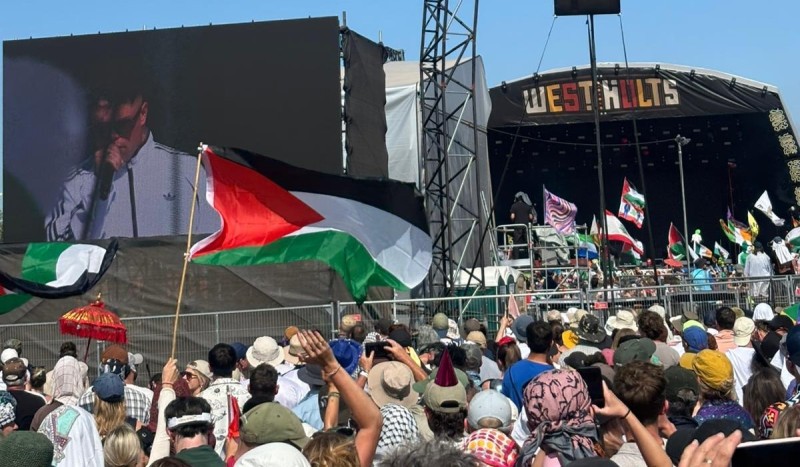
Unfortunately for the BBC, another even more controversial set, by the punk-rap duo Bob Vylan, slipped under the wire. Looking out from the West Holts stage on a sea of Palestinian flags, rapper Bobby Vylan led the 45,000-strong crowd in chants of “Free, free Palestine” and “Death, death to the IDF.”

Bob Vylan’s entire performance was broadcast live, although “a warning was issued on screen about the very strong and discriminatory language” and it was decided not to make the set available on demand via iPlayer. This did not stop pressure mounting on the BBC, as the police announced a criminal investigation into Kneecap and Bob Vylan’s performances and lurid headlines filled the conservative and tabloid press.

Whacking the moles

Two days later, BBC Chair Samir Shaw issued a contrite statement, which apologized “to all our viewers and listeners and particularly the Jewish community for allowing… Bob Vylan to express unconscionable antisemitic views live on the BBC” and acknowledged that continuing the broadcast was “an error of judgement.”

He promised that “The Executive have agreed to put in place a set of strengthened editorial practices and policies for live music programming” and was “initiating a process to ensure proper accountability for those found to be responsible for the failings in this incident.”

On July 7, the Times reported that Lorna Clarke had resigned her position as BBC director of music “after UK Culture Secretary Lisa Nandy condemned the “appalling and unacceptable scenes,” adding that “other senior BBC staff have also temporarily relinquished their day-to-day roles over the Glastonbury controversy—pending an investigation.” Needless to say Robbie Gibbs is still in place.

Clarke’s is not the only scalp Nandy is after. She is also demanding to know why nobody had yet been fired at the corporation for permitting an earlier documentary, Gaza: How to Survive a Warzone, to slip through the censorship net and be broadcast in February.

The BBC pulled the program from its iPlayer after it emerged that its 13-year-old narrator was the son of a deputy agriculture minister in the Hamas-controlled Gaza administration. By then the damage was done. Palestinian children had been allowed to speak of their own experiences in their own words, and we can’t have that, can we?

Nandy told the Times that:

I have asked the question to the board [of the BBC]. Why has nobody been fired? What I want is an explanation as to why not. If it is a sackable offence then obviously that should happen. But if the BBC, which is independent, considers that it is not, I think what all parliamentarians want to know is why.


It seems not to have occurred to her that if parliamentarians—or a government minister—can interfere in the BBC’s internal affairs to the extent of demanding to know why staff have not been sacked, its independence is (to say the least) seriously compromised.

Doubling down

Bob Vylan have now been dropped by their agency, banned from several music festivals in the UK and elsewhere, had a number of European gigs cancelled, and seen their US visas revoked by the State Department, scuppering their upcoming US tour. Their following on Spotify has meantime soared and their 2024 album Humble as the Sun has re-entered the charts. Currently it is number one on the UK hip-hop and R&B albums chart, and number seven on the album downloads chart and number eight on the independent albums chart.

It is difficult to think of a clearer indication of today’s societal rifts over Israel and Gaza.

On the one hand, we have ever-growing public revulsion over Western complicity in the Gaza genocide. On the other, we see the political establishment doubling down on a narrative of Israeli self-defence that is losing whatever emotional purchase it once had—a doubling down that is increasingly enforced by the full power of the state.

In the US, they are deporting pro-Palestine activists and withholding research funding from universities they falsely accuse of being “antisemitic.” In Britain, parliament has just proscribed Palestine Action, a protest group whose most violent action to date has been throwing red paint over military aircraft, as a “terrorist organization”—on a par with al-Qaida, Hezbollah, or Hamas. To support it now carries a sentence of 14 years in prison.

The first arrests have just been made by the Metropolitan Police. They include an emeritus professor, several health professionals, and a 83-year-old retired priest, Sue Parfitt, who said the ban was “a very dangerous move that has to be challenged.”

Wither the West?

On June 21, 75 German professors published a letter to the German government arguing that “Your current actions, like those of the previous government, are violating international law and are politically highly dangerous: Germany is actively undermining the international legal system that was established after the Second World War, partly as a response to German crimes.”

It concluded by demanding “an immediate end to the restrictions on academic freedom and freedom of speech in Germany”:

Currently, critical voices on Israel’s actions and its occupation are being defamed using scientifically questionable definitions of antisemitism, events are being cancelled, and protests—including student protests at universities—are being criminalized … The systematic suppression and marginalization of voices expressing criticism and solidarity contribute to Germany’s complicity in Israeli violations of international law—both those already committed and those ongoing—and must end.


The point does not only apply to Germany—or to academia. The demolition of the rule of law in the international arena goes hand in hand with the destruction of liberties at home.

We might well ask, as the Irish poet W.B. Yeats did in an earlier time of troubles:

And what rough beast, its hour come round at last,

Slouches towards Bethlehem to be born?